Tag: Covid-19

  • Punjab Kesari partners VMate to offer Covid-19 information

    By A Correspondent


    VMate has collaborated with leading Hindi-language newspaper Punjab Kesari to provide its users relevant information related to Covid-19. The publication has launched an official profile on the app through which it disseminates news through short videos.


    Talking about the collaboration, VMate Associate Director Nisha Pokhriyal said: “We at VMate have been striving to cater authentic and relevant information to our users in the wake of the novel virus outbreak. We are looking for more such publications to come onboard the platform to ensure users get real time information through verified sources.”


    Added Vijayender Singh, Punjab Kesari spokesperson and Head of Digital Ad Operations: “VMate has an extensive reach in the rural belt and is rightly called ‘Rural India’ s TikTok’. This association will enable dissemination of information among millions who use the short video app.”


  • Zee unveils new anthem in collaboration with SBI Life

    By A Correspondent


    Zee Entertainment has joined hands with SBI Life Insurance and Mindshare to produce the ‘We Can, We Will!’ anthem, which involves 27 TV artists singing the anthem in their local languages to invigorate the nation to fight against Covid-19.


    Expressing his views on the collaboration, Ashish Sehgal – Chief Growth Officer, Advertisement Revenue, Zee Entertainment Enterprises said: “As a network, Zee has always believed in ‘Customer First’ and this venture of creating an anthem of collective unity for SBI Life with Zee is truly one such classic example from our Content & Partnership team. Similarly, SBI Life with the thought of the anthem to inspire the collective willpower of the nation, hit a synergy with Zee when they during difficult times thought of creating this anthem to rally our nation’s battle against the corona outbreak. The anthem has been executed with 27 powerful influencers of Zee in nine languages from their homes and edited remotely to take it live across the network through a roadblock, truly exemplifying Zee’s philosophy of Extraordinary Together through an extraordinary feat.”


    Talking about this association, Ravindra Sharma, Chief of Brand & Corporate Communications, SBI Life Insurance, added: “The Coronavirus outbreak has thrown up multiple, unprecedented challenges for people from all walks of life, the entire nation is exploring solutions to tide through this crisis. In current times of self-isolation, the anthem is our humble effort to lift the spirits of every individual and remind them that as a nation we need to stay together, as with our collective will power we will overcome the biggest of challenges.”


    Said Amin Lakhani, Chief Operating Officer Mindshare South Asia: “These are indeed challenging times for mankind. People from all walks of life have been affected in some way or the other. There’s massive uncertainty, anxiety and boredom that is impacting our morale. This initiative is our humble effort to help uplift the spirit of our nation. We Can, We Will! is a unique anthem. For amplifying this message, Zee was the perfect partnership. It deployed its huge network presence throughout India and with the help of 27 celebrities in nine languages reinforced the belief that together India can, and India will win!”


  • Times Network unveils Times Fact India Outbreak report

    By A Correspondent


    Times Network ,in partnership with consulting firm Protiviti, has unveiled the ‘Times Fact India Outbreak Report’ that highlights the impact of the pandemic in India and projects the possible number of active cases in the weeks ahead.


    Said MK Anand, MD & CEO, Times Network: “The current pandemic disruption is probably the most significant event of our lifetime with socio-economic implications. As India’ss significant influencer and opinion maker, we at Times Network believe in taking onus and proactively responding with timely and high-quality information that assists in arresting the adversity. The Times Fact India Outbreak Report is a step in that direction aimed to dispel the uncertainty with facts, ably backed by a scientific approach that analyses the impact of Covid-19 in India and throws light on potential lethal gaps in infrastructure which can be a lead indicator of social unrest and disruption in specific geographies. I am confident that this report will act as an important enabler to navigate the evolving scenario of the pandemic with a systematic approach and help in building decisive strategies to flatten the curve.”


  • Mumbai Press Club urges Maharashtra CM to protect journos covering Covid-19

    By A Correspondent


    With the Covid-19 situation in Maharashtra showing no signs of abating, the focus is now on journos who are facing the heat in the line of duty. After a record spike in number of journalists testing positive for Covid-19, the Mumbai Press Club has reached out to the Chief Minister of Maharashtra Uddhav Thackeray, urging him to protect them with several measures.


    The Mumbai Press Club has written a letter to the CM, the full text of which is reproduced below:


    Dear Uddhavji Thackeray,


    It is with dismay and shock that we have learnt that as many as 53 Mumbai-based journalists, many of whom are our members, have tested positive for the Covid-19 virus. The tests were carried out at a special camp held by the BMC for 171 journalists working in the field. Most of the journalists – photo journalists, video journalists and reporters – are fortunately asymptomatic and have been quarantined and being looked after by the BMC health authorities.


    It must be pointed out that as Mumbai City locked down to face the challenge of the Coronavirus, these field journalists even today continue to stand by their duty, filing their reports, taking photographs and recording videos in the most hazardous locations.


    Most media houses have shut their offices and have not provided any protective gear, or special insurance to these frontline personnel. However, they continue to demand reports and visuals and expect the journalists to move around the city risking life and limb.


    In these circumstances, the Mumbai Press Club had taken some initiative to provide some logistical support as well as accident insurance, etc. but that is not enough.


    As can be seen, the pandemic shows no signs of dying away, and journalists are forced to continue to work to provide news and information to the public. While some of us have the privilege of working from home, many journalists have still to venture out in hazardous zones and common spaces, and require immediate protection.


    As journalists and news media are declared as ‘essential services’ we request you to take the following immediate steps to safeguard our lives and profession:


    1. Ensure that all media companies immediately provide proper transport, safety equipment and sanitized space to work. Where it is not possible for the media companies to provide the above, the state government should ensure necessary personal protective equipment (PPE) and sanitized space to those venturing in the field.


    2. To provide immediate testing facilities for all journalists who are suspecting symptoms, or who have been in proximity of colleagues who have tested positive. There should be no time lost in this, and the testing location must be a captive facility without crowding and only for journalists.


    3. The state government has been providing special insurance cover for all emergency and essential category of workers who are tackling the coronavirus pandemic for the sum of Rs 50 lakh. Since journalists are performing an ‘essential service’, it is requested that the category of working journalists be brought under the same umbrella with cover of Rs 50 lakh and provided the protection of an essential worker.

     

  • As Society Changes, Will Your Marketing Plan Change Too?


    By Brian Wieser


    KEY TAKEAWAYS

    We review changes relevant to marketers that will occur as the coronavirus crisis evolves. We specifically consider new ways consumers will spend time, how they will change media consumption and how B2B marketing will evolve.

    In assessing the behavioral changes following from the current crisis that will impact marketing, we must lay out our assumptions regarding the path forward for the virus and societies around the world alongside our expectations for the evolution of the economy.

    In general, we can assume that while containment efforts will generally be successful in most countries and that the phase of the crisis involving country-wide formal lockdowns will come to an end, risks of further outbreaks will persist until a vaccine is both discovered and widely distributed.  As a result, while there will be a gradual and at least partial resumption of many pre-crisis behaviors over the course of the next year, a complete return of old social patterns will not occur any time soon.  Because of the sudden shut-down and related disruptions in economic activity, we can also assume the economy is likely weak for the foreseeable future, with a disproportionate impact on workers in retail and hospitality sectors who tend to be lower income.  Any concentration of negative outcomes among certain groups of people could exacerbate existing trends, which could play out in public policies related to populism, global trade and taxation among other issues.

    For all of these reasons, it is reasonable to assume that some behaviours will permanently shift because of the time people will have had to get used to new patterns and because of the new products and services that will evolve to meet changing needs between now and then.   From here, with an eye toward identifying the behavioural changes from societies under lockdown, the changes that will follow as society gradually opens up and the changes that will follow once a vaccine is widely distributed, are worth noting.

    Following from these assumptions, in the remainder of this note we consider three general groups of behaviours relevant to marketers, including ways consumers will spend their time and money, how their media consumption patterns will change and how work – which impacts B2B marketing in particular – will evolve over time.


    HOW WILL THE WAYS IN WHICH CONSUMERS SPEND TIME CHANGE?

    Behaviour Description
    Spending on being at-home vs. away-from-home Consumers will alter their mix of spending where choices involve avoiding leaving the home or not and could involve trade-offs of services for products. While some people may initially look to reconnect with distant family, most will presumably spend less on vacations. Consumers may choose to spend more on home improvement or expensive home-based products (backyard jungle gyms or staycations, for examples).
    Physical proximity to large vs. small numbers of other people Going to see live sports or live events won’t be an option if venues are closed and large crowds are not allowed to congregate; however, even going out to large venues – such as clubs, bars and restaurants or sports-related environments – may be out-of-favour even where it is allowed. Socialising may become home-based or more focused on smaller groups.People could become less focused on conspicuous consumption of certain luxury goods, but could consume different ones, such as wines or lipsticks especially where they are objectively superior or personally preferred products.
    Changes in time allocations beyond media Home-based hobbies will expand.
    Other social preferences Owning your “space” takes on new importance. “Rental economy” companies such as Zipcar, VRBO, WeWork will require a mix of reinvention and repositioning or may be negatively impacted.  Additionally, many companies are realising that more physical space is not necessary to accomplish their business goals, which may have additional consequences at a social level
    E-Commerce purchasing habits E-Commerce growth accelerates, especially within certain categories and for certain people where penetration rates were previously low (groceries, older people).


    HOW WILL MEDIA CONSUMPTION CHANGE?

    Behaviour Description
    Video consumption More at-home video-based entertainment will be consumed, although there is risk of screen “fatigue” prompting consumers to look for different types of media exposure.With Hollywood/professional content production in question, more potential for viral content (virtually produced).

    AVOD probably becomes bigger because of appealing value proposition.

    Outdoor advertising consumption There will be fewer opportunities to reach consumers with OOH ad products until normal social patterns return, although advertising could very well be more impactful if there is less clutter.Different places may become differently valuable: for example, pharmacies or places where essential workers travel may become much more valuable on a relative basis
    Event marketing Event marketing falls off or needs to get reinvented.Virtual / home-based experiences explode in importance.
    Audio consumption Audio platform consumption patterns will change and to the extent that audio associated with commuting, it will probably fall.  On the other hand, some of these providers will evolve to produce content that is more desirable to consumers while at home.  To illustrate: consider that if podcasts were primarily consumed by commuters, can they evolve to be consumed by people at home?
    Digital media consumption Breadth of users of platforms might expand along with depth; niche digital platforms probably widen their audiences if more free time causes more people to experiment.Video game usage explodes.
    Other activities New activities could redefine media (gardening, cooking, DIY) and could have new media assets attached to them.

    HOW WILL B2B MARKETING CHANGE?

    Behaviour Description
    Influencing sales / senior decision-makers and managing ongoing relationships Sales and service involves fewer in-person meetings. More is accomplished via webinars, digital platforms, white papers.  Historical relationships may be worth more than before.Senior managers / influencers / decision-makers may spend more or less time managing than before, which alters how they prioritise their time.  Those managers will likely spend more time interacting with distributed teams, and degree to which those teams influence decisions may also change.

    Sales efforts could become more objective (less subject to casual lobbying by salespeople or internal constituents).

    B2B vs. B2C orientation / disintermediation B2B businesses looking to avoid retail disruption in the future will invest more in B2C / DTC wherever possible.

    Opportunities to disrupt supply chains (i.e. movie studios “breaking” the windows) will emerge.


    Societal changes seem highly likely to occur as a consequence of the current crisis, and consumers will change the ways they interact with people and brands for the foreseeable future.  While many behaviours will revert to historical patterns once a vaccine is discovered and distributed, there will be many that will become permanent.  Brands have opportunities in the interim to find new ways to become relevant or maintain relevance.  They will also be able to find new ways to be tangibly helpful as consumers adapt to the new behaviours they will adopt.  Planning for those opportunities now will help brands drive growth in the future as economies eventually and inevitably improve.


    Brian Wieser is Global President, Business Intelligence, GroupM. Republished from https://www.groupm.com/changes-following-the-crisis/


  • Dark Days Ahead for Adspends


    By Indrani Sen


    Last week, KPMG released a report titled “Covid-19: The Many Shades of a Crisis” trying to provide stakeholders in media and entertainment a perspective of the effects of Covid-19 on M&E sector (https://home.kpmg/content/dam/kpmg/in/pdf/2020/04/the-many-shades-of-a-crisis-covid-19.pdf).
     

    The report reviews three alternative scenarios related to the overall performance of Indian economy. The first scenario assumes that the spread of covid-19 would be largely contained by April-May and Indian economy could grow in the range of 5.3-5.7% in FY21. The second scenario assumes that under the shadow of a global recession with a containment of spread of the virus in India, the country could witness 4-4.5% growth for FY21. The third scenario assumes a proliferation of the virus in India accompanied by a global recession, GDP growth could fall below 3%. However, the report does not throw any light on how the three alternative scenarios may affect the M&E sector in different ways.


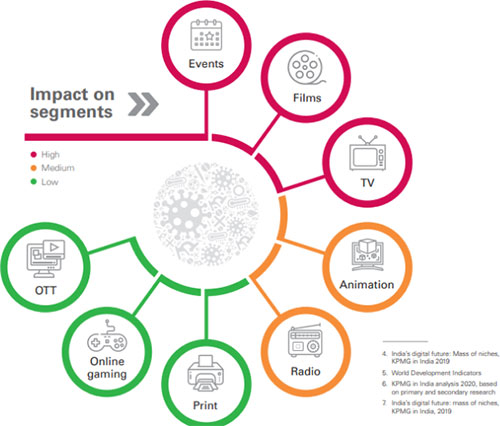
    The title “The many shades of a crisis” relates to how Covid-19 has affected the different segments in the M&E sector. The graphical presentation of their assessment (shown below) raises some doubts regarding the parameters used for making the assessment, particularly in relation to traditional media where print has been shown as having low impact against television having medium impact.


    Source: KPMG Report “COVID 19: The many shades of a crisis”


    While BARC data is showing a week-on-week increase in TV consumption, at the same time there is de-growth of advertising revenue leading to slowing down of monetisation with additional crisis of production of new content /episodes of the serials. KPMG has predicted for TV “slow ad spend recovery in medium term with long term risk due to digital competition”.

    On the other hand, KPMG has predicted “a new lease of life” for print riding on the credibility of the printed words against proliferation of fake news in social media and has advised print media to “leverage positive consumer segment and build strong digital products to capture the opportunity”. This advisory ignores the current scenario related to printing and distribution of hard copies of newspapers and the various hurdles which they may face in recovering their circulation and readership post COVID 19. It is difficult to agree with KPMG’s views that the impact of COVID 19 will be less on print than on television.


    Animation sector also has been hit severely as work from home poses a challenge to implementation of the tools and techniques which are difficult to access from home of the individual illustrators. High fixed costs and high investment costs of the animation sector clubbed with cancellation/ postponement of contracts have created a serious cash flow crisis.


    The impact on radio also has been quite high as there is a loss of listenership due to lack of travel and work from home. Many advertising campaigns on FM radio are linked with activation and events at various social gatherings which have been as badly affected as the events sector. KPMG agrees that ad spends on radio will take time to recover and assures that demand for timely localised content should remain high even after the recovery from the virus. Given the restriction on production of news content by FM radio, they can do very little to satisfy the demand for timely localised content during lockdown and after removal of lockdown.


    KPMG shows that Events and film sectors have been badly affected due to social distancing and the OTT and gaming sectors have gained riding on the additional time spent by people at home. KPMG predicts footfalls in cinemas may take a while to return to normalcy and live events may also take longer time to recover as consumers emerge gradually from the social distancing mode. Both OTT and gaming can benefit if the growth in current consumption can be converted to habitual activity.


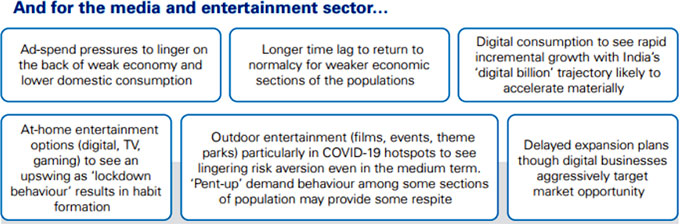
    Summing up, the KPMG report provides the following insights for the M&E sector:


    Source: KPMG Report “COVID 19: The many shades of a crisis”


    The above themes will play across the M&E value chain impacting supply chain, consumption and monetisation. KPMG apprehends that the gap between India and Bharat in consumption of various goods and services may widen due to the reverse migration from urban areas to rural areas as a result of lockdown and halt in all economic activities. Remote collaboration for creative ideation and scripting may last beyond COVID 19 altering the supply chain management of content creation permanently. Finally as far as monetisation is concerned, KPMG predicts longer timelines for ad spend recovery as the economy would continue to be under stress even after the virus is contained. The slowing down of the economy would have adverse impact on key advertisers in FMCG, auto, e-commerce etc. and they might take longer time to restore their ad spends to the level before the pandemic struck India.


  • Ogilvy partners government in war against Covid-19

    By A Correspondent


    Ogilvy India has created an anti-coronavirus campaign for the Government of India, under the title, ‘Mask Force’. It involves some of India’s cricketers talking to the nation, starting with captain Virat Kohli and concluding with Sachin Tendulkar. The lineup also includes women cricketing stars such as Harmanpreet Kaur, Smriti Mandhana and Mithali Raj.


    Speaking about the exercise, Ogilvy’s Chief Creative Officer Worldwide and Executive Chairman, India, Piyush Pandey said: “For decades now, we at Ogilvy have stepped up to stand by our country’s needs through our CSR, be it for polio eradication, literacy, fighting crimes against women and many more causes. So as soon as the Government of India approached us for our effectiveness in spreading messages to the masses, we wholeheartedly jumped in to do our bit. I believed that ‘Mask Force’ would be a likeable term that could be used to galvanise the whole country, hence decided to name this program ‘Mask Force’.”


  • 10 Takeaways from BARC India-Nielsen Media TV/Smartphone consumption given Covid-19


    By A Correspondent


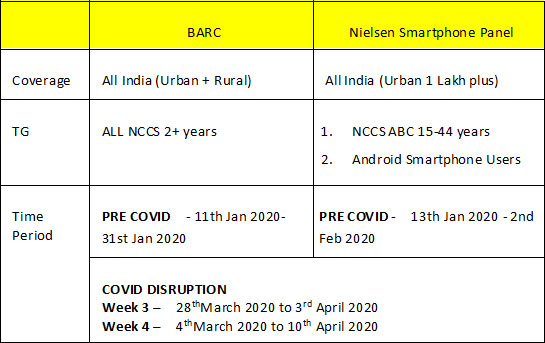
    Some four weeks back television audience measurement joint industry body BARC India and Nielsen Media unveiled the “Crisis Consumption on TV and Smartphones” series of reports with in a web-based presentation. The fourth edition of the report was presented on Thursday (April 16) and over 950 professsional from across industry were present.


    BARC India, as we know, is the official currency on television measurement in India and Nielsen Media runs a 12,000 strong smartphone panel in India passively capturing smartphone behaviour.


    Some of the key highlights of TV and Smartphone consumption during the fourth week of the 40-day National Lockdown are as follows: –

    1. COVID-19 is taking the most mind space with ~40% of top 100 Google searches last week being in COVIDand 1 in 8 consumers accessing the AAROGYA SETU app

    2. PM’s addresson Lockdown extension garnered 4 Bn viewing minutes  – the highest of the 4 addresses on COVID-19

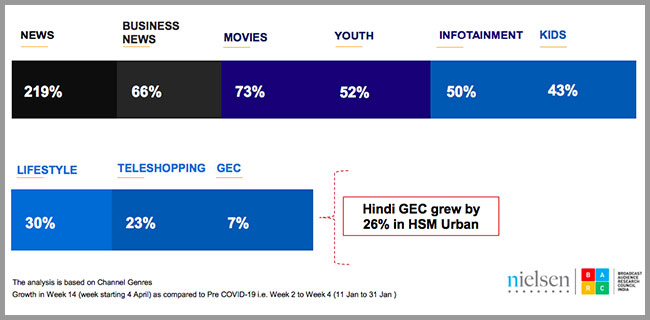
    3. TV consumptions grows 38% over pre-COVID periodnow at 2 Trillion minutes

    4. Hindi GEC attains all time High Viewership of 4 Bn since 2015 in HSM Urban this week

    5. Movies show an increase across HSM, while GEC maintains share and continues to lead in South markets

    6. Top 5 content for digital audiencesis a mix of Fiction, History, Mythology and Supernatural

    7. Premium audiences onDigital clock remarkable growth in time spent on News, Chat, Fitness and Streaming

    8. The News franchise on Digital is close to 50% now (+25% over PreCovid period) – Video News consumption shows a huge growth of 75% over the PreCovid period

    9. COVID Lockdown  gives a big fillip to Education Apps, Surge by 30%+

    10. Overall FCT on TV drops by 26% over the PreCovid period- however a 142% increaseseen in FCT for Social Ads – Digital ads also showing a slowdown in last week


    Considerations:


  • India Influence Report 2020 casts positive outlook post Covid-19

    By A Correspondent


    The influencer marketing industry is confident of rebounding once the Covid-19 lockdown is lifted in a phased manner. According to the third edition of the India Influence Report conducted by Zefmo Media, 72 percent of the respondents expressed their confidence in the revival of influencer marketing by leading brands of the country.


    In addition, the survey also revealed that average monthly influencer earning in 2019 crossed INR 5,000 (India Rupees five thousand) in India to become a viable profession for millions of people in the country. However, the outlook for 2020 remains cautious as over 95 percent influencers foresee a dip in earnings due to the Covid-19 impact on the overall industry. The survey insights are especially relevant in the current context as the industry will be grappling with viable options to regain the market once the lockdown is lifted. It also substantiates influencer marketing as a potential vocational avenue for millions of digitally connected and socially active Indians to make an earning while creating meaningful content.


    As part of this annual survey, more than 1500 influencers participated in a nationwide survey to gauge the pulse of the influencer landscape in a world that is under the shadow of lockdown due to the Coronavirus pandemic. However, 83 percent of the influencers have indicated that working from the confines of their homes will not be a constraint in creating new content and will not hinder their ability to improvise since they are not able to venture outdoors. At the same time, 92 percent of the respondents are either already innovating or plan to innovate their content creation strategy in wake of travel and public gathering restrictions across the globe. An overwhelming section of the influencers, about 77 percent have created organic Covid-19 related content in support of the nationwide fight and close to 80 percent of them plan to continue creating content to spread more awareness around the pandemic.


    Said Shudeep Majumdar, Co-founder and CEO of Zefmo Media: “In the third edition of the India Influence Report, we focussed on the influencer community, whereas the first two editions leaned towards the brands. The survey findings clearly tell us that well-thought-out, and co-created content by influencers can boost the quality of content for brands during uncertain times. With the lockdown in force and lack of other marketing channels,  influencers are confident that the brands will lean on them to deliver contextual content to keep audiences engaged amid the COVID-19 crisis. While the influencer earnings in 2020 will be impacted, more number of millennials will find their calling in influencer marketing than anywhere else in the world. This is truly democratization of independent content creation which can be commercially remunerative as well.”


    The influencers also indicated a number of challenges when it came to content creation. A majority of them, about 55 percent, find it tough to shoot and edit photos or videos in the absence of readily available professionals to do the same. Perhaps because of this, almost half of the respondents, about 49 percent are also reskilling themselves in audio and video editing among other skill-sets, thereby reducing their dependency on outsourced professionals. Erratic cellular data network and broadband speed is a major issue faced by 64 percent of the influencers; two out of three respondents citing internet connectivity as a major issue belongs to non-metro areas of the country.


    Above all, due to the lockdown, product reviews have completely stalled, but 47 percent of the influencers have indicated doing reviews of older products or doing more detailed feature reviews to sustain the connection with their followers. As brands will adjust their marketing spends to limit the outflow of cash, 73 percent of the influencers feel that brands will engage them on longer-term contracts rather than one-off paid posts, thus driving economies of scale in addition to the audience connect. In terms of technological adaptations, 58 percent of the influencers have either embarked or are currently evaluating live sessions and webinars on a periodic basis to engage with their audiences in real-time.


    The survey was able to gauge a shift in trend towards the emergence of newer genres of content creation by influencers – 64 percent of the influencers are open to trying out a new genre to keep themselves relevant in the ‘social universe’. The top-ten content genres that are likely to emerge in the current scenario include, (1) health & wellbeing, (2) food & nutrition, (3) comedy & satire, (4) do-it-yourself (DIY), (6) music & dance, (7) training & education, (8) fashion & makeup, (9) career & personal finance, and (10) motivation & mental health.


  • TBWA launches microsite for marketers

    By A Correspondent


    TBWA India has launched a microsite that brings together Covid-19 insights. It has a variety of insights and thought starters for marketers to explore how to formulate their brand strategy in these critical times.


    The microsite compiles insights from different perspectives – how consumer behaviours are changing (culture), how marketing can navigate these uncertain times (possibilities), what interesting brand actions have been taken till date (actions) and what data tells us about what people are talking about online (social listening).


    Said Govind Pandey, CEO, TBWA India: “In this crisis of uncertain proportions, we are here to help businesses see an opportunity in these disruptive times.”


    To make the microsite comprehensive, it also has two more reports. First, an analysis on the various strategies already deployed by brands in India to react to emerging consumer behaviour. Second, an analysis of the conversations on COVID-19 across India to know what’s keeping locked-down India occupied.  Also, the microsite showcases some of the disruptive creative work released by TBWA clients, both locally in India and globally during this pandemic.


    Said TBWA\India Chief Strategy Officer, Krishnan Subramanian: “It is safe to predict that these are not normal times. Coming out of this virus situation, we Indians would be fundamentally different. It is important to get on top of what new values would Indian consumers embrace to make sure that our brands remain relevant as and when the recovery happens. Our microsite intends to help you do exactly that – stay on top of shifting consumer values.”


  • Khabri launches new talk show, #VoiceOfBlinds

    By A Correspondent


    Khabri, the audio content platform in regional languages, has launched its celebrity-based talk show. Launched as a part of #VoiceofBlinds initiative by the platform amidst the current situation of lockdown in the Covid-19 pandemic, the show accentuates the need to help the blind population in the current crisis. The talk show, titled “Sachche Nayak”, will be aired every Saturday at 7 pm.


    Emphasising the need to raise awareness in the current situation, Pulkit Sharma, Co-founder & CEO, Khabri, said: “These are testing times for the nation and require all sections of the society to understand the potential threat of the pandemic and exercise utmost caution. Our new talk show Sachche Nayak will reiterate the need to stay indoors and maintain social distancing in this hour of crisis. It will provide useful information about the consequences of the current situation and how life may change for people once the crisis is finally over. In addition, the show will touch upon everyday life related discussions and conclude with a 5 minute interaction with Khabri users.”


  • Sun TV Group donates Rs 10 cr towards Covid-19 Relief Fund

    By A Correspondent


    Sun TV Network Ltd and its group companies has donated a sum of Rs 10 crores to Covid-19 relief funds. In an expression of solidarity with the nation’s collective fight against the dreaded virus, the employees of Sun TV and other affiliated Group companies numbering more than 6,000 will also contribute one day’s salary.


    Notes a communique: “The said money will be donated for several initiatives currently under way at various states of India including donations to the various programmes initiated by Government of India and state governments; partnering with NGOs that are providing succour to migrant labour displaced from their livelihoods and other initiatives related to Covid-19 relief work; financial assistance to daily wage earners, working either directly or indirectly associated with TV, movie industry and other allied activities.”