Tag: Coca-Cola

  • Coke gets real to boost drinking of ‘thanda’ in ‘thandi’

    By Rajiv Singh


    Coke’s New Year resolution, it would seem, is to go ‘crazy’ in its quest to spread happiness. The beverages major last Thursday rolled out its latest TV commercial for India, its second successive winter campaign in the country; but, for the first time, it features real-life characters.


    Conceptualized by McCann Erickson, the campaign titled ‘Crazy for Happiness’ showcases people who are committed to doing good deeds. It is an extension of Coke’s ‘Ummeed wali dhoop, sunshine waali aasha’ campaign that rolled out in December 2011, exhorting people to believe in a better tomorrow.


    The TVC has a teenage singer from Indore who has been performing stage shows across the country to collect money for treating sick children.


    She is followed by a Mumbai lad who loves stray dogs, and spends a chunk of his salary to feed over 30 dogs every day.


    Prasoon Joshi

    “Coke has always been called the Real Thing,” says Prasoon Joshi, CEO and chief creative officer of McCann World Group India. So, it’s no surprise that it has used real-life characters, he adds. “When the values of helping and being kind have taken a backseat, why not celebrate being nice to each other,” he says, explaining the theme of the campaign.


    Not only is Coke determined to make people happy, it also appears keen to improve their lives. In today’s world, people have become more insular and self-focused, says Anupama Ahluwalia, vice president, marketing, Coca-Cola India & South West Asia. “The ‘I’ has stopped caring for the ‘WE’ and doing something good for a stranger is often considered crazy,” she points out.


    But why has Coke chosen the chill of winter – the ad hit the small screen a day after New Delhi recorded its coldest day in decades – to drive home its altruistic messages? After all, traditionally it’s the onset of summer that sets the cola majors into overdrive with fresh war chests and mint-new campaigns.


    “It’s not about seasonality anymore,” contends Ms Ahluwalia. “With changing lifestyles, consumption of cola happens round the year, and we have been looking at various occasions for connecting with the consumers.” She, however, refuses to divulge the sales figures for Coke during winters.


    Marketing experts agree that the new campaign could be a deliberate attempt to de-seasonalize the brand and give it a distinct brand personality.


    While the ‘Open Happiness’ ads effectively set the stage in this context, the latest campaign infuses life into the brand by way of giving it a distinct personality, says Smitha Sarma Ranganathan, a brand communication specialist who teaches marketing management at IBS Bangalore. “After all, every brand is a story and every story needs a well-defined stage and attractive characters that come alive with every narration,” she adds.


    Analysts say typically 40% of cola consumption in India happens during summer, and the rest takes place during the festive season, starting with Diwali.


    With per capita consumption of Coca-Cola beverages in India at 12 servings a year, as compared to 403 in US, the Atlanta, Georgia-headquartered beverages maker has been trying to create occasions to push its brands and, in the process, close the gap with arch rival Pepsi, say marketing experts.


    The ‘Coke and meals campaign’, which talks about happiness around mealtimes, is one of the ways in which the brand is trying to do a Cadbury – which has its ‘kuch meetha ho jaaye’ slogan – and encourage consumption on virtually every occasion, says Subrata Chakraborty, a Delhi-based brand expert and head of ad agency Brand Curry.


    Source:The Economic Times

    Copyright © 2013, Bennett, Coleman & Co. Ltd. All Rights Reserved


  • Debrief: Coca-Cola: Tremendous insight

    By Anil Thakraney


    Coke’s new positioning for the Diwali season is: ‘Saath khao, khushiyaan badhao’. I like the consumer insight, it originates from the ancient proverb: The family that eats together stays together. And it’s most valid in the Indian context because we folks believe in the idea of the family as a single unit. Look around you at restaurants… the number of tables occupied by hanste khelte parivaars is likely to be far higher than those occupied by couples and singles.


    The TVC features a large family at the dining table. As they bond over food and Coke. It’s a very simple treatment, there are no dialogues, and typical family interactions are captured through expressions. A strict dad who won’t relent to his son’s demands. A granny with an emotional tale to tell. A disinterested kid who later begins to enjoy the family time. And so on. All the things that usually happen at a family table.


    [youtube width=”400″ height=”220″]http://www.youtube.com/watch?v=XP6sPhwmDag[/youtube]

    Good stuff, and there are many reasons why I like this approach. There are no celebrities in the ad, only regular people. The music track is very cool, it adds to the liveliness of a happy family gathering. ‘Saath khao, khushiyaan badhao’ further strengthens Coke’s ‘Open Happiness’ idea, so they haven’t gone away from that. And despite the lack of a storyline, the TVC entertains. I particularly like the last touch. A mobile phone buzzing away in a corner and no one bothers to answer it. This is family time you see, the ‘Airtel zaroori friend’ can wait! Brilliant!


    Rating: (On a scale of 1-5): 4. Cool insight backed by endearing creative

  • Suresh Balakrishna now also CEO of Lintas Outdoor

    Suresh Balakrishnan

    IPG Mediabrands has announced the appointment of Suresh Balakrishna as CEO of Lintas Initiative Outdoor. The leadership responsibilities of all the OOH businesses of IPG Mediabrands will now report to Suresh Balakrishna, with immediate effect, according to the official communique.


    Mr Balakrishna, a media veteran with over 25 years of publishing, brand building and media agency experience, had rejoined Lintas Media Group in January this year to roll out and lead BPN, the third agency network of IPG Mediabrands.


    He will be handling this assignment in addition to his current responsibilities as CEO of BPN India.


    Hemanth Shah, Managing Director of the company resigned a month ago and will be with the organisation till the end of August. His next destination is not known. He joined the company two years ago from Times OOH.


    Some of the leading OOH businesses in IPG Mediabrands include Nokia, Hindustan Unilever, Union Bank ofIndia, Coca Cola, Tata Consultancy Services, Expedia, Citibank, Monte Carlo etc.


    For the record, Lintas Initiative Outdoor has 22 offices around India.


  • Paritosh Joshi: So you want a job in the Media?

    By Paritosh Joshi


    MBA from a leading business school in the American Midwest, two years with a boutique investment bank in Boston and then this young man lands up for a chat about what he needs to do to get a job in the media.


    It is still easy to think there is a clear demarcation that sets the media apart from the rest of the world. Aamir, Ashton, Arnab and Aishwarya are in the Media. (They don’t even need surnames to identify them). Media people ‘need no introduction’. Us grunts have nothing worth introducing and thus, don’t need to be introduced.


    Or is it so simple?


    There were the Media people but they were few and readily identified as such. M J Akbar dazzled us with his insight in columns for a newspaper he edited. Rajat Sharma put people into the dock, quite literally, as he hosted a talk show. Derek O’Brien got all of us furiously scratching our heads even as he quizzed school kids. Madhuri Dixit sent testosterone levels into orbit merely by counting from 1 to 13. And Lalu had to invoke Sridevi’s cheeks in search of a universally comprehensible metaphor for Bihar’s roads.


    Then Tim Berners-Lee came along and changed everything, although for years after he thought up hypertext in an obscure corner of CERN, we would scarcely have known it.


    By the late 90s, regular blokes discovered that it was possible to find a wider audience for their periodic rants on WWW than they previously could muster around a water cooler or in a cafe. The web log, then portmanteau-ed to weblog and finally truncated to blog was born either in 1995 or 1997 (you can find an interesting history here).


    Then blogger came along in 1999, bang in the heady days of the Dotcom Boom and setting up a blog became Luddite-proof. From the very beginning, the blogging community had a wide range of interests and capability. The largest majority would create an account in an idle moment never to visit it ever again. A few would invest time and effort in their posts and endeavour to reach out to an audience with regular, engaging updates. Remember that these were people operating far away from the conventional notion, but what they were doing was indisputably publishing.


    Everyman had just stormed Fortress Media.


    It began with the written word. Soon enough, authors had found ways of adding pictures to their words. And the web was becoming more clever all the time. It was able to transport not just text but sound and video too. Also, devices to record audio and video had started to shrink in price and size even as they got massively more powerful, thus putting near professional quality sound and image acquisition within reach. Events unfolded at a rapid pace thereafter. Amazon pioneered a lightweight handheld device for reading digital publications. The Kindle was a runaway success and for the first time, books could be self-published by anyone with a good idea and capable penmanship without ever being imprinted onto the dead-tree medium. Soundcloud allowed wannabe speakers, singers and instrumentalists to distribute their art and craft without surrendering themselves to the crafty gnomes of the music industry. Youtube opened doors for every standup comic, ballerina, burlesque queen and cute kitten to show off its talents on glorious Technicolor video.


    But wait, we were talking about an investment banker contemplating a career in the media. So what’s with this long riff about what we now refer to, rather condescendingly I might add, as User Generated Content?


    Well, it wasn’t just individuals that got inspired to start using the all new powers of WWW to talk to their “Audience”. Businesses of every stripe saw the opportunity too. To be rather more honest, what they saw was consumers – happy and irate, sounding off about their brand experiences in these wide open spaces and were left with little choice but to deal, for better or worse, with what they were getting. Surely we’ve all heard the now almost apocryphal story of Coca Cola’s attempt to take down a fan page on Facebook that spectacularly backfired? To the point where they had to pretty much say ‘Let bygones be bygones and let’s be friends’? (Moral: Don’t clobber, co-opt).


    You see what’s happening here. Companies and brands were becoming broadcasters and publishers.


    At no time before in the history of our human civilization has communication across every conventional fence and barrier been so easy, inexpensive and by implication pervasive or ubiquitous. And barring the rare exception, individuals and entities find it more productive to be participants in this endless feast of reason and flow of soul than mere mute spectators. There’s even a taxonomy to describe different levels of involvement with media: Paid media are, as the name suggests, those that you have to buy access to. Earned media are where the media voluntarily carry news or content about you. Finally, owned media are, again as evidenced by the name, those that you own and control. Who doesn’t want earned and owned media?


    And what was it that we were talking about when we began this ramble? Ah, yes. A job in the media.


    I told the young man, he could stop looking. After all, every job- FMCG, Banking, Automobiles, Telecommunication, <insert randomly chosen industry name here> eventually, was going to be a job in the Media.


    Paritosh Joshi was until recently CEO, Star CJ. He has been a marketer, a mediaperson and a key officebearer on industry bodies. He is Strategic Advisor, Ormax Media. He can reached via his Twitter handle @paritoshZero


  • It’s wrong for us to say that India is slowing down: Muhtar Kent, Coca-Cola

    Muhtar Kent

    By A Correspondent


    Unfazed by the economic slowdown and talks of policy paralysis, Muhtar Kent, global chairman and CEO of beverage maker Coca-Cola, on Tuesday announced a fresh investment of $3 billion (approx Rs17,000 crore) over an  eight-year period for expanding its bottling, cooling, and distribution operations as well as accelerating its pace of growth in India.


    “Whether or not the government makes policy changes, we continue to announce investments in India,” Mr Kent said, adding that the company’s focus would be on ‘continuing to be flexible, and work with more speed than ever before’.


    “Yes, there are some issues in the world economy. But it’s wrong for us to say that India, or China, or Brazil or any emerging market is slowing down. As you go up, the oxygen gets thinner. What’s being created today at 6-7 per cent GDP is incrementally much higher than it was some years back… what’s more important is sustainable growth and not growth that can’t be controlled, ” he added.


    The $3-billion investment is over and above the $2 billion, the maker of Thums Up cola and Kinley water had announced last November. The company has invested $2billion in India since 1993, when it-entered the country.


    Mr Kent said he expects India to be among its top 5 markets soon’, up from its current No 7 ranking. “This is a realistic goal. India’s demographic, economic and social trends are all huge drivers of growth. Six years ago, we were not strong here, not at all… but India has been a remarkable turnaround story,” he said.


    The CEO, who got a pay package of $21.2 million last year, up 10 per cent from the previous year, flew down in his private jet with close family and friends on what is his first India visit as Chairman on Monday night. During his three-day India stay, he is visiting the Taj Mahal in Agra, making a flying visit to Amritsar to meet a handful of key bottlers and attending a Coke Studio concert in Delhi. Thrown in between is a town hall meeting with Coca-Cola employees, a few market visits and a visit to the beverage giant’s headquarters in Gurgaon. Unlike rival PepsiCo’s Chennai-born global CEO and Chairman Indra Nooyi who’s a frequent visitor to India – a key growth bastion for both cola majors – Turkish American Kent had not visited India since he took over the corner office at Coca-Cola’s headquarters in Atlanta in 2008.


    Coca-Cola’s portfolio in India includes aerated drinks Coke, Thums Up, Fanta, Sprite and Limca, Kinley water and Minute Maid juices. Even after two decades of being here, the beverage maker’s top-selling drink here remains Thums Up, which it acquired from Ramesh Chauhan-owned Parle Bisleri.


    But Mr Kent said the choice depended on ‘the consumer’. “We remain “constructively discontent and we believe we are just getting started. We need to make sure we provide choices to consumers… responsible choices. And help create solutions for over-nutrition and under-nutrition,” he said.


    Like most food and beverage firms worldwide, Coca-Cola too is trying to transform itself as a ‘health and nutrition-focused company’. But over three-fourths of Coca-Cola’s revenues continue to come from sugary aerated drinks . “We let the consumer decide what he wants…. and we label our products responsibly.” said Mr Kent.


    Like its American rival PepsiCo, Coca-Cola too, has been depending on India for driving double digit growth. For fiscal 2011, for example, Coca-Cola said its global volume grew 5 per cent, aided by key emerging markets such as Latin America, India and China. A consistent growth performer, Coke’s India business has been growing for the last 23 quarters, of which 17 were in double digits.


    Source: The Economic Times

    Copyright © 2012, Bennett, Coleman & Co. Ltd. All Rights Reserved


  • Ranjona Banerji: Irritating ads that irritate

    Ranjona Banerji

    By Ranjona Banerji


    Am stepping on a few toes here and other people’s territory but then wothehell. As much news as you watch on TV (or as much TV that you watch, be honest) you’re forced to watch as much advertising as content.


    And sometimes it’s fun (like Hari Sadu and naukri.com) or even the poor chappie who thinks he’s eating chicken, but it turns out to be a doggie. Or Fastrack’s funny series on the risqué side with Genelia D’Souza and Virat Kohli. Or even the Flipkart ads where children play adults.


    But what does one make of Priyanka Chopra squirming about on the ground to a song that does not match the bizarre dance she does as she tells us she hates the “chip chip”. All that happens for Garnier is that most people throw up and switch channels.


    Through the telecast of Wimbledon on Star Sports you get to hear that “amazing Thailand always amazes”. Well, duh, couldn’t they think of another word? Or has someone done Thailand tourism in?


    The Kelloggs ads with that vastly annoying mother who does something as simple as throw a few almonds on a bowl of cereal and pretends she’s invented sliced bread is anodyne as such ads normally are.


    But the winners of the most irritating ads have to be Reliance Foundation and Coca-Cola. Insensitivity seems to rule the Coca-Cola ad in which a group of not very well off (how do I say this politely?) children play cricket in some dusty desert scrub land as a voice over tells us poetically how they have no cricket bat, ball, stumps, the pavilion has no roof and so on and ends some poignant note about how this is not play but the call of the earth or something. Then Sachin Tendulkar with his strange new hairstyle drinks a Coke and says play on. The children and Tendulkar never meet and you get the feeling that the children cannot afford to drink Coca-Cola, certainly not one each.


    And there’s the Reliance Foundation. I’m not getting to the connection with the programme Satyamev Jayate. For one, the ad looks like a copy of the Vedanta ad, which claimed to be saving the lives of various village children with schools and food and making their dreams come true. The ad ran into as many problems as Vedanta does with its mining projects and the company’s attempt to redeem itself with this real or exaggerated NGO social work effort did not work.


    If indeed Nita Ambani is moving into social work, an ad that copies an already discredited ad is surely not the best vehicle. Also, the figures put up for the number of children fed or schooled or clothed is embarrassingly small for a company the size of Reliance. Even worse, Nita Ambani’s look is so carefully crafted that it looks just that. Also makes her ears look unnaturally large.


    Hidden persuasion is fine. But these are attempts at such blatant manipulation that they are not just exploitative, they may not even work.


    For those interested in advertising and how it works, try and catch The Gruen Transfer on the Australia Network or Youtube. Hosted by Australian comic Will Anderson, it is funny, incisive, intelligent and hard-hitting. And did I say funny?


    All right, I’ll watch the news from tomorrow.


  • It’s A Real Aha Moment for Grand Prix Winner Mak

    By Delshad Irani


    He is perhaps one of the busiest persons at the 59th Cannes Lions International Festival of Creativity. No, it’s not Sir Martin Sorrell. He’s chatty we were told. But more importantly he’s creative. It’s Jonathan Mak, a twenty-year-old Hong-Kong based communication design student. Mr Mak is an ad aberration. At his age he took one of the most iconic images of our time and turned it, not just into a tribute to a man he admires and a global viral hit, but also an example of great design and what it can achieve.


    If that isn’t enough to make you feel like an under achieving member of the human race, or at least the advertising race, the following might just hit the spot. He won a Grand Prix, the highest accolade at Cannes , for the work he did for Coca-Cola and Ogilvy & Mather Shanghai. A poster that is, quite literally, a visual translation of the brief he was presented with – sharing a coke. The silhouette titled ‘Coke Hands’ is on a red background, and it’s, simply put, two ribbons of white combining to create the illusion of two hands sharing a coke. Asked to fly in on short notice, Mr Mak arrived just in time to pick up his award as thousands of advertising professionals from across the world cheered for him.


    However, this former teenager is no stranger to the limelight and looked like a seasoned adman. He can’t describe the process of creation, he’ll tell you, “It’s always tricky to explain a minimalist design.” The Steve Jobs image has similar design aesthetics to Coke’s poster, yes. But Mr Mak says it is an iconic image and he put a twist on it: “I always try to give viewers a real ‘aha’ moment.”


    Not a big fan of people typecasting his work, he says, “It’s not like Coke asked me to do something similar.”


    Source: The Economic Times

    Copyright © 2012, Bennett, Coleman & Co. Ltd. All Rights Reserved


  • Debrief: Coca-Cola: Zero Freshness

    By Anil Thakraney


    Interestingly, there’s a new commercial on air from Coke, and it’s based on cricket. A bit strange that, because summer’s coming to an end and the IPL is done and dusted.


    Anyway, the TVC features some rural kids playing the game in extremely hot, dusty and inhuman conditions. It looks like a desert. They seem to be enjoying themselves all the same, since the kids are passionate about the game, like everyone else is in this country. And that passion is what Coke wants to ride on. However, all of a sudden, towards the end of the commercial, Rajya Sabha MP designate, Shri Sachin Tendulkar, appears on the screen. He ‘opens happiness’ and happily gulps it down.


    I have two huge problems with this one. For one, cricket has been heavily flogged in Indian advertising, and for the game to carry any further appeal, the execution has to be seriously fresh. We are done with watching kids play street cricket, surely that’s become ultra boring in circa 2012. So on this count, the TVC fails miserably, despite a good voice-over and a decent script.


    Secondly, Sachin looks like a cut-paste job in the film, an after-thought. Would it not have been a little nice if the hero lands up in those hot conditions and offers the poor kids some Coke? That would not have injected any freshness to the commercial, but it would have brought in some warmth at least. Currently, it looks like the kids are living a life of hell, and the Rajya Sabha MP designate is chilling inside an air conditioned studio. This kinda puts you off.


    Rating: (On a scale of 1 to 5): 1. Thakela idea. And it makes Sachin look bad. 


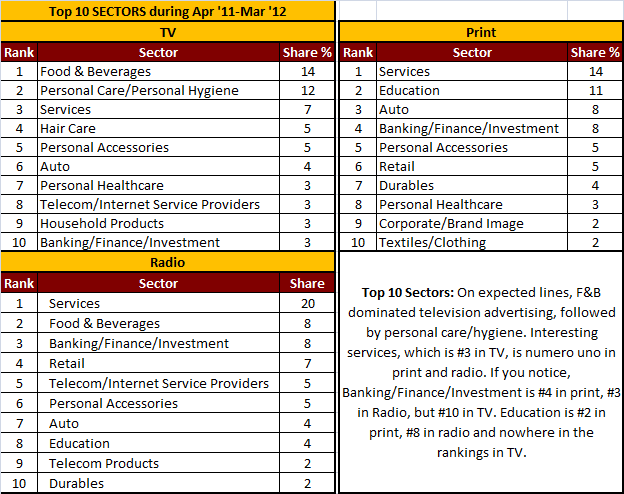
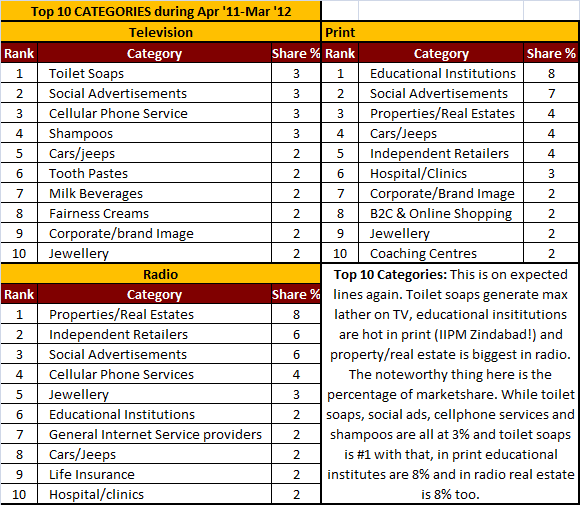
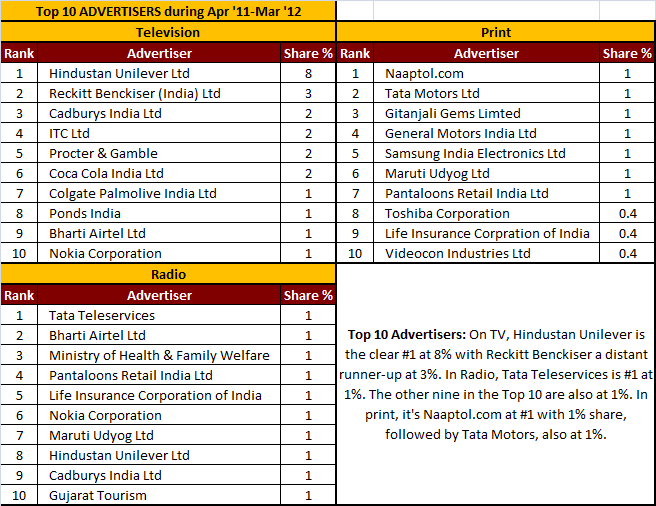
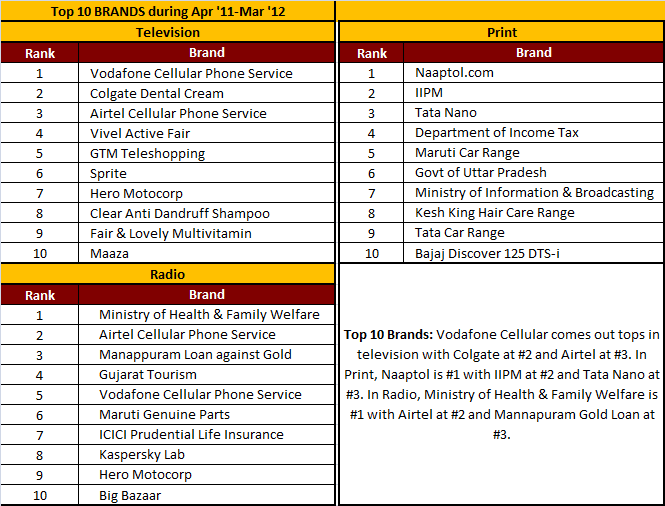
  • AdEx 2011-12: Print grows 14%, TV 11%, Radio 0%


    By A Correspondent


    This is perhaps the shortest Big Story you’ve read in the eight-month existence of MxMIndia. But then more than words, it’s numbers that have got to do to the talking.


    MxMIndia requested TAM Media Research which painstakingly computes data for ad volumes for the television, print and radio sectors. The growth figures are indicative of how these are doing: print isn’t down and out yet with 14%, TV is growing but it’s not as dramatic as we thought it would and Radio hasn’t degrown. In fact we must urge radio practitioners to interpret the 0% in a positive way because there were enough naysayers willing to rubbish the potential of the business.


    Note: the analysis is based on ad , that is duration in seconds/CCMs and excludes promos.


  • Info explosion has made India smarter: ‘New Realities 3.0’ study

    By Robin Thomas

    The Interpublic  Group (IPG), one of the world’s premier advertising and marketing services companies, has come out with its global ‘New Realities 3.0’ study that provides a unique window into how the Indian consumer is coping with information overload. The study provides insights on the decision-making process of the consumer in today’s era of information explosion. The study also aims to answer the unanswered queries of marketers on whether the information explosion has made consumers smarter or confused, the role of social media in a making consumers more informed, the role of brand advocates and much more.


    The study covered five countries namely, India, China, Brazil, America (US) and Germany. The India leg of the interview was conducted by Draftfcb Ulka’s independent consulting agency, Cogito Consulting. Over 600 online interviews were conducted in each of the five countries between October 26 and November 10, 2011. Some of the findings from the ‘New Realities 3.0’ study reveal that most Indian consumers feel they have grown smarter with the available product information, which is higher than the other countries. Further, the study notes that consumers in India rated a reasonable 7.3/10 when asked whether the available product information made them feel smarter compared to China that showed a rating of just 3.9/10, the US at 6.8/10, Brazil at 6.4/10 and Germany reporting 7.0/10.


    Interestingly, despite consumers in India claiming to feel smarter and not confused or frustrated with the product information available to them, they do not trust the information they see on brands, especially from the manufacturers end. Further, 32 per cent of Indian consumers say they do not trust most of the information they see on brands, whereas 31 per cent say they do not trust information from manufacturers or providers.


    The trust deficit that brands have among Indian consumers is higher than the other four countries, for instance only 11 per cent of Germans say they do not trust any information from brands whereas 22 per cent say they do not trust information from manufacturers or providers. Even Chinese consumers seem to trust information from brands and manufactures as compared to the Indian consumers. 19 per cent of Chinese say they do not trust information from brands whereas 24 per cent Chinese do not trust information from manufacturers or providers. 16 per cent of those interviewed in the US say they do not trust information from brands whereas 15 per cent do not trust information from manufacturers.


    Another interesting finding is that with the exception of Germany, the remaining four countries interviewed – India, China, Brazil and United States have said that product learning is a source of joy and fulfillment. 54 per cent of Indians have said that they enjoy researching the information for buying decision whereas 52 per cent of them say they find the information on brands fulfilling.


    Terry D. Peigh

    The findings have also revealed that most Indians learn product information to build an expertise about a certain product and brand as well as because it helps them stand out in their social circle. 53 per cent of Indians said that the reason they stay informed about certain products is because ‘people value me and my knowledge about certain products’, whereas 52 per cent of them said it helps them enhance their self-esteem.


    In addition to these, the study also revealed that consumers in India and China are most likely to turn into brand advocates and become a media channel and that in India, Brazil and China, especially, social networking sites are a good source for word of mouth information on brand experience.


    As vague and unique as it sounds, MxM India’s Robin Thomas got Mr Terry D. Peigh, Managing Director and Senior Vice President, IPG to relay more outcomes from the study, the role of social networking sites in decision-making capabilities and much more.


    New Realities… is an online study across multiple countries, including India. What is the sample size that was chosen for this study? Who are the respondents i.e. the TG for this study?

    We interviewed 600 people in each country i.e. in India, China, Brazil, United States and Germany. Out of the 600 people sampled, one-third were Gen X, one-third were Gen Y and one-third were boomers. 50 per cent of those polled were men and 50 per cent women.


    What was the key objective of the study? What, according to you, are the learnings for the Indian market, as well as the global market?

    The key objective was to better understand how the consumer has changed because of the new media. We came across the idea years ago as we noticed that the number of information sources available to consumers today has grown exponentially. So we found out if people were confused, frustrated, overwhelmed, and how are consumers viewing the overall experience of absorbing product information and using that information.


    We learnt that consumers have evolved over the years and hence they are not confused or frustrated with the information explosion. Consumers have not only learnt to easily filter or absorb the information but, they have also learnt how to manoeuvre their way through all the multiple choices of product information available to them.


    We have also learnt that surprising number of consumers, especially from India, are now very open, willing and eager to learn about product information as they find a lot of joy and satisfaction in learning about product information. In fact, our research also shows that people in India are most likely to really enjoy research and product information.


    One of the reasons why many in India are willing or open to product information is because they find it of social value as it allows them to have an expertise in certain products. We have also learnt that consumers are aggressively willing to become advocates of brand. Our research also shows that they are now interested in continuing to learn about a product even after they have purchased a product as they want to learn more about the product and advance their knowledge about that product.


    What this reveals is that communication should not stop at the time of sale and that marketers must continue to talk to their consumers even after they have purchased the product. As a result marketers may convert their consumers to brand advocates.


    The study reveals that Information explosion in India has led consumers to become smarter and helped them beat the system – much higher than what the other countries have reported. What are some of the factors that influence the consumer’s decision-making process around a product?

    We see a dominant role of family and friends in a consumers’ decision-making process. Although social media is still small, its role as a channel is growing, but too often social networking sites are limited to ‘likes’ or number of friends which is wrong. It’s too easy to get someone to push the like button or accept a friend request, even though they may really not like the brand or want to be their friend. A research from Australia finds that less than one per cent of friends are actively engaged and want to be truly engaged to the brand. So we keep encouraging our clients to go beyond ‘friends’ or ‘likes’ on a social networking page but, instead seek true engagement.


    As India becomes more tech-savvy, do you anticipate further information explosion to come about that could lead to further increase or decline in consumers who are confused or frustrated with the information?

    We were, in fact, surprised that the confusion or frustration numbers were not higher. My projection, however, is that it (frustration and confusion) will not go up as consumers have learnt the role of technology very quickly. Technology is fast reaching to the lowest common denominator very quickly so, I think people are learning to process information very quickly.


    Will there be a Phase II of the ‘New Realities 3.0’ study?

    Yes. We will soon be out with the second phase of the study in another 18 or 20 months, which will help us understand more trends. In China, for instance, during Phase I and II we have seen dramatic changes in over 18 months. We found that the Chinese were much more inclined to use the internet for product research. In China, the internet was used primarily for entertainment purposes, now it’s used for product information.


    Not surprisingly, consumers in India do not trust brand information especially from the manufacturers. This is not so with other countries, particularly Germany, US and China. How would you explain this? What must brands / marketers in India do to build the trust deficit among their consumers?

    I believe it is because of the newness of the consumer culture in India. In the US, for instance, there has been a mass market of consumer culture for 100 years and the same in Western Europe. I think consumers need to develop trust for their products. Brands must not be afraid to enter into the world of social media and hearing negative comments about one’s brand. There is probably no quicker way to gain trust with the consumer than to actually legitimately and honestly respond to criticism and fix the problem. This, I believe, is one way for brands to gain trust of the consumers.


    With the exception of Germany all other countries seem to enjoy product learning. What makes the consumers in Germany not really enjoy product learning?

    Yes, German people usually do not associate joy from product information. The Germans usually get their joy from music and food


    How has social media changed consumers’ decision-making across the globe? What role do you see social networking sites play in the near future in India?

    The role of social networking sites as a tool for brand advocates will increase. One thing we have noticed in the western world is that the number of people visiting brand pages on social networking sites is on a decline in Europe. This is not the case in India. In the western world a lot of consumers say that they do not visit Facebook for brands, but for friends therefore, it will be interesting to see if it will be any different in the developing economies. Nevertheless brands like Coca-Cola have leveraged social media well by finding ways to reach out to the consumers by engaging in a good conversation and get them to participate in brand activities. Right now the data shows consumers are willing and eager to visit social media to learn about products or brands.


    Even though broadband penetration is still low in India as compared to the US, why are consumers in the US and Germany reluctant in using social media for product research?

    This may be because brands that first started using the social media didn’t do a good job in engaging the consumers. The consumers may have clicked ‘like’ or may have become friends but, the brand may not have received anything else. Brands must, therefore, learn to go beyond the ‘likes’ and adding of friends to adding value in a consumer’s life as the consumer is not accessing social networking sites for brands but for something else. Therefore, in order to leverage the social media, brands need to operate in a different way. Increasingly, many brands are beginning to use social media effectively to engage with their consumers.


    How do you plan to reach the brands or marketers with the study? What can brands or marketers expect from the study?

    This study is important for clients because it is consumer based, is fresh, is in-depth, is broad, it looks at many different segments by product category, by demographic and it is the consumer telling us what he or she is thinking about.

     

  • Goafest 2012: Creativity plus content, the Coca-Cola way

    By A Correspondent


    Speaking about creativity at Goafest, Mr Jonathan Mildenhall gave a ten point plan on creativity plus content which included key points like ‘evolving creative agenda’, ‘case for change’ and ‘the evolution of storytelling’.


    Mr Mildenhall illustrated how Coca-Cola moved from creative excellence to content excellence and the way they created popular culture – which is very important in building a brand – through conversation. Highlighting the three key drivers in the ‘case for change’, Mr Mildenhall said that distribution of technology plays a key role in the growth of a brand. Citing the example of the Vodafone zoozoos, he was of the view that technology enables creativity and hence a brand must have a direct relationship with the technology company.


    He also explained how a brand must encourage its consumers to express their stories because there is a need to move to dynamic storytelling. He said that brands need to converse, and not just listen to the consumers, and thereby create an inspiration provocation.


    Mr Mildenhall felt that a brand’s story should connect with the consumers as there is a need for more collaborative, adaptive and connected content. He explained in detail about how a brand need to understand how to use research to expand its ideas to the creative best and the importance of brands to iterate and not just replicate content.


    During the Q&A session, moderated by Mr Sanjay Behl, CEO Reliance Digital, when Mr Mildenhall was asked on the consequences of negative conversation on brands and the dramatically changing role of marketers in the road ahead, he said:’It depends on how we are creating conversation content that users are generating. If brands inspire good conversation, it will no doubt benefit the brand because I believe that eventually good wins over evil but, brands have to be a lot more open or transparent in their conversation and relation with their consumers.”


    Click here to view all Goafest 2012 stories


  • Goafest 2012: ‘Need for old & wise to guide youth’

    By A Correspondent


    Keeping in line with the theme, ‘Ideas that impact the full circle’, a panel discussion moderated by Anuradha Sengupta, Features Editor, CNBC TV18 and including panelists like Tim Love, CEO, APIMA, Vice Chairman, Omnicom Group; Jonathan Mildenhall, VP, Global Advertising Strategy and Creative Excellence, Coca-Cola; Jayant Murty, Director of Strategy, Media and Integrated Marketing, Asia Pacific Region, Intel Corp and Jean-Yves Naouri, COO, Publicis Group discussed the need to present their agencies differently; the loss of long-term relations between the clients and the agencies and the need for multiple agencies to build a brand.


    Tim Love observed that advertising is actually an education and noted that while the advertising industry is all about ideas and thus need young rebellious minds, there is also a need for the old and the wise to guide and direct the youth.


    Jean-Yves Naouri, on the other hand, insisted that creative agencies are here to respond to business and gain the trust, mind and presence in their client’s life. “Keep the dialogue between brand and consumer alive. Engage consumers as there will be people who will be inspired by the brands and this is what matters the most.”


    Speaking on the agency-client relationship, Jonathan Mildenhall said that it is easy to maintain one relationship better that ten different ones, and therefore he would reluctantly look outside his roster agencies for creativity. However, he felt that brands may scout for multiple creative agencies if they find the need for specialist agencies that could help them reach out to their clients more effectively. He was also quick to point that although digital is showing robust growth in India, it needs to boost its creativity in this space. “Majority of UK spends on digital, however the internet reality is bigger than the creative ambition in India.”


    Click here to view all Goafest 2012 stories