Tag: big story

  • A wishlist of improbables and imponderables for 2013


    By Ranjona Banerji


    1. Less interference on the newsroom floor by the management (please give me a moment to recover from that fit of exhausting laughter).


    2. Editors who have the courage to stand up to owners and marketing departments (I am now in cardiac arrest).


    3. Journalists who are less interested in personal aggrandizement and more in getting the facts and presenting a good story (giggling is occasionally good for the central nervous system).


    4. Television journalists getting a crash course on what the profession means and what it’s supposed to do (not holding my breath because that could cause pulmonary failure).


    5. Some greater knowledge of the English language in English language newspapers (have failed to wipe the smirk off my face).


    6. Am not even wandering into better English on television (thus protecting my sanity).


    7. At least one evening where TV discussions do not degenerate into a verbal version of WWE. At least the wrestlers’ bodies are more buff (well, one can hope).


    8. Newspapers that effectively separate paid or sponsored news from real stories so as not to fool the reader (am wiping a tear from my left eye).


    9. Women’s magazines that refuse to reduce themselves to brochures for various beauty, lifestyle and glamour products (oh wait, now who’ll tell me which lipstick to buy?).


    10. Glamour and lifestyle supplements in newspapers who remember there was a time when “features” did not mean what PR companies tell you to do (I know, your sides are splitting).


    11. A little bit of bitchiness to be re-injected into film journalism (rubbing my hands with glee).


    12. For those in charge of book review sections in newspapers to have read at least one book (of course, this means they have to be able to read…)


    13. Some semi-wise employed senior journalist to understand how the social media is influencing public discourse (meet me on Twitter and I’ll tell you more…).


    14. That at least a few journalists in newspapers are over the age of 13 (I know, no HR department in the country will agree with me but then, they never have).


    15. Stop HR departments from recruiting journalists (especially from bogus journalism courses).


    16. No more bogus journalism courses (damn, there goes a fine lecturing opportunity).


    17. A ban on the following expressions: “wee hours of the morning” unless it refers to dawn micturition, “lesser”, unless you are comparing qualities not quantities (am sorry to use so many big words), confusing “loose” with “lose” where in one case your pants fall off because the elastic has lost its tenacity and in the other you have misplaced your pants altogether (and you are in the altogether), “miniscule” when you mean “minuscule” (and now I give up).


    18. Everyone should own a dictionary (preferably not one provided by Microsoft).


    19. No more Wikipedia as a source (what! Did I really just say that?!).


    20. More media gaffes and goofs so I can remain employed (heh heh heh).


  • New year, new job scene?


    By Tuhina Anand


    We know that 2012 was not a great year as far as the job market was concerned, hence a general sense of uncertainty prevailed. That holds true for those in the creative business too. However, the year did see some movement of key leaders of an agency to another, and hence it was not really devoid of any such hype that surrounds when a biggie moves from one agency to another. Year 2013 is also being touted as a year where caution will be the mantra, thus job opportunities will be available but not in abundance, and hiring will be done after much consideration.


    Understanding the current scenario, we at mxmindia decided to talk to few creative people who made the transition from one agency to another last year and understand how easy or difficult that transition was for them. Also we try to take a peek and understand some rules that would help those looking at a transition in the year 2013 and what would be few key attributes that would help them in making a smooth shift and adapting to a new environment. Besides, we also try to understand that while everyone is lamenting the lack of jobs available in the market, what really made these professionals make that leap and make them a desirable candidate in such a gloomy job environment.


    Bobby Pawar

    At the start of the year in 2012, Bobby Pawar took reins as the Chief Creative Officer and Managing Partner of JWT India. He was moving from a biggie Mudra which was undergoing a transition to another biggie thus there was speculation galore. He was in fact welcomed by his ex-agency on his first day at work at JWT thus making some wonder whether Mudra was so very happy to bid goodbye to Mr Pawar.


    However for Mr Pawar, his agenda was clear. He had come on board with a vision to raise the bar at JWT and bring in few changes that would help him to that. Along with Colvyn Harris, Mr Pawar went on executing his plan. Talking about the transition, Mr Pawar said, “Understanding and adapting to a new place takes time. It is about understanding how much are you willing to push boundaries in a new set up as you are still getting to know the people you get to work with and understanding the culture of the place. However, at a senior level, if you have come on board that is with a view to bring in few changes and that is a challenge as to when, how and to what extent are you going to bring about that change without bringing a disruption among the existing talent pool.”


    He said, “One has to learn to be patient in adapting to a new place. While I might like to take out a pen and start doing my own things to expedite results but that should not be the case as it will deter others working with you. It’s a fine balance that one has to maintain. Understanding the new clients and their issues too requires patience. I think one has to be absolutely clear as to what one wants to do when one makes a shift. There is no scope for half measures to go ahead in your career, that’s just not done.”


    Sanjay Thapar

    Another shift that got the media buzzing was of Sanjay Thapar moving from Ogilvy to Bates India as its CEO. For Mr Thapar, the move is significant not because of the lofty designation he acquired but because of the task ahead at Bates. Beset with issues where the agency saw many of its senior resources move out, the task for Mr Thapar clearly is to catapult the agency to the big league. On the move, Mr Thapar said, “Both Bates and Ogilvy are from WPP so there is culture that runs common. Having said that, if you ask me if it is as good or bad as I had expected, let me say that the job has just begun. But one thing is clear that in terms of opportunity there is immense potential.”


    He says that when one is looking for a change it clearly has to do with the individual’s aspiration and what he or she wants to do ahead in life with respect to his or her job. For those looking for a change in 2013, Mr Thapar suggests that one has to keep in mind that when one moves to a new place consider starting from ground zero, so basically start from the scratch and second attribute that’s necessary is to have an ability to take quick decisions and make them work.


    Manoj Kandoth, Chief Consultant at Urjja which is a human resources and business consulting company and does lot of hiring for the agency points that while job scene was conservative in 2012, he seems to be bullish about 2013 especially in the telecom and FMCG sector. He points that telecom has seen a robust growth which then also reflects on the ad spends thereby also in the way hiring is done by agencies to service this sector. He said, “When making a shift, one should not think of the size of the agency but clearly the portfolio of clients that one gets to handle at the new job.” There has been rise on the spends on the digital media hence one will see a demand for professionals who understand and cater to this medium.


    Rana Barua

    While we have seen the adaptability issues when one moves from one agency to another, what really happens when one moves from a different media to advertising? Rana Barua who joined as the COO of Law & Kenneth from the radio industry, said, “For me it was coming back to advertising after spending few years at a different medium. Still, I would say that it does take almost a month to get into the groove. But I see the move as a positive comeback where I have acquired a multi-dimensional experience and been on the other side thus coming with a different perspective.”


    He said, “At a new place one has to be open minded and be ready to embrace the new culture besides try to value add to the new organization every single day however small that addition may be.”


    Interestingly he points that in today’s time advertising needs people who are multi-dimensional hence a person who cannot just think TVC but print and be a digital expert too. So according to him while the job scene will continue to tight in 2013 but there will be demand for such multi-talented people. The classical strait-jacketed people might find it difficult to make a switch only because the way talent is being looked upon now is different.


    So the year might look tough but not for those who are willing to take risks. As Mr Pawar of JWT rightly said, “I might have the visiting card with a designation that looks impressive but unless I demonstrate how I can make things happen, nobody will take my visiting card seriously.”


    So the year may be tough but not for those who are willing to push boundaries and show that they are made of tougher stuff. If you demonstrate that then a job switch might just seem like the easiest issue in 2013.


  • Lookback 2012: Voices from the Top


    By Ritu Midha


    In the action-packed year that went by, with the political cauldron boiling and the economy on a sliding spree, media and marketing were not spared the impact of events and consequences. Ritu Midha touched base with a few media, marketing and advertising leaders, who shared with MxMIndia their key takeaways/learnings from the year 2012.


    Anupriya Acharya, Leader, Client Leadership, South Asia, Mindshare Fulcrum

    I was looking to move back to India, and getting an opportunity in Feb 2012 to lead Unilever for South Asia was both exciting and challenging. Coupled with the fact that the year was also one of global review on the account. Successful retaining of the account in South Asia and globally has been a great learning experience and a delightful milestone. On the back of disproportionate effort, it was also a year of record-breaking performance for Unilever media across Goafest, Emvies, Spikes!


    Geetanjali Bhattacharji, CEO, SA2, Spatial Access

    A single window that delivers trends, benchmarks, consumption and insights across all marketing investments is a must. Over the past seven years of working with marketer data, the volume of data we’ve encountered in the BTL space has been staggering: TVC production costs of hundreds of commercials across animatics, post-production, transfers, talent & royalties; Event & activation deliveries, resources & validation metrics; Print production technical specification standards, logistics, cost & compliance data; Vendor networks, spread, terms of engagement, selection criteria & rates; PR data expressed in terms of media-relevance, tone of content, share of voice & semantics. I’ve come to believe there is a huge opportunity in unbundling and analyzing collectively all these data points. 2012 has been a year of addressing these data integration challenges in marketing services. 2013 will be the year of minting the success of this labour with the launch of SA MINT – Spatial Access’ Marketing INvestment Tracker, an online access tool that will integrate all marketing services data into a single dashboard to deliver trends, benchmarks, consumption and much more!


    Conquering the enigma of tracking marketing investments has been my largest challenge in 2012 – one that has been well worth it!



    Harish Bijoor, Brand-expert & CEO, Harish Bijoor Consults Inc

    My most notable learning in 2012: ‘Get inclusive, or get excluded!’


    In everything you do or think, involve every one of the constituents of larger society. Don’t think for yourself. Don’t think only for your client. Think of the end consumer all the while. Think of the non-consumer even. Think exclusive. Or run the risk of getting excluded in the long run.


    Hoshiedar Ghaswalla, CEO, Cybermedia

    As I moved into a new position at Cybermedia, it has been an year of tremendous unlearning and learning for me. In the B2B space it is very important to deliver value – if you make a difference to your subscribers’/consumers’ life, you move a few notches higher. Aiming for that is exciting and challenging and demands excellence and zero error. We aimed for superlative work – and have attained it in the last quarter – and would like to make it even better.


    RoI has become more important than ever before. And for a publisher, more so in B2B space RoI needs to be measured not only in terms of advertising revenue – but also consumer/subscriber involvement.


    Ajay Kaul, CEO, Jubilant Foodworks Ltd

    When the market is going through a bit of a downturn or sentiment is a bit sluggish, it’s the best time to increase investment on the brand, and also the people brand. It may sound counterintuitive, as one would try to manage costs, but the pay-offs are great in the long run.



    Shripad Kulkarni, CEO, Allied Media Network

    2012 was our year to get ready to storm in the Top 3 Media AORs of India. This turned out to be a bigger challenge than what we had planned for. The sudden slowdown triggered by the international economic scenario manifested in a unique way for us.


    Our market situation: While it was a challenge for the industry, for us it was a unique speedbreaker. For the first five years of existence, Percept’s Allied Media grew @ 40 percent each year. We have been rated in the Top 5 consistently for three years in the Brand Equity Study. That’s because we have matched the best in class in Buying and Implementation and more than matched them in 360 marcom services.


    Our planned thrust for 2012: Our thrust was clearly in strategic tools. We had committed to the World Class M3 Model of Pointlogic, Netherlands. M3 is a Simulation tool based on product category specific consumer Research. It Optimses Message and Media Combination for maximum market share preference. M3 meant big investment in time and monies.


    The challenge: The challenge for us was to stick to our plan of investing heavily in strategic tool M3 despite the slowdown!


    How we overcame the challenge: We dug in our heels and stuck to our investment plan. The third quarter proved especially lucky with a Rs 150 crore win through various accounts like DB Reality, Sahara Q, Just Dial, Italy Tourism, Baskin Robbins and DSK Hyosung.


    What 2012 means to us: It means we are now ready for a full-throttle storming into the big league of Top 3 AORs in India !



    Rohit Ohri, Chairman, Dentsu India

    “Trying times will not drag you down if you treat them as doorways to new beginnings.”


    2012 has been a challenging time for me professionally. Rebuilding an organization is always a hard task. Fortunately, thanks to all the hard work put in by my great team and the support of our fantastic clients, 2012 has become a rock-solid foundation for the Dentsu India Group. 2013 will be the year in which we will walk through those new doorways and show the world the Dentsu Way.



    MG Parmeswaran, ED & CEO, Draft FCB Ulka

    We have been hearing that digital age is coming, digital will destroy television, print, magazines, and so on, for the last five years. Due to poor broadband and poor 3G this has not yet happened. But we did see a strong signal of digital emerging out of the woodwork in 2012. Television is still very powerful, but digital is becoming more important and the likes of Google, Facebook and YouTube are straining at their leash to push their agenda. I think marketers today have an opportunity of using the cost-effective, humungous power of television to build brands in India. This window will disappear in the next five years, as the SEC A / B consumer start consuming content on their mobiles and tablets. So in a sense this is the diluted era of Chitrahaar, Chhayageet and Ramayan once again. Brands like Nirma and Vicco got built during that era. Today you don’t get 25 percent GRP, but you can get to 4 to 6 percent of C&S homes through several GEC channel programmes, and importantly television advertising rates in India are among the lowest, if we are to look at a CPT metric. Instead of paying for brands astronomical multiples, I would spend the money building brand salience using television. That is a big learning from 2012.



    Josy Paul, Chairman and National Creative Director, BBDO India

    This was the year of celebrity deaths. Lots of well known personalities died in 2012. The news, nostalgia and content of these deaths may have overpowered the sound of advertising.


    Ideas that integrate with society and social issues seem to have gained greater connect with consumers. Brands are going beyond just selling and are now building something. We are in the business of ideas for life, not just advertising.


    The buzz of Facebook and YouTube is one way to measure the popularity of a campaign or film. Our touching film for Visa Debit – showing a teacher creating light for his village in the upper reaches of Kashmir – was an instant hit on YouTube. More than a million hits in less than two weeks. Looks like, if it’s shareable it’s air-able.



    Mayank Shah, Parle Products

    The year taught us to look at value from the consumers’ perspective and not from marketers’ perspective as we did till date. It is true of all the marketers involved in food marketing in some way or the other. To give you a simple example, earlier in case of an increase in product cost for marketers due to reasons like raw material going expensive or increased taxes etc, a part of the price increase was passed to the consumer. As marketers we thought, we were sharing only a part of the increased cost, and the consumer should be happy. But if you look at it from the consumers’ perspective, it is a price rise anyway. True value to the consumer is when there is no price hike despite increased input cost. Of course, marketers have to find out alternate strategies to take care of their top line and bottom line. And that has been the key challenge for the marketers this year.


    Arunabh Das Sharma, President, BCCL

    My key learning from 2012 is that the overall advertising pie is just not growing fast enough. Everybody is fighting for a share of the same pie and I do not think that many people are looking for ways to increase the pie. My second big learning is that the traditional ways of selling advertising space is going to get tougher and tougher. And I think media houses, owners, media agencies and advertisers will have to come together to see a model that puts the way forward for greater investment in the industry. Because that is the biggest challenge that the industry is facing.



    Jaideep Shergill, CEO at Hanmer MSL

    Learnings from 2012: The key takeaways from the year this year are:


    • Unidirectional messaging is passé. It’s the age of dialogue with your stakeholders – multiple conversations on multiple platforms.
    • Public relations is now a strategic service, critical to the brand and not restricted to media relations.
    • Asia – with China and India leading the charge – will provide virtually all the growth for the global public relations industry.
    • Tough economic times underscore the value of public relations. It is more cost effective and delivers better results than advertising.
    • Talent is a make or break issue. Talented people no longer want to know what they are doing in their jobs, but why they are doing it. Hence, businesses’ social objectives will play a key role in attracting talent.
    • Social media is no longer an either/or option for your communications strategy; it’s a must.
    • Clients are increasingly demanding integrated communications services from their agencies.

     

    Harish Shriyan, COO, OMD

    A noteworthy observation from 2012 is the manner in which technology has infiltrated our lives. Technology is seeping into our lives by the minute, and today it is a multifaceted engagement. The impact of technology in media, marketing and entire world around it is manifold. Whether it is in terms of creating content, offering value to the viewers through HD technology, providing news and entertainment across platforms ie mobile, iPads along with addictive apps, etc. or marketers reaching out to their customers through better distribution mode etc.


    This explosion of these relatively new media platforms is changing the rules of engagement. The perks of this engagement is it allows specific targeting, and leveraging the medium as an interactive platform. Once a critical mass is reached via mass media, the business of specialization comes into play. Agencies too have improvised and are offering specialized services. More advertisers are seeking new platforms, alternate mediums, new ideas & insights, fresh thinking on their brands to reach out to their customers.


    Tier 2 and 3 cities have gained significant importance and will become the next big consumption hub. As the rules of engagement change and evolve, advertisers need to talk to these consumers on more 1-on-1 platforms in both local language and nuance; and media agencies need to provide customized and tailor made solutions.



    Man Jit Singh, President, Indian Broadcasting Foundation and CEO, Multi Screen Media

    The biggest set of takeaways is that when the industry comes together and when the ministry (MIB) comes together with the industry, we can achieve significant things. Digitization has been a collective effort of four stakeholders: broadcasters, MSOs, LCOs, and certainly, MIB. The Ministry has been instrumental in bringing about digitization, which is a huge achievement. And this is a big takeaway – when we all work together and make compromises to make something successful, we will succeed.


    The second thing that governed this year is the whole issue of self-regulation. By setting up an independent commission by Justice Shah, I think we proved that the industry can take an initiative and can actually regulate itself successfully by addressing complaints and resolving them.


    Jasmin Sohrabji, CEO, Omnicom Media Group

    Another year done and dusted! And while many of us will reminisce the new opportunities 2012 brought us, the new platforms, the distribution changes etcetera and so forth, some age old questions still remain a challenge. How do we divvy up the pie? We live in evolving times, and I am just as excited as the next planner about the multiple ways to not just reach out but engage with our customers. Two decades ago we asked ourselves how much TV do I introduce to my primarily print plan? Later, it was how much C&S to my TV plan? The questions were not so deep with regard to some of the lesser used mediums. Then came digital. Not satisfied with its insignificant presence among the ‘other’ media, the medium is proliferating and taking over our lives like never before. So now the obvious question…how much digital? As the ad pie threatens to remain stubbornly flat, or with more realistic single digit growth in the years to come, it will be both challenging and interesting to see a third medium demanding not just our attention in engaging the consumer, but finding critical budgets. Like we often ask ourselves is there room for another GEC or news channel, we will be looking at our media budgets and say the same – is there room for another significant medium in the pie or do we de-prioritise another? If yes, who? How much? Why?


    As we spend our holidays enjoying pies of another kind, see you in 2013 with some answers and directions. Happy Holidays!



    Ajit Varghese, Managing Director, South Asia, Maxus

    The year 2012 has been clearly a year of uncertainty in real sense. Even in 2009, we all knew that we were heading for recession. But 2012 did not live up to any predicted trends – up or down! Ever-changing economy, changing expectations almost every month, nothing going as per predictions. These kind of times brings out the best in managing business top line and bottom line, and how investing in fundamentals helps sustain the crests and troughs. Investing in good products managed by a set of good people, investing in building process and organization and ability to command a good price for quality service is fundamental to our business.


    The challenge of course has been to keep the spirits and ambitions of teams up when outcomes may not be as desired and fast as we all want to.


    One of the key learnings has been that tried and tested formulas will give us the same results as anybody else in the market. Brands which are willing to think a bit different and put their conviction and monies behind it are able to stand out and get unexpected results. The key is to invest more and more on understanding the consumer better and developing insights which can be leveraged upon.



    Balu.V, Rainman Consulting

    The most noteworthy learning: Given the many talks of “new age media” across various forums by many, and many brands in the process of embracing it and using it many forms for a better consumer connect, in Asia, TV still rules in terms of response. “New age media” here refers to all forms of “digital” media. TV not only plays a crucial role in driving the business metrics of brands, it also play a pivotal role in driving the consumers to digital media. Maybe because of low digital penetration in this market, but what one expected was of a different degree of influence by this medium – “the new age media”. It seems not wise to take resources from traditional media and re-plough it on new age media in the current context in the Asia market, but to sustain traditional media investment and bring in additional resources to back “new age” media. This may be a short-term effect, and surely as in the US as the market evolves may be future years could witness a totally reverse picture, but from the current time point of view this was a great insight I personally got. This came from various projects implemented by RainMan for various Asia markets. To add, the scene was totally different for brands in the US!


    Challenge: The hype about “Big Data”. It has become a fashion these days amongst industry circles to utter this word. The challenge is to put this in the right perspective by any marketer in this market. It looks like it’s going to take some time for this to really take off for Indian clients.

     

  • Indo-Pak series: Another historic thrash-a-thon?


    By A Correspondent


    Tensions of other sorts are usually forgotten when India and Pakistan meet on the cricket pitch. This time it is a battle of one-upmanship as the two countries are clashing after a gap of five years.


    While the Indo-Pak series of three ODIs and two T20s is a short tour, it is creating enough ripples among cricket-crazy fans. What makes it more enthralling is the fact that India had beaten Pakistan in both formats of the game the last time they landed here during the 2007-08 tour. Of the three Tests that the two played against each other, India won the series 1-0, having drawn the remaining two. As for the ODIs, it was a 3-2 victory in favour of India that did the country proud.


    While it was Saurav Ganguly who was at his superlative best in the Test series that enabled India to take the lead, it was the young Yuvraj Singh who shone with the bat in the ODI format, making him earn the prestigious man-of-the-series award.


    Going by speculation doing the rounds, for broadcaster ESPN-Star the tournament was a success even before it took off. According to some reports, the channel has managed to sell out maximum inventory at two to three times (totalling more than Rs 1.5 billion) the rate compared to the just concluded India-England series. This augurs well for the network given that it has to pay Rs 322.5 million per match for the five match series.


    Sanjay Kailash

    To a query from MxMIndia, Sanjay Kailash, EVP, ESPN Software India Pvt Ltd, said, “We are delighted with the response from advertisers to the India-Pakistan series. India-Pakistan is always extremely sought after and the series therefore was sold at a premium. We have monetised India-Pakistan ODIs at a rate which is double as compared to the historical industry average. Even rates for India-Pakistan T20 are double than the most sought after T20 tournament in the country.”


    Anilkumar Sathiraju

    Sharing his excitement about the series, Anilkumar Sathiraju, AVP & Head, DDB MudraMax, Media, said that on the ratings front he expects the series to be a big hit. “It will be quite good. I am expecting it to be a positive and a good series. Ratings will definitely see a spike as it is India-Pakistan at the end of the day. The fact that a few advertisers are quite gung-ho about it makes it more exciting.”


    Divya Gupta

    Divya Gupta, CEO, Dentsu Media, too had some words of praise for the series irrespective of the fact that India had put up a drab performance in the recent past. She said, “An India-Pakistan series is in a realm of its own; evokes emotions, fervour and fever like none else. It doesn’t matter whatever Team India has achieved /not achieved in the recent past. It is a marquee game, event, media property that viewers and marketers and broadcasters are betting on; and deliver it will.”


    Anita Nayyar

    Giving a more detailed outlook on the series, Anita Nayyar, CEO, Havas Media India & South Asia, said the fact that the series is taking place after many years is in itself a great pull. “From a viewing perspective three of the five matches are scheduled on holidays which will help the cause of viewing. Also the ODIs start at 8pm-primetime making viewers more available. In fact, most India-Pakistan matches have delivered ratings in the range of 5-6. This series should do similar numbers; however, with TAM data not being available the deliveries will be guess estimates.”


    Ms Nayyar’s summation of the series is probably what will matter at the end of this historical sporting tie-up. “Ratings or no ratings, the competition between India and Pakistan has always generated huge interest for both viewers and advertisers, and is considered a safe investment. It is a good way to bid adieu to a tough year and a fine beginning to a new one.”


    If the first T20 encounter between the India and Pakistan in Bengaluru last evening (Dec 25) was any indication, the contest on field is going to be tough. While every match going down to the wire may not be good news for weak hearts, it’s sure to see ratings soar. And advertisers and broadcasters happy.


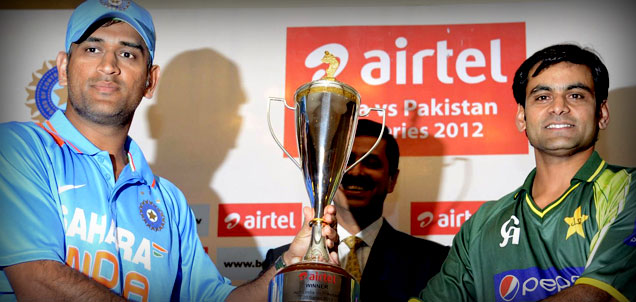
    Photograph: Fotocorp


  • How safe are women in media – Part II


    By Ananya Saha


    Even as we brought you the views of women in news media on how safe they feel, yesterday (http://www.mxmindia.com/2012/12/how-safe-are-women-in-news-media/), we also got in touch with women in non-news fields to share their views.


    Rita Verma

    Media seems like a glamorous business. And probably it is, minus the harassments that go unnoticed or unreported. With stringent HR policies being put in place, it might just be a thing of past. We reported yesterday on how safe and unsafe women in news media feel in their respective cities. Today, we bring you the views of the females in non-news media.


    The industry coherently believes that the country is getting unsafe for women. Rita Verma, Senior VP, Organisation Development, DDB Mudra, voiced her angst, “With all the current issues going on across the country no women feels safe. And in odd hours it only gets worst. It does not matter if you are in an urbanIndiaas all these major cases are happening in the major metros.”


    ‘Learning self-defence is important’


    MxMIndia staffer Shruti Pushkarna weighed in: “As a working professional, I am pretty used to driving around the city on my own even in the late hours but yes, it would be wrong to say that I never worry about getting back home safely. There have been several incidents in the past when I have been stranded on the road with a punctured tyre or something else, and no one to help. This one time I remember, I was waiting for help to reach me and to be safe I locked myself in my car and then I saw a cop cross by, Hoping that he would help me, I rolled my window down to ask for his help, but he just told me, ‘Push your car to the corner of the street and stop blocking the road!” I was shocked and told him I had a flat tyre and needed help, but that didn’t seem to have any effect on him and he walked away saying it wasn’t his job!


    “Well this was when I still had a car to lock myself in, a helpline car service which came to my rescue twenty minutes later, but it was worse a couple of years earlier when I had to use public transport to commute across the city. And my only hope then, were a bunch of safety pins I kept handy. Small things women carry around in their bags turn out to be useful weapons at times, and I have used those safety pins many a times to guard myself on DTC buses.


    “In a previous job, we were provided with office cabs to go home from late night shifts. One night as I stepped into the car, a guard also joined us. I asked him if he was headed in the same direction as I was but turned out that the HR had decided to let a security guard (a man) travel with me and the driver (another man) for ‘my’ safety. I don’t know if it crossed anyone else’s mind but the only thought that crossed my mind was, “If the driver tries to rape me there’ll be another man to help/encourage him.” So I went and told the HR next morning that it’s obviously more difficult to guard myself against two men at the same time!


    “The news is full of how rapists are on a power trip, how the police are inefficient, how the politicians and the government don’t take any strict action and so on. I feel the logical thing to discuss and perhaps propagate via national media, is the need for women to be prepared for these things. It’s important for them to learn self-defence methods and have self defence devices handy.  I for instance, took a short Krav Maga self-defence course. It’s an Israeli martial art form which helps you defend yourself and also teaches you to be more cautious and guarded against odd/dangerous situations. I think it’ll take a lifetime to change the men in our society so let’s start with the easiest and the most logical solutions.


    Sagorika Kantharia

    Sagorika Kantharia, Chief People Officer, Radio City 91.1FM, opined, “We really need to do something to make women safe in this country. Nowadays when you open the newspaper only thing you get to read is crime, rape cases, murder stories. Really ugly stories like father raping daughter, man throwing acid on woman’s face etc. One of the news reports on “Crime against Women” shows rape cases have grown by 30 percent since 2007, molestation cases have gone up by 52 percent and sexual harassment by 50 percent. I think the offenders should be punished with capital punishment in such cases of crime. Today women are working and demands of work is just increasing day-by-day wherein women have to travel outstation, work late hours at times how does one manage if the country is going to unsafe for women.” To make the women employees feel safe and protected, “At Radio City, we do have facilities for women employees who work late hours. Special arrangement like a re-imbursement for a private cab booked post 11pm etc. are provided for employees,” she said.


    However, it is not difficult to guess how safe urban India is before 11pm.


    Ambika Sharma

    Ambika Sharma, MD and CEO, Pulp Strategy said, “Women in India are not safe, especially not post-dark. One has only to read the papers to realize this. Those of us in media who keep odd hours at work need to be extra cautious. Delhi in particular is not a place to be out at night, and its getting worse every year. If you are to be late at work ensure that the organization is responsible enough to drop you to your doorstep.” At Pulp Strategy, it is a rule that women colleagues be escorted to their homes if leaving office post dark. “I personally would not recommend public transport post sunset, its difficult but there is no other choice, safety comes first,” she said.


    But there are bosses who do not care. Megha Swarup (name changed on request) works for a PR company in Delhi, said, “We are not given cabs unless it is for official meetings or media rounds. Since our boss is stringent with proper filing of papers, minutes of meetings etc, we usually get late in office. Our office is in a commercial complex that empties out by 7 pm. There have been times when we have had to ignore lewd remarks within the complex, but bosses do not care. And the bizarre fact is that our boss is a female. They do not even ask if anybody wants a lift to a certain point.” One of the female colleagues of Ms Swarup, gets picked up by her husband every single day after office.


    Vivek Srivastava

    But then there are bosses who do care. Vivek Srivastava, Joint MD, Innocean Worldwide, said, “This heinous crime has shaken us all. It has definitely made us reassess the security of our women colleagues once again. Ours is a professional space that truly accords importance, equality and respect to the efforts of the women folk. Advertising is a service industry driven by client imposed deadlines which can be difficult and late nights at office happen often. At Innocean we ensure that women take utmost precautions when working late. They are provided safe taxi services verified for their antecedents whenever they work late. In some cases the other office colleagues accompany them as well wherever routes are common. Moreover we do occasionally issue advisories to our colleagues to maintain their safety not just from sexual crimes but road rage, avoiding driving when under the influence of alcohol and avoiding over crowded places during times of alerts as well.”


    Prerna Uppal who handles MTV Consumer Products at Viacom18 in Mumbai said, “I do not feel safe when I am travelling on a business trip especially to Delhi, Gurgaon and Noida. I usually wind up all my meetings before7pmespecially when I am travelling alone. I feel very unsafe and sadly, I end up ordering room service rather than experiencing the great gastronomy the city offers.”


    MxM View


    MxMIndia has a clear view on the issue of the safety towards women in the news media. The people who run the newsrooms – owners, CxOs, editors, team leaders, and commentators — must ensure that we provide for the safety of our women colleagues. We know that the world outside our offices – including our public transport — is unsafe. We also know that expecting people around to protect women is too much to ask as we discovered when a senior news journalist was mute witness to an excess on a Mumbai local train.

    So, while it’s good to see the news media playing up the Delhi gangrape story, it’s critical that stiff laws are created. Our newsrooms must work towards taking care of the staff as they work odd hours.


    If you think your newsroom or that of a friend is not taking good care of its women employees, write to us at editor@mxmindia.com. While we don’t guarantee a solution, we will take it up the bosses of the news media entity to ensure a better, safer world.


    - Pradyuman Maheshwari

    Editor-in-Chief and CEO, MxMIndia


    Mumbai-based Lekha Saluja (name changed on request) manages corporate communications for a media house. She said, “I feel safe in Mumbai, no matter what time of the night. The roads are buzzing, there are people and I think it is largely safe. Having said that, it has to do a lot with me having my own car and driving. I am not sure the trains or the rickshaws will be as safe. Regular patrolling of the cops and better security is required. My office ensures late night travel for women employees.”


    A corporate communications manager in Bengaluru for a media company (who did not wish to be named) said, “There is no security. But due to the cab pick-up-and-drop-facility that I have arranged for myself, picks me from my building’s gate and drops me to office gate, I feel safe. To each, its own, is the norm here.” Apparently, she worked in Delhi earlier and depended on male colleagues to go back home if leaving late from office. Echoing her thought is Bengaluru-based advertising professional, Astha G, who said, “The whole feeling of being safe in media is more of a mindset. HR does not provide any safety measures. Only your own methods can help you feel safe.”


    Another corporate communication woman who works in Delhifor a news website, said, “What safety are we talking about? I have to catch hold of one colleague at least to go back with me when I drive back home late at night. Even though my office provides a cab post 8 pm, I do not feel safe going in one.”


    Cab services are a precaution, which every organisation must have. While no one can make females feel safe on roads, it becomes imperative for organisations to take stricter measures for them. If they won’t, who will?


  • How safe are women in news media?


    By Ananya Saha


    A recent incident when an Aaj Tak reporter was sexually harassed while reporting for a story raises concerns about women working in the media industry. We spoke to a few of them to know how they feel, and what have they been through.


    The number of working women is increasing, and so is the number of them working long hours. Journalists usually have to work late nights. While the work itself is not a cause for complaint, safety is a concern for most women journalists. In the wake of a rape case, a reporter was teased by a group of men (in a car) while reporting! Who is to be blamed for it? And how can the companies make them feel safer? There is hardly a woman in media who does not have a story to share about feeling unsafe or harassed. While stringent company policies have made offices a better place, while reporting or while stepping out of office, at least Delhi women have had a bad experience.


    The names in the story have been changed, on request.


    MxM View


    Write to us an editor@mxmindia.com if your newsroom is not taking good care of women employees


    MxMIndia has a clear view on the issue of the safety towards women in the news media. The people who run the newsrooms – owners, CxOs, editors, team leaders, and commentators — must ensure that we provide for the safety of our women colleagues. We know that the world outside our offices – including our public transport — is unsafe. We also know that expecting people around to protect women is too much to ask as we discovered when a senior news journalist was mute witness to an excess on a Mumbai local train.


    So, while it’s good to see the news media playing up the Delhi gangrape story, it’s critical that stiff laws are created. Our newsrooms must work towards taking care of the staff as they work odd hours.


    If you think your newsroom or that of a friend is not taking good care of its women employees, write to us ateditor@mxmindia.com. While we don’t guarantee a solution, we will take it up the bosses of the news media entity to ensure a better, safer world.


    - Pradyuman Maheshwari

    Editor-in-Chief and CEO, MxMIndia


    Sakshi Bhasin, a television journalist who works in Noida does not feel safe in Delhi. “There was an instance when at about 10.30pm, which is my usual time for leaving office, I stepped out to board my office cab only to find a car passing by in which the ‘men’ passed a comment ‘we’ll drop you home’. Not in the genuine sense of course!’ But as soon as they found I had a male colleague with me, they quickly drove past. I spoke to my HR head about the incident and she suggested sending a guard with me if I needed. I joked that rather than having two guys at that time of night in my cab (the second one being the driver), I’d rather go alone. Although it was a joke, it is sad that even professional women like me are fighting with the male psyche everywhere.”


    Kolkata-born Sumitra Bose who currently works in Delhi said, “Safety is always a concern when leaving in the late hours. Bahadur Shah Zafar Marg is a place where all the major newspaper offices are located, there is a police patrol van also deployed in the area but the walk till the metro station is filled with notorious elements and no one has been able to a thing about it. You cannot stand on the road to hail an auto rickshaw without having some bikers or hooligans pass a comment or two as you stand there, right under the nose of a police van. The underbridge that one has to cross, for instance, is replete with drunkards, homeless, beggars, and it has space enough to only walk to in a single file. There isn’t even a proper road.” However, she feels safe once aboard the metro.


    About the HR policies of her organisation, she said, “In my organisation there is a cell for women to complain for sexual harassment, and also like most other newspapers, they provide a drop facility after 10pm with a male escort. But if you are leaving at 9, then they probably think it is safe enough!”


    From the women on the MxMIndia team


    Ritu Midha

    As a media journalist you interact with a certain set of people – and in my off and on innings here I have not really faced any issues with the people I have interacted with.


    Commuting in Mumbai too has never been a problem – even with two cub female journalists in tow – I have, in the past, travelled from Bandra to Navi Mumbai in the middle of the night and even later. Having said that, bus travel has been minimum – and cabs are safer in Mumbai anyway.


    As for MXM India, it is a small team, and there is no question of things going wrong. A happy family. A comfortable place to be yourself! Having said that, to say that Mumbai corporate life does not have its fair share of ’embarrassing’. incidents would be a sham. Women employees do give up their jobs for being eyed and invited.


    However, in comparison to Delhi – it is a much better place to work for women in media I guess. As a journalism student in Delhi many years back, I do remember walking to the stop where bus initiated and got down two stops ahead to avoid the ‘rush’.  And also that in a posh South Delhi women’s hostel criteria for getting the room was taking the manager out for a movie!


    Sad part is we keep quiet, tell our youngsters to ignore (I too have advised one of my journalists to walk away from a drunk guy, instead of slapping him on his face), and society keeps getting sicker and sicker. Sometimes I wonder what kind of journalists we really are.


    Tuhina Anand

    Late night shifts or covering an event late night for female journalists is riddled with many issues. While the job profile requires one to attend events late night but traveling alone certainly is not advised. So you have to make arrangements to see that there is somebody to escort if the event finishes really late at night. I have done this as part of Delhi Times where you ended up covering events that ended late night or even at occasion left office late as filing stories took time. But never could I think of taking public transport or driving back alone hence had to look for someone to accompany which actually is such a pain as you are disturbing the peace of others too at some unholy hour. We have to accept that despite all talk of gender equality our work place and society is not women friendly especially not sensitive to late working hours for women.


    What can be done? I don’t really know because even if we take measures to make the work place environment conducive for working women, what can you do of rogues who are waiting on the streets to catch their next prey?


    Vidya Heble

    I’ve worked all shifts as a desk journalist in Mumbai and, touch wood, never had a problem going home from work at any time. Nevertheless, I take the usual precautions, such as keeping to better-lit parts in public, avoiding dark paths, and travelling in the ladies compartment of the local train which is nearest to the motorman’s cabin. There is a policeman stationed in the compartment, but in case of any problem I feel assured that I can lean out and call the motorman for help. So far, however, I have never had a problem even when I have caught the penultimate train to my destination 35 km away, and then taken an autorickshaw from the station. In general, I feel safer in BEST buses and the local trains, rather than in taxis and autorickshaws.


    But this is Mumbai. In Delhi, I would not dream of going anywhere. At all. My several visits to Delhi have left me very wary of the men in that city.


    I also did not face harassment at the workplace in Mumbai.


    But I’ve worked earlier in Goa, and it is a very different cup of tea. There was harassment there, both at the workplace as well as in public transport and public places. It’s a great place to live in but not to work!


    Ananya Saha

    I have had the opportunity to work in Delhi and Mumbai. And of course there is a stark difference of how both cities treat their women. Yes, we do feel safe when inside office or home, but the travelling alone to home or office never comes without concern. Since I work from home, I do not face the daily travelling ordeal but if travelling for work, by auto or cab, I always take down the vehicle number before boarding.


    While company policies have been stringent at most media houses, I know of a girl who was harassed by a male colleague. While she was asked to keep mum, she approached the proprietor of the company. The senior management protected him and he was let off after a warning. She quit after few months.


    I know of media organisations who do not even have ‘cab facilities’ for females who get late at work and some of them do not make sure if female colleagues is dropped first. While we wish to be independent, financially, I think it will take a long time to be truly independent. At least in Delhi.


    Stuti Bhattacharya has reported from various cities across India. She said that she felt the most unsafe in Delhi. “I have worked in all urban cities in India. Even returning home at 11pm in Hyderabad was safer than retuning from work at 9pm in Delhi. “Since I work for a newspaper, our shift usually ends pretty late around 8-9pm. I have had an incident while leaving office. I was accosted by a drunkard whom I pepper-sprayed. Then, I complained to the Police and Women Cell that resulted in patrolling of PCR vans for next two days. But today, it is back to square one. I prefer travelling with fellow colleagues for sense of security. I prefer travelling by metro, since it has separate coach for females, than travelling by auto or bus.” She feels that following any untoward incident involving a woman, the government blames the company or the individual. “It is the responsibility of the government to make us feel safe,” she opined.


    Megha Ghose, television producer with a leading news channel in Mumbai, was once stalked by a colleague for more than two weeks. She then made a police complaint, and the colleague was asked to leave the organisation. “What is strange is that he found a job the very next day at the competitors’ channel, who also knew about the whole episode. I wish it was not so easy for him,” she said.


    Kolkata-based magazine journalist Saroni Roy said that while she has not had any untoward incident at work, “I have to keep my family informed about where I am going for my assignment. Mostly, I travel by my own car and not the official cab. Who can you trust anyway? Company policies do not matter since your safety is your own concern.”


    Monica Kapur, a web journalist in Delhi said, “For most events that I cover, I get cab facility but still it does not make me feel safe. We have rotational shifts. Once I got free at 2am, and was driving back when another car started following me. I took a U-turn and went back to the office at 3 am.” Delhi-based TV Journalist Neha Bhasin said, “As a female journalist, I feel insecure if I work late at night and have to make my way to home on my own. I try and ensure that an office vehicle drops me home if I work beyond 10pm. However, at times when I drive to work, I need to drive back instead of using office vehicles and at such times I feel vulnerable. Thankfully I haven’t had to face a situation where I have felt threatened but the thought is always there at the back of my mind. I worry constantly if I will make it safely back home. Living in the capital city, it’s shameful that such a basic right – safety for women – is not ensured.”


    While women journalists struggle with the not-so-safe environment, Advocate Rekha Aggarwal, Supreme Court and Delhi High Court, told MxM India that there are no special privileges to protect the women working late hours. “It is not only media, but look at other professions where women work late. It is up to the companies to make such provisions for the safety of female staff. They have arranged cabs with male guards to drop female staff. But then I am not sure how safe it would make them. Yes, they can have special privileges such as regulated working hours where females are not allowed to stay in office beyond the said time, ‘work-from-home’ option for them. However, this should not come at a cost of lesser pay or lesser opportunities at work. But this would be a totally utopian situation. And I am not sure if we are ready for it. Not only the government, it is important that companies protect women employees.”


    Ensuring the safety of women in the supposedly egalitarian urban Indian society is a 360-degree issue. Everyone plays a part: employers, law-enforcers, infrastructure providers and the woman herself. Still, it is a long way before the Utopia of true safety can be achieved.


    Look out for Part 2 of our report on how safe are women in the rest of the media – advertising, marketing, experential media, public relations and non-journalists in the news media. If you wish to share an experience here, write to editor@mxmindia.com


    Image: Rafiq


  • Is our TV measurement future-ready?


    By Bipin Mundhwa and Amit Nevrekar


    TV audience measurement through the ‘peoplemeter’ is accepted as the most appropriate technique among others for measuring TV audiences. However, the capability of the peoplemeter (an electronic device) is completely dependent upon external factors such as continuous human intervention (Manual Inputs). Viewers need to press their respective button on the peoplemeter remote (as assigned to them) to let the system capture the data on who is viewing what. Which means it is safe to say that it does not automatically capture the viewers and their viewing patterns. It requires the viewer to keep in mind that they have to press the respective button every time they leave the room and enter the room.


    In an age, where people forget to turn off the switches while not occupying the room or even turn off the water taps after use, do you think people will remember religiously to switch on and off their respective people-meter remote button every time they enter and leave the room?


    There are high chances that the viewer may get interrupted by something and leave the TV room or for a while take an exit to do some other household activities without pressing the exit button. In such situations, the people-meter does not stop capturing the viewership of the audience, even though he/she is no longer viewing. What could be more erroneous than this?


    Jaldi 5 with Bipin Mundhwa & Amit Nevrekar: No one influenced us to write book
    Bipin Mundhwa

    01. It’s interesting that your book is published around the time when TAM is being needled by many stakeholders. In fact it’s also being sued. Is it just a coincidence or planned… given that you’ve highlighted the T, A and M in your book title ‘The Advertising Mess’?

    Frankly speaking, we had planned the date for our book launch much before the announcement of non-reporting of viewership data by TAM. The main objective of our book was to provide the necessary practical literature on The Audience Measurement systems in India. Over the years, we have seen different methodologies for the same medium in the same period resulting in different findings and thereby creating a Mess in media buying and planning.


    Amit Nevrekar

    02. Having worked with TAM as also with other media organizations, why is it that you didn’t raise some of the issues earlier?

    Working with TAM was always a pleasure. And we constantly discussed many improvements as part of our professional duty.


    There may be people who may say that you have written this at the behest of someone wanting to take on TAM?

    Firstly, we have not condemned a particular organization or criticized upfront. The book is about ‘bridging the gap for accountable MarCom’, where we have presented the ‘Bridge’ model which provides a unified B-Score across mediums in a single metric based on engagement levels, rather than inflated exposures. No one can influence us for taking such a mammoth effort whilst working, especially in a media agency, media house with hectic working hours. It’s only our self-inspiration and passion for our industry.


    03. Given that there will always be television channels who feel aggrieved by any ratings, there will be people who will raise objections against any measurement system?

    Every media professional subscribing to the respective measurement system’s data has the right to raise questions to understand and utilize the data in most logical and appropriate manner.


    04. You’ve touched upon corruption. And you say that with digitization, it could only increase?

    Yes, we have identified some loopholes in the system which can simplify corruption post digitization and needs to be addressed for robust data representation.


    05. One of the primary motives of the book is to talk about the ‘Bridge’ model that both you have developed. Have you had any discussions with BARC about it?

    The bridge model is purely developed by us. We haven’t had any discussions with BARC as an organization but we certainly had series of discussions with members of BARC, MRUC and other media veterans of the industry.


    In the current peoplemeter, if the TV is ON but none of the panel members have logged in the system (that is, pressed the peoplemeter button), then the peoplemeter would prompt for an input to register the viewing occasion for the respective panel member.


    But what if the panel member has logged in the system and is not present in the room. Is there any kind of validation thought about?


    However, today’s technological advancement allows us to make every impossible thing ‘possible’. There are Pyroelectric (“Passive”) InfraRed sensors that can detect whether a human has moved in or out of the sensors range. And undoubtedly, these are very inexpensive chips.


    Another such technology is used by Microsoft in their Xbox 360 game console, ‘Kinect”, which is a motion sensing input device capable of facial recognition along with full-body 3D motion capture. Which means if incorporated in the peoplemeter, will not only sense the individuals present in the room, but also identify if they are viewing the TV along with their engagement through facial expressions.


    Also, a very interesting point crops up, which ideally should have been raised by MarCom professionals. Bear with us as we elaborate.


    With the new Digital Video Recorder now commonly available along with most of the DTH providers, individuals have now got into the habit of not watching programmes live, but recording their programmes of choice and watching at their convenience.


    For example, if a working individual chooses to record a programme which was telecast from 4 – 5 pm, reaches home at 8 pm, and watches this recorded programme from 9 – 10 pm.


    ANOTHER PROGRAMME BEING TELECAST FROM 9 – 10 PM ON SOME OTHER CHANNEL IS ALSO RECORDED BY HIM AT THE SAME TIME TO VIEW AT A FUTURE TIME OF HIS CONVENIENCE.


    The critical point we are making is, most people with DVR facility have now got into the habit of recording almost all programmes they wish to view, and while viewing the recorded programmes, most of them would forward and skip all the ads.


    The question is, at 9 pm in the case of the above example, what will the peoplemeter capture as viewership?


    Will it capture the 4 – 5 pm show which is being watched between 9 – 10 pm or will it capture the 9 – 10 pm show which is being recorded for future viewing at the same time?


    And will the peoplemeter be able to gauge whether the ads have been skipped by the viewer while watching the recorded programme, which is bound to happen in most cases?


    BECAUSE THE 10-MIN AD BREAK CAN BE FORWARDED AND SKIPPED IN A MATTER OF FEW SECONDS..


    Thus this DVR facility has the potential of making the peoplemeter defunct and useless.


    Definitely, the currencies such as TAM should be keeping up with these advances in technology. We are very sure they have an answer for the questions we have raised above.


    BUT, we are also sure the industry and MarCom professionals would love to see a practical demonstration, if they claim that the people-meter can take care of these issues. Speaking is so much easier than doing.


    According to research paper published by Andrew Green (2010), the people-meter is only capable of capturing what is being displayed on the TV screen and not the actual behaviour of viewers.


    Very interestingly, TV broadcasting would be going digital in coming days. It has already gone digital in the four metro cities of India as on November 2012.


    In future, there could be options of pay v/s free channels, where the pay channel will have only programme content and no advertisements, similar to the current HD channels.


    DVR (Digital Video Recording) technology is also expected to dominate in the near future, which means there would be more flexible and enhanced TV viewership. This would also include storing of favourite TV programmes by viewers who would watch them at their convenience while skipping the commercial breaks.


    There is also an increasing trend of VOD (Video on Demand) in direct-to-home households. Would this mean lower viewership for repeat telecast of TV content? Because as the name suggests, VOD is TV content that can be viewed at anytime as per the convenience of the individual viewer. More sob stories for MarCom due to digitization.


    The new-age television viewership will include CAS (set top box), as well as others like DTH, DVR, IPTV/VOD, internet TV, TV programmes via YouTube and mobile TV. Conventional wisdom says that subscribers of these technologies will have vastly differing lifestyle habits. As we say, “necessity is the mother of all invention”. For the first time, the audience will be in the driver’s seat for choosing their option of technology of reception. So is the case with TV channels that they wish to subscribe to.


    Now, looking at the traditional TV measurement system, the viewership base will be determined by subscription packages, as now the option of choosing a specific channel is available to the viewer. In the recently phased-out analogue system in 4 metros, for a fixed monthly subscription fee, subscribers got access to ALL TV channels.


    This means the sampling frame for estimating TV viewership is based on the audience pool that recently had access to all the channels for a fixed subscription fee.


    Whereas, the new technology of digitalized reception will make the subscriber’s pool asymmetric for sampling. There are bright chances that the universe (the channels which an individual subscribes to), will fluctuate depending on basis of favourite channel/popular programmes/sports seasons or a new series, as people may change their channel subscription from time to time.


    For example, let’s consider a household which has recently switched to the DTH system from the old analogue system. Now this particular household has not subscribed to a particular GEC channel because they felt it was not worth paying an extra fee as they were casual viewers of only one programme on this channel, as against other GEC channels where they watched multiple programmes.


    Now after a couple of months, this household again decides to subscribe to that GEC channel they had abandoned because of a new programme of interest to them, along with a sports-pack for the upcoming IPL cricket season. Post the IPL season, they again unsubscribe the sports-pack.


    This means the channel’s universe has now changed beyond recognition. This will keep happening as now it will be directly related to pay for what you watch.


    In such situation of switching subscription plan from analogue to digital, peoplemeter may capture the audience movement from analogue to digital. However, within digital, the viewership for channels may fluctuate significantly (as these are sample surveys, where 1 panel member’s viewership is extrapolated to around 20,000 audience or more). This could result into vague and half-hearted understanding of channel viewership as practitioners would not know the reason for volatility in channel viewership i.e. Subscribed but NOT viewing OR Channel NOT subscribed.


    Until now in analogue mode, the same set of channels that a household with a people-meter had was also the same set of channels that all other households had, so the household with the people-meter was representative of all other households in the universe, at least as far as availability and access to channels went.


    But now, with households free to choose and reject individual channels, it is not necessary that a household which has a peoplemeter will have similar channels as other households in the universe.


    In fact there could be thousands of permutations and combinations of households with different sets of channels. So how would one judge whether the peoplemeters households are truly representative of the universe.


    Now with due respect to the existing people-meter technology for capturing TV viewership data, can we ask ourselves how geared up are we to take on the future challenges of capturing TV viewership data in light of the above mentioned technological advancement.


    The story does not end here. The real challenge is still to be explained by us. TV as a medium was largely an ‘at-home’ medium. However, TV as a medium is now becoming highly portable. How are we going to measure the audience on portable TV?


    For example, most of the working population may watch IPL out-of-home such as at office, at a common friend’s place, on their laptop, etc. On weekends they would also go to restaurants and pubs to watch the game in a social gathering and cheer for their favourite team. Their receptivity to the programme may be higher but it does not get covered as the people-meter is not capturing out-of-home viewership.


    This may influence viewership of popular sports seasons and they may get under-reported as compared to actual viewing figures.


    According to Horrell (2008), IPTV (Internet Protocol Television) could offer some encouraging answers to audience measurement such as real-time audience measurement through return-path-data technology from TV owning households itself. Moreover, it allows broadcasters to divide audiences based on socio-economic class, geographies and basic demographics. This would enable advertisers and media planners to showcase lifestyle, socio-economic class and geographic location based Ad streaming. One can avail the technology now as this is reality.


    One of the sophisticated devices according to Pellegrini, Pasquale and Purdye, Ken (2004), for measuring out-of-home TV viewership is Arbitron’s Portable People-Meter for capturing passive viewership data based on encoded audio signals, embedded in the TV programmes being watched. This pager-like device would have to be carried by selected individuals to enable this device to capture the encoded audio signals. However, it could prove to be misleading if the audio signals are being captured in the vicinity but the individual is actually not watching it. For example, in a coffee shop, the PPM may record TV viewership for an individual but the selected individual is engrossed elsewhere.


    What does all this mean for advertisers? How will they optimize their media investment?


    In totality, TV as a medium which even today is highly fragmented with 700+ channels will have very tough and challenging days ahead as far as measurement goes.


    ‘The Future is now, but Measurement is Yesterday’


    Extracted with permission from

    The Advertising Mess

    By Bipin Mundhwa and Amit Nevrekar

    Published by Sci-MO

    Price Rs 249, 139 pages

    www.theadvertisingmess.com


  • What do our metro collegians want?


    By A Correspondent


    From tracing behavioural patterns of the customers from the comfort of their offices a few years ago to carrying out extensive fieldwork in the remotest parts of India today, marketers have come to realize the facets that really drive the populace to take a liking to a product or an offering. In fact, analysis drawn up from extensive market research activities today enables marketers to go the extra mile and bombard the consumer with offerings that are relevant to his or her liking. But what such exercises have managed to do in the recent past is also gaze into patterns or strata that were not catered to in much detail before.


    Like for instance, the youth. There’s no denying what this TG has managed to do to every brand and the marketer who scamper to have a piece of his or her attention. That India is a nation where more than half its population is young (including children), makes this TG a goldmine for brands seeking them. But while brands are making use of umpteen mediums to pass on their message to the young populace, what was important was finding out whether the youth is satisfied with what is being thrown across to them. And if they are not satisfied, then what would be the ideal solutions they feel could drive the industry into the future.


    As part of the MxMIndia Annual print edition, MxMIndia commissioned youth marketing and communications consultancy firm DDB Mudra Concrea to conduct a survey and question a cross-section of the urban youth on a stream of solutions or ideas they felt were standouts from each of the following mediums -television, print, radio, digital, outdoor, creative and PR & events. The survey was conducted among 700 students from the top 5 colleges in Mumbai and Delhi NCR region. These comprised Jai Hind College, K.C College, St. Xavier’s College, H.R. College of Commerce & Economics and Sophia College for Women in Mumbai whereas from Delhi the list comprised Lady Shri Ram College, Hans Raj College, Hindu College, Indian Institute of Technology Delhi and Jesus & Mary College.
     

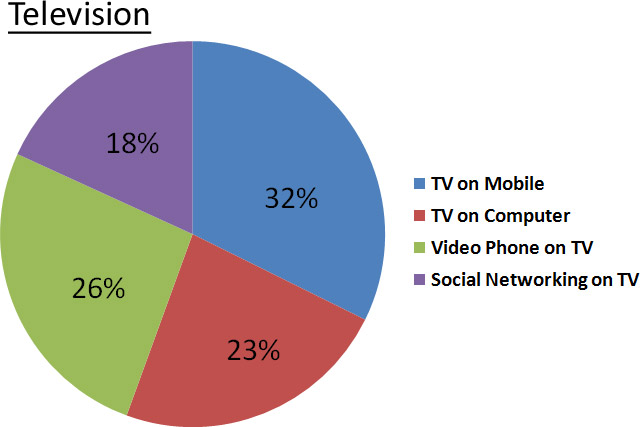
    To begin with, in the domain of television about 32 per cent respondents said watching television on mobile would be great, while 26 per cent said they preferred having video phone facility on television. A further 23 per cent said that they preferred watching television on computer while 18 per cent were in favour of having social networks on television.


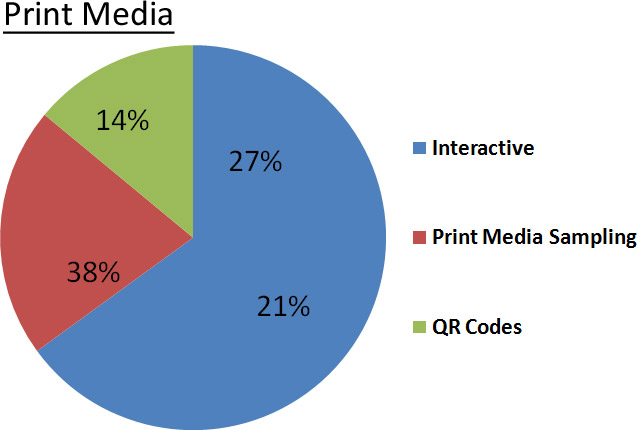
    For the domain of print, about 48 per cent respondents were in favour of the medium being interactive while 38 per cent said that print media sampling was what excited them. The remaining 14 per cent of the respondents thought that QR codes would be the next big thing that would drive this domain.


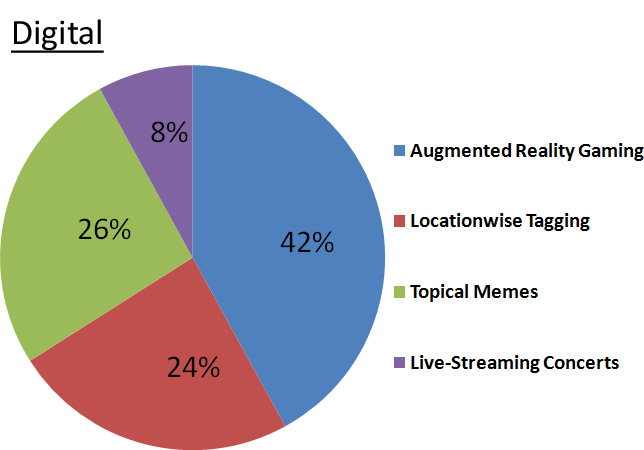
    When asked about digital, about 42 per cent respondents felt that augmented reality gaming was something unique while 26 per cent felt that topical memes was good. A further 24 per cent felt that location-wise tagging was a neat feature to exist while 8 per cent said that live streaming concerts was exciting.


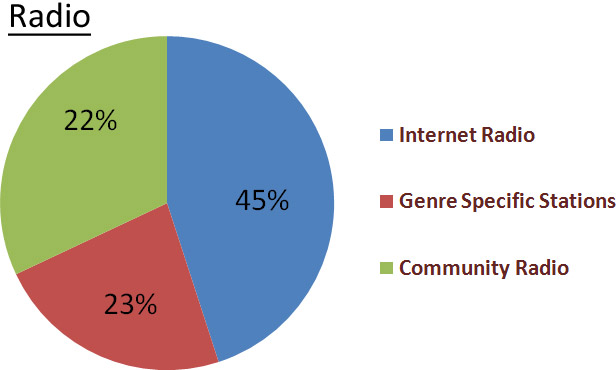
    As for radio, about 45 per cent respondents felt that consuming radio on the internet would be a big boon followed by 23 per cent respondents who said that having genre specific stations would drive the show in India. This was closely matched with 22 per cent respondents who said that community radio stations would be the way ahead for India.


    For the domain of outdoor, the idea that took the cake was installation art that was supported by about 35 per cent respondents. This was followed by 29 per cent respondents for whom augmented reality was important. Summing up the table was the remaining 17 per cent respondents who preferred having more LED-based hoardings.



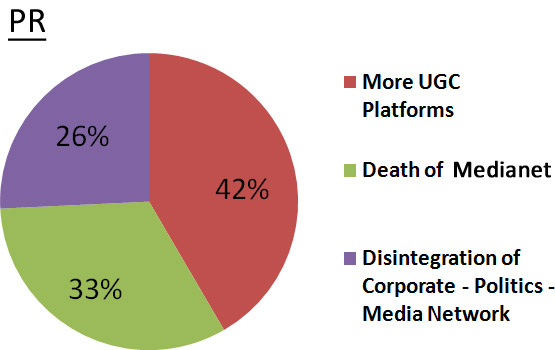
    In the domain of PR, about 42 per cent respondents were in favour of having more UGC-based platforms. A surprising 33 per cent felt that doing away with the regressive Medianet  offering would do wonders for the medium while the remaining 26 per cent felt that disintegration of corporate-politics-media will bode well for the domain. It is of course known that Medianet is not a policy of any PR agency, but that of a leading media company. The ‘paid editorial’ policy is also practised by many print and electronic media companies.


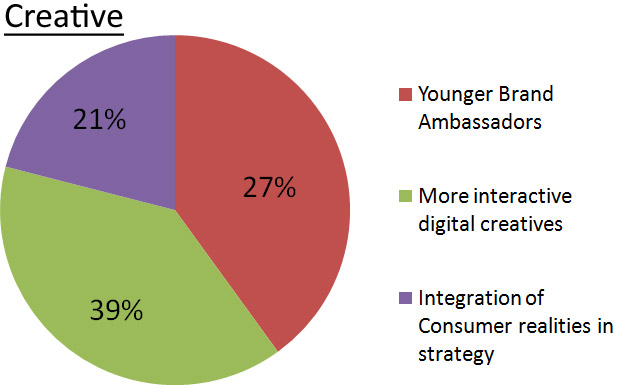
    For the domain of creative or advertising, about 40 per cent respondents said that it would be good to see young brand ambassadors while 39 per cent said that they wanted to see more interactive digital creatives and 21 per cent felt that integration of consumer realities in strategy would be useful.


    Youth Say:

    “I’m a TV addict. I live, eat, sleep TV. Thanks to 3G and TV-Mobile, I get to watch TV anywhere.”

    – Sarthak Nagpal on the medium of television

    “The Volkswagen ‘Feel the Shiver of Excitement’ print ad was one of my favourite newspaper ads of all time. Everyone talked about it for a whole week.”

    – Raghav Bagai on the print medium

    “The Nintendo Wii actually helped me lose weight! I think interactive gaming is the future of the gaming world.”

    – Faateh Ahmed on the digital medium

    “The fact that I listen to the radio anywhere and anytime on my mobile is surely one of the best innovations in this stream.”

    – Nitin Jethani on the radio medium

    “The best way you can market your product is to make the consumer experience it. So put it out there and let them perceive it.”

    – Barkha Singh on the medium of Outdoor

    “The City Ninjas initiative started by Anisha Sharma is an awesome way to get to know any city.”

    – Jubin Jacob on the medium of Creative

    “The Red Bull Stratos jump is probably one of the most memorable things to happen in our time. Our parents had Neil Armstrong, we have Felix Baumgartner!”

    – Priyanka Kumar on the PR medium


  • How M&E CEOs are embracing digital growth


    After years of uncertainty and caution in the digital world, CEOs are now more optimistic than ever about the digital future, notes leading consulting firm Ernst & Young. “This was the primary theme that emerged from our 2012 CEO study, in which 34 CEOs from leading global media and entertainment companies shared their views on how the industry will benefit from the digital future.The CEOs we interviewed represent leading global companies with combined annual revenues exceeding US $300 billion.”


    Five industry captains from India were among the 34 interviewed. These being: Messrs Ravi Dhariwal, CEO-Publishing, Bennett Coleman & Co Ltd; Sudhir Agarwal, MD, DB Corp; Sanjay Gupta, CEO and Wholetime Director, Jagran;  Tony D’Silva,  Group CEO, Sun Network (now with the Hindujas) and Punit Goenka, MD and CEO, Zee.


    Excerpts from the report:


    Four key actions from CEOs
     

    1. Focus on the customer.

    “The world’s greatest company will have the customer at the center.” “Having a direct relationship with the consumer will translate into new revenue stability and growth.” “Companies understanding and concentrating on the consumer’s need will do better than those that concentrate inwards.”


    2. Create differentiated content.

    “First, second and third things will be the creative success of our brands and studios.” “Being able to navigate the waters with compelling, cost-efficient movies that people have to see.” “Strong content delivered in exciting ways.”


    3. Deliver a seamless experience to the customer across all devices, platforms and geographies.

    “We are looking to be with the customer all day with tablet, iPhone(R), online and IPTV.” “Providing seamless delivery of all content on a global basis.”


    4. Recruit and retain the right people. They will be the ones who will drive success.

    “Digital reduces the number of levels of hierarchy, allowing the CEO to interfere in debates that are not necessarily his.”

    “Our company needs to become more horizontal and less vertical.” “I want my people and teams to (1) be well-grounded, (2) be competitive with a desire to win, and (3) take responsibility and be decisive.”


    Courtesy: Ernst & Young Media and Entertainment practice (http://www.ey.com/IN/en/Industries/Media-Entertainment)


    The 34 media and entertainment CEOs interviewed for Ernst & Young’s 2012 CEO study are optimistic about the opportunities in today’s digital world. They see digital as key to their revenue and margin growth. It is their present and their future. This contrasts with E&Y’s 2008 study, which showed that CEOs were more tentative about digital’s potential.


    However, every path has its risks. In addition to sharing their insights into the opportunities digital offers, CEOs also admit they face challenges.


    Getting the consumer to pay fair value and developing their “digital muscles” across the front, middle and backoffice continue to be key focus areas for media and entertainment companies.


    And yet, CEOs are meeting these challenges head-on and are regaining control of the reins of their future long-term growth. In today’s rapidly changing digital marketplace, CEOs remain undeterred about the role digital will play in their companies’ future


    Summary of key points

    CEOs are optimistic about digital. They are no longer tentative about digital. They see opportunities for growth in both revenues and margins.


    Connected technologies drive growth and create transformative digital ecosystems. This growth is being driven by connected technologies that are, in turn, creating transformative ecosystems.


    CEOs are thoughtful about where to invest. CEOs currently see new distribution methods and new types of content as the most attractive investments. CEOs see these investments as central to setting them apart from their competition.

     

    Exploiting digital opportunities comes with challenges. CEOs are working to make sure customers pay a fair price for content, and they are building the competencies in their back, middle and front office to maximize their advantage in a digital world.

     

    Digital drives double-digit growth

    Today, CEOs see digital as a core part of their business, as well as a key driver of growth. As one respondent commented: “everything we do is digital.”


    Definitions of what constitutes digital can vary by subsector and even by companies within a sub-sector. With this caveat, CEOs were asked what impact digital would have on their own company’s revenues and margins over the next three years. Sixty-four percent of study participants expect digital to drive revenue growth of 10% or more. Forty-eight percent of CEOs also expect margins to increase by 10% or more in the same time frame.


    This compares to the 2008 study, where CEOs were more focused on protecting their traditional business than pursuing digital opportunities. One respondent worried that “digital media may not be as economically attractive as old media.” Another suggested that “media is trading analog dollars for digital dimes.” For many, digital media was still viewed as a new frontier – a place only for gamblers willing to take a chance on the unknown.


    Intuitively, there is a prevailing belief that digital margins should be higher because media and entertainment companies no longer have the cost of physical distribution. In the short-term, investments required in infrastructure to enable digital will tend to drive margins lower. However, that is only in the short-term. Once companies have the required digital infrastructure in place, we expect their margins will rise.


    Tablets and smartphones are driving growth

    So what is driving this double-digit growth in digital revenue and this foundational shift in consumption? When CEOs were asked which technologies they see having the greatest impact on their individual sectors, 79% suggest tablets, 62% say smartphones. The impact these devices have on the consumer experience is obvious to each of us in our daily lives.


    These devices are supported by the technology that respondents see as having the third biggest impact on the media and entertainment industry in the next three years: cloud hosting services and digital lockers.


    When CEOs were last surveyed in 2008, consumer tablets were not even on the market, cloud computing was a niche product and smartphones were focused on email and texting as opposed to video and apps. Today, more digital content across more platforms and available on more devices has created new and significant monetization opportunities for media and entertainment companies.


    Conclusion

    CEOs have a clear vision of a digital world

    When CEOs survey the future, they see the opportunities that digital media presents. Whether it is B2C or B2B, the direct relationship that applications, ecosystems and technologies enable is fundamental to their vision. It is about the ability to drive an outstanding consumer experience by offering differentiated content on an array of platforms and devices, anytime, anywhere.


    Their success will depend on how quickly they can optimize their back, middle and front offices to overcome challenges they face – getting consumers to pay fair value, managing content and optimizing their supply chains.


    It will also depend on their people. It will depend on having the right people with the right skills to win in a fast-paced, ever-evolving digital landscape.


    Once a gambler’s enterprise, CEOs today see digital as necessary for future long-term growth. Undeterred by their challenges, CEOs are optimistic and they have greater confidence their companies can take full advantage of the opportunities that exist in today’s digital world.


  • Tot’s the way ahead for Nick Jr


    By A Correspondent


    Most parents are faced with a slightly amusing scenario almost every other day in their lives when their kid is stuck between choosing what programme to watch from an array of kids channels that are blasted across to them. From toddlers to tweens to even teens, children across different age categories have a tough time trying to watch an entertainment channel that amuses them the most. While some may blame this on the innumerable offerings that are available today, others may reason that the quality of content is so superior that it makes the task of staying loyal to one channel more demanding.


    While in any other space (under the realm of television), players would think twice before venturing with a new channel if the space is too cluttered, that is not the case with the kids genre that saw the launch of a new and challenging entrant in the form of Nick Jr. Said to be the third such launch from the Nickelodeon stable, Nick Jr. is being positioned as an eco-system for pre-school kids and their moms. With world-class content on-air, backed by a comprehensive consumer products range at retail, Nick Jr. aims to become the preferred destination for kids from the age group of 2-6 years and their moms.


    With history by its side, Nick Jr. is known to be successfully beamed around 125 countries and across 25 different languages with the tag of being a kid-friendly channel that airs safe and edutaining shows. The content is so devised keeping in mind curriculum goals and a child’s growing needs – be it motor, cognitive, creative or technical skills. In fact properties like Dora the Explorer, Go Diego Go, Team Umizoomi, Bubble-Guppies and Blues Clues, amongst many others, Nick-Jr shows are well-researched and proven to aid learning amongst pre-school kids.


    Nina Elavia Jaipuria

    Sharing her excitement with MxMIndia on the latest entrant and on the positioning being adopted, Nina Elavia Jaipuria, EVP & Business Head – Kids Cluster, Viacom18, said: “It just isn’t education per se as that would be very boring and that’s what children do anyways at school. The focus for us is edutainment – a combination of entertainment and education. The focus is a result of the multiple choices that are available for parents and children today.” Given her own example, Ms Jaipuria added, ” As a parent, I can tell you that there are some choices that a parent has to make for their children and as one moves forward one realises that there is a time for everything – both education as well as entertainment. Today, in most houses television has become inevitable and is on switch-on mode for most part of the day. At such times, kids become passive viewers to a lot of content that adults watch. So to bring back the focus on development for children through entertainment was what our objective is.”


    According to Ms Jaipuria, “There is too much pressure on kids today to perform well be it at school dance, sports etc. As a result of which they get stressed out easily. So the focus here is development of the child which is not rigorous in nature but which is helpful for the growth of kids.”


    Along with most experts who agree that the edutainment segment is still unexplored and in a nascent stage in India, Jaipuria too has a similar sentiment to share. Says Ms Jaipuria: “The whole concept of parents wanting their kids to be competitive has been there from the start but what has changed today is the offering. We didn’t have much choices or offerings when we were young but that aspect has changed today. So while edutainment offering is in a nascent stage in India the need was always there. Today there is content available that is bridging that gap.”


    Packing a punch

    To begin with, the channel would be airing content daily between 6am to 7pm in the evening and would be followed by Nick Teens. Elaborating on the channel’s approach to content, “The content would primarily be in English and no other language as yet. That’s because in India, English is an aspirational language. Most parents want their kids to learn English whether from SEC A, B, C or D it doesn’t matter. We will play our content only in English so that it helps create another language skill for children,” she explained.


    On whether the channel will be open to incorporating indigenous content, Mr Jaipuria said, “We don’t plan to launch Indianised shows as yet on Nick Jr. as the shows are very well researched and need a lot of pipeline time as well. Since we have Nickoledean as our mother brand we know that we have invested in three more shows as we go along – they take years to make and we are waiting for them to launch in the US and then bring them here. Having said that, we know that kids are universal in their appeal and therefore every content targeted towards them works today. You do not have to make desi content to cater to local needs; at least not for this genre.”


    Sandeep Dahiya

    Sharing his plans on the retail front, Sandeep Dahiya, SVP, Consumer Products – Viacom18, said, “Given the line-up of iconic characters on Nick Jr., we’re ready to give wings to kids’ imagination, through a product range that’s comprehensive as well as interactive. As part of our plan to create an eco-system around Nick Jr., we will not only further strengthen the Dora the Explorer franchise, but also bring to life some of our other internationally acclaimed properties like Go Diego Go, Bubble Guppies, Blues Clues and Team Umizoomi, in categories that are both, conventional as well as unconventional.”


    While the kids genre is increasingly being viewed as being cluttered, that may not necessarily be the case, feels Ms Jaipuria. In fact, according to her the kids genre contributes around 8 per cent to the overall television pie and is second only to GECs in India. The space has also being seeing good response from advertisers with the ad spends pegged at around Rs 250-300 crore. According to Jaipuria, what will further incentivize players to do well is the digitization wave that will bode well for all players. “With digitization having come in, there is a lot of segmentation that is now possible for us to do. Digitisation has enabled us to segment and provide offerings to viewers in a manner where business also makes sense for us. I guess it’s a wave of digitisation that we rode on with Nick Jr. particularly,” she said.


    As for launching the channel in a slowdown phase, Ms Jaipuria said, “Slowdown has had no effect on our channels so far. In the past six years that I have been here, we have launched three channels and each one of them has being throwing up good viewership numbers so far. In fact we’ll be launching more Indian content as we move along.”


    On solid ground

    With its plans around content firmly in place, the channel would be complementing the offline initiative with a little help from online too. Added Ms Jaipuria: “We will be focusing on digital around Nick Jr. And will especially be targeting the mothers. As we’ve said, mothers will be a very important subset while we promote this channel. Also, I am imagining that it will be the mother that will lead the channel on to the digital platform; and mothers today are present on the website – let’s get real about that fact. There are a lot of activities that the mother can do with the child on our digital platform.” According to Jaipuria, the idea is to stay ahead of the curve as kids today are becoming screenagers and they want to consume content across various screens. “We want to make sure that we are present across various screens and therefore the idea of engaging outside of television,” she affirmed.


    When asked about the viewership numbers expected from the newest entrant, Jaipuria expressed a feeling of caution as she said, “It is difficult to predict what viewership Nick Jr. will throw up because the slicing of TAM doesn’t even capture this segment; the whole rating system starts from the age group 4. So I do not know they will manage to capture our TG. Ideally Nick Jr. will be like any other niche channel that not necessarily depends on GRPs but has a whole lot of connect with the TG audience. We are trying to figure out if TAM can do anything about the slicing of the kids genre but till then we will live with what we have.”


    Presenting a robust outlook for the various channels under Nickelodeon, Ms Japuria sounded content as she said, “Sonic has a 3 per cent market share and is riding high on digital. If you know the kids category you will know that it is a very slow category as you have to build loyalty with children over a period of time. They are so in love with their favourite character that it takes time for them to like another. As for Nickoledean, it occupies anywhere between 18-22 per cent market share and competes for the top spot. With digitisation taking off, we expect our market share to only grow further.”


    —————–


    MxMIndia spoke to top media agency captains on the launch of Nick Jr 


    Mohit Joshi, MD, MPG India

    Yes, definitely there is scope for more kids channels in India. Kids consume a lot of television and are most loyal viewers of shows – ‘appointment viewing’ in the true sense happens in this TG. On a personal note, my daughter is very upset that ‘CBeebies’ is not available anymore. Point being made – this TG is hungry for more content and ‘good’ content.


    Also, we as parents and as media experts, would love to have an edutainment channel option in this country.


    Shashi SinhaShashi Sinha, CEO – Lodestar UM & IPG Mediabrands


    I have not seen the content on the new channel and would therefore not be in a position to comment much on it but the fact is that the kids genre is at an exciting phase in India. With edutainment as their core focus, the channel has made a good segmentation move that will ensure that kids come and watch their channel. Moreover, more than half of India’s population is young and anything that is catered to or centered around them will eventually do well in the long run.


  • MxM Monday: Is BTL gaining acceptance as a must-have in a media plan?


    By Ananya Saha


    Is Below-the-Line (BTL) advertising gaining bigger share of clients’ advertising budgets over the last few years? How innovative has BTL become, and what are the challenges it still faces?


    Anwesh Bose, Senior VP, DDB Mudra Max

    BTL has gained prominence over the years and will continue to do so as advertising communication is evolving from a ATL-BTL model to a Through the Line (TTL) model. The lines have blurred between ATL & BTL giving rise to a new phenomena where a medium can take the form of ATL or BTL depending on the need of the communication. The challenge today is for the communication professionals to justify the Return on Investments on any form of media and the pitch will keep getting higher. It is time for the industry to jointly work on a multimedia optimization model that would justify investments.


    Narayan Devanathan, SVP, National Planning Head, Dentsu India Group


    That’s a very broad question, but going by overall trends, the answer is probably yes. The more pertinent question, how much bigger is “bigger?” Who is measuring this? How does it differ by category? What all goes into the definition of BTL? For example, with the expansion of modern trade in retail, you’ll obviously see a lot more BTL money being spent on in-store merchandising, POS and promotional campaigns. A second factor affecting expanding BTL investments will likely be the short attention spans and the myriad of choices and screens that consumers interface with today. TV, radio, web and mobile are probably vying for the consumers’ attention simultaneously at all times. But with definitive metrics, the impact of last-mile tactics and campaigns will be a key differentiator between brand success and business success. All this does factor into the fact that, yes, BTL as a share of clients’ ad budgets is seeing an upsurge.


    Innovations can happen on three fronts: technology, measurability and the balancing act between strategic and tactical objectives of the campaign.


    On the technology front, something like RFID, for example, can turn walking behind a shopping cart into inputs for a shelf-stacking strategy in-store. A combination of GPS, augmented reality and a promotional scheme can turn a mobile phone into a CRM platform. But innovations like these and others depend on the evolution of both marketers and the retail (and other parts of the brand) environment.


    Technology can also be the difference between best-case guesstimates and data-driven strategies that reduce wastage of marketing investments.


    Finally, marketers have to find ways to close the gap between strategic and tactical goals. If brand-building is a strategic goal, how do you use BTL not just be a one-off tactic or part of promotions but contribute to brand-building?


    All said and done, as with ATL, the point of all communications, regardless of medium, is to create stories, conversations and transactions (not always monetary) that people want to engage in. If that perspective is missed, then we will continue to see a “line” and see “below” and “above” this imaginary line that only marketers – not consumers – see.


    Nina Jaipuria, EVP and Business Head, Sonic and Nickelodeon India

    Nickelodeon has always believed in the virtues of experiential marketing through on-ground engagements. While TV helps in reaching out to millions of viewers, it allows for only one way-communication. On the other hand, BTL promotions despite the high cost per contact have the potential of making the engagement truly memorable for consumers. There is nothing that can replace the experience and thrill that kids feel when they meet their favourite Nicktoons Ninja Hattori, Dora, SpongeBob or Keymon in person.


    In addition to engaging our young viewers at schools, malls, retail chains etc, we also conduct van activities that helps us reach out to smaller towns and villages in the interiors of India. For example during the launch of Motu-Patlu, we engaged kids in over 30 towns like Lucknow, Kanpur, Allahabad, Varanasi, Agra, Mathura, etc in Uttar Pradesh and Gwalior Khandwa, Indore, Ratlam, Bhopal, Jabalpur, etc in Madhya Pradesh. We often do mall activities to celebrate days and occasions that are important to kids.


    At Nickelodeon, we are constantly seeking new and innovative ways of connecting with kids all through the year. In-store promotions and toon visits at retail stores further helps in strengthening our on-ground presence when it comes to merchandize


    Brand partnerships also play a very important role in creating unique propositions for designing innovative on-ground programmes. BTL promotions are thus an integral part of our media plan as they enable us to connect with our consumers and give them a ‘Touch. Feel. Play.’ experience. In today’s day and age, it is imperative to be present across multiple touch points and to tangibilize the brand.


    Uday Mohan, Executive Director – North, MPG India

    With the increasing fragmentation of the media space it is not enough to just make “contact” with the consumer, but more importantly to “connect” with him. First hand experience of the product/service offering and the customization of it allow this impact extending it to sales as also brand perception. It is here where the relevance of BTL in the overall marketing/media mix is increasingly gaining importance.


    BTL is now moving from its earlier perception of basic activation to being an integral part of the consideration set at the media strategy formulation stage itself. FMCG for the mass audience spends even up to 25 percent of their advertising budget, luxury would spend more. Auto, telecom, food outlets also see the merits of BTL as we see more spends and ideas. It is getting very innovative using insights and planning; 3M Scotch-Brite came up with Wash your Bill, where you had the choice of washing dishes over paying the bill, adding a fun twist to the old adage of ‘pay your bill or wash the dishes’. The activation connected with a younger audience, made them use the product, gave immediate gratification, put it up on YouTube and created word-of mouth.


    Lack of quality data is a major challenge that BTL faces as there are as yet no set parameters for evaluation. Another challenge is the infrastructure and operational co-ordination required from global and nationalized brands of mass appeal where delivery to target audience becomes an issue. For example even Pepsi in its ‘Open Happiness’ campaign could create the reach because of the use of digital and social, else the cost would go out of hand. BTL activation for a mass brand would require innovative use of the media mix to get the desired effect.


    Ambika Sharma, MD & CEO, Pulp Strategy Communications

    There is a definitive shift in perception, below-the-line is media that barrier is fading, it is new media which adds the rich creamy layer to the traditional media plan. Inclusion of BTL in a plan has increased steadily but has seen a stronger spike in the last 2-3 years. It is not in the perfect place that it could be in the consideration set but it is no longer ignored like it used to be a decade ago.


    BTL is now increasingly being evaluated and included when developing the mix, for the simple reason that it cannot be ignored, as it is the only media that allows people to experience the product outside of the retail format. Below-the-line activations can be great when done cleverly. The medium provides the freedom to engage with your core consumers and almost always has the potential if designed wisely to be quirky and attention-grabbing.


    BTL needs to be carefully considered in the planning process and not as an after thought. A well-thought-out, through-the-line campaign (or 360-degree approach), will always have more impact than one curtailed to a limited approach. This is perhaps the most positive change where in some marketers are consciously choosing BTL within their plan with specific deliverables in mind. This way the plan is tighter knit, and the ROI is richer. This change has reflected in a higher share of voice for activation in the media budget.


    Other factors have also contributed, one is what we call the “Ego” slice in the media plan, prominent some time back its the forced fit into the prominent / upmarket ATL mediums because “presence there was a must” at times this ate into the working budget which would have been considered for new media including activation. This is no longer the case. Activation / BTL is holding its own in media plans and gaining its due in media budgets.


    Samar Singh Sheikhawat, Senior Vice President - Marketing, United Breweries Ltd

    We do not call it BTL, but refer to it as activation or leveraging. I would say that activation has always been an important part in the UB Group’s marketing intervention. And today it is almost equal to our sponsorship amount. So if we are involved with an event, property or platform, and suppose Rs 50 lakhs as sponsor, we will spend an equal amount in leveraging it or BTL. I would say, it is practically 1:1 for UBL and our portfolio of brands when it comes to the ad pie division of BTL with other media.


    I think a lot of things are happening apart from the display being used in this medium. The kind of consumer touchpoints being used, digital and social media is becoming a big thing and is being used increasingly as activation by us. Video mapping, production technologies have improved a lot. There are new techniques we are using from overseas in terms of projections, holograms, video mapping on walls etc. the ways to reaching out to consumer is getting innovative whether it be direct mailers that we do or CRM or get-togethers. The kind of media being used in activations is seeing innovation and substance that is being used in production is getting innovative.


    This medium faces challenges in terms of credibility and execution capability. Anything that you do in BTL needs to be relevant to your product, your target audience and to your brands’ positioning. A large part of differentiation in BTL goes towards execution.


    Raghu B Viswanath, Founder & Managing Director at Vertebrand Management Consulting
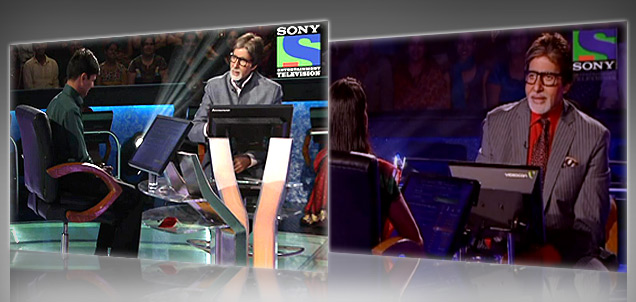

    Media today is fraught with many challenges. While the overall ADEX spends has been growing at a much higher rate than GDP increasingly clients are questioning whether they are getting enough bang for buck they have spent by advertising in media.


    Earlier brands focused on getting more eyeballs translating to more awareness on the brand. Since the competition intensity was earlier relatively low mere awareness got translated to purchase. That is not the case today. With increasing competition and very little differentiation, it is important for brands to not just enhance the brand – building efforts on awareness creation, but to go beyond and engage their customers meaningfully. This in turn means that brands need to connect with their customers through as many touch points as possible. So, non-traditional (BTL) lends itself to this two-way communication. The rules of the game is not about seeing or hearing. It is about experiencing the brand with all the senses. Hence, touch feel and other sensorial connects with the brand, is the need of the hour.


    For many brands, BTL is becoming a more significant component of their marketing spends (almost equal to ATL). I believe this trend is expected to grow, as brands pursue serious efforts to engage better with their customers.


  • Did the switch to weekends impact KBC buzz?


    By Kshama Rao


    That the sixth season of Kaun Banega Crorepati opened with a massive 6.1 is old hat; but what also seems to be equally true is that the show has failed to cash in on the success of last season. The buzz in the TV industry is that there is no buzz around the show this time despite its lofty tagline of ‘Gyan hi aapko aapka haqq dilata hai’. That there are no ratings to corroborate this (in the wake of the announcement of deferring the TAM data during week 41 ((October 7, 2012,) to week 49 (December 8, 2012) by the industry bodies, Indian Broadcasting Federation (IBF), Advertising Agencies Association of India (AAAI) and Indian Society of Advertisers (ISA), in consensus with TAM Media. The nine-data is scheduled to release along with the week 50 (December 9-15, 2012) results).


    Says an industry insider, “Last year, KBC had a free run with no new big ticket shows at the same time slot on rival channels. They also got many sponsors on board at a premium and though the marketing and promotional buzz was as much or more for the current season, the hype amongst viewers is negligible as if viewer fatigue has set in and it’s no longer fun to watch yet another person with a background full of hardships win. Besides, Zee’s Sa Re Ga Ma Pa and Bigg Boss on Colors cut into KBC’s timings on weekends. Also, apart from crime shows on the weekends, nothing else has traditionally worked on Sony. KBC is no longer appointment-viewing.”


    What the industry thinks
    Basabdatta Chowdhury, CEO, Platinum Media

    Without the data and TVR, it will be difficult to comment. It is also about reach even though success is one parameter. The show has done well for the channel and they have got their revenues, so it is a success for them.

     

    Samir Khanna, EVP and Head, DDB MudraMax Media

    If you go by so-called numbers, KBC 6 is a success even though social media says otherwise. According to the common currency that we had precisely till October 8, KBC 6 was doing fairly well. Moving it to weekend was a good move since it is an episode-to-episode show and does not have continuity like serials. KBC format essentially works on weekend format, and it was a good strategy to move it to weekend slot. It might have become repetitive and getting to a point of viewer fatigue, but this fact has nothing to do with weekend.

     

    – Ananya Saha


    Also, unlike last season, this year, Sony gambled with the show telecast days. From weekdays it moved to weekends and that, say industry sources, did it in. A channel insider, who’s worked on the last two seasons of the show, on condition of anonymity says, “Well, it opened with a 6.1 which is huge but, yes, the sustenance ratings were affected. And with now the ratings coming in only on December 19, it’s a wait-and-watch game. Having said that, when it was on weekdays it consolidated the viewers, who were looking for more than just daily soaps as viewing alternatives. But this year, with KBC moving to weekends, the very same loyal audience has been fragmented. And that always happens because the weekend viewership is drastically different from the one during weekdays.”


    The source continues that while the show started with the noble intention of “gyan” being paramount and the tagline being “gyan hi aapko aapka haqq dilata hai”, it didn’t do much for the show in the later episodes. The channel brought the common man into the forefront with the last two seasons when the show moved from Star TV to Sony and we managed to surprise the audiences; that worked very well so unless you change the fundamentals, surprise your audience every time you bring in a new season, it won’t work in the longer run.”


    A member of the production crew who’s been instrumental in putting the show together says on condition of anonymity, “If you ask me, KBC is now settled in its orbit, so ratings don’t matter. But yes, change of telecast days made some damage.”


    Has the show run its course? “No,” says the channel source. “It is a great product. It has potential and like in case of any reality show, be it the Indian Idol or The X Factor, unless there is a surprise at the basic level for the viewers, the show won’t click the way you want it the way you want it to. Another very important factor that could have hampered the show prospects is the fact that it came too soon in the wake of the last season. Normally, there should be a healthy gap of say 12-14 months between the two seasons. This time, it ended in January last year and came back in September. The breathing space for the viewers was not adequate enough.”


    Another grouse against the show is its duration. The show last one-and-a-half hours. “I don’t think anything is wrong with the duration. 8.30 pm is absolutely fine because that’s when the viewers in the interiors tune in and by the time it’s 10 pm, the metro audience too has joined in. So it works. The celebrity specials too worked be it the Shah Rukh-Katrina Kaif episode, the Sridevi one or the recent Lara Dutta one,” the insider who wished to stay unidenitified told us.


    Siddhartha Basu

    Siddhartha Basu, chairman and managing director, BIG Synergy, which produces KBC, in a reply to our mail on the same, says, “These are highly subjective perceptions, and quite contrary to the depth and width of KBC’s impact, from the feedback we are getting. But please follow this up with the broadcaster who will be in a better position to respond on whether there is any objective basis or substance whatsoever to such a negative perspective.”


    Well, we can instead wait for December 19 when the ratings will come in and tell us the real story. Meanwhile, Kaun Banega Crorepati airs its last episode on January 19.