Tag: BCCI

  • Jio & RF ESA to sponsor Women’s T20 tournament

    By A Correspondent


    Nita Ambani, Founder and Chairperson, Reliance Foundation has announced a significant support for women’s cricket in India. As the first step in this direction, Jio and Reliance Foundation Education and Sports For All (RF ESA) have come in as sponsor for the upcoming Women’s T20 Challenge. An extension of the IPL, the Women’s T20 Challenge will be played at Sharjah between three franchises – Supernovas, Trailblazers and Velocity led by Harmanpreet Kaur, Smriti Mandhana and Mithali Raj respectively, starting November 4, 2020.


    In addition, Ambani has offered the cricket facility at Jio Cricket Stadium, Navi Mumbai, for women cricketers. The stadium can be availed to conduct trials, camps and host competitive matches, throughout the year – all free of cost for our national women team. Furthermore, women cricketers can now benefit from the amenities for rehabilitation and sports science available at the reputed Sir HN Reliance Foundation Hospital & Research Centre in Mumbai.


    Commenting on her support for women’s cricket, Ambani said: “My heartiest congratulations to BCCI for organising the Women’s T20 Challenge. This is a progressive step towards the growth of women’s cricket in India. I am delighted to offer my full support to this wonderful initiative. I have immense faith in the potential and capabilities of all our sportswomen. Indian women cricketers have made the country proud with their outstanding achievements in ICC events over the last couple of years. Our aim is to ensure that we offer the best of infrastructure, training and rehab facilities to our girls. Players like Anjum, Mithali, Smriti, Harmanpreet and Poonam are great role models. I wish them and every member of the Indian women’s squad even greater success and glory in their journey ahead.”


  • Former BCCI boss Rahul Johri joins Zee as President – Business, S Asia

    By A Correspondent


    As part of its Zee 4.0 strategy, Zee Entertainment has effected a significant restructuring of its top deck. Punit Misra will take over as President – Content & International Markets, Amit Goenka will take over as President – Digital Businesses & Platforms, Tarun Katial who is leading the ZEE5 India business will continue to report into Goenka, Shariq Patel will be responsible for the integrated movies business and Anurag Bedi will continue to drive the music business.


    But the big announcement is the appointment of Rahul Johri as President – Business, South Asia. Johri will be responsible for leading the integrated revenue and monetisation team. Until recently CEO of the Board of Control for Cricket in India (BCCI), Johri was associated with Discovery Networks Asia Pacific for 15 years.


    Speaking on these announcements, Punit Goenka, MD & CEO, Zee Entertainment Enterprises Ltd. said: “Zee 4.0 will be an integrated and synergised organization, with a sharp focus on delivering world class entertainment content to our consumers across the world and enhanced value to our partners across the ecosystem. As I had expressed in my Open Letter, our endeavour will be to build a process-oriented structure for the future and our integrated approach is a strong step in this direction. ‘Gusto’ is an extremely important pillar of the new version of the Company and as an ‘Academy of Talent’, Zee will continue to nurture and build leaders for the Company and the Industry at large. I am delighted to have Rahul Johri join us to lead the Revenue & Monetization team and I am equally glad to have a strong business leadership team comprising of Amit Goenka, Punit Misra, Shariq Patel and Anurag Bedi, leading their respective functions. I am most certain that the collective experience and expertise of the leadership team, will help us immensely in achieving our set goals for the future.”


  • IMG-Reliance reports record revenue for year; closes 36 deals for IPL 2020 including Dream11’s title sponsorship

    By A Correspondent


    The sports arm of Reliance Industries Ltd – IMG-Reliance, has reported closing 36 deals across multiple brands and franchises for the ongoing Indian Premier League season, including the Indian cricketing board BCCI. According to its communique, IMG-Reliance, has raised a record revenue, estimated to be double of the agency’s last year’s earnings.


    The marquee deal for IMG-Reliance’s growth trajectory for this year has been Dream11’s title sponsorship of INR 222 crore with IPL. The Mumbai-based firm has exclusively represented Dream11 on its BCCI and IPL-related partnerships and also assisted them in securing cricketers as part of their activation plans. This is in addition to facilitating 6 team deals with Mumbai Indians, Chennai Super Kings, Delhi Capitals, Kings XI Punjab, Rajasthan Royals and Sunrisers Hyderabad.


    Said Nikhil Bardia, Head of Sponsorship Sales and Talents, IMG-Reliance: “This season, Dream11’s IPL title sponsorship was a very big win for us, along with BKT who joined the IPL wave with 6 IPL team partnerships. The brand partners have consistently appreciated our strategic insights, our knowledge around the assets and most importantly, our ability to find a fine balance between rights holders & brands, to make the partnerships impactful for all parties. It is this experience, which has helped us to grow in the sponsorship landscape with a large number of deals to become a dominant player in the region for cricket.”


    IMG-Reliance is also on board with marquee brands like BKT Tires, BoAt, FanCode and Jio through a combination of licensing and sponsorship service. IMG-Reliance also exclusively represents six leading cricket talents globally – Rohit Sharma, Jasprit Bumrah, Shreyas Iyer, Shikhar Dhawan and Krunal and Hardik Pandya.


  • IPL: The 2020 Showstopper Is Here


    By Shailesh Kapoor


    The show must go on, it’s said. That famous phrase, which has its origin in the circus in the 1800s, has been used more than ever before during this pandemic period, not just by the entertainment industry but by people in all walks of life. You cannot put nations or cities on pause mode for months at end. And hence, the show must, indeed, go on, even if it looks and feels a little different from what it was meant to be.


    IPL 2020 is one such show. When the event was indefinitely postponed in what seems like many months ago, many would have doubted if there would be an IPL season in 2020 at all. But the IPL brand is way too big to skip a season, unless there’s absolutely no choice. And here it is, starting tomorrow, on foreign land, without stadia audience, in a bio bubble.


    IPL has been a runaway success since its start in 2008, and only continues to get stronger with each passing year. The last couple of years have seen an increase in viewership. While its digital viewership has zoomed to new levels altogether, even the traditional media (television) continues to get stronger for IPL every year.


    Viewership increase in this year’s IPL is a given outcome. A cricket-starved nation will lap it up instantly. Time spent watching TV is anyway higher than usual levels because of lesser incidence of going out, especially on the weekends. The festival season, with its share of holidays, is setting in too. There are no headwinds at all as far as IPL viewership is concerned. Absence of spectators may impact the viewing experience a bit, but that wouldn’t take much time getting used to. And in any case, IPL is way too big for such factors to become sizeable viewing barriers.


    There may be no headwinds for viewership, but the headwinds come in the area of revenues. Despite its huge equity, IPL cannot possibly offset the impact of a struggling economy, and both BCCI and Star India have taken this in their stride, as they work towards making the most of the power event.


    While much is different about this year’s IPL, the one thing that makes it stand apart from previous seasons is that in 2020, its mere occurrence is a celebration. While eventually, the discussions around which team is doing well, who’s likely to win, etc. will pick up, those discussions will still be ‘secondary’ in nature this time. For many viewers, even those who follow IPL only casually, just the presence of IPL in prime-time everyday for seven weeks is a blessing. A pleasant distraction from what has been a tough and fairly deflating year for many.


    This status that the IPL acquires in 2020 can potentially take the brand to another level altogether, where its meaning in Indian lives goes beyond routine entertainment, and acquires elements that are more intrinsic, such as feel-good and happiness. I was a bit surprised to see that the brand ads released so far do not bring out insights around this transcendental opportunity this season offers. Perhaps they have been put together in a hurry, given how things have unfolded.


    So, get ready for the biggest IPL season ever. Even if the cricket is strictly average (never really the case with IPL), it will be a national feast like no other.


  • IPL 13: Who will Gain & Who will Lose?


    By Indrani Sen


    Ever since BCCI announced that IPl 13 will be held this year in the UAE from September 19 to November 10, there has been a lot of speculation in the media about how much revenue BCCI, the eight franchisees and Star India would be able to earn through this high value cricket tournament held away from home turf.
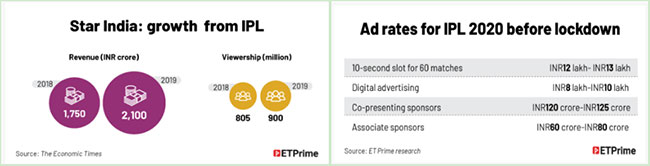

     

    It is still a matter of speculation, but one aspect is clear that BCCI’s scheduling of IPL 13 matches scheduled during evening primetime will deprive many GEC channels from the revenue which they have been expecting to get from the festive seeson advertising. As per various industry estimates, 40 to 45% of total annual advertising revenue is generated during the festive season spreading from September to December with bulk of it spent by Diwali every year.


    Revival of mega programmes like KBC, Big Boss, Indian Idol and Dance India Dance is expected to give IPL some competition and to help the big players Sony, Colors and Zee to get a good share of the TV advertising budget of festive season, but many other channels will not be that lucky. BCCI has also planned for maximising its revenues during the festive season as after October 25, 2020 there will be no afternoon match and all matches will be scheduled at 7.30 pm IST. With the final scheduled on November 10, only a small window of  four days before Diwali is left for other channels to encash on their share of festive spends. Had BCCI scheduled the IPL 13 a month later from October 2020, then probably the picture could have been different.


    Let us now look at the three main interested parties who have serious revenue tagets to be realised from IPL 13. The first is BCCI who earns the lion’s share of its annual budget every year from IPL. Apart from Rs 3270 crore which Star pays to BCCI every year for the TV and digital media rights, they were supposed to get Rs 440 crore from Vivo for title sponsorship, Rs 250 to Rs 300 crore for other associate sponsorships and another Rs 17 to Rs 20 crore from other sponsorships. After Vivo pulled out from the title sponsorship, BCCI got Dream 11 as a title sponsor for Rs 220 crores, at 50% discounted price of the earlier deal. BCCI shares 50% of the title sponsorship money with the eight franchisees by distributing the same among them and the revenue of the fanchisees has also been reduced as a result of this discounted deal. As per the experts’ views, BCCI’s revenue target from associate sponsorsips etc. are also expected to see a downward revision. BCCI will have to give a hefty fees to Emirates Cricket Board for holding the matches at UAE and their other logistical cost will also go up. A combination of all these factors will lead to a lower realisation of BCCI’s earlier revenue target from IPL 13.


    As far as the eight franchisees are concerned, each of them will lose out revenues from three sources. The first will be the loss from their share of title sponsorship which BCCI has sold at 50% lower value than expected earlier. The second will be the loss from gate revenue which used to be between Rs 22 to Rs. 28 crore per team from cricket grounds. The third will be from expected lower revenue of title sponsorship of each team under the current situation. Each team now anticipates to earn at least 15% to 20% less on the estimated the team title sponrship value of Rs. 50 to Rs. 75 crore (except Mumbai Indians which was looking at Rs 100 crore-plus) from title sponsorship before the pandemic struck.


    In addition, all of the franchisees will have to spend extra for the travel and accomodation cost of the players as well as creating arrangements for the bio-bubble and net practice at UAE. The combined effect of all the above is expected to result in a loss of Rs 80 to Rs 90 crore per franchisee. BCCI has already rejected the appeal for concessions in IPL 13 due to the pandemic made by the franchisees. (https://www.insidesport.co/ipl-2020-bccis-stern-no-to-ipl-franchises-demand-for-compensation/)


    The last but not the least of the three interested paries is Star India, the broadcaster holding the media rights of IPL for TV and Digital media. In Star India’s original plan for revenues to be earned over the contract period with BCCI, 2020 was supposed to be a crucial year when they had expected to replace earlier losses with profit. However, the pandemic changed their plans. An article published on July 4, 2020 by www.sportstar.thehndu.co referred to a statement made by Uday Shankar, the Star & Disney India Chairman to ET Now: “If there is one tournament where advertisers will put money, that is IPL but only if they have to put monies. The market has gone through massive shock. Whether it would recover enough to put thousand of crores worth of advertising in next 6-8 weeks is the real issue and we doubt that… I am not sure the market is ready to support the IPL with the same fervour…” (https://sportstar.thehindu.com/cricket/ipl-2020-postponed-future-star-india-uday-shankar-advertisers/article31986991.ece). He has obviously changed his mind since then as in a recent article in  https://www.timesnownews.com/sports/cricket/, he has been quoted as saying: “Our viewership of IPL on TV, as well as OTT platform, has grown year-on-year, and that will continue even this year…Also, for any company, which is looking at advertising, IPL provides the best and most-effective platform.”


    As per industry sources, Star is targeting at a revenue of Rs 3000 crore plus from IPL 13. There is difference in estimates on how much they earned from IPL 12. According to ET Prime, the revenue was Rs 2,100 crore in 2019, but some other sources peg the earnings around Rs 2500 crore.


    Source: https://economictimes.indiatimes.com/prime/media-and-communications/ipl-2020-star-india-will-have-to-rework-its-strategy-to-hit-the-inr3000-crore-revenue-target/primearticleshow/77321586.cms?from=mdr?fromsrc=etprime


    Star India has already declared that there will be no reduction on the advertising tarif declared earlier which had a built in 20% hike over IPL 12. As per industry sources going rate for 10 second advertising is 12.5lakhs. Based on estimate of ET Prime, with a revenue target of Rs 3000 crores in IPL 13 Star is aiming for a growth of 43% over IPL 12, which semms to be highly ambitious. Based on the estimate that revenue from IPL 13 was around Rs 2500 crores, a 20% to 22% growth over last year will enable Star to achieve the revenue target of Rs. 3000 crores, which seems to be more realistic. There is already a prediction that viewership of IPL 13 will increase by 25% from IPL 12 which will help Star in marketing IPL.


    To sum up, the broadcaster seem to be on a good wicket as riding on the promise of 25% higher reach, they have a good chance of realising the target revenue for IPL 13. On the other hand, BCCI and the 8 franchisees will have to be contented with reducing their losses from IPL 13 held in UAE than a total loss of cancelling IPL 13 in 2020. The smaller TV channels across genres may be complete losers as many marketers suffering from the loss in sales and revenue over the first two quarters of 2020 and the slow rate of recovery in the third quarter, may not be able to extend their advertising budgets  for festive seasons beyond investing in IPL 13.


  • BCCI formally announces Dream11 as title sponsor for IPL 2020

    By A Correspondent


    There were rumoured to be some hiccups. So for nearly 24 hours after the IPL chairman Brijesh Patel announced that fantasy game league Dream11 was the title sponsor for IPL 2020, the formal press release was made public on the Indian Premier League website.


    The IPL Governing Council has confirmed that Dream11 is the new title sponsor of the 2020 edition of the league. The communique adds, and we don’t miss out on the significance of the statement: Dream11 (Sporta Technologies Pvt. Ltd) is an Indian company based in Mumbai, Maharashtra.


    It also adds: Dream11’s association with sports has grown over the years and it is presently partnering a total of 19 sports leagues along with six Indian Premier League Franchises.


    Said Patel in the statement: “We welcome Dream11 on board as title sponsor for the 2020 edition of the IPL. Dream11 upgrading their association from an Official Partner to Title Sponsors is a great testament to the brand IPL. Dream11 as a fantasy sports brand will only grow the engagement of the IPL with its fans. As a digital brand it will give them leverage to create exciting online engagement for fans sitting at home and watching the matches. We look forward to delivering great value to Dream11.”


    Added Harsh Jain, CEO & Co-Founder, Dream Sports (Dream11): “The launch of IPL in 2008 gave birth to the idea of Dream11. As avid sports fans, we wanted to offer fantasy cricket to IPL fans to help them further engage with the sport they love and showcase their sports knowledge and skill. Being a proud homegrown Indian brand that is made in India, by Indians and exclusively for Indian sports fans, we would like to thank the BCCI for giving us an opportunity to become the title sponsor of IPL, which in our opinion is the world’s greatest sports property. We believe that ‘Dream11 IPL’ also perfectly defines what IPL is all about: every team fielding its Dream11 team culminating in the IPL finals determining The Dream11. We are happy to continue building our partnership with BCCI & IPL to further promote sports fan engagement in India, and look forward to 10 Crore+ Indians making their Dream11 for every Dream11 IPL match.”


    There were some murmurs of discontent amongst sports sponsorship-watchers given a minority stake held by Chinese investments major Tencent.


  • Just how much Covid-19 impact AdEx in 2020?


    By Indrani Sen


    Today, it is difficult to make any guess on when our country and the world at large will be free from the deadly attack of Covid-19. The UN Conference on Trade and Development estimated it may wipe off $1 trillion from the global economy in 2020. It is too early to estimate the effect of the pandemic on Indian economy and business and the consequences of the same on media and advertising industry.


    Our economy has been slowing down from last year and now various manufacturing industries are facing a forced halt in production due to lack of supply of parts and ingredients which are usually imported from China. Recently, we have been witnessing a fluctuating Sensex in a jittery stock market which is unlikely to recover soon.


    On March 12, the Indian government suspended issuing tourist visas till April 15 and on the next day BCCI postponed IPL 2020 till April 15. What miracle are we expecting to happen in next 30 days? Experts in healthcare have declared that this 30 days window is the most crucial period for India to control the spread of Covid-19 and stop it from getting into the third stage of community transmission, though some of them feel that community transmission of Covid-19 is inevitable (https://economictimes.indiatimes.com/industry/healthcare/biotech/healthcare/community-transmission-of-covid-19-is-inevitable-icmr/articleshow/74621197.cms).


    In other words, by end-March/ early-April, we will know if we have been able to contain the progress of Covid-19 and escape from getting into the dreaded stage three of community transmission. If we fail to contain the disease in stage two of local transmission, then the current restrictions may be extended beyond April 15 till we are able to curb the growth of Covid-19. Considering that from January 30 when the first case of Coronavirus was reported in Kerala, it took 40 days for 50 cases to be detected in India and then in the next six days the number climbed from 50 to 108 cases spreading across the country, the virus is an active growth phase in our country.


    What will be the fall out of Covid-19 on media spending by Indian advertisers? The industry sectors/ organisations whose production will be affected may start reducing their ad spend to mitigate economic losses. The sectors/ organisations who are dependent on Chinese supply chain, may also find their sales taking a dip as consumers are not likely to spend less and save more in the current situation of uncertainty. Some industries like travel, tourism and hospitality are already in severe loss and are unlikely to spend on advertising during the first half of 2020. Events have also taken a hit and are not likely to recover before the festive season. A lot of money rides on IPL and if BCCI is forced to cancel the tournament due to Covid-19, it will be a great loss of revenue for traditional as well as digital media.


    As severe to moderate restrictions are imposed by different state governments on their citizens, they have started avoiding shopping in crowded malls and markets and are utilizing online shopping for purchasing daily necessities and other goods. Advertisers who would like to reach out to their consumers during the next six to eight weeks can ride on this wave of online shopping. E-commerce is likely to get a boost as people also try to avoid cash transactions in brick and mortar outlets.


    With closure of schools and colleges in various states, there is bound to be an increase in content consumption across traditional media and digital media at home. It will be interesting to analyse the readership and viewership data for this period to assess if traditional media were able to get a share of the consumers forced to stay at home. Many organisations who have adopted digital technology are asking their employees to work from home which in turn can boost the other uses of internet for entertainment e.g. engagements with OTT platforms and other digital media.  However, given the current scenario of consumer spends across various categories of goods and services, it is unlikely that such consumer engagements will attract higher investment in digital advertising.


    The two other media which are going to be affected are cinema and outdoor. As state governments close down malls and cinema halls to prevent spread of Covid-19, cinema will not only loose the ticket sales money, but also advertising revenue. Due to travel restrictions, social distancing and forced staying at home, the traffic on the roads, stations, airports etc. will be less having a negative impact on OOH advertising.


    As a combined effect of all the above factors, it will not be surprising if the growth rate of AdEx drops from two digits (10.4% as per Pitch Madison Media Outlook 2020) to single digit in 2020. On the whole, 2020 does not promise to be an exciting year for media and advertising in India.


  • Given Covid-19, must the IPL show still go on?


    An update: BCCI has announced the postponement of IPL 2020 to April 15, 2020. This column was written much before the announcement was made.

    By Shailesh Kapoor


    The twelfth edition of IPL is scheduled for kick off 10 days from today, i.e., on March 23, 2020. In the wake of the escalating Covid-19 situation across the world, ‘non-essential’ travel and community gatherings are being restricted, both by the administration and the private sector. Sporting events tick both these boxes. They are non-essential, and they involve community gatherings in stadia. And it’s only natural that they should be considered for postponement.


    While several sporting events have been canceled or postponed over the last two weeks, the big news came in yesterday with the suspension of NBA, after player Rudy Gobert tested positive. Gobert incidentally mocked the Covid-19 situation by touching the mikes at a presser, just two days before he was diagnosed.


    Should IPL go on, then? Till about a week ago, BCCI was cautious, but keen on going ahead with the league anyway. But much has changed since then. The ‘best-case’ scenario of BCCI today stands at an IPL played in empty stadia, to eliminate the community-gathering risk. Television and digital media are the revenue drivers for IPL, and while empty stadia may take some of the zing away, the economics of the big-ticket event will be impacted only marginally.


    However, one could question the desperation to go ahead with the tournament at any cost. IPL is clearly non-essential, and the marathon length of the event would mean that players and officials are exposed to multiple people during the course of the league. Over the last few days, high-profile cases ranging from heads of state to ministers to actors have emerged from across the globe. In no uncertain measure, it tells us that public life puts you to more risk than an average citizen. Sportspersons fall in this category, and there’s the additional complication of overseas players, who may have traveled to different countries in the lead up to IPL.


    But a lot of cricket is going on worldwide. Among that, India is playing South Africa at home, where the remaining two matches will be held to empty stadia. The Ranji Trophy final is being played too, even as I write this. The veterans’ tournament, promoting road safety, was called off yesterday after five days of cricket. But in general, cricket across the world seems somewhat immune to the hazard at hand. Then why should IPL take all the blame?


    But that’s how IPL’s imagery is. There’s an intrinsic association between IPL and greed, built as a public perception over the years. Because there’s so much money involved, all IPL-related decisions can come across as material and insensitive.


    The players, especially the young talent, would really want to play. They may not get this once-in-a-lifetime opportunity again. But this should not be a decision governed by advertisers, franchises or players. It should be based on larger considerations of a situation that’s evolving rapidly with each passing day.


    IPL can surely wait another year (it’s impossible to reschedule it later in the year given the cricket calendar). And BCCI could be fighting many perception battles, with the media and the administration, if they decide to stick to the schedule.


  • Leadership Lessons from Sports Coaches


    By Prabhakar Mundkur


    It might not be a coincidence that we use sports terminology in everyday management in our companies. We talk about a ‘pitch’, to a client, or we ask ourselves what is the ‘gameplan’ or when appropriate we say someone ‘dropped the ball’ when we see an error of judgment. Obviously, there is a lot to learn from the field of sports management.


    And interesting area of sport management are the  sports coaches themselves and their style of team management. For example, if we were to look at some of our past coaches for the Indian cricket team, there might be one crucial difference between Anil Kumble and Ravi Shastri when it comes to evaluating coaches. And that is the question of ‘who is the boss?’ Kumble thought he was the boss, but Shastri thinks it is the captain of the team that is the boss.

    If press reports are to believed, Kumble’s pep talk after losing the Champions Trophy final against Pakistan didn’t go down well with the team which might have led to his final ouster. Although Kumble was not rude, he is supposed to have mentioned how wides and no-balls cost India dear and how the bowlers were not able to execute their game plan. While Kohli might have agreed with Kumble on how the team could have done better, he is known to have gone on to give a positive spin with his Captain’s pep talk by mentioning how the team played well to reach the final.

    In many ways, Kolhi acted like many leaders. Point out the mistakes to the team, but make sure that the team is not demotivated for future games and spur them on to do better in the future.

    Paul Barron, goalkeeping coach at Newcastle United, is an advocate of relationship coaching and once described his philosophy as

    :: They forget what you say to them.

    :: They forget what you do with them.

    :: But they never forget how you made them feel!


    So, perhaps, it is not just about Kumble said, but it is about how he made them feel. And obviously he didn’t make them feel good after the defeat in the Champions Trophy. Relationship coaching is about coaches connecting with their players, getting to the real pulse of the team, and releasing a powerful collective emotional energy. This very often is the edge that allows teams to survive the bad times and go on to remarkable achievements.

    Athlete-coach wars have been on as long as one can remember. Andy Murray for example re-hired Ivan Lendl after the pair decided to call it quits.

    If there are no codes of conduct formulated to protect coaches and athletes, then there is risk of a breach in the athlete-coach relationship. So if some of the reports in the press are to believe about Kumble and Kohli falling apart because of a discipline issue, or because Kumble wouldn’t let the players go out shopping for example, this is a fault of not laying down an athlete-coach code. The code in this case would have determined who was wrong and who was right.

    Coaches all desire strong team discipline, but do we really understand what that means? Are we willing to do what it takes? Athletes also crave discipline. They crave rules and boundaries regardless of how they may rail against them. Structure and a set of team rules, lets them know exactly what is acceptable and what is not for all aspects of team membership.

    You’re NOT a good coach when you call an athlete out in front of the team and tell that athlete, “You absolutely suck! The questions this raises is

    Does it motivate an individual to want to work even harder to improve?

    Does it help that individual to feel good about themselves?

    It;s very much the same in an office atmosphere.

    Shastri plays it right when he pats the team on the back when the team wins. A win is a win and needs to be celebrated and is a strong motivation to keep winning.

    According to various individuals from the BCCI and CAC as well as the committee of administrators, one big point of difference between Kohli and Kumble was who was the boss.

    Shastri is more than happy to let the captain take charge. “It’s always the captain’s team and it is the leader who calls the shots. That’s how it has always worked. A coach’s role, effectively speaking, is to stay in the background and let the onus be on the players. The coach and support staff’s role is to get the players in the most brilliant frame of mind to execute things and if done effectively, it brings enjoyment to the player’s game.”

    You’re NOT a good coach if you think that your most important job as a coach is to win games. If winning is the primary goal as a coach, he may have significantly lost his way and as a consequence, he might actually win less! The mission of a coach is to teach the team and help them grow as individuals so that they become better people in the world, both on and off the field. Good coaches teach their athletes how to be better people in the world and they use their sport as nothing more than a vehicle for this teaching. The winning and losing outcomes are completely secondary to the teaching of valuable life lessons.


  • Star Sports does IPL 2020 campaign on its own

    By A Correspondent


    Star Sports has relied on its own creative team for the campaign of the the forthcoming edition of the Indian Premier League as it launched the ad campaign titled Khel Bolega, along with the BCCI.


    According to a communique: “Khel Bolega indicates that the coming season will end the response to the chatter (#BolBakar) surrounding VIVO IPL when the player performances will speak for themselves. The performance by teams will also give fans a chance to silence all the #Bakar from opposing fans as well.”


    The TVC, conceptualised this year by the in-house creative team of Star India, was helmed by Taproot Dentsu last year and Ogilvy in 2018. The film, adds a release, was released in multiple languages such as Hindi, Tamil, Kannada, Malayalam, Telugu, Bengali across TV and digital


  • Piramal Enterprises ropes in Sourav Ganguly as its brand ambassador

    By A Correspondent


    Piramal Enterprises’ Consumer Products Division announced its association with Sourav Ganguly, President, Board of Control for Cricket in India (BCCI) as the brand ambassador for Polycrol, its antacid brand.


    Commenting on this association, Nandini Piramal, Executive Director, Piramal Enterprises Limited said: “We are pleased to have Sourav Ganguly as the brand ambassador of Polycrol. Sourav, fondly known as ‘Maharaja’ in Eastern India, has been one of the world’s leading batsmen and a successful captain of the Indian cricket team. His association with Polycrol is a testament to our legacy brand’s strength and trustworthiness.”


  • Dhoni’s Brand-I Value Is intact, but for how long?


    By Sanjeev Kotnala


    So, BCCI dropped former Indian skipper M S Dhoni from the list of centrally contracted players. It was coming he has not been in the national team for some time since July 9 2019, when he played the World Cup semi-final. That is long enough a gap. Surprisingly, when so many questions are being raised, Dhoni has remained silent on his plans. Even Indian selectors and the board find themselves in murky waters with nothing much to comment on this mystical absence of words from him.

    Naturally, the marketing community questions, if and will the Brand Dhoni be eroded. And the answers are not surprising.

    Brand Dhoni has enough of stickiness. CSK has already indicated that he will be retained in 2021. IPL 2020 will be a test.

    In 2014, when MSD retired from Test Cricket, there were thoughts expressed that his association with the shorter format will extend brand Dhoni longevity.

    In fact, after five years, Brand Dhoni was performing spectacularly on screen. In 2016, Forbes, in its list of most valuable sports brands of 2016, stated that MS Dhoni’s brand value suffered a 48% year-on-year decrease. Dhoni, the only Indian on the list, was placed tenth in the athletes’ category.

    In 2019, Dhoni retained his position as the second cricketer (Rank 12) after Virat Kohli, captain of the Indian cricket, who topped the powerful celebrity brand list of Duff & Phelps.

    But then the aura for sports person remains as long as they play and in Dhoni case, it will not be different. And every time his name will come up in discussions, there is going to be a debate. However, everyone is expected to hedge his or her bets.

    Brand-I is the image that rests in the eye of the audience. It like product image is the result of experience and expectations. If Dhoni the non-continues to perform with a similar level of success keeps his coolness quotient buzzing and dominates IPL, his brand value will remain intact. However, every player has his life cycle as a brand. Sooner or later, and as and when Dhoni retires from real cricket- the T20- national contention, with time, the brand will start having lesser meaning and attractiveness for the audiences.

    We must park this question for the next 100 days, until IPL 2020, which is crucial for Brand Dhoni. IPL 2020 performance in many ways will define the difference between ‘IS’ and ‘WAS’.

    We know Dhoni is unlike Gavaskar or Kapil or Sachin. Dhoni retired from Test cricket and one-days when people were still asking why is he retiring.

    We have seen him take a calculated gamble in the field. So, only time will tell if his silence is another such masterstroke.

    If IPL 2020 will bring him back into contention of the audience and their love for Captain Cool and his contribution. The flair of heart-stopping run chases and the sixes he fires. Maybe, Dhoni will reinvent. Whatever is in his mind, he has an obligation to his fans to reveal his plans.

    One must be warned that time and audience memories have limited elasticity of excitement and association.

    Brand Dhoni, will have to fight new faces, wins, memories and associations. And if the new breed of young cricketers delivers what we all believe they can, the slide for Brand Dhoni could be faster. And it is all about performing and dominating the audience mind space and nothing about the contract.

    Dhoni knows how to keep relationships alive. How friendship and business associations need to be nurtured. In fact, I expect him to further reap the benefit of this deep associations and brand endorsements.

    Dhoni has been slowly toying with his image we see in the advertising films. He seems to be conscious of the scripts he is picking or the way his persona is leveraged. There is a marked shift.

    Now, it is more about logic, rationality, maturing with age, and someone who has your best interest in mind. And a lot non-cricket and yet he is evolving and seems convincing enough. His advertising films are also seeing a Dhoni who can somewhat act and is not merely a prop on the screen. Though in the process, the legendary story of his dream and resilience wonderfully captured in the movie is missed out. His radiating success and being an absolutely loveable team player is missed out. But that inspirational part has already been utilised and has no additional pull.

    ……………….

    A sportsperson brand value is in her/his earnings, minus the average income of that sport’s Top 10 athletes.