Tag: BCCI

  • EssenceMediacom secures mandate for Wonder Cement

    EssenceMediacom, GroupM’s media agency has announced winning the media mandate for Wonder Cement, after partnering with BCCI to secure them as the official umpire partner for the IPL.

    Said Navin Khemka, CEO, EssenceMediacom – South Asia: “We are witnessing a paradigm shift in how brands engage with their audiences. Through this partnership we look forward to being a part of Wonder Cement’s ambition in becoming India’s foremost cement company. By leveraging innovation and technology, we aim to deliver outstanding results for both the fans and the company. This victory reaffirms our commitment to building stronger teams and creating innovative, tailored solutions for our clients.”

    Added Vinit Karnik, Head, Sports E-Sports and Live Entertainment, GroupM – South Asia: “Securing the media mandate for Wonder Cement underscores our agency’s expertise in positioning brands at the forefront of their industries. By harnessing advanced technology and innovative strategies, we are poised to elevate Wonder Cement’s profile as a leading cement producer in India. This partnership with the IPL exemplifies our commitment to leveraging sports marketing to drive brand growth and visibility, and we are thrilled to contribute to Wonder Cement’s ambitious journey.”

    Said Vivek Patni, Director, Wonder Cement: Wonder Cement is a gold standard when it comes to quality. BCCI represents the highest standard in the world of cricket. Partnering with BCCI for IPL is in line with our philosophy of maintaining the highest quality standards be it in our products or our associations and partnership.

    IPL is the most watched sports across continents. And it is a matter of pride and happiness to be seen on the National stage and what better way than IPL? This partnership is a significant step towards building a brand that spells quality, commitment and excellence.”

  • Summer Diaries: Elections, Cricket & More

    Summer Diaries: Elections, Cricket & More

    Shailesh KapoorWe are hitting peak summers, and elections are generating their share of heat too. Having watched election coverage over the years, it is impossible to not experience déjà vu. With all the growth in technology, election rallies continue to be a prominent election feature since the 1950s. I first remember watching election rallies in the late 80s, and visuals from the current elections look remarkably similar, just better in video quality.

    Elections are one place where the poor and the rural population, otherwise ignored by media for most part, comes into the mainstream, simply because each vote carries equal value, and the numbers are heavily stacked up outside the big cities and the affluent classes. And this hasn’t changed over decades now.

    But one thing that has changed is the use of the word “manifesto”. Over so many elections, one got a feeling that the term was moving out of election lexicon, and there didn’t seem to be even basic awareness about it among the general voters. But the Congress manifesto being targeted by BJP has stirred up things, and it is hard to find any political speech or interview where the M-word is not uttered.

    We are less than halfway into these long elections, and still four-and-a-half weeks away from June 4, which is the results day. June will be the more interesting month compared to May, as results lead to headlines, irrespective of how emphatic or fractured the mandate is.

    Interestingly, the T20 World Cup kicks off in the same week, and India play their first game on June 5, followed by a marquee clash with Pakistan on June 9. Even the T20 World Cup is month-long now, extending from June 2 to June 29. The venue may be West Indies and USA, but BCCI’s might ensures all India games are 8PM IST. After all, there’s an IPL slot to fill!

    India looks for its first World Cup win in this format since the nobody-saw-it-coming win in the inaugural edition in 2007. But irrespective of whether that happens or not, we are in for a double bill of politics and cricket in June.

    Meanwhile, Malayalam cinema is making waves, and setting all kind of crazy records, which deserve a separate piece of its own someday. After a euphoric 2023, the theatrical business has been tepid so far this year, but for the astonishing performance of Malayalam cinema, which is set to cross its 2023 annual number in just 4.5 months in 2024!

    And since I frequently rant in this column about the lack of innovation in Hindi GEC content, I should take a moment to acknowledge a trend that surprised me, and very pleasantly so. My colleagues Keerat Grewal and Aakriti Bhatia have put together this report on how Hindi GEC women are not housewives anymore. It’s a crazy trend, and even if you have no interest in GECs, I highly recommend reading it, just as a showcase of how data can be so powerful in revealing trends, and in such a simple manner too.

  • WPL: The Big Opportunity for Women’s Sports

    WPL: The Big Opportunity for Women’s Sports

    Shailesh KapoorThe second edition of WPL, or Women’s Premier League, starts tonight. It took BCCI a bit longer than expected (perhaps the pandemic delayed their plans) to launch the ‘IPL of women’s cricket’, but they finally did so last year. BCCI is by far the richest cricketing body globally, and is in pole position to drive growth of women’s cricket, in India and worldwide.

    Of course, WPL is a welcome step, and one hopes the second edition continues to expand interest in the sport, especially among young women audiences. After all, the idea of gender inclusivity has been an elusive one in Indian sport, over many years now. It’s ironical, because some of India’s best individual achievement in sports over the last four decades have come from sportswomen, starting with PT Usha in the 1980s, followed by the likes of Mary Kom, Sania Mirza, Saina Nehwal, PV Sindhu, the Phogat sisters, Sakshi Malik, etc. In the Tokyo Olympics (2021), three of India’s seven medals came from sportswomen: Mirabai Chanu (Weightlifting), Lovlina Borgohain (Boxing) and PV Sindhu (Badminton).

    Yet, in a cricket-dominated sport, female sportspersons have operated on the fringes. It doesn’t help that football and kabaddi, the next two most popular sports in India, are male-dominated too. In our monthly popularity track Ormax Sports Stars, we ask audiences to name their favourite sportsperson, irrespective of their sport or nationality. On an average, only 4% audiences name a sportswoman as their favourite. Even among female audiences, this percentage is in single digits every month, without exception. While it’s understood that sport is male-dominated worldwide, 96:4 is an embarrassing ratio.

    Even as more and more Indian sportswomen are managing to break new barriers globally, they are fighting decades of gender bias, stereotyping, and conditioning embedded in our socio-cultural fabric.

    Sports is an expensive category, and sustainable sport at the top level has to be advertiser-funded. Sportswomen continue to struggle to get endorsement deals, even from brands that otherwise champion projects focusing on gender equality and women empowerment. Till the audiences (including women) begin to watch more women’s sport, it’s going to be an uphill task. The medals may come, but the deals won’t.

    Hence, WPL has a lot riding on it. It can become that one property that creates demand for women’s sports in India. It may take some time, perhaps 3-5 years. But the opportunity does exist.

    With great power comes great responsibility, Spider-Man famously said. That saying perfectly captures BCCI’s role regarding the growth of women’s sports in India.

  • The Games Take Over


    By Shailesh Kapoor


    Shailesh KapoorThe Cricket World Cup has taken off to a good start. As good as the World Cup for an eight-hour format can be, in today’s age of instant gratification. Why does the 50-over format still exist is a larger question, whose answer is purely commercial in nature. Many experts have raised doubts over the purpose this format is serving, but who needs to disrupt a cash-generating machine, in India at least?


    So, the current World Cup will put that question aside for a few weeks, even months. The 2027 World Cup, by the way, is already planned to be held in South Africa, Zimbabwe, and Namibia, though four years is a long time away, and a rethink is not entirely ruled out in the coming year or two. On the format itself, not on the venue.


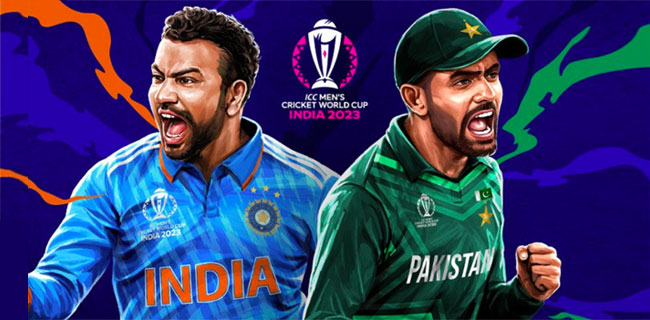
    But let’s come back to the World Cup that is currently underway. By and large, on-field action has taken large share of the attention in the last one week, and India’s two wins have given an initial sense of comfort to the fans. All eyes are currently on the big India-Pakistan clash tomorrow. India’s record against Pakistan in the 50-over World Cup remains unblemished, with a 7-0 lead. We could see both television and online records for live sports being rewritten tomorrow.


    The only major off-field controversy over the last week is not a frivolous one. It’s to do with mismanagement of tickets. The opening game between 2019 finalists England and New Zealand had thousands of empty seats visible on camera, even as the tickets showed largely sold out on online platforms (Imagine that happening with ad inventory during a World Cup game!). BCCI’s handling of scheduling and ticketing of this event has been unprofessional, even incompetent. The advantage of a long tournament is that you can learn on the job, and one hopes corrective action is already being taken.


    The broadcast of the World Cup is strictly on expected lines, and I say that in a good way. BCCI and Disney-Star have kept it simple, focusing on first principles, than offering too many distractions via meaningless innovations. Commentary in nine languages is impressive, though the absence of Bhojpuri (JioCinema’s cute contribution to sports broadcast) takes a bit of the fun factor away.


    The World Cup ends in the week after Diwali, and shortly after, we will be entering the elections season. Our news channels have enough fodder to keep themselves busy till mid-2024 at least. Which is not such a bad thing at all, because at least they will not have too much time to conjure up bizarre stories to keep the ratings going.


  • Understanding Bollywood’s image problem


    By Shailesh Kapoor


    Shailesh KapoorThe ICC Cricket World Cup is less than two weeks away. The mad rush for tickets has been the dominant headline associated with the tournament so far. But as we get closer to the date (October 5), on-field action will, hopefully, be where all the attention is.


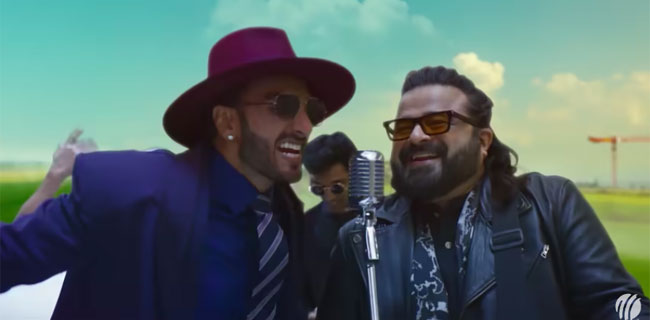
    Earlier this week, ICC released an abomination of a video in the name of the event’s theme song, titled Dil Jashn Bole. There’s so much wrong with the song that one wouldn’t know where to start. Why is the song of a world tournament in Hindi, when it’s not even the language all of India understands? Bizarrely enough, the official YouTube version does not even have English subtitles. Fans have been brutal about their feedback, remembering the much-superior De Ghuma Ke, which was the theme song the last time the event was held in India, in 2011. Despite being in Hindi as well, that song was distinctly Indian (and sporty) in its spirit, and never seemed to struggle on inclusion.


    Which brings me to the main point of this piece: The random obsession with Bollywood. With due respect to Ranveer Singh, who’s a fine actor, ICC (or BCCI, whoever greenlit this train-wreck of a project, pun intended) should have known better. Cricketers don’t need film stars to represent the sport to the fans. And even if one were to go in that direction, someone with a pan-India and global stature would be a minimum expectation for World Cup of a sport India is crazy about. Like an ensemble of SRK, Allu Arjun and Vijay, for example, in the video.


    Obsession of other domains with Bollywood was also evident in the Parliament this week, when Kangana Ranaut and Esha Gupta were present on the day when the Women’s Reservation Bill was presented (and passed) in Lok Sabha. The former’s choice is clearly political in nature, and I don’t quite know what to make of the latter’s presence on the day.


    Over the last few years, and since the pandemic in particular, the idea of stardom has evolved in India, and is clearly a lot more ‘pan India’ in its spirit. As per Ormax Stars India Loves, out of the Top 10 most popular male and female film stars each in August 2023, only three men (SRK, Akshay and Salman) and four women (Alia, Deepika, Kiara, Katrina) hail from the Hindi film industry. The Bollywood lens should have been an obsolete idea by now, for events of national and international significance. Yet, it continues to find more than a few takers.


    Ironically, this obsession doesn’t do Bollywood much good. The industry has been fighting for reputation, and even as box-office has been better this year (though driven by the stars from the 90s, which makes the success precarious), the overall image of a low-on-innovation, spoilt, and inward-looking industry continues to persist as a media narrative. And projects such as the Dil Jashn Bole video only add to that narrative.


    Image management at an industry level is always tricky terrain, because the ownership is de-centralised. But one hopes that somehow, the industry finds a way to come together to address what’s a growing concern, definitely for brands, if not for the box office.


    Meanwhile, away from all this, let the games begin!


  • Viacom18 bags BCCI TV & digital rights till March 2028

    By Our Staff


    The Board of Control for Cricket in India has awarded Viacom18 the contract for media rights all its international and domestic matches from September 2023 to March 2028. As part of the process, an e-auction was conducted yesterday (August 31) where eligible bidders were permitted to participate to determine the successful bidder. India is expected to play 88 matches over the next five years. This includes 36 T-20 internationals, 27 ODIs and 25 Tests.


    Viacom 18 has acquired the rights  for a cumulative figure of Rs 5,963 crore, pipping Sony Pictures Network, by a few hundred crore. Disney-Star was third in the fray. The awarding of the contract is, as a communique from BCCI notes, “subject to execution of definitive documentation and completion of formalities as required by BCCI, and other obligations specified in the ITT being completed”.


    Viacom18, it may recalled, already owns the digital rights for IPL.


    Said BCCI President, Roger Binny: “The recent BCCI e-auction has unequivocally demonstrated the vigour of cricket in India. The remarkable journey of Indian cricket, its meteoric rise on the global sporting arena, owes its success to the unwavering trust that people have vested in the BCCI leadership and its dedicated workforce. With the staunch support and collaboration of every stakeholder within our cricketing ecosystem, I am confident that we will continue to propel the brand BCCI to uncharted territories on the global sports stage.”


    Added BCCI Honorary Secretary, Jay Shah: “It fills me with immense joy and a profound sense of pride to witness the remarkable growth of brand BCCI. Today’s e-auction has propelled BCCI into the upper echelons of per-match media rights valuation, marking a monumental stride in our journey. Throughout this process, we have steadfastly upheld the principles of transparency and fairness, ensuring that all stakeholders are treated equitably. I extend my heartfelt congratulations to Viacom18 for emerging successful in the e-auction, and I express my sincere gratitude to all the bidders who participated in this process. Their involvement underscores the industry’s confidence in India Cricket. I also want to acknowledge the role of market forces in reinforcing their belief and trust in us.


    Our underlying goal remains to strike a harmonious equilibrium between cricket and commercial interests. BCCI remains deeply committed to nurturing sports development in India through the medium of cricket. The revenue generated from media rights is an essential catalyst for nurturing grassroots cricket across the nation—a cause that resonates deeply with us. It’s the legacy we leave behind and the positive impact we create in our country’s cricketing ecosystem that truly matters.”


    Added N P Singh, MD & CEO, Sony Pictures Networks India, in a statement: “We extend our heartfelt congratulations to the BCCI for a transparent and efficient e-bidding process and to the winners for securing the bilateral media rights. Our disciplined bid was grounded in market forecasts and a long-term growth strategy. We remain committed to delivering top-tier sporting entertainment as we continue to see growing enthusiasm across various sports genres.”


  • Free-to-stream: Will subscription models survive?


    By Shailesh Kapoor


    Shailesh KapoorThe much-anticipated India-Pakistan clash in the Asia Cup, scheduled tomorrow (Sep 2), marks the start of a busy cricketing scene. The action is equally hectic off the field too. The start of the Asia Cup also coincided with the news that Viacom 18 has bagged the rights for BCCI-organized bilateral series in India over the next five years.


    Viacom 18/ JioCinema’s entry into sports has disrupted the landscape in 2023. From being a driver of paid subscriptions, cricket is now playing the role of reach aggregator on OTT. The Asia Cup is available for free streaming on Disney+ Hotstar, and the ODI World Cup that follows will go the same way. Indeed, the era of paid sports content in India maybe over. It’s only a matter of time that sports channels on TV go free-to-air as well.


    With the no. 1 sport in the country (and by some margin) being available for free, the state of several other sports, including football, tennis, wrestling, etc. hangs in balance. Will they continue to be “premium” offerings that get smaller audiences who are willing to pay for them? Or will the networks hope to expand the reach of these sports by making them available free? The question, of course, extends to television too.


    Are we going back in time, by shunning subscription models in favor of those dependent on advertising? Far from it. For the last several years, almost all major players, in the streaming space in particular, but also in linear television, have over-rated an average Indian’s inclination to pay for content. They have priced their products at levels that are untenable, and then gone on to offer handsome discounts, to the extent of 50-75% at times.


    But the core question is not about the price alone. It is: “Why pay at all?” Changing a market’s mindset from free to pay is an arduous task. We have seen how niche channels lost out once the NTO effects kicked in a few years ago. Outside the top 10 cities in India, paying for data, however low the rates maybe, itself is a choice to make. Stand-alone subscriptions are not even serious considerations. Reluctantly but inevitably, platforms have consented to being a part of aggregator bundles, where the ARPUs are much lower. A Jio-Netflix deal was announced just last week.


    It may seem like an extreme position to take, but the days of pay content in India, especially when it comes to mainstream content that’s targeting a wider demographic, may be numbered. The major GECs going free-to-air in the next 2-3 years is not ruled out either. It would just take one of the top 4 to make the move and grab the top spot, and things may look very different overnight.


    All hail the advertising economy!


  • India-Pakistan Cricket: Bigger than the Best


    By Shailesh Kapoor


    Shailesh KapoorA high-decibel cricket season is round the corner. The ICC Men’s World Cup kicks off two months from today, on October 5, in India. There’s also the Asia Cup from the end of this month, as the lead-in to the World Cup. BCCI has taken its time to release the World Cup schedule, and are still tinkering with it.


    In a cricket crazy nation like ours, a World Cup in the thick of the festive season is an irresistible proposition, and the delay in scheduling, or the dwindling fortunes of the 50-overs format for that matter, are unlikely to keep viewers or advertisers away from this mega event. The last time the 50-overs World Cup was held in India, the home team emerged victorious. A repeat this year is what many will be hoping for, including Star Sports and Disney+ Hotstar, who have a lot riding on this event.


    But the really big cricket story of the year is… India-Pakistan. There are at least two ODI contests lined up: Sep 2 at Pallekele (Sri Lanka) for the Asia Cup, and Oct 14 at Ahmedabad in the World Cup. A second Asia Cup encounter is almost a certainty, given the Super Fours format. And a clash in the final is not ruled out. That could mean potentially four India-Pakistan games in six weeks. When did that last happen? In 2012-13.


    India-Pakistan games transcend the sport, and can even make the World Cup setting look like mere scenery. Having closely followed the exciting Ashes series that concluded earlier this week in England, one would be tempted to compare the India-Pakistan cricket rivalry to that between England and Australia. But there’s a crucial difference. The Ashes rivalry is cricketing in nature. It largely plays out on the ground, in the stadia, or in press conferences leading up to a match. But India-Pakistan cricket matches come with their share of politics and diplomacy, and the aura around them is never quite limited to just the cricket itself.


    The Indian team is currently on a dreary tour in the West Indies, where even the T20s feature scant crowds, and not just because they must be held during the day to match broadcast timings in India. As we gear up for an intense cricket season after the West Indies humdrum, this article titled ‘Can Indian fans ever expect a pleasant stadium experience?’ by Sidharth Monga (ESPNcricinfo), resonated with me immensely. I have now traveled to watch cricket in England and Australia on three occasions, including the recent WTC Final at the Oval. And it’s fair to say that the in-stadia experience in India is not even in the same vicinity. For a board that’s got all the money, there just doesn’t seem enough will to fix this broken piece. Because in a country of 1.4 Billion, it’s easy to fill in the stands anyway.


    If one looks at this issue at a more macro level, in India, cricket matches are still seen as forms of video entertainment, whose real potential is realized on TV and streaming. The crowds at the stadia are merely seen as tools to create the atmospherics that make the telecast look good. This mindset is an outcome of the absence of a sporting culture in India, at large.


    So, as one prepares to watch the games at home, one hopes the commentary lives up to the standards a World Cup deserves. Of late, that’s been a growing concern for those who prefer English commentary. But that’s another grouse, for another day.


  • BCCI & Adidas announce multi-year partnership

    By Our Staff


    The Board of Control for Cricket in India (BCCI) and sporting/leisure brand Adidas have announced a partnership as the kit sponsor for the BCCI. The contract, which runs through to March 2028, will give Adidas exclusive rights for manufacturing kit across all formats of the game. Adidas will be the sole supplier for all match, training and travel wear for the BCCI- including the women’s, men’s and youth teams. Starting June 2023, Team India will be seen in the three stripes for the very first time and will debut their new kit during the World Test Championship Finals.


    Speaking about the partnership, Jay Shah, Honorary Secretary, BCCI said: “We are committed to helping grow the game of cricket and could not be more excited to partner with one of the world’s leading sportswear brands, Adidas, in this journey. With its rich historical legacy in sports, world-class products, and strong global reach, Adidas will play an important role in driving the performance and future success of different categories of Indian cricket.”


    Added Adidas CEO Bjørn Gulden: “We are proud to partner with BCCI and Team India, the most iconic team in India. Cricket is the most important sport in India, and it is very important for us to be visible and invest in it. We could not have found a better partner than BCCI. I believe India to be the fastest growing sports market for the next decades. We are very committed to supporting our team to become the best sports brand in India.”


    Said Neelendra Singh, GM, Adidas India: “We are beyond excited for this historic moment at adidas, not just in India but also globally. We are proud to see the three stripes on the Indian cricket team. This is our moment to present Cricket to the world with high quality performance products for our athletes. We look forward to creating moments with our consumers through the most celebrated sport in India. Adidas truly believes in the potential of cricket in India and through this partnership with BCCI we will accelerate growth.”


  • IPL: Are we the prisoners of advertisers’ laziness?


    With apologies to none at all

    By Vikas Mehta


    Vikas MehtaSome people have equated IPL matches as the equivalent of modern-day colosseum games with the two teams being the gladiators. The stadiums are a riot of screaming chanting spectators who are fenced in almost like prisoners. I tend to agree, having watched one or two matches at the stadium before the pandemic. But I think the same spectacle is at home too. Specially if one is watching the match on a big screen. Except one feels like being imprisoned by a cacophony of repetitive and listless ads. Not to forget the myriad ads by the channel which keep on promoting the matches endlessly.


    I used a strong word, prisoner. For many reasons. Because most of the ads are bad. I am sorry there is no better word to describe how I feel about the decline of a profession with which I was associated for quite a long time.  And I think everyone is getting caught in a vicious economic cycle, with we, the audience at home, getting the wrong end of the stick at the lowest end of the food chain.


    As a sport, IPL is definitely a hot property. It’s sport, entertainment, tamasha and money all rolled into one. And it can’t get bigger. The biggest name in world cricket are a part of it. There is a bottomless pit of unlimited audience and there are big brands and corporates ready to shower crores on it. Safe to say that IPL has made the BCCI the big bully of world cricket. But in all this, the viewers, who sit at home and watch the matches on TV and through streaming, who are the reasons that the brands spend the big bucks are being served up some sports in the cacophony of the ads. Hardly a decade ago, when the IPL started, brands and companies would work towards preparing some memorable communication for the IPL. But the decline is alarming.


    Many people put the blame on arrival of digital. On lack of enough data to measure ad effectiveness. On short attention spans. But all of this is irrelevant. What has happened is that in the guise of all of the above both, marketeers and advertisers have become lazy.


    Lazy enough to repeat product proposition and forgetting the role of desired response. Lazy enough to finetune the target audience and not talk to all. Lazy enough to get some celebrities and not bother to see if their personality matches with the brand’s. Lazy enough not to have an idea which the target group can relate to. And to sum it up, lazy enough to not weave a story but happy with hammering a generic benefit while glamming it up with technical effects.


    And still worse, in today’s day and age lazy enough to run ads which have been on air for past few months. Be it Kingfisher, Kamla Pasand, Rajashree Pan Masala, Vimal Pan Masala, TVS tyres, Macho underwear…….and all of them use celebrities, most of whom do not fit the brand personality.


    There are some new ads. Spinny. It’s a vehicle buy, sell and upgrade platform. And they use not one or two but three ex-cricketers. Tendulkar, Kumble and Yuvraj. I am not even getting into if the brand personalities match but I did not even get what the product is or how it is different from other vehicle resell platforms. And seriously, does the brand want us to believe that these three are the best of friends who would be going for long drives in ordinary vehicles?


    Those of you who read my last column here, will remember that I had singled out the Dream 11 ad as a stand out. It’s follow up ads are also very well done. I think that amidst a clutter of fantasy sports brands, it’s Dream 11 advertising which has positioned the brand brilliantly. The others, inspite of using celebrities, are a haze of similar sounding and similar offering brands.


    I had asked my readers to revert with their comments on the Ranveer Singh Pepsi ad. Some who responded, mostly GenZ, gave it a thums up. I think it’s a good ad, could have been better, but Pepsi has finally found a celebrity which matches its brand persona. Frankly, I wonder what took them so long. I always slotted, Ranvir as the Pepsi type of a guy.


    Then there is the new Rupay Visa card ad. A very good example of story telling while communicating the product proposition. Well crafted, good stimulus and sustains interest. Watch it here.


    In a similar vein is the new Maaza ad with Amitabh Bachchan. I thought the second ad in the series, worked very well. It sticks to the product benefit. It uses the personality of Mr. Bachchan and very nicely superimpose it onto the brand and in an interesting way also takes care of the target groups desired response. Here it is.


    Last IPL, Tata the key moneybags of the tournament, had launched the Tata Neu super app. While the product got a lot of flak and the consumer experience was not as great as thought, the communication has not disappointed. Even this year, the peppy, making shopping an enjoyable experience, the ads have focused on the story of Neu coins helping you buy more. The short stories have good humour and they have focused on the product proposition interestingly.


    Just when one thought that things were looking up, I came across this ad for Happilo. So, you are an official sponsor. You can use some cricketers. Their availability is an issue. They maybe cannot act or emote. What does one do? Use them in a song and dance. Use them against a chroma background. Superimpose the shots with some tech wizardy. Get a rap sounding song. Highlight all benefits in the lyrics. Use some GenZ typical words or phrases. Let the brand name be mouthed in direct proportion to the number of seconds that the celebrities can speak. Voila! You have an ad.


    Can it be worse? Yes, watch this Ceat tyre ad with three cricketers.

    I am bailing out. Need a release from all these ads.

    So, next week I am off to watch a match. Maybe it’s better to be a prisoner in the colosseum of a stadium rather than in my TV room. Will keep you all posted.


  • IPL valuation jumps 75% to USD 10.9 bn in 2022


    By Our Staff


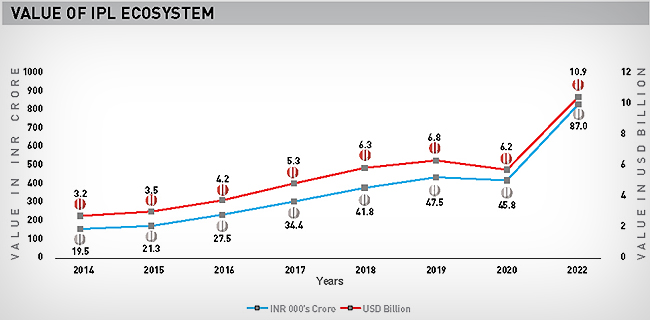
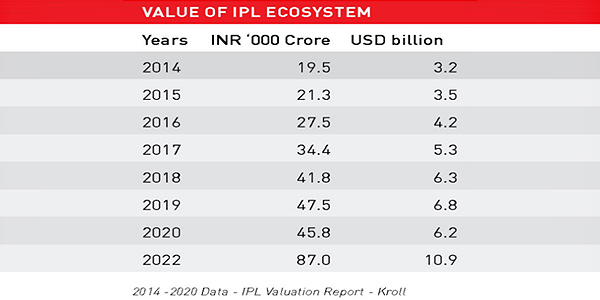
    D and P Advisory, a leading providers of consulting and advisory services, has announced the launch of a valuation report on the Indian Premier League (IPL) for 2022. The report titled ‘Beyond 22 Yards’ highlights that the value of IPL ecosystem registered a 75% growth since 2020, and now stands at USD 10.9 billion.


    Here are highlights of the report:

    In 2020, the IPL was valued at USD 6.2 billion. This valuation makes IPL a Decacorn (a business with a value more than USD 10.0 billion) within 15 years of inception. The IPL Ecosystem represents the value generated by the IPL as a business.


    A landmark event this time was the auction of the IPL media rights for 2023 to 2027. For the first time, media rights were spread among different broadcasters, breaking the monopoly of one company. The league has sold media rights at USD 6.2 billion, registering a three-fold jump compared to the previous 5-year cycle in 2017. Additionally, the tournament in 2022 also registered a record breaking combined viewership of 426 million on television and OTT platforms.


    With two new teams (Gujarat Titans and Lucknow SuperGiants) getting bought last year at a combined staggering value of USD 1.6 billion, the average price tag of a team has seen a whopping 16-fold jump from its inception. These two factors were instrumental in boosting the valuation of IPL to become a Decacorn and the second largest sporting league (on a per match basis from broadcasting fees) globally.


    To add to the momentum, the Board of Control for Cricket in India (BCCI) has announced the launch of Women’s Indian Premier League with a base price for a franchise at INR 400 crore (USD 50 million). This price is higher than most other cricket leagues globally, and will add immense value to the overall IPL Ecosystem.


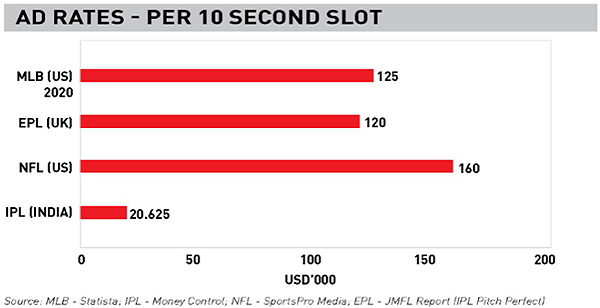
    However, on a broader scale, IPL is significantly behind in terms of ad rates, when compared with some of the other global sporting leagues. For example, a 10-second slot for an ad during IPL 2022 costed nearly USD 20,000; whereas, the ad rates for the same time slots at National Football League, English Premier League and Major League Baseball were over USD 1,00,000. Drawing this comparison, the report mentions how IPL has a lot more space to grow in future provided broadcasters are able to monetise the content well.


    On the launch, Santosh N, Managing Partner, D and P Advisory sid: “Since its launch in 2008, IPL has reimagined the nation’s cricket competition. IPL 2022 witnessed some major milestones and captivating games throughout the season. The renewed media rights deal was a major contributor towards a substantial jump in value for a relatively young league like IPL. These observations are an assurance of the fact that the IPL will continue to revolutionise the game of cricket and will be etched in the hearts of millions of fans for years to come.”


    The report goes on to say that the IPL team owners are looking to replicate the multi-club ownership model as part of their long term strategy. For example- The Knight Riders Group owning the right to Trinbago Knight Riders in the Caribbean Premier League, and a franchise of the UAE T20. It also has plans to build cricket stadiums in Los Angeles, USA, in partnership with the Major League cricket. Reliance Industries, the owners of Mumbai Indians, recently unveiled two new franchises in UAE’s International League T20 and Cricket South Africa T20 League.


    Furthermore, with BCCI having forged and locked in new broadcasting deals for the next five years, the report foresees a more stable phase in terms of the value of the IPL Ecosystem. “The value appreciation may not be as fast as seen in the earlier years”, it states.


    The report also states that the digital rights being sold separately from TV rights would result in greater engagement on the digital platforms. Further, the impending introduction of 5G services, greater penetration of the internet and increased smartphone usage will add to the rise in viewership.


    The report concluded stating that for these growth trajectories to maintain their momentum, all teams need to continue broadening their footprint, forming relationships, and generating revenue opportunities in different markets. Ultimately, apart from the love for cricket that viewers have, much of cricket’s future depends on ensuring quality; not just for the fans, but also to attract sponsors and broadcasters, the latter of which have become vital for the game’s financial health.


  • BCCI & Mastercard promote women’s cricket

    By Our Staff


    Mastercard and the Board of Control for Cricket in India (BCCI) have jointly launched the #HalkeMeinMattLo (don’t take it casually) campaign as part of their ongoing endeavor to support gender equality on and off the field. The films developed under the campaign depict the journey of top Indian women cricketers Shafali Verma, Harleen Kaur Deol and Renuka Singh, highlighting their struggle, hard work and determination to do well.


    Speaking about the campaign, Jay Shah, Honorary Secretary, BCCI said: “India and Australia are among the top teams in world cricket and the contests between these teams have been quite thrilling. Each of their last few games has gone down to the wire and I am sure we will get to witness some top-quality cricketing action in Mumbai as the two teams meet again. We are happy to partner with Mastercard for the campaign, which will bring out the stories of hard work, sacrifices and dedication. We want to encourage young girls to pursue cricket as a passion and a career option.”


    Added Julie Nestor, Senior Vice President and Head of Marketing & Communications, Asia Pacific, Mastercard: “Mastercard has been striving to make sports more inclusive globally. Cricket is the most celebrated sport in India. We commend the BCCI for its inclusive pay policy and are delighted to actively support women’s cricket as part of the overall sponsorship of the BCCI home series matches. Collaborating with the BCCI to promote women’s cricket is an extension of Mastercard’s larger commitment to address gender biases and encourage women’s participation in sports.”