Tag: BARC

  • Has the Lockdown diverted audio streaming to video?


    By Indrani Sen


    During this decade, the listening habits of consumers have been steadily moving to online platforms. The demand for vernacular content consumption helped popular music streaming giants to establish their apps in India and benefitted the homegrown apps. At present, the main players in the Indian market are Times Internet-owned Gaana, JioSaavn, Apple Music, YouTube Music, Amazon Prime Music, Spotify, Google Play Music and Airtel Wynk.


    The consumption of digital audio has been growing steadily from music streaming to podcasts. One would have thought that the coronavirus pandemic would further increase digital audio streaming, but it reality it has turned out to be different.


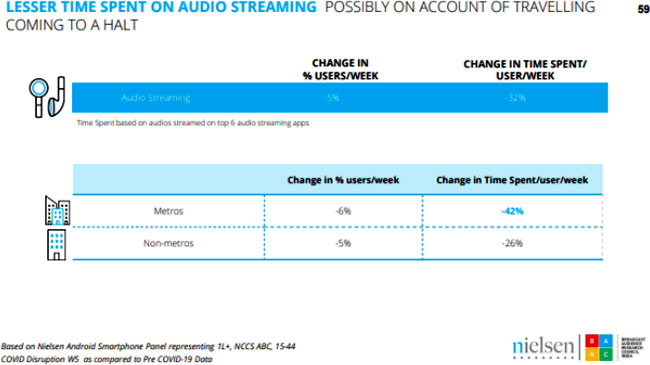
    In one of the earlier reports released jointly by BARC and Nielsen, it was reported that both users per week and time spent by users per week for audio streaming have been going down across metros and non-metros. While the research agency attributed the decline to travelling coming to a halt, informal research showed that people staying at home preferred to see music videos than listen to audio tracks of music.


    Source: Deep Dive into content and advertising consumption during COVID 19, 23rd April, 2020


    This trend has been seen across the world with www.emarketers.com  reporting on audio streaming getting diverted to video streaming in UK and US during Coronavirus lockdown resulting in decline of average time spent with digital audio in 2020.


    In UK, where steady gains were made till recently in digital audio consumption, www.emarketer.com has predicted a zero growth among the adult population in 2020. The picture in the US is broadly similar, though with time spent among adults declining only by a single percentage point. (https://www.emarketer.com/content/in-the-us-and-uk-audio-streaming-has-diverted-to-video-during-coronavirus-lockdown). April 2020 data from Nielsen Music as reported in the article, found that compared to an eight-week pre-Coronavirus baseline, audio music streaming volumes in the US were down by 6.2% in the week ending March 19 and by 9.2% in the week ending March 26. Music video streaming on the other hand increased by 9.3% and by 13.4%, respectively during the same two weeks. It is likely that a similar analysis in India will show similar trends during Covid-19.


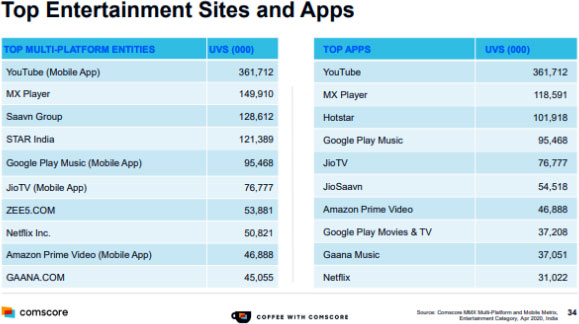
    Source: Coffee-With-Comscore-India-JUN2020


    The Comscore Report of June 2020 estimated  the number of Unique Visitors (UVS) for top entertainment sites and apps in India. Among the music steaming apps, Jio Saavan had highest number of Unique Visitors followed  by Gaana Music. Hotstar has almost double the number of UVS of  Jio Saavan. An informal check with the audio streaming companies further revealed that both their Daily Active Users (DAU) and Monthly Active Users (MAU) have been going down staedily. They are now shifting their focus to increasing their subscription revenue, which currently has a miniscule share of their revenue.


    The question which is currently haunting the audio streaming industry is if this shift to video streaming from audio steaming is a temporary phenomenon which will disappear with the pandemic or is it going to be a lasting effect which will adversely affect their future business plans? As education, trade and commerce grapple with the manifestation of the ‘new normal’ status, it can be safely guessed that the current trend is not a short-term affair. Unlocking of the economy will probably slow down the rate of diversion from audio streaming to video streaming, but it would not bounce back to the pre-Covid-19 scenario.


  • BARC vrooms from BMW to Yumi

    By A Correspondent


    Yumi in Japanese means “reason”, “cause”, “archery bow” or “beautiful”. It’s also said to convey abundance and beauty. In this case, it’s the plaform developed by Lisbon, Portugal-based Markdata which is going to be determing the fortunes of the television industry in India. So: You for Markdata’s partners, and Me for, well, Markdata itself. We thought the other meanings of reason, cause, archery bow and beautiful perhaps fit the sentiments that we see every Thursday after the ratings are out.

    Television measurement company Broadcast Audience Research Council (BARC) India, will complete transitioning to Yumi Analytics, starting tomorrow, July 1. The idea, notes a communique, is to offer an enhanced experience and more holistic data generation and analysis. With modules that are more flexible, customisable, and designed to be performance oriented with a more intuitive approach. Until now, BARC subscribers used a platform called BMW (short for BARC India Media Workstation). Over the last 11 months, Yumi and BMW have been operational in parallel to afford a smooth transition.

    Romil Ramgarhia

    Said  Romil Ramgarhia, Chief Operating Officer, BARC India: “BARC India is driven on strengthening its existing framework while introducing new products and services that help our clients make more informed decisions. Yumi Analytics is one of the most advanced software with respect to television measurement and insights. It is user-friendly, intuitive and has ability to perform multiple tasks efficiently. BARC team across India have worked closely with the clients over the last 11 months to ensure a smooth transition.”

  • BARC India greenlights ops in ‘Green Zones’

    By A Correspondent


    Television measurement company Broadcast Audience Research Council (BARC) India and Meterology Data Pvt Ltd (MDL) have resumed the servicing of panel homes in areas classified as ‘Green Zones’ by the government across India.


    Notes a communique: “BARC and MDL are ‘active on the field’, where permitted, ensuring its service is ‘always on’ for the industry. It has resumed its on field operations in green zones following mandated precautions for the Panel Homes and the on-field executive.  To ensure smooth operations and minimal disruption going forward, training is being imparted to household members in case a meter requires servicing or maintenance remotely. BARC India and MDL are committed to serving the industry and will continue to resume servicing of panel homes in areas that continue to get classified as ‘Green Zones’. Equipped with Aarogya Setu App and PPE kits, the team is always vigilant to not visit an unsafe (Red/Orange) zones and are taking time to ensure panel homes are trained on safety measures it can take amid the crisis.”


  • The Internet Gets Mainstream, Finally


    By Indrani Sen


    On May 8, 2020, the Media Research Users Council India (MRUC) released its findings of the last and final quarter of Indian Readership Survey 2019. Fieldwork of IRS 2019Q4 covered the period from December 2019 through March 2020 and the report has data based on a rolling average of four quarters of IRS 2019 data i.e. Q1+Q2+Q3 and Q4 2019.


    The highlights of the readership trends among English and vernacular titles have already been reported and analysed by different industry websites. The highlights of the survey- presented jointly by Nielsen and MRUC – has noted that: “Newspaper readership, is on a slow decline and is a trend seen across Hindi, English and Regional languages”. Vikram Sakhuja, IRS Technical Committee Chairman and Group CEO Madison Media & OOH, Madison World has noted in the press release: “(The) ability to read and understand English has increased and while overall print readership is holding, daily readership has started showing signs of decline.”


    According to the highlights of the report, a “rapidly evolving media landscape with multi-media adoption is seen across consumer strata resulting in large media markets, both traditional and digital with substantial increase in Internet penetration lifting it to mainstream along with TV and Print.” Moreover, the report has acknowledged “There was more number of internet users (Last 1 month) in rural now then urban.”


    Source: IRS2019Q4


    If we consider that the fieldwork for March 2020 ended before the National Lockdown due to Covid-19 was imposed on March 25, 2020, we can easily guess a further surge of internet users has happened across urban and rural India in the last seven weeks. Unfortunately, as the IRS fieldwork also is on hold now, we will have to wait for sometime before we get a clear indication of the media usage during the total and subsequently partial Lockdown enforced by Covid-19.


    IRS2019Q4 highlights have also given us a glimpse of how Indian consumers today are more equipped and more connected than before as shown in the following chart. There would not be significant change in the connectivity except during the lockdown both ‘shop from modern trade’ and ‘online shopping’ may go down and ‘access social media’ may go up substantially.


    Source: IRS2019Q4


    This calls for a total change in the approach of media planning where TV and Digital would have to be planned simultaneously now supplemented by Print, Radio and OOH plans. It would also be beneficial to plan for TV and Digital under the same roof by the same media agency than to distribute the business by traditional media and digital media to two different media agencies.


    Unfortunately, we still do not have single source data for TV and Digital media users which is essential for preparing cutting edge media plans. BARC’s plan for providing such data have been shelved indefinitely reportedly due to non-cooperation by Google and Facebook and instead of finding a solution to that problem, TRAI has now created other problems for the ongoing research on TV viewership with their new directives about TV viewership research. So, as internet continue to surge ahead as a mainstream media, media agencies will keep struggling with data and insights for doing justice to their media plans.


  • Reminiscing the BARC set-up days

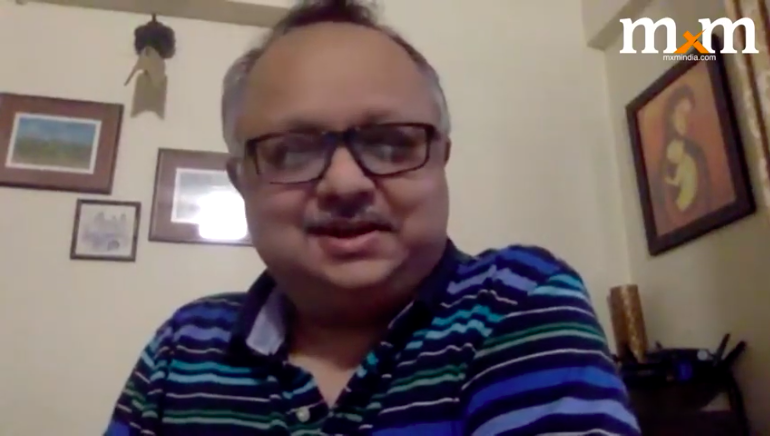
    Partho Dasgupta: Screengrab from Video


    By A Correspondent


    Over the last five-odd years MxMIndia would’ve done over a hundred-odd stories on television audience measurement and central to all of them was Partho Dasgupta, former CEO of BARC India.


    Dasgupta joined BARC in June 2013 and in November last year handed over operations to his friend and former colleague, Sunil Lulla.


    He is now using his experience and learnings to various places in the world, setting up BARC-like entities as an expert. He is also consulting broadcast and new media companies as a management consultant. And overseeing performance management. He of course continues to be President of the Advertising Club.


    Earlier this week, we interviewed Sunil Lulla, CEO, BARC India on the eve of its fifth anniversary. We now speak with Partho Dasgupta, the former CEO of BARC India and get him to reminisce the days before operations began on April 29, 2015.


  • Five years of BARC. Looking Back. Looking Forward


    The Broadcast Audience Research Council (BARC) celebrates five years of operations today (April 29, 2020).


    Many of us know the circumstances in which BARC was envisaged and established, and given that audience measurement doesn’t come cheap, it was indeed wise to have a joint industry body doing the exercise.


    With BARB from the United Kingdom as inspiration, BARC was incorporated in 2010. Operations though took off only after some five years and the first set of data was published on April 29, 2015. In the very year of launch, it also announced rural audience measurement and now measures 185,000 individuals over 44,000 homes, and that number is set to grow to 55,000. Well it was scheduled to, if Covid-19 hadn’t happened.


    Viewership, as measured by BARC, grew 38% till 2019 and a total of 48.4 trillion viewing minutes were consumed in 2019 alone. BARC currently measures 634 channels. The future is bright given that 100 million homes still to get a TV set.


    It’s unfortunate that the celebrations are dampened by an ill-placed recommendations from the Telecom Regulatory Authority of India (TRAI)


    Sunil Lulla, a veteran mediaperson who has worked across the M&E spectrum, took charge at BARC in October 2019. With broadcast – entertainment, news, with advertising and with a large production house. He has also spent some quality with a large digital venture. He spoke with Pradyuman Maheshwari, Editor-in-Chief, MxMIndia on a wide range of issues. Check out the video. It’s nearly 30 minutes. So pull out the popcorn or whatever. And enjoy.


  • On eve of BARC’s 5th birthday (of ops), TRAI issues recommendations on TV audience measurement

    By A Correspondent


    On April 29 (that’s tomorrow), television audience measurement body BARC India (short for Broadcast Audience Research Council) celebrates its fifth anniversary of operations. And before we could sing Happy Birthday and bring out the bubbly, the Telecom Regulatory Authority of India (TRAI) has issued recommendations on the way television audience measurement should happen in India in the form of   “Review of Television Audience Measurement and Rating System in India”.


    Notes a press release: “Several concerns relating to neutrality and reliability of the existing rating system have been raised  by  stakeholders,  which  necessitated  a  need to review of existing Television Audience Measurement arid Rating system in India. A consultation paper was issued in December 2018 seeking comments from all stakeholders.


    After considering all comments received from stakeholders during consultation process and further analysis of the issues, the Authority has finalised its  recommendations.  The  salient  features  of  the recommendations are given below:

    1. Structural reforms are required in the Governance structure of BARC to mitigate the potential risk of conflict of interest, improve credibility, and bring transparency, and  instill confidence of all stakeholders in the TRP measurement system

    2. The composition of the Board of BARC India should be changed as part of the proposed structural reforms.

    3. The Board should have at least fifty percent  independent members which should include one member as a measurement technology expert, one statistician of national  repute  from among the top institution s) of the country and two representatives from the Governments Regulator.

    4. Restructured Board of BARC India should provide for equal representation of the three constituent lndustry Associations, namely, AAAI, ISA and IBF and with equal voting rights irrespective of their proportion of equity holding

    5. Tenure of the members of the board shall be for two years.

    6. Active participation of representatives of the Advertisers and the advertising agency will bring more accuracy, transparency, credibility, arid neutrality in  the  system,  due  to  their  inherent need of advertisers to reach viewers accurately.

    7. The constituent industry associations shall be entitled to nominate their representatives to the board membershlp subject to the condition  that  a  cooling  period  of  4  years  shall  be applicable between two consecutive tenures, for any such nominee member.

    8. Tenure of the Chairman of the Board should not be more than two years. Chairmanship of the Board shall  be  rotated  among the constituent industry associations in every two years.

    9. Number of members in the technical committee should be increased to 5 with addition of two external technical experts

    10. An Oversight Committee should be formed to guide BARC India in the areas of research, design and analysis,  constantly  improving the rating system

    11. The Oversight Committee should have representation from the National Council of Applied Economic Research, IIM, IIT, media research expert and demography  expert,  nominee  from  the Ministry of Information & Broadcasting, and TRAI.

    12. The   Committee   should   also   be    responsible    for nomination/ appointment of independent members  of  the Board as well as to give policy direction to BARC India, if it is so required.

    13. To create credible and accurate collection of data, multiple data collection agencies need to be encouraged.

    14. Competition and multiple agencies for data collection and processing would bring in new technologies, new research methodologies, new methods in  analysis,  new and  better  ways to ensure better data quality.

    15. BARC should be at an arm’s length from its own subsidiary, Meterology Data Pvt Ltd., which is the sole data collecting  agency for BARC, as of now; so that the entire process of measurement is carried out independently to ensure inherent checks in data inconsistency.

    16. Efforts may be made to withhold the  identity  of  the  channel’s name and number while collecting and  processing  the data from the field, to bring more transparency in the complete process.

    17. BARC should also separate its functions in two units (a) one unit should be responsible for prescribing methodology  of ratings/ validation of data, publishing the data and audit mechanism and (b) the other unit for processing the data, watermarkirig or any other such technical work including management of data collection agencies.

    18. Once multiple agencies come forward for rating, BARC should limit its role to publishing the ratings, and framing methodology and audit mechanism for the rating  agencies,  so  that  the number of agencies can develop multiple rating system  leveraging new technologies.

    19. The  rating  agency  should  be  mandated  to  increase  the  sample size from the existing 44,000 to 60,000 by the end of 2020, and 100,000 by the end of 2022 using the existing technology.

    20. BARC shall immediately  conduct a study in collaboration  with   the Indian Statistical Institute or  any  other institute  of  repute,  to estimate the appropriate sample size, and to get the correct representation of the viewership including regional and niche channels. Sample size once increased; i1 will make the data tampering an arduous exercise. On the basis of the study conducted, BARC should reach the target of  reaching  the  sample size in a time-bound manner.

    21. There  should  be  some  financial  disincentives  prescribed   as penal provisions including the cancellation of registration, if the specified target is not met by BARC .

    22. MIB should amend the DTH License and MSO registration so as to mandate STBs capable of transferring viewership data and adoption of RPD technology.  This transfer  of data can be done by establishing a return path / connection from MTB to the remote servers of the Audience Measurement agency

    23. Anonymised viewership data should be transferred electronically to the Audience Measurement agency for statistical analysis and Television Rating purpose. No data from any STB should be transferred to Rating agency without explicit consent from the subscribers

    24. DPOs should be allowed to mutually negotiate the terms and conditions for sharing the data with Measurement Rating  agency within the overall framework prescribed by TRAI from time to time. Such framework shall be prescribed by TRAI once these recommendations are accepted by MIB.

    25. BARC should keep all relevant data such as original data (meter-level data) arising out of the household panel, the data de1eted/ ignored/ not considered for ratings and the resultant processed data for TRP rating at least for one year in the same format and pattern as in the final ratings, declared to the subscribers including Broadcasters, advertising agencies, and advertisers.

    26. BARC should review / frame its outlier policy based on scientific study and market survey conducted from time to  time.  BARC should automate data processing in such  a  manner  that  no  manual intervention is required before the final TRP rating is released. Any type of manual intervention in the meter level / raw data arising out of household panel  must  be  avoided. Manual intervention,  if  any,  in  abnormal  circumstances  should be reported and informed to the auditors also.

    27. Adequate framework for grievance  redressal  may  be  made  having nodal officers and Appellate body.

    28. BARC should get annual audit conducted  by  an  independent agency to ensure conformance with TRP rating methodology-, Sample size, and grievance redressal methodology and  publish audit report on their website after board approval within three months after end of the financial year.

    29. The full text of recommendations is available on TRAI’s website (www.traigov.in)

    Meanwhile, when asked for a statement, a BARC India spokesperson said: BARC India spokesperson. “The TRAI recommendations have only just been received. BARC India is reviewing the same in consultation with its Board and stakeholders.. All Stakeholders from the Industry and the Government and related bodies are aware of the scientific, statistical and technical robustness of the data collated and released by BARC. BARC truly represents all facets of the Industry comprising Advertisers, Agencies and Broadcasters regardless of size, as the Currency of What India Watches. We do not wish to comment at this very early stage.”


     

  • Premium Hindi news audiences watch us, reports India TV

    By A Correspondent


    In all the hullabaloo of weekly television audience ratings, the Prima VU data is also offered by Broadcast Audience Research Council (BARC) is often forgotten.


    And according to India TV, the channel has been ruling the Hindi news channel domain’s premium viewership category. As per data released last week (April 23), India TV rules with 87 million viewing minutes in the three megacities of Hindi speaking markets, Delhi, Mumbai and Kolkata. India TV also tops the chart in the six mega cities put together with 89 million viewing minutes as per the BARC Prima VU report, notes a communique.


    Adds the communique: “Clearly, the data reveal that India TV is the most preferred choice for news in premium homes spread across mega cities in the Hindi speaking market. It enjoys the loyalty of elite TV audience and continues to influence the influential strata of society. In the genre of Hindi news channels, India TV has been topping the charts of Prima VU household data week after week. With a viewership of 514 million viewing minutes during the last 18 weeks, India TV was positioned #1 among all the Hindi news channels, according to BARC Prima VU data collated in the 14th week of the present calendar year.”

  • Forced confinement leading to increase in TV consumption, but…


    By Indrani Sen


    On March 27, 2020 Nielsen and BARC India shared the first edition of their report “Covid-19 Impact- What’s happening in the TV and smartphone landscape” with the industry at large analysing how the lockdown has increased TV viewership in India. In the first week of the partial lockdown from March 14 to March 20 (BARC Week 11), the all-India TV viewership in minutes/week went up by 8% and TV reach went up y 6%. Overall time spent on TV went up by 2%.


    BARC conducts television audience measurement in India while Nielsen passively captures smartphone behaviour through a 12,000 strong smartphone panel. The time spent on smartphones per user also went up by 6.2%. The time spent/user/week on VOD apps saw an increase of 3%. News apps saw 8% more users per week with an increase of 17% in time spent/user/week stimulated by use of non-English News apps (+87%). Gaming apps saw an increase of 2% in users/week supported by 11% increase in time spent/user/week.


    We will look more closely at changes in TV audience behaviour. In Week 11, average daily viewers grew by 32Mn supported by kids, younger age groups and NCCS A. Viewing time for Television increased by over 70 billion minutes in India with each of 592Mn viewers watching TV daily for 3hr 51 minutes. Strangely, there was hardly any growth in the primetime viewership as the growth in viewership was driven by non-prime time. GECs also grew by 32% in non-primetime slots, but saw a 15% dip in the primetime slots which was higher (23%) in the Hindi Speaking Market (HSM) than the south Indian market (5%). An analysis by genres given below show that news, kids and movies gained the most in terms of daily ATS followed by infotainment, lifestyle and youth.


    Last week, Nielsen and BARC released the second edition of the ‘Crisis Consumption: An Insight Series into TV, Smartphone and Audiences’ report of Week 12 (starting March 21) where four days  coincided with the first week of country wide lockdown, showing an unprecedented growth of  298%  in TV news viewership. The increase in the viewership of news channels was accompanied by a 15% growth of average daily free commercial time (FCT) to 6 lakh seconds in between March 21-27 (Week 12) compared to January 11-31, 2020 or the pre-Covid-19 period reflecting last-minute changes in the allocation of TV budgets.


    All the parameters reported by BARC showed increases during Week 12 with the weekly viewing minutes (total number of minutes spent watching TV) touching 1.2 trillion. The number of people watching TV all seven days a week jumped from 32% to 44%, the average time spent per viewer increased 23% from 3 hours 46 minutes to 4 hours 39 minutes. As a result, the total number of channels consumed per viewer in the week also increased from 16 to 22. This surge is TV viewership is expected to continue during the next few days of the nation wise lock down and the spread of Covid- 19 in India will decide its future course.


    It is heartening to see that the news genre has been able to get additional advertising during this lock down period. Kids’ genre, with 20%+ share of total TV viewership and only 3% share of the overall advertising space, has not been so lucky. However, on the whole the prognosis is not good when we look at ad revenue of TV channels in immediate future. Going by the current trends, TV channels will hardly be able to convert this increase in viewership to increased ad revenue. Financial Express reported on March 21, 2020 (https://www.financialexpress.com/brandwagon/coronavirus-impact-ad-expenditure-to-decline-by-50-55-on-tv-between-april-june-2020/1914445/) “As the novel Coronavirus continues to wreak havoc around the world, television is one such industry which is currently under its grip, besides other sectors. According to industry estimates, advertising expenditure on television is expected to decline 50%- 55% to anywhere between Rs 3,750 crore – Rs 4,125 crore between April-June, that is Q1 FY2021 – if the lockdown continues.”


    The economictimes.indiatimes.com reported on April 2, 2020 in similar lines, though their estimate of the loss was pegged at 30-40% than 50-55% reported by Financial Times – “Top broadcasters, media buyers and advertisers ET spoke with, feel that if the situation doesn’t improve by end of April, the TV industry will end up with a 30-40% drop in ad revenues in April and May.” (https://economictimes.indiatimes.com/industry/media/entertainment/media/broadcasters-stare-at-drop-in-ad-revenues/articleshow/74937708.cms?from=mdr)


    While we wait for FICCI-EY to release an update of their report on M&E industry, FICCI’s recent report on the impact of Covid-19 on the Indian economy has predicted that the pandemic will potentially derail India’s growth story by affecting both the demand and the supply side. We are going through unprecedented times when it is extremely difficult to predict even the immediate future.


  • Aaj Tak maxes in lockdown. India Today shines too in megacities

    By A Correspondent


    Only the fittest thrive in times of duress. Similarly, only those news channels that are strong on content and distribution, come out on tops on big news days. As they did in the lockdown period – Week 12 of the BARC measurement period. Aaj Tak came out tops across all channels aired in India. Now this isn’t the first time it has happened. In the past, around the time of the surgical strike and the Abhinandan Varthaman return, viewership for 2+ all-India – the same yardstick chosen for general entertainment channels, the gross impression was 55.5 crore and for the Janata Curfew and Lockdown the weekly gross impressions generated was 66.3 crore. In #2 position in the 2+ segment has been ABP News and in #3 is Republic Bharat. The movie channels follow thereafter, but News18, Zee News and India TV are come thereafter – and all are part of the Top 10. Interesting, the first English news channel is at #240 and the next two are at #350 and #385.

    Amongst English news channels in Week 12, while Republic TV is  #1 in megacities, India Today TV is #2 (22+ M AB). In the three days of the lockdown, while the pecking order at an all-India level saw Republic TV followed by Times Now and then India Today TV, in megacities, India Today is ahead of Times Now. Meanwhile, according to numbers available to us, for a full-day period of Week 1-12 in 2020, India Today TV has been #1 – ahead of Times Now and Republic TV (15+ M, Wk 1-12). In the NCCCS A higher socioeconomic strata, India Today has ranked ahead of Times Now (22+ M A, 07-24 HRS)


  • Television, Smartphone consumption leapfrogs


    By A Correspondent


    The disruption caused by Covid-19 continues to result in television viewership, smartphone usage and video-on-demand (OTT) consumption. Week 12 of the BARC ratings saw Total TV consumption skyrocket. This was determined in the insights provided by TV audience measurement body BARC and research major Nielsen on Thursday. The second edition of the ‘Crisis Consumption – An Insights Series into TV, Smartphone and Audiences’ was presented by the research bodies.


    According to the report, there has been growth in TV and Smartphone consumption across geographies, socio-economic classes and age groups. Television viewing in Week 12 stood at a record 1.2 trillion minutes and the average daily viewers grew by 62 million ad 622 million viewers watched television daily for four hours, forty minutes.


    The lockdown period registered many ‘firsts’ in television viewing history. News and Movies recorded an all-time high growth in viewership, in fact Hindi movies surpassed Hindi GECs The all-India consumption increase was 37 percent over the previous week. Viewership grew significantly post-lockdown on March 25, 26 and 27.


    Being the first week of lockdown there was a sizeable growth in all demographics, thought particularly amongst males. Non-primetime viewership surged by more than 70 per cent, and growth in Hindi-speaking markets was higher than the south.


    While movie channels along with News and Kids grew higher than GECs, the general entertainment channels grew in non-primetime by 32%. News saw a growth of more than 200 per cent. In fact the share of news to Total TV leapfrogged from 7% to 21% at an all-India level in both primetime and non-primetime.


    As for advertising, the average FCT in Week 11-12 grew 15 per cent – by 6 lakh seconds. Week 11-12 saw a growth across genres except for sports and youth.


    On the digital front, consumption of news continues to show a huge increase, and Chatting and Social networking show a significant increase in timespent. E=commerce though has suffer due to difficulties in logistics management in the lockdown


    According to the report, The re-telecast of epicserial Ramayan garnered the highest ever rating for a Hindi GEC show since 2015.


  • News Broadcasters Fed asks ad fraternity for help

    By A Correspondent


    The News Broadcasters Federation has reached out to advertisers with a plea that news channels have emerged as the single greatest source of news and information at a critical time of the lockdown. Adds a communique: “Across India, broadcasters in all languages are doing non stop programming with an almost 100 % focus on battling the Coronavirus and ensuring the success of the nationwide lockdown. Besides the news on the latest figures of corona infected and the degree of spread of the pandemic, news channels have put hundreds of experts, doctors, public health experts, civil and police personnel, and government officials on air in a massive effort to disemminate the right information and counter the barrage of fake news.”


    Said Arnab Goswami, President of the News Broadcasters Federation, in a statement: “At a time when other media can scale down resources and expenses, news broadcasters are scaling up their effort, and going all out to scale up their resources on the ground. We, the news broadcasters of India, consider ourselves as a public and emergency and essential service at a time of national crisis, and are absolutely committed to play our role in ensuring that by reaching out to the largest part of Indias 1.3 billion people, we stall the spread of this dangerous virus. I appeal at this time to all my friends in the media industry, and our partners in all sectors to contribute to the efforts of the news broadcasters by supporting news channels in terms of advertising on this period as a preferred partner in thuis difficult time.”


    The NBF, the communique added, would also like to point out that viewership trends in news channels have significantly risen, as per the latest report on trends put out jointly by BARC and Nielsen on Friday morning. The press note said: “As per the report, the viewing of news channels had gone up in last week by 57 % and Hindi news channels by 67 %. Regional language news channels are also seeing a major spike in viewership and the increase in viewership has been across segments. Interestingly, BARC CEO Sunil Lulla had pointed out during the press conference that even the kids category saw viewership jump in news channel consumption by a whopping 87 % which is a clear indicator that the nature of informative and contextual news programming on battling Covid 19 among news channels is being received favourably across all segments of the TV audiences.”