Tag: anil thakraney

  • Hard Knocks: Do movies need so much hype?

    By Anil Thakraney

    There are two things I will do this Diwali for sure. One is to try my best to make my house soundproof in order to escape the deafening cracker explosions. And two, avoid the other mega explosion: Mr Shahrukh Khan. The man is leaping out at you from every single media vehicle, whether it’s old media or new media. I even fear going to the loo these days, the star may creep up on me there too.

    On a serious note, I wonder if the carpet bombing of the media that SRK and some other producers do really makes a difference to a movie’s fortunes. Khan has, of course, gone ballistic in his marketing and has even done brand promo tie-ups, gaming, merchandise… the works. Not to speak of the PR machinery on overdrive. I am not sure how much the marketing budget for ‘Ra One’ is, but it would be safe to assume it’s at least 30% of the cost of the film, and that’s many serious crores of expenditure. When you consider ‘Rang De Basanti’ scored big with zero marketing and SRK’s own ‘Chak De, India’ made no noise and still went on to be a big hit, you wonder if movie makers are wasting their money. It’s Diwali, a long holiday weekend, and there’s no reason why the janta won’t fill up the multiplexes anyway, especially with Shah Rukh in the house.

    There’s another thing: This level of marketing raises expectations to dizzying heights. And if the movie doesn’t live up to those, it comes crashing down even harder. Recall some of Sanjay Leela Bhansali’s more recent films. As it’s often said, nothing kills a bad product faster than brilliant marketing. So perhaps it makes sense to cut out the marketing expenditure, and invest it into the film’s production. Keep the expectations low, and then surprise and delight the audiences with great cinema. Guess SRK is destined to learn this lesson at a huge price.

    As for me, this 360 degree blast for ‘Ra One’ ensures I keep 180 degrees away from the multiplexes. I can only handle that much noise. Good luck to SRK!


    ***


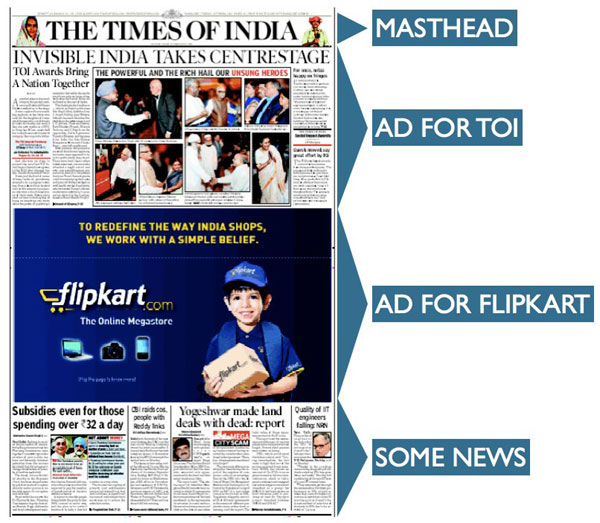
    PS: One media ‘innovation’ I totally detest is the half-page cutout ads in the newspapers. Where the front page of the newspaper arrives half. This makes it very unwieldy and painful to hold the newspaper. Perhaps the new press council head, Mr Katju, should clamp down on this malpractice. Paid news I can live with (it’s easy to smell it out). But not deformed newspapers that are a struggle to deal with.

  • With animals, what you see is what you get. With human beings, it’s more complicated


    Make no mistake about this: Lynn de Souza has a soft, warm, chilled out, happy exterior. But inside that resides a steely, tough, hard-edged professional. And she needed all that internal strength to survive and thrive in an industry notoriously dominated by what she calls the ‘Old Boys Club’. Lynn and I go a long way back, and this made our conversation frank, fun and, yes, highly argumentative. And we discussed many issues ranging from the dubious media research, the future of various media, her role in promoting gender equality, her formula for cleaning up the otherwise scandalous Goafest. And why she, er, chooses dogs over men.  


    By Anil Thakraney


    What’s your exact job portfolio at Lintas?


    I look after Lintas Media Group, and our subsidiaries Karishma Initiative, Aaren Initiative and Lin TV. LMG and Karishma are media agencies, Aaren Initiative is the largest OOH agency and Lin TV produces and distributes branded content. I am responsible for their overall financial and reputation, health, corporate governance, etc.


    Who do you report into?


    Michael Wall, the global CEO of Lowe Worldwide.


    Would you not like a global role now, having been there and done that in India?


    Have I been there and done that in India? I don’t think so. India’s potential story is not even the tip of the iceberg, and I haven’t even travelled the whole tip yet! I would love to have a global role that is based out of India, because this is where it’s all happening. I am fiercely proud of India and all things Indian and it’s our time to show the globe a thing or two. We don’t need to be sitting in Manhattan or London to do that, in fact, that could be counterproductive.


    Would it be correct to say you’ve reached the top of the Indian media peak?


    More like the bottom of the ocean, which has the most beautiful creatures and colours in the world. There are so many challenges ahead, so much to learn and so much to do. Our lives as consumers of media are being transformed so rapidly it’s really hard to keep pace, and this rate of change is even faster in an emerging market like ours. What we thought we knew yesterday is no longer relevant today, and what we think we know today will not be relevant tomorrow. The only people who can be on top of all of this are those who want to keep learning and keep evolving and keep travelling. There is no place for those who think they have arrived.


    What’s your goal for the next 10 years? What else would you like to achieve?


    Goals are for footballers and 20-year-olds. I don’t have any. I am just happy to be alive, to have a wonderful family, to work with some awesome people, to have a few good friends, and to do my little bit for my four legged friends. I take each day at a time, that’s all, and just try to do the best I can for that day, honestly. When I was young, I did have plans and was ambitious, too ambitious. My values have changed. It’s important to be good at what you do, but it’s also important not to be so good that you become bad for everything else around you.


    Key challenges ahead for the media buyers.


    Look beyond the colour of money to the colour of advertising and media content, and the kaleidoscope of consumer insights. Get away from the keyboard and play some real piano now and then. Visit places they have never been to, in reality, and not only on 3G. Meet and talk to people from all cultures including, especially including, our villages in the length and breadth of our country. Data will never be a substitute for reality and as long as we hold on to it for dear life, we will continue to reduce the value of the media, and the consumers they deliver, to the lowest common denominator – a CPRP.


    Are our creative people ready for the new media? And the clients?


    I think the younger ones are. I have been meeting a lot of independent digital agencies recently, and it’s always great fun to meet their founders – usually young creatives and techies who have left traditional agencies and employers to write their own dreams and ‘apps’! You would also be surprised how many clients are now taking to what you call ‘new’ media like fish to water. There are lot of questions and uncertainties and domain knowledge issues of course, but there is no dearth of desire to learn, because user technology has become so easy and enjoyable that once they use the digital spaces for themselves, they want to start using them for their brands.


    Was media unbundling a good thing? You pioneered it.


    It was the best thing to happen to the media function. Till then, media planners were languishing in the backrooms with their big red NRSs and estimates, always at the tail end of a presentation and often sent home without even presenting. Making the function profit seeking in its own right attracted the right kind of front-room talent, investment in tools and databases and the ability to then cope with a magnifying media world. Which industry has seen such an explosion of new offerings in such a short time – 600 TV channels, 70,000 print titles, 350 radio stations, and countless websites, all in 15 years or less? Unbundling has allowed us to specialize enough to cope with this growth, possibly even enable this growth.


    Predict the future of the print media in India. Newspapers are shutting down all over the world.


    You need to separate form from content. Newspapers abroad have digital versions that have a much larger following than the newsprint version. I read the NY Times every day because the reading experience is so enriching, it doesn’t matter that I don’t live in that city. As long as people have eyes, they will read, and as long as they read, there will be something delivering the news to them in a written form… in newsprint or cyberspace, or Kindles, how does it matter? About India, do you know that the highest read newspaper in the world is a Hindi daily? Regional language papers have trebled in readership in the last ten years. Tier two and three cities, where literacy is still not even 70% and growing, register the highest growth.


    And what about television?


    TV will be fully digitized very shortly and this means that the convergence of content across digital broadcast, web and telephony platforms is almost here. My agency is already producing content for television, re-purposed for mobile, and developing web apps to go along. As are many others. Consumers follow and lead content, so to track them and predict their behavior will be very important, our measurement systems will need to keep pace and adopt new technologies to capture, retrieve and analyze data.


    There are too many complaints about media research in India. What can be done to change things?


    There’s an overload of data in some aspects. We have different data sources for different media. And there’s no one single source available. That’s why many of the media agencies invest in their own studies. We have our own, for example. What worries me is that nobody’s looking at the future. So that we have future-ready research which is truly centered around the consumer. I told the IRS people that they need to think ahead. They have a 10-year-old way of collecting data and that has to change.


    Also TV viewership measurement.


    That’s why you can’t recommend media only on that basis. Which is why a lot of us have our own proprietary research which picks up a whole lot of other aspects. You cannot rely only on these data sources.


    That’s no solution. We need few but reliable research studies which the whole industry can follow.


    It’s not necessary for everything to be done at the industry level. You do things at an industry level when you want a currency. When you want a common parked research where both the buyer and the seller access it, so it becomes a currency. But if you want to do things that are genuinely good for the brand, you develop a whole lot of other proprietary studies, which many of us do.


    Lynn, frankly I am disappointed with you. You’ve spent a lifetime in the media industry, you’ve done it all, you’ve made your money. Isn’t it time for you to think of the industry and take on the challenge of reforming media research so that everyone benefits?


    If I did that, I wouldn’t say it to you. If I had any ambitions that I want to change something, I would quietly go about doing it my way. Three years ago, I didn’t want that there should be two research agencies, the IRS and the NRS. I was sitting on both the committees and I found both doing the same things, both saying the same things, so I said why can’t they be together. So quietly, at both meetings, I would suggest let’s have only one study. It took three years of doing this before the RSCI got formed. They’ve elected me as the first Chairman and we had our first meeting only last week. I am hoping we will change the readership agenda of this nation. Print is still the largest medium in India, and if the RSCI works out, we will make a big change. But I won’t thump my chest and say ‘Hum yeh kar rahe hain, hum woh kar rahe hain!’ (Laughs.)


    Not enough. You should take on media research full-time, and become the Queen B who made a huge difference.


    (Long pause.) I promise to give it a serious thought just to please you. (Laughs loudly.) But I will not commit to anything you wish me to commit to!


    You’ve cleaned up Goafest. There were no scandals this year. How did you do it?


    I am a great delegator. And I give a lot of respect to people I delegate to. So we had Shashi (Sinha) completely given the role of running the awards. I gave Sundar the role of running the conclave. I looked after the organizing and the venue. The most important thing I did for Goafest was to create an impression of being clean. I looked for a very clean looking place, I changed the venue itself. So it looked fresher, cleaner, greener. That had a very subtle effect. Then, I roped in the ASCI and the IAA with the responsibility agenda on the first one and the sustainability agenda on the second one. That gave the impression we are doing something good for the industry, and not just pampering creative egos.


    How did you handle the problem of self-voting?


    Shashi led that and he did a fantastic job. People were not allowed to self-vote. One or two individuals who were supposedly high on self-voting in the past were not included as judges this time.

    But Lintas still won’t take part in the awards…


    We do not have any confidence in the awards given by our peers. I was given a job to do, to chair Goafest. I was forced to do it, and I did it to the best of my ability. But that’s different. You know, I served at the Cannes media jury in 2009 and it was a fantastic experience. It was professionally run, it was technically advanced. I have served on the Indian juries as well, and it was nonsense, though am sure this time around they did a better job. I have seen the behaviour of our peers, the kind of lobbying and planning that goes on. As an agency we are not into chest-thumping. But when our agency wins awards because our clients have won, I value those because the consumers voted us.


    But now that you’ve cleaned up the place, will Balki take part next year?


    That you have to ask him. But it has to do with the value you place behind awards. Not everyone thinks awards are the best thing in life.


    Looks like you’ve fallen in line with Balki’s ideology.


    (Laughs.) On the contrary he may be falling in my line! We have our own independent reasons.


    What’s this about women’s rights you’ve been promoting?


    Internationally, diversity and inclusion is a big agenda. As a part of that agenda, two years back, IPG asked me to set up and lead the women’s leadership network. Initially I refused. I didn’t think there should be segregation of any kind. Later I studied the subject in detail, and I realized there’s a very powerful economic reason why you have to support women. There are three ‘Ws’ that will transform this century: Web, Weather and Women. And the power that women are exerting on this century is enormous. It’s said if women were empowered at Wall Street in 2009. things wouldn’t have been the way they were. In India we have 29 women heading banks and financial institutions. So there is an approach that women bring to the table that improves the productivity of a team. So it’s important to keep and retain women. At IPG, 30% of our staff are women, and when you come to the top, it’s just 11%.


    How do we change this inequality?


    We need hardcore practices in place. We can have a hiring quota set aside for women. I believe last month Hindustan Lever hired only women. We need to make everybody conscious we are not doing anything special for women. We have to make men and women understand that when you work together, you do well. For example, Coca Cola has something called the ‘Power of 3’. They believe that in any big team, the minute you have three women in the team, the group becomes far more productive. And if you have just one woman in the team, she gets eaten up.


    But Lynn, women falling out along the way is a social problem. Babies have to be looked after. How will you change that?


    You try and keep them engaged in the work orce. Some of the things we’ve done include giving them the option to work from home when they are pregnant. By giving them a desktop mirroring system at home. That’s literally like working in the office. There are lots of such ways in which you can keep women productive even if they have babies.


    Personally, I am quite cynical about this whole thing. You can’t change deeprooted beliefs and attitudes so simplistically.


    Anil, you are basically cynical about everything! Anil ‘bloody cynical’ Thakraney! (Laughs.)


    Why are all ad agencies headed by men?


    In the creative agencies there is a very strong old boy’s club. It’s very difficult for women to break through into that club. And if they don’t play by those rules, they will not break into it. Read my blog on this (link).

    Exactly why were the 3As of I guys giving you stress? Why didn’t they want you in?


    (Long pause.) Because I am clean.


    You found corrupt activities going on?


    (A longer pause this time.) No comment.


    One rival media chief you admire.


    Sam Balsara. He’s awesome. A hardcore desi boy with so much energy, he does so much.


    The best boss you’ve had.


    Ravi Gupta. And Steve Gatfield.


    One thing you learnt to do from Roda Mehta?


    Two things. Precision and integrity.


    One thing you learnt NOT to do from Roda.


    (Thinks.) Over-precision. Beyond a point you have to just let it go, you don’t need perfection.


    Roda didn’t just do the media job, she built the media planning and buying industry in India. None of you guys have been able to do that. She was a game changer.


    It’s not needed. You don’t need a crusader in today’s world. You need inventors and innovators. In today’s world we need enablers. Twenty years ago it was different, it was the licence era, there were strictures and rules. Today there’s far more freedom. No one wants a crusader. Everyone wants an enabler.


    Would it be correct to say you love dogs more than men?


    (Laughs.) Why only dogs, any animal. With animals, what you see is what you get. With human beings it’s more complicated.


    Is that the reason you are still single?


    No, it has nothing to do with that. I didn’t find anyone as intellectually stimulating as… my dog! (Laughs.) Are you happy to hear that?


    Have you watched Balki’s two films?


    I haven’t watched ‘Cheeni Kum’ yet. And Balki hasn’t forgiven me for that. But he sent me the ‘Paa’ DVD, and I really liked it. I didn’t watch the last five minutes of the film though. Because I wanted to make my own ending. I wanted the character to live. So I made him into a dog. (Laughs.)

  • Hard Knocks: Katju’s unreal expectations

    By Anil Thakraney


    The Chairman of the Press Council of India, Justice Markandey Katju, reminds me of a very strict uncle. You don’t mess with the guy. You quietly listen to him and obey his orders. Or else get ready for some nice punishments. Katju thinks the Indian media tends to be irresponsible, that it’s not doing its job, which is to serve the people. That there’s too much of celebrity journalism. And yes, he gets really riled on the issue of paid news. And yes, he wants to change things around. By carrot or by stick… whatever it takes.


    Of course the man’s heart is in the right place, and he means well. And good luck to him in his mission to clean up the desi media houses. But am afraid it’s not going to work. This issue is too complex and layered to be solved by Katju’s simplicity and good intent. And even threats of punishment won’t work. Here’s why.


    Broadly speaking, the Indian media is run by proprietors and not by editors. Let’s be clear about that. So however honest and diligent the editor might be, the control room is really run by the owner of the publication or the TV channel. And these people are businessmen. They don’t worry about public service, they are focussed on return on investment. They are not in the game to make India a better place, they are here to liven up their own balance sheets. They are not saints, they are suits. In this scenario, dodgy practices is a sad but logical outcome. Because there is too much competition in the mass media. Hundreds of channels and thousands of print brands are chasing the same ad pie. In how many ways can you divide one cake? Mouths have to be fed, no? This then results in excessive celebrity coverage. What to do, everyone wants a piece of SRK! And irresponsible journalism. How can you get eyeballs by following boring rules in the news room? And yes, paid journalism. If the advertisers aren’t gonna entertain me, I have to find other revenue channels, thank you very much.


    Anyway, good luck to Mr Katju. He deserves no less than a Nobel if he can clean things up out here.


    ***


    PS: It’s common sense to me, but I don’t understand why the TV chiefs don’t get it. The ONLY reason some goons hurl chappals and rain punches on important people is to get noticed, to get their 15 minutes of fame. And beaming their actions on screen is playing right into their hands. Just don’t feature these incidents, simply report them. Is that so difficult to understand? There are other ways to get TRPs. Try SRK!

  • Anil Thakraney’s Debrief: Wacky and effective!

    Apparently you can purchase many goodies at a new portal called Yebhi.com. (I like the brand name, very imaginative.) And ‘great rates’ is their USP. To communicate this promise, they have come up with a completely hilarious ad.


    There’s this lucky dude who’s hit a gold mine. Nearly electrocuted at an ATM machine, his daddykins goes through a magical transformation. The ol’ man now coughs out currency notes. In other words, he’s become an ATM machine himself. Naturally, his loser, good-for-nothing, wastrel son is elated. And the lad goes on a mad shopping binge, with his ATM daddy coughing away wads of rupees. Great idea. Every loser’s dream come true. To have a dad who’ll keep showering money, no questions asked.


    And the execution is wacko, it’s full-on entertainment. Full marks, I say. For a new online shopping portal, it’s critical to come up with a clutter-breaker, which Yebhi has done. Also, the message is single-minded: You don’t have to be a lucky son to get lucky at Yebhi. Should get the portal lots of hits.


    [youtube width=”400″ height=”300″]http://www.youtube.com/watch?v=oWpNrrImxbA[/youtube]
    Rating: (On a scale of 1 to 5): 4. I would have given it 5 if they had featured a mantri’s son. In which case the daddy works like an ATM just by winning an election. No need for electric shocks! 


  • Anil Thakraney: No Sahara for hockey

    Must say I am quite confused why the Sahara Group would want to invest in Formula 1, an extremely niche, up market, Page 3 sport. Sahara, at least to my mind, has always had the image of being the aam aadmi’s organization, and their association with Indian cricket for all these years is par for course. And suddenly, out of the blue, they tie up with Mallya’s UB Group, and invest a whopping $100 million in the F1 team.

    Yes, every corporate has the right to decide where it parks its monies. And I can understand Mallya’s interest in F1, not just as an extension of his own flamboyant, high profile personality, but because of all the booze brands he owns. However, in Sahara’s case, the F1 investment seems a bit out of character. Almost like a ‘wannabe’ decision, so to speak. How much value they’ll eventually get out of the association remains to be seen. And am not sure if Sahara will acquire the image they probably desire.

    But the real pity is this: One sport that’s crying out for serious investment in India is hockey. Not only is it our national game, it’s a sport that connects with the masses. It may be dying because of little support from the corporate sector and the sports associations (the players have to demand meager prize monies when they win big tournaments!) but it’s still the aam aadmi sport. And this is where a company like Sahara ought to have shown interest. Not just for noble reasons, but also because they can own hockey, promote it, and make it their own. And capitalize on it once the popularity grows again. In any case hockey, in terms of branding, connects well with Sahara’s image. (By the way, I am aware the group has pitched in with prize monies on occasion for the hockey players but it’s not the same thing as owning the sport.)

    The hard truth is this: US$100 million may have been invested. But F1 in India will always be perceived as a UB Group event.


    ***


    PS: Must read. An open letter to Barkha Dutt by a blogger. Good points on why social media needs to be taken seriously.


    Link: http://marchingonthesand.wordpress.com/2011/10/16/open-letter-to-barkha-dutt/

  • Anil Thakraney: Brand SRK needs help

    Celebrities are brands. And just like detergents, condoms, noodles and cars, they need to build and nurture their brand image. Because that’s what ultimately decides their performance in the market place. People like to be associated with desirable brands. And that’s also the reason advertisers like to associate their brands with celebs. To have the values of the celeb brand rub off on their own brands.


    When I examine how Shahrukh Khan has been going about building his own brand of late, it kind of confuses me. Clearly the actor isn’t really thinking out here. Let’s first study his movie brand. Instead of competing with Aamir Khan, and experimenting with new forms of cinema, he seems to have made it a mission to target Salman Khan. Perhaps in reaction to the success the latter has enjoyed with his recent mindless action films. SRK is now taking his brand into the ‘Mine is bigger than yours’ space. Completely ignoring his own core brand strengths, which is the soft, vulnerable, caring, sensitive, romantic persona… the image that endears him to his fans… and is now trying to compete with a macho star on values alien to him. I really have a bad feeling about the so-called India’s most expensive film Ra One, and its debacle will hurt the SRK brand considerably.


    Next, his choice of brand endorsements and his performances in them. You’ll notice glaring fault lines here too. Not only is there no attempt at being discerning, which once again Aamir Khan is, SRK agrees to endorse just about anything that comes his way, and acts the same in every commercial, convinced the buyers will buy into whatever nonsense he does on the screen. Frankly, it’s embarrassing to watch him in ads for Hyundai i10, Linc Pens, Videocon and many others. There’s another cringeful ad he’s done with wife Gauri (it’s so silly, can’t even recall the brand name). Guess baniyan and chaddi brands are next up. If this continues, and his movie career stagnates, SRK will find the going quite difficult.


    Celebs, like all brands, must fiercely guard their value. So that it remains powerful, relevant and enduring. The hit-and-run approach won’t work. Guess SRK badly needs a brand manager.


    ***


    PS: Watch this brilliant ad from Pro Infirmis, a Swiss organization that supports handicapped people. THIS is the way to use emotion in advertising. A big hug for the creator of this advert.


    [youtube width=”400″ height=”300″]http://www.youtube.com/watch?v=zFWr-CKMWGY[/youtube]


  • Anil Thakraney’s Debrief: All you need is…

    The Honda guys have finally realized there’s an aam aadmi in the Indian market. So they’ve launched a hatchback called Brio, and it’s affordable. (Jazz, their other hatchback, is much too ridiculously priced… one can buy a nice sedan at Jazz’s price point.)


    The positioning for Brio is rather interesting… ‘Brio loves you back’. The commercial features a guy and his girl romancing. At the same time, the bugger also romances his Brio. This love-all saga goes on till the poor guy discovers his lover has been cheating on him. But instead of burying himself in booze, he returns to his car. Why? Well, because as the ad says, Brio loves him back!


    Despite the fact that the desi middle class doesn’t buy cars for love… they buy them mainly for economy and resale value… I think the concept of love does have potential. But the execution messes things up, because it’s a convoluted tale. The ad has to establish love between the two human beings. Simultaneously runs the story of the chap’s love for his car, and this requires many car shots to be showcased. And in this dual love story, things get rushed through, the cutting is too fast, and the victim is emotion. And what’s love without emotion?? You only see a mish-mash of many visuals. To make things worse, the video don’t sync well with the languid, easy paced background score.


    Bottom-line: Promising idea let down by a not-very-smart script.


    [youtube width=”450″ height=”250″]http://www.youtube.com/watch?v=CQJ4OOupGHE[/youtube]
    Rating: (On a scale of 1 to 5): 1.5. Didn’t feel the love.


    Anil Thakraney’s ad review column DeBrief appears twice a week.


  • Anil Thakraney’s Hard Knocks: The damned misleading adverts

    So, finally the government has woken up on the issue. No less than the Prime Minister’s Office (PMO) has gotten into the act. The plan is to come up with policies that can control the malaise of misleading ads.

    Well, to be honest this should have been done a long time ago. The Indian mediascape is lined with ads that make false/exaggerated promises. Health drinks that will make your child grow tall. A magic lotion that will sprout hair on that bald pate. Cars that give you outstanding mileage on Indian roads (wow!). The dubious list is long.

    Yes, the ideal solution is self-regulation. But it will never work, there are just too many brand managers ready to play mischief for that extra market share point. Therefore unfortunate though it is, we do need some powerful and implementable regulation in force so that consumers don’t get fleeced.

    However, and this is the crux of the problem: More than policies, we need hard punishment delivered to the offenders. Because penalties for misleading ads are very light in India, it becomes tempting to cheat. In the US, consumers can file for huge sums in damages if a brand has lied to them. And they do often get rewarded with the big bucks, and quite swiftly too. This ensures that brand managers think many times before misleading their consumers. In India, harassed grahaks have to do a lot of legwork at consumer courts; and even when the ruling is in their favour, the compensation is a pittance.

    So let’s have the regulation in place by all means. But there needs to be severe penalties spelt out to discourage mischievous marketers.


    ***


    PS: Ads for cars have seen a sudden surge; almost every other commercial is for a gaadi these days. Guess sales are down because of massive hikes in price of petrol and diesel, and there’s a bit of panic in the auto companies. But instead of offering cash discounts and other usual freebies, why don’t they offer schemes like ‘Free 10 litres petrol every month for one year’. That’s actually just Rs 9,000, but it could strike a chord with a junta reeling under murderous fuel price hikes.

  • Anil Thakraney’s Debrief: Very touching

    Brilliant start by Cadbury to the Diwali festival season. Their new ‘Lonely Maa’ commercial tugs at the heart-strings. It’s a simple treatment. An elderly lady is seen struggling with the computer to connect with her son who lives in another city/nation. And that insensitive chap only communicates with her via the web. Because he’s too busy focussing on his career. The poor lady isn’t able to log in, accidentally spills tea on the comp, and looks utterly lost, dejected and lonely.


    Outstanding. And here’s why: The chocolates aren’t rammed down our throats, the brand comes across as this nice, gentle soul who reminds you of your responsibilities. This endears us to Cadbury. The insight is timely and relevant. Many youngsters give their careers top priority, and find no time to spend with their aged parents. And they imagine that virtual connect is good enough. It isn’t! And most importantly, the treatment. The film is executed with so much heart, as a viewer, you badly want to reach out to the old lady and comfort her. Help her. Take care of her. And this is how brands build an emotional bond with their consumers. Way to go!


    I would be very surprised if this ad doesn’t win many trophies.


    Rating: (On a scale of 1 to 5): 5. This is what advertising ought to be.


    Anil Thakraney’s ad review column DeBrief appears twice a week.

  • Anil Thakraney’s Hard Knocks: A problem called film publicists

    Part of my work involves doing big, detailed interviews with movie stars. And meeting these mighties is often a tedious process. Interviews get cancelled at the nth hour, or the star will arrive hours late for a pre-arranged meet. And therefore instead of it being a routine story, the ritual turns into an exercise in testing one’s patience. Of keeping your cool. Most filmi journos, for whom actors and directors constitute a regular beat, have reconciled with the waiting game.


    Though I must mention that an interview with Amitabh Bachchan starts sharp at the appointed time. On the occasions I have met him, I never have had to twiddle my thumbs. So if the ultra-big and the ultra-busy Big B can be so disciplined, it makes you wonder about the younger stars. Perhaps they get some jollies out of making journalists wait? Or they are simply disorganized folks, and haven’t been brought up to value other people’s time.


    And what makes things worse is the role played by the star’s PR agent or Publicist (or whatever fancy title they’ve acquired these days). Except for very few senior agents, who are a little more professional, I have often had rotten experiences with these front men and women. The job of representing movie stars (and close proximity to them) seems to give these people a false sense of self-importance. And the boom in the media, which also means a boom in celeb journalism, has resulted in too many journos chasing these PR agents with interview requests. And this has made the fronters feel even more powerful.


    The PR agents are often abrupt and rude. Indisciplined too, perhaps influenced by their bosses. And their egos massively inflated because they believe they ‘own’ the stars. As journalists, most of us have learnt to live with these ‘obstacles’ enroute to meeting the actors. Some junior reporters even indulge them, so that interview requests don’t get turned down, and gossip about rivals keeps pouring in. And the show goes on, as it should.


    But a few of them have gotten so drunk on their access to celebrity, they refuse to leave the room even AFTER the interview begins. They continue to hover around like a nasty presence, like ghoulish shadows. Completely ignoring a basic principle of journalism: That the best interviews (at least for the print medium) happen one-on-one, and it’s in their interest if the discussion with their bosses is insightful and meaningful. I have had PR agents politely evicted from rooms, but some die-hards still won’t get it. They’ll hang around despite being ticked off.


    I hope one day we see some degree of professionalism come into this job. So that meetings with film stars can be a joyful ride. And not a pain in the you-know-where, which it often is.


    ***


    PS: My best film interviews, in my own judgment, have so far been with Amitabh Bachchan and Shah Rukh Khan… in both cases there was no middle person involved. And with Aamir Khan and Kareena Kapoor, because their agents were wise enough to leave us alone.

  • The Anchor: Anil Thakraney’s 4 reasons why Steve Jobs was so special

    The entire world seems to be in collective grief over the death of Steve Jobs. As if people have lost someone close. Does it make sense? When you consider he was just another businessman out to make a lot of money. And there are thousands of very loaded industrialists all over the world. Most of who we don’t care much about. And Jobs, unlike rival Bill Gates, wasn’t even big on charity work. So then why do we all adore him? Even those of us who have never touched an Apple product in our lives. (I certainly haven’t.)


    There are many reasons behind the cult of Jobs. Here’s my little list on what made the man so special. And my reasons actually lie within Apple’s own legendary ‘Think Different’ advert. It’s as if the script was written with Jobs in mind. Businessmen and industry leaders must pay close attention to what it takes to catch consumers’ hearts and minds. From across the world.


    #1 Because he was a rebel: Jobs did not conform to the industry standards, nor did he try to surpass them. Instead, he showed them the finger. He was a true inventor, a visionary, who believed he could do it his way. Self-belief was at the heart of his success. And that’s how a lad working out of a car garage went on to build an international tech empire.


    #2 Because he didn’t just make and market products, he pushed the human race forward with his bold innovations. Product innovations that are not just technologically marvellous, but are slick and aesthetically rich. Consumers don’t just wait for a new Apple product. They queue up for it. They save up for it. They dream about it. Jobs never short-changed his buyers by taking short-cuts. He thought big. He delivered better.


    #3 Because instead of throwing out the ‘square pegs in the round holes’ from his organization, he trained, nurtured and cherished the misfits. He saw the genius in his crazy, offbeat employees. He knew he needed people who thought differently, if his vision for Apple was to come good. Look around you… very, very, very few leaders in the corporate world are capable of such an ideology. That’s why we have just one Steve Jobs.


    #4 Because he genuinely, passionately believed he could change the world. And he did.


    Links: The unforgettable Apple advert.
    [youtube width=”400″ height=”250″]http://www.youtube.com/watch?v=4oAB83Z1ydE&feature=related[/youtube]
    A touching tribute to the tech king.
    [youtube width=”400″ height=”250″]http://www.youtube.com/watch?v=XzWft8ZtTTY[/youtube]

    ***


    PS: Apparently there’s a TV journalist called Mandeep Something inside the Bigg Boss mad house. And she wailed on national television that she hasn’t gone to crap for four days. If a journo is doing stuff like this, can we really blame the other bimbettes on the show for all the nonsense? Anyway, guess now you know why it’s called a crappy show.

  • Anil Thakraney’s Hard Knocks: The Bitch Boss

    This completely ridiculous reality show is now in its fifth season. Five, five, five, five… as the hosts Sallu and Sanju very irritatingly croon. Therefore how much ever many of us loathe Bigg Boss and its floozy contestants, we have to grudgingly admit the format works. It’s also worked in the western nations, where the show is called Big Brother.


    The serial is totally dumb in its content, and that’s by design. Because it is targeted at the low-brow viewers, and there are plenty such in every nation. People who look for cheap laughs after a hard day’s work, and particularly enjoy it when the contestants slam and abuse each other. Which is why the channel and its producer only pick people with shady backgrounds and aggressive demeanour…. even retards will do… as they are most likely to clash with each other. In fact, even to be offered a part in Bigg Boss is tantamount to a grave insult.


    It’s very tempting for me to trash Bigg Boss five, five, five, five, five. It’s a sitting duck for ridicule. Examine the fantastic star cast: Twelve dumb chicks, one transvestite and one confirmed sex pest. And two hosts, both of whom face criminal charges in assorted cases. And that’s just the start.


    But I have decided to hold my fire, grab some beers and catch the demented action whenever I can. Because the hard truth is this: There’s a big market out there for this sort of crap. And you can’t argue with business and TRPs beyond a point.


    Ganda hai par dhandha hai, as it’s often said.


    ***


    PS: Found this image floating on the net. A good example of how valuable readers are to the publishers of the TOI. And the irony is that just a few days back the newspaper was gloating over its rising readership!