The Advertising Standards Council of India (ASCI) has launched the #ChupNaBaitho, a call-to-action digital campaign, to create an awareness about objectionable advertisements and encourage consumers to report such advertisements. In the three-month pilot, ASCI will focus on Mumbai and New Delhi.
Said Manisha Kapoor, Secretary General, ASCI: “One of ASCI’s key objectives is to turn consumers into allies. We want them to be more aware of their rights and what constitutes objectionable advertising. We want them to report such claims to us and we promise to act quickly and decisively on such complaints. The overall goal is to drastically reduce the number of misleading and objectionable advertisements. Over the last few months, we have introduced several guidelines, reports and advisories like the ones on COVID-19 advertising and Online Gaming for Real money winnings. The Trust in Advertising report that studied how much faith consumers have in advertising is another example of how focused we are towards protecting consumers. #ChupNaBaitho is another step towards this goal. We want to encourage consumers, especially the youth, to report advertisements that they find objectionable. This campaign is just the start and will be followed by other such initiatives in the year.”
In August and September 2020, the Advertising Standards Council of India (ASCI) reports that it has looked into complaints against 317 ads, of these 64 were “promptly withdrawn by advertisers on ASCI’s intervention”. The independent Consumer Complaints Council (CCC) of ASCI evaluated the remaining 253, of which complaints against 221 advertisements were upheld. Of these 221 advertisements, 101 belonged to the education sector, 77 to healthcare, eight to food and beverage, seven to personal care, three to finance and investments and 25 were from other categories. Complaints against 32 advertisements were not upheld as they were found to not be in violation of the ASCI code.
Notes a commuique: “In August and September both, the education sector saw a sharp rise in institutes making misleading and false claims in their advertisements, claims such as top of their field, Ranking No. 1, 100% job placements, best institute, 100% passing rate, were the most used claims that violated ASCI’s code. One online learning app claimed to be the best and pioneer of live online classes. Many educational institutions didn’t have substantial data and surveys to support the claims they were making and the CCC recommended that these advertisements be declared misleading. ASCI also upheld misleading ad claims made on various digital platforms like Instagram, Twitter and Facebook.”
Said Manisha Kapoor, Secretary General of ASCI said: “Covid-19 related claims as well as misleading education claims continued to dominate the kind of complaints we received at ASCI during this period. The independent Consumer Complaints Council (CCC), which comprises members of civil society as well as industry, jointly view such advertisements and adjudicate. The CCC goes deep into understanding the underlying complaint and the advertiser response and justification before an opinion is given. ASCI’s only goal is to promote responsible advertising which safeguards consumers.”
The Advertising Standards Council of India (ASCI) has issued a statement following a decision on the complaints received against the Tanishq advertisement. The complaint that the ad was objectionable “since it promoted communal intermingling”, as per an ASCI communique.
Added the ASCI communique: “The advertisement in question was viewed at ASCI by an independent multi stakeholder panel – The Consumer Complaints Council, which balances view points from industry, civil society, lawyers, consumer activists as well as domain experts. This panel was unanimous that nothing in the advertisement was indecent or vulgar or repulsive, which is likely in the light of generally prevailing standards of decency and propriety, to cause grave and widespread offence. The complaint was not upheld, as the advertisement did not violate the ASCI codes of honesty, truthfulness and decency in advertising. Therefore ASCI has no objection to the airing of this advertisement, should the advertiser choose to do so.”
In the months of June and July 2020, the Advertising Standards Council of India (ASCI) investigated complaints against 363 advertisements, of which 76 were withdrawn by advertisers. The independent Consumer Complaints Council (CCC) of ASCI evaluated remaining the 287 advertisements, of which complaints against 257 advertisements were upheld. Of these, 150 belonged to the healthcare sector, 40 to education, 20 to food and beverages, 4 to GAMA complaints, 12 to personal care and 31 to the other category.
Subhash Kamath
Said Subhash Kamath, Chairman of ASCI: “There has been a flood of advertisements with dubious claims about COVID-19 cures and preventions. Especially at this time when consumers are feeling more vulnerable about the virus, it becomes more important for us as regulators to ensure that these ads don’t exploit the consumer’s anxiety. We understand that such claims can adversely affect consumers and we are committed to work closely with the Ministry of Ayush to help eliminate such malpractices from society.”
Last Thursday, September 10, CEO of BBH-Publicis Worldwide Subhash Kamath was unanimously elected Chairman of the Advertising Standards Council of India (ASCI). We interviewed him a day later as part of the MxM Live Leadership Series, and Kamath was, as always, his candid best. But first a disclosure, I have been a part of ASCI’s Consumer Complaints Council for a few years, but that I must tell you is purely coincidental.
A little about Kamath: He has been in the business of building brands for over three decades (32 years, to be precise), 22 of which have been in senior leadership roles. Over those many years, he has worked in renowned creative agencies in India like Ogilvy, Trikaya Grey, Ambience Publicis and Bates 141. He was one of the founding Managing Partners at BBH India in 2009 and currently serves as the CEO for BBH & Publicis Worldwide, India which is part of the Publicis Groupe.
Kamath has been an active member of The Ad Club in the past and has served on the Board of Governors of the Advertising Standards Council of India (ASCI) since 2010. He plays in a rock band called ‘Wanted Yesterday’, and is crazy about cricket, single malts and good food.
The Advertising Standards Council of India (ASCI) has partnered with TAM Media Research to add the monitoring of digital platforms to the already tracked print and television media under its National Advertising Monitoring Service (NAMS) for identifying potentially misleading advertisements. Initially, ASCI will track the food and beverage, healthcare and education sectors on digital media as they accounted for 79% of the complaints processed by ASCI last year, notes a communique, which adds: “With this, ASCI will now be monitoring a media horizon that is estimated to have more than 80% of India’s advertising spend on it. With digital advertising now accounting for 30% of the total mediaspends, and growing fast, this was the need of the hour. The variety of platforms covered spans search engines to video sites, news portals and websites for interests like astrology and automobiles. It is a natural extension of the responsibilities ASCI takes on to ensure the highest ethical standards in advertising and to increase consumer trust in it.”
Said Rohit Gupta, Chairman, ASCI: “We live in a world that’s becoming more digital by the day, so a lot of marketing is shifting to such platforms. For a self-regulatory body, it makes sense to expand our monitoring of the offline space to include the online space as well. I believe ASCI is the only self-regulatory organisation in the world that does such extensive and ongoing monitoring of advertising. We couldn’t have asked for a better partner than TAM – its reputation and wide experience will help us achieve our mission to enhance trust in advertising and to ensure that our ethical code is adhered to.”
The Advertising Standards Council of India (ASCI) has named Manisha Kapoor as its new Secretary-General. From September 1, Kapoor will take over ASCI’s secretariat responsibilities, including the consumer complaints redressal process as well as the marketing, public relations and social media initiatives. Kapoor has been part of ASCI’s Consumer Complaints Council for the past five years and is, therefore, closely associated with the advertising industry’s self-regulatory body. She will take over from Shweta Purandare who joined ASCI eight years ago as Chief Complaints Officer and took over in 2014 as the Secretary-General.
Said Rohit Gupta, Chairman of ASCI: “We thank Purandare for her work in achieving our vision and her belief in our goals and motto. She was instrumental in enabling ASCI’s closer engagement with the regulators resulting in ASCI signing MoUs with the Department of Consumer Affairs, the Food Safety and Standards Authority of India and the Ministry of AYUSH. As she embarks on the next phase of her career, we wish her the very best. We are delighted that Kapoor will take on the role now. We look forward to her valuable inputs and leadership.”
Added Purandare: “It has been an extremely enriching experience professionally through which I could contribute to ASCI’s transformation in terms of capacity, capabilities and stature. As I move on to undertake a new journey, I wish Kapoor the very best.”
Said Kapoor: “It’s an honour to be given the responsibility of leading ASCI’s vision for the future. I look forward to working closely with all of ASCI’s stakeholders and furthering its agenda of fairness in advertising.”
Kapoor has more than 25 years of experience in building brands and businesses. Having worked with companies like Hindustan Unilever and J&J India, she has also consulted with corporations on brand development and strategy for the past 15 years – first with MarketGate Consulting and more recently with Futurebrands Consulting. Kapoor has also worked with non-profits and the government on development sector projects.
The Advertising Standards Council of India (ASCI) has mandated Pitchfork Partners Strategic Consulting with its public relations and digital counsel following a multi-agency pitch. Ketchum Sampark held the mandate until recently.
Rohit Gupta
Said Rohit Gupta, Chairman, ASCI: “When it came to choosing our communication partner, we wanted people who could synergise with ASCI’s vision and direction, refresh its communication and ensure that our connection with consumers strengthens more than ever before. We are delighted to have Pitchfork Partners as our communication experts. Pitchfork’s young team and expertise will help us achieve our mission.”
Jaideep Shergill
Added Jaideep Shergill, Co-founder, Pitchfork Partners: “We are elated to partner with ASCI. With the growth in miscommunication through advertisements which in turn harms the consumer, especially in these times, ASCI has a very important role to play. The new consumer protection regulations mean great empowerment for consumers. This is an opportunity for ASCI to make an even stronger impact and underscore its leadership role in consumer protection and responsible advertising. Pitchfork Partners will assist ASCI through its strategic counsel in this effort.”
In May 2020, the Advertising Standards Council of India (ASCI) investigated complaints against 251 advertisements, of which 23 were promptly withdrawn by advertisers. ASCI acted against 222advertisements on a suo motu basis and its Consumer Complaints Council (CCC) upheld 209 cases.
Of the complaints, other than those against the withdrawn advertisements, the CCC evaluated 228 advertisements. Complaints against 221 were upheld. Of these, 162 belonged to the healthcare sector, 47 to education, 1 tofood and beverages, 1 to personal care and10 to other category. As the lockdown was enforced across India, several advertisers, especially in healthcare, made false claims about Covid-19 cures and preventions. The Ministry of AYUSH is reported to have sought help from ASCI to alert it about such advertisements. In the months of April and May over 100 such cases were flagged to the industry-governed regulator.
Rohit Gupta
Said Rohit Gupta, Chairman of ASCI: “We believe in the effectiveness of co-regulation – essentially self-regulation acting in alignment with government laws and guidelines. The new law is a tremendous opportunity for the advertising industry and brands to raise their standards even higher and to put the consumer firmly at the centre of their efforts. It paves the way for advertising that is more informative and honest while introducing serious disincentives for violators.”
As an advertising self-regulator, ASCI has succeeded over the past 35 years to establish and maintain consumer trust in advertising, acting swiftly and effectively against misinformation. With the new law in place, ASCI is strengthening its monitoring mechanism by including digital media in it. Its National Advertising Monitoring Service already tracks potentially misleading ads nationally for suo motu action.
On the impact of COVID-19 on the advertising industry in general and ASCI in particular, Gupta said: “The past four months have been extremely challenging as we got familiar with virtual processes of monitoring advertisements and the functioning of the CCC. All teams are now well aligned to ensure smooth processing and timely action.”
The Advertising Standards Council of India has welcomed the new Consumer Protection Act. In a statement, Rohit Gupta, Chairman, ASCI commented on the new Consumer Protection Act:
Rohit Gupta
“ASCI welcomes the new Consumer Protection Act set to be enforced from July 20, 2020. Our efforts, as the advertising self-regulatory body, are also to protect the consumers’ interest. We expect to see a significant impact in the control of misleading advertisements – currently very high in educational as well as healthcare products and services sector and teleshopping genre. We would soon be launching monitoring of potentially misleading advertisements appearing on digital media, in addition to the print and TV surveillance. We see our role to be complementary and promoting responsible advertising by providing guidance to marketers and celebrities via Code for Self Regulation in Advertising and Guidelines thereof.”
During the month of December 2019, the Advertising Standards Council of India (ASCI) informs us that it investigated complaints against 310 advertisements, of which 77 advertisements were promptly withdrawn by the advertisers on receipt of communication from ASCI. The independent Consumer Complaints Council (CCC) of ASCI evaluated remaining 233 advertisements, of which complaints against 225 advertisements were upheld. Of these 225 advertisements, 124 belonged to the education sector, 66 belonged to the healthcare sector, seven to the food & beverages sector, six to personal care and 22 were from the ‘others’ category.
A popular online shopping website was found misleading consumers by advertising a coupon code offering discount on all orders. The print ad of one of the leading alcohol brands in India was upheld because of surrogate advertising and violating ASCI’s guidelines of brand extension products. A widely used toothbrush brand could not substantiate a claim of being India’s No. 1 Toothbrush brand, recommended by Dentists.
ASCI, through its Suo Motu surveillance, also picked advertisements that were in violation of guidelines for celebrities in advertisement. An advertisement featuring a Bollywood actor endorsing the claim “India’s First Hygienic Gym” was found to be misleading. Claims made by one advertiser marketing ayurvedic eye drops co-promoted with a movie release and endorsed by the two female leads in the movie were not substantiated. Another advertisement by the same advertiser for women’s health tonic featuring a yesteryear Bollywood celebrity was found to be misleading.
Shweta Purandare
Said Shweta Purandare, Secretary General, ASCI: “Due to the current Covid-19 pandemic situation, there is widespread anxiety, confusion and fear amongst public at large. ASCI is monitoring advertisements that are making unsubstantiated and opportunistic claims. We have issued notices to advertisers for immediate suspension of such advertisements pending investigation. ASCI’s active social media listening as well as availability of the WhatsApp number 7710012345 during the lock down period have been key in enabling ASCI to act swiftly.”
The Advertising Standards Council of India has reported that during the months of August and September 2019, it investigated complaints against 564 advertisements, of which 179 advertisements were promptly withdrawn by the advertisers on receipt of communication from ASCI. The independent Consumer Complaints Council (CCC) of ASCI evaluated 385 advertisements, of which complaints against 344 advertisements were upheld. Of these 344 advertisements, 259 belonged to the education sector, 50 belonged to the healthcare sector, eight to personal care, eight to the food & beverages sector, and 19 were from the ‘others’ category.
There were several prominent brands in the Food and Beverage sector making comparative claims regarding the product composition, taste preferences, health benefits or market leadership. Many of the claims were not adequately substantiated. The CCC also considered the comparisons to be unfairly denigrating the entire category in which the advertiser brands were competing in. A leading dairy brand presented their butter cookies to be superior due to presence of 25 per cent butter and 0 per cent vegetable oil. However they made a sweeping statement that “other” butter cookies contain only 0.3 to 3 per cent butter and 20 to 22 per cent vegetable oil without presenting any verifiable evidence. Another snack brand, endorsed by a prominent cricket celebrity claimed that up to 60 per cent of people said that their baked snack was tastier than other fried snack brands. However, this claim was not conclusively proven. The same celebrity also endorsed a leadership claim for a food supplement brand ‘No. 1 Supplement for Men’. As this ranking was achieved in the UK and not in India, the claim was considered to be misleading.
Rohit Gupta
Said Rohit Gupta, Chairman, ASCI: “Recently as per media reports, Food Safety and Standards Authority of India (FSSAI) issued a statement that that the advertisers must desist from making misleading claims and that the food companies could be liable to pay a fine of up to INR 10 lakhs. Consequences of misleading advertising are grave, not only for the public but also for advertisers as it damages their reputation and breaks consumers’ trust in their products. ASCI encourages advertisers to follow the ASCI Code for self-regulation in advertising and Guidelines for Food and Beverages sector in particular so that all stakeholder interests are taken care of.”
EDUCATION: – 259 advertisements complained against
Direct Complaints (8 advertisements)
Suo Motu Surveillance by ASCI (251 advertisements)
HEALTHCARE: – 50 advertisements complained against
Direct Complaints (17 advertisements)
Suo Motu Surveillance by ASCI (33 advertisements)
PERSONAL CARE: – Eight advertisement complained against
Direct Complaints (2 advertisements)
Suo Motu Surveillance by ASCI (6 advertisements)
FOOD AND BEVERAGES: – Eight advertisements complained against
Direct Complaints (6 advertisements)
Suo Motu Surveillance by ASCI 2 advertisements)
OTHERS: – 19 advertisements complained against
Direct Complaints (10 advertisements)
Suo Motu Surveillance by ASCI (nine advertisements)
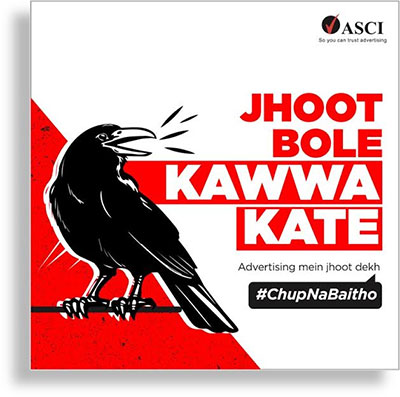 The Advertising Standards Council of India (ASCI) has launched the #ChupNaBaitho, a call-to-action digital campaign, to create an awareness about objectionable advertisements and encourage consumers to report such advertisements. In the three-month pilot, ASCI will focus on Mumbai and New Delhi.