Tag: Advertising Standards Council of India

  • ASCI acts upon multiple ad complaints for July 2019

    By A Correspondent


    The Advertising Standards Council of India (ASCI) has reported investigating complaints against 489 advertisements in July 2019,, of which 151 advertisements were promptly withdrawn by the advertisers on receipt of communication from ASCI. The independent Consumer Complaints Council (CCC) of ASCI evaluated 338 advertisements, of which complaints against 299 advertisements were upheld. Of these 299 advertisements, 201 belonged to the education sector, 59 belonged to the healthcare sector,  nine to personal care,  four to the food & beverages sector, and 26 were from the ‘others’ category.


    Over 200 advertisements belonged to the education sector with advertisers making unsubstantiated claims such as being No. 1, holding awards or providing ‘100% placement’ misleading students and parents. Few educational institutes were observed to downplay their status of being a “Deemed to be University” and presenting it in a misleading manner by overly emphasising the word “University”.


    Said Rohit Gupta, Chairman, ASCI: “We have seen an increasing trend by advertisers to use reference of “Awards and rankings” to make superiority or leadership claims in their advertisements. These claims may mislead the consumer by communicating that the advertised institute, product or service is recognised, esteemed or evaluated by experts or a large body of experts, whereas this may not be the case. There are also dubious cases where such awards are self-sponsored. Effective November 1, 2019, ASCI is rolling out ‘Guidelines for Usage of Awards/Rankings in Advertisements’. This would ensure that the awards and rankings claimed are authentic and credible.”


  • ASCI welcomes the passing of new Consumer Protection Bill

    By A Correspondent


    The passage of the new Consumer Protection Bill has received an overwhelming thumbs-up from advertising self-regulator Advertising Standards Council of India (ASCI).


    D Shivakumar

    Commenting on the development, D Shivakumar, Chairman, Advertising Standards Council of India (ASCI) said: “This is a great development in favour of consumers and ASCI welcomes the passing of the new Consumer Protection Bill. Protection of consumers’ interest is also ASCI’s core mission. As an expert body dealing with complaints pertaining to misleading advertisements, ASCI has been working closely with the Department of Consumer Affairs. Complaints being received on the GAMA portal are being examined by ASCI since the launch of the GAMA portal. We expect this co-regulation model to be strengthened further as per recommendations of the Parliamentary Standing Committee.”


  • ASCI processes complaints against misleading ads

    By A Correspondent


    In October and November 2018, Advertising Standards Council of India (ASCI) investigated complaints against 389 advertisements of which the advertisers ensured corrective action for 112 advertisements. ASCI’s Consumer Complaints Council (CCC) upheld complaints against 232 advertisements from a total of 277 advertisements evaluated by them. Of these 232 advertisements, 95 belonged to the education sector, 53 to the healthcare sector, 36 to the food and beverages sector, 23 to personal care, and 20 were from the others category.


    Amongst various advertisements that were examined, the CCC observed that, a cricketer endorsing a bike brand shown driving rashly and violating traffic rules amounted to manifesting a disregard for safety. In addition to this, a celebrity was found to endorse a shampoo claiming to keep hair non-stop fresh for up to 72 hours. In another advertisement a celebrity was endorsing a well-known brand of glasses promising that the product blocks harmful blue rays from digital media unlike other glasses.


    A significant number of complaints looked into by the CCC pertained to F&B sector. The most common reason for upholding complaints were unsubstantiated and exaggerated claims that exploit consumers’ lack of knowledge. It was also observed that the advertisements had unsubstantiated leadership claims, improper use of FSSAI logo in contravention of the FSSAI advisory, organic claims, disparagement of healthy eating habits as well as surrogate advertisements.


    D Shivakumar

    Said D Shivakumar, Chairman, ASCI: “ASCI and FSSAI recently concluded their second year of collaboration via an MOU. FSSAI had given ASCI a mandate for comprehensive Suo Moto surveillance of potentially misleading advertisements in the F&B sector. Over 200 misleading advertisements have been looked into by the CCC and their compliance status was updated to FSSAI. This co-regulation model has been quite effective in ensuring compliance and was recently also referred in a Rajya Sabha question.”


    The following advertisements were in violation of ASCI’s Guidelines for Celebrities in Advertising. The advertisers did not provide any evidence to show that the celebrities did due diligence prior to lending their name for the endorsements, to ensure that all description, claims and comparisons made in the advertisement are capable of substantiation:


    Hero MotoCorp Ltd (Hero Xtreme 200r): In the advertisement, cricketer Virat Kohli is seen driving rashly in normal traffic conditions. The advertisement portrays violation of traffic rules, shows dangerous practices and manifests disregard for safety. The advertisement showed speed manoeuvrability in a manner which encourages unsafe or reckless driving which could harm the driver and general public.  The TVC contravened Chapter III.3 of the ASCI Code and Clauses (a) (b) and (c) of the ASCI Guidelines for Advertisements depicting Automotive Vehicles.


    L’Oreal India Pvt Ltd. (L’Oreal Extraordinary Clay Shampoo): The advertisement’s claim, “The power of pure clay in shampoo” is inadequately substantiated as it lacked specific scientific evaluation showing the effectiveness of clay and is misleading by ambiguity and implication. For the claim “keeps hair non-stop fresh for up to 72 hours” the advertiser did not provide appropriate scientific evaluation to substantiate the claim, hence is misleading by ambiguity and exaggeration and is likely to lead to grave or widespread disappointment in the minds of consumers.


    L’Oreal India P. Ltd. (Garnier Micellar Cleansing Water): The advertisement with celebrity Alia Bhat claimed, “Makeup off in just one swipe,” which was not substantiated. The claim is misleading by exaggeration, and is likely to lead to grave or widespread disappointment in the minds of consumers. The advertiser did not provide any testimonials, or any evidence of the consent of the celebrity for the product efficacy claims.


  • ASCI welcomes Consumer Protection Bill: D Shivakumar

    By A Correspondent


    On Thursday, the Lok Sabha passed the Consumer Protection Bill, 2018. The Bill will now go to the Rajya Sabha for consideration and action. If it is adopted, it will replace the Consumer Protection Act 1986.


    D Shivakumar

    Commenting on the development, D Shivakumar, Chairman, Advertising Standards Council of India (ASCI) said: “ASCI welcomes the new Consumer Protection Bill which replaces the old 1986 bill. ASCI has been actively involved in addressing consumer grievances on behalf of the Department of Consumer Affairs. With the new bill brand owners need to think sharper about claims they make and product quality as product liability will be an issue if not delivered on promise. celebrities will have to pick the right quality brands. ASCI will help in ensuring that consumers rights are protected”.


    The Bill provides for protecting consumer rights and setting up a redressal mechanism at the national, state and district levels. Consumer Affairs Minister Ram Vilas Paswani sought help of members to help with the passage of the Bill to protect the interest of consumers.


  • The ASCI Jan-Dec 2016 Complaints Roster


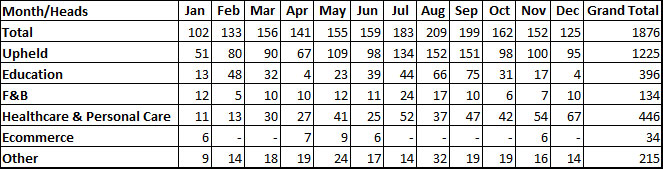
    The Advertising Standards Council of India has been on overdrive over the last few years. At MxMIndia, we compiled the various communiques we receive from ASCI on the decisions taken by the Consumer Complaints Council (CCC) for the months of January to December 2016. The last of these was received in end-March 2017.

    This report carries summaries of the monthly CCC communiques, a table compiling the key numbers and an interview with veteran adperson and ASCI President Srinivasan K Swamy.

    Together healthcare and personal care contribute to more than a third of the complaints upheld. Education is second, with the number of complaints upheld nearly 50 per cent of the complaints upheld in August and September 2016. Read on… the interview and the numbers….


    We have seen a steady rise of complaints against healthcare and personal care advertisements being upheld. Would you be able to attribute any reasons for this?

    ASCI started their suo moto surveillance through the National Advertising Monitoring System (NAMS) in 2012. Every month on an average 1600 TV and 45000 print advertisements are monitored to track down advertisements making misleading, false and unsubstantiated claims. Among complaints against misleading advertisements, most are from Education sector and Healthcare Products and Services, hence you see this rise in the trend of the complaints on an annual basis. Complaints against Personal Care product ads are relatively less.


    Both education and healthcare-personal care complaints to a greater malaise that afflicts our society. Advertising making false claims and also playing with the lives of individuals and families. Do you think the government must do more to check these?

    Government regulators including The Department of Consumer Affairs (DoCA), Food Safety and Standards Authority of India (FSSAI) and Ministry of AYUSH have partnered with ASCI to address all misleading advertisements in their respective sectors. These regulators take appropriate action when non-compliances of CCC recommendations are reported to them by ASCI.


    Are there any trends that you would like to highlight that need highlight from the various complaints received and acted upon in 2016.

    The growing rate of digitalisation of media in our country has had critical impact on consumers and their behaviour. At ASCI, in comparison to the other platforms to lodge your complaints, the WhatsApp number alone contributes to approximately 15% of the total number of advertisements complained against by consumers. Besides the traditional medium of Print and TV advertisements, Digital advertisements going live on Websites, Mobile Apps, Social Media Ads, etc. are getting more and more attention of consumers as well and their share in the complained advertisements has increased from 11% to 14%.

    This year,we also saw an increase in the number advertisements complained against in new sectors such as E-Commerce. This digital shift has clearly been a highlight for ASCI too. Self-regulation of advertising content as per ASCI code for direct or indirect (e.g. paid blogs) advertisements in online digital channels/sites by both advertiser and media is a need of the hour.


    January 2016:In January 2016, ASCI’s Consumer Complaints Council (CCC) upheld complaints against 51 out of 102 advertisements. Out of 51 advertisements against which complaints were upheld, 13 belonged to the Education category, 12 to the Food & Beverages category, followed by 11 in the Healthcare category, 6 in the E-commerce category and 9 advertisements from other categories.


    February 2016:

    In February 2016, ASCI’s Consumer Complaints Council (CCC) upheld complaints against 80 out of 133 advertisements. Out of 80 advertisements against which complaints were upheld, 48 belonged to the Education category, 13 in the Healthcare category, followed by 5 in the Food & Beverages category and 14 advertisements from other categories.


    March 2016:

    In March 2016, ASCI’s Consumer Complaints Council (CCC) upheld complaints against 90 out of 156 advertisements. Out of 90 advertisements against which complaints were upheld, 32 belonged to the Education category, 30 in the Healthcare & Personal Care category, followed by 10 in the Food & Beverages category and 18 advertisements from other categories.


    April 2016:

    In April 2016, ASCI’s Consumer Complaints Council (CCC) upheld complaints against 67 out of 141 advertisements. Out of 67 advertisements against which complaints were upheld, 27 belonged to the Healthcare & Personal Care category, 10 in the Food & Beverages category, 7 in the E-commerce Category, 4 depicting Automotives, followed by 4 in the Education category and 15 advertisements from other categories


    May 2016:

    In May 2016, ASCI’s Consumer Complaints Council (CCC) upheld complaints against 109 out of 155 advertisements. Out of 109 advertisements against which complaints were upheld, 41 belonged to the Healthcare & Personal Care category, 23 to the Education category, followed by 12 in the Food & Beverages category, 9 in the E-commerce Category, 9 in Consumer Durables Category and 15 advertisements from other categories.


    June 2016:

    In June 2016, ASCI’s Consumer Complaints Council (CCC) upheld complaints against 98 out of 159 advertisements. Out of 98 advertisements against which complaints were upheld, 39 belonged to the Education category, 25 in the Healthcare & Personal Care category, followed by 11 in the Food & Beverages category, 6 in Ecommerce category and 17 advertisements from other categories.

    July 2016:

    In July 2016, ASCI’s Consumer Complaints Council (CCC) upheld complaints against 134 out of 183 advertisements. Out of 134 advertisements against which complaints were upheld, 44 belonged to the Healthcare category, 44 to the Education category, followed by 24 in the Food & Beverages category, 8 in Personal Care Category and 14 advertisements from other categories.


    August 2016:

    In August 2016, ASCI’s Consumer Complaints Council (CCC) upheld complaints against 152 out of 209 advertisements. Out of 152 advertisements against which complaints were upheld, 27 belonged to the Healthcare category, 66 to the Education category, followed by 17 in the Food & Beverages category, 10 in Personal Care Category, 5 in clothing and accessories category and 27 advertisements from other categories.


    September 2016:

    In September 2016, ASCI’s Consumer Complaints Council (CCC) upheld complaints against 151 out of 199 advertisements. Out of 151 advertisements against which complaints were upheld, 39 belonged to the Healthcare category, 75 to the Education category, followed by 10 in the Food & Beverages category, 8 in Personal Care Category and 19 advertisements from other categories.


    October 2016:

    In October 2016, ASCI’s Consumer Complaints Council (CCC) upheld complaints against 98 out of 162 advertisements. Out of 98 advertisements against which complaints were upheld, 37 belonged to the Healthcare category, 31 to the Education category, followed by 6 in the Food & Beverages category, 5 in Personal Care Category and 19 advertisements from other categories.


    November 2016:

    In November 2016, ASCI’s Consumer Complaints Council (CCC) upheld complaints against 100 out of 152 advertisements. Out of 100 advertisements against which complaints were upheld, 43 belonged to the Healthcare category, 17 to the Education category, followed by 11 in Personal Care Category, 7 in the Food & Beverages category, 6 in the E-Commerce Category and 16 advertisements from other categories.


    December 2016:

    In December 2016, ASCI’s Consumer Complaints Council (CCC) upheld complaints against 95 out of 125 advertisements. Out of 95 advertisements against which complaints were upheld, 58 belonged to the Healthcare category, 10 in the Food & Beverages category, followed by 9 in Personal Care Category, 4 to the Education category, and 14 advertisements from other categories.


  • ‘ASCI decisions are not taken by the Board’


    On Friday (September 9), Srinivasan K Swamy, Chairman and Managing Director, R K Swamy BBDO, was unanimously elected Chairman of the Board of the Advertising Standards Council of India (ASCI) on September 9. Abanti Sankaranarayanan, Vice Chairperson, CIABC was elected Vice-Chairman and Shashi Sinha, CEO, Media Brands was reappointed the Honorary Treasurer. Other members of the Board of Governors are Al Rajwani (Managing Director & Chief Executive, Procter & Gamble), Benoy Roychowdhury (Executive Director, HT Media), Mr. Dev Bajpai (Executive Director Legal & Corporate Affairs & Company Secretary, Hindustan Unilever Ltd), D Shivakumar (Chairman & CEO, PepsiCo India), Gurmit Singh (Vice President & MD, Yahoo India), N S Rajan (Global Partner & MD, Ketchum Sampark), Narendra Ambwani (Director, Agro Tech Foods), Prashant Singh (MD, Neilsen India Region), Raj Jain (CEO, Bennett Coleman & Co Ltd.), Rohit Gupta (President – Network Sales & International Business, Sony Pictures Networks India), S K Palekar (Adjunct Professor & Advisor – Executive Education, Institute of Management Technology), Subhash Kamath (Managing Partner, BBH Comms India) and Sunil Lulla (Chairman & Managing Director, Grey Worldwide India). Anuka Roy caught up with the new ASCI Chairman for a quick chat:


    On his new role:

    ASCI is fairly well-known. There is no advertiser or agency of consequence that has not been told that their ad is somehow misleading or offensive. They all know because they have been hit by ASCI at some point. My real task I do not think is to talk about what is ASCI, that is known. The important thing to tell people is that ASCI’s decision is not made by the Board of Governors of ASCI but is made by something called Consumer Complaints Council (CCC) and what is more relevant there has members from the civil society. The majority of the members are from the civil society that means consumers activists, educationists, lawyers, doctors  – they constitute the majority in CCC. Only some people are from the advertising industry. These people look at advertisements and figure whether they are misleading, offending and then they take the decision. So, they are the ones who take the decision. That is something I would like to take an important part of the agenda to tell people who adjudicates on passing a campaign and hopefully that would set the record straight because the general perception is that ASCI is being influence by the people in the Board of Governors and their mission is against one competitor because the Board influences the decision. That is something I would like to bring in front, so that people know what is happening here


    His agenda as the new ASCI Chairman:

    To talk about CCC. There are many things we need to talk about with respect to what it does. For example, when a mission is given, that is an appeal process, you can then get appeal.  When the matter is very complex, you have experts coming in briefing the CCC members about the complexities, whether it is technical or a complex thing they cannot understand, expert is called in. Based on that, CCC members actually take a call. So, there are many things which we can talk about. And, of course we have regular issues like someone will take us to court; we will have to figure out what our strategy will be to defend ourselves. There are all these government bodies that are a part and parcel of us. If ASCI is finding a place in Consumer Protection Act then there is a lot work to be done.


    Any other new initiative to engage the consumer, like the WhatsApp initiative:

    The point today is not to get more complaints. We ourselves are monitoring the complaints. We have a group of people looking at all that is appearing in all important advertising categories to see whether an ad is offending or not. Even if you do not complaint, we will track those ads. The marketing of WhatsApp and all is more to engage the consumer but we have been tracking a lot more ads on our own.


    On the Patanjali controversy:

    Patanjali is taking ASCI to court, the court will decide whether Patanjali is right or ASCI is right. The fact of the matter is ASCI’s decision is not the Board’s decision, it is the decision made by people like consumer activists, journalists, doctors, educationists etc. So, the court will look at all the facts and decide. Advertising is a critical part of every business and is somebody is going to challenge them in running the business they will take them to court, it is a part of life and we will address it.


  • ASCI dismisses complaint against Emami Hair oil

    By A Correspondent


    In an encouraging move to both consumers and brands, the Advertising Standards Council of India (ASCI) has affirmed the soundness of the claims of “Emami 7 Oils in One Damage Control Hair Oil” of providing ‘Upto 20x stronger hair’ and ‘Upto 96 per cent less hair fall’.


    The affirmation of ASCI on the soundness of the product comes in the wake of complaint received by them on the above claims being made by the brand, which was dismissed by the regulatory body.


    To substantiate its claims, Emami had submitted detailed response along with clinical trial reports done at a renowned International Laboratory in USA, which proved that there was upto 96 per cent reduction in hair fibre breakage for ‘damaged Indian black hair’ treated with single application of Emami 7 Oils in One vis-a vis untreated hair of similar origin.  Emami also shared instrumental studies conducted at IIT Mumbai to validate the product’s efficacy in terms of hair fibre smoothness and its thickness.


    Based on the above, the Consumer Complaint Council (CCC) of ASCI concluded that both the claims of “Upto 20X Stronger Hair” and “Upto 96 per cent Less Hair Fall” have been duly substantiated and do not mislead consumers. ASCI’s decision reaffirms the sound testimonials of ‘Emami 7 Oils in One Damage Control Hair Oil’.


    Emami 7 Oils in One damage control hair oil has been designed by leading international hair trichologist and the Research & Innovation Team of Emami Limited with the unique combination of vegetable oils, mineral oils, omega fatty acids, vitamins and hair beneficial 7 herbal aushad complex.


  • Indrani Sen: Destroy the Demon

    By Indrani Sen


    Advertising Standards Council of India (ASCI) greeted the Indian Advertising Industry this year with ‪@#‎HappyDussehra  Destroy the demon of misleading ads! Dassera, the time when the entire country celebrates the triumph of good over evil, is probably the right time to introspect how we have fared in the area of self-regulations over the last 30 years.


    Founded in 1985 with support of three main constituents of our advertising industry, viz. advertisers, advertising agencies and media owners along with other professional /ancillary services connected with advertising practice, ASCI has come a long way in three decades. The Cable Television Network Rules 1994 included ASCI’s Code for Self-Regulation in Advertising in the Advertising Code under Cable TV Act’s Rules. The 2007 amendment of Cable and TV Network Rules reconfirmed it. For some time, ASCI have been taking part in all committees working on advertising content in every Ministry of the Government of India. Many misleading ads are short lived, thanks to ASCI’s rulings.


    Yet, we find that at times rulings by ASCI are not followed by the parties concerned. Last year, an advisory issued to all TV channels by the Ministry of Information & Broadcasting on August 21, 2014 spoke about violation of ASCI’s rulings by some TV channels and advised not to carry ads found ‘violative’ by ASCI. In 2014-15, 80% of the advertisers agreed to accept ASCI’s rulings and agreed to withdraw the misleading ads while 20% did not.  It is more common to find that advertisers, agencies drag their feet before they finally withdraw the offending ad from the market. The media houses very rarely take the onus on themselves and do not refuse any ad even when there is a clear ruling given by ASCI against it. So, the demon of misleading ads continues to haunt our advertising industry with many organisations turning a blind eye.


    Can we collectively take some steps to strengthen ASCI’s hands for destroying this demon? Can the various industry bodies like ISA, AAAI, IBF, INS etc. take some positive steps to ensure that all their members abide by ASCI’s rulings? Can our law-makers help ASCI by introducing specific penalty for violation of ASCI’s rulings? I would humbly like to propose a few suggestions to all concerned.


    Extend Membership of ASCI

    Currently, the membership of ASCI is voluntary and therefore optional. While ASCI cannot enforce the advertisers, agencies and media houses to become their members, the various industry associations can consider making it compulsory for all their members to become a member of ASCI. This would help to spread the awareness about ASCI which currently in many non-member organizations rest on the back burner.


    Support Funding of ASCI

    As an independent NGO funded by its members, ASCI is not very cash-rich. An extended membership pool will help to increase its resources. In this context, our industry and our law-makers may like to review the system of funding Advertising Standards Authority (ASA) in UK which is funded mostly by the advertisers through a remote control mechanism. There is a 0.1% levy on the cost of buying advertising space/time and the 0.2% levy on direct mail which are collected by the Advertising Standards Board of Finance (Asbof) and the Broadcast Advertising Standards Board of Finance (Basbof) for funding the ASA. Advertisers in UK can choose to pay the levy, but they cannot choose to comply with the Advertising Codes or the ASA’s rulings.


    Introduce Penalty for Disobeying ASCI’s Rulings

    The Advertising Standard Authority (ASA) in UK , which is a part of the European Advertising Standards Alliance (EASA), ensures primarily obedience by broadcasters to their rulings – “Broadcasters are obliged by a condition of their broadcast licences to enforce ASA rulings.  If they persistently run ads that breach the Codes broadcasters risk being referred by the ASA to Ofcom, which can impose fines and even withdraw their licence to broadcast.” (https://www.asa.org.uk/Industry-advertisers/Sanctions/Broadcast.aspx) ASCI have an associate membership of the European Advertising Standard Alliance, but the obligation to comply with ASCI’s rulings rest primarily with the advertisers and agencies in India. Would it be possible for our law-makers to impose fines and withdrawal of licences on Broadcasters/ Newspapers for disobeying the rulings of ASCI? Can IBF and INS who are very strict with advertisers and agencies when it comes to credit control, introduce some such disciplinary measures for their members for disobeying rulings of ASCI?


    Introduce Pre-clearance of Ads

    Currently, there is no system to ensure that no ad is misleading before it is released. “Some countries’ eg France have pre clearance of ad by self regulatory body requirement, UK TV channels also pre clear advertisements just like DD does it in India”(http://ascionline.org/index.php/faqs.html).The broadcasters in the UK have established and funded two pre-clearance centres: (i) Clearcast for television commercials and (ii) Radiocentre for radio ads. Considering that most of the ads that the consumers complain against in 2014-15 were from TV media, would it be possible for IBF to introduce a similar system of pre-clearance of all TV commercials in India?


    Make ASCI Certifications compulsory in Agencies

    ASCI’s new websites has introduced an E- Learning Portal offering 14 modules of self learning courses with certifications at a nominal cost. Agencies should make it compulsory for their creative people to take these courses. I am sure that ASCI would be willing to consider discounts against bulk enrolment, particularly from their member agencies.


    Promote ASCI through Corporate Social Responsibility Projects

    The aim of ASCI is to maintain and enhance the public’s confidence in advertising. Their mandate is that all advertising material must be truthful, legal and honest, decent and not objectify women, safe for consumers, especially children and last but not the least, fair to their competitors. In 2010, ASCI launched a national campaign against dishonest, misleading ads. Advertisers, who have to spend on Corporate Social Responsibility, may like to consider promoting the aims of ASCI through similar campaigns to public at large and through specific activities to various industry constituents.


    Let good sense prevail on each one of us in the industry! Let all of us join hands to support ASCI in destroying this demon of misleading ads!!


  • ASCI frowns at Ullu-Banoing, finds Idea ad defaming Haryana

    By A Correspondent


    In February 2015, the Consumer Complaints Council (CCC) of the Advertising Standards Council of India (ASCI) upheld complaints against 125 out of 167 advertisements. Of the 125 ads against which complaints were upheld, 73 belonged to Personal and Healthcare category, followed by the Education category with 29 advertisements, followed by others.


    Says a communiqué on the Idea ad: “The advertisement of Idea Cellular shows the practice in Haryana of girls not being allowed to step out of homes to study, is defaming Haryana and tends to bring this State into disrepute.  Also, the TVC is misleading by implication as the product/service promoted (Idea Internet Network) is shown as a substitute to and equating to college education.”


  • Action time at ASCI


    Narendra Ambwani, chairman of advertising self-regulator Advertising Standards Council of India (ASCI), talks to ‘dna of brands’ about the extensive campaign to connect with consumers and educate them on how to file complaints, and seek redress, against ads which make tall claims. Everyone, from local agencies and state governments to the Centre, are now happy to partner with ASCI.


    Although established way back in 1985, would you say that 2014 was a landmark year for the Advertising Standards Council of India (ASCI), given all the activities that were undertaken in its capacity as a self-regulator for advertising?

    We have seen growth in leaps and bounds at ASCI every year, but 2014 was definitely a notable year for the organisation.


    The year started off with ASCI bagging a gold at The European Advertising Standards Alliance (EASA) Global Best Practice Awards for ‘significantly reducing’ average time taken to handle complaints. We were credited with reducing the lead time for processing complaints from an average of 45 days in 2011-12, to 28 days in 2012-13 and just 12 days in 2013-14. Recognising our efforts to curb misleading advertisements, ASCI was also made a key stakeholder in the Inter-Ministerial Monitoring Committee (IMMC) by the Department of Consumer Affairs. Further, during the year, ASCI’s role was strongly appreciated and acknowledged by the Medical Council of India (MCI) for taking action against misleading advertisements by doctors. We were approached by various ministries for a potential partnership to look into this issue. So all in all, last year was indeed a landmark year for ASCI.


    From a government that was, some years ago, questioning the role of ASCI as self-regulator, to one that is collaborating with it, ASCI has a come a long. Your comments?

    Even though ASCI was considered a self-regulating industry body, it has received considerable support from the Ministry of Information and Broadcasting (MIB). A notification dated August 2, 2006, issued under the Cable Television Network Rules, 1994, states that “no advertisement which violates the Code for Self-regulation in advertising, as adopted by the Advertising Standard Council of India, Mumbai, for public exhibition in India, from time to time, shall be carried in the cable service”. After that, ASCI received statutory recognition. The FDA authorities have also been sending us complaints against advertisements violating the Drugs and Magic Remedies Act. Besides this, ASCI is a key stakeholder in the Inter-Ministerial Committee of the MIB, as well as the Inter Ministerial Monitoring Committee of the Department of Consumer Affairs. Efforts at ensuring ethical advertising practices have earned ASCI its credibility, and the confidence of the government of India.


    While policing unethical ads is taking place through ASCI’s Consumer Complaints Council (CCC), there is still a view that by the time any penal action is taken, the damage is already done. Is this correct?

    ASCI has to provide due process for the advertiser, whose advertisement has been complained against, to respond to the allegations. Providing adequate time for the advertiser to respond, is mandated by law. However, ASCI has recently instituted three new initiatives to speed up the CCC decision process. One is to have the CCC meet four times a month instead of once, so that decision-making takes places within 12 days on an average (as opposed to a month or 45 days previously). And two, starting the Fast Track Intra-Industry complaint (FTCC) redress process, where decisions regarding complaints from one member advertiser against the advertisement of another, are taken within seven working days. Since March 15, 2013, ASCI has initiated the Suspension Pending Investigation (SPI) process. According to this, ASCI can, ex-parte, ask an advertiser to suspend an advertisement, pending final decision by the CCC if, prima facie, it is seen to cause harm or hurt to consumers and the society in general.


    If one feels an ad is making unrealistic claims and complains to ASCI, in how much time can one expect a response?

    In the past few years, ASCI has made significant changes in the complaints processing system. Thanks to electronic communication, weekly meetings of the Consumer Complaints Council and the Online Complaint Monitoring Services, the average lead time to take a decision on a complaint is 12 working days from the date a “complete” complaint was received. This includes full details of the print advertisement, the name and date of publication, and clippings or a copy of the print advertisement. In case of a TVC airing, we require the name of the channel, the date and time of the broadcast; a reasonable description of the clip, specific claims or visual depictions which are considered to be false, misleading or objectionable, and the reasons for the same.


    Would you recommend a Censor Board-like pre-release certification for ads, just as it exists for films?

    Throughout the country, there are a large number of advertisements being released every year. Under our National Advertisement Monitoring Service (NAMS) initiative, we scan at least 45,000 print ads and 1,500 TVCs every month. It is impossible to create a mechanism and run an efficient system to pre-approve every advertisement which is released in the country. No system would be able to cope with such a large number. So we as an organisation, from inception, have been promoting the concept of “self-regulation in advertising content”, and truly believe in this best practice which is being implemented all over the world.


    There are several advertisers who release ads directly through specific media, like mailers or SMS blasts. How do you check these, especially if the publication is not an ASCI member?

    Ever since the launch of our Online Complaint and Monitoring Service (OCMS), we have received complaints against misleading advertisements across all media. While complaints relating to mailers and SMSes comprise a small percentage, they are increasing year on year. Currently, we are monitoring print and TV advertisements via NAMS. However, we do have plans to also track digital media. The processing of complaints is uniform across advertisers, regardless of whether they are an ASCI member or not.


    Your Clean Ad Campaign seemed to have been quite a hit. Tell us more about it. Are you going to make it an ongoing exercise?

    We launched the ‘Swachh Ads Abhiyan’ to mark National Consumers’ Day on December 24, 2014, and made a splash about it on social media (Facebook, Twitter, LinkedIn and YouTube). Since it resonated with the Swachh Bharat campaign, it created a great amount of media buzz. The aim of the campaign was to increase awareness about false claims [made by advertisers] and combat misleading advertisements to safeguard consumer interests.


    We engaged with consumers through our virtual platforms, and this drove consumer attention towards the campaign, educating them about not to be misled through advertisements, and the importance of taking action by lodging an online complaint. We believe this initiative has empowered and encouraged consumers to make the right choices, when it comes to advertisement claims.


    The campaign was conducted through videos that lent clarity to misleading claims and invited interaction from consumers culminating with a call for action to lodge a complaint online. This resulted in 150% more people engagement and the message reached more than 2.5 lakh consumers. It also resulted in tangible change that was sustained by the social media thrust. For instance, the number of online complaints increased by 166%.


    What’s next at ASCI? What are the other activities you propose to take up?

    Our priorities for the year have been chalked out as self-discipline by creators of advertising, easier access to ASCI services, collaboration with regulators and we are keen on being viewed as fair by all stakeholders. Our major focus, therefore, would be on activities enabling these goals. We are going to launch, shortly, an online training programme called the ASCI e-learning. We have plans to further increase awareness and accessibility regarding ASCI. As mentioned earlier, in terms of collaboration with the regulator, we are in talks with the Department of Consumer Affairs and the FSSAI.

     

  • I&B intervention gives ASCI more teeth to curb ads that violate guidelines

    By A Correspondent


    In a recent development, the Ministry of Information and Broadcasting (MIB) has ordered broadcasters not to air advertisements that have been found in violation of the Advertising Standards Council of India’s (ASCI) code and not complying with the decision of its Consumer Complaints Council (CCC). While deliberating on the complaints received in ASCI, the CCC observed that many of the teleshopping advertisements made unsubstantiated claims & violated the provision of code for self-regulation as well as provisions under Drug & Magic Remedies (Objectionable Advertisements) Act, 1954. MIB has in its Advisory compiled a list of these ads and asked broadcasters not to carry them in their respective channels and to ensure strict compliance of the advertising code in the Cable Television Networks Act (CTN).


    The CTN code and rules state that ‘no advertisement which violates the code of self-regulation in advertising, as adopted by ASCI for public exhibition in India, from time to time, shall be carried in the cable service’. Therefore, the ASCI decisions are not just bound for compliance by advertisers but also by TV channels.


    Partha Rakshit

    Partha Rakshit, Chairman, ASCI shared, “This is another feather in the cap of ASCI, in its efforts to make advertising more responsible. We were finding that some advertisers on TV channels, especially Tele Shopping Networks, were not complying with the ASCI decisions. We submitted the list to the Inter Ministerial Committee (IMC) of the MIB for their consideration. Based on that, IMC observed that any violation of ASCI code also violates the Advertising Code enshrined in the CTN Act and its rules. In short, IMC has directed that advertisements found to violate the ASCI code cannot be carried on TV channels.”


  • Hic, Hic, Hurray!


    By Pritha Mitra Dasgupta


    On Monday, @BudweiserIndia tweeted out a cheery message to its 6,000 followers: “How are you coping with your #MondayBlues! Keep your #Buds close and watch them disappear!” Does a tweet urging beer consumption constitute advertising? It’s not quite clear. The rules banning the advertising of liquor products are at least about half a century old and predate the computer age. Social media is, naturally enough, a grey area.


    No matter, liquor companies have been happily making use of the platform. Diageo, the world’s biggest liquor company, the UB Group’s Kingfisher beer, Budweiser, Tuborg, SAB Miller, Johnnie Walker are all active on Facebook and Twitter, using them to spread the message about their brands, complete with visuals. Kingfisher tweeted to its 44,000 followers on Wednesday from @kingfisherworld: “Okay so beerheads, here we go. Remember that 1st #KFBeer you ever had?


    We want to know the story! Tweet to #HowIMetMyKFBeer right away!” Last year, Diageo’s vodka brand Smirnoff, using the handle @SmirnoffIndia, had this to say: “You don’t need an occasion to gift someone gold! Treat your friends to the royal taste of Smirnoff Gold today.”


    Samar Singh Shekhawat, senior V-P (marketing), UB, said: “The guidelines do not clearly define ban on social media and there are no clear clauses for liquor companies by the I&B (information and broadcasting) ministry on social media and online advertising.”


    However, he added that liquor companies tend to self-regulate by strictly following the age-restriction policies of the sites. “So whoever comes on to the social media platform are well within the drinking age limit. Whatever is not allowed on mainstream media we do not put on as digital advertising unless it is age gated,” Shekhawat said.


    However, while brands ask consumers to enter their age or date of birth in order to access their websites, there is no way to restrict the visibility of tweets.


    A top executive at another leading liquor brand said, “The maximum traction that social media gets is from our core target audience. The absence of any law has made it easier for us to interact with them directly.”


    Arvind Sharma

    Arvind Sharma, former chairman of the Advertising Standards Council of India (ASCI), said social media messages from a manufacturer qualify as advertising.


    “On the whole any message put out by a company is an ad,” he said. “It is not an ad if it is created by the consumer.


    While ASCI is yet to receive any complaint against liquor brand related to social media activities, “such messages should not be allowed as social media is also a form of media”, he said.


    Although the rules haven’t been amended in the last 50 years, the spirit of the law can still be implemented, said Prem Rajani, managing partner of legal firm Rajani, Singhania & Partners. “While one may argue that you need a clear statute to pin them, I would say the current statute if interpreted properly should be enough to pin them down.”


    The information and broadcasting ministry hadn’t responded to queries as of press time. Interestingly, tobacco brands in India which are also barred from advertising, have not taken the social media route. Even international brands such as Marlboro don’t have any social media engagement with Indian consumers.