The Advertising Standards Council of India (ASCI) recently published a discussion paper titled ‘Dark Patterns in Advertising’ highlighting how certain UI/UX deployed by digital platforms could manipulate consumer choices and consumption patterns to the detriment of consumer interest. The self-regulatory organisation had invited public feedback and comments on the recommendations of the discussion paper which will help ASCI extend its self-regulatory code on objectionable ads to cover dark patterns too.
Now, ASCI has extended the deadline for the feedback until the 16th of January 2023 based on requests it has received from a few organizations. Submissions by any member of the public or any organization public can be sent to contact@ascionline.in
At the board meeting of the Advertising Standards Council of India (ASCI) held last week, public relations industry veteran NS Rajan was unanimously elected Chairman. Rajan, Director, August One Partners LLP, was Founder and Managing Director of Ketchum Sampark. Sampark is an agency that Rajan set up with his wife Bela which was later acquired by the Omnicom group. Rajan was Vice Chair of ASCI over the last two years, and was an active participant of the weekly complaints meetings that the Council conducts for complaints redressal. Excerpts from a quick interview over email.
ASCI has reinvented itself over the last few years. What next for the self-regulator?
ASCI has reinvented itself to keep pace with the nature of the new and emerging advertising ecosystem. Besides upgrading our complaints systems and processes to become more agile and responsive, we have also invested in monitoring technology. As we go ahead, we will strengthen the preventive side of our work to become more robust and mainstream. ASCI Academy through training, outreach, and thought leadership is an important pillar of taking ASCI into the future. I look forward to advancing the agenda of the Council to rapidly increase ASCI’s awareness among consumers so that they engage more readily and in greater numbers, voicing their concerns, anxieties, and questions about what they experience in the form of thousands of ads per day.
Has the ghost of the Central Consumer Protection Authority (CCPA) usurping ASCI’s status/role vanished?
It is a common misconception to think that regulation and self-regulation compete. Both these mechanisms are part of the ad regulation ecosystem and, they are complimentary in nature. Self-regulation is the first line of defence that looks at voluntary compliance and education and essentially this is an inexpensive and quick method to resolve issues related to advertising. It comes at no cost to the taxpayer. ASCI has a very robust infrastructure setup to resolve consumer grievances as well as take suo-moto cognisance and action. Across the world, self-regulation and regulation co-exist and work together in complementary ways. When the advertiser refuses to undertake voluntary compliance, ASCI works with regulators to resolve the issue. It is also important to note that the CCPA advertising guidelines and ASCI’s guidelines on misleading ads are very similar. We will continue to work with the government together on this common agenda. It is also pertinent to note that the Consumer Protection Act deals with misleading ads, but the ASCI code also looks at indecent, unfair, and unsafe ads in addition.
How has the prevention offering worked? The pre-approval process that was announced with much fanfare.
We would like to clarify that there is no pre-approval offering. ASCI has s a voluntary due diligence exercise that advertisers or endorsers can avail of. They can seek advice from ASCI at the pre-production stage. Many brands have used this service both for technical and non-technical claims before major campaigns. We also have some companies signing up for an ongoing subscription and this shows that the culture of preventive responsibility is taken seriously. In time, we expect this to become a more mainstream practice. So far, about 30 ads have undergone a pre-production scrutiny at ASCI.
What’s your view on influencer complaints. Are advertisers and influencers gaming the system?
Honesty and transparency are the bedrock for any system that wants to be sustainable. As with any category, there will be a set of people who will always try to game the system and undermine it. However, by and large, we have seen a very positive response around the influencer guidelines and increasing awareness about their responsibility when it comes to promotions. We are also keeping a close watch on this category, and 30% of the complaints that we looked at last year have been from influencer advertising. As influencers become more aware of their responsibilities, we see a more long-term honesty-based orientation. Compliance is at 86% in the first year itself. We will continue our efforts to educate advertisers and influencers as to the importance and benefits of honesty in advertising.
The awareness levels of self-regulation appear pretty low. What are ASCI’s plans for outreach across the trade?
While ASCI’s awareness has seen an increase, it is still lower than desired.Our outreach budgets are low; however, we are happy to note an increase in our interactions with industry, government, domain experts, consumer organisations and other stakeholders. Now, with the soon-to-launch ASCI Academy, we look forward to interacting even more with young industry professionals, students, influencers, endorsers consumers as well as non-industry stakeholders.
Tell us more about the AI-driven engine that ASCI has development for complaints redressal
ASCI has been upgrading its complaints system ‘TARA’ to offer a seamless experience to both consumers and advertisers in the management and resolution of complaints. TARA will offer features like real-time tracking of complaints, dashboard views, automatic updates etc. In the second phase which we are embarking on now, the system will allow for a rich access to its archival data and cases.
The Advertising Standards Council of India (ASCI) released its annual complaints report for the period April 2021 – March 20222, during which it processed 5,532 advertisements across mediums including print, digital, and television. With a sharp focus on the digital domain, ASCI saw an overall compliance rate of 94%.
In 2021-22, ASCI processed 62% more ads compared to the previous year, and 25% more complaints. While television and print ads remained in focus, ASCI broadened its ambit by “proactively” monitoring advertising in the digital landscape. Nearly 48% of the ads processed belonged to the digital medium. With the influencer guidelines coming into force last year, complaints against influencers constituted 29% of the total grievances. Complaints regarding misleading claims in ads featuring celebrities saw a 41% increase out of which a staggering 92% were found to be violating ASCI’s guidelines, notes a communique.
ASCI continued its proactive surveillance and 75% of ads processed were picked up suo motu. This included the AI-based monitoring that ASCI has set up for digital tracking. Complaints from consumers constituted 21% of complaints, followed by intra-industry at 2% and CSO/ Government complaints at 2%. Of the 5,532 total ads processed, 39% were not contested by the advertiser, 55% of them were found to be objectionable after investigation, and complaints against 4% of ads were dismissed as not violating the ASCI code. 94% of ads that ASCI processed needed changes so as not to violate the ASCI code.
Given its focus on digital monitoring, emerging categories included the relatively new categories of virtual digital assets and online real money gaming, contributing significantly to objectionable ads at 8% each. Education (33%), Healthcare (16%), and Personal Care (11%) were the Top 3 violative categories.
Subhash Kamath
Talking about the annual report, Subhash Kamath, Chairman, ASCI said: “2021-22 was the year we followed through on our promise of increasingly monitoring the digital media given the way it has been dominating the advertising landscape. We invested heavily in technology and that has worked quite well. We also upgraded our complaints system which has made it very easy for consumers to register their complaints and for advertisers to respond to it. Going ahead, we will continue to be at the forefront in understanding how best to regulate and monitor the digital frontier, even as we keep streamlining our processes to become more responsive, and more proactive.”
Manisha Kapoor
Sharing her thoughts about the annual report, Manisha Kapoor, CEO & Secretary General, ASCI, said: “The ASCI team, the Consumer Complaints Council, the Honorable ex-high court judges on our review panel, and our domain experts have debated the nuances of advertising and scientific evidence of thousands of ads to ensure that the process and outcomes are fair to both consumers as well as advertisers. Simultaneously, the constant update to our code ensures that we constantly offer guidance and transparency to consumers and advertisers on newer and emerging formats and categories. This helps in keeping self-regulation at the frontier of advertising developments.”
Good news. ASCI acted fast. It is debatable who acted first to ban/ withdraw the controversial Layer’r Shot ad. Was it the government or the Advertising Standards Council of India (ASCI)? I am glad someone did. However, the story has died fast. Everyone is okay after the ad is withdrawn and a vague apology tendered. One does not know the mandatory approvals, who approved, and why there is no further action?
Meanwhile, the government got into the act. The Central Consumer Protection Authority (CCPA) released new guidelines against misleading advertisements. It says surrogate advertising is now banned- was it allowed earlier? The celebrity must disclose association and do due diligence before endorsing – was that not the case?
Meanwhile, ASCI released new guidelines on Harmful Gender-Stereotype in advertising. It aims to encourage advertisers to create progressive gender depictions. It is okay if the ground realities are different and do not reflect this expected holier-than-thou depiction in advertisements.
This reminds me of Sunny Deol’s famous dialogue; Guideline pe Guideline pe guideline- nahi milte hai toh misleading advertisements se chutti.
Minister Calls ASCI act
I read the overdramatic comment of the Union Minister for Women and Child Development, Mrs Smriti Irani and I smiled. She said, “If women were valued enough, we wouldn’t need guidelines”. I believe she would know the reality.
However, she made a relevant observation on ASCI members and their engagement. Of the 800 ASCI members, just three members (officebearers) were at the guideline event. That’s how integral ASCI is to the industry. That is how concerned, involved, and serious the industry is towards self-regulation?
Intent does not Count
The guidelines on Harmful Gender-Stereotype in advertising call for not including gender stereotypes likely to cause harm or serious or widespread offence. For ASCI, it is a strong step towards a more responsible and progressive narrative. Well, I am not so sure. We know how guidelines are exploited, played with, and not adhered to by advertisers.
The truth is that most creative and client teams do not know the guidelines and don’t understand them. Brands simply don’t give a damn to ASCI, given that it only seeks a polite enquiry and request to withdraw the offending advertisement.
Things have changed a bit
ASCI has streamlined the processes. There are quick processes to address the problem. But withdrawing the ad with no public apology shows ASCI has no bite. In most cases, the advertisement achieves its objective before ASCI request a withdrawal. However, the ASCI service #GetItRight, get the creative pre-checked at the production stage, returns a 404 error!
Different strokes
Surprisingly, large brands and big advertisers regularly feature in the quarterly reports of offending work. ASCI guidelines have no say on advertorials, political and Government advertisements.
Will ASCI guidelines restrict creativity?
In today’s world of rapid information exchange, heightened point-of-views and hardened social voices help nudge the brands in the right direction. But storytellers must have creative licenses.
Is ASCI not asking too much for brands to reinforce unrealistic and undesirable gender ideals or expectations. For example, expecting a woman to return from work may not be shown as solely responsible for doing household duties while others around her are at leisure. Remember Airtel.
Should advertising worry about social reform?
When the guidelines become constraining, they will be questioned.
Should advertising stop reflecting the social and cultural realities?
Will it not make them irrelevant, ineffective, and tough to relate to?
Should advertising aim to nudge people towards the right desired way of life?
Or should the ground realities change before advertising reflects it?
Are we not giving advertising too much credit for possibly impacting human behaviour?
Are guidelines not trying to dictate what should be controlled by the market forces?
Net-net
Advertising is becoming a tough maze with all the guidelines. There is too much of what not to do. Maybe creative teams see it as a decent challenge. But this forced wokeness is wrong.
The brands should be free to tell the story how they want and ensure that no misinformation or false promise is being made. And that it does not hurt religious, regional, language or gender groups or objectify any gender. And if there are guidelines there should be a robust way to implement them by Sham, Daam, Dand or Bhed. (Logic, cost, Penalty and differentiation/doubt).
Let us understand, that ASCI cannot do much till the corporates, the marketing and the brand owners take the initiative. Self-regulation is all about knowing and doing things consciously as per the guidelines. Till the time ASCI does not have real teeth to penalise and persuade brands for breach of guidelines, they may just remain guidelines.
Not against self-regulation
I am not against self-regulation; it is crucial. As an industry we all owe to the society the right way of promotion. If the industry continues to fail at self-regulation. In that case, someone like government will have to regulate it, which will be a sad day for the industry.
I am all for effective self-regulation, where there is one expectation from every stakeholder, and the regulating authority has the right to take action. Where every team member on the client and the agency side understands and appreciated the need for the guidelines, maybe then they will follow it better. Maybe I am asking for too much.
The Advertising Standards Council of India (ASCI) has followed up the launch of its GenderNext report in October 2021, a study by ASCI and Futurebrands, with the release of guidelines that guard against harmful gender stereotypes. The guidelines were released at an event held in Delhi presided over by Union Minister for Women and Child Development Smriti Irani.
While the guidelines focus on women, they also provide pointers for depiction of other genders.
The guidelines, encourage advertisers and creators to deploy the SEA (Self-esteemed – Empowered – Allied) framework that guides stakeholders in imagining as well as evaluating portrayals of gender in their advertising by building empathy and aiding evaluation, as well as the 3S framework, which provides a checklist to guard against tropes and implicit stereotypes that creep into advertising.
These frameworks can prove to be extremely useful for marketing and advertising professionals to improve their advertising ROIs.
Speaking at the launch of the guidelines on harmful gender stereotypes, Irani said: “While there are women who are happy with the incremental change that has been made in the advertising industry, women of my generation are a bit more impatient. It is time not only for the men but also for the women in the advertising industry to step up. This is a very important move, and I believe that there is a long journey to be undertaken to turn the thinking but it’s required now. Work in this area must move with more and more speed and organisations like ASCI should lead this, the action beginning with its member base.”
Added Subhash Kamath, Chairman, ASCI: “The new guidelines were created after extensive consultation with many partners- both from industry, as well as civil society organisations, including the Unstereotype Alliance and UNICEF. These guidelines are a big step forward in strengthening ASCI’s agenda to shape a more responsible and progressive narrative. We are grateful to the government and Shrimati Smriti Irani for supporting these guidelines, and to the many partners who have been with us on this journey.”
ASCI’s Guidelines on Harmful Gender Stereotypes in advertising:
Note:
1. ASCI will consider an ad’s likely impact when taken as a whole and in context.
2. ASCI will consider stereotypes from the perspective of the group of individuals being stereotyped.
3. The use of humour or banter is not likely to overcome the underlying issue of such harmful stereotypes.
4. The guidelines do not intend to prevent ads from featuring:
5. glamorous, attractive, successful, aspirational or healthy people or lifestyles;
6. one gender only, including in advertisements for products developed for and aimed at a particular gender;
7. gender stereotypes as a means to challenge their harmful effects.
Advertisements must not include gender stereotypes that are likely to cause harm or serious or widespread offence.
1. While advertisements may feature people undertaking gender-stereotypical roles e.g., a woman cleaning the house or a man going to an office, or displaying gender-stereotypical characteristics, for e.g., a man being assertive or a woman being sensitive to others’ needs, they must not suggest that stereotypical roles or characteristics are:
:: always uniquely associated with a particular gender;
:: the only options available to a particular gender; or
:: never carried out or displayed by another gender(s).
1.1 Advertisements that are aimed at / depict children may target and feature a specific gender but should not convey that a particular children’s product, pursuit, behaviour, or activity, including choice of play or career, is inappropriate for one or another gender(s). For example, ads suggesting that a boy’s stereotypical personality should be “daring” or that a girl’s stereotypical personality should be “caring”, or someone chiding a boy playing with dolls or girls from jumping around because it is not the typical activity associated with the gender, are likely to be problematic.
2. While advertisements may feature glamorous and attractive people, they must not suggest that an individual’s happiness or emotional wellbeing depends on conforming to these idealised gender-stereotypical body shapes or physical features.
3. Advertisements should not mock people for not conforming to gender stereotypes, their sexual orientation or gender identity, including in a context that is intended to be humorous, hyperbolic or exaggerated. For example, an ad may not belittle a man for carrying out stereotypically female roles or tasks or make fun of a same-sex relationship.
4. Advertisements should not reinforce unrealistic and undesirable gender ideals or expectations. For example, an advertisement must not depict a man with his feet up and family members creating a mess around a home, while a woman is solely responsible for cleaning up the mess, or a woman overly grateful for the man helping her in everyday chores. Similarly, a woman returning from work may not be shown as solely responsible for doing household duties while others around her are at leisure.
5. An advertisement may not suggest that a person fails to achieve a task specifically because of their gender e.g., a man’s inability to change nappies; or a woman’s inability to park a car. In categories that usually target a particular gender, care must be taken to not depict condescension towards any other gender or show them as incapable of understanding the product or unable to make decisions. This does not prevent the advertisement from showing these stereotypes as a means to challenge them.
6. Where an advertisement features a person with a physique or physical characteristics that do not match an ideal stereotype associated with their gender, the advertisement should not imply that their physique or physical characteristics are a significant reason for them not being successful, for example in their romantic, social or professional lives. For example, an ad may not suggest that a man who is short, a woman who is dark, or any individual who is overweight has difficulty finding a job or a partner due to this aspect of their physique.
7.. Advertisements should not indulge in the sexual objectification of characters of any gender or depict people in a sexualised and objectified way for the purposes of titillating viewers. This would include the use of language or visual treatments in contexts wholly irrelevant to the product. For example, an online takeaway service featuring an image of a woman wearing lingerie lying back in a provocative pose behind various fast-food items would be considered problematic. Even though the image may not be sexually explicit, by using a suggestive image of a woman that bears no relevance to the advertised product, the ad would be considered objectifying women by presenting them as sexual objects, and therefore is a gender stereotype that is likely to cause harm.
8. No gender should be encouraged to exert domination or authority over the other(s) by means of overt or implied threats, actual force or through the use of demeaning language or tone. Advertisements cannot provoke or trivialise violence (physical or emotional), unlawful or anti-social behaviour based on gender. Additionally, advertisements should not encourage or normalise voyeurism, eve-teasing, stalking, emotional or physical harassment or any similar offences. This does not prevent the advertisement from showing these depictions as a means to challenge them.
The Advertising Standards Council of India (ASCI) has updated its code to add greater inclusivity in advertising depictions. Notes a communique: “The ASCI code already required ads to not deride anyone on the basis of race, caste, creed, gender or nationality. However, new areas of possible discrimination or derision have now been included such as gender identity and sexual orientation, body shape, age, and physical and mental conditions. Advertisements that mock or deride anyone on these bases will now be considered in violation of the ASCI Code.”
Adds the communique: “This clause is now updated as part of Chapter 3 pertaining to advertisements that cause harm, which reads as follows:
3.1. No advertisement shall be permitted which:
(b) Derides any individual or groups on the basis of race, caste, color, religion, gender, body shape, age, sexual orientation, gender identity, physical or mental conditions or nationality.”
Speaking about the changes, Manisha Kapoor, CEO & Secretary General, ASCI, said: “We have seen consumers call out ads that mock or deride people, or portray them in unfavourable ways. And it is only right that advertising becomes more inclusive and sensitive to this. It is not acceptable for example, to associate characteristics such as sluggishness with a certain body shape. Similarly, to deride someone with a physical or mental ailment, or their gender identity would now violate the ASCI code. With this change, ASCI hopes to ensure that advertising becomes more inclusive and sensitised to all sections of our country, and does not perpetuate certain portrayals that have no place in a progressive society.”
The Indian Premier League (IPL), the latest edition of which kicked off on March 26, has witnessed high-decibel advertising from the online real-money gaming industry. Unfortunately, many of the commercials do not pass scrutiny when it comes to the guidelines prescribed by the Advertising Standards Council of India (ASCI).
In the first week of the IPL alone, March 26 to April 3, ASCI screened 35 ads from the category and identified 14 as being in potential violation of its code. ASCI is keeping a tab on TV as well as OTT ads. In addition, in March alone, 285 social media ads of online real-money gaming companies were identified as being in violation of the ASCI code.
ASCI noted that in some instances dubious claims such as ‘India’s biggest 1st prize’ were being made, and in many cases the disclaimer informing consumers of the risks was flashed very quickly rather than at a normal speaking pace. In some cases, the advertisements had celebrities acting while the disclaimer was being spoken, distracting consumers from important information about risks. Some advertisements had disclaimers that were smaller than what has been prescribed.
These attempts at glossing over the disclaimers required to be carried in the prescribed manner, informing about the risks of financial loss or game addiction, can severely compromise consumer interest. ASCI has urged gaming industry bodies to take up this issue with their members.
ASCI guidelines on real-money gaming came into effect on December 15, 2020. The guidelines require advertisements to not be aimed at minors, not present gaming as a source of livelihood or link it to success. In addition, the guidelines require all advertisements to carry a prominent disclaimer regarding the risk of financial loss and the addictive nature of such games. These guidelines were backed by the Ministry of Information and Broadcasting, which issued an advisory asking that advertisements adhere to the guidelines.
Manisha Kapoor
Said Manisha Kapoor, Chief Executive Officer (CEO) & Secretary General (SG), ASCI: “ASCI is concerned to note that, despite clear guidelines, some online real-money gaming firms are attempting a shortcut. For an industry that is under significant regulatory scrutiny, such acts by some companies paint the entire industry as irresponsible. IPL, being a massive platform, requires responsible behaviour from all parties – including gaming firms, broadcasters, celebrities and ad creators. We hope that all parties play their roles to ensure that consumers are not exposed to misleading advertising.”
The Advertising Standards Council of India (ASCI) has launched an Endorser Due Diligence service to help endorsers avoid making misleading claims in advertisements. Service will provide guidance from highly-qualified specialists from over 20 disciplines.
ASCI has established a panel of experts, from over 20 disciplines, ranging from advertising regulation and legal, ayurveda, microbiology, electronics, market research, nutrition, dentistry, product formulations, financial services, and so on. The panel will assess the representations, statements, and claims in the advertisement from a consumer and technical perspective, examine the evidence in support of the claim where necessary, and thereby help the endorser conduct their due diligence. The advertisements can be sent to ASCI at any stage, including pre-production. This ensures that the endorser can do their independent due diligence before the advertisement is produced.
Said Subhash Kamath, Chairman, ASCI: “Endorsers, particularly celebrities have a huge fan following and they enjoy the trust of millions of consumers. There is therefore a direct moral and now, legal responsibility that they bear to ensure that they do not make representations in ads that could be considered misleading. ASCI has always required celebrities to be mindful of what they endorse in advertisements, and now the law too, requires them to do due diligence in this regard.”
Adds a communique: “Similar to the Advertising Advice service offered by ASCI, Endorser Due Diligence will be confidential and non-binding and will be issued in the name of the endorser.”
Added Manisha Kapoor, Secretary-General ASCI: “Endorsers may not always be experts when it comes to the products they push and the claims they make. The law makes endorsers liable for the advertisements they appear in, hence Endorser Due Diligence becomes a critical need. ASCI’s service that is speedy, confidential, and based on the assessment of a multi-disciplinary panel can help endorsers do their due diligence in a timely and comprehensive manner, ensuring that consumers are not misled and that the endorser too, fulfills their legal obligations.
The Advertising Standards Council of India (ASCI) has announced guidelines for virtual digital asset advertising.
The guidelines will be applicable to all advertisements released or published on or after the April 1, 2022. Advertisers and media owners must also ensure that all earlier advertisements must not appear in the public domain unless they comply with the guidelines, post the April 15.
Subhash Kamath
Said Subhash Kamath, Chairman of ASCI: “We had several rounds of discussion with the government, finance sector regulators, and industry stakeholders before framing these guidelines. Advertising of virtual digital assets and services needs specific guidance, considering that this is a new and as yet an emerging way of investing. Hence, there is a need to make consumers aware of the risks and ask them to proceed with caution”.
These guidelines interpret, for virtual digital assets, Chapter 1 of the ASCI code, particularly clauses 1.1, 1.4 and 1.5. that require ads to be truthful, and not mislead consumers by implication, ambiguity, exaggeration or omission, and are not framed in a way that abuses their trust or exploits their lack of knowledge.
It is important to note that these guidelines do not amount to any legal recognition or endorsement of the industry or the sector, as that is a matter of government policy. ASCI only provides self-regulation for content of ads that are permitted by law.
Manisha Kapoor
Added Manisha Kapoor, Secretary General, ASCI: “We have seen a spate of advertising for virtual digital assets which could compromise consumer interest in the absence of some guardrails. Use of celebrities and high decibel advertising would attract consumers to these offerings, without full disclosure of the risks. Given that this is, as of now, an unregulated space, it is even more important for advertising to be upfront regarding the risks associated with these products. Globally, this is an emerging technology and products in the virtual digital asset industry have seen significant volatility. We believe with these guidelines, advertisements would be fairer and more transparent.
All advertising for virtual digital assets and services needs to follow the following guidelines:
(1.1) All ads for VDA products and VDA exchanges, or featuring VDAs, must carry the following disclaimer.
“Crypto products and NFTs are unregulated and can be highly risky. There may be no regulatory recourse for any loss from such transactions.”
Such a disclaimer must be made in the following manner so that it is PROMINENT and UNMISSABLE by an average consumer:
(a) In print or static, equal to at least 1/5th of the advertising space at the bottom of the advertisement in an easy-to-read font, against a plain background, and to the maximum font size afforded by the space.
(b) In video, the disclaimer should be placed at the end of the advertisement against a plain background. A voice over must accompany the disclaimer in text. The voiceover should be at a normal speaking pace and must not be hurried. In the case of long format video of over two minutes, the said disclaimer should be repeated at the beginning and at the end of the video. The disclaimer must remain on screen for a minimum of five seconds.
(c) In audio, the disclaimer must be spoken at the end of the advertisement. The voiceover should be at a normal speaking pace and must not be hurried. In the case of long format audio of over 90 seconds, the said disclaimer should be repeated at the beginning and at the end of the audio.
(d) In social media posts, such a disclaimer must be carried in both- the caption as well as any picture or video attachments. The disclaimer within the caption must be placed upfront at the beginning of the post. Where social media posts. or advertisements have restrictions on text in the static picture, the disclaimer must be carried upfront in the caption before the fold.
(e) In disappearing stories or posts unaccompanied by text, the said disclaimer will need to be voiced at the end of the story in the manner laid out in points (a) or (b) above. If the video is 15 seconds or lesser, then the disclaimer may be carried in a prominent and visible manner as an overlay.
(f) In formats where there is a limit on characters, the following shortened disclaimer must be used “Crypto products and NFTs are unregulated and risky” followed by a link to the full disclaimer.
(g) The disclaimer must be made in the dominant language of the advertisement
(h) In addition to the above, all disclaimers must meet the minimum requirements laid down in the ASCI guidelines for disclaimers.
(2) The words “currency”, “securities”, “custodian” and “depositories” may not be used in advertisements of VDA products or services as consumers associate these terms with regulated products.
(3) The information contained in advertisements shall not contradict the information or warnings that the regulated entities provide to customers in the marketing of VDA products from time to time.
(4) Advertisements that provide information on the cost or profitability of VDA products shall contain clear, accurate, sufficient and updated information. For example, “zero cost” will need to include all costs that the consumer might reasonably associate with the offer or transaction.
(5) Information on past performance shall not be provided in any partial or biased manner. Returns for periods of less than 12 months shall not be included.
(6) Every advertisement for VDA products must clearly give out the name of the advertiser and provide an easy way to contact them (phone number or email). This information should be presented in a manner that is easily understood by the average consumer.
(7) No advertisement for VDA products or exchanges may show a minor, or someone who appears to be a minor, directly dealing with the product, or talking about the product
(8) No advertisement may show that VDA products or VDA trading could be a solution to money problems, personality problems or other such drawbacks.
(9) No advertisement shall contain statements that promise or guarantee future increase in profits.
(10) No advertisement may show that understanding VDA products is so easy that consumers do not have to think twice about investing. Nothing in the ad should downplay the risks associated with the category.
(11) VDA products may not be compared to any other asset class which is regulated.
(12) Since this is a risky category, celebrities or prominent personalities who appear in VDA advertisements must take special care to ensure that they have done their due diligence about the statements and claims made in the advertisement, so as not to mislead consumers.
The Advertising Standards Council of India (ASCI) has released guidelines for influencer advertising. After extensive feedback from all stakeholders – advertisers, agencies, influencers, and consumers, the guidelines were framed which are applicable to commercial messages or advertisements published on or after June 14, 2021. The guidelines make it mandatory for influencers to label the promotional content they post and ensure that it is identified as paid promotion. Post releasing the guidelines, ASCI saw a compliance of around 97% on the digital front, with a majority of the influencers following the ASCI code and marking the adverts as paid posts.
In a recent development, ASCI shared that the paid partnership tag that influencers carry in their advertorial posts on Instagram meets the principles of the ASCI guidelines for influencer advertising on digital media. ASCI agrees to this as an acceptable alternative to its disclosure labels. This decision will go a long way in reducing the burden on brands and influencers and will encourage greater compliance from all parties.
The Advertising Standards Council of India, the self-regulator body set up advertisers, advertising agencies, media companies and others in media ecosystem, has come up with a report titled ‘What India Takes Offence To’.
Based on 1,759 complaints against 488 advertisements over the past three years, ASCI undertook a deep dive to identify trends in such complaints in order to deconstruct not only the messaging that was found objectionable, but also the articulation of the complaint along with desired action asked for.
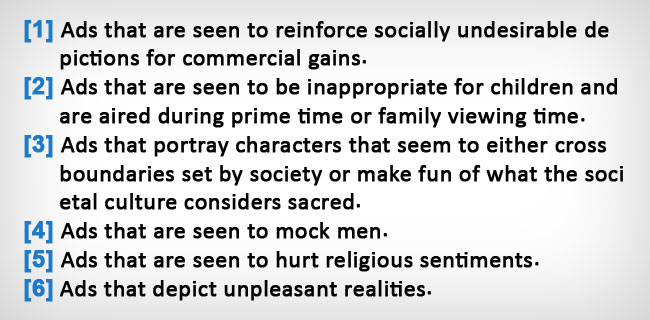
There are six broad patterns of triggers:
Socially undesirable depictions for commercial gains: Some ads were seen to reinforce depictions of society that perpetuated unhealthy practices or beliefs for the sole purpose of commercial gains. For example, ads that promote stereotypes such as fair skin, certain body shapes or ads that create undue pressure on parents and kids in the field of education.
Inappropriate for children: This category had ads, mostly viewed at prime-time, that seemingly provoked children’s interest in ‘adult life’, particularly in the idea of sexuality and physical intimacy. The complainants were largely embarrassed or concerned parents.
Ads where people seemingly crossed cultural boundaries: Depiction in these ads seemed to cross boundaries set by society or to make fun of what was considered sacred in our culture. Individualist depictions, particularly of youth and women, were key triggers. Many ads that showed intergenerational dynamics in non-traditional ways were also considered problematic by some people.
Advertising mocking men: Ads where men were depicted in a negative or poor light, even in humorous or introspective ways, were considered offensive by some.
Hurting religious sentiments: Ads portraying mixed religious narratives, depictions of new interpretations of traditions or the use of religious and cultural motifs in a humorous manner became a trigger point. Complainants questioned the intent of the ads and felt the need to guard against ‘conspiracies’.
Depicting unpleasant realities: Everyday realities, when depicted in an in-your-face manner, triggered complaints from consumers who preferred a more sheltered and ‘civilised’ version of realities. Showcasing death, raw meat or blood tended to raise the hackles of these complainants.
Said Manisha Kapoor, Secretary General, ASCI: “Being in direct touch with the complainants gives ASCI a unique vantage point to understand what people find offensive in advertising. We are sharing these insights with our stakeholders to help advertisers plan campaigns better and be more cognizant of consumer sentiment.”
Added Subhash Kamath, Chairman ASCI said “At ASCI, we believe our role is not just to police the narrative but to also constantly add value to the industry by guiding our members towards more responsible advertising. These kinds of reports, along with initiatives like our ‘Advertising Advice’ service will help the industry a lot in that direction.”
The report can be accessed at https://ascionline.in/.
The Advertising Standards Council of India’s (ASCI’s) Board has elected Subhash Kamath for a second consecutive term as Chairman. NS Rajan, Director, August One Partners LLP, was re-elected Vice Chairman of the Board.
Said Kamath: “I thank the Board for its support and trust. We have flagged off important initiatives in the digital space, such as the influencer guidelines and the monitoring of promotional content. We are becoming future-ready in this ever-changing marketing and media landscape. The second term will allow me to push further with these initiatives, which are showing immense promise. As we expand our presence, we are engaging more with consumers as well to increase awareness of their rights.”




 Good news. ASCI acted fast. It is debatable who acted first to ban/ withdraw the controversial Layer’r Shot ad. Was it the government or the Advertising Standards Council of India (ASCI)? I am glad someone did. However, the story has died fast. Everyone is okay after the ad is withdrawn and a vague apology tendered. One does not know the mandatory approvals, who approved, and why there is no further action?
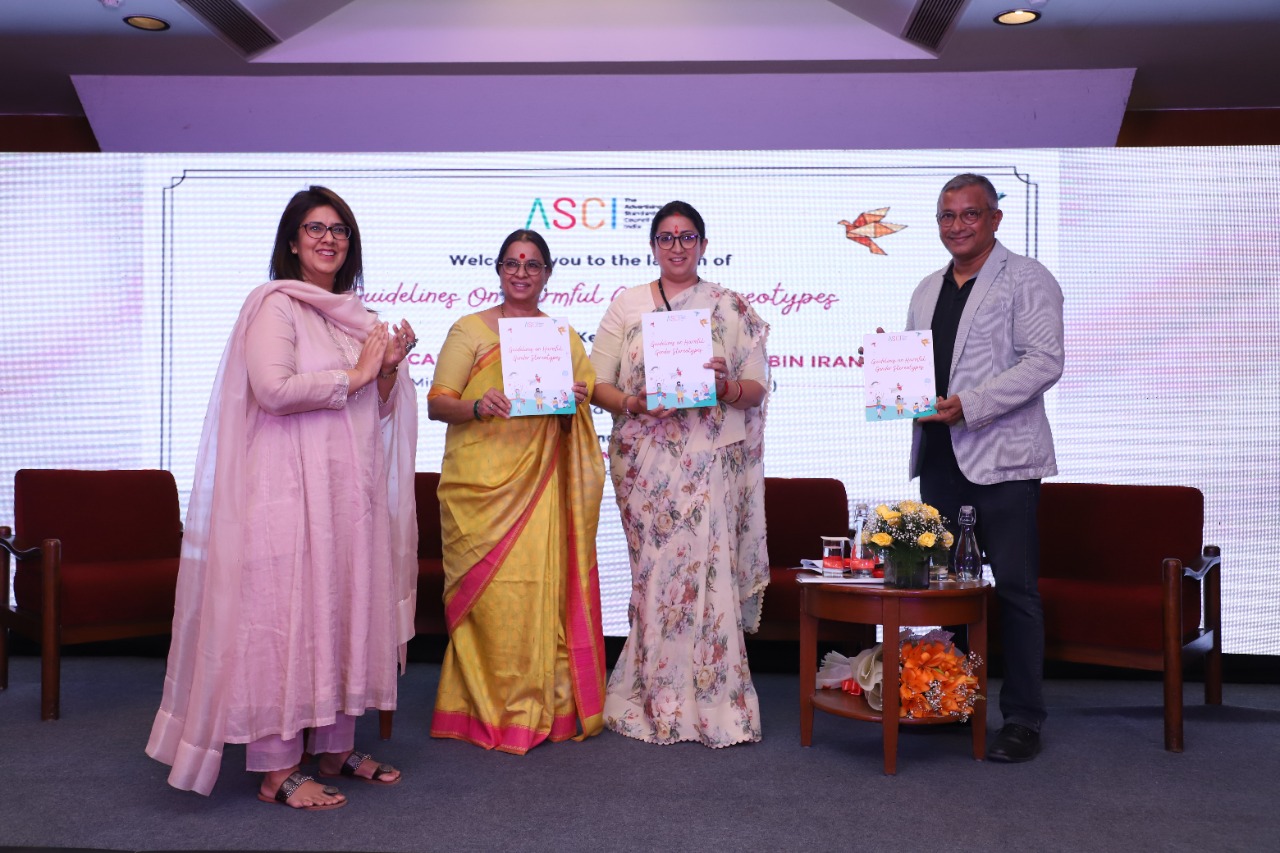 The Advertising Standards Council of India (ASCI) has followed up the launch of its GenderNext report in October 2021, a study by ASCI and Futurebrands, with the release of guidelines that guard against harmful gender stereotypes. The guidelines were released at an event held in Delhi presided over by Union Minister for Women and Child Development Smriti Irani.