Blog

  • Newswatch: Irom Sharmila and the loneliness of the long-distance runner

    By Pradip Phanjoubam


    Irom Sharmila is in love with somebody who has been communicating and sharing soul anguish with her in her confinement through letters. A report in The Telegraph, Kolkata declared this loudly. Nothing very strange about this, after all Sharmila is only 39 years of age and has been living alone in a prison cell after having vowed to sacrifice eating to demand the repeal of the Armed Forces Special Powers Act (AFSPA) for nearly 11 years. Her fast completed 11 years on November 2 which is the day her family says her fast began, or November 5 when the newspapers first took notice of her fast and put it on record in the next day’s edition.


    The terrible privation she has inflicted upon herself and how she has been coping with it is next only to superhuman, and it is a wonder that her spirit did not break down long ago. Ordinary men and women would have probably lost their sanity by now. She is still very much alive today, carrying on the fight she took upon herself to shoulder. It must come with a great deal of bewilderment for many to discover that a superhuman has the heart of a human within. This should not be a matter of discouragement but of elation. After all, what we want to see demonstrated is an ordinary human pushing the boundaries of achievement and not a god doing what are humanly impossible.


    We would in this sense give three cheers to Sharmila for the revelation and not downgrade her stature in any way, although we do feel as a public figure she should have been a little wary and discreet about going public with her very private life. It is also unfortunate that she had not indicated this to the local media, making it seem as if the local media has been party to keeping her feelings under wraps. Or is it a case of efforts by interested parties to do just this? This should become known sooner than later.


    But no great damage done, the truth is out, so be it, and hopefully for the better towards the actualisation of the noble cause she is fighting for. Her direct supporters, and all the rest of us, must come to terms with the new and more human image of the lonely tough-willed fighter, and carry the movement forward with renewed vigour. After all the movement is what is important, and with or without an iconic figure like Sharmila as standard bearer, it should carry on without any sense of loss or that the wind in the sails has diminished. She has done enough to highlight the issue, more than anyone behind the cause can imagine every doing. We should not be on the lookout for a martyr in her. Instead we should be encouraging her to end her self-inflicted privation and carry on the struggle without having to go through all the torture of unending hunger. The issue is the draconian AFSPA and not Irom Sharmila, however great she is.


    We cannot however help wondering if Sharmila is not under psychological stress more than ever in the past few months. It is learnt that meeting her even by her own family members is no longer as easy as it used to be, permission now having to be acquired from the chief secretary of the state himself. All of us who have visited the iron lady in the past know her confinement was not so strictly guarded. For whatever the reason, her privation was being deepened and surely her loneliness too in equal measures, after all she is a human too. Imagine 11 years in a prison cell all alone, not even in contact with other prisoners as she is in a special jail ward in the Jawaharlal Nehru Hospital Porompat so as to enable medical care and nose feeding.


    Not only this, going without food is not just about tolerating hunger. In fact, in her case, hunger may not be much of an issue for she is fed through the nose and kept alive. But her self-denial is more about foregoing taste and smell of food, some of the most gratifying of all human senses. Any lesser person would have lost sanity under the circumstance. Is this additional stress having a toll on her? We hope not.


    In any case, the campaign against the oppressive AFSPA has been allowed to hinge on Sharmila alone for too long. This was not good for her as she is finding out now, or for the movement, for it deprived individuality of individual campaigners, most of them having simply to rally behind Sharmila, abdicating in the process the need to take individual stances in the manner Erich Fromm described the emergence of dictatorships in “Escape from Freedom”.


    The episode is sad in another way though. The paradoxical thing is, to be a public leader entails a great deal of sacrifice of private life. Sharmila as a selfless crusader against the embodiment of an oppressive law automatically came to be lifted on an exalted public pedestal. Sharmila as a shy private woman can lead a happy individual life but will disappear from the public domain. This is the difference between an inspirational leader and a common citizen. The freedom to aspire for either should remain with the individual. Let Sharmila decide her own future without any guilt. She has contributed enough already. Manipur and its resistance against the AFSPA must however continue undeterred even if she decides to retire to a peaceful normal life.


    Leaders and Followers

    But there are more to what this recent development has proven. The fact that a personal decision of Irom Sharmila is now seen somewhat as a threat to the campaign against the AFSPA in Manipur is a demonstration of the strategic and structural flimsiness of any protracted struggle to resort to hero worship. It has to be said that Sharmila’s direct followers are guilty of having done this to a great extent. Even if it is not hero worship, they had built their campaign with her as the major, if not the only prop.


    The approach should instead have been to see Sharmila as a star campaigner, but not the heart and soul of the campaign, but unfortunately, for whatever their reason, this route was not given much importance. And so a single report of Sharmila’s love affair with a hitherto unheard of man, and her reported statement that she is disillusioned with her followers, caused so much trepidation and even the fear that the campaign against the AFSPA would lose much of its steam.


    We hope this does not happen and the movement is able to find new legs that could do with but did not absolutely need Sharmila as a prop if she at all becomes unavailable. Indeed, the myriad human rights organisations actively involved in the campaign must now take time off to rethink, retrospect and reorient their future strategies. Meanwhile leave Sharmila to be where she wants to be.


    But increasingly confounding is also the reason why The Telegraph chose to give so much prominence to Sharmila’s declaration of her very personal affair. This is even more intriguing for in all of the 11 long years she has been staging her protest fast, even on the day she completed the 10 year landmark, she was not seen as deserving headline space by this newspaper. Many other newspapers and television channels even ignored the event. So why this sudden interest in her personal affairs, even though it is clear she was the one who revealed it to the journalist who did the report.


    The timing, whether by design or coincidence is also curious for only a few days earlier the Union home minister, P Chidambaram had announced in New Delhi that the government was considering a review of the AFSPA. Moreover a reflected halo from the Anna Hazare blitzkrieg in New Delhi was beginning to hover over Sharmila, signifying perhaps liberal India’s conscience was being awoken, and the issue of AFSPA was beginning to attract national attention. It was in the midst of this that the story of Sharmila’s love affair butted in rudely.


    The story was heart-warming no doubt despite the hiccups caused by a passage suggesting Sharmila was having very serious differences with her supporters, still the question of its timing as well as the prominence given to it, would undoubtedly make many suspicious that it may have motives other than plain journalistic calibration of news value. Thankfully however, it does now seem the sensational revelation is unlikely to sidetrack the anti-AFSPA campaign.


    The development also should bring back the old debate of whether leaders make situations or the situations make leaders. The Sharmila case should again highlight the need to find the right balance between two. Leaders with vision give any movement the right focus and charisma, but it is also equally true that it is the peculiarities of a given situation which throws up a leader. For instance it is unlikely Gandhi could have happened in the 18th Century or Abraham Lincoln in the 20th Century.


    This notwithstanding, it would be wrong to also dismiss human agency in shaping event and indeed history. If everything were to be predetermined by circumstance and leaders too were forged only by the impersonal forces of history, as Isaiah Berlin noted in “Crooked Timber of Humanity” a difficult ethical situation would arise whereby it would become impossible to hold anybody accountable for history’s many atrocities. Hitler, Stalin, Pol Pot and all the other mass murderers of history would then appear to be no more than quasi-tragic figures, compelled by historical circumstances to do what they did.


    In this context, Pol Pot who killed two million of his countrymen in the span of a decade of his rule, believed whatever he did was for the good of his country even on his deathbed as became evident in what was to be his last interview by Far Eastern Economic Review. It would thus be prudent for the human rights movement in the state to assess the situation arising out of Sharmila’s changed emotional constitution from this light.


    Pradip Phanjoubam is Editor, Imphal Free Press.

  • Ketchum Sampark goes Digital

    By A Correspondent


    Ketchum Sampark, the Indian Affiliate of global communications network Ketchum Inc, has announced the launch of its digital media business Ketchum Sampark Digital. Aimed at garnering substantial market share in the emerging digital media business, Ketchum Sampark Digital will offer full-service interactive strategy, web design, video production and multimedia development to help companies tell their stories and build engagement with their audiences on digital media (internet and mobile).


    Commenting on the launch of Ketchum Sampark Digital, N S Rajan, Managing Director, Ketchum Sampark said, “The launch of Ketchum Sampark Digital reflects the emerging significance of engaging with consumers through prolific use of digital domains. There has been a distinct shift in usage patterns wherein consumers look beyond email and casual surfing to complete engagement and internet as the media of choice for information. We are initially launching our Digital business with a team of young social media experts and progressively build a bandwidth of skills and digital capabilities including a team of interactive strategists, digital designers and producers.”


    According to Jonathan Kopp, Partner & Global Director, Ketchum Digital, “Globally, Ketchum Digital has created innovative digital media solutions for clients including FedEx, Kodak, ConAgra, Absolut amongst many other industry-leading companies. With the launch of Ketchum Sampark Digital India joins other Ketchum Offices and digital experts around the globe in the Ketchum Global Digital Network bringing digital social media solutions from around the world for our clients everywhere.”


    As part of its foray into the digital media business, Ketchum Sampark is concluding a detailed study of 200 Indian corporates and nearly 150 brands in the Indian marketplace to track their digital footprint as well as user engagements. The study covers Corporates from across 20 different industries including Aviation, BFSI, Consulting, Diversified Large Indian Corporates, Healthcare & Pharmaceutical, Oil & energy, Software Services and FMCG. The Brands covered in the survey are from across 14 categories including Apparel, Automobile, Media & Entertainment, Personal Care and Retail.


    “Our study has tracked engagement of these corporations & brands with their target audiences using social media channels like Facebook, YouTube, Twitter and LinkedIn,” said Ajay Sharma, Managing Partner, Ketchum Sampark.


    Key Findings of Ketchum Sampark Digital’s Indian Social Media Engagement Study 2011


    > Initial findings indicate that while most Indian companies (82 %) have registered a presence on at least one of the four social media channels that were surveyed, the activity is largely focused around consumer communication for their products and services.

    > LinkedIn seems to be the most preferred channel on social media with 72 % of the companies surveyed having a dedicated page on LinkedIn.
    Though Facebook is the largest social media platform in India with over 38 million followers, it lags behind LinkedIn with only 55% of Indian corporates registering a presence on it.

    > Using video and multimedia to create engagement with consumers, investors, potential employees and other audiences is still not an avenue explored by Indian corporates with barely 6% being Very Active on YouTube.

    > More than 50% of corporates despite opening up a channel or registering a page on social media are Inactive. Some Inactive corporates also tend to use the presence on a channel opportunistically during launches and other significant company initiatives.

    > We feel that with the explosion in social media users this will change in 2012.

    > Out of the 150 brands surveyed, 23% did not have any presence on social media platforms while 30% had a presence on only one channel. Only 22% of brands were present on all three social media platforms.

    > Unlike corporates, Facebook is the clear favourite for brands with 75% of these brands registering a presence on it. YouTube and Twitter followed with 42% and 28% respectively.


    79% of brands with a presence on Twitter were Very Active / Active on the platform as compared to 69% on YouTube and 63% on Facebook.

  • Flipkart, Myntra & desi e-tailers launch ad blitzkrieg to up buyer base

    By Samidha Sharma


    A fledgling Indian online retail industry has unleashed big buck mass media advertising in the past six months as they seek to build businesses with a broader urban consumer base in the country. Advertising from e-tailing portals surged 228% on television, 78% in print and 797% on radio compared to the same period last year, said data from TAM Media Research.


    Start-up firms such as Flipkart.com, myntra.com-flush with funds from private equity investors led the way in creating brand buzz going beyond the top metros, which some skeptics argued was reminiscent of the build-up to the dotcom bubble a decade ago. The growth numbers from TAM are based on ad volumes and not absolute spends.


    One industry source said the Bangalore-based online retailer Flipkart has marked Rs 100 crore as its advertising budget- significant for a four-year-old firm still soaking in losses. Flipkart, which sells books and electronics online, is labelled as the poster boy of Indian e-commerce and has invested heavily in building distribution and brand visibility across 50 cities.


    “E-commerce is at a very nascent stage but witnessing a lot of traction with urban audiences. Mass media advertising by e-commerce players will hasten this process and make more people shop online,” said Mr Ravi Vora, VP, marketing, Flipkart.com, backed by marquee investors such as Tiger Global and Accel Partners.


    Travel portals like makemytrip, yatra and cleartrip entered mass media advertising sometime back but the rush of brand-building activity from the e-tailing fraternity worries critics, who caution against the hype surrounding online retailing.


    “It is widely known that advertising does not build a strong online business. Successful online brands like Amazon, Facebook, Twitter and eBay almost never advertised. Great online brands are built through tremendous word of mouth. If you don’t organically have it, no amount of ad spend can get it for you,” said Mr Mahesh Murthy, founder, Pinstorm, and co-founder, Seedfund.


    Mr Rishi Khiani, CEO, Times Internet, which runs timesdeal.com and indiatimes.com, agreed, “The advertising push may drive initial traffic but post that the growth will depend on the word of mouth. Advertising does help in creating a differentiator but brands have to maintain their margins to run the business successfully,” he said.


    Flipkart and others have been able to shore up sales riding on the back of ongoing media spends. “We feel our campaign has been successful and we plan to continue with our marketing activities,” Flipkart’s Vora added. India’s consumer internet story has been one of the hottest themes for US investors, which was reflected when makemytrip listed on Nasdaq last year with $1 billion market cap.


    “The intersection between deepening internet penetration and rising disposable income in India is an exciting sweet spot,” said Mr Brewer S Stone, MD, Pacific Crest, a boutique investment bank involved with makemytrip’s US listing, in a recent interaction.


    But Murthy, an internet industry veteran, cautioned: “This happened the last time around when Rediff, Indya and HomeTrade spent loads of cash. It will happen this time around too-just let the dust settle down in a year’s time. We weren’t prepared for the last bubble.”


    The Indian e-commerce market is expected to cross Rs 46,000 crore in 2011 driven by the travel industry, with Indian Railways accounting for bulk of these transactions. The e-tailing industry is a distant second with 8% share, according to estimates from the Internet and Mobile Association of India.


    Source:The Economic Times

    Copyright © 2011, Bennett, Coleman & Co. Ltd. All Rights Reserved

  • Debrief: Tata Tea: ROFL!

    By Anil Thakraney


    Remember that offensive cad in the Tata Tea ads, the one who’d smugly ask us to ‘Jaago Re’? Well, mercifully he’s been given a break in the new TVC created to celebrate 25 years of the brand. Now the message is ‘Soch Badlo’, and there’s a lady protagonist.


    But the anti-corruption tirade goes on. A cynical man cribs in his living room that corruption will never end in the nation, and that basically India is doomed (my thoughts exactly!). He then turns to his wife and demands a cup of tea. The missus uses the opportunity to teach him a lesson. And she delivers a long lecture about how preparing tea is like changing the state of the nation. A convoluted metaphor about boiling water being the raging nation or some such gibberish.


    I don’t know whether the makers of the ad intended this as a desired response, but I was left laughing out loud. Because the whole anti-corruption crusade of Tata Tea is getting cornier by the ad. And the juxtaposition of tea-making with nation-building is completely hilarious. Plus, in all this pagalpanti, the tea story gets buried somewhere.


    Yes, some soch needs to badlo out here. On the part of Tata Tea managers and their ad agency. They should leave the anti-corruption drive to Anna saheb. And stick to selling us chai.


    Rating: (On a scale of 1 to 5): 2. The marks are only for some good laughs!   

  • Amitabh, Ram Kapoor are top of the pops

    By A Correspondent


    According to the ninth edition of Ormax Media’s quarterly study Characters India Loves (CIL), Amitabh Bachchan (Kaun Banega Crorepati) and Ram Kapoor (Bade Achhe Lagte Hain) are the most favourite non-fiction and fiction characters on television respectively.


    This ninth track of CIL was conducted in October 2011, with a sample size of 3477 respondents in six cities – Mumbai, Delhi, Ahmedabad, Lucknow, Indore & Jalandhar, in the 15-44 years age group.


    Amitabh Bachchan leads the non-fiction popularity list with a staggering 57 percent share. A very successful season of his show Kaun Banega Crorepati (Sony) ended this week.


    Ram Kapoor leads with 12 percent share in a more fragmented fiction category, ahead of past leaders like Anandi (Balika Vadhu) and Jethalal (Taarak Mehta Ka Ooltah Chashma), as well as Priya, his wife in Bade Achhe Lagte Hain.


    The CIL report is available to subcription to broadcasters, advertisers and media agencies.

  • Let’s look beyond Kasab!

    By Ranjona Banerji


    Newspapers in Mumbai this week will be full of articles and opinions about 26/11 this week as it’s been three years since terrorists ran amuck all over Mumbai in November 2008, killing and maiming. I have to confess that I have done it as well with my column in Mid-Day. However, I cannot quite understand why there is so much focus on the money spent on Ajmal Kasab, the sole terrorist who was caught. Kasab has been sentenced to death and is awaiting a Supreme Court appeal. Most of the money, as the newspapers tell us, has been spent on securing Arthur Road jail which surely should have already been done considering the number of terrorists and underworld characters who live there. In which case, the story should be: why was Arthur Road jail not secure enough to house one terrorist?


    The big stories for me out of 26/11 start with the shoddy investigation into whoever helped the terrorists on the ground – considering the two put forward by the police were acquitted? After all, convicting Kasab was inevitable, given the evidence against him and he is now within the judicial process on his way to the gallows. But what about those of us who are still alive – what has been done to secure Mumbai since? What about all the promises about equipment for the police? Is there enough electronic surveillance? Where are the boats which the Coast Guard can actually use?
    Hopefully, our newspapers will give us more and get out of this Kasab focus.


    **


    It is good to see Indian TV getting interested in the renewed revolution in Cairo. Suddenly, it’s been headlined on a few channels after the Arab Spring was ignored for weeks in India as if a Bollywood-cricket-faff-filled Indian brain could never be interested in anything else.


    **

    Is it good journalism or bad that the birth of Aishwariya and Abhishek Bachchan’s first baby was treated with kid gloves? I would have thought that in these hard-boiled, in-your-face paparazzi times, good manners would have been thrown out of the window. Even worse, everyone just fell in with Amitabh Bachchan’s requests? Come on, this is not the way a free, independent media behave. Whoever said that we had to be polite and non-intrusive?


    It is true that I care a hoot about this child (I think it’s been born because I saw a picture of Amitabh carrying it out of hospital) but the rest of the country surely wanted to know? Who does the media owe first loyalty to? Readers and viewers, surely!


    **


    Those interested in the run up to the US presidential election should try and catch the debates between the Republican Party hopefuls on CNN. It actually makes for compelling and amusing viewing as candidates rip into each other or trip up. Nothing like watching a politician looking bad – whichever country he or she belongs to!

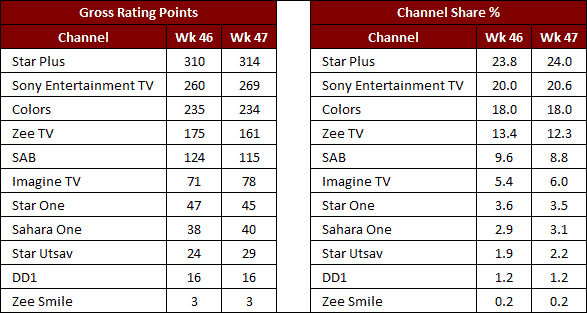
  • GRP Channel shares of HGECs- Wk 47 2011

    Source: TAM Peoplemeter System

    TG: CS 4+ yrs

    Market: HSM

    Period: Wk 46: Nov 6 to Nov 12, 2011

    Period: Wk 47: Nov 13 to Nov 19, 2011


    About TAM Media Research


    TAM is a joint venture between Nielsen Company & Kantar Media Research. Besides measuring TV Viewership, TAM also monitors Advertising Expenditure of Television, Print & Radio through its division AdEx India. Since 2004, it extended its presence in the PR Measurement & Analysis space for Corporate/Marketing Clients by setting up a separate division Eikona PR Measurement.


    In 2007, the joint venture introduced RAM (Radio Audio Measurement) service to track Radio Listenership for the Indian Radio Broadcast Industry. In year 2009, TAM launched a division, called TAM Sports that specializes in monitoring Sports Sponsorship ROI.


    TAM Media Research’s objective is to fuel media insights that will drive the growth of the Indian Media Industry.

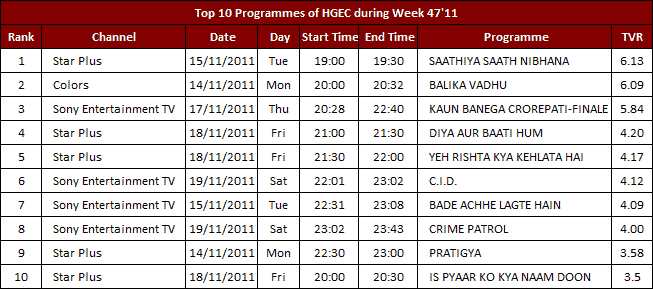
  • TAM data Top 10 programmes on HGEC – Wk 47’11

    Source: TAM Peoplemeter System

    TG: CS 4+ yrs

    Market: Hindi Speaking

    Market Period: Wk 47: Nov 13 to Nov 19, 2011


    About TAM Media Research


    TAM is a joint venture between Nielsen Company & Kantar Media Research. Besides measuring TV Viewership, TAM also monitors Advertising Expenditure of Television, Print & Radio through its division AdEx India. Since 2004, it extended its presence in the PR Measurement & Analysis space for Corporate/Marketing Clients by setting up a separate division Eikona PR Measurement.


    In 2007, the joint venture introduced RAM (Radio Audio Measurement) service to track Radio Listenership for the Indian Radio Broadcast Industry. In year 2009, TAM launched a division, called TAM Sports that specializes in monitoring Sports Sponsorship ROI.


    TAM Media Research’s objective is to fuel media insights that will drive the growth of the Indian Media Industry.

  • The Anchor: 8 key aspects of Phase III that radio companies need to address

    By Ashish Pherwani


    #1 Which licenses to bid for:

    The answer is quite complex, as it needs to consider the ability to sell the new stations both singly and as a bouquet, how well the new stations complement the existing bouquet of stations in terms of tactical sales, the future revenue potential from these stations both from the point of view of generating local revenues and adding on to the revenue generating ability of other stations, etc.


    #2 Bid values: 

    The bid value should logically be based on the revenue generating ability of the station over its license period, and expected costs.  But when you factor in that the revenue generating ability depends on the listenership position the station achieves, the rest of radio company’s station network, the efficiency of the sales team, expected competition in the market, etc, and the cost depends on variables like the license period (10 or 15 years), the rate of music royalties, the ability to share infrastructure and content, etc, it’s a complex decision to make!


    #3 Alliances:

    Some radio companies need to consider which stations to bid for on the assumption that they will form alliances with other networks that together will provide advertisers with national, regional or state-wide reach.  In addition, radio companies with existing ad sales alliances may need to reconsider these in the light of the licenses they propose to bid for.


    #4 Trade licenses that add value to other networks:  

    Radio networks are entering the phase where they will be able to begin trading their licenses.  Some radio companies may want to exit, and valuations aside, may find buyers in those wishing to enter the segment, as well as those which need to increase their presence through a more assured mechanism.  Particularly if multiple frequencies are permitted.


    #5 Using FDI effectively:

    Given the increase in foreign investment that is expected to be permitted, radio companies are already looking to identify partners / investors.  The long term strategic fit and the degree of control that is required to be diluted are key areas that need to be considered.  Particularly since there will also be a Phase 4 one day.


    #6 Go for multiple frequencies:

    If they do come into being, the key questions will pertain to the programming mix – what genre should the new station be? – and ad sales – how not to discount the existing station’s rates when selling space to advertisers.


    #7 Build better MIS and control mechanisms to prevent operational chaos:

    Given the growth in the number of stations, the need to refine processes, automate, and ensure an adequate level of controls in the new, and existing, stations, will be key.  As the span of controls increases, controls always get less effective.  Processes which were performed manually across 20 or 30 stations won’t continue to operate across a 100 stations.  Key persons from existing stations will be used across new station launches, and that could cause the controls environment in existing stations to get lax.  Integrating station infrastructure and content, centralising capex and support function, implementing standard operating procedures and accounting checklists could benefit radio companies.


    #8 Focus on people:

    When 300 stations become 900, the number of people is expected to grow by 175 percent as well.  Recruitment, training, and then monitoring the new set of radio operations will be a challenge by itself.  Not to mention managing the inevitable poaching!


    Ashish Pherwani is Associate Director, Advisory Services, Ernst & Young Private Limited.

  • Gouri Dange: The Media Menu Card

    Talking of paid news, it’s interesting to see how it all works. Meaning the modus operandi. Not just the big-ticket paid news where political parties and heavyweights slip big bucks to large newspaper and tv corporations.


    I’m talking about the mere-mortals path to godhood via the media. Well if not godhood actually, at least the pay-your-way route to your five-minutes-of-fame. Everything’s on sale, going by Media Menu Cards that doctors, lawyers, academics, business people, sportsmen, performers et al have been getting via email over the last couple of years. They are sent by big papers and small, national as well as local and some tv channels too.


    Here’s a sample menu card, with the cunningly worded introduction.

    Dear So-and-so

    Your contribution to society is a matter of pride for us. It would be our pleasure to feature you and your achievements in our paper. Your valuable opinions are also solicited on matters of importance in our city. Please contact Ms X or Ms Y (note, they are interchangeable, the first is a journo and the second is an adgirl from the publication) after going through the contents below.


    Page 3 package

    Rs 4,000/- + taxes for parties

    Our Deliverables : Your presence at any Page 3 event, and/or your and your spouse photograph.

    Rs 8000 + taxes (photos to be provided by you) for family wedding

    Our Deliverables: Event will be reported, pictures of you and any important guests will be featured.


    Opinion-maker package

    Rs 8,000 + taxes
    Our Deliverables : Your views solicited and quoted in stories relating to your field of operations.


    Conference reporting package

    Rs 5000+ taxes (local); Rs 8,000 + taxes national; Rs 10,000 + taxes international. (with photo to be provided by you)

    Our Deliverables : When you attend a conference as a speaker/delegate, it will be our pleasure to report your contribution to the proceedings.


    Hospitalization

    Rs 5000/- taxes

    Our Deliverables: Successful emerging from surgery or illness will be reported, along with pictures (our photographer will be sent).


    …and so on and so forth, you get the point! There are these packages offered foreign trips, awards, donations that you make, stuff that you publish, charitable visits that you undertake to cancer-struck kids and slums…all of it can go up there as news, if you tick the right choices in the Media Menu Card.


    That last one is my favourite – I mean I had never thought of coming out of hospital as news, unless you were a loved leader, or a jailed corporate type pretending to be ill, or had climbed Mt Everest and were in hospital for exhaustion. And one would imagine that the ordinary person wouldn’t particularly like to be shown wheeled out of somewhere. But it looks like there is some valuable brand-enhancement to yourself by being hospitalized. Go figure! Perhaps the hospitals involved are also being contacted as we speak, for their frontage to appear in the papers, at a price. But hell, everything is on sale, so why not!


    While I haven’t been offered this Media Menu Card myself (what, I’m not a potential news-client? My money’s not good enough for these people?), I and other book writer friends have been offered similar menus, by bookstores. Not the ordinary corner bookstores that invite you to actually talk about book; and not the ones where I have launched all my books without paying a penny. But a few other new entrants, that go by lofty names. Their ‘bill of fare’ goes something like this. On an ascending scale starting from Rs 8000 right up to Rs 25,ooo (this was last year, perhaps the rates have gone up in a year), you are offered packages like:


    > venue

    > seating

    > sound

    > f&b (tea and cookies for 40 people)

    > art work for invitation card

    > invitation to our databse


    Write out a larger cheque and you can get
     

    > media presence

    > venue

    > seating

    > sound

    > f&b (tea and cookies for 40 people)

    > art work for inviation card

    > e invitation to our databse


    Then come options where you pay for the book to be stacked on the cash counter. Perhaps they haven’t thought of it yet, but they could easily offer you a package in which a stack of your books accidentally falls on people’s heads.


    And then come the more expensive add ons that maketh or breaketh your book, they say:


    > Your book banner up for 4 weeks in our store


    And the crowning glory that is within easy reach if you’re ready to fork out more mullah:


    > All of the above facilities for your book, PLUS it is placed on our bestseller list for eight weeks running.


    Somebody pass me the antacid, this menu’s a little too rich for me.

  • Hard Knocks: Heavy price for a goof-up

    By Anil Thakraney


    In a nation that boasts of hundreds of news channels (with more dying to get into the fray), speed of content is crucial. It’s a cut throat situation out there, and there is tremendous pressure in the news rooms to be first with the story. In this high tension scenario, mistakes can and do happen. And even if heads of news channels build in fool-proof checks and balances in the process, one can never totally eliminate the chance of a slip up.


    Because making mistakes is human, we have all been guilty of it at some point or another. That’s why the defamation suit of Rs 100 crores slapped against Times Now by an aggrieved judge is not just a bit excessive, it’s rather frightening for all of us in the media. The case pertains to the channel erroneously carrying a picture of the judge while reporting on a scam story.


    Now, I have no doubt at all that the judge in question has every reason to be upset. We would all be in similar circumstances, when someone wrongly tarnishes our integrity. But with due respect to the esteemed judge, if the channel has publicly apologised, that should be the end of the matter.


    While the good thing that could come out of this incident is that the media will hopefully be more careful in the future, there is no denying that the rather harsh punitive action against Times Now has alarmed all of us in the media. Many of us would now think a hundred times before running edgy stories, even after filtering them through a battery of lawyers. Who wants to carry the burden of such a stringent defamation action? And when, after having said sorry, the case goes on.


    On my own part, I have reached a state where I am seriously contemplating seeking a PR job. Forget imagining what an amount of Rs 100 crore looks like, the very mention of the figure gives me nightmares.

    Meri to phat gayee, yaar!


    ***


    PS: So, the Bigg Boss cuckoo house has a new inmate, a porn star. Makes no sense to me. The only great thing a porn star can do is to expose, that’s her ticket to fame. And when she can’t be allowed to expose on a family channel, what’s the point in spending so much money on her? They should invite me into the house, and I am available for a fraction of her fee. I shall create trouble in seconds, that’s my ticket to fame! 🙂

  • Sabeer ‘Hotmail’ Bhatia’s launches JaxtrSMS. Offers free SMS, NEware

    By A Correspondent

    The man who gave users a free medium to download and access e-mail may soon be causing another such explosion, albeit in the world of mobile phones. Hotmail’s original founder Sabeer Bhatia and Yogesh Patel have announced the launch of JaxtrSMS, a cross-platform, open texting application that would enable users to send SMS to anyone in the world for free.

    What is unique about this new venture is that a mobile user can send a text SMS to any mobile phone in the world without requiring the receiver to have the JaxtrSMS application installed on her phone. This open facet of JaxtrSMS distinguishes it from other free mobile messaging applications where messages can only be sent within a closed network to people who also have the same app installed. JaxtrSMS retains the number of the user and no new number is required while signing up for the JaxtrSMS service.

    Unveiling details at an event in Mumbai, Sabeer Bhatia, CEO & Co-Founder, Jaxtr Inc. and Co-Founder of Hotmail, said, “15 years ago, we gave you Hotmail.com, the world’s first webmail service that freed up e-mail from the confines of the desktop and aided the creation of a global communications network which was completely open and free for users. Today, we present JaxtrSMS which does to SMS what Hotmail did for e-mail. Now, mobile users can leverage our free and open application to send messages to their contacts anywhere across the world without having to pay anything. The fact that our application has been downloaded by users across 197 countries in just a few weeks since our soft launch amply reflects our belief that JaxtrSMS will prove to immensely useful to mobile users across the world.”

    JaxtrSMS can be easily downloaded from www.jaxtrsms.com or from the app store on the handset for free and is compatible with all mobile operating systems including the iPhone, Blackberry, Android and J2ME.