Blog

  • Rocky road for Digital OOH?

    By Robin Thomas


    The ‘Global Digital Out-of-Home Media Forecast 2011-2015’ revealed Digital Out-Of-Home media as the fastest growing media in the world with the US as the largest global market and China, the fastest growing.


    However, in India, the medium is yet to make a huge impact. Advertisers are said to be sceptical about investing in the medium due to the lack of an effective measurement system, which is seen as the single biggest challenge. In fact, the effectiveness of digital out-of-home, as per experts, is not evangelized to advertisers and media planners, and as a result, India has not been able to catch up with some other markets.


    Ishan Raina, MD and CEO, OOH Media observed, “The OOH TV medium in India is still in its growth phase. India provides tremendous opportunities to advertisers to reach out to their target group. This has also resulted in the development of various new media formats, and digital OOH being one of them. In general, digital OOH space is expected to see a tremendous growth in the future, given the expected infrastructural growth, increased amount of time spent outside home, and the general economy boom in the coming years.”


    According to industry estimates, the OOH industry, estimated to be around Rs 1,500 crore, commands around 15 to 20 percent of the total advertising share, of which digital Out-of-Home commands 1 to 2 percent and is expected to further grow to 4 to 5 percent in the next two years. It has telecom, banking and finance as its top spenders, among other categories such as retail, FMCG, consumer durables, education and media.


    OOH media players are very optimistic about its future in India, and feel that as infrastructure develops, the economy grows and consumers spend more time out of home, there is high possibility for the medium to grow tremendously.


    Gourav Tandon, Managing Partner, Apex Integrated Marketing said, “India is still at a very nascent stage; however I strongly believe that digital OOH has immense potential in the Indian OOH scenario. The transition has already begun and we do have very large format digital media in places like Gurgaon. Clients today are immensely demanding and the onus is on the agencies to provide high quality mediums.”


    For Digital OOH to grow, there has to be significant number of innovations in the medium, the effectiveness of the medium also has to be evangelised to the advertisers and the media planners, and most of all the industry must come together for an effective measurement tool for digital out-of-home.


    R Venkata Subramanian, Senior Director-Investments, MPG India said, “Advertisers are still sceptical about Digital OOH as there is no effective measurement in place. It is a very good medium and its future is bright, the only draw is the lack of effective measurement to showcase the effectiveness of the medium. However Digital OOH is growing and one of the reasons is because consumers are increasingly spending most of their time out of home.”


    But not all are so positive about the potential of the Digital OOH industry. Ashish Pherwani, Associate Director, Advisory Services Ernst & Young said, “I currently don’xt see Digital OOH crossing 4 to 6 percent of the total OOH segment in the next two years. It requires a different mindset to create ads for Digital OOH, as well as a separate sales technique.”


    Harish Bijoor, CEO, Harish Bijoor Consults Inc, underlined the need for a scientific exploration of the Digital OOH space. “Digital OOH is a medium with potential, but I do not believe the potential has been exploited. What is needed is a scientific exploration of this space. It is time for digital OOH companies to do pressure tests in limited number of cities to prove the efficacy and true value of the medium. As of today, there is a gap in terms of acceptance and faith in this medium, and in the bargain, the medium writes a self-fulfilling prophesy of stagnation in terms of value and use,” he said.

  • Hindustan launches 9th edition in Aligarh

    By Akash Raha


    Hindustan Media Ventures Limited (HMVL) launched its 9th edition in the state of UP from Aligarh on December 10, 2011. With the addition of Aligarh, Hindustan is now printed from 17 centres across the states of UP, Uttarakhand, Bihar, Jharkhand and Delhi.


    Commenting on the launch, Amit Chopra, CEO, HMVL said, “Aligarh is a unique region, culturally rich and prosperous. Its traditional segments like manufacturing and agriculture trade have made the region prosperous. And, education adds to its cultural heritage. It is the perfect setting for a progressive newspaper like Hindustan to enter. The team at Aligarh is setting the stage to making this a success right from the start.”


    Hindustan has launched in Aligarh with a strong 75,000 circulation that is unsurpassed in that zone. Aligarh edition launch comes a year after the launch of Gorakhpur edition which has continued to progress strongly.


    Shashi Shekhar, Editor-in-Chief, Hindustan said, “This is the city of Sir Syed and Maulana. We are honoured to have Aligarh as a key part of our network. For long, readers have had limited choice. Hindustan will offer a refreshing change for Aligarh and its surrounding region. High standards of integrity and journalistic reporting have made Hindustan a much loved and read newspaper in other areas. I am confident that Aligarh will respond to us in the same manner. We will understand and partner with the residents of this belt in their march towards progress.”


    Speaking on the launch Rajan Bhalla, Head-Marketing, Strategic Businesses – HT Media said, “The core proposition of Hindustan is ‘Tarakki ko chahiye naya nazariya’. We have approached Aligarh with the respect that the ‘Mecca of Education’ commands. Recognizing this we sought participation from college and school students in a unique initiative. We asked them to express themselves on the topic of ‘Aisa ho mera naya Aligarh’. Needless to say the response was overwhelming.”

  • HT celebrates Capital’s 100th bday with conclave & campaigns

    By Akash Raha

    Hindustan Times, the top English daily in New Delhi, has been celebrating the 100th Birthday of New Delhi under the banner of ‘I Love Delhi’ throughout 2011 and is getting ready for a high point on December 15 – which is the day the foundation stone of New Delhi was laid and which paved the way for the metropolis to develop.

    Shantanu Bhanja, Vice President – Marketing, Hindustan Times, has said, “I Love Delhi is a continuing initiative for Hindustan Times since it encapsulates our feelings for this beautiful city perfectly. Every year, we have a theme for the initiative and this year, what else could it be except the Centenary of the Capital. We have done a series of events already and hope to bring it to a grand closure now.”

    Hindustan Times is organizing the New Delhi 100 Conclave (on December 15,), inviting Delhi’s most prominent citizens to share their vision of Delhi over the next 100 years. On the occasion, Delhi Chief Minister Sheila Dikshit will release a coffee-table book that puts together Hindustan Times’ entire coverage of New Delhi 100 over the last year.

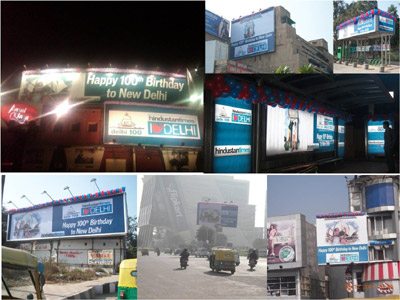
    Hindustan Times has a large outdoor campaign around Delhi-NCR on currently. In the campaign’s innovation, most sites have been decorated with red and blue balloons, wishing Delhi on its 100th birthday. The balloons give the city a festive and colourful look.

    Hindustan Times kicked off the celebrations for New Delhi’s 100th birthday on January 1, 2011 with an editorial series around various aspects of the evolution of the city. Chronicling how the political, cultural, social and architectural landscapes of the city have changed through the decades, this series was done at regular intervals throughout the year. One of the highlights of this series was the 100 Icons of Delhi – a listing of 100 buildings and institutions that define New Delhi as we know it today.

    In addition to the editorial features, Hindustan Times carried out several initiatives to increase reader engagement throughout the year under the Delhi 100 platform.

  • Reviewing the Reviews: Ladies vs Ricky Bahl

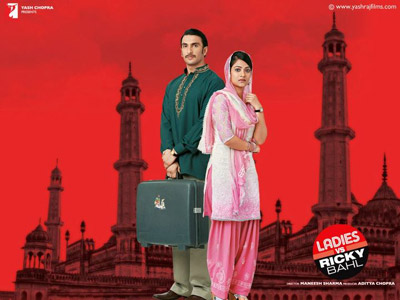
    Ladies vs Ricky Bahl

    Key Cast: Ranveer Singh, Anushka Sharma

    Directed By: Maneesh Sharma

    Written By: Devika Bhagat, Habib Faisal, Aditya Chopra

    Produced By: Aditya Chopra


    Coming out with the notable YRF stamp, Ladies vs Ricky Bahl got mixed reviews, mostly on the negative side. The director Maneesh Sharma’s first film Band Baaja Baraat had been such a delight, that the second one had trouble matching up.


    The one who came out a clear winner is Parineeti Chopra who played a loud, chatty Delhi brat, and is likely to bag all supporting actress awards next year.


    Gaurav Malani, in the Times of India online, feels, “The major hiccup in this otherwise engaging film is that it falls prey to the typical trappings of Bollywood. As romance takes over the con-games, the smart-n-saucy film is substituted by a tepid tale where the conman wants to come clean and change his ways for that one girl in life. That makes for a lame climax and a conventional end. The graph of the narrative drops somewhere in the second half and plunges even further as one realizes mixing con with cupid might not be the best of ideas. Thankfully the pacing is perfect and the film never seems stretched.”


    Sanjukta Sharma of Livemint is left cold. She writes, “The screenplay … gets tiringly predictable from this point. Forget being similar to Frank Abagnale, the smug, glorious con man in Steven Spielberg’s Catch Me If You Can. Sunny starts showing signs of a weepy lover boy. The film falls right into the Yash Raj formula of hinging all stories on soppy romance. This guy is not even a patch on the smiling assassin he is in the first hour.”


    Bollywoodhungama’s Taran Adarsh is uncharacteristically tepid. “On the whole, Ladies vs Ricky Bahl is, at best, decent fare, which appeals in parts. The film starts well, even ends well. It’s the in between that’s plain ordinary. One definitely expected more from the director of the immensely likeable Band Baaja Baaraat. Ideally, the film merits a two-and-a-half star rating, but that extra half star is for Ranveer and Anushka, who steal your heart with truly striking performances.”


    Rajeev Masand found the film watchable and went with2-1/2 stars, but also pointed out flaws. “Ladies vs Ricky Bahl nosedives further post-intermission because of script holes the size of craters. The trio of women track down our hero way too conveniently, and you can’t help but question how a seasoned conman could so easily be charmed into parting with his cash. Doesn’t help either that the narrative is interrupted far too often with unnecessary songs.”


    Raja Sen found it sluggish and predictable and gave it 1-1/2 stars. “It’s always tragic to see those who defy the cookie-cutter mould try and sanitise themselves in an attempt to fit in. Ranveer Singh, who was fantastic in last year’s Band Baaja Baaraat, here has his rough edges blunted by the generic sheen of wannabe stardom, and the result is most unfortunate. ”


    Shubha Shetty Saha of Mid-day settles for 2-1/2 stars too. “The script should have been as clever as it is trying to portray its lead man to be. For Ricky, cheating comes naturally, but disappointingly, it seems like he doesn’t even have to exercise his brain cells to cheat any of them. Ricky gets so lucky every time that things easily fall into place or his victims are so foolishly gullible that they are more than willing to fall into his trap, again and again. Also, the track where he becomes an art dealer, Deven Shah and cheats Raina (Dipannita Sharma) seems highly improbable.”


    Mayank Shekhar is kinder than usual with 3 stars. “The young Ranveer Singh plays Ricky Bahl, his character’s real name, which we don’t know yet. Given almost all Bollywood leading men now are forced to play proper characters (something they used to do back in the 1950s), as against portray merely themselves: a back-story might become slightly necessary. We know nothing about the motivations of this conman, besides what we see: he is single, looks like a loner, is pretty much sexually uninterested in the women he takes for a ride, and is interested in money for money’s sake. Placement of this kind of guy was handled much better in Yashraj’s previous, similar flick, Badmaash Company (2010), which had suffered for completely other reasons.”


    Soumyadipta Banerjee of DNA didn’t dislike the film at all. “Right from the first shot to the last shot, the film has stayed real without the usual loopholes that draw it away from reality. And yet, the film has stayed on top when it came to the entertainment quotient. It has been edited well which doesn’t let the pace slacken and engages you till the last moment. It seems that the film has been developed after consulting a lot of DVDs of Hollywood rom-coms, but who cares? Everybody does that and yet comes up with a shoddy film. This time, all the home-work seems to have paid off.”


    Sudhish Kamath of The Hindu nails it. “How good is a con if the stakes aren’t high? This is the safe, family-entertaining Bollywood film where the hero is virtuous even if he’s a con man (he wouldn’t even let the girl he’s conning kiss him) and turns out to be smarter than four women put together. The makers aren’t even in the mood to play Bluff. The film unfolds in a linear fashion and we are privy to all that’s happening and the only twist coming our way is that there is no twist.”


    And just by the way, none of the mainstream critics found similarities with Mohan Sehgal’s 1974 film, Woh Main Nahin.

  • AdStrat: Happy beginnings with Shubh Aarambh

    Abhijit Avasthi, NCD, Ogilvy & Mather


    [youtube width=”300″ height=”200″]http://www.youtube.com/watch?v=JJ-WZqaGAf0[/youtube] [youtube width=”300″ height=”200″]http://www.youtube.com/watch?v=odmcmnWjK10[/youtube]


    Name of the Campaign/Ad:

    Cadbury Dairy Milk – Shubh Aarambh


    The Brief:

    Get consumers to eat more chocolate by creating new occasions for consumption.


    Research insights

    Our strategy was to grow chocolate consumption by making it part of Indian meetha (sweet) consumption behaviour. By positioning ourselves as meetha and an accompaniment to celebrations, the most obvious meetha consumption moment in India the brand saw tremendous growths. The challenge for the brand was how could we go beyond this?
    How do we integrate with the Indian meetha behaviour even more strongly beyond celebratory occasions?


    Analysis of culture codes of chocolate and meetha helped to uncover a new opportunity and a new occasion for chocolate consumption.


    The western culture code for chocolate is: Sin. Chocolate came to India from the west but the culture code for chocolate in India is different. In India chocolate had become ‘meetha‘ and to Indians, the significance of sweet or meetha runs beyond its physical and functional attributes.


    In India sweet (meetha) performs a spiritual role. Meetha is offered to the gods, it allows us to connect with optimism. Meetha is associated with festivity, purity, and all things good and happy. The Indian culture code for sweet (meetha) hence chocolate is: Auspicious.


    This led us to the cultural insight: “Having something sweet before starting or doing anything new is considered auspicious and suggests that the outcome would be good”. More like “Things that are begun on a sweet note have sweet endings”.


    The thought process behind the creative:

    Having something sweet before starting something new is an old Indian tradition and is deeply entrenched in our behaviour. Changing such behaviour is the most difficult task, but Cadbury Dairy Milk was determined to achieve it. So how did we do it? How did we make chocolate a part of auspicious occasions? We realized that the way to get into the traditional auspicious occasion zone was by transforming it.


    So we redefined the auspicious occasions – made it more contemporary, gave it a fresh perspective. These were not the conventional auspicious moments that India was generally used to. These were more modern and reflected the progressive young India. These real but non-obvious ‘Shubh aarambh‘ moments would expand the footprint beyond traditional occasions like beginning a journey, buying something new during Diwali or Navratri, house warming (moving into a new home), before exams etc…


    And the idea of starting anything new on an auspicious note with CDM was conceived –
    ‘Make a Shubh Aarambh with Cadbury Dairy Milk’.


    While most of the past CDM campaigns like “Pappu pass ho gaya” focussed on meetha after something good had happened – celebrations (post event), this uncovered a new meetha occasion, meetha before a new start (pre event). Shubh aarambh was an even bigger opportunity as inevitably the number of number of people anticipating success tends to be much higher than those who actually succeed.


    Media vehicles chosen:

    TV was the main medium to launch the ‘big brand idea’ but the campaign was also supported with a robust 360 programme (Radio, OOH Print, Mobile and Internet) creating a multiplier effect for the campaign.


    Key issues kept in mind while executing the ad:

    Creating contemporary ‘Shubh aarambh‘ moments.
    Real but non-obvious ‘Shubh aarambh‘ moments like a boy asking a girl out for the first time or a middle-aged sari-wearing lady stepping out in jeans for the first time, or a girl eloping with her boyfriend; all situations that one is likely to encounter these days anywhere in India. These allowed us to squeeze our way into tradition by transforming – making it contemporary.


    Does the treatment do justice to the brief?

    The executions turned contemporary new beginnings into memorable ‘Shubh aarambh‘ moments on television. Deliberately shorn of glam and celebrity endorsements, the executions helped the idea shine brightly. The results speak for themselves. It got over 7,50,000 views on YouTube and its popularity even crossed Indian shores. It was easily the most recalled and liked campaign in 2010.


    What according to you is the differentiating factor about the ad/campaign?

    It came from a real insight into India and Indians and the creative helped it shine through in a way that connected with consumers from all walks of life and across age groups.


    Market and client feedback:

    Forty-two per cent value growth and a 33 per cent volume over the previous year for a brand of its size is nothing short of spectacular. To put it in perspective, just the additional volumes from the campaign accounted for enough CDM bars to cover more than 2.5 times the Great Wall of China!


    The campaign was awarded the ‘Global Marketing Excellence award’ for best IMC within Kraft Foods and has also won accolades at all leading creative and effectiveness awards including Grand Prix at ABBYs, Gold at AME and APPIES.


  • Channels need to develop editing skills

    By Ranjona Banerji


    The fire at the AMRI hospital in Kolkata was one of those tragedies which challenge our skills as journalists. And how did we come out of it? Perhaps some of the visuals on television of mourning relatives were too much to handle as was the fear of having to look at victims of the fire but on the whole, not a bad job.


    TV channels went from covering the news to opinions but perhaps reporters still have to learn that editorialising should be left to those in the studio. Many commended Monideepa Banerjee of NDTV for her clear, concise reporting – experience probably helps (all right, it definitely does).


    Also, TV channels might do well to develop some editing skills. A clearly awe-struck reporter on Times Now was full of admiration for west Bengal chief minister’s efforts to help the situation from the ground when common sense would have told him that she would only have been hindering efforts. It took Saturday’s newspapers to point that out.


    The stories of how the fire spread and the deaths of helpless patients are horrifying in themselves. TV was quick to pick up on culpability and newspapers have gone further by looking at the lacunae in fire safety protocols across the country. (Needless to say they are more honoured in the breach.)


    The Kolkata (or in the case of The Telegraph, Calcutta) newspapers obviously have more details about the incident and were somewhat more scathing. It would be interesting to know just why the patients were locked in by the guards. Also, how much further we will follow this story – how soon, for instance, will all the board members currently arrested be out on bail and get away scot-free?


    **


    The Lokpal draft was released by the Parliamentary committee on Friday but the Kolkata fire seemed to have topped all other news stories – perhaps appropriately. Team Anna as usual started spitting fire and venom and Prashant Bhushan, called for some kind of a revolution against our democratic system – or so it seemed to me.


    No one else appears to have picked it up.


    Personally, I would be interested to know if the India Against Corruption movement also targets non-government corruption. The AMRI fire was evidently a case of private sector fraud. Any takers?


    **


    The Calcutta Club debate aired on Times Now was interesting – the subject was whether the means justify the ends, with reference to the Jan Lokpal movement and Team Anna. Of the six speakers – Salman Kurshid, Sitaram Yechury, Ravi Shankar Prasad, Sudhir K Singh, Arvind Kejriwal and Kiran Bedi – only Kejriwal and Bedi had severe problems understanding the protocol of a formal debate. They seemed to believe this was a normal TV haranguing match. Moderator Arnab Goswami had to work hard to ensure discipline and was tougher than he is on his TV extravaganzas. The politicians were civilised and Sudhir K Singh made the most sense.

  • FM radio: Waiting in the wings for how long?


    By Ritu Midha


    Television and print continue to be the mainstay of any media plan. The buzz around launch of new channels and publications (largely newspapers) is difficult to ignore. Digital media, too, has become a medium of ‘now’. Meanwhile, radio continues to struggle, with cost to operate being quite high while profitability is still an issue. Is it time, then, to ring the alarm bells? Is radio getting lost even before it has acquired a national footprint?
     

    Prashant Panday

    Radio: Today

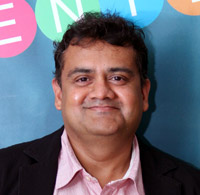
    Prashant Panday, CEO, ENIL, emphasises: “There is no evidence of that yet, though if Phase III expansion gets delayed, this is bound to happen. The Indian media scenario has new brand launches happening all the time. Newspaper reports say that since August this year, the Ministry of I&B has given permission for 745 new TV channels – about half of which are news channels. Likewise, if you look at newspapers, there are editions opening across the country almost every month. It’s the same with outdoor sites and internet portals. In a scenario like this, if there is no addition in the number of radio channels, then the sector will get affected. That is one reason we are waiting for the 800 odd new radio licenses to be issued under Phase III. At present though, radio continues to grow, and its share continues to be just under 5 percent of total advertising spends.”


    Media planning and buying fraternity, in turn believes that radio as a medium is gaining popularity, and that is largely because of its content which touches a cord with the local consumers. Mohit Joshi, Managing Partner, MPG India, explains, “While there is not as much buzz about radio, I don’t think it is losing out. It has developed a unique role in the communication mix, which straddles ATL and BTL. Advertising support on the medium has been growing at 11 percent over the years.”
     

    Ashit Kukian

    Increase in FDI Limits: Low impact

    Media owners are of the view that increase in FDI in radio would not really impact the sector, unlike retail where the proposal for FDI in multi-brand retail has raised a storm. The common belief is that not many foreign players would be interested in the medium because of low profitability.


    Mr Panday says, “Remember, FDI only enters sectors where there is profitability and where the regulatory regime is favourable and stable. Today, most radio broadcasters are barely hitting EBITDA break-evens. This, after half the license period of ten years, is already over. I personally feel that the higher FDI/FII limit will help increase trading in listed radio stocks like ENIL and RBN, but apart from that, the impact might not be that high.


    Ashit Kukian, COO and President, Radio City, agrees, “The increase in FDI in radio sector from 20 to 26 percent is not really going to make any dramatic impact on the industry.”
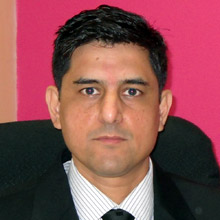
     

    Vinish Joshi

    Slowdown: Whither goes Radio?

    While FM in India continues to struggle, impact of the slowdown, interestingly, on radio, as per the expert opinions might be the least, courtesy its local content. As per Mr Panday, with a slowdown in ad spends, the overall ad industry is unlikely to grow at more than 5-8 percent. His belief is that radio may grow slightly higher at 10-12 percent. “Almost all sectors are seeing a slowdown. We attributed the slowdown in the 1st quarter to the higher spends in the preceding 4th quarter on account of the cricket. However, the 2nd quarter also has been weak,” he says.


    Vinish Joshi, GM, Mediacom, too believes that radio might see a higher percentage growth than other media – largely due to its reach and content. He says, “Increasingly FM-enabled mobile phones are driving radio growth in India and phase III is expected to extend radio’s reach to 294 towns and 839 stations. If any medium stands to gain from this slowdown, it is radio, as during the periods of slowdown, marketing activities get more focused. The concern remains on accountability, as marketing will also be more accountable during this period and comprehensive measurement tool for Radio industry will be critical.”
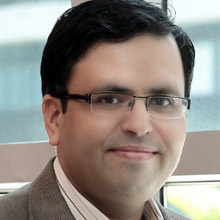
     

     Mohit Joshi

    Measurement currency: A catch-22

    Indeed, the tighter times lead to a lot more stress on RoI, and measurement currency becomes very important. The radio players feel that there is need for a more robust radio measurement system. Mr Panday says: “The present system is a diary system which has many flaws. What we need is an electronic measurement system which accurately captures listenership. We also need more sample sizes to better capture the heterogeneous habits of our cities.”


    This sentiment of the media players is shared by media planning and buying fraternity. While, they agree that attempts being made to capture a larger listener base are commendable, they believe that it needs to broaden further.


    Mohit Joshi says, “Effort is already on for increasing the coverage of the network of the current Radio Measurement systems. Today, when we have radio stations across most of the key cities, the coverage also needs to mirror that growth. The better the data, the easier it would be to establish the role of Radio.”


    It would be interesting to find out how much is the fraternity ready to invest in improving the measurement system and currency. It is a known fact that research and measurement is cost-intensive. With RoI being an issue, most of them might find it difficult to make a major investment in anything.


    FM stations: Same, same – no different

    Radio, at the moment is suffering from me-too syndrome – which to a large extent can be attributed to investment constraints. There is definitely a need for differentiation – enter localised communication.


    Mr Kukian says, “Radio as a medium has the ability to create customized communication for pocketed audiences and impact millions of Indians due to its wide coverage and personal connect. This coupled with the medium’s innovation quotient gives it one up over other media in terms of fulfilling advertisers’ requirements.”


    Vinish Joshi shares a similar opinion, but he qualifies, “Inserting rapid-fire weather forecasts and traffic reports is just providing minimum local content. Local radio, by my definition, is the real interaction of radio personalities, announcers, the people on the air, with listeners both on and off the air. As long as radio maintains its local presence, something that other syndicated forms cannot provide, there will always be a need for its services.”


    Unfortunately local content on radio, largely restricted to traffic reports and contests, seems to be similar on all the stations. The reason for this, yet again, is operating costs and limited number of stations. The game might change once there are more radio stations post Phase III.


    Mr Panday states, “Very little content differentiation will happen unless more frequencies are released. Let’s take an example. Suppose only 10 TV channels were allowed by law. Which channels would exist then? My guess is that the 4-5 GECs would still exist, there would be 1-2 news channels and 2-3 other channels. The reason for so much content differentiation in TV is that there are so many channels. The second reason is that broadcasters are allowed to own and broadcast several channels, so that the cost of operating smaller format channels is reduced.”


    He continues, “In radio however, we suffer from restrictions on both the above mentioned requirements. There are only 7-8 channels in the major markets and broadcasters are allowed to operate only one channel per market. The Phase-III regulations are going to relax the second condition, but till the number of channels increases significantly, we cannot expect much content differentiation. And if the auctions happen the way they are planned – e-auctions for one frequency in Delhi and two in Mumbai – then the license fees will shoot up and niche formats will become unviable. The government needs to release more spectrum BEFORE auctions are conducted. We have even given them a formula to do this – just reduce the “separation” between two adjoining radio channels from the 800 kHz at present to 400 kHz.”


    If the separation between two adjoining channels is helved, the number of channels would double – broadcasters will be able to compete better with TV and print, the government will get more license fees through auctions. And it just might help in increasing FDI investments in the sector by raising the bar and the competition.
     

  • Anil Thakraney: Deccan Herald’s Mission Impossible

    By Anil Thakraney


    Having learnt to live a life in India where just about anything is possible, nothing ever unnerves me. But I must say I woke up on Sunday morning to rather shocking news, it totally rattled me. No, not that Anna Sahib is going on another fast (that’s no news, really), but that Bangalore’s Deccan Herald has launched a Delhi edition. To be honest, I am still reeling from this totally sensational khabar.


    Here are few reasons why the Deccan Herald simply CANNOT be undertaking this suicidal mission: One, newspapers are closing down all over the world. And India, because of its massive reading population and a continuous flow of new readers, will survive this danger for some more years. But closures will happen, it’s only a matter of time. In fact, quite ironically, Deccan Herald’s foray into Delhi comes close on the heels of Mid Day’s closure out there. Given that, prudence lies in beefing up strong editions and putting all the resources into your main markets, so that the demise can be postponed as much as possible. One would imagine that the proprietors of the Deccan Herald would go all out to spruce up their Bangalore edition. And what do they do? They go to Delhi! Wow!


    Next. Delhi is a very crowded newspaper market, and it’s pretty much dominated by the very deep pocket wallahs, the TOI and the HT. It took the Times many years and lots of moolah before it could manage to eat into HT’s market share. And there are other cash rich players too. In this fish market scenario bravely trots in the low profile southern Deccan Herald, hoping to make a dent in the market. And from what I know, owners of the DH aren’t exactly loaded like the owners of the TOI and the HT, so they will always struggle to get noticed.


    And finally, what sort of freshness can the DH bring to an alien territory? The name ‘Deccan’ itself cues south of India. Why would a Dilliwallah be interested in finding out from a southie what’s going on in his backyard. And where he must wine and dine. Makes no editorial sense at all.


    Well, all I can say is that the publishers of the Deccan Herald are either being very brave. Or very foolish. Either way, let’s wish them luck. They’ll need loads of it.


    ***


    PS: Some of the more enterprising ex-O&M guys organised an agency reunion in Mumbai last week. To catch up and mark David Ogilvy’s 100th centenary. Was fantastic meeting the old boys and gals, it felt like homecoming. I must say this: no reunion brings me as much joy as the one with the Ogilvy gang. Not school, not college, not other organization reunions. Must be Sir Ogilvy’s magical touch. Can’t think of another reason.


    Anil Thakraney is a Mumbai-based columnist and commentator and is a former adman and editor. He is Editor-at-Large, MxMIndia. The views expressed here are his own.

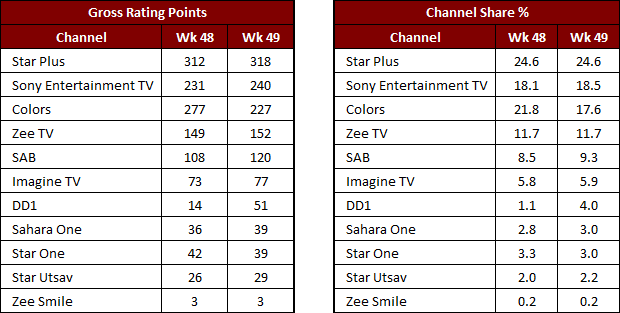
  • GRP Channel shares of HGECs- Wk 49 2011

    Source: TAM Peoplemeter System

    TG: CS 4+ yrs

    Market: HSM

    Period: Wk 48: Nov 20 to Nov 26, 2011

    Period: Wk 49: Nov 27 to Dec 3, 2011


    About TAM Media Research


    TAM is a joint venture between Nielsen Company & Kantar Media Research. Besides measuring TV Viewership, TAM also monitors Advertising Expenditure of Television, Print & Radio through its division AdEx India. Since 2004, it extended its presence in the PR Measurement & Analysis space for Corporate/Marketing Clients by setting up a separate division Eikona PR Measurement.


    In 2007, the joint venture introduced RAM (Radio Audio Measurement) service to track Radio Listenership for the Indian Radio Broadcast Industry. In year 2009, TAM launched a division, called TAM Sports that specializes in monitoring Sports Sponsorship ROI.


    TAM Media Research’s objective is to fuel media insights that will drive the growth of the Indian Media Industry.

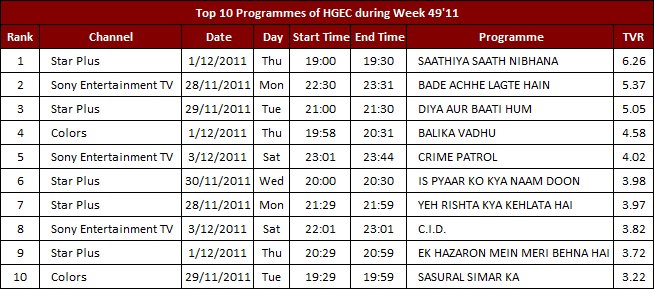
  • TAM data Top 10 programmes on HGEC – Wk 49’11

    Source: TAM Peoplemeter System

    TG: CS 4+ yrs

    Market: Hindi Speaking Market

    Period: Wk 49: Nov 27 to Dec 3, 2011


    About TAM Media Research


    TAM is a joint venture between Nielsen Company & Kantar Media Research. Besides measuring TV Viewership, TAM also monitors Advertising Expenditure of Television, Print & Radio through its division AdEx India. Since 2004, it extended its presence in the PR Measurement & Analysis space for Corporate/Marketing Clients by setting up a separate division Eikona PR Measurement.


    In 2007, the joint venture introduced RAM (Radio Audio Measurement) service to track Radio Listenership for the Indian Radio Broadcast Industry. In year 2009, TAM launched a division, called TAM Sports that specializes in monitoring Sports Sponsorship ROI.


    TAM Media Research’s objective is to fuel media insights that will drive the growth of the Indian Media Industry.

  • [PR CHANNEL] Public Relations needs measurement for its Advertising & PR!

    By Siddhartha Mukherjee


    Hollywood legend Gregory Peck’s reply – “I don’t know anything about Public Relations” – to a PR job proposition from a friend in a company where he was working in the Hollywood flick, The Man in the Gray Flannel Suit, sums up the state of Public Relations. His reply, despite the fact that it dates back to the post World War II era in the 1950s, still echoes the current state of this credible marketing tool called Public Relations, atleast in India.


    Before we get into the scope and type of measurement for a client’s Public Relations initiatives, there are a couple of points, I thought, we can throw light on:


    The central question is – Why does a Corporate/Brand do PR? It is a simple question, but the answer may not be so simple!


    Let us see if this question can be answered by deconstructing some possible thoughts or responses:


    a) We (the Corporate/Brand) do PR because it makes us feel/look good infront of family and friends

    For some this could well be a preposterous presumption. However, the fact is this is the belief for most of us – some may acknowledge…some won’t.


    Majority of the Corporates end up creating CorpComm/PR machineries to serve individual agendas, and not one single Corporate and Brand marketing agenda. Time is spent and efforts are made to expose “faces” of the organization rather than the Corporate itself, what it stands for and its product offerings. PR still continues to be used more as a personal and personnel gratification tool rather than a brand building tool. Many will not acknowledge this. Those who do are far more credible and only adding to their organization’s equity.


    b) Monthly PR scores Ranking

    Some slightly better off organizations have taken it one notch up. Given the fact that the actual purpose of PR/Corp Comm is still ill defined, self gratifying efforts to prove successful creation of decibels levels are quite high in usage. The mandate therefore given to the PR Machinery is – “My company should be No. 1 in the media visibility rank”. No wonder then, the Corp Comm machinery and its PR Agency runs helter-skelter after every possible journalist in every possible newspaper and TV news channel to get some ink or soundbyte in next morning edition. The ballgame ends up being all about the “CHASE”(journalist/publication). Get me some coverage somewhere…anywhere…with any mention of my company becomes the dictate. The thickness of the clippings dossier becomes an emblem of the PR machinery’s achievements.


    The only problem is that it can be easily proven that just because the Company scores rank 1 in media visibility does not mean they have actually done or achieved great PR! Same way, just because an organization has ranked no. 3 does not mean they have achieved bad PR!


    We are obsessed with ranking. PR Industry just re-iterates the same principles.


    c) To justify Ad budgets and EAV (Equivalent Advertising Value) targets:

    This is an extension of the above point. The norm of marketing team (marcomm to be specific) setting targets for PR/Corp Comm team is still a sacred ritual. Targets of Rs 5 crores, 20 crores, 50 crores are a set norm of advertising equivalent editorial value to be achieved by the Corp Comm/PR team at the end of the year. In fact, this has three interesting outcomes: a) The Corp Comm/PR team starts going through tremendous palpitations. Which in turn puts the entire Corp Comm Machinery (including PR Agency) in a tizzy. B) The corporates’ winning/dinning/gifting and media round bills go up because we somehow want to get any coverage somewhere B) Corp Communications starts losing focus on what it is ideally there to achieve.


    At the end of the year, the marketing team rejoices on the achievement of the EAV scores encoring “a great job done”. They possibly will also look at Share of Expenditure (SOE) Vs Share of EAVs Vs Share of Voice/Space. However, whether the annual PR efforts have borne fruit or not, who know! Is someone interested to know?


    The other aspect of this advertising correlation becomes all the more interesting when Corporates look at editorial space as money game – that can be “bought”…courtesy their media buying “power” houses. Some do this with a generalised belief that editorial space across print, TV and online is rigged, no longer a purist zone and should/could be bought therefore. Some believe that this is the best way to control what they want to get and not get written.


    d) To keep negative stories at bay

    Our country is all about negation and rejection! Critics, crisis, negatives, these are aspects that dawn on us almost everyday, starting from our breakfast table. Corporates increasingly becoming within the common man’s radar find them mentioned in most “negatives”. PR/Corp Comm machinery therefore is expected to play a role in pre-empting these negative mentions in the next day morning news reports. Worse case, if pre-empting efforts fail, they start rolling out damage control exercise. Actually, where Corporates passionately believe in this principle of getting easy ink in next day’s paper, and more importantly, pre-empt negative stories, often ex-journalists find a prominent place in the CorpComm/PR chair of the organization.


    e) To achieve a set business objective

    This is where we normally get stuck. How many times have we asked a simple question – why am issuing this press release? Why am I proactively approaching a publication and to give an interview to a journalist? Can the answers to “why” be broken down into specific Quantitative and Qualitative target outputs?


    The reality is that this seldom happens. Those Corporates/Brands who have started with this are already enjoying the benefits of this Samaritan tool. For their customers or consumers out in households, communications is much more smooth, homogenous and credible. For those who have not, probably best is to leave them to market forces. One day, they will realize it is too late.


    Way Forward:

    Our good old Public Relations industry started and has been thriving on Jugaad. This silent army of PR professionals, certainly for the last two decades, has been quietly helping organizations and brands get marketing “exposure” in the news space across Newspapers, Magazines, TV Channels and Websites. Their Jugaad as relationship managers with journalists has actually helped many Corporate Entities enter India, settle well, understand the market and more importantly trigger the interplay of Demand and Supply.


    However, in the last seven odd years especially, this ART of Jugaad has been complemented with a crying need of SCIENCE both in strategic & tactical planning and implementation of Public Relations. CEOs, Directors, Marketing Heads, CFOs, HR Heads, now that all are getting hooked and booked under “ROIs and Accountability”, they are finding it both important as well as challenging to incorporate the tool of PR into their Corporate DNA.


    Here is where PR Agencies have initiated and paved the way. Starting with transforming themselves into Consultancies, their thoughts and initiatives have changed the matrix of this tool called Public Relations. The tool, which was largely confined to the PRO/Corporate Communication desk of their Client Office is actually today showing its influence and usefulness to the internal clients of this same desk – Marketing, Financial as well as HR corridors…not to leave alone the CEOs office. Public Relations can be created, nurtured and propelled only with the vision and proactive initiatives of its Agencies.


    Measurement of PR can go a long way in establishing purpose and focus to a brand PR efforts. PR Agencies therefore will play a big role in introducing measurement into the DNA of PR and Corporate Communications industry.


    Let us not forget that Measurement or Data can do actual PR for PR! The Client, its agency and the industry stands to benefit from it. What the benefits could be, who all stand to gain and how…next time!


    Siddhartha Mukherjee is senior VP, Communications and Business Head, Eikona PR Measurement

  • Mediaah!: Aggie – well-deserved Impact Person of the Year

    By Pradyuman Maheshwari


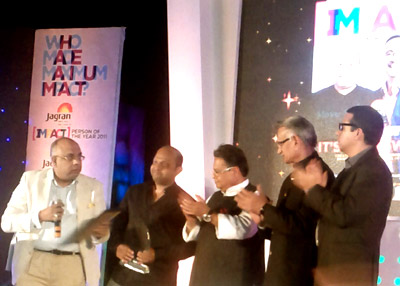
    So it’s Agnello Dias as Impact Person of the Year. For the first time in the seven-year history of Impact Person of the Year, an adperson has won the coveted accolade. Guess there have been times when people have come very close, but given the way the selection is done whoever is top of mind in the second half of the year, generally forges ahead (see disclosure).


    Deserving choice, and in every way echoes the sentiment of the industry. Aggie, with his Airtel ad, has been the toast of adland. I did a quick dipstick on Tuesday asking for names of the top creative folk in the country. The sample: 11 people from three metros. And this is what 90 per cent of the people said: Piyush Pandey, Prasoon Joshi and Agnello Dias.


    Feel sorry for the rest of the immense creative talent that India has, but guess these things happen and I don’t think anyone minds it. While Piyush is around, there is a laaarge creative pool at Ogilvy. Ditto in JWT, Mudra and the mom-and-pop shop based in Patna and Panjim.


    Should it have been one of the others?


    Haresh Chawla, outgoing Group CEO, Network18 and Viacom18

    Madhukar Kamath, MD & CEO, Mudra Group and Chairman, AdAsia

    Man Jit Singh, CEO, Multi Screen Media

    Rajiv Verma, CEO, Hindustan  Times

    Ronnie Screwvala, CEO and Founder Chairman, UTV

    Sandeep Goyal, Non-Executive Founder Chairman, Dentsu India

    Vineet Jain, Managing Director, Times Group


    Guess since it’s the fraternity who decides on who the award should go to, I think the question should be asked to each of us and not the exchange4media group management. For me, Agnello Dias represents the new face of Indian advertising. He is young, dynamic and has done some super work when with JWT and now as an entrepreneur running Taproot.


    What you can ask them (and the editorial team) is why they chose Haresh Chawla as Editorial Choice and not Vineet Jain, Sandeep Goel, Ronnie Screwvala, Man Jit Singh, Rajiv Verma and Madhukar Kamath? I think Haresh Chawla deserved it awesomely and since he’s moving out of the Network/Viacom/Web/etc 18 group, there can be no nasties like he was given the award to get more ads.


    So just as you may ask as to why cricketer x wasn’t selected for the Australia series, there will be questions asked as to why Haresh and why not Vineet Jain or Ronnie or Madhukar or Rajiv Verma or Sandeep Goel or Man Jit Singh?


    Pointless discussion. Many congratulations to Agnello Dias and Haresh Chawla.


    (Disclosure: I worked with the exchange4media group until May this year and ran the Impact Person of the Year for the last three years)

    Photograph: Bharat Kapadia


    The PR Channel

    Must mention here that I have been think of a specialised PR publication ever since Hanmer & PR founder-bossman Sunil Gautam asked me a question of whether it would work here in India. I didn’t think it would as a standalone, but in a broadbased site like MxMIndia, it should.


    SRK: India’s biggest endorser

    His Ra.One may not have worked as well as he would have, but the publicity around it was phenomenal. Clearly the biggest we’ve seen in India. Little wonder that an Economic Times report says that SRK emerged as the most visible celeb on TV followed by Katrina and Kareena. I missed reading it in the Mumbai edition of ET, but here’s a web link: http://economictimes.indiatimes.com/news/news-by-industry/services/advertising/shah-rukh-khan-fmcg-cos-lead-tv-advertising-charts/articleshow/11041079.cms


    Buzz me if you have a story to tell and gossip to share. Confidentiality assured. Andar ki baat will stay under. There are various ways you can reach me: pradyumanm[at]mxmindia.com, BBM @ 23050B5D, pradyumanm[at]gmail.com, @pmahesh, 98338 76278.


    Disclaimer: Although Pradyuman Maheshwari is CEO of MxMIndia other than being editor-in-chief, he chucks those hats while writing Mediaah! So, the views expressed here are entirely his own and not those of the website and the team that runs it (especially the National Sales Head!).