Blog

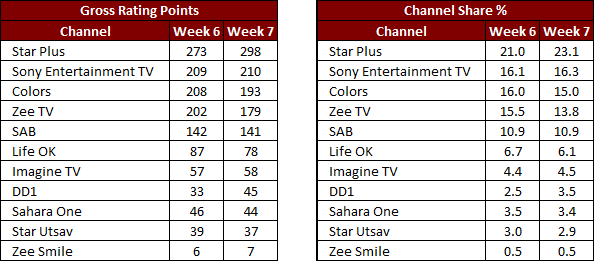
  • TAM Data (GRPs Channel shares of HGECs)- Wk 7 ’12


    Source: TAM Peoplemeter System
    TG: CS 4+ yrs
    Market: HSM
    Period: Wk 6: Feb 5 to Feb 11, 2012
    Period: Wk 7: Feb 12 to Feb 18, 2012


    About TAM Media Research


    TAM is a joint venture between Nielsen Company & Kantar Media Research. Besides measuring TV Viewership, TAM also monitors Advertising Expenditure of Television, Print & Radio through its division AdEx India. Since 2004, it extended its presence in the PR Measurement & Analysis space for Corporate/Marketing Clients by setting up a separate division Eikona PR Measurement.


    In 2007, the joint venture introduced RAM (Radio Audio Measurement) service to track Radio Listenership for the Indian Radio Broadcast Industry. In year 2009, TAM launched a division, called TAM Sports that specializes in monitoring Sports Sponsorship ROI.


    TAM Media Research’s objective is to fuel media insights that will drive the growth of the Indian Media Industry.

  • Of Un-Saif celebs & hysterical cricket journos

    By Ranjona Banerji


    The happiest two Indians in the world right now must be Mahender Singh Dhoni and Virender Sehwag. The alleged fracas between film star Saif Ali Khan and a South African businessman and his family has pushed the apparent rift in the Indian cricket team to second or may be even third priority in the breathless world of Indian news television. We started Wednesday debating every small eyebrow lift made by the Indian captain and examined every snort by Sehwag to try and determine whether it was derogatory or just plain bacterial.


    But by the middle of the day, there was some terribly plaintively hurt gentleman, Iqbal Sharma, telling us in self-righteously hurt tones how Saif and friends had beaten him and his father-in-law up at Wasabi, probably Mumbai’s most expensive and best restaurant. Sharma sported a band-aid on his nose and told us it was broken. His father-in-law said he was punched in the face with a glancing blow (or something that sounded like boxing terminology) but even my flat screen hi-definition did not catch any visible marks on his smooth cheeks. Whatever. The duo appeared on any number of TV channels (all exclusively) and repeated their story. Saif Ali Khan said nothing. But the rest of the day was spent in speculation about when he would arrive at Colaba police station, when he would be arrested, what it would mean and so on. Maybe someone even discussed what he would wear, but I missed that.


    This drama went on and on although meanwhile some CPM cadre were killed in West Bengal, presumably by Trinamool Congress workers and Kingfisher’s fortunes continued to dip.


    But nothing was as big as the imminent arrest of Saif Ali Khan. Every TV channel accepted the version given by Sharma and family. The objectivity of there being two sides to a story seemingly goes out of the window when a celebrity is involved. As for the celebrity – he or she is either the worst person in the world or the best. I’ll qualify that, if the journalist is an entertainment journalist, the celeb is the best person. If a general category journalist then the celeb is the worst. The price of fame, presumably.


    Sadly, when the arrest happened, it lasted only a few moments and the film star was then out on bail. This also caused outrage. But regardless of whether Saif Ali Khan is a film star or not, I would like our TV reporters to investigate the last time someone was not eligible for bail for having a little late-night fisticuffs in a restaurant. If everyone was given seven years rigorous imprisonment for this crime, we would have to build thousands of new jails.


    * * *


    Anyway, the big news of the day appears to be the resignation of Mumbai Congress chief, the controversial Kripa Shankar Singh. Not only did the Congress do miserably in the recent elections but Singh has also been charged with corruption on several counts. I thank the newspapers for this.


    * * *


    Meanwhile, Dhoni and Sehwag must still be holding their breath. Because the hysteria of sports journalists and TV commentators, when it comes to Indian cricket, knows no bounds. It is completely unrestrained by logic, rationale, practicality and other such mundane notions.


    * * *


    RIP Marie Colvin, veteran journalist, with the Sunday Times (London), killed in Syria.


  • DraftFCB+Ulka launches Asterii Analytics

    By A Correspondent


    The DraftFCB+Ulka group has launched Asterii, an analytics company which is stated to continue the group’s endeavour to build capabilities and solutions that will create brand wealth for its clients.


    Explaining the rationale of the launch, a release from the company said, “Today’s business environment is being reshaped by three distinct factors. The first factor is a rapid decline of exploitable market segments. Easy access to technology and global internet-driven communication systems means that any idea gets replicated in months, if not weeks. The market has millions of profitable niches but these are not visible using conventional marketing techniques. “The second factor is the high cost of launching new brands and variants and consequently the high cost of failure. A cluttered market environment compounds the problem.


    “In such an environment marketers and businessmen are discovering that the time-tested method of intuition-based decision systems, albeit with a lot of process and information backups, is not yielding the desired results. In such an environment, there are several companies, which we call analytic organisations, which are competing on the basis of analytics and have built the entire organisation on a culture and process of data-driven decision systems. These companies increasingly are outperforming their peers in the marketplace “This shift has become possible because of a third factor which is the confluence of data and the computing power needed to manage and interpret that data.India, traditionally, has a paucity of good data and computing power was too expensive for the medium-sized business.


    “But today, India is at a tipping point due to the rapid expansion in the retail and financial sectors and a huge amount of data being available to marketers, the IT and communications revolution would mean computing power on your desktop. These three factors are going to intensify a trend and a shift towards analytics-based decision-making, which would become the game changer for companies over the next ten years.”


    Asterii is headquartered in Mumbai with Niteen Bhagwat as the executive director and CEO. The global analytics network has over 100 analysts within the DRAFTFCB network with key resources in Europe andUSA. Asterii has domain expertise across retail, automotive, financial services and packaged goods. The release said that Asterii, a coined word, is derived from the word Asterism which means seeing a pattern of stars in the sky and patterns, which give meaning to the billions of data points that any business has to interpret and decipher.


    Asterii will draw on over 50 years of expertise in creating ‘brand wealth” and developing communication programmes and marketing strategies that are based on unique consumer insights. The company is unique among analytics companies in that it goes beyond techniques and tools to bring “insights” which are rooted in data and analytics and which will help create solutions that will have a predictable impact on the client’s brands and business.


    Asterii, a specialist marketing analytics company, plans to support clients across the entire spectrum of marketing activities. It is supported by a global network of analysts in the DraftFCB ecosystem, giving its clients and business partners access to the global tool kit and best of breed technology solutions. The Asterii solutions toolkit will span the entire spectrum of marketing activities from the assessment phase to growth and maintenance strategies for a brand. The specific modules that Asterii Analytics offers are as follows:


    • Assessment Solutions

    Robust tools to help clients evaluate and select markets, map competitive forces and thus help assign a value to the consumer opportunity. This will help create a macro view on the brand and also help develop go to market strategies.


    • Growth Solutions

    Growth opportunities that emerge from being able to segment the market and do predictive modelling based on behaviour data or other unstructured data sources. Growth is about designing the right acquisition programme and by developing a robust testing and consumer response model. Growth is also dependent on the pricing decisions.


    • Relationship Management Solutions

    Asterii believes in the adage that the best means of growth are from within and that meeting customer expectations and creating customer delight is far more valuable than acquiring new customers.


    • Monitoring & Optimisation solutions

    Analytics also means that measuring and calibrating the performance of the marketing programme. With state of the art reporting platforms like the smart wall and the social news room data and information becomes easily interpretable insight.


  • Amagi announces operations in 35 cities

    By A Correspondent


    Amagi Media Labs, the pioneer and leader in smart advertising on television, has announced its recent entry into tier-1 and tier-2 cities across the country with more than 400 small and medium businesses using Amagi platform for local TV advertising.


    Since the launch of Amagi platform nationally last year, hundreds of retail and regional advertisers across categories – education, jewellry, apparel, real estate, FMCG, white goods and auto dealerships have flocked to the platform to advertise on premium national TV channels.


    Amagi’s co-founder KA Srinivasan said: “Though every business dreams of being on national television, very few could afford it earlier. Through Amagi’s Smart Advertising TV platform, small and medium businesses have now been able to advertise on premium national TV channels at ultra low rates – targeting specific cities or regions.”


    Amagi offers smart advertising on TV in over 35 cities, including metros, tier-1 and tier-2 cities. Amagi has partnerships with 15 satellite TV channels, including leading news, music, lifestyle, movie and regional entertainment channels as well as more than 50 cable MSOs acrossIndia. Amagi platform is ideally suited for regional brands that want to reach their target audience without paying for wasted coverage.


    Hundreds of advertisers acrossIndiahave reaped strong benefits by using Amagi platform. SS Bhamra, Chairman, JLPL said: “I have used Amagi Smart Advertising platform to build my brand in Punjab on national TV channels at a very low cost – my campaign using Amagi Media has delivered overwhelming response from our customers and has helped position JLPL as the developer of choice in Punjab”


    Saumil Pandya, Vice President, MAS Financial Services Ltd, Ahmedabad said: “Amagi’s Smart TV Advertising platform is a boon for regional brands. I can now get the best of both worlds – national TV and local rates. Coupled with Amagi’s creative services, this platform has helped me get both branding and response at a reasonable budget”


  • Tamil KBC begins on Feb 27

    By A Correspondent


    A game show that has been played across 116 countries in 83 languages in the past 13 years, the ‘Who Wants to be a Millionaire?’ format is being brought to Tamil audiences by Vijay TV and Big Synergy, in the form of ‘Sunfeast presents Neengalam Vellalam Oru Kodi powered by Cadbury Dairy Milk’ which hits the small screen on February 27, airing Monday-Thursday at 8 pm.


    The show “Neengalam Vellalam Oru Kodi” on Vijay TV will be hosted by actor Suriya, and promises a whopping amount of Rs 1 crore to be won; an amount that can change a common man’s life forever.


    Actor Suriya says, “From the moment I walked onto the sets of ‘Who wants to be a millionaire’ I knew that this was more than a mere game show.  In the short span that I have spent on this iconic brand, I can assure you that this show is not only about money but about people, their lives, the relevance of money and different perceptions of it across varied strata of our society.  I thank Vijay TV for having me host this and go through a whole new experience.  We have done our best and now we wait , like any other big movie release, hoping the audience loves the show as much as we joyfully lived every minute of it.”


  • Is more the merrier for Kannada news TV?


    By Tuhina Anand


    The Kannada news space has been abuzz with action all of last year especially with new launches and the momentum has continued with the launch of another new player, Public TV. With the new entrant, the number of players totals to six, including TV9, Suvarna 24X7, Samaya 24X7, Janasri, Kasthuri Newz 24, Udaya News.


    Besides the new launches the market which one can estimate to be around Rs 100 crore (only Kannada news) has been also on an overdrive on some of the existing players looking at potential buyers. TV9 has been in news as it has shown interest in diluting its stakes only to build its business further while there has been news on Janasri being keen to offload their share and on a lookout for potential buyers besides Samaya too keen on selling.


    With the new players coming in the truth is that there has been growth in this genre but there is also the view that some of the players have come into the business for propaganda, as the entertainment industry and politics go hand in hand in the South. So while Congress MLA Satish Jarkiholi started Samaya 24X7where news came of H D Kumaraswamy showing interest in the channel, Reddy brothers of Bellary own Jansari, Kasthuri Newz 24 is run by Anita Kumaraswamy who runs Kasthuri TV while Samaya 24X7 is Member of Parliament and Asianet boss Rajeev Chandrasekhar’s baby. Public TV is led by H R Ranganath who was earlier with Kannada Prabha and Suvarna News. In fact, the channel has been promoting itself by saying it’s the only channel run by a Kannadiga.


    Mahendra Mishra

    So the grouse as Mahendra Mishra, Director, TV9 Karnataka and News9 outlines is, “There has been a growth in Kannada news genre but I would put it as negative growth. If new players come into the fray it is obvious that it would lead to increase in the viewership pie but this growth has come at the cost of the news business. What one sees today on many of the Kannada news channels is not a pro-journalism but more on the lines of being pro-party. It is a sad story and we would really like professional players to get in the business and raise the bar.”


    Coming from the leader this statement is thought provoking considering that TV9 has almost 60-70 percent share in this market and its reach is more than Udaya TV which is the leader in GEC. It is also India’s biggest non-Hindi news channel in terms of viewership. The second position is of Suvarna News which stands at 60-70 GRPs while all the other players are fighting for the third spot and here too the gap between the second and the third is too huge. In this race, ironically Udaya News is nowhere close. In fact, another sad state that is expressed by an insider at Kasthuri TV is that many new players have been selling at extremely low rates thus spoiling the market altogether and making it difficult for genuine players to find its footing. He said, “For us, right now the focus is to beat Janasri and Suvarna and get a clear number three position in the market.”


    The state of affairs doesn’t seem too rosy for the players even if new entrants are there in the market. The revenue size has not grown despite new players. There seems to be stagnation in the market mainly because there is more focus on views and propaganda than on news and players entered with vested interest without a long term view. Essentially further growth will come when serious players get into news business. There is a need to build perception and credibility and go beyond TRPs.


    Suresh Selvaraj

    Suresh Selvaraj, ED and CEO, Asianet News Network however is bullish on this genre. He said, “We have seen jump in Kannada news viewing and have seen growth. Our channel is different from the rest as there is a difference between mass and class and we provide class to the mass.”


    Anil K Sathiraju, Associate VP and Head South, Mudra Max, observed, “Out of the six news channels which exist, viz., TV9, Suvarna News 24×7, Janashri, Samaya 24×7, Kasthuri Newz 24 and Udaya News channel, TV9’s relative share is the dominant with close to 60 percent channel share among 15+ CS (latest six weeks’ average). Between Suvarna, Janashri, Samaya & Kasthuri the balance shares are split. Udaya News comes as the last. TV9 has been in this genre for the maximum time and therefore has the first mover’s advantage. While one has to wait and watch how Public TV does, the feedback is quite positive in the market with lot of marketing efforts by the channel. They also claim to be a ‘balanced opinion’ated channel.”


    Karthik Lakshminarayan, COO, Crest (Madison Media), said, “Whenever there is a growth/spurt in the number of entrants in a category, growth is imminent and is good for all. It helps the consumers as they get options, it helps advertisers as they can segment audience better and target individually and specifically. Definitely a win-win. I don’t think that six players in this genre suggest overcrowding. It’s the natural way to grow and in most developed markets the number of news channels are equal to or more than this. The number of Hindi new channels or Tamil news channels are more than six and they don’t seem to be doing too badly (barring maybe a few) so why should this become a deterrent in this market?”


  • Big Bazaar brings new recipe to boost sales

    By Sarah Jacob


    Future Group’s Big Bazaar is making its biggest move into Indian households yet. The value retail chain is not just retailing grain, but grinding it, kneading the dough and even making chappatis for its consumers – at no extra cost.


    Such services, including de-seeding pomegranate, grating coconut as well as cutting pineapple and jackfruit on the spot, are presently offered only at its prototype Rajaji Nagar store in Bangalore, but will soon be rolled out in all the 12 family Big Bazaar outlets across the country.


    “The idea is to take care of all the pains of cooking, to reduce the negative labour that families do not typically reward the women for,” said Ashni Biyani, director of Future Ideas, the innovation and incubation cell of Future Group.


    “The consumer is familiar with modern retail and is willing to move to the next level,” added Future Group Founder and Group CEO Kishore Biyani’s only child.


    Industry watchers say the move will help Future Group, which launched value retailing a decade ago, win the loyalties of working women, students and singles with the new services. “This will help the company not just be relevant to consumers as international competition increases, but also in smaller cities such as Aurangabad, where the consumer may expect such services,” said Raghav Gupta, principal at management consulting firm Booz & Co.


    Big Bazaar has a team of ‘sevaks’ at the Rajaji Nagar store, which opened doors on Wednesday, to offer different kinds of additional services. If it’s vegetables, they can be diamond cut, in cubes, for salad or sambar as per choice and zipped into a bag or chutneys can be whipped up.


    With grain, the store allows the consumer to buy, for instance, a kg of multi-grain such as wheat, jowar and bajra. Once billed, the consumer has the option of getting it ground, kneaded into dough and even made into chappatis either for the full weight or in parts.


    The store also has a tailor to stitch curtains and a vendor to dry clean carpets and provide after sales services for electronics. Future Group has also opened an office for citizen service centre Bangalore One, which allows consumers to pay utility bills within the store


    Source:The Economic Times
    Copyright © 2012, Bennett, Coleman & Co. Ltd. All Rights Reserved
  • The Economist circulation in India grows 26% y-o-y

    By A Correspondent


    The Economist inIndiaregistered an impressive 26 per cent growth (year-on-year) in its circulation as per the latest ABC period [ABC UK/US July-December 2011] to reach 34,953 copies.


    Suprio Guha Thakurta, managing director,India, said: “This is the eighth consecutive ABC increase, confirming our belief that curiosity about the world is growing rapidly inIndia. We have made considerable investments in developing the magazine’s circulation inIndiaand the results are heartening.”


    TheIndiaperformance is in line with the growth of The Economist globally. The world wide circulation of The Economist has passed the 1.5 million mark for the first time. It has achieved print circulation of 1,487,010 in the latest ABC period [ABC UK/US July-December 2011], combined with a digital-only paid circulation of more than 100,000 in December 2011.


    Andrew Rashbass, CEO of The Economist Group, said: “It took us 160 years to reach one million circulation, but only seven years to reach one and a half million. We now expect to reach two million within five years, fuelled by rapid growth in digital circulation. By then, we expect to have more digital than print readers.


    Although our print circulation continues to rise, at some point in the near future it will go down as more and more of our customers choose to read us on a tablet or e-reader. We’re relaxed about that because we are discovering great opportunities in digital having already reached a digital-only circulation of more than 100,000. Over 75 per cent of these readers are new to us and 12 per cent had previously given up their print subscription.”


    The following table is a breakdown of ABC UK/US released and certificated figures July-December 2011 for the print circulation of The Economist.


    Table: Combined growth figures for The Economist in print and digital:


    Print CirculationABC UK/USJuly-December 2011 Print YOY GrowthABC UK/USJuly-December 2011 Digital CirculationData sourced from The Economist
    Global 1,487,010 +0.9% 100,000 


    UK 210,384 +0.1%
    North America 844,766 +1.3%
    ContinentalEurope 241,726 +0.4%
    Middle East andAfrica[MEA] 29,129 +0.4%
    Asia Pacific 146,531 +2.2%
    Latin America 14,474 -14.4%
    Combined total circulation: 1,587,010


    With a global print and digital circulation of over 1.5million and a reputation for insightful analysis and perspective on every aspect of world events, The Economist is one of the most widely recognised and well-read current affairs publications. The paper covers politics, business, science and technology, and books and arts, concluding each week with the obituary. Its website (www.economist.com) offers articles from the past ten years, in addition to web-only content such as blogs, debates and audio/video programmes. The Economist is now available to download for reading on Android, iPhone, or iPad devices.


  • Will private FM soon be allowed to freely air news?

    By Robin Thomas


    While it is known that private FM radio broadcasters will be permitted to air news and current affairs restricted to AIR (All India Radio), MxMIndia has learnt that all this could soon change with the setting up of a Central Monitoring System by the government.


    Mr Uday Chawla, Secretary General, Association of Radio Operators for India (AROI) has confirmed the development to MxMIndia, “The Government will be setting up a Central Monitoring System for content, following which restriction of content including news will be removed.”


    In fact, in an earlier interaction (interview) with MxMIndia, Ms Anurradha Prasad, President, AROI was of the same opinion that once a central monitoring system is set up there will be no restrictions to air news on private FM radio. When asked why the government is reluctant to allowing complete independence to private FM radio on news and current affairs, Ms Prasad stated, “The issue is of setting up a monitoring system so that radio content can be monitored by the government. Once this is ready, we don’t think the government will have any reason to limit news on FM radio.”


    The monitoring system will allow the government to monitor content aired on radio and perhaps prevent any possible adverse effects of the content aired. It is however not known when the central monitoring system will be set up by the government. At present private FM stations are not allowed to air news and current affairs on air and only a year back in July 2011, the government had given its nod to the MIB proposal which allows private players to carry news bulletins of All India Radio.


  • Debrief: Didn’t smell the coffee (but loved the innovation)!

    By Anil Thakraney


    So, after ‘singing’ newspapers, we have smelly newspapers. (God knows what awaits us next… perhaps farting newspapers.) Last Sunday, makers of Bru Gold executed a sensational media innovation in the TOI. The cover page was made to smell of coffee beans. So that readers could experience the fragrance of Bru Gold.


    To be very honest, I had no idea and only heard about this innovation from reports in the media. Because when I lifted that particular edition, which was soon after the municipal elections in Mumbai, I could only smell rats inside the newspaper, if you know what I mean. But I did not smell the coffee. To give the advertiser the benefit of the doubt here, I must declare that I don’t drink coffee, so maybe that’s why the aroma eluded me.


    Therefore I shall do my evaluation purely on the presumption that most readers were able to smell it. If that is the case, it’s a kick-ass innovation and needs to be applauded. Must have taken a lot of preparation and perseverance to make it happen, and one must appreciate that. I also approve of the innovation because unlike Volkswagen’s musical newspaper (a really corny idea) this one was non-intrusive and silent. So, good work guys, and I will be generous with my rating.


    However, that still doesn’t change the fact that I only smelled rats in the newspaper that morning.


    Rating: (On a scale of 1 to 5): 4. Super media innovation. Should win a few trophies.


  • IIM prof Dr Nagesh Rao is MICA Director

    By A Correspondent


    The Mudra Foundation is pleased to announce Dr. Nagesh Rao’s appointment as a Director of MICA (Mudra Institute of Communications, Ahmedabad). He comes to MICA from the Indian Institute of Management, Ahmedabad, (IIM-A). MICA,India’s premier communications management institute, was established in 1991. The institute’s foundation lies in being an innovative and creative school addressing the needs of an ever-changing marketing and communications environment.


    Dr. Rao has done his doctorate in communication fromMichiganStateUniversityin 1994. Over the past twenty years, he has taught in several US universities, including University of Maryland, Ohio University and University of New Mexico. In each of these universities, Dr. Rao was voted the Teacher of the Year at the university-level, and was voted “University Professor” in 2002. He has also been a visiting professor at Bangkok University, Zayed University (U.A.E) and Hong Kong Baptist University. He has been faculty, from 1996, in the prestigious Summer Institute of Intercultural Communication, teaching professionals from all over the world about different aspects of intercultural competence.


    Dr. Rao’s work has been published in internationally reputed communication and health journals, including Communication Monographs, International Journal of Intercultural Relations, and Studies in Family Planning. He has served as a consultant or a trainer for Siemens India, NextGen Health Care, Price Waterhouse Coopers, England, Johns Hopkins University Medical School, and North western University Medical School, US.


    He has worked on research projects funded by the National Institutes of Health(NIH), the National Science Foundation (NSF), the Agency for Health Care Policy and Research (AHCPR) and the National Institute for Alcohol Abuse and Alcoholism (NIAAA). “Dr. Rao has achieved outstanding success in his field of specialization. Given his varied international experience and prolific achievements, we look forward to his steering the Institute over the next several years and taking it from its pre-eminent position as a leading Communication Management school in India to a globally recognised school,” said Madhukar Kamath, Chairman, Mudra Foundation on the appointment.


    On joining MICA as the Director, Dr. Rao said: “It is with honour and pride, I accept the position of Director, MICA, a premier communications management institute in the country. With its outstanding Governing Council, faculty, staff and students, I look forward to taking MICA to greater heights – both nationally and internationally.” MICA (Mudra Institute of Communications, Ahmedabad) is India’s No. 1 communications management school nestled in a 20-acre campus in Ahmedabad. Since its inception more than a decade ago, MICA has produced over 900 advertising, communications & marketing professionals and was ranked the 3rd best private business school in the country by Outlook India magazine’s ‘Best B-School Survey 2009’.


  • What’s a PR agency doing with a marketing head? Quick chat with Genesis CMO Judith Ostronic

    By Johnson Napier


    For many professionals from the PR and communications industry, having a CMO as a regular fixture in the leadership team may well be a distant dream. But that’s a role that has been integral in the functioning of leading PR agency in India, Genesis Burson-Marsteller. That’s one of the many ways the agency plays the game of differentiation. In keeping with its focus, Genesis recently appointed Judith Ostronic as its CMO in India.


    As Chief Marketing Officer, Ms Ostronic will serve as the head of both marketing and new business development for Genesis B-M. In addition to new business, Ms Ostronic will focus on further expanding Genesis B-M’s visibility and leveraging its position as India’s leading integrated communications firm, she tells MxM India in an email interaction.


    The immediate goal for Ms Ostronic would be to work alongside other strategists from the team in realizing a well mapped plan for 2012. It is something that has already got her excited as she looks forward to doing her bit in implementing the 2012 plan and working with her colleagues in ensuring that they are prepared to deliver quality counsel and services to its clients under any and all circumstances.


    Q: Congratulations on being appointed the CMO at Genesis. On a professional note, what would be your key responsibilities at Genesis?

    As Chief Marketing Officer, I serve as the head of both marketing and new business development for Genesis B-M. I’ll be working closely with Prema Sagar, Founder and Principal of Genesis B-M, as well as the practice chairs to incorporate a targeted strategy that ensures we are maximizing every opportunity and converting the best leads into actual business.


    In addition to new business, I’ll focus on further expanding Genesis B-M’s visibility and leveraging our position as India’s leading integrated communications firm. India’s public relations industry is experiencing a surge as more multinational corporations expand their operations here, so the field is more competitive than it was just five or ten years ago. Genesis B-M is an industry leader – with a proven track record – and it’s essential we maintain our visibility and reputation as the communications industry begins to keep pace with India’s overall growth.


    Q: Having a CMO in a PR firm is an unexplored practice as yet, so to speak. What is the differentiation that a CMO can bring within a PR firm?

    The CMO position is not new to Genesis B-M and has been in place for over ten years. Prema Sagar founded Genesis in 1992 and once the firm started to grow, she quickly understood the value of dedicating key personnel to driving new business with a steady eye on marketing and improving brand awareness. With a CMO in place, you have a leadership role dedicated to working across practices and leveraging the necessary media to communicate the value of our services to an increasingly diverse universe of potential clients.


    Q: What are the learnings from Direct Impact that you plan to incorporate at Genesis?

    Direct Impact specializes in targeted communications across multiple industries and geographies. There is no one-size-fits-all approach when developing a communications strategy for a client, and the same will be true for marketing Genesis B-M’s services. We have the resources to meet the unique needs of a diverse range of clients looking to do business here in India, and therefore we must continuously customize our approach to reaching these clients when marketing our own services.


    Q: What is your assessment of the Indian PR and communications market? How does it stack up against the PR model being practised by developed countries, say for example, the US?

    The Indian PR market is still relatively new when you compare it to the US, but there is a high volume of multinational corporations here. While these companies may be new to India, their needs in this market aren’t entirely different from the US or elsewhere. Naturally there are nuances to every market but the needs of the clients, and the challenges we in the industry face in meeting those needs, are universal.


    Q: What is it about the India offer that made you shift base over here?

    India is a fascinating place. Living in the US, I would see daily news reports about India, its people, and of course the economy. India is the world’s second largest population and growing. It’s also a global player commanding international attention and I really wanted to see and experience it first-hand. I am stationed here for two years and will be looking to make the most of every day spent in India.


    Q: As the CMO, what would be your contribution in getting more revenue for the company?

    There is tremendous revenue opportunity and it is growing. I’ll be working closely with my colleagues at Genesis B-M identifying and converting the best of these opportunities. A sound marketing strategy that highlights our position as an industry leader with a solid talent base will lend to our ability of continuing to attract new business.


    Q: Also, will you be possessing authoritative powers to drive change, make investment decisions, media decisions, etc?

    There is a shared responsibility for that. The value I hope to bring to Genesis B-M in the near term is that of someone who is new to this market and can view and assess current operations with a fresh perspective. Genesis B-M provides an environment that fosters new ideas and continued growth which ultimately are the drivers of change.


    Q: How can a CMO help in addressing impending challenges like that of talent, measurement etc in a PR firm?

    As more PR firms enter the market, we are not only competing for clients but also for talent. In my role as CMO I will dedicate much of my focus to building and maintaining our reputation as a respected firm that operates under strict ethical standards. This will be integral to attracting the best clients and make this a place where experienced and qualified communications professionals want to work.


    Q: Do you feel other PR firms need to consider hiring CMOs as a routine exercise?

    Of course I think there is tremendous value in having a CMO here at Genesis B-M. Every firm is structured differently, however, so it’s difficult to say if it should be an industry standard.


    Q: Have you chalked out a marketing plan for Genesis India for 2012?

    Prema and her team have a well mapped plan for 2012 that was already in place when I arrived. Genesis B-M has a strong team of talented strategists who have applied their knowledge and experience in putting this plan together. Key to the success of any plan, however, is having the flexibility to adjust to whatever comes your way. I look forward to doing my part implementing the 2012 plan and working with my colleagues to ensure we are prepared to deliver quality counsel and services to our clients under any and all circumstances.