Blog

  • Atul Phadnis: Industry must not duck core issues on measurement

    By Atul Phadnis


    Atul Phadnis

    All of us have read the astonishing news of a lawsuit in recent days in a New York court making allegations on the efficacy, integrity of TV Ratings in India. A lot of us in the TV Broadcast industry have perhaps turned to our nearest industry colleague the moment we heard this news and blurted – “See! I told you that something like this was going to happen one day!!”


    Unfortunately, for the entire TV industry this is bad timing when already nerves are frayed with the Cable Digitalization issue! I would consider this development as a time to reflect on how we, the TV sector, have got into this position and how all of us collectively have been responsible for the mess with TV measurement.


    Lets look at the key questions that need answers urgently before more damage is done that could potentially destabilize ad revenue structures within the industry.


    The Burgeoning Issues with TV Ratings

    There is no doubt that there have been problems associated with the way TV Ratings have been measured in recent years. Some of the methodology related issues have also played their part in getting things down to this latest litigation :-


    1. For instance, take the issue on the validity of some of the parameters used to select sample homes. More than a decade ago, a panel quota system called Primary Control Variables was introduced with 5 main factors to select panel homes. Some of the parameters have remained unchanged in spite of their doubtful use in recent times.

    2. One such question that needs to be asked in this regard – do we still have Colour versus Black & White TV sets – as one of the factors? If yes, is this factor relevant at all today? And by sampling on irrelevant factors what sort of panel would be constructed? If this is not a factor any more then what’s replaced this? Has industry approved (or is aware of) a new sampling methodology?

    3. Do we still sample homes on the basis of Terrestrial versus Satellite? Should the Satellite sampling not be modified to sampling within these homes by Cable/ DTH players-wise market-shares? Not having this correction means dreadful, crazy results for certain channel genres. Again ignorance is bliss for the industry at large with this question not being asked.

    4. Why should the 600th or the 650th channel be reported for minute-by-minute ratings by market and by target group? Are we not playing with fire with samples for that 600th channel down to 1 or 2 or 5 people within the panel! In fact, this sort of low samples thresholds could also make any research system extremely fragile and vulnerable for interference by external forces.

    5. A continuation to the earlier point is that why should India not follow the practice from other mature markets wherein channels falling below a sample threshold are not reported for certain analysis types. So you may get weekly Channel Reach but not minute-by-minute viewership sliced by markets and target audiences.


    So the question that begs answers is – how can we continue the panel home selection and reporting on criteria, parameters and rules that are a decade old? These need to be contemporized with todays realities. And with industry support and consensus.


    INDUSTRY APATHY

    Incidentally, at this stage I must ask you, the reader, to mourn for a minute, the sad, silent demise of the Joint-Industry-Body. The JIB that had taken birth in the early nineties to guide TV measurement initiatives in our industry passed away a couple of years ago. His daughter – the Industry Technical Committee, who oversaw critical issues such as panel home selection methodology, technology selection decisions also had an untimely death. They both died waiting for its members to come to their rescue.


    BARC – The Puzzling Enigma

    A lot of folks will recall enthusiastic announcements several moons ago about the creation of BARC – a joint initiative by three industry associations. The promise was to create a new TV Ratings system with the circulation of RFPs, finally leading to a Tendering and Commissioning process. The puzzling part that was unaddressed or unclear in the BARC strategy was what happens to the here-&-now even as the new system comes about. Read on…


    1. For instance, why could industry not take control of the way TV Ratings are being done today? One Option would be for the top 5 Media Agencies and TV networks to pool their current TV Ratings deals to pursue a unified conversation with the data supplier.

    2. Why should industry as a first step not address the ‘here-&-now’ issues and ask for weekly panel KPIs from the incumbent measurement company? Panel health indicators, number of suspect samples and observations, past complaints and their explanations – could easily be taken up in a structured manner. Why should everything rest on the ‘utopian’, ideal system that might take another 1 or 2 or 3 years to come by?

    3. What will it take for some of the allegations and accusations being made routinely in private quarters to be audited by an independent, neutral organization? Why cannot BARC be the redressal body to sort issues relating to TV measurement? After all it has the support (and mandate) from IBF, ISA and AAAI. If an effective redressal system existed would any player have gone to court in the first place?


    Agency Media Buyers : faith beyond belief!

    That the average media buyer considers TV Ratings outputs as the gospel truth is well known. Imagine this guy (or gal) who is perhaps sitting in the agency at 10pm churning data for the 633rd ranked channel. The analysis is minute-by-minute viewership for Jharkhand, SEC AB, 15-24 years and is being done since the Buying Head has a meeting with that Channel’s team the next morning.


    At that precise moment what should have happened is Helicopter Gunships should have descended on the rooftops of that agency, Black-Cat commandos should have whooshed in through the AC ducts and screamed at that buyer “STOP! You cannot look at min-by-min trends for a microscopic market-audience for the 633rd ranked channel!”. But none of these stunts will happen. The Buying Head will receive the analysis in time for the meeting and will happily use that data to negotiate ad rates, oblivious to ludicrously low sample sizes! Sad, but true.


    Conclusion

    My last word on this is that – as an industry if we continue ducking the main, fundamental issues in this space we will keep having disturbances that hit at the revenue stability and predictability that measurement brings in. It’s finally our choice – yours and mine!


    Atul Phadnis is CEO, Whats-On-India. He has been associated with all aspects of the measurement process – as a media planner, employee of TAM, a broadcaster and now a technocrat

     

  • Trade shocked as NDTV sues Nielsen,Kantar,TAM & others

    By A Correspondent


    New Delhi Television Ltd (NDTV) has sued The Nielsen Co, a global research and information firm, and its partner Kantar Media Research in a New York court for tampering with TV viewership data to favour broadcasters who allegedly bribed executives in its Indian JV, TAM India.


    In an unprecedented action, the Indian television producer and broadcaster, NDTV, which owns the news channels NDTV 24×7 and NDTV India, has filed a suit in the New York State Supreme Court seeking damages of around $1.4 billion for negligence and fraud and hundreds of millions more for interference and breach of fiduciary duty. Advertisers and media agencies depend on TAM data – the only available measurement for TV viewership – to negotiate ad rates.


    In its 194-page lawsuit, NDTV claims that it had confronted Nielsen with evidence of data manipulation, including taped meetings with TAM India employees, which showed that they were willing to tamper data for bribes. Nielsen, according to NDTV, had admitted in meetings and through emails that its data was indeed being manipulated and that it was willing to address the issue by July 1, 2012.


    NDTV says that Nielsen continued to publish these ratings despite repeated demands to stop distribution of TAM TV ratings until the sample size was increased and a proper security mechanism was put in place.


    The broadcaster has charged Nielsen and Kantar with “operating worldwide through a deliberately complex web of subsidiaries and joint ventures, creating, at least in India, a monopoly and abusing the power of that monopoly.”


    It has also called the Nielsen board of directors “proxies for the world’s largest and most powerful group of corporate takeover specialists (referred to herein and in Nielsen’s 2011 Annual Report as ‘Sponsors’)” and alleged that they took this approach to “‘cash out,’ as part of the typical leveraged buyout ‘exit strategy,’ making billions of dollars in profits.”


    Among the sponsors of Nielsen are KKR, The Blackstone Group, The Carlyle Group, Thomas H. Lee Partners, Alpinvest Partners, Hellman & Friedman and Centerview Partners. These sponsors, however, have not been made defendants in the suit.


    NDTV has also said that the problem extends to other markets such as Turkey and Philippines.


    NDTV managing director Vikram Chandra declined comment as “the matter is in court”. LV Krishnan, CEO, TAM Media Research said: “There is no comment to make right now as the matter is sub judice.”


    NDTV is being represented by law firms, Sabharwal & Finkel and Luthra & Luthra.


    The news created ripples in the media industry with many advertisers saying they were shocked by the developments. “I am shocked. They (TAM ratings) are a key component of all media investment decisions today,” said Madhukar Kamath, group chief executive officer and MD of advertising and media major, Mudra group.


    A media planner who did not wish to be identify, said: “We take TAM ratings very seriously and all our investments depend on them. It is hard to believe that a company like Nielsen, which invests so much in market research, would manipulate the ratings.”


    “There have been questions about the sample size of TAM and number of meters it uses to arrive at ratings, but in the absence of an alternative in the TV measurement space, we depend on TAM as large investments on advertising have to be made on the basis of some numbers.”


    Source: The Economic Times

    Copyright © 2012, Bennett, Coleman & Co. Ltd. All Rights Reserved


  • Arvind Sharma elected AAAI President for 2012-13

    By A Correspondent


    Advertising Agencies Association India (AAAI) has elected Arvind Sharma, Chairman, Indian Subcontinent, Leo Burnett as the President for the year 2012-13. MG Parameswaran, Executive Director and CEO, Mumbai at Draftfcb Ulka has been elected as the Vice President. Nagesh Alai, the outgoing President will be the ex-officio member of the new AAAI Executive Committee.


    When MxMIndia congratulated Mr Sharma and asked about his agenda for the year ahead, he said: “AAAI is an industry body and it is a team work. We will be meeting on August 17, where we shall be listening to each other’s views before setting up the agenda.”


    He added: “The industry is growing and transforming at a rapid speed, thereby also providing newer opportunities to an advertising agency for growth. The amount of monies being invested in advertising has increased, and newer avenues have opened up for investments, thus the challenge is to understand and adapt to the changes. As an industry, we need to understand what lies ahead and prepare the agencies for the future.”


    Other elected members of the Executive Committee include Ganesh Baliga (Fifth Estate Communications), Ashish Bhasin (Aegis Group), Nakul Chopra (Publicis Communications), Tanya Goyal (Mogae Group), Kunal Lalani (Crayons Advertising), Vinod Nair (Network Advertising), Pranav Premnarayen (Prem Associates Advertising & Marketing), Sridhar Ramasubramanian (Matrix Publicities and Media India), Vikram Sakhuja (Group M), Umesh Shrikhande (Contract Advertising) and Srinivasan Swamy (RK Swamy BBDO).


  • After 1.5lakh+ views, Agnee’s ‘reveal yourself’ video is unmuted for launch of B’lue!

    By A Correspondent


    Almost a week back, on July 23, Scarecrow Communications had launched a silent music video featuring Agnee to promote Danone-Narang’s new drink B’lue. People were asked to lip-read and guess the lyrics. Through a specially designed Facebook application, one could type in the lyrics. On submitting their lyrics, every user got a score on the correct words revealed and more interestingly, the correct words got unmuted in the silent music video on replaying.


    In just a week’s time, the campaign got a whopping 1.5 lakh+ views. With engagement and curiosity at their peaks, on July 30, the original track – Reveal Yourself – was unmuted and released. Here is when the brand B’lue unveiled its association with Agnee and the idea behind the ‘Reveal Yourself’ campaign.


    Renu Bansal, Head-Marketing, Danone-Narang Beverages said: “Today’s youth is aware of what they want to pursue and don’t live a life dictated by others. With our new campaign ‘Reveal Yourself’, we wish to foster a passion to inspire people to pursue their dreams. Agnee has beautifully captured this sentiment in their music video. ‘Reveal Yourself’ is B’lue’s tribute, along with Agnee, to all Punekars.”


    The premise of the campaign was unique. Amitabh Sreedharan, AVP-Account Management, Scarecrow Communications said: “Before launching the brand nationally, Danone-Narang was looking to do a pilot launch for B’lue in Pune. While a print and outdoor campaign was created under the theme of ‘Reveal Yourself’, there still had to be a big buzz-generating activity that engaged the youth of Pune.”


    Kapil Tammal, Executive Creative Director, Scarecrow Communications said: “Since ‘Reveal Yourself’ is all about inspiring people to follow their hearts, team Scarecrow decided to help the brand philosophy come alive through a song that connects with the youth of Pune. While Agnee is today a popular national band, it’s still very much Pune-based. Agnee’s popularity among the youth of Pune and the roaring music culture of the city was only to leverage upon.”


    Team Scarecrow jammed with Agnee to draft the lyrics and roped in a technology partner to design this one-of-its-kind app. Sarvesh Raikar, Creative Director, Scarecrow Communications said: “Besides launching the silent video, we created a range of interactive elements that drove engagement further. Videos were shot with Mohon and Koco (the band’s lead singers) playing dumb charades and helping people guess the lyrics.  Fun stuff like lip-reading tutorials and crosswords were also uploaded to boost the buzz.”


    The band members also interacted with the participants through Twitter and encouraged them.


    To catch the teaser phase action, visit Agnee Facebook page: http://www.facebook.com/agneelive


  • Anil Thakraney: Crime instigating journos need to be punished

    By Anil Thakraney


    We first heard about it during the Assam molestation incident. Now the same allegations are being made about the Mangalore party bust, where some youngsters were beaten up and molested by a bunch of goons. That, if not directly provoked, both incidents were encouraged by the media persons present out there. Find that surprising? I don’t.


    Here’s the problem: There are TOO many news channels in India. National and regional. No other country in the world has such a large number; it’s going insane out there. And to think more stations are waiting in the pipeline! Quite naturally, most of these channels are bleeding very badly; the market simply cannot support such a huge crowd. In such a crazy scenario, pressure on content heads to deliver viewership numbers is intense. And this pressure percolates down to the reporters and the camera crew on the ground. A couple of young TV reporters have told me, in private, that they have been warned to either ‘somehow’ get juicy stories or face the axe.


    And I believe this is the key reason behind the nonsense we are witnessing on the idiot box. It’s a very tempting idea. Not being able to get a story? Let’s create one. And we’ll worry about the consequences later. It’s the question of jobs and livelihood, food has to be put on the table, boss. So what we are witnessing these days is the inevitable result of the news channel madness in India.


    So what’s the way out, given that we are a free economy and entrepreneurs have every right to set up their own news shops? It’s simple, and the answer has already been given in the UK. When Murdoch’s editors crossed the Lakshman Rekha of ethics in journalism, they not only had to accept the closure of a newspaper, some senior staff members are staring at a prison sentence.


    Ditto needs to be done with editors/reporters who are found to have abetted or encouraged incidents like the ones in Assamand Mangalore: Loss of broadcast license for the channel. Jail term for the staff members found guilty. There is no other option. Inaction in these matters endangers the safety many young girls in this nation. And I am very sorry to have to state this.


    * * *


    PS: Art has often inspired advertising across the world, and particularly so when it comes to legendary paintings. This cult Michelangelo artwork has been used many times over, but must say it works perfectly for this particular client. Innovative thinking!


  • EEMA-E&Y report predicts 25% growth for Event & Activations in 2 years

    By A Correspondent


    The Indian event and activation industry in the organized sector is expected to grow at an average rate of 25 per cent from its current size of Rs2,800 crore to Rs4,375 crore in 2013-14. Out of Home (OOH) and radio segments are said to be one of the key growth drivers of the event industry over the last three years. The next phase of growth in activations is expected to come from ruralIndiaas the metros are said to have reached a saturation point; hence the need to tap the large consumer base in the rural belt. These are some of the findings from the EEMA (Event & Entertainment Management Association) and E&Y (Ernst & Young) white paper on the ‘The Business of Experience – The Indian Events and Activations Industry’.


    In addition to these findings, 57 per cent of the surveyed respondents are of the opinion that the share of the total marketing spends attributed to BTL (Below the Line) activities (including events and activation) is expected to grow around 10 per cent over the next two to three years to reach nearly 20 per cent of the total marketing spends. The respondents also believe that on the road ahead, profit margins of the events and activation companies will grow at an average of around 15 per cent.


    The respondents were also asked to list five most critical issues they expect to face over the next few years. Inadequate event infrastructure; Talent acquisition and retention; Poor image/ Lack of transparency; High competition levels and Inability to demonstrate ROI’s were the top five issues that were a cause of concern for the respondents.


    In conversation with MxMIndia, Brian Tellis, President, EEMA talked about the two areas of growth for the event and activation industry in the near future. According to Mr Tellis, the unorganized part of the industry is estimated to be as large as the organised sector, if not larger: “The industry will grow from two areas. First, the industry will start getting a larger share of the existing marketing pie. The existing marketing budget of the brand is estimated to grow by 10 per cent as far as experiential marketing is concerned. The second area of growth will come from the bits of the unorganized sector which will become organized. So yes, it is time for high growth.”


    On the takeaways for the industry from the white paper, Mr Tellis said that the industry should first start developing its own Intellectual Properties (IP’s) because the ROI on Intellectual Properties is very high. He also pointed out the need to develop a calculation matrix and ROI matrix as this would enable marketers to confidently spend more money on BTL or experiential marketing.


    Talking about the challenges and opportunities for events and activation industry in the long run, Mr Tellis said: “There is a need to convert the unorganized sector into organized sector and the to develop Intellectual Properties (IP) because that will ensure sustainable revenues in the long run.”


    MxMIndia also spoke to other industry players and marketer for their views on the challenges and opportunities facing the event and activation industry and its effectiveness in brand building.


    According to Mr Girish KJ, vice president-Wizcraft International, over the years as the economy expanded rapidly, so did the need for brand activation, and experiential marketing has become a key value driver in the marketing mix: “In certain sectors, we find that  experiential marketing is what delivers high value to brands. We find a lot of first time clients simply being overwhelmed by the value they derive from investing in brand activation. Eventually, brands that invest in creating meaningful experiences will have a much better reason to be in the customers’ consideration set. In terms of engagement with communities, branded experiences deliver the best return on investment. We have seen that branded events and activation delivers among the highest return with a carefully thought out strategy and a well planned and executed branded experience.”


    On the challenges and opportunities facing the events and activation industry, Mr Girish KJ said that investing in and creating experiential marketing professionals for tomorrow; and attracting and retaining the best and the brightest talent will always be a challenge. “To today’s digitized, desensitised, over-communicated customer, the power of the brands experience cannot be over-emphasised. Globally, customers are shunning main stream, talk-down communications and clamouring to be involved with their brands. That is the opportunity for our industry to embrace.”


    Yogesh Nambiar, Head, Events Operations, TransStadia felt that events and activations industry is expected to grow in the future, but the real growth is however expected only post January 2013: “Currently we are witnessing a downslide from the event management side of the business, because most of the marketers are more or less looking at the Intellectual Property (IP) side of the business and not the event management companies or agency. Today marketers are looking at events and activations as an extension of their marketing arm, so you have to have good ideas to increase ROI’s for brands. From an ROI basis, I believe activation or BTL plays a large role for marketer or brands.”


    Kamal Nandi, Executive Vice President (Marketing and Sales), Godrej Appliances observed: “With more and more brands give experiential experience to consumers, I believe events and activations are only going to increase because that allows consumers to experience the products. Yes, marketers are spending more on activations. But, if you compare ATL and BTL spends, you will find that BTL spends have been constantly increasing over the years, and more money is being spent on experiential marketing. In our industry, events and activations are gaining momentum; however more and more spends are increasingly shifting towards BTL activities. So we definitely see this as an effective way of connecting with consumers and therefore as an industry we are spending more in this area.”


  • Lowe Lintas bags Amrutanjan mandate

    By A Correspondent


    Amrutanjan has selected Lowe Lintas and Partners as its new brand communications partner. The agency’s Chennai office will handle the business. This development is the result of a multi-agency pitch that was initiated in Chennai around the first week of April.


    Joydeep Chatterjee, Business Head-Sales & Marketing said: “Lowe Lintas and Partners’ long experience in FMCG and its proven track record in turning around the fortunes of brands gave Amrutanjan immense confidence. During the pitch, the agency highlighted its deep understanding of the Indian consumer across SECs and categories and we felt that a heritage brand with an iconic status such as Amrutanjan would benefit from this understanding in its effort to stay relevant and increase market share. Yet another aspect that went in favour of Lowe Lintas and Partners was its long associations with clients, many of them stretching over decades. This kind of consistency is good for brands as it is possible to share and pursue a vision in a spirit of partnership over long periods of time.”


    GV Krishnan, Executive Director, Lowe Lintas and Partners added: “We are proud to have won the creative mandate of Amrutanjan, an iconic brand with a rich heritage. Our task will be to rejuvenate the brand and build preference. This win adds to our strong and rich FMCG portfolio.”


    Joseph George, Chief Executive Officer, Lowe Lintas & Partners concluded: “Being asked to partner a brand like Amrutanjan is both a privilege and a huge responsibility; and we look forward to the challenge. After Daimler Bharat Benz, this is Lowe Lintas Chennai’s second significant win this month. This momentum of success and positivity is not just great for the agency, but also for the brands it handles.”


  • The Anchor: 5 reasons why mobile advtg has a gr8 future

    By Sunny Nagpal, Co-Founder & MD, Httpool India


     

    We’ve come a long way since Martin Cooper invented mobile phone in 1973 as a portable handset, to early 1990s when they were actually available in the markets, or in 1994 when the first SMS was sent in Finland to 2000 when mobile advertising made its debut and still grows strong in the marketing scenario of the world.


    We have seen an exponential growth in mobile web and app usership, through the release and distribution of smart phones and open platforms like Android.Mobileis shaping up as an exciting medium for advertising and we have seen that the smart brands have already taken these first green shoots of growth as a sign to start investing in the medium.


    Mobile advertising, undoubtedly, has a great future as it begins to prove itself as the most effective digital advertising channel.


    Here is why the advertising on cellph”one” will be the most preferred one:


    1. One on One: (Personalized, location sensitive)

    One of the major reasons why mobile ads are so effective is largely due to mobile phones allowing advertisers to target their audience with messages that are intended just for the user. Users generally pay more careful attention to mobile ads (example: banner on a notification page). You see people adding utility and productivity tools to their phones in a very personalized manner. Advertisers have already started focusing here, creating such tools, applications which work as enhanced sponsorship and works well with mobile because it is such an intimate environment – people are looking to add more content to their phones and personalize them.


    Moreover, a mobile phone can provide information about the user’s movement and changing location that can be used for timely offers, such as a discount at a store or at a cafe in the food court as a user enters a mall.


    So, the next big thing is location-based marketing. This means the example that is often cited of someone walking past a coffee shop and getting a text telling him to come in and have a cup of coffee is not far off. Advertising for small local businesses can have a much stronger business case.


    2. Many to One: (Manifold Messaging)

    There are multiple points to deliver your brand messages, unlike other media, mobile advertising has a much richer menu of options to offer advertisers: voice (visual voicemail, ringback tones, missed call notifications), text (SMS), multimedia messaging (MMS), mobile Internet, billing touchpoints, handset clients and more.


    This allows an advertiser to create a trail with multiple messages delivered to same user through above means. However, here the attempt should be to deliver them as seamlessly and non-intrusively as possible.


    There are ads that can come across as real-time situations such as billing and location triggers, and can be highly effective in meeting immediate real-life needs and maximizing response rates.


    3. Two sided one: (Interactive)

    The interactive nature of the mobile phone removes barriers to responding and purchasing through direct user response capabilities.


    As mentioned, mobile’s targeting technologies make ads more relevant to users, while also delivering successful campaigns for advertisers. With mobile, the ads can become more effective and relevant to the user when they can engage in a conversation with the person with regards to the advertised product or service. Mobile advertising allows for users to click/touch the banner ad and then is prompted to their dial screens with the number already configured into their dialers. This functionality is called Click to call.


    There are also possibilities to do campaigns with a click to SMS/Purchase/Download/View Video/Email functions as well, all depending upon the campaign objective. Instant interaction will make the lead more valuable and in result lead to an increase in sales.


    4. “That” one: (Targeted)

    A mobile phone provides extremely granular details about the user. This allows advertisers to know exactly who the users are in order to target ads effectively. They can thus target by Geography (Country, City), Carrier (Airtel, Vodafone and so on), Channel (category of content – Entertainment, Business Finance, Travel and so on), Device (Nokia, Samsung, Micromax, iPhone and so on) and Operating System (IOS, Android, RIM, Symbian).


    Because targeted ads are inherently more relevant, they are more interesting. Users pay more attention to them, and advertisers get a higher response rate. This makes the medium really cost effective and ROI driven.


    5. Everyone has one

    Well, we all know that by now! Very often, we see people having more than one mobile phone. While volumes are great and will give you that reach, it is the way people use their phones that is of more interest to the advertisers. Mobile phones today are central to many aspects of people’s lives, and are a key access point for most media consumption – information, entertainment, communication, transaction, self expression and socializing.Mobileis a huge part of people’s live already and it continues to evolve its purposes.


    Think most developing countries. Think India, where most cities are still fighting to meet their power needs. In such times, mobile phones come up as a vital source of information, utility and entertainment. Broadband is still to cover whole of India, but mobile providers with 3G have changed the scenario of Internet browsing. This will only get better with time.


    Historically, it is clear that people don’t like to pay for content. So then, we shall see advertising fund the mobile content as it funds TV, Print and Online.


    Mobile advertising in current scenario remains a part of overall digital mix, rather than a standalone platform and therefore advertising spend is largely contingent on, and limited by, overall media budget mix. However, this is slated to change soon, with most advertisers and agencies realizing the effectiveness of the medium both as a standalone and an integrated channel. We see major agencies appointing media planners dedicated to mobile, and it would be an understatement to say mobile advertising has a very bright future globally and in India.


    And for the advocates against the perception, here is what Thomas Watson, chairman of IBM in 1943 said: “There is a world market for maybe five computers”.


    Sunny Nagpal is co-Founder & MD, Httpool India


  • NDTV takes TAM, principals to US court for $580 million [updated]


    By A Correspondent

    Leading news and lifestyle television broadcaster NDTV has taken TAM and its principals Nielsen and Kantar to court. We confirm we have filed a lawsuit in the Supreme Court of New York State. Because the matter is sub judice, we have no further comments at this time,” said an NDTV spokesperson. And here’s the response from the TAM spokesperson: “TAM India, a 50:50 Joint venture between Kantar Media and Nielsen, doesn’t comment on any litigation.”

    According to a report in Courthouse News Service and Entertainment News Digest (link: http://www.courthousenews.com/2012/07/30/48808.htm and http://www.entlawdigest.com/2012/07/30/1672.htm) :

    It seeks $580 million on 42 counts, including negligence, gross negligence, false representations, prima facie tort and violations of the FCPA and Dutch Corporate Governance Code. It claims that the Dutch Corporate Governance Code requires that Nielsen, a Netherlands-based company, act in the interests of all corporate “stakeholders.”

    The Defendants include five Kantar entities, TAM and 14 Nielsen group entities, Nielsen CEO David Calhoun and its directors James Atwood, Jr., Richard Bressler, Simon Brown, Michael Chae, Patrick Healy, James Kilts, Iain Leigh, Eliot Merrill, Alexander Navab, Robert Reib and Scott Schoen.


    [we’re unlikely to see any more updates on this, but we will update the story in case there are any]

  • U-turn to comfort zone!


    By Tuhina Anand


    Anita Nayyar

    After a fabulous five-year stint at Havas Media, Anita Nayyar is returning to the agency post a four-month stint at Bennett Coleman & Co Ltd (BCCL). The news of her joining BCCL as Director, Customer Strategy was seen as a big leap and an opportunity for her to be on the other side of the table. Her decision to come back and reclaim her old role as the CEO for Havas Media for India and South Asia hence came as a surprise. The fact that post has been vacant ever since she left in April this year evidently made it easier.


    On her part, Ms Nayyar maintains that she was missing the pace of her agency life; after all she has been with media agencies for more than two-and-a-half decades. “There was nothing wrong at BCCL. In fact, it was an interesting assignment and BCCL is a fantastic organization and they took good care of me. However, I have realized that my heart lies in being on the other side of the table and that is on the agency side,” she told MxMIndia.


    “In fact, the stint made me understand the issues from a publication point of view which often we fail to see as we have not been a part of it. It gave me an opportunity to see a new side of business and will surely help me in the way ahead,” she added.


    CVL Srinivas

    CVL Srinivas, Chairman, SMG India and MD, LiquidThread, APAC, moved to Private Treaties at BCCL after Maxus and now with SMG. Talking about his moves, Mr Srinivas said: “I moved at a time when I was to head to Singapore to run Maxus Asia-Pacific. I had chosen a successor to head Maxus India and completed the handover, so it was a good time to sit and evaluate career options. Having worked in media agencies for 13 years on the trot, I felt it was time to get out of my comfort zone and explore the world outside. I had always done roles that involved scaling up businesses, building teams, so I thought working with or for start-ups would be a good way to build on my strengths and yet do something different.


    On the stint at Private Treaties (now called Brand Capital) ending soon, Mr Srinivas commented, “I consulted for a few start-ups before joining Times Treaties where I had a two year stint. In all, I was outside of media agencies for a good four years. I chose to come back because of the role that was offered to me by SMG. It seemed to have all the right ingredients at that stage of my career.”


    It is not uncommon of an advertising person to move to the client side of the business but only few switch to the media side of the business (print and broadcast primarily) and more importantly even rarer come back to the agency once again. However, as we understand that it’s not the case of sour grapes for comebacks.


    Karthik Lakshminarayan

    Karthik Lakshminarayan, COO at Crest (Madison Media) re-joinedMadisonwhere he had worked for close to eight years post his foray into broadcast and production when he was with Colors, FoodFood and Fremantle Media. For him the decision to join broadcast was, as he puts it: “A challenge thrown to be a part of a launch and do something completely different and radical from Media Planning and Buying which I was doing for over 14 years and was adept at.”


    However, the decision to come back was, “purely because it was Madison as it was a home-coming. Any other agency would not have been the same or felt the same.”


    A senior industry person who had been in a similar situation pointed that while hiring an agency person is desirable for media houses as they come with multiple experience of working on various brands, but the difficulty begins once you are inside the publication or broadcast company. There is a huge cultural difference, because the kind of monies the media houses deal with is humongous as compared to what the agencies deal with. In his words: “The agency people are bound by certain set of responsibilities, it’s like a relay race where you do your work and then hand the baton to the next yet at the same time be part of a team, however the media house is huge and set of responsibilities diverse hence making the transition becomes difficult. Also, one could be a CEO of the agency and be well recognized but the same person will get lost in the media house where there are many biggies ruling the roost.”


    Suresh Balakrishnan

    Talking of the scale of business being different, Suresh Balakrishna who joined back LMG as CEO of Brand Programming Network after a decade of being with print explained, “The media houses definitely means operating on much bigger canvas and the scale of monies involved being huge. You learn to be a business man as there are hard trade-offs and you need to take hard calls on driving the bottom line as well as the top line. So the pressure involved in definitely higher. ”


    While that’s the view of people who have made a comeback, the recruiters have a different take. An advertising industry recruiter on anonymity said: “I can’t really think of many who have made a transition and then come back to the media agency. Yes for us, those willing to come back especially at senior level are good prospects for recruitment considering the dearth of talent besides they are value for money. There is comfort in coming back to your old set up.”


    However she added: “I do think that people who are willing to come back are usually those who are having a tough time in their current set up.”


    On the other hand, those who made the switch and then came back to agency feel that the experience only helped them in their career. As Mr Srinivas puts it: “I learnt a lot at BCCL. Firstly, to get a first-hand experience of being on the media owner side was very helpful. Secondly, I worked with some very fine minds at Private Treaties and got a much better understanding of how businesses are built and brands created from scratch. And being part of India’s largest media company (when one is not used to such scale on the agency side) was a huge learning in itself.”


    Mr Balakrishna too added, “The learnings at media houses have been immense as I had  joined HT around 2001 which was a time when media houses were just getting professional in their approach and this was an aggressive phase of growth. Mint and DNA were challenger brands as they were not the leaders so one had to be literally on our toes thinking all the time to take away whatever possible from competition to establish ourselves.”


    However he added that his decision to join back was primarily because he felt that while he had acquired depth of learning he was missing the width of learning that an agency offers. One gets to work on different categories and with market becoming increasingly competitive and clients keeping a vigil on ROI the media agency business has become only more organized and scientific in their approach.


    Imaging: Rafiq, Images: Clipart


  • Ranjona Banerji: Good to hear sports greats on CNN-IBN

    Ranjona Banerji

    By Ranjona Banerji


    Which is bigger news wise? Gagan Narang winning an Olympic bronze, the collapse of the Northern grid leading eight states, including the national capital, powerless for close to eight hours or a fire in a train in Tamil Nadu leading to at least 30 deaths? It’s a tough call to some but most newspapers decided that “feel good” was the way to go and Narang got top billing therefore. After that, as far as Mumbai’s big two broadsheets are concerned it looks like Hindustan Times exercised better judgment than The Times of India. HT Mumbai took the power grid collapse as the second lead and carried the train accident just above the fold, giving all there prominence. Times of India gave the power story a single column and then decided to go what used to be the DNA way when I worked there – fill every page with 80,000 stories. This can be counter-productive: the reader may be impressed that you have so much news but gets confused about which tiny bit to read first.


    **


    Primetime TV news was on its usual trip. These days, they have permanent scanners on Gujarat chief minister Narendra Modi and on members of the Anna Hazare-led India Against Corruption movement. And when the two converge, nothing like it! Every time Modi sneezes or Arvind Kejriwal hiccups, we get a panel discussion. The same people mysteriously appear on every channel at the same time. They say the same things. And most sensible people are either watching the Olympics, Masterchef Australia, going out for dinner or reading a book.


    But I have to give a shout out to Arnab Goswami for his impassioned speech about the flip flops in the Anna Hazare movement. And good effort by Rajdeep Sardesai, trying to make some sense of why safety is not a priority for the Indian Railways.


    **


    Olympics coverage has been good across most newspapers – although sometimes with too much focus on India. The world’s best athletes have gathered to demonstrate their prowess after all, so more about them please. But the winner for me would be the special discussions on CNN-IBN with Michael Ferreira, Geet Sethi, Vimal Kumar, Enrico Piperno, Raghavendra Rathore and others. It’s illuminating to hear sports greats discussing other sportspersons and recounting their own experiences without losing their tempers. Getting the great Carl Lewis is a good coup as well.


    Times Now has the squeaky and annoying Boria Majumdar so I am afraid to go there.


    **


    While on sports, he’s a good friend of mine but I defy anyone to anyone to make sense of Bobbili Vijay Kumar’s attempt in yesterday’s Times of India to try and give a cricket spin to archery just because the Olympic event was taking place at the hallowed ground of Lords. After two paragraphs I knew that even if William Tell’s father stuck an apple on my head I wouldn’t be able to understand it.


    Ranjona Banerji, senior journalist and commentator and Contributing Editor, MxMIndia, reviews media four times a week. The views here are her own.


  • Mediaah! Dear Editor, Mint: It’s incorrect to damn TV news

    By Pradyuman Maheshwari


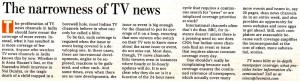
    Click here for Larger view

    I find the media coverage in the Mint by far the most balanced from the time it started and was quite surprised to see a bizarre second edit in today’s edition titled ‘The Narrowness of TV news’.


    Now we all know the problems with the news on television: it’s often sensationalized, it can go and on over an inconsequential issue and do whatever it takes to garner ratings.


    While making a case for its argument on the narrowness, the editorial concludes:

    One shouldn’t really be complaining because such coverage ensures the continued relevance of newspapers, which actually cover many more events and issues in, say 20 pages, than news channels do in an entire week, and also provides an opportunity for news websites and news apps to get ahead. Still, such complaints are reasonable because such coverage amplifies the inconsequential at the cost of other, more substantial, stories.


    I don’t think there’s anything wrong in what the Mint has said, except that it has made some gross omissions. One, it bases its arguments only on the primetime slots on news channels. For instance, let’s take Times Now among the English. Yes, the 9-10/10.30 blocks are taken up by extended studio discussions on one or two or at most three topics and an end-piece, but at around 8.30 it does carry news snippets from across the country. I must confess I don’t watch enough of news television to be able to give you specific timeslots across networks, but I’m certain every channel has a slot for round-up albeit not at the 9-10pm slot.


    Mint’s editorial evidently doesn’t take factor in the news on the Doordarshan channel (DD News) which is possibly more all-encompassing, though the emphasis is more on the ministers and government events.


    My peeve against the comment is that it assumes that news in our newspapers is perfect. It may be noted that HT Media, the company that owns and publishes Mint, doesn’t own a news channel, though it actively allies with CNN-IBN for special surveys and events.


    The fact is that just as the malaise afflicts news on TV, it also exists in newspapers. In fact there are enough biases in the papers. And these move from news to editorial pages too. A leading national daily who the Mint editors may be familiar with dropped the column of a well-known commentator because he/she had written a slightly negative article on an emerging politician of a disposition that the newspaper group is close to. Then there are cases of paid news and a variety of vested interests at play.


    The primetime slot on television news is like the front page of the newspaper. Just as you’ll not get a hundred news stories on Page 1, the same holds good for television news.


    So to damn the content mix of one medium on its editorial page is not on, dear editors of Mint. The decay is huger in print – in the big and small cities. The narrowness exists in newspapers too — on the news pages and beyond.


    Buzz me if you have a story to tell. Confidentiality assured. There are various ways you can reach Mediaah!: pradyumanm[at]mxmindia.com, Gtalk pradyumanm@gmail.com, BBM 29FEA79C. Twitter @pmahesh and of course the mobile: 98338 76278.  The views expressed here are my own.