 By Indrani Sen
Will the Demonetisation accelerate marketing communications with connected consumers in our country? It has undoubtedly given a strong push to the growth of digitally-enabled consumers in India. We need to wait for couple of months till statistics from the telecom industry confirms if 4G followed by the Jio launch and the demonetisation has helped to increase the number of connected consumers in India. It will indeed be an achievement if our smartphone penetration crosses the inflection point of 30% by December 2016.
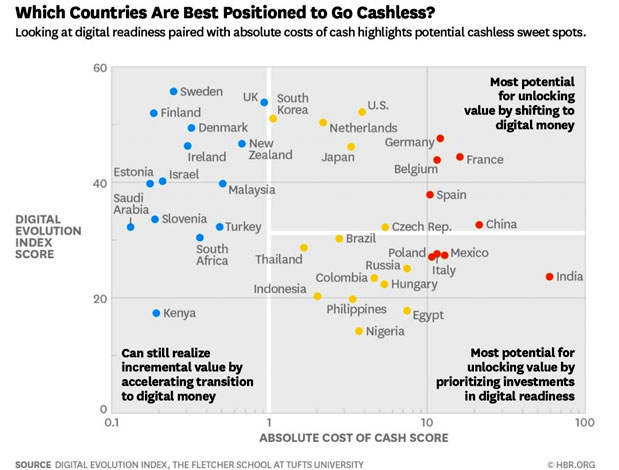
The Fletcher School at Tufts University publishes a Digital Evolution Index which lists each country’s position to go cashless based on their digital readiness along with absolute costs of cash. In the mapping of the countries based on the index published earlier this year, India was shown in the box in the bottom right corner with a label “Most potential for unlocking value by prioritising investments in digital readiness.â€Â We have pole-vaulted using demonetisation as the flexible pole to cross the bar of digital connectivity and join the elite countries who have already progressed towards cashless economy.
According to the Central Statistical Office (CSO), the Indian economy grew 7.3 % in 2014-15 against 6.9 % on 2013-14. In 2015-16, the economy was recovering, consumers were fast adopting digital platforms and digital advertising was enjoying a steady growth rate. In 2016, the media and advertising industry was looking forward to another profitable year, when suddenly the sword of demonetisation struck down not only the cash flow in the marketplace, but also the consumer demand and forced advertisers to slow down their production and reduce their advertising expenditure.
The negative effect of the demonetisation on the media and advertising industry in the short term is evident now.In spite of thecurrent effect of shortage of money supply hitting the consumer demand, will webe able to sustain or accelerate thesmartphone penetration which is essential for our consumers’ journey towards the cashless economy? It will indeed be sad if the projected growth of our connected consumers also slows down due to the demonetisation.
A cashless economy means loss of financial privacy through traceable online information on every transaction. While government departments and bank officials can trace the movement of money in the best interest of economy and public at large, corrupt individuals can easily track and abuse the system. Cybercrime is still in its nascent stage in India but abolition of black money and the parallel economy can unleash the pack of hounds called “hackers†on our connected consumers. Has our government taken sufficient measure about protecting the connected consumer by investing in cyber security measures before pushing for a cashless economy?
Cash means security to Indians, particularly the housewives. It is interesting to note that most countries which are trying to achieve a cashless economy have decent public social security systems to take care of their citizens including poor, sick and elderly people. In comparison, we have a weak social security system and poor public health facilities in India. Even our sophisticated connected consumer in the upper-middle class may not feel absolutely secured without having some cash savings at home for medical emergency.
At present, cash has been made so inconvenient that people are learning to live with less cash and spend even lesser. Even our connected consumers are spending less than average going by the reports from the e-commerce sector. While the government is pushing for the digital adoption rate among the consumers, retailers, distributors and wholesalers, advertisers are not supporting the move by shifting adspends from traditional to digital advertising. The demonetization is surely creating more connected consumers but their behaviour in the marketplace will determine how fast our media and advertising industry will recover after the current setback.
Indrani Sen is a media services veteran, having worked with JWT, later Mindshare and then with Emami. In recent years, she is an independent consultant and academic. She is Adjunct Professor incharge of the Media Management programme at the Symbiosis Institute of Media & Communication, Pune. The views expressed here are her own.