Tag: MediaSENse

  • Indrani Sen: Indian Social media in 2019: “Big Brother” to watch over users

    By Indrani Sen

    2019 will go down in the history of Indian social media as the year when the “Big Brother” started watching over Indian social media and the users lost to a large extent their rights to privacy and freedom of expressing their thoughts. As we get ready for the general elections in May 2019, the Indian government is planning to change its IT rules to control fake news and curb spread of misinformation under the pretext of maintaining the “sovereignty and integrity of India”.

    The changes in the IT rules proposed by the Information and Technology Ministry towards the end of December, 2018 and open to public comment till January 31, 2019 have sparked some protests from civil rights activists and ensued debates among select experts in cyber media law regarding its scope and interpretations. We have seen fresh news reports over the last couple of days about global social media and technology companies getting ready for legal actions against the proposed regulations.

    The new rules, when implemented, would compel all social media platforms to remove unlawful content, such as anything that affected the “sovereignty and integrity of India” within 24 hours. It calls for 24X7 surveillance of 100% of the posts, comments, chats, etc. by all users of social media in India which is estimated to be close to half a billion.  If implemented, this will increase the cost of operations of the social media platforms which eventually will affect the consumers apart from depriving them of their rights to privacy and freedom of expressions as mentioned earlier. The safe harbour protection currently available to intermediaries, which is an integral part of the way the social media business is run, is under threat of removal under the proposed rules.


    Please see the link https://economictimes.indiatimes.com/tech/ites/govt-plans-amending-it-rules-to-curb-social-media-misuse/articleshow/67232660.cms  for details of the proposed rules, a glimpse of which is shown below.
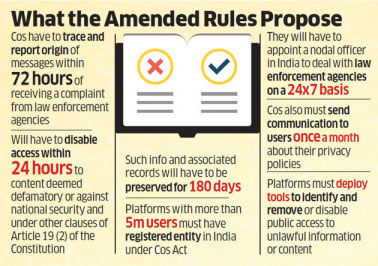
     

    Infographic: https://economictimes.indiatimes.com


    Indian social media was all set for a roller coaster ride in 2019. Read an article on January 3 in www.socialsamosa.com by Vijay Shenoy, AVP Operations South, WatConsult, highlighting four trends that we can expect to see in social media during 2019: moment marketing, video marketing, applications of augmented reality and influencer marketing in a mobile first Indian market with estimated 258.27 million social network users. The global trends showed that Facebook will have a strong growth of users from Asia-Pacific region headed by India with US accounting for only 10% of Facebook’s global base. Instagram and Snapchat are both expected to grow globally in 2019 and again India will be contributing substantially to their growths.

    In a report on the forecasts and predictions for social media in US in 2019, www.emarketer.com  commented “We expect an explosion of stories and vertical video across the digital landscape. That will lead to the inevitable swing of the pendulum toward backlash and questioning about stories’ effectiveness. Facebook will work hard to promote the format to users and advertisers, but the feed will remain the dominant way users use the app”. In India we are already seeing Facebook and Snapchat investing in the original video content and introducing new tools and features for their users.

    In 2018, social media giants had started actively implementing certain steps against fake news and misinformation generated by users. Managing the election-related interference in 2019 is an uphill task and Facebook announced in October 2018 that they are establishing a task force in India to ensure that users do not abuse their platform. Now the proposed “censoring” of all social media content by the Indian Government with a very steep implementation dead line of removing the “undesirable content” has baffled all social media owners and as per various reports in media they are busy taking legal opinions on the proposed amendments in Indian IT rules.


    The users of social media in India have not yet woken up to the full implications of the rules on their rights of privacy and freedom of expressing their thoughts. We have also not seen much of expert opinions expressed on the topic across different media. In 2016 when Facebook proposed their plan for introducing “Free Basics” in India, we had witnessed much more uproar in our public domain. This proposed amendment in our IT rules has far more serious long-term implications, but strangely till now there have been very little public views with 18 days left for commenting on the same.


  • Indrani Sen: OTT has entered media mix of our campaigns

    By Indrani Sen


    On April 22, ET Brand Equity carried a news item based on a report the research firm Gartner who has estimated that 65 per cent of all phone sales in India will be smartphones in 2018. The article while discussing the content of the report, mentioned that “report also said with increased push from the government for digital currency, as well as people becoming more open to using digital payment methods, the rise of digital currency is bringing a new use case for smartphones, which will trigger higher demands for smartphones”.


    This is a huge jump from the earlier estimates of the growth of smartphones in India and has created quite a stir among the global vendors, who are busy planning for strategies to get a higher share of category sales from India. According to Gartner, Indian consumers are becoming tech-savvy and they are willing to pay more for smartphones with better features. The next question, which comes up inevitably, is the Indian consumer ready to pay for the content which she/he would be consuming on smartphones? Advertisers however are not concerned whether the consumer is paying for the content or not. They simply want to be the first to catch him/her in this new media environment.


    Just the day before, on April 21, ET Brand Equity carried an interesting article on a related topic saying “OTT and VOD are steadily revolutionising the way we consume content, because of mobility and sheer range. They’ve seeped into our daily routine; be it catching up with the latest episode of our favourite web-series during loo breaks to late night binge watching.” The article described battle plans for capturing market shares by  Voot’s Gaurav Gandhi, SabGroup’s ManavDhanda, YuppTV’s UdayReddy and NexGTV’s AbheshVerma. They all were shining with positive notes about the changes in media consumption habit acrossand counting on favourable reactions from the Indian consumers.


    ManavSethi, Chief Marketing Officer at ALT Balajisaid in exchange4mediaon April19: “This change is more structural than cyclical in nature. This change is empowering. This change is latent and personal when it comes to entertainment. It’s not “prime time” only and it’s certainly not India’s prime time, it’s rather MY TIME; MY PLACE and MY VIEW, on MY DEVICE!”Sethi was optimistic about OTT’s future in India which he felt would soon take a definite shape through the interaction of more and more consumers (with access to smartphones) and the market forces.


    On April 22, exchange4media carried another story about Ogilvy creating history by making India’s first TVC for Milton shot on a smartphone, more precisely with an iPhone. Conceptualised by Ogilvy Mumbai, the TVC shows the tough journey which theTiffinbox has to undertake every day to reach the office from home through regular city life and the chaotic traffic. Stories of such technical triumph is bound get consumers exited about viewing the same and producing similar contents shooting with their smartphones.


    Informal interactions with industry experts indicate that OTT hasnot only arrived in India, but is steadilyclaiming its own share in the mix of traditional and online media for many campaigns. The media planners have no alternative but to work out thumb rule approaches for assessing the cost of OTT and its ROI. This state of flux will continue till BARC are ready to release their Ekam findings towards the end of 2018.


    Indrani Sen is a veteran media agency and marketing services professional. She is currently an Independent Consultant and Adjunct Faculty, Media Management at Symbiosis Institute of Media & Communication, Pune. The views expressed here are her own.


  • Indrani Sen: Will Ekam provide the missing links in digital measurement?

    By Indrani Sen


    Digital media measurement has been breeding a sense of dissatisfaction among global marketers.  Recently, Procter & Gamble chief brand officer Marc Pritchard, was quoted in media that he was tired of waiting for digital platforms to get their measurement act together http://www.thedrum.com/opinion/2017/03/28/why-marketers-should-follow-coca-cola-and-pgs-lead-overhyped-digital. Pritchard complained about the inadequate viewability data from Facebook, Snapchat, Google, and others who are reaping the benefits of the advertising spends in digital media by all leading brands. The article also referred to Marcos de Quinto, Coca-Cola’s global chief marketing officer, who a few months back criticized his company’s history of digital spending, and stated that TV advertising is still the best investment for brands.


    Jeri Smith, chief executive of Communicus, wrote in the above article “So far, only de Quinto has opened up his brand’s books to show evidence of effectiveness. Stating that “TV still offers the best ROI across media channels,” he revealed that Coca-Cola has reaped a return on TV investment of $2.13 for every dollar spent. Their return on digital? Only $1.26 per dollar spent.”


    In August 2016, Sir Martin Sorrel had cited the example of Procter & Gamble planning to cut investment in digital ad spends while predicting that the digital ad spend to slow over the next few years https://www.marketingweek.com/2016/08/24/sir-martin-sorrell-brands-are-starting-to-question-if-they-have-over-invested-in-digital/. All these comments make one wonder if digital media is really overhyped and why the digital industry is unable to get the their measurement act together.


    Digital media haveplenty of measurable metrics and other analytical data available in real-time, but a comprehensive measurement of these data across different digital platforms is lacking. The metrics are generally categorised into three groups, according to the flow of any digital marketing campaign from traffic generation to conversion to revenue. Overall site traffic, traffic sources, click through rate, cost per click are typically the traffic metrics which progresses to conversion metrics like conversion rate, cost per lead, average page views per visit, average cost per page view, average time on site, bounce rate, rate of return visitors, etc., followed by calculations of return on investment and cost to acquire a customer. With all these metrics being flaunted by the digital media and organizations like comScoreproviding measurement for cross platform audiences in digital media, why are the global advertisers complaining about the lack of measurement?


    Last year, when BARC announced their plan for measuring digital viewership and going beyond audience measurement of broadcast media, it also claimed that BARC will be the first to provide a TV+ Digital viewership measurement service across the globe. The press release issued data “BARC India to Solve the Digital Puzzle with its “EKAM” range of products” announces certain unique offerings in digital measurement. Ekam range of products needs to be studied in greater details through interactions with representatives of BARC to understand their full implications. We will have to wait for another 18-20 months for the reports to roll out before we can sample the results and proclaim it as “EkamevaAdvitiyam” of digital measurement.


    The irony is that better tools and techniques of measurement of digital media may not be able to improve on the ROI as the consumer becomes more and more elusive. In the digital age, we are getting bombarded by consumer-led demassification of media which is shrinking the value of the advertising budget. The return on media investment is bound to fall in future with proliferation of media types and vehicles in spite of best efforts through programmatic media planning and buying.


    Indrani Sen is an advertising and media services veteran and now an academic. The views expressed here are her own


  • Indrani Sen: FICCI-KPMG Report 2017: Scripting the Digital Decade

    By Indrani Sen


    I must confess that I am disappointed with the title of the FICCI-KPMG 2017 Report on Media & Entertainment Industry – “Media for the masses: The promise unfolds”! Has not the media always been for the masses? What is this promise which will unfold particularly in 2017? After last three years’ reports with exciting titles which spoke volumes: 2014 “The-stage- is-set”, 2015 “#shootingforthestars” and 2016 “The Future: now streaming”; this year’s title sounds drab though it is politically correct.


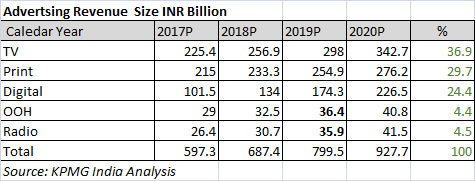
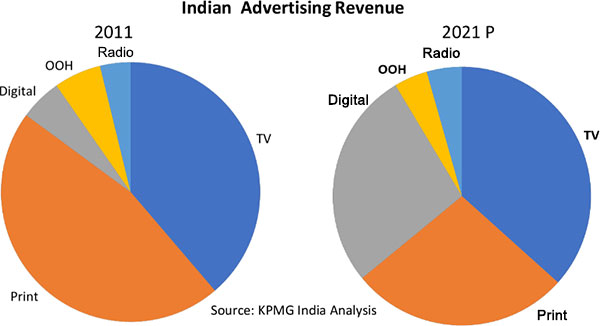
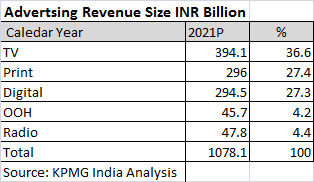
    After going through the report, I felt that “Scripting the Digital Decade” could have been an alternative title from Advertising Industry’s view point as the predicted growth in advertising revenue shows Digital ad revenue equaling Print ad revenue in 2021. The total advertising revenue will grow at 15.3% CAGR over 2017-21 with digital advertising revenue growing at double the rate of 30.8% CAGR over 2017-21.


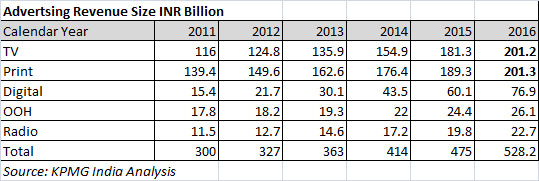
    Everyone is talking about the evolution of Free to Air TV channels post expansion of rural audience measurement by BARC and the impact of the 4G rollout as the highlights of 2016. It should be noted that as per KPMG India Analysis, TV advertising revenue for the first time touched the Print advertising revenue (201 INR Billion) in 2016 as shown in the table below.Further analysis shows that from 2011 to 2016, Print advertising revenue has increased by 61.9 INR Billion and a similar amount of 61.5 INR Billion has been added to Digital advertising revenue.  During the same period, TV advertising revenue has grown by 85.2 INR Billion to catch up with the Print advertising revenue.


    An analysis of the future projections show that in 2019 advertising revenue of radio industry will catch up with advertising revenue of the OOH industry and will have similar share of the Indian advertising pie by 2020.


    As per the FICCI KPMG M&E Industry Report 2017, the shape of the Indian advertising revenue pie will change completely during this decade. The rate at which digital advertising revenue has been growing and the digital industry is predicted to grow during 2017-2021, it will not be surprising if we find that the size of digital advertising revenue equalises the print advertising revenue even before 2021.


  • Indrani Sen: Effects of Union Budget 2017-18 on M&E Industry

    By Indrani Sen


    The M&E Industry has welcomed the Union Budget 2017-18 presented by the Finance Minister Arun Jaitley on February1, 2017 in spite of any specific reference to the industry. Industry stalwarts seem to be of the opinion that the general tone of the budget boosting the infrastructure and lifting rural income will help in the growth of the M&E industry. While Arun Jaitley did not highlight any direct plan for the M&E industry, he announced other indirect plans that could help the industry in positive way.


    The focus on digitisation announced by the FM allocating Rs10, 000 croresfor Bharat Net to boost the rural fibre optics network, seems to be the high point of this budget for the M&E industry.This plan, after implementation, promises to give digital access to over 150,000 gram panchayats. It will not only give a boost to the rural economy, but also result in acceleration of digital consumption of video content on various OTT platforms across India. This boost to the digital ecosystem is the beginning of the end of the urban-rural divide in terms of digital media reach in this vast country.


    While Indian broadcast media has welcomed the above move, Indian print media has remained conspicuously silent. Print needs to make plans for becoming a part of the upcoming digital India by moving along with the laying of the fiber optics network and adopting the gram panchayats as they become digitally literate. A constructive movement by regional dailies to make digital news hyperlocal may help also in monetizing the e-editions from the grass root level. After all, print can micro-control their footprint on the ground which is not possible for the broadcast media.


    The FM announced reforms in the financial sector such as the abolition of the Foreign Investment Promotion Board (FIPB) so as to facilitate a new policy for foreign direct investment (FDI). This move has been welcomed by the M&E industry, who are expecting further liberalisation in FDI policy during the course of the fiscal year. Bollywood has welcomed this move particularly as it expects the abolition of FIPB will induce more foreign studios to invest in India which will create more job opportunities and also will bring more international cinema to the Indian audiences.


    The quick action teams proposed by the FM, to look into cybersecurity infractions has also been applauded by the M&E industry as an essential requirement for a smooth transition to a digitally enabled India. Bollywood has also welcomed this announcement hoping that such a watchdog would also help in countering film piracy which has been pestering the Indian film industry for decades.


    While presenting the Budget, Jaitley has announced that GST will be implemented as per schedule. Except the print industry, the rest of the M&E industry seems to have no major quarrel with the implementation of GST. The broadcast industry, currently paying double taxes on TV channels, expects a lot of uniformity in taxation. Again, the film industry is looking forward to the GST regime which is expected to regularize the Entertainment Tax across the sates. As a result, it is forecasted that the rates of movie tickets will go down to about 15-20 per cent in the states where currently the Entertainment tax is high.


    A few leaders of the M&E industry have expressed some disappointment about the 2017-18 Union Budget. ABP News Network COO Avinash Pandey was quoted by Indiantelevision.com”The Union Budget 2017 was disappointing as far as the expected incentive for the broadcast business is concerned. Service tax remains the same. Most importantly, there is no parity with the print sector. The ‘wow’ factor was missing (in the budget) as far as the business is concerned. Disposable income is going to increase, and hence the quantum of spending. Economy may revive after the implementation of the budget.” http://www.indiantelevision.com/specials/budget/budget-2017/media-and-entertainment-industry-hails-union-budget-2017-170202.


    A Mohan, President – Legal and Regulatory Affairs, ZEEL, was quoted by MxMIndiatalking on the need of infrastructure status for the broadcasting sector. The sector deserves to be treated as Infrastructure industry, thereby qualifying for benefit u/s 72A(1) of the Income Tax Act, he said.. The same article also quoted Girish Srivastava, Secretary General, IBF: “The Foundation is extremely hopeful that the Government would consider the suggestion for granting ‘infrastructure status’ to the broadcasting industry, along with permission to carry forward of losses in case of amalgamation or merger as that would have made the M&E sector a more viable engine of speedy growth.” http://www.mxmindia.com/2017/02/reactions-to-budget-2017-18/.


    The FM has promised that effects of demonetisation will not spill over to the next year. It is expected the economy will get remonetised with consumer spends bouncing back to normalcy helped by the personal tax reforms. It remains to be seen if the advertising industry forecasts for adspends in the current year echoes the same promises.  To sum up, it seems the recommendations of the Union Budget 2017-18 would help inreinstating the growth rate in the M&E industry.


  • Indrani Sen: Are Indian Newspapers Ailing?

    By Indrani Sen


    Last week, on January 19, The Times of India carried an article by TOI Editorial Team on the edit page titled “Indian Newspaper Industry: Red ink splashed across the bottomline” blaming the implementation of the recommendations of the latest wage board and the damaging impact of the demonetisationfor accelerating the degrowth newspapers in India. The article also cautioned that if the effect of demonetisation continues and the flow of advertising to the newspapers declines further and if implementation of GST results in raising taxes, then 2017 will be the worst year in the recent history of Indian newspaper industry.

    Though the newspaper industry in the West has been declining for some time due to spread of internet and digitisation, it continued to be growing in the East, particularly in India and China. For some time though, the insiders in the Indian newspaper industry have been indicating that all is not well across the industry. This writer pointed out in this column on September 28, 2015 that a comparison of projected growth in the FICCI KPMG Report for the newspaper industry over the years has been showing a decline in the growth rate. We will not see the full effect of the gloom predicted by the TOI Editorial Team in FICCI-KPMG 2017 Report which will show the growth in 2016 over 2015. The story may be different in the next report, comparing 2017 and 2016.

    On December 10, 2016 the media and advertising industry was stunned by the news of ABP group’s plan to retrench journalists and non-journalists and downsize its workforce by as much as 40% based on the advice of an American Consultancy firm for improving its bottom line. ABP also decided to cut down the number of pages of its two dailies and close some of the supplements which were not running profitably. WouldABP Group be the only one taking such drastic measures or would other newspapers be joining them during the course of the year? Is the newspaper industry really ailing?

    The TOI article pointed out the anomaly between the DAVP and the market rate which effectively reduces the advertising revenue, the main source of earning for newspapers.  The editorial team mentioned the high exchange rate enjoyed by other currencies vis-a-vis rupee has a spiraling effect on the cost of imported newsprints which are required for the high-speed printing machines. They arguedin favour of the newspapers that in spite of such pressures, the newspapers have kept their cover prices low (one of the lowest in the world) keeping in mind affordability by the lowest common denominator among the current and the prospective readers.

    All the above issues have been existing in the newspaper industry for a long time, but the continuous loss of advertising revenue to TV and digital media have highlighted their importance. The solution lies in Indian newspapers promoting their online editions and monetising them. It has been one-and-a-half years since the annual World Press Trends Survey released on June 1, 2015 by WAN-IFRA claimed that global newspaper circulation (print and digital combined) revenue had crossed global newspaper advertising revenue in 2014 (http://www.wan-ifra.org/wpt.). This was discussed in the article “The Seismic Shift” in MediaSense dated February 1, 2016. With half the population of the country under 25 years and at the top-end reading news only online, the newspapers will become sick unless they keep up with the changing time.

    As far as the recommendations by the latest wage board is concerned, it is well-known in the industry thatlarge newspaper groups have been moving their employees from wage board stipulated pay scales to company pay scales through various means over the years. So, to what extent the recommendation of the latest wage board would affect the bottomline of the large newspapers is a debatable point. The medium and small newspapers who do not enjoy the muscle powers of the large newspapers are likely to be affected by the recommendation of the latest wage board.

    The TOI article concluded with two suggestions for the government, firstly to review wage board and to remove non-journalist staff from its ambit and secondly to ensure zero-rating of the newspapers under the GST regime as alternatively, the entire industry may turn sick in next few years. There should not be any debate on the need for a reasonable fiscal and labour policies for the Newspaper Industry. However, from the tone of the TOI article, it appears that there is an apprehension that newspapers may be taxed unfairly with the introduction of GST. In that case, the newspaper industry will have to engage in a legal battle with the Government. I would like to humbly remind the newspapers by converting hard copies to online subscriptions, they can also avoid part of the taxation burden.


    Indrani Sen is a veteran media agency and marketing services professional. She is currently an Independent Consultant and Adjunct Faculty, Media Management at Symbiosis Institute of Media & Communication, Pune. The views expressed here are her own.


  • Indrani Sen: Will low financial liquidity & limited digital connectivity lead to a Recession?

    By Indrani Sen


    After taking the great leap forward to cashless society and connected consumers, the question which our government is avoiding to address is how long it will take us to get our infra- structure right to connect the entire country digitally? Last Saturday, on December 17, 2016, our Finance Minister Arun Jaitley announced in Mumbai that the government intends to keep “a significant and substantial” part of the demonetised currency in digital form.


    There is a joke going around in social media asking tourists to be prepared to wash the utensils in remote wayside dhabas if there is no connectivity there for accepting plastic money! In the last six weeks, our government has been able to steer considerable section of the population to digital transactions by controlling their financial liquidity, but to hold back considerable amount of cash from the financial system may have other consequences.


    As a young media practitioner in the early eighties, I witnessed the period when Mrs Indira Gandhi’s government took steps to expand the television network in the country with the slogan “One transmitter a day”. The government made plans to import equipment and a debate went on for some weeks in print media if a developing country like India should introduce colour TV transmission when majority of Indians could not afford colour TV sets. The debate met with a sudden death when our government discovered that B&W transmission technology had become obsolete in developed countries and had no option but to introduce colour TV in India. For many years after we got colour TVs, finicky clients targeting for consumers in small towns and semi-urban areas viewed the colour TVCs produced by the ad agencies in B&W before giving approvals. The Indian Readership Survey went on reporting ownership of colour and B&W TVs for almost three decades after early eighties till digitisation of cable television became mandatory in India. The moral of the TV story could be: “Time will take its own course’.


    Unfortunately, the sheer willpower of the government cannot make it possible for Indians to somersault into the cashless and digitised world. Our media consumption habits and purchase behaviour in the marketplace cannot be changed overnight. Like B&W and colour TVs co-existed for quite some time till the price of colour TVs became affordable, cash transactions and cashless transactions should be allowed to operate parallelly till our government sorts out the issues related to digital connectivity and ensures every aspect of our life becomes closely connected across the length and breadth of our country. The more we rely on our devices, more will be our need for new systems capable of handling greater bandwidth and reaching out to the consumers in every corner of our country.


    The FICCI KPMG 2016 report while commenting that “given a primarily mobile-driven internet base, India has always been a mobile first ecosystem”, estimated 500 million unique mobile users in India against 944 mobile connections and 180 million smartphone users in 2915. In other words, almost 60% of our total population did not have a mobile subscription till 2015. Under the Digital India initiative, the government has projects for creating broadband high ways and filling in the gaps in connectivity across India costing crores of rupees with a time line of 2014-18. By the time the current issues are sorted out by the government and 4G is able to roll out uniformly, the fifth generation mobile network 5G, which is now in its early stages of development, may be knocking on our doors! At present, various developed countries are also musing over the issue of spectrum availability for 5G as radio frequencies for both 3G and 4G are overcrowded. In addition, India will have to invest substantially for adding more fibre cables into our fixed telecommunication networks and collaboration between public and private organisations.


    Squeezing the cash flow from the financial system will not solve any of the above issues related to digital connectivity; on the other hand it may seriously affect the recovery of demand and supply across different sectors of the economy which have already experienced a set back after demonetisation.  The combined effect of low financial liquidity and limited digital connectivity may set in a recessionary condition in the advertising and media industry.


    Indrani Sen is a media services veteran, having worked with JWT, later Mindshare and then with Emami. In recent years, she is an independent consultant and academic. She is Adjunct Professor in charge of the Media Management programme at the Symbiosis Institute of Media & Communication, Pune. The views expressed here are her own.


  • Indrani Sen: Connected Consumers after Demonetisation

    By Indrani Sen


    Will the Demonetisation accelerate marketing communications with connected consumers in our country? It has undoubtedly given a strong push to the growth of digitally-enabled consumers in India. We need to wait for couple of months till statistics from the telecom industry confirms if 4G followed by the Jio launch and the demonetisation has helped to increase the number of connected consumers in India. It will indeed be an achievement if our smartphone penetration crosses the inflection point of 30% by December 2016.


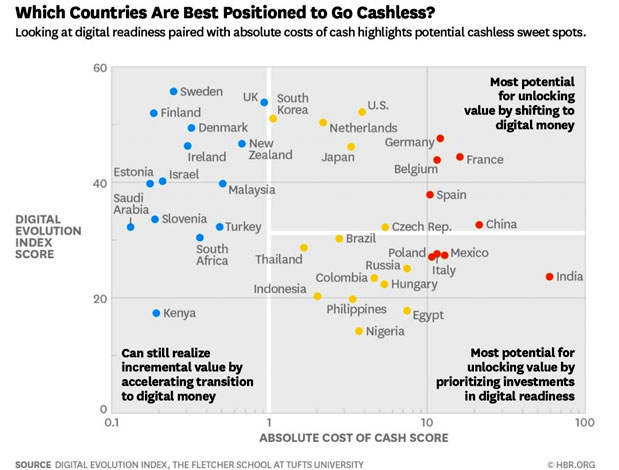
    The Fletcher School at Tufts University publishes a Digital Evolution Index which lists each country’s position to go cashless based on their digital readiness along with absolute costs of cash. In the mapping of the countries based on the index published earlier this year, India was shown in the box in the bottom right corner with a label “Most potential for unlocking value by prioritising investments in digital readiness.”  We have pole-vaulted using demonetisation as the flexible pole to cross the bar of digital connectivity and join the elite countries who have already progressed towards cashless economy.


    According to the Central Statistical Office (CSO), the Indian economy grew 7.3 % in 2014-15 against 6.9 % on 2013-14. In 2015-16, the economy was recovering, consumers were fast adopting digital platforms and digital advertising was enjoying a steady growth rate. In 2016, the media and advertising industry was looking forward to another profitable year, when suddenly the sword of demonetisation struck down not only the cash flow in the marketplace, but also the consumer demand and forced advertisers to slow down their production and reduce their advertising expenditure.


    The negative effect of the demonetisation on the media and advertising industry in the short term is evident now.In spite of thecurrent effect of shortage of money supply hitting the consumer demand, will webe able to sustain or accelerate thesmartphone penetration which is essential for our consumers’ journey towards the cashless economy? It will indeed be sad if the projected growth of our connected consumers also slows down due to the demonetisation.


    A cashless economy means loss of financial privacy through traceable online information on every transaction. While government departments and bank officials can trace the movement of money in the best interest of economy and public at large, corrupt individuals can easily track and abuse the system. Cybercrime is still in its nascent stage in India but abolition of black money and the parallel economy can unleash the pack of hounds called “hackers” on our connected consumers. Has our government taken sufficient measure about protecting the connected consumer by investing in cyber security measures before pushing for a cashless economy?


    Cash means security to Indians, particularly the housewives. It is interesting to note that most countries which are trying to achieve a cashless economy have decent public social security systems to take care of their citizens including poor, sick and elderly people. In comparison, we have a weak social security system and poor public health facilities in India. Even our sophisticated connected consumer in the upper-middle class may not feel absolutely secured without having some cash savings at home for medical emergency.


    At present, cash has been made so inconvenient that people are learning to live with less cash and spend even lesser. Even our connected consumers are spending less than average going by the reports from the e-commerce sector.  While the government is pushing for the digital adoption rate among the consumers, retailers, distributors and wholesalers, advertisers are not supporting the move by shifting adspends from traditional to digital advertising. The demonetization is surely creating more connected consumers but their behaviour in the marketplace will determine how fast our media and advertising industry will recover after the current setback.


    Indrani Sen is a media services veteran, having worked with JWT, later Mindshare and then with Emami. In recent years, she is an independent consultant and academic. She is Adjunct Professor incharge of the Media Management programme at the Symbiosis Institute of Media & Communication, Pune. The views expressed here are her own.


  • Indrani Sen: CPT ke peechhe kya hai?

    By Indrani Sen


    Ever since Shashi Sinha spoke about adopting CPT (Cost per thousand) as a measure of TV buying instead of CPRP (cost per rating point) at the Advertising Club’s annual Media Review, the old debate about CPT versus CPRP has opened up. A week back, I read on the net the views expressed by some stalwarts of our industry, most preferring to continue with CPRP over CPT for TV buying. The TV Channels showed preference for shifting to CPT which they feel would capture the incremental viewer base (http://www.exchange4media.com/tv/cprp-vs-cptwhats-the-need-of-the-hour_66504.html ).


    Most of the debates are happening assuming that CPT stands simply for “advertising cost pe thousand target audience” and with the knowledge that internationally CPT is the more accepted currency for TV buying. Collective opinion in the industry is that shifting from CPRP to CPT will inflate the TV advertising rates. Shashi Sinha said in an interview with Admatazz: “There is a fallacy in everyone’s mind that when you move from CPRP to CPT, rates will go up.” (http://www.admatazz.in/2016/10/20/interview-with-shashi-sinha-ceo-ipg-mediabrands-india/). According to Sinha, rates are governed by various supply and demand factors in the market place and shifting from CPRP to CPT will not affect them.


    The definition of CPT is commonly known as “cost per thousand target audience” and most books on media planning still promote that definition. A doubt had crept into my mind when the CPT vs. CPRP debate had first began in 2010. In the age of rapidly growing digital media with CPM or the cost per mille (thousand) impressions on the web as one of the measures for online media buying, why should the digitally advanced nations use a simple measure like “cost per thousand target audience” irrespective of their TV viewing behaviour as the measure for TV buying?


    Subsequent search on the Net revealed that Broadcasters’ Audience Research Board (BARB), UK defined CPT as “The cost of one thousand commercial impacts for a target audience. Cost-per-thousand (CPT) is used when purchasing and measuring the efficiency of advertising campaigns”. It seemed to me that the definition of CPT was reinvented by BARB in order to estimate impact of TV advertising across multiple screens and to make the performance of TV advertising comparable with the performance of online advertising. Sinha mentioned in his interview: “CPT helps because you can compare…today you can do inter media comparison digital, print, television with CPT…..we are already doing it, we are plugging in CPTs…our clients are seeing how the integrated model of TV and print work together.”


    The renewed debate reminded me about my old search findings. I checked and found that the definition of CPT still remains the same (http://www.barb.co.uk/about-us/glossary/) in BARB Glossary. The “cost per thousand target audience” and the “cost of one thousand commercial impacts for a target audience” are two totally different measures. The BARB definition of CPT will not bring joy to the TV channels as it will still be linked with TVRs without which it will not be possible to calculate cost of thousand commercial impacts for a target audience.


    While checking the BARB Glossary, I came across an interesting article posted in October 2015 (https://www.thinkbox.tv/Getting-on-TV/Useful-resources/How-to-calculate-CPTs) on www.thinkbox.tv which is the marketing body for commercial TV in UK. The article takes the reader through the formulae required to calculate the cost of airtime and how many Television Ratings the advertiser can afford to buy, etc. The equation used for calculating CPT is CPT = Budget/universe/TVRs x 100,000 in that article.


    I humbly request the multinational media agencies to share the definition and calculation of CPT which they are using currently in their in-house media planning models with the industry at large. Before we think of shifting from CPRP to CPT for TV buying, the industry bodies need to agree on a new definition of CPT in keeping with the international practices. BARC can also take the lead in promoting the new concept of CPT though the current BARC Glossary of Terms does not include either CPT or CPRP definitions. Finally, I agree with Sinha that Indian marketing and advertising industry should replace CPRP with CPT as a measure for TV planning and buying, but arguably we will have to use the new avatar of CPT.


    Indrani Sen is a media services veteran, having worked with JWT, later Mindshare and then with Emami. In recent years, she is an independent consultant and academic. She is Adjunct Professor incharge of the Media Management programme at the Symbiosis Institute of Media & Communication, Pune. The views expressed here are her own.


  • Indrani Sen: Let us prepare for adblocking and anti-adblocking solutions

    By Indrani Sen


    The foreword of the FICCI- KPMG Report on Indian Media and Entertainment (M&E) Industry, 2016 said “In 2015, we finally began on a journey that is expected to change the M&E industry in India. A host of changes – many of them already transforming the industry in other countries are gaining traction in India… This new wave of change is likely to fundamentally alter the way content is created, distributed, consumed and monetized in India.” Adblocking on websites is such a change agent which is yet to see high traction by users in India. However, in digitally matured countries it is changing the business economics of publishers and is also threatening to change the core of brand communication.


    Earlier in this month, I read an interesting article https://www.theguardian.com/media-network/2016/oct/04/adblock-plus-publishers-tempted-feed-hand-bites which described how an adblocking firm’s new move to charge publishers to serve whitelisted ads has created a commotion in the industry.  Eyeo, owner of the adblocking tool Adblock Plus with a significant user base, was already charging publishers like Google, Microsoft and other publishers for getting on to their Acceptable Ads List. They have now created their own network offering to sell access to advertising which has created a controversy in the market place.


    The above article prompted me to explore the anti-adblocking measures which are being used currently by publishers to save their digital ad revenue. According to Pagefair and Adobe Report quoted in http://blog.pubnation.com/publishers-fight-back-how-the-top-50-websites-combat-adblock/, adblockers have grown at an astonishing rate, increasing from 20 million users in 2009 to 200 million in 2015. From Q2 of 2014 to Q2 of 2015, they grew by 41%, adding more than 50 million new users. Historically the problem was confined to desktop and laptops, but now it has spread into mobile users. Various researches done by publishers and other research organizations seem to indicate that native ads and sponsored articles have better chance of survival against the onslaught of adblockers than the standard ads. This article is a must0read for Indian publishers as it cites screenshots of publication websites before and after adblocking showing effectiveness of sponsored articles and native advertising.


    In another article published earlier this year, https://www.techinasia.com/talk/forbes-failed-6-real-ways-publishers-stop-ad-blockers-stealing-revenue Rhiannon Young criticised the anti-adblocking approach adopted by Forbes and prescribes other measures. Forbes does not allow their audience access to their content unless they turn off their adblocker or whitelist Forbes. Young suggested that instead of such a heavy-handed approach, publishers should try having a conversation with their audience, Pay wall/ Freemium model, work with an adblocking software and advertisers for creating acceptable ads, pay adblocking companies for whitelisting the publication, focus on native advertising and sponsored content. In response to Young,   Søren Fuhrjan suggested that publishers should move to a two-way communication with their audience instead of the current one-way (read-only) communication. This may create a hybrid publishing website which will be partially content-driven and partially social media-driven.


    A rising crop of startup organisations, Pagefair, Source Point, Secret Media, Uponit, etc., have stated providing anti-adblocking solutions to publishers for protecting their most viable business model based on ad revenue. These organisations aim to provide ways for bypassing adblockers or tracking protection, but their business models are yet to stabilise. This could become a cat-and-mouse game with the adblockers coming up with technically superior versions which cannot be bypassed by the anti-adblocker tools.


    By the time Indian publishers get their act together in digital publishing and its business economics, they will be simultaneously hit by a tsunami of adblocking tools along with anti-adblocking tools.  So, the publishers and the agencies need to prepare in advance for safe guarding their digital ad revenue stream. The advertisers need to learn about native advertising and researchers need to come up with special matrix to measure the effectiveness of such advertising. Finally, the industry needs to prepare ethical standards for sponsored content and native advertising.
    Indrani Sen is a veteran media agency and marketing services professional. She is currently an Independent Consultant and Adjunct Professor, Media Management at Symbiosis Institute of Media & Communication, Pune. The views expressed here are her own. 

  • Indrani Sen: Geo-targeted TV Advertising

    By Indrani Sen


    Brand Equity carried an article on September 7, 2016 about Amagi’s launch of Amagi Mix, India’s first online media planning and buying commerce platform. It is targeted specifically for the growing SME sector in India, who can plan and buy TV campaigns at an affordable cost. Amagi Mix allows the SMEs to develop their own media plans based on their market priorities and execute the media buy within the limitations of their budget. In addition, Amagi will offer creative solutions to the SMEs for developing their TV commercials.


    Amagi, a media technology company, was launched with a futuristic vision in 2008 in Bengaluru with an aim to deliver disruptive technology-driven solutions for TV advertising on a hyperlocal basis. The business model of Amagi is three-tiered; it buys commercial time on TV channels and sells the ad spots to advertisers on regional/ hyperlocal basis by using its technology and Ad Syndicate Network. Finally it shares profits with MSOs and DTH operators. Amagi has a partnership at one end with the TV channels and at the other with MSOs and DTH operators. Its website (www.amagi.com) portrays its technology-driven solution as “Amagi’s solution can be customised to support the duration and frequency of all ad-replacement needs. Amagi’s solution is based on a patented content trigger (The Amagi Watermark) and STORM, an enhanced satellite receiver that descrambles and decodes the channel in addition to inserting local ad seconds”. Amagi’s unique service has been used not only by local and regional advertisers, but many national advertisers also have used it to leverage TV for geo-targeted advertising in addition to their national TV campaigns.


    It will be interesting to watch how the Indian SMEs take advantage of this new online platform which enables them to buy a traditional media like TV online with targeted foot print. Amagi is expecting 20 per cent of advertising by SMEs to be routed through Amagi Mix within the next three years. Apart from The Media Ant (TMA), another media agency from Bangaluru, no other media agency has explored or targeted the SME market seriously. Founded in 2012, The Media Ant claims to be a (http://www.themediaant.com/) “market place for media” with “information for more than 200,000 advertising touchpoints across various offline and online media verticals.” TMA offers to their clients “Marketing Assistant Online” for planning and buying across traditional media. While TMA does not have any geo-targeting technology for TV, which is a high impact expensive medium, it will continue to cater to a large section of SMEs who would prefer to use Print, Radio and OOH for their campaigns which have always fulfilled their need for geo-targeted advertising.


    Earlier this year, Rediff’s Vubites and Star India’s Adsharp were launched as geo-targeted TV advertising tools. Zee TV is one of the channel partners of Amagi and the partnership has expanded over the years with addition of channels from its stable. So, geo-targeted TV advertising has arrived as the new strategy for TV planning and buying in India. The country is now divided into 17 regions for which advertisers can buy TV inventory on premium channels. These regions are also supported by the BARC findings, which makes it easier for the advertisers and media agencies to plan their geo-targeted spends on TV against its effective reach. Amagi would continue to enjoy the first mover’s advantage in the geo-targeted advertising arena backed by their wide network of partnerships with various TV channels.


    Indrani Sen is a media services veteran, having worked with JWT, later Mindshare and then with Emami. In recent years, she is an independent consultant and academic. She is Adjunct Professor in charge of the Media Management programme at the Symbiosis Institute of Media & Communication, Pune. The views expressed here are her own.


  • Indrani Sen: Dependability of Digital Media

    By Indrani Sen


    ET Brand Equity has listed on August 28 among the most read news of last week an interview of Sir Martin Sorrell by Sarah Vizard which appeared originally in the Marketing Week on August 24. “Sir Martin Sorrell: Brands are starting to question if they have over invested in digital” https://www.marketingweek.com/2016/08/24/sir-martin-sorrell-brands-are-starting-to-question-if-they-have-over-invested-in-digital/. The prophecy of Sir Martin that growth that digital adspend will slow down over the next few years must have caused some worries to the big players in social and digital media in India.


    Sir Martin raised a few very pertinent points related to the dependability of digital media. He was quoted by Sarah saying: “We have seen this before in arguments about viewability, ad fraud and measurement issues, not forgetting adblocking. That is where the debate is.” The issue of measurability is complex as initially the advertising industry was lured into trusting Google Analytics and Facebook data almost blindly. The industry had not dealt with real-time data while working with traditional media, so they found Google Analytics as a God’s gift. But with Google changing its algorithm without any explanation and Facebook altering content on people’s newsfeeds, it is not only traditional media who are raising questions about the dependability of digital media, advertisers have also started asking for independent research done by third party which does not have any stake in the digital media.


    FICCI KPMG reports on Indian Media and Entertainment Industry have been consistently reporting over the last three years that growth in the industry would be led by the growth in digital media. Our government launching its “Digital India” programme backed by the rapidly growing number of internet users and India becoming the fastest growing smartphone market has added fuel to the fire of their future projections. The two questions which become pertinent now are: (1) will there be independent third party research on consumption of digital media in India and (2) will the ad investment in digital media slowdown in India?


    In India, the advertising and media industry have been used to living in a sub-optimal condition of media research data for traditional media. Thanks to IBF’s initiative we seem to have solved the research issues related to broadcast media through BARC. But MRUC is still to put its act together as far the IRS is concerned. So, it is unlikely that our industry will be bothered about not having independent third party research on digital media. It is also doubtful if the industry will be able to raise funds for supporting such third party research on digital media. So we will continue to work happily with Google Analytics and Facebook data.


    Similarly, the advertisers are also likely to continue with the present trend of investing in digital media advertising. However, if the multinational organisations receive directives from their head offices/ holding companies to review and slow down their investment in digital and social media then it may be a different story. In the absence of any data on what percentage of the advertising spend on digital media comes from multinational organisations, it is difficult to estimate the extent of slowdown in digital media advertising if the multinationals withdraw or reduce their support.


    The interview of Sir Martin has thrown some doubts about the dependability of the digital media for advertising communication and it would be necessary for our industry to take the promises of digital media with a pinch of salt in near future.


    Indrani Sen is a media services veteran, having worked with JWT, later Mindshare and then with Emami. In recent years, she is an independent consultant and academic. She is Adjunct Professor in charge of the Media Management programme at the Symbiosis Institute of Media & Communication, Pune. The views expressed here are her own.