
By Ranjona Banerji
 The verdict of the International Court of Justice on the case for emergency measures in the genocide in Gaza brought before it by South Africa appears to have confused the media, especially the western media. Of the 17 judges, 15 voted for most of South Africa’s demands, except the demand that Israel stop all military action in Gaza.
This means that the ICJ ordered Israel to take action to prevent acts of genocide in Gaza, it disagreed with Israel’s contention that the ICJ had no jurisdiction in the matter, it directed Israel to abide by the Genocide Convention and noted that several acts by Israel and statements by its officials fell within the scope of the Genocide Convention.
And yet, if you followed the western media after the ICJ ruling on January 26, you may have missed all this. You may have even understood that South Africa’s case had been struck down. Almost all the attention was on the two judges – one from Israel and the other from Uganda – who did not agree with the majority verdict.
The problem in some parts for the media is that the judgment is nuanced, and the media on the whole does not do nuance. A big fat hammer has not fallen on Israel’s head. But Israel has been told that what it is doing is illegal, and it does not get immunity for its actions. Both South Africa and Israel are signatories of the Genocide Convention and therefore, South Africa has every right to call Israel to account.
Some of the attempts to whitewash Israel have taken interesting turns – the court did not come down that hard, the Israeli judge voted with two of the rulings and that Russia has ignored the ICJ ruling on its invasion of Ukraine. The Ugandan judge had her own reasonings, which possibly went beyond the brief of the court – she said the matter had historical and political context. However, the issue at hand was contravention of the Genocide Convention.
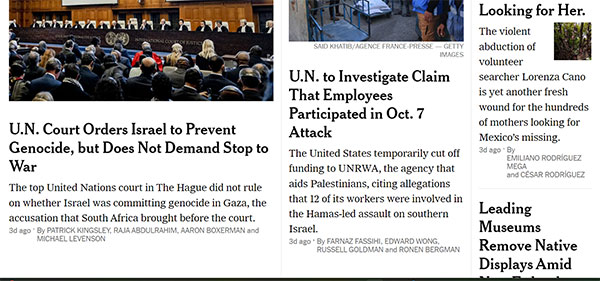
A screenshot of the online front page of the New York Times on January 27 shows how the entirety of the ruling is misconstrued in the headline. The adjoining story is of the US cutting of aid to the United Nations Relief and Works Agency, based on Israeli accusations that 12 workers may have been part of Hamas. Heinous as this funding holdback is, the fact that Israeli prime minister Benjamin Netanyahu openly collaborated with Hamas is largely ignored. Nor does the headline mention that over 150 UNRWA workers have been killed by Israel, since October 7.
A sweep of the CNN website shows a tilted concentration on reactions to the ICJ ruling to those from Israel and from Hamas. The Palestinians themselves – over 25000 civilians, many of them women and children, and the attacks on them and their homes, are all spun through a Hamas lens. This bombardment of the word Hamas is a clear tactic.
The ICJ ruling has in fact provided much fodder to the news chain. And eventually, within western intelligentsia and political thought, there may be some course correction. The official US position may not change, but within civil society, there is already change. Influential podcasters like Joe Rogan for instance no longer toe the Israel line. University lecturers within the US are calling out their universities for not allowing students to protest for peace. The Nakba – massacre – of 1948, where more than 750,000 Palestinians were forcefully evicted and hundreds of homes destroyed is now open for discussion.
As this opinion piece in the Los Angeles Times discusses:
https://www.latimes.com/opinion/story/2024-01-27/icj-israel-south-africa-gaza-genocide-court-ruling
As for the western media, well…
Meanwhile in India, we practically donated Republic Day, January 26, to the “consecration” of a temple. It is poignant that the ICJ ruling came on January 26, the day we the people of India adopted our Constitution. It harks to a time when we, India, stood tall on the world stage against injustice, colonialism and oppression. This mantle we appear to have handed over to South Africa, even as our media remains caught up in religious fervour. And celebrating attacks on Muslims by Hindutva over temple politics.
The government, being in control of the Indian media, is triumphant. Please do read the link below, based on a statement by the Network of Women in Media, India, on how the proposed broadcast bill is one more way to regulate the media. It will affect everyone.
https://m.thewire.in/article/media/intent-to-overregulate-media-behind-draft-broadcast-bill-irreprable-damage-nwmi
Ranjona Banerji is a senior journalist and commentator. She writes on MxMIndia on Tuesdays and Fridays. Her views here are personal.