
Category: Uncategorized

  • We’re looking at strategic inputs from CA Media, Zodius: Vijay Nair

    By Shruti Pushkarna


    Vijay Nair

    What started as a hobby for Only Much Louder founder and CEO Vijay Nair became a business venture when he set up the first artist management company for indie bands in India. Mr Nair’s career started at the age of 15 when he started consulting Procter & Gamble on their Indian youth portal Masti.com. Subsequently, he worked with the Indian indie music zine Gigpad.com and got initiated into the music business. Excerpts from an interview


    So do we see Only Much Louder getting bigger, better and louder with this investment?

    Well that’s the idea… and we’ve been kind of slow in terms of picking which investors we want to work with and at what stage of our company do we want to get the investments in. So having established a few properties, I think this is going to help us amplify lot of that and take it to different cities, work out a much stronger deal as well.


    What are the specific objectives of taking this investment?

    Building a stronger team is the primary objective of this. And, secondly, scaling some of the things that we’ve been already working on. Thirdly, a specific reason for working with CA Media and Zodius is to focus a lot more on the digital and television part of it as opposed to our focus which has just been live events so far. So we want to take it to multiple platforms.

     

    You’ve started out as a small enterprise doing interesting things with youth and music and then with Babblefish, you’ve done Dewarists and Sound Trippin’ with MTV. Is there a fear of losing out on the pulse as you grow bigger?

    I don’t think anyone who knows OML will ever fear that…the two examples you mentioned of Dewarists and Sound Trippin’, that’s exactly the kind of stuff we want to do. What this gives us is the opportunity to work with multiple networks and more shows, but everything that OML does, will revolve around music and alternative culture. And that’s something that investors are not only clear about but I think that’s one of the reasons they’ve invested in us, because they wanted to look at a niche player.


    Also read…
    CA Media to invest in companies, build brands
    That Rajesh Kamat was 1st CEO of Endemol is not a coincidence: Deepak Dhar
    Two investments done. Many to come!

    Is there a role model among the various Indian and international companies?

    Not specifically… I think as far as Indian market goes, we are quite an exception in terms of what we are trying to do is only be an agency focused on music and alternative culture and not be an event management company, so definitely not with an Indian company. Within each of the divisions that we have, we have role models which are similar to that of abroad but none of them operate as one cohesive unit which is what we are trying to build.


    Mr Rajesh Kamat has been a super successful GEC CEO. With CA investing, do you see him adding value on your TV production venture?

    Yes, we have been working with him for the last six months now, when the deal was coming together, it’s already made an immense amount of difference. Rajesh’s inputs make a lot of difference… this year Babblefish should be doing at least six television shows, not only the GEC part of it but he was also one of the main guys who set up Endemol, so from a production perspective, his inputs have been very important because this is the area we were not familiar with. This is one of the main reasons in fact, Neeraj from Zodius and Rajesh from CA. both of them bring in strength which OML definitely needs to be a scalable business.


    You’ve not had one but two investors… CA and Zodius?

    The story behind is that initially I met Neeraj and we started talking about this. Zodius has always been focused on the digital part of the business and there’s only one of the divisions in OML which is really focused on digital… Neeraj in fact introduced us to CA Media saying that these are good partners to have because  they have a larger media play and they collectively work with us. So for us it actually came as a team, so it wasn’t us going to two different people, they kind of came in together and structured this entire deal.


    What are your immediate targets?

    Right now we are looking at building a fairly strong team and getting the right people in. But otherwise just trying to see what new properties we can seed which can last as a brand for a much longer time, wo we are working on a lot of new concepts knowing that we have the option to scale a lot of them with the investments that have come in.


    Both Rajesh and Neeraj are known heavyweights in the business. Do you fear that they could be influencing (and often charting) your course of operations?

    We would want them involved at a strategic level because both the companies, we haven’t looked at them as financial investors. We are very keen on them being involved at a strategic level, in fact both of them are strict believers of the fact that we should stick to the niche stuff we are doing because they have experience on the other side of the fence of building very large scale mass businesses. So they will have significant inputs and we are going to take that very seriously but there’s complete clarity in terms of the direction that OML is going to go in.

     

  • The Anchor: 5 low-cost HD cameras that come in handy for journos

    Gone are the days of bulky camera units…now any reporter can move around with slick video gear that doesn’t require a whole crew to function around with. Here are a few options of low cost HD cameras that can come in handy for journalists on the move, especially if you carry the tag of a ‘multimedia journalist’.

     

    1. Kodak Zi8:

    An easy to carry pocket size full HD camera. It’s a great combination of superior video quality and a reasonable price. It comes with an attached foldable USB which you can easily plug into your computer to upload videos. A step up from its previous model, Zi8 records full 1080p HD video. And it also has other video mode options like, 720p/60fps, 720p/30fps or a WVGA mode. You can also shoot stills at 5 megapixels. Another big plus is an external mic jack which helps you attach an external mic to get great sound quality. There are hardly any product offerings at this price that come with an external audio jack. The design is simple, it looks almost like a phone which you can easily slip into your pockets. It also features a few interesting tricks like face detection and digital image stabilization.

    http://store.kodak.com/store/ekconsus/en_US/pd/Zi8_Pocket_Video_Camera/productID.156585800

    Price: Rs. 8000 approx.


    2. Flip Ultra HD:

    Another pocket size camera that records HD quality. Flip pretty much kick-started the pocket camcorder trend. The Flip, like the Zi8 comes with built-in software for uploading straight to YouTube, Twitter or Facebook. Using the side-mounted flip-out USB connection you can plug it straight into a PC or Mac to either copy your files over or upload them directly from the device. Like the Zi8, this too comes with a HDMI connection if you want to plug it directly into a TV. It comes with an internal storage of upto 8GB, enough for 2 hours of recording. In terms of battery, the Flip Ultra offers the best of both worlds: rechargeable battery pack, or the option of regular AA batteries if it runs flat and you can’t charge it. It has added features like image stabilization, and its low light performance is impressive as well.

    http://support.theflip.com/en-us/products/ultrahd

    Price: Rs. 9000 approx.


    3. Kodak Playsport:

    A shockproof, dustproof and a waterproof camera that records full HD video. If you want to record video outdoors, at the beach, or anywhere else there’s water, Kodak Playsport is a top choice. It can withstand drops up to 5 feet, and it’s as waterproof as ever, with the ability to shoot up to 10 feet deep. Unlike the Kodak Zi8, it does not come with an external audio jack or a built-in USB connector. You have the option to record in high-definition 720p at 30 or 60 frames per second or at 1080p at 30 fps. Videos are recorded as MP4 files which can be uploaded directly into YouTube and Facebook for sharing.

    http://store.kodak.com/store/ekconsus/en_US/pd/PLAYSPORT_Video_Camera__Zx5/productID.221644700

    Price: Rs. 7000 approx


    4. Creative Vado:

    A pocket camcorder that can record 720p high-definition video. It scores over other camcorders for its solid video quality and feature set. Unlike other camcorders, it comes with a wide-angle lens that lets you capture wider scenes and more action in your videos. Like the other pocket camcorders, the Vado HD has an integrated USB connector that you plug into a PC to offload your footage and charge the camcorder. The integrated 8GB of storage holds up to 2 hours of 720p high-definition video in HD+ mode, up to 4 hours of footage in HD mode, and up to 8 hours of standard-definition VGA video. Like Kodak Zi8, the Vado HD includes an external microphone port for recording better audio, and it doubles as a headphone jack for listening to playback on a pair of headphones. The Vado has a superior low-light performance and a manual exposure control.

    http://in.creative.com/products/product.asp?category=833&subcategory=834&product=18108

    Price: Rs. 8000 approx.


    5. Sony Webbie MHS-PM 1:

    The Sony Webbie resembles the Creative Vado. What helps it stand out of the pack of camcorders is its inclusion of five different shooting modes. Apart from its 1080p recording, it can also shoot decent 5 megapixels stills. It also offers convenient uploads to YouTube and sharing sites via USB cable, although it lacks an integrated USB connector like in the Zi8 or the Vado. It comes with a rechargeable lithium ion battery and a tripod mount. The other key feature is the Webbie’s swiveling, fixed focal-length lens that provides some shooting flexibility and lets you record yourself while looking at the sharp 1.8-inch LCD. A few shortcomings, you cannot charge the battery in the camera, you have to remove it to charge it. Also, it lacks the HDMI connector found on other competing models.

    http://store.sony.com/webapp/wcs/stores/servlet/ProductDisplay?catalogId=10551&storeId=10151&langId=-1&partNumber=MHSPM1

    Price: Rs. 9000 approx.


  • Satyamev Jayate reports gr8 Chrome numbers

    By A Correspondent


    Aamir Khan’s Satyamev Jayate has reported  “unprecedented” launch episode numbers, reports Chrome Data Analytics and Media.


    Says Chrome founder Pankaj Krishna on why it’s unprecedented, “Conventionally, KBCs have premiered on weekday evening primetime when the overall TV viewership is at peak and so have most other big promotables across channels where one shows rides on the back of another during the three hours of evening peak prime (8-11pm) as against a Satyamev Jayate that’s going solo on a Sunday morning.”


    The Chrome Television Panel Audits indicate the following numbers. Note this is only Star Plus and the Hindi Speaking Market (HSM). Since SMJ was aired across various channels and languages, we could see a healthier story if those are taken into account.


    Satyamev Jayate, Sunday May 6, 2012, 11 AM, Star Plus, HSM:


    Show Distribution Availability

    99%

    Show Reach

    11.8%

    Show Average Stickiness per viewer

    39 Mins

    SHOW TVR –

    5.12


    SOURCE : CHROME TELEVISION PANEL AUDITS, C&S 4 +( DIGITAL + ANALOG) – SAMPLE 2847 Individuals, HSM


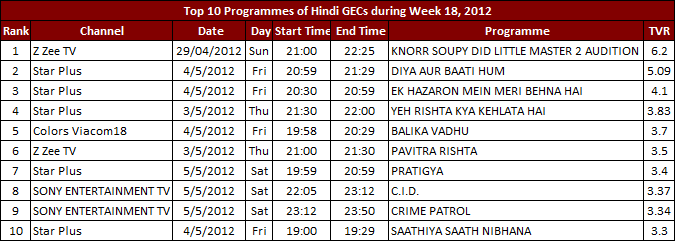
  • TAM data Top 10 programmes on HGEC – Wk 18’12


    Source: TAM Peoplemeter System
    TG: CS 4+ yrs
    Market: Hindi Speaking Market
    Period: Wk 18: Apr 29 to May 5, 2012


    About TAM Media Research

    TAM is a joint venture between Nielsen Company & Kantar Media Research. Besides measuring TV Viewership, TAM also monitors Advertising Expenditure of Television, Print & Radio through its division AdEx India. Since 2004, it extended its presence in the PR Measurement & Analysis space for Corporate/Marketing Clients by setting up a separate division Eikona PR Measurement.


    In 2007, the joint venture introduced RAM (Radio Audio Measurement) service to track Radio Listenership for the Indian Radio Broadcast Industry. In year 2009, TAM launched a division, called TAM Sports that specializes in monitoring Sports Sponsorship ROI.


    TAM Media Research’s objective is to fuel media insights that will drive the growth of the Indian Media Industry.


  • By Invitation: Sundeep Nagpal | Will Satyamev Jayate work for advertisers?

    By Sundeep Nagpal


    Much has been said already about this latest attempt at garnering mindshare (no, not that one …. please notice, the ‘m’ is not in caps !). And most of it is reasonably credible and justifiable. For instance, there’s little doubt that the show is a brave attempt by an entertainment channel to create some degree of social transformation, as much as being almost a challenge to its sponsors to leverage its equity for their brand.


    There’s also little doubt that both, the anchor of the show and its production values are as superlative as they could be.


    But the question is: Will it work?. What are the benchmarks of performance? Should they be just the ratings? And if not, are there any other – for example: any NGOs which can monitor changes in behaviour, attitude, etc. towards the social issues that the programme addresses.


    However, until such time that any social transformation becomes evident, here are some thoughts that still intrigue media professionals (especially after seeing the first episode). (Lesser mortals such as us can only look at this prism, in the light of the advertising / media business).


    – By any stretch of imagination, and despite being broadly classified under the genre of reality, SJ is far from being an entertainment show (no argument that even KBC was entertaining to some degree, despite basically, being a general knowledge quiz). So, will it work even half as well as KBC?

    – With the backdrop of socially-oriented programs like Aap Ki Kacheri, what can be expected from SJ? Can the host / treatment of this show make it a commercial viability for the channel?

    – In a season where the popularity of the country’s largest entertainment spectacle (the IPL) seems to be on the wane, what can be expected by an advertiser from a social talk show?

    – To what extent could the marketing muscle behind the show have bolstered the ratings of the first episode? (and of course, what, if anything would sustain its popularity?)

    – While there is no doubt that the host/ anchor, production values and the promotional strategy (including the suspense created), have been very favourable for the show, are the time slot, program duration and basic content, favourable enough to create a block buster?

    So, this article is not a shot at ‘philosophical gyaan’. In fact, it is an attempt to understand audience perception as well as an attempt to predict the popularity of the show (yes in terms what the opening ratings are likely to be).


    To address the former issue, we at Stratagem Media, undertook a dipstick study of a cross-section of more than a 100 people who had watched the show, in Mumbai only, (needless to say that dipsticks are only meant to be indicative of any patterns that may exist and not necessarily statistically accurate).


    Also, we did look at the ratings of a variety of other reality shows quite closely, just to be able to arrive at an educated judgement on what its opening TVR would be on Star Plus (for an All India, CS, 4 + audience).


    Here are some of our observations.

    –  To begin with about 25 % of people approached for the dipstick survey had not seen the show (but that’s not surprising, after all people do other stuff on Sunday mornings), and males formed a larger component of the non-viewing audience.

    – 18 % watched for less than 15 minutes, while 27% watched for more than an hour (albeit, not for a statistically valid sample).

    – A majority of male viewers did not even know the duration of the programme, (even after having watched it).

    – Two-thirds of viewers watched the original airing and almost everyone who saw it, did so on Star Plus (in Mumbai).

    – A majority of Males watched primarily because of the host/anchor, while about a third of them were curious about the content. Whereas a much larger proportion of women watched for the content.

    – More than two-thirds of viewers rated content and credibility of the show very highly.

    – In fact, the majority seemed to find nothing wrong with the time slot and expressed a desire to watch it again.


    And lastly, while the media fraternity waits with baited breath for this, and purely based on judgment, the opening original episode of Satyamev Jayate on Star Plus, ought to garner a rating of between 3.2 to 3.7 for an All India, C&S, 4 years-plus audience.


    However, as has been said before, for advertisers/ sponsors, this programme is not about ratings alone – it’s about an opportunity to build brand equity, which can be invaluable. In fact, it could be about diverting your CSR budget to Television !


    So, All the best, Aamir & All the best, Star!


    Sundeep Nagpal is director of Stratagem Media Pvt. Ltd, a Mumbai based media agency!


  • SJ is Aamir’s baby, completely: Satyajit Bhatkal

    By Meghna Sharma


    With just two day to go for the launch of Satyamev Jayate, the show has created much curiosity among everyone. The industry’s well-kept secret is Aamir Khan’s maiden entry into the small screen.


    Talking about the show, Satyajit Bhatkal, director of the show, told MxMIndia that although the team has been working on the show for over two years, the concept is very old. “The idea of something like the show has been on Aamir’s mind for over years now. It is his baby completely. Along with his small team which I’m part of, Aamir worked on it for many years. And only when the idea of clear did we approach the channel which again added to the concept.” The channel, Star Plus, will air the show on May 6 at 11 am.


    It’s a known fact that Aamir is a perfectionist so it won’t be a surprise if he wasn’t involved in every aspect of the show. “He was there at every moment of the show. Even today he’s here. A lot of attention has been given to details and extensive research was done to produce the show,” said Bhatkal.


    Speaking on the morning slot of a Sunday morning, the director laughed and said, “It’s only in the metros that we tend to laze around on a Sunday morning. Most of the country is up and about early. So, I don’t think the morning slot should be an issue.”


    Like everyone else, the director too is keeping his fingers crossed about the show he described as ‘nothing ever seen before on TV’ and hopes to reach out to every Indian. “It’s not always entertainment which might click with people; we are hoping that our show will be able to garner people’s interest for long and good.”


    Photograph: Fotocorp


  • Lokmat aiming for, and racing towards growth

    By A Correspondent


    To drive its growth agenda in a more meaningful manner inMaharashtraand Goa, Lokmat Media Ltd has renamed its advertisement and circulation departments as AIM and RACE.


    “In a time like this it is important to enhance focus in our business. The two most important and critical departments for the topline growth of our business are Advertisement & Circulation. Therefore, renaming of the two departments will bring focus to the core competence and also align every team member with the larger vision.  The two teams now have a new vigour to drive the growth agenda,” said Jwalant Swaroop, COO-Publishing, Lokmat Media Ltd.


    AIM stands for Aiding Impact Monetization. The advertisement department does chase every rupee in the client’s wallet, but, at deeper level, it has to monetize the impact delivered as response to advertising released in the columns of Lokmat, Lokmat Samachar and Lokmat Times.


    ‘Aiding Impact Monetization’ also sets the agenda for AIMERS (members of the advertising department) to provide innovative and skillful selling of solutions to the clients.


    RACE stands for Reader Acquisition & Content Engagement.  Traditional circulation strategy, the Lokmat Group realized, will not work any further.  Therefore, the circulation department’s new mantra is to consolidate and widen the target net.


    Backed by rejig of its editorial team, Lokmat now promises to deliver more engaging content.  The circulation department, therefore, has to re-align its focus to reader acquisition and content engagement.


    “From a pure distribution focus, the circulation department now moves to follow a Reader-Centric approach to acquire and retain readers who are important for our future growth,” said Mr Swaroop.


    The timing of the announcement has been most appropriate as the economic slowdown is pushing media owners into re-engineering their businesses.


    Lokmat Media Ltd. is one of the leading media houses inIndia. The Group publishes three newspapers, 19 newspaper editions and 58 sub-editions in three languages collectively, in Maharashtra andGoa.

  • Suryan FM & Red FM sponsor radio forum

    Nisha Narayanan

    By A Correspondent


    Suryan FM and Superhits 93.5 RED FM have partnered the India Radio Forum (IRF) 2012 as Premium Presenting Sponsors.


    Radio over the years has emerged as a strong medium and a credible platform creating a significant place for itself amongst the more dominant and traditional forms of media communications. The Radio Industry is growing steadily and this association with IRF 2012 is a way of showing Suryan FM and RED FM’s commitment to the industry.


    Speaking on the association, Nisha Narayanan, Senior VP Projects and Programming, RED FM said: “We as a leading network in the country are proud to be associated with a prestigious event like the India Radio Forum. It is always nice to see the enthusiasm and passion that our radio fraternity has for the medium and IRF is one of the platforms where all of us meet year on year and share the work and see the best work getting rewarded, looking forward.”


    During the CEO Roundtable Session ‘Let’s get the bigger picture’ Mr. B Surendar – Senior V P & National Sales head, Red FM, will be sharing his views on the coming years of radio industry in India, the growth prospects and the major happening which will make the business more lucrative and absorbing, and the most awaited 3rd phase of licensing in Radio.


    Red FM, India’s Largest Radio Network, with 50 stations across India (including the Suryan Stations) was first launched in Mumbai in 2002 followed by Delhi and & Kolkata in 2003. Red FM has always believed in philosophy and attitude of “Bajaate Raho!” along with a music strategy of playing only Super Hit music, based on the internationally successful CHR (Contemporary Hit Radio) format.


  • Lowe & Lifebuoy win India’s first Global Effie

    By A Correspondent


    Lowe Lintas and Partners India’s campaign for ‘Lifebuoy Super-Fast Handwash’ was declared the 2012 Global Effies Bronze winner at New York on Wednesday. Earlier this year, Global Effies had called for entries of globally effective campaigns across the world. Lifebuoy was shortlisted earlier in the month along with brands like Nike, Google and X- box.


    Said Saji Abraham, Global Planning Director, Lifebuoy and Virat Tandon, Global Business Director, Lifebuoy: “Lifebuoy Superfast Hand-wash is a liquid handwash formulation that kills 99.9% germs in 10 seconds. We responded to this fantastic innovation with a simple but insightful and persuasive idea – that children are in a hurry when it comes to hand-washing; and so if your handwash cannot keep pace with them, germs on their hands will just not go. This campaign won because we were bold, competitive and consumer focused at the same time.”


    Joseph George, CEO, Lowe Lintas and Partners, said: “As an agency, we take the Effies seriously. And so winning, not just the Lowe & Partners Worldwide Network’s but also India’s first ever Global Effies is hugely satisfying and encouraging.”


    See also:

    http://www.effie.org/winners/showcase/category/43 Grand Effie winners

    http://www.effie.org/winners/showcase/2012/6695 Information on Lifebuoy ad and credits

    http://www.effie.org/winners/showcase/2012/6695 The Lifebuoy presentation


  • The Six Ps of Data Driven Marketing


    By Rishad Tobaccowala


    Samuel Taylor Coleridge in his famous poem “The Rime of The Ancient Mariner” has a stanza describing what it is like to be stuck in a salty ocean under a withering sun:

    Water, water, every where,

    And all the boards did shrink;

    Water, water, every where,

    Nor any drop to drink.


    Today we live in a data driven, data infested, data diarrhea world where we may plaintively wail:

    Data, data every where

    So much data that we will sink

    Data, Data every where

    Pray who will help us think?


    It is clear that data itself is being created in such piles that data itself is close to meaningless and information from it is often not too meaningful. What we really need is to be able to make this torrential flow yield a waterfall of actionable insights and maybe even wisdom.


    This is unlikely to come from yelling “big data”. ” we need to own the data”, “data is critical” and other data shibboleths that the most data challenged companies and individuals brandish like some magic sword.


    A better way is consider the six Ps of Data.


    1. Perspective: What perspective do you expect to get from the data ? What connections are you hoping to see? How do you plan to use this data? Asking the questions before you collect or cull through the data can be very helpful. There are times that the data itself may yield the answers but to do so you will need the next P which is people.


    2. People: The shortage in data driven marketing is clearly not the data or the storage capacity or even the computing capacity but of this rare bird called the “data scientist”. John Rauser of Amazon in this fine talk explains how this species combines applied math and engineering with a layer of curiosity, skepticism and good writing skills.


    3. Punctuality: The half life of a tweet is probably 8 minutes and of any piece of data probably less. Collecting data is like building a museum to the past in a real time world. What is critical is to have data arrive where you need it, and when you need, both from some past archive and some just in time magic. As the world gets more mobile and place and time-based relevance increases in importance so will the punctuality of data.


    4. Privacy: As data scientists glean insights such as the likelihood of you being a valuable pet food buyer is if you celebrate/promote your pets birthday on Facebook , and combine it with the amazing technology of just in time, things may get all creepy and icky. And to ensure that this privacy issue will become a critical factor one can look to the Government. Not just the Europeans but of every country whose political structures are being disrupted by technology armed citizens. To make an example of things the Government  will come after the big companies and so data policies and transparency will be key going forward to keep things all nice and elegant.


    5. Pooling: We are living in a connected world. The Internet is a connection engine. Data APIs and access to databases from all over will be critical to make data driven marketing a reality. Here is a simple example of how Google Trends data and retail location allowed for some superb marketing. It’s not the data you have but the data you can access. Access to rather than ownership of data is key and therefore the ability to partner and leverage platforms and portholes into data clusters will be key.


    6. Partnering: As large companies like Google, Amazon, Facebook, Experian, IBM and several others around the world build data stacks, warehouses and tools,  the key will be to partner with these platforms that allow companies to process, pool and pull their own information. There are huge economies of scale that come with data collection and processing and therefore it will be key to decide what platforms to partner with rather than build a complete vertical stack.


    The age of data driven marketing arrived some time ago. Now companies and people have to catch up with how best to thrive in such an age and collecting data and running algorithms are unlikely to yield much without the six Ps.


    Rishad Tobaccowala serves as Chief Strategy and Innovation Officer of VivaKi which combines the media and digital assets of the Publicis Groupe including Starcom, Zenith, Mediavest, Optimedia, Digitas, Razorfish, Moxie Interactive, Performics and Denuo. Mr Tobaccowala can be reached at @rishadt


  • The 6.5% GDP growth and the economic mess: What does this mean for the media?

    Ashish Pherwani

    By A Correspondent


    The front pages of the business papers express shock. With reason. The 5.3 percent GDP growth rate for the fourth quarter of 2011-12 is the lowest since 2003 and the full-year growth of 2011-12 of 6.5% is lower than the 6.7% of 2008-09.


    So what does this mean for the media? Should we press the panic button? When asked whether the GDP growth numbers and the prevailing economic situation in the country will impact the media, Ashish Pherwani, Associate Director, Ernst & Young said: ” I think it’s normally the other way round. The media is at least one quarter ahead in terms of the impact. So it’s been a couple of quarters since media effective rate has been falling or has stayed flat, volume growth has also not been great. So that’s like an early warning signal which comes always a quarter before actual numbers start going down at a national level. To answer the question more specifically, media has already reacted to it so hopefully there won’t be any further reactions.”


    MxMIndia spoke to some mediapersons and economists for hints on the shape of things to come. While many are still hoping that it will not impact them, those who have experienced 2008-09 believe there is no need to panic as the government is now seized of the situation. Big ticket announcements will not get stalled, so if there’s a new show that is going to be announced on a GEC or a rejig expected on a channel or a newspaper, that will continue. And must continue.

     

    However, there will be caution everywhere. Media entities depending much on real estate and the financial sector need to be alert, but with the government sure to act to improve things, there is a feeling that the crunch (from the realty sector) will not last beyond six months as the government will prop it up.


    Meanwhile, the sentiments will indeed be weak. And marketers known to splurge will take a backseat as stakeholders will be more demanding.


  • Peter Mukerjea: A Real Live Whodunnit?

    By Peter Mukerjea


    So the tentpole industry event of last week – Goafest , is over for another year. Advertising , marketing and media industry executives will be back at their desks catching up with the backlog of work and the start of a new week. Some will still be nursing hangovers and some will be recovering from other forms of stimulation, no doubt. Judging by the numerous photos in the various picture galleries, I’m sure many new relationships will have been forged – digitally or otherwise.


    Meanwhile the biggest global media business event, so far in 2012 and by all probability, in all of 2012, is about to begin this week in a court room in London. Apart from the employees of News Corporation around the world, all newspapers and media organisations here in the UK, the US, Australia, Canada and other parts of the world will be looking forward to the chart and TRP-topping opportunity of seeing several media owners take the stand this week at the Royal Courts of Justice. Not just any owners but the Barclay brothers , who own The Daily Telegraph newspaper , the junior Lebedev who owns the Evening Standard newspaper, but above all James Murdoch and his father Keith Rupert Murdoch who will be taking the stands – separately on different days this week. All of these will make for very enjoyable viewing for a lot of us, particularly those who have worked at close quarters with these people. A family affair once again.


    Hours of television and on line viewing (itn.co.uk on Tue, April 24 / Wed, April 25 / Thu, April 26 ) will take place this week without doubt and journalists all around the world – both pro-Murdoch and anti-Murdoch will be glued to a screen of some sort and will analyse and dissect each and every word for the benefit of their readers/ viewers.


    No matter what the result of the findings, public perception of all of this is going to be very interesting and insightful. I’ve asked friends who have never had anything to do with either of the Murdoch’s other than as readers of the newspapers or viewers of TV stations owned by them and their take on it is very simple. It seems they both come across as walking on extremely thin ice and that they should take responsibility for the actions of their executive and their staff, appears to be the most favoured impression so far.


    The issues at hand are email hacking and phone hacking which seem to have been committed by journalists, numerous times over, sometimes ‘ in the public interest ‘ and sometimes in the interest of gaining an advantage over competitors. There’s the relationship between politicians and the media and and also the relationship between the police and the media. All of these issues are not uncommon in our own ‘ desi’ world today. Many of us reading this will have had to juxtapose our personal beliefs and interests versus those of the organisation that we work/ed for at some time in our lives. This, should then concern those in media and it’s surely a question that we should be asking ourselves, as to whether we believe this conduct is acceptable or not.


    Editorial priority is a critical ingredient as is the question of proportionality and both of these should be written into the charter document of all news channel and newspapers if it isn’t so already. Who takes on the enforcement of this responsibility ? Should we believe and trust the CEOs, Editors and owners of these organisations who advocate self-regulation as the best way forward, given that they are all reasonable, just and responsible citizens. Perhaps ‘fit and proper’ too. Or, should this be the task of a Media Commission?


    Do we genuinely believe that media owners should be treated differently to their executives, who run the organisation/s and who are hired hands at the end of the day? Where does the buck exactly stop? Where do investors fit in ? They want profits but very often are not keen on getting their hands dirty with integrity issues. Perhaps Rajat Gupta, who is due to go on trial for alleged insider trading and passing on tips to a friend, will have a point of view here as he’s been an investor in media companies himself and is also going on trial in a month or so.


    Is there a conflict of interest if the owner is also the senior-most executive in the organisation or should that be ignored and seen as a mere coincidence? Or should they all be looked at in a similar way and therefore expect to have the same respect for the concept of law and order and governance?


    Either way, the next few days will make very interesting viewing and I would advocate that that all news channels, media companies, law firms that have or would like to have media clients, law schools, the regulator etc make this essential viewing for all their staff who are engaged in similar matters so that they can all have a more evolved sense of how to deal with these often complex issues of media ownership, media management, media ethics and governance.


    We may not be willing to impose this on ourselves but i would argue that if we are to be seen as a responsible industry, then we must make a note of the developments on this side of the pond. Then make the most of this opportunity and watch the grilling that’s going to take place, of some of the most powerful media people on the planet. There is no doubt however that the barristers who will be doing the grilling over the next few days will do so – ‘very carefully’ and will bear in mind Rupert Murdoch’s comment in July 1995, when the newly elected British PM Tony Blair came to Hayman Island to visit him and Rupert said ” I suspect we will be like two porcupines making love – very carefully”.


    Peter Mukerjea, celebrated media professional and former CEO of Star India, mulls frequently for MxMIndia.com