Category: Uncategorized

  • From the MxM Annual 2014: Oh Yes, Abhi! Really?

    By Shalini Rawla


    Millennial youth as a cohort is not such a mystery really. Born circa 1990 they have grown up in front of us. We can see how they behave. We know what makes them laugh and cry. Sometimes we lament about them as their employers. Sometimes we are happy for them as parents. But when it comes to marketing to them, we feel at sea even as experts. We kind of know they are the ‘here and now’ generation, restless and impatient for immediate results, but is that really who they are?

    The millennial’s back story

    We all know that kids these days grow older, younger. So what an adult of my generation learnt at, say, age ten, a five year old in the new generation would already be aware of. They take to computers and smart phones as naturally as fish to water. By this logic, when the millennials became first time voting adults and employees, they should have been behaving like they are already in their thirties. Herein lies the dichotomy.

    The millennial youth of today may be technologically ahead of its parental generation, but they are behind them by several decades in emotional maturity. It is as if this cohort has unanimously decided to push all other traditional milestones of ‘settling down’ or taking on newer responsibilities to a decade later. So they are choosing a career late, marrying late, starting a family even later and so on.

    They are more comfortable with technology than their parents thanks to the liberalization of our economy – a time when the millennial generation and their parents both got exposed to technology almost at the same time. The younger, more curious and flexible minds adapted to technology faster than the oldies. In fact, the two generations discovered and experienced more things together as against the previous generations where the parents were looked upon as teachers – their guiding light – a part they played beautifully. There was very little that the previous generation’s kids knew more about or learnt much before their parents.

    Experience junkies

    Our ‘millennial’ economy and technology is responsible for democratizing knowledge and breaking the traditional patriarchal and hierarchical structures. When the parents were experiencing their maiden trip abroad, so were their millennial kids.

    The parents were students of the new experiences themselves along with their children. And India suddenly embraced a new school of parenting – of discovering and sharing everything with their children. They were not authority figures to be respected but friends who did not just ‘provide for’ their children but indulged them in every form – be it branded possessions or more new experiences like swimming, tennis, drama, aeronautics etc.

    The millennial generation was fed on scores of such new experiences. Parents felt dutybound to give to their child ‘the best of everything new’ – something they vicariously enjoyed when the kids shared those experiences with them. And somewhere around this time, Facebook happened.  Discovering and sharing became the millennial generation’s DNA and their parents forever lost their venerated top position in the family totem pole.

    Helicopter parenting?

    Some call this helicopter parenting. I call this mother-of-all parenting challenges. With the breakdown of joint families, the parents of this millennial generation were spreadeagled under the twin onslaughts of modern parenting and new age employment/responsibility – both of which they were learning for the first time and had to do it all by themsleves with no support from anywhere. Like each generation faces its fair share of challenges, this generation of millennial parents also faced theirs. They learnt by making mistakes. They did not experience any economic deprivation as their parents did, but a strange kind of emotional deprivation – a feeling of being out of depth with themselves as model parents, employees and children. Their own dreams seemed dangerously close to being compromised.

    Each generation can be best understood only in the context of its earlier generation. And this paper is not about the Gen Xers. It is about the millennials, the youth of today. But I am sure much of what we think of as their inexplicable behaviour, can be understood better if we keep this context in mind.

    The millennial employee

    The just working, under thirties, a few years out-of-college kids are used to being fed on experiences. They treat each job as an experience. That is why they quit companies very quickly. It may just be that they were experiencing a new field altogether and joined your company to find out if they saw themselves continuing with the same job for a longer time, little realizing that the company may have longer term plans which completely go awry because of this trait of experience junking and dunking.

    The millennial’s work place

    The millennials are used to being indulged by their parents, so they expect the same from their employers. They do not respect structures, so they reject the 9am – 6pm routine. They like flexi timings and would love to work out of cafes. ‘Never Boring’ is what they seek out of life and even their jobs. Since most jobs are serious and the work atmosphere cubicled, they quit. Never boring is also their set of friends who they have to meet compulsively every weekend. Heaven forbid if the employer asks them to work on a Saturday. Their idea of work-life balance is more read as life-work balance in their minds.

    They don’t like desk jobs – they like to move around, meet people, travel, after all experiences do not happen sitting at one place. They like managing people but don’t like a job where there is daily reporting to a boss. They have difficulty seeing their boss as an authority figure as they never did face any ‘real authority’ at home. If they face a problem at work, they expect their boss to solve it for them just as their parents helped them in their school projects.


    They do not know how to react if the boss says, ‘Go figure’. Chances are they may call their parent to ‘figure’.


    The millennial’s life goals

    They want to earn money – lots of it. And they want it now. They know the end but have not figured the means to that end yet. They are celebrity struck. They want to dress up like them and wear brands they wear. Their parents indulged them so far. Now that they are working, they want to live the same lifestyle without asking their parents for money. They jump jobs for money. In that sense they are more risk taking. They do not feel they must secure one job before quitting their current job. They do not feel that many jobs in a short span would show badly on their resumes. After all, all stints tot up to a variety of experiences. A job is a means to an end of gaining another experience. A job gives them their right to stay out of home for longer hours. It is a like a date. You have to experience all kinds before you settle on the one you really, really like.

    Width of experience is more important than depth in any one subject. To them knowledge and intelligence are inter-changeable terms. That is why they consider experience more important than education. Most of them believe that it is important to get some work experience after graduation before deciding which subject to major in for further education.

    Millennials as consumers

    Millennials are very appearance conscious. They are willing to spend money on fitness, beauty, apparel and accessories. And of course eating out. They are influenced by celebrities and brands. They believe in turning out well at any time as fashionable clothes are their confidence boosters. They feel less inhibited in making friends offline if dressed well. Online, of course they befriend loads of them within their most extended circles – but never a rank stranger.

    They share fashion trends, clothes they like, jokes and party pictures which flatter them and make them look more affluent than they actually are. They are fitness conscious and try not to get addicted to any vice. Marketers can lure them with classy stuff that respects the environment and uses a lot of humour to market itself. They seek creativity and innovation in products and services as these two add to the ‘Never Boring’ dimension of consumption.

    Millennials understand their own importance in the eyes of the marketers. Brands that give them due respect as a serious consumer while simultaneously engaging them as a fun shopper, are the ones that shall pass the loyalty test. Millennials are fans of brands. They respond to the personality of the brand more than its promise. A brand that becomes their fan is likely to end up being the most significant player in the game.

    Millennial’s social quotient

    Twitter is not a medium where they can show off or see others like them. They prefer to post visuals than 140 characters of text. They want to be famous in their contact list and change their profile pictures often. The number of likes and comments they get is a measure of their popularity and how much influence they have on others. They feel power begets money and fame and hence consider these ‘likes’ as symbols of power and influence. Yet, they know their virtual power is of no use without their friends. They value relationships over individuality. Egos have very little role in a team of millennials. They like to participate as a team member than be seen as the lone performer. Give them a relevant cause, and see them rally around it. Together they can make it happen. The solo angry young man wanting to change the system has given way to a collective power that wants to change the system by being in the system. Yes, most millennials want to participate in effective governance and joining politics is not something they are dead against. It is another route to influencing others by wielding their power. So don’t be surprised if most of them have already put in their efforts voluntarily in NGOs to help the oppressed. The share generation is willing to share their time, effort and money for the socially oppressed and the physically challenged.

    Oh no! Abhi nahi

    There is no urgency to divide life into key milestones like their parents did. Today, the journey is different, where the goal is the experience not necessarily the destination. Now is for the new. Later is for things that are passe – job, accomplishments, acquisitions, marriage and parenting. Think of the future only in the future. Commitment is not the ultimate goal, experience is. If that is construed as being confused, so be it. Use confusion as a badge – a leverage to explain your delayed maturity. You live only once. So enjoy each experience. Life is not a linear journey of responsibilities but a kaleidoscope of experiences. You have not lived a full life until you have experienced everything – the good, the bad, the ugly. No need to shut old doors and open new ones. Leave all doors open – you never know when you may need to pass through them again. Don’t burn bridges with anyone as success comes only with the help of others. Networking is the corner stone for a life full of meaningful experiences.

    The beta youth

    Millennials are fascinated when they get involved with “work in progress”, living in a beta world, they’re exhilarated by the challenge to participate and create collaboratively. They’re used to curating their own content– reusing, remixing, repurposing– and they’re empowered by discovering things on their own. They change quickly and don’t let attachments hold them back because for them, it’s about living in the present with no illusion with what the future will hold.


    Shalini Rawla is Founder & CEO, The Key Consumer Diagnostics Pvt Ltd

     

  • GroupM elevates Sidharth Parashar & Jai Lala

    By A Correspondent


    Jai Lala

    GroupM has announced the promotion of two of their senior executives of the Central Trading Group (CTG). The company elevates Sidharth Parashar, as Head, Pricing & Investments, and Jai Lala, as Head, Trading & Partnerships. Both will report in to Prasanth Kumar, Managing Partner, CTG, South Asia.


    Prior to his promotion, Mr Parashar was the Agency Buying Head for Maxus, for over five years, where he was a valued member of the leadership team, working on media mandates for brands such as Google, Nokia, Vodafone to name a few. In his new role, Mr Parashar will be responsible to facilitate and execute GroupM investment mandates across media. His key focus will be on the GroupM trading products that should continue to offer the edge to our clients. All the GroupM Agency Trading Heads and cluster heads will now report in to Sidharth.


    Prior to Mr Lala’s elevation, he was the Agency Trading Head for Mindshare, where he worked on media mandates for clients such as Pepsi, GlaxoSmithkline, ICICI, Aditya Birla Group and Nike. Going forward Jai will be managing all trading mandates at GroupM. He will also be heading a team of all the heads across verticals: Proprietary media, DTH, Xaxis, Syndication, GME and Special projects and maximize value for our clients. He will also work closely with Sidharth and the agency trading heads on delivering the maximum ROI on media investments.


    Speaking on the new structure, Prasanth Kumar said: “As we move into a growth phase largely driven by converging synergies across the group and driving client satisfaction it has become critical that we create more focus, especially in the area of media investment. With the development of new concepts of integrated media, merging traditional and digital media, we are also looking at reforming the way we plan our investments as a central hub. This new structure in our core function will deliver unparalleled client delight and value.”


  • Planning to resolve complaints via social media? Things you should beware of

    By Preeti Kulkarni


    Mumbai-based IT consultant Manish Thakkar had almost given up. Despite several attempts, his bank branch had refused to entertain his concerns. Then, on the behest of a friend, he posted his grievance on microblogging site, Twitter, tagging the bank’s customer care handle to his tweet. To his surprise, the bank not only responded to the long-standing grievance immediately, but ensured quick redressal.


    DOs & DONT’S


    While both Twitter and Facebook can yield instant results, the former has an edge, feels Bhupendra Khanal, co-founder and CEO, Simply360, a social media analytics firm.


    “In case of Facebook, the customer is required to visit the organisation’s page to post a complaint. However, on Twitter, they have to merely mention the company name in their complaints to bring it to the notice of the concerned banks or insurance companies.


    The organisations keep a tab on these ‘mentions’ on Twitter using tracking applications,” he says. While the benefits are plenty, you must know a few things before you decide to get your problems resolved. The internet can be a financial death trap for those who do not take due care while transacting or sharing personal information.


    There’s always someone prying to rob you of your wealth. Such people may come across as bank or insurance company representatives and try to trick you into disclosing your personal information, such as your contact details, date of birth, as well as your bank account or insurance cover details. Don’t fall prey to these fraudsters.


    Make sure you are specific and don’t reveal any personal information. When you lodge your complaint, specify the nature of your query and location; mention the city, but not your address.


    More importantly, never reveal sensitive information. “One should never divulge one’s account numbers, personal identification number (PIN), credit card numbers and insurance policy numbers,” says Subho Ray, president, Internet and Mobile Association of India (IAMAI).


    Therefore, you can send a direct message on Twitter or Facebook, if you are asked to provide personal information, but remember that banks will never ask you to give your user ID, password, PIN or credit card CVV number, be it on the social media platform or via phone banking.


    If someone asks you to reveal such details, you need to be on the alert. It could well be a fake handle of the bank or insurer you are trying to get in touch with. “A common mistake made by customers is to end up writing on Facebook and Twitter destinations that are not the official presence of the brand,” says Rajiv Anand, president, retail banking, Axis Bank.


    Preferably, you should post your complaints only if the handle or page displays the verified sign. Even if the handle is trustworthy, ensure that there is no confusion regarding group companies. “It is also important for customers to first reach us at the correct brand destination.


    There are lots of instances where we receive complaints that are actually meant for other HDFC group companies, and we route them to the respective stake holders wherever required,” says Tripathy. So, be sure of your posts to save on time.


    Mr Thakkar is not alone. Browse through the Twitter timeline and Facebook pages of customer care handles of various banks and insurance companies, and you are likely to come across similar stories. Realising that any negative publicity on the high-visibility social media can dent their image, companies have become proactive in addressing customer concerns on these platforms.


    They have set up dedicated teams to address customer complaints on a real-time basis. This advantage is being readily tapped by customers, typically in the 25-35 age group, who are posting their queries on the companies’ official Facebook pages and Twitter handles.


    Advantages

    Banks and insurance companies acknowledge that visibility on such platforms results in quick resolution of grievances. “When a customer posts a message on the company’s brand page or Twitter profile, it usually results in faster response because it is out there for the whole world to see,” says Rituraj Bhattacharya, head, market management, Bajaj Allianz Life Insurance.


    Some organisations have trained professionals to address complaints via social media. “Facebook and Twitter are monitored as priority platforms and we make sure that the turnaround time for complaints is as short as possible and, in fact, real-time in most cases,” adds Sanjay Tripathi, senior executive vice-president, marketing, product, digital and e-commerce, HDFC Life.


    The delay in receiving a response from customer service has been the pet peeve of many clients and social media seems to be providing the solution. “From a customer’s perspective, the advantages of lodging complaints via social media are immediate acknowledgement and convenience of filing it,” says Karthi Marshan, executive vice-president, Kotak Mahindra Bank.


    Convenience is the other advantage as you can access these sites on an hourly, or at least, on a daily basis. “They have the convenience of sending their queries to us on the same platform that they spend time on a regular basis. Customers do not need to take the trouble of switching to another platform, such as the bank branch or call centre to resolve their issues,” says an ICICI Bank spokesperson.


    All such grievances are treated at par with the complaints received through formal channels, including the branch, e-mail and phone banking. “The grievances received on social media are treated as formal complaints and are handled in a manner specified in the Insurance Regulatory and Development Authority (IRDA) guidelines,” says T R Ramachandran, CEO, Aviva India.


    So, if you want to escalate the matter to the banking or insurance ombudsman, complaints on social media sites will also be treated as official.


    Source:The Economic Times

    Copyright © 2014, Bennett, Coleman & Co. Ltd. All Rights Reserved

    Licensed to republish


  • How India went Social with Fifa WCup


    The Insights team at media services agency Maxus is putting together social media statistics and trends around the ongoing FIFA World Cup. This is in partnership with Radian6, a platform that enables organizations to monitor and engage in conversations across the social web.


    I. TOPLINE FACTS

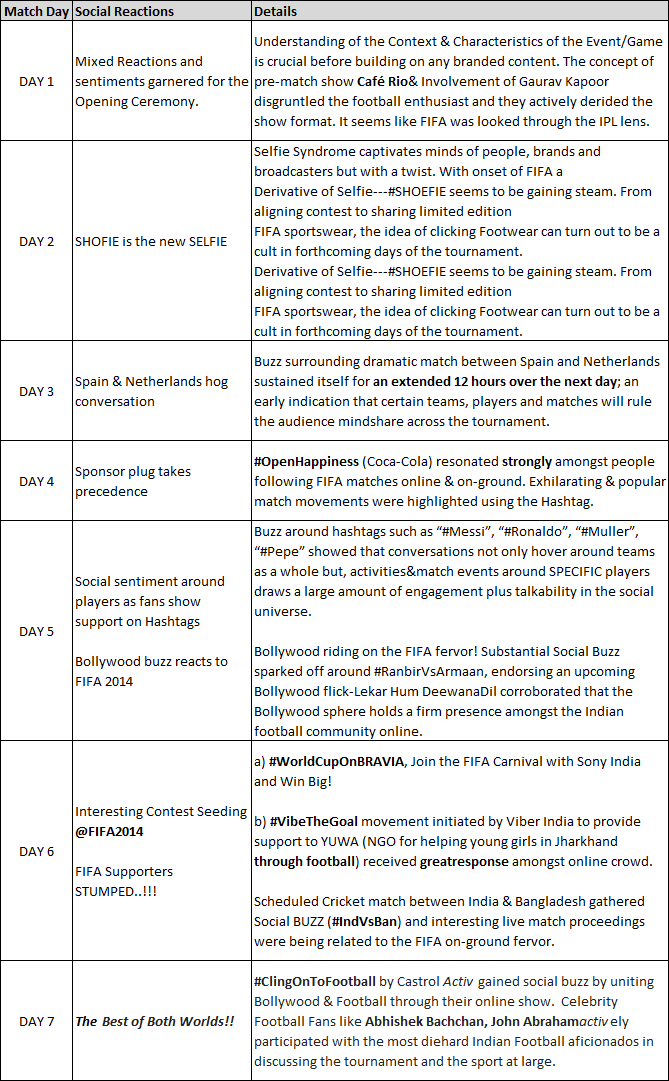
    – FIFA World Cup 2014 seems not only an interesting contest between countries, matches, teams and players but also a contest of audience viewership and engagement numbers. This quadrennial edition of the beautiful game is slated to reach 100 million viewers in the country and burgeoning social buzz builds the testimony for it. The inaugural week of the game garnered a cumulative social conversation buzz of approx 4.75 Lakh plus mentions, with Twitter emerging as a Numero uno social platform to broadcast, trend & share information. (Estimationbased on trackable sources).


    – Interestingly, The Social Buzz volumes were highest across late evening (2000-2359) and early morning hours (0000-0359). These time stamps reflected that in GEC dominant households’ football enthusiasts were consuming live match streams during the prime time band and this consumption stretched onto odd hours. This gives an indication of the dual screen or multi-screen scenario and an opportunity for marketers to harness this evolving consumption pattern.


    – A moderate yet a significant amount of social buzz volumes were tracked across Noon or mid-day hours. Delving into the social buzz we figured that a sizeable amount of audience followed Match Highlights and some even record odd hour matches to view it in day time. With convergence of multiple mediums and formats of feed, the line between online & on-tv viewership seems to be blurring.


    – During the week, highly engaging & conversing matches were Brazil vs Croatia, Spain vs Netherlands and Germany vs Portugal. Neymar, the Brazilian forward striker emerged as a popular and resonating player among FIFA enthusiasts in the country. Looking at the Match trends & Hashtags (#) associations, it is evident that certain teams, players and brands have higher equity in the tournament across all the participants. A point crucial for marketers focusing on Football advertising & looking forward to execute mid-course strategy corrections.


    The official Facebook Handle of FIFA World Cup 2014 garnered overwhelming response with fan base growth of approx 36% & conversing rate of 28%during the tracked week. Above all number the most engaged nation on the page was India followed by Indonesia on number 2 and United States on number 3. Beyond the FIFA World Cup, some of flourishing Facebook brand pages from India were: Nokia India (+ 120k New likes), XOLO Mobiles (+106K New likes), Reliance Industries (+150K New likes), Sunsilk (+400K New likes), Aircel India (+120k New likes), etc.


    II. MATCH HIGHLIGHTS OVER THE WEEK ON SOIAL PLATFORMSS


  • Aidem bags ad sales mandate of AM Television

    By A Correspondent


    M Television Pvt. Ltd., pioneers in the field of Electronic Media in the North East, have appointed Aidem Ventures as their media representative in the Delhi, Kolkata & Chennai markets for their channels Prag TV & Rengoni. The deal will allow Aidem to expand its reach in the North East.


    Launched in 2000, Prag TV is the oldest news channel of the North East region of India. Prag TV is currently available across Assam and entire North-East regions and enjoys a viewership of over 10 million.


    Rengoni is a premium, Assamese GEC that delivers a mix of fiction and non-fiction shows catering to the North Eastern region. Given the network’s superior understanding of the audience preferences, Rengoni aims at providing content customized to the taste, language and culture of the local audience.


    Prag TV & Rengoni are both being distributed by Assam Cable Communication (ACC) in association with the Digital system of Scientific Atlanta USA. ACC is the leading digital cable TV service provider that provides its services through 2000+ local cable operators in Assam & North Eastern States. Both the channels are being distributed across India through Citi Cable, parts of Bihar (Darsh Network), J & K (7 Sea), Fast Way (Punjab) & West Bengal (CTVN).


    Rajeev Bora, Director, AM Television, while announcing the appointment, said, “I am very happy about this association with Aidem. Their national footprint will give the channels the advertising exposure they need. We hope that this combined with Aidem’s expertise will prove beneficial to the channels’ overall growth. The North East as a market has always been ignored by marketers. Now one sees FMCG, pharmaceutical, F&B, tourism & auto clients apportioning a good amount of their advertising budgets to this market. Steadily, the region is moving into the national spotlight, with some states performing better than the national average both in terms of economic growth and socio-economic progress.  Its economic structure is changing. The region has traditionally been more primary sector dependent than the rest of the country—but this is changing rapidly in the coming years.”


    Alok Rakshit, Business Head – Regional Channels, Aidem Ventures added, “Prag TV & Rengoni give us access to the North East market which has been untapped by major television networks so far. This association will give our advertisers a chance to reach out to the North East markets. The team is very excited about both the channels.”


  • It’s now announced. Pradeep ‘Praddy’ Hejmadi appointed Zee TV biz head

    Pradeep Hejmadi

    By A Correspondent


    We had written about this earlier, but now there’s an official announcement. Zee Entertainment Enterprises Limited (ZEEL) has announced the appointment of Pradeep Hejmadi as Business Head – Zee TV. Praddy, as he’s called (not to be confused with what our own MxMIndia editor is also referred to by some) will be responsible for the overall functioning of Zee TV and will report in to Bharat Ranga, Chief Content and Creative Officer (CCCO), Zee Entertainment Enterprises Limited.


    Punit Goenka

    Speaking on the appointment, Punit Goenka, MD & CEO, Zee Entertainment Enterprises Limited said, “We would like to welcome Pradeep into the ZEE family. With multi-dimensional understanding of the Indian media industry, he has spearheaded and successfully launched, innovative and first-in-class profit-bearing initiatives in the Indian media marketplace. We are confident that his industry knowledge and consumer insight will be invaluable in driving Zee TV’s further growth and innovation.”


    Said Bharat Ranga, Chief Content and Creative Officer (CCCO), Zee Entertainment

    Bharat Ranga

    Enterprises Limited: “Pradeep brings with him an immense experience that will help us drive our Vision 2020 goals. We welcome him on-board and we are confident that his presence will add value to the channel and the organisation.”


    Praddy has over 18 years of experience in the Indian media industry spanning Media Sales, Media Planning and Buying, Consumer Research, Business Planning and Product Development. Prior to joining ZEE, he was the Senior Vice President – Strategy Group & Marketing at TAM Media Research Pvt. Ltd. where he was responsible for anticipating needs and focusing resources towards ensuring TAM that builds on its Intellectual Properties and drives the value upwards for consumer insights data and services.


  • Realty Check | Day 1 | Dr Sunit Sachar: Much demand for Affordable Housing

    By Dr Sunit Sachar
    Senior VP-Marketing & CRM, Parsvnath Developers Ltd 


    The Realty Sector is one of the biggest contributors to the GDP of the country. It was approximately 10.6% in 2011 which has come down to 6.5% in 2013 and is now in the slab up to 5.4% due to the dwindling sale and development experienced. The Real Estate sector enjoys the qualification of being the second largest employer in the industrial sector following IT and is instrumental in influencing over 4000 industries directly or indirectly.


    The major concern that has influenced the sector was the instability of the political scenario (the situation now has been changed) which had influenced the economic scene of the country to a great extent. With the coming of the stable government at the Centre and the government having constructive plans which have already been announced, the possibility of a brighter future is on the anvil. The government, which is the biggest spender of money, has shown interest in developing of the basic infrastructure facilities and urbanization in the country which is bound to influence the growth in the economy as well as contribute towards better sentiments in the market place which shall result in overall good. With recent government policies for the benefit of the middle class, the home loans, the announcement of Rs 37,880 crore for NHAI to undertake 8500 km of highway in addition to Rs 3000 crore for road to the NE Region, Rs 700 crore to be allocated for 100 Smart Cities, Rs 11,600 crore to be planned for harbour projects, with 16 new ports to come up, the liberalization of FDI policy, streamlining of land use, motivating bureaucracy and steps towards reforms are all constructive policies which will help improve government planning thereby resulting in better circulation of monie which in turn shall contribute towards the demand of goods and services leading to industrial growth and employment generation etc. All this will not only boost public sentiments but also the Real Estate sector which will contribute healthily to the coffers of exchequer enabling the government to go in for spending on infrastructure and development of urbanization.


    In a recent survey conducted amongst 3400 home buyers/investors (68% end-users and 32% investors ) conducted by Realty Plus–99 acres.com, it has been found that barring 15% people, all are buoyant about the future and 75% people said definite ‘yes’ when asked about thinking of purchasing a home in the near future. However, it is interesting to note that 51% people preferred Ready to Move in property, 26% under construction property and 23% are looking at newly launched property.


    Although there is a great expectation of the reduction in bank loan interest rates, 40% people would like to wait for it to happen, the other section is ready to take a plunge forward if they are influenced with the builder’s track record or when they get the option of ready to move in or near-completion hopes.


    It was observed that 73% people preferred property of Rs 50 lakh and 40% of out of that between Rs 25 to Rs 50 lakh. Thus, it is clear that there is a tremendous demand for Affordable Housing. In fact, a great amount of stress is being laid on this housing segment by the Government.


    It was seen that 70% of the people preferred to purchase the houses in major Metros and NCR, greater importance is given to location, connectivity, facilities around, builders brand equity apart from project specifications and ticket size of the Units. Amongst residential properties, 75% of the Buyers like to go in for Group Housing/Independent Floors,15% Independent Houses / Villas, 5% for High-end property and 5% for Serviced Apartments.


    Twenty-six percent people feel that there will be no change in prices while 28% are expected to go down by 10% while 46% of the people expect that there will be price increase of minimum 10%. The industry has experienced unsold inventory, subdued transactions, uncertain political environment, economic slowdown, non-rise of income levels, increased construction cost, slow pace of construction, and preference for low value property and domination of actual users.


    Coordinated by Shobhana Nair


  • Realty Check | Day 2 | Ashok Gupta: Tier 2 and 3 cities growing at rapid pace

    By Ashok Gupta
    CMD, Ajnara India Ltd


    It is true that land is limited and more of it cannot be created and thus the value of the real estate sector is of prime importance to every country. In India, this sector contributes the most to the gross domestic product and employment of the country; as the sector contributed 6.3 percent to the Indian GDP in the final quarter of the last year and went on to provide as much as 7.6 million job opportunities in 2013, and this is not the first time that this sector has produced such results. This goes to show the performance of this sector in the nation’s upbringing.


    The real estate sector in India is divided into numerous clusters today with various top notch brands having their presence in almost all major states and cities. At present Bengaluru, Delhi/NCR, Mumbai and a few other developed states fall under the Tier 1 category of real estate as they are infrastructurally well-equipped and hold the presence of India’s best developers. Speaking of Tier 2 and 3 cities like Bhopal, Lucknow, Indore, Raipur, Vadodara, Patna, Ranchi, Chattisgarh and others, they have learnt from the Tier 1 regions and are developing at a rapid pace. This has come out as a major growth driver for the Indian real estate sector in general.


    In the past few decades, this sector was popular amongst end-users only as enough investment in property was not prevalent. While real estate as an asset is regarded as the safest and highest return providing investment today, currently there are more of investors or second home buyers than end users. Also, due to the immense impact of globalisation in India, top companies around the globe are settling in and hence, the demand for commercial property has sky-rocketed in the last decade or so. The last five years especially witnessed a huge revolution in demand for real estate as more and more brands have entered and people have started to understand the value of this sector.


    The only thing that remains now is the due credit that this sector is to receive from the governing bodies in the country. There is an urgent need to form a separate government entity for this sector so as to aid in cleaning the dirt persisting in the sector which will help to safeguard the interests of the future investors and stakeholders.


    Coordinated by Shobhana Nair


  • Realty Check | Day 3 | Balaji R: Need for focused push for real estate sector to remain buoyant

    By Balaji R
    CMO-Vizag & Chennai, Shriram Properties


    The Indian construction market is expected to be the world’s third largest by 2020. It is currently the fourth largest sector in the country in terms of FDI inflows. The market is projected to reach US$ 649.5 billion by 2020 from US$ 360 billion in 2010.


    Real Estate contributes about 5 per cent to India’s GDP. The market size of this sector is expected to increase at a compound annual growth rate (CAGR) of 11.2 per cent during FY 2008–2020.


    The Government of India has shown support for the industry. It has allowed foreign direct investment (FDI) of up to 100 per cent in development projects for townships and settlements, as well as formally approved 577 special economic zones (SEZs).


    Growth:

    Real Estate is an integral ingredient in the formation and growth of all businesses and steadily maturing into a big business itself. As such the performance of the real estate sector depends largely on the performance of the economy and the businesses in specific. Decision-makers have been in a state of indeterminacy given the fabric and structure of how the country keeps oscillating between promises and optimism and persistent challenges and policy inertia.


    At a juncture like this, there is a need for a focused push in the right direction for the real estate industry to remain buoyant going forward. It is therefore essential for all stakeholders to equip themselves with a deeper understanding of not only the real estate sector but also the businesses they serve.


    There is vast opportunity for the real estate sector to grow. The healthcare sector is estimated to touch US$ 100 billion by 2015. Also, emergence of nuclear families and growing urbanisation has given rise to several townships that are developed to take care of the elderly. Further, growth in the number of tourists has resulted in demand for service apartments.


    Issues of Concern:

    The year 2013 was a year of survival for the real estate sector, but expectations are now high among developers and analysts.


    So how would 2014 pan out for realty? The first three quarters would see much of the problems of last year persisting, before showing some signs of change. Few experts believe that prices in several locations will go northward.


    That would be constraints since the problems of the sector remain unsolved, and policies have made no substantial impact, and those on the cards may not be enough to give the required momentum.


    Real Estate is an asset class that demands specialised skills and the complexity surrounding this sector increases in the Indian context.  Compared to the mature real estate markets in the developed nations, buyers in India need a higher degree of diligence before entering into property agreements.


    Issues pertain to ownership rights of the property, understanding the difference between usable area and saleable area in absence of standardised definitions, completion of the project and receipt of the completion certificate and so on. Further, when evaluating multiple investment opportunities, the absence of industry standards in developer ratings, building structure comparison, price distinction across different projects and other factors create difficulties in arriving at a direct comparative approach. In brief, information asymmetries and laxity in disclosure norms need to be addressed for the sector to achieve optimum potential in development and investments.


    :: It was a year of “slow-down, stagnancy and stalling” for real estate.

    :: It was a year of much economic turbulence. The current account deficit has fallen to 1.2 per cent of GDP in July-September period, while inflation is again above 10 per cent, as recorded in October. Wholesale price inflation was at an eight-month high of 7 per cent while retail inflation crossed 10 per cent.

    :: The rupee dropped sharply by net 22 per cent during first two quarters. Private equity (PE) investments witnessed a drop of over 65 per cent for the quarter-ended September 2013. All of this has negatively impacted investment sentiment.”

    :: Even as the rupee fell, NRIs cashing in on the foreign exchange situation did not show up in sales numbers.

    :: Monetary tightening resulting from RBI’s measures to control inflation was the major macro influence on the real estate business in India

    :: High interest rates, spiralling vacancy levels and lower margins arising from inflationary pressures too, led to a slowdown which resulted in reduction of new launches and also delayed project deliveries. Developers with exposure to residential projects are worried as slow sales have created a situation of oversupply in many parts of the country.


    Persistent problems

    India has its own unique and integral complexities and business is not an exception to it. Corporations strive for increased efficiency and productivity amidst these complexities. Real Estate is an integral ingredient in the formation and growth of all businesses and steadily maturing into a big business itself. As such the performance of real estate sector depends largely on the performance of the economy and the businesses in specific. Decision makers have been in a state of indeterminacy given the fabric and structure of how the country keeps oscillating between promises and optimism and persistent challenges and policy inertia.


    The recently approved Real Estate Regulatory Bill is an important initiative by the government to address the concerns of real estate sector. Land Acquisition and Rehabilitation and Resettlement Bill that is yet to be approved is also expected to be another step towards regulating the real estate sector. However, information asymmetries and laxity in disclosure norms need to be addressed for the real estate sector to achieve optimum potential in development and investments. While the real estate sector is moving ahead slowly and steadily, certain inaction is resulting in to stagnation from this dense and multifaceted much to be attained growth.


    At a juncture like this, there is a need for a focused push in the right direction for the real estate industry to remain buoyant going forward. It is therefore essential for all stakeholders to equip themselves with a deeper understanding of not only the real estate sector but also the businesses they serve. The key for businesses to do well will be their ability to decipher this complexity and embrace it with a pragmatic approach, and the same applies to real estate sector.


    References: Ministry of Finance, Press Information Bureau (PIB), Media Report, Department of Industrial Policy and Promotion (DIPP), CREDAI, The Union Budget 2014-15


    Coordinated by Shobhana Nair


  • Realty Check | Day 4 | Honey Katiyal: Getting right advice most critical

    By Honey Katiyal
    CEO, Investors Clinic Infratech Pvt Ltd


    Today, the real estate sector has already transformed from being unorganized to a professional, dynamic and organized sector over the past few years and Investors Clinic has played a significant role in bringing about this change. Investors Clinic acts as strategic advisers to both, real estate developers and buyers. The company’s business model is aligned to become a real estate advisory and portfolio management firms. It’s their business to understand our clients’ financial requirements and go on to serve premier corporate houses in both domestic and international arena. Today, more and more well-educated professionals are joining the real estate bandwagon. Business school graduates who aspire to be entrepreneurs look up to the real estate sector as a worthy option. There is more trust between buyers and builders owing to the professionals.


    The real estate sector in India has given a red carpet welcome to a stable government. Realtors and local players expect that the market is now all set to pick up after the polls and with PMO’s declaration of goal to develop at least 100 cities over a period of five years, a high paced double digit growth is expected.  Proposed tax reforms and policy improvements should definitely benefit both buyers and real estate developers. This period, being start to another expected bull run in the sector, is definitely an appropriate time to invest.


    Real Estate is one of the few investment vehicles where, factors like the ability to make a downpayment, leveraging your capital etc can increase the overall return on investment. Real Estate provides Competitive Risk-Adjusted Returns which makes it a attractive stable market for investment. Accordingly getting the right advice to invest at the right time and on the right option is the most critical aspect faced by the prospective buyer.


    The most crucial concern is that the consumers are portrayed as victims by the people having their investments gone bad. This is a one-in-a-hundred scenario where people who invest their stakes with a greedy eye allowing themselves to fall into a the trap of false bank guarantees and fake promises offered. A genuine buyer never invests without doing his/her homework. Consumers are well aware of the risks and speculations associated with each and every investment of such kind.


    Hence, here at Investors Clinic we have made it our job to provide consumers the relevant and genuine information with regular updates. Investors Clinic is a one-stop shop which provides latest updates and acts as the real estate advisory service linking the buyers with the developers, thus safeguarding their interests. As per Mr. Honey Katiyal, CEO, Investors Clinic Infratech Pvt Ltd, “This is just a beginning of the kind of advancement we want to bring in the Indian real estate sector. We, at Investors Clinic aim to bring the best options possible to our customers”.


    A lot of issues and concerns can be solved if project delays that are often beyond the control of the developer can be put to an end. For instance, there may be a change in policy or genuine shortage in raw material, these things put the developer in jeopardy. Secondly, if only registered, licensed and reputed vendors are allowed to exist and conduct business, many concerns in the industry will be resolved. Government policies need proper implementation across the country. Finally, the buyer and builders should not have to pay heavily for changed policies, and added costs owing to government increasing raw material costs while the projects are under construction. These unjust features if, given proper light to can change the whole framework of the real estate arena.


    Coordinated by Shobhana Nair


  • Realty Check | Day 5 | Sumit Jain: High demand for Ready-to-Move-in Properties

    By Sumit Jain

    Co-founder and CEO, CommonFloor.com


    The Indian real estate market has witnessed the emergence of various trends over the last one year. And one significant trend seen is the increased demand for ready-to-move-in properties. Various factors are responsible for this rise in demand. Inordinate delay in project delivery, leading to increased pressure of EMIs plus rental values,has pushed demand for ready-to-move-in projects pan-India. Additionally, a number of projects have been completed recently and are ready to occupy.


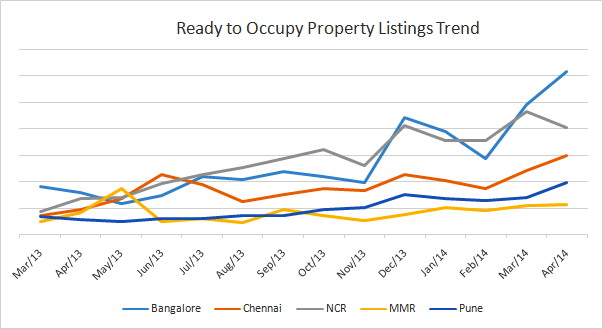
    Figure 1

    Source: CommonFloor.com Listing Data


    Ready-to-occupy property market

    According to data, there has been a decent rise in the number of ready-to-occupy property listings over the last one year across cities. Figure 1 indicates that while most cities saw a significant increase in the number of ready-to-occupy property listings, MMR and Chennai regions were seen to be more or less stagnant. This could be attributed to various reasons.


    In MMR – Mumbai, Thane and Navi Mumbai – property prices have become unaffordable for many. Property buyers were hoping for some price corrections but no significant change was seen with exceptions of minor corrections (within 5 per cent) in certain localities. Hence, buyers preferred to wait and watch. Developers, on the other hand, are reluctant to offer any discount on account of increased input cost and high capital cost due to high interest rates. As a result, property prices have reached their peak and sales have been stagnant.


    In Chennai, too, the ready-to-occupy property listings remained stagnant over the year. The overall economic environment could be one of the major reasons for this. However, real estate activity is expected to pick up over the next few months.


    Bengaluru saw a significant increase in the number of ready-to-occupy property listings. Q1-2014 witnessed an increase of almost 35 per cent in ready-to-occupy listings as compared to previous quarter (Q3-2013). This is primarily because most of projects have completed resulting in ample supply. The trend shows that there is an increasing interest for ready-to-occupy property as against under construction. There have been inordinate delays in several under construction properties due to multiple reasons and buyers, in turn, have to suffer. Hence, they prefer to opt for properties where they can instantly move in.


    Surprisingly, NCR has seen about 19 percent increase in Q1-2014 as compared to Q3-2013. This increase can be seen particularly because the investors are seen to exit the market and they released their inventories. They are also offering discounts in the tune of 15-25 per cent in order to lure the customers. According to CommonFloor data, several projects have completed over the last one year and there is ample ready-to-occupy supply available in the market. On the other hand, various under construction properties are being delayed on account of low sales resulting in fund crunch etc. Moreover ready-to-occupy properties offer various benefits such as –


    :: Tax benefits such as no service tax

    :: Immediate rental income or saving of rent, and

    :: Less risk of interest-burden when construction is delayed.


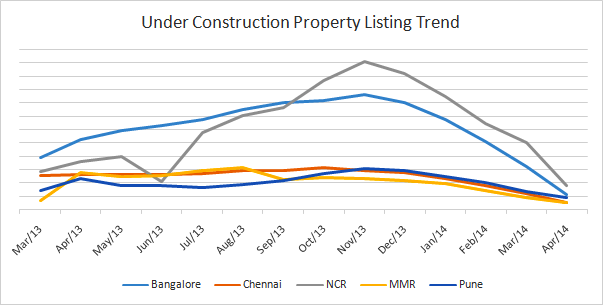
    Figure 2

    Source: CommonFloor.com Listing Data


    Under-construction property market

    Figure 2 clearly shows the declining trend of under construction property listings. This can be attributed to various reasons. According to CommonFloor quarterly report – Q4 2013, the overall new launches of projects in top seven cities including NCR, Bangalore, Chennai, Pune, Hyderabad, MMR and Kolkata declined by 18 per cent as against the same quarter in 2012. Grim economic scenario coupled with rising interest rates, high inflation and depreciating rupee resulted in low buyer sentiment and hence decline in launches.


    Moreover, CommonFloor survey conducted earlier on post-election expectations confirmed the fact that a stable government with new reforms in the sector would give a major fillip to the real estate industry. The survey also strengthened the fact that buyers, in the current scenario, preferred to opt for ready-to-occupy property as against under constructed.


    As per CommonFloor Listings data, there was a significant decline in the number of listings for under construction properties in Q1 2014 as compared to Q4 2013. Chennai witnessed maximum decline of about 40 per cent followed by MMR which saw a decline of 37 per cent, Bengaluru by 35 per cent, Pune by 32 per cent and NCR by 26 per cent. This decline clearly highlights the growing preference of property buyers. Demand is now tilted towards ready-to-occupy properties as investors are taking a back seat and now the realty sector is being driven largely by the end-usersin most metros.


    However, the debate on ready-to-occupy vs under construction properties is a never-ending one and will seldom find a concrete conclusion. Sheer attractiveness in terms of monetary benefits might attract denizens for under-construction property. But the bottom line is that one should carefully analyse the pros and cons of both and accordingly base his/her decision. For immediate requirement, it makes sense to opt for ready-to-move in properties. On the other hand, if one is looking for higher returns and has high risk-taking appetite then he may opt for under-construction properties. But, unlike earlier, new trends are emerging that are all set to shape the future of the Indian real estate market.


    Coordinated by Shobhana Nair


  • Realty Check | Day 6 | Aditya Verma: Paradigm shift from unorganized to organized retail scenario

    By Aditya Verma
    CEO, Makaan.com


    The Indian real estate sector is one of the fastest growing real estate market in the world. Real Estate is a driving force of the Indian economy which the Indian government also realizes, thus, it has introduced several friendly reforms to boost the overall sentiment of the industry.


    Over the past few years, private participation from real estate developers has changed the face of India by developing the state of the art infrastructure. Today, India houses some of the most beautiful architectural marvels in residential, commercial and retail spaces. The development has not been confined to metro cities, as developers have come up with architectural masterpieces in the Tier II and Tier III cities as well. Another interesting aspect is the expanding borders of most Indian cities like Delhi, Mumbai, Bengaluru, Kolkata, Pune, Hyderabad and Chennai. All these cities have expanded in size to accommodate development activities.


    Due to improved infrastructure and facilities, most Indian cities have seen a steady property price appreciation. Although, there has been a slight consolidation in the recent past, prices have increased handsomely over the past decade and in future too the real estate market is set to deliver returns higher than any other asset class in the country.


    Many households now enjoy double income benefits, people have more disposable income and they prefer to buy their own property rather than living on rent. This change in attitude has led to increase in demand in the residential housing segment. The real estate market is also witnessing a decent demand for commercial development due to a paradigm shift from unorganized retail towards organized retail scenario. Several MNCs are looking to invest in commercial areas in India to establish their offices here.


    The real estate sector is faced by some issues like liquidity crunch, unsold inventories, labour problems, etc that have capped its growth in the recent past. The new government has announced some friendly reforms like incentive for affordable housing, developing 100 smart cities, speeding up the road development projects, increase in the income tax exemption on repayment of interest on home loan from Rs 1.5 to 2 lakh and increase in IT exemption limit from Rs 2 to 2.5 lakh that has started a sentiment revival for the sector. With continued growth driven strategies and activities coupled with due attention and support from the government will help the real estate of India to skyrocket.


    Coordinated by Shobhana Nair