Category: RESEARCH

  • IRS Q2 2011 – East

    From Stratagem Media

    Market :WB

    Publications

    IRS 2011 Q2

    IRS 2011 Q1

    % growth in IRS 11 Q2 over 11 Q1

    IRS 2010 Q2

    % growth in IRS 11 Q2 over 10 Q2

    Est. Individuals (000s)

    71839

    71478

    0.5

    70400

    2.0

    Ananda Bazar Patrika

    5992

    6048

    -0.9

    6466

    -7.3

    Bartaman

    2963

    2926

    1.3

    2811

    5.4

    The Telegraph

    1039

    1035

    0.4

    1027

    1.2

    Sangbad Pratidin

    958

    1004

    -4.6

    1103

    -13.1

    Ganashakti

    790

    761

    3.8

    960

    -17.7

    Aajkaal

    628

    651

    -3.5

    785

    -20.0

    The Times Of India

    600

    630

    -4.8

    642

    -6.5

    Uttar Banga Sambad

    516

    512

    0.8

    495

    4.2

    Sanmarg

    480

    502

    -4.4

    505

    -5.0

    Sambad (Ben)

    185

    221

    -16.3

    292

    -36.6

    Market :Assam

    Publications

    IRS 2011 Q2

    IRS 2011 Q1

    % growth in IRS 11 Q2 over 11 Q1

    IRS 2010 Q2

    % growth in IRS 11 Q2 over 10 Q2

    Est. Individuals (000s)

    22626

    22511

    0.5

    22169

    2.1

     Asomiya Pratidin

    1120

    1152

    -2.8

    1177

    -4.8

     Asomiya Khabar

    324

    347

    -6.6

    395

    -18.0

     Assam Tribune

    265

    252

    5.2

    241

    10.0

    Dainik Agradoot

    216

    210

    2.9

    289

    -25.3

     Dainik Janambhumi

    169

    199

    -15.1

    181

    -6.6

     Amar Asom

    153

    192

    -20.3

    218

    -29.8

    Dainik Jugasankha

    150

    171

    -12.3

    #VALUE!

     Dainik Assam

    75

    89

    -15.7

    133

    -43.6

     Ajir Asom

    69

    78

    -11.5

    #VALUE!

     The Telegraph

    49

    65

    -24.6

    89

    -44.9

    Market :Orissa

    Publications

    IRS 2011 Q2

    IRS 2011 Q1

    % growth in IRS 11 Q2 over 11 Q1

    IRS 2010 Q2

    % growth in IRS 11 Q2 over 10 Q2

    Est. Individuals (000s)

    32302

    32153

    0.5

    31698

    1.9

    Sambad (Ori)

    1504

    1581

    -4.9

    1606

    -6.4

    Dharitri

    1455

    1442

    0.9

    1322

    10.1

    Samaj

    1378

    1396

    -1.3

    1497

    -7.9

    The Samaya

    185

    215

    -14.0

    341

    -45.7

     The Times Of India

    161

    174

    -7.5

    191

    -15.7

     The New Indian Express

    87

    101

    -13.9

    124

    -29.8

    Dainik Jagran

    31

    37

    -16.2

    41

    -24.4

    Nava Bharat (Mah/Chh)

    30

    22

    36.4

    20

    50.0

     The Hindu

    21

    23

    -8.7

    34

    -38.2

     The Telegraph

    19

    15

    26.7

    16

    18.8


    Information courtesy:

  • IRS Q2 2011 Maharashtra & Gujarat

    From Stratagem Media

    Market :MH

    Publications

    IRS 2011 Q2

    IRS 2011 Q1

    % growth in IRS 11 Q2 over 11 Q1

    IRS 2010 Q2

    % growth in IRS 11 Q2 over 10 Q2

    Est. Individuals (000s)

    91548

    91137

    0.5

    89580

    2.2

     Lokmat

    7426

    7305

    1.7

    7396

    0.4

     Daily Sakal

    4399

    4511

    -2.5

    4107

    7.1

     Pudhari

    2511

    2589

    -3.0

    2514

    -0.1

     The Times Of India

    2012

    2050

    -1.9

    1918

    4.9

     Punya Nagari

    1716

    1810

    -5.2

    2182

    -21.4

     Maharashtra Times

    1140

    1148

    -0.7

    1150

    -0.9

     Loksatta

    975

    984

    -0.9

    1082

    -9.9

     Deshonatti

    835

    744

    12.2

    1006

    -17.0

    Gujarat Samachar

    776

    828

    -6.3

    711

    9.1

     Mumbai Mirror

    758

    780

    -2.8

    786

    -3.6

    Market :Gujarat

    Publications

    IRS 2011 Q2

    IRS 2011 Q1

    % growth in IRS 11 Q2 over 11 Q1

    IRS 2010 Q2

    % growth in IRS 11 Q2 over 10 Q2

    Est. Individuals (000s)

    46903

    46622

    2.4

    Gujarat Samachar

    4444

    4449

    -0.1

    4506

    -1.4

    Divya Bhaskar

    3536

    3534

    0.1

    3366

    5.1

    Sandesh

    3329

    3232

    3.0

    3127

    6.5

     The Times Of India

    335

    327

    2.4

    232

    44.4

    Saurashtra Samachar

    230

    231

    -0.4

    334

    -31.1

    Gujarat Mitra & Darpan

    176

    170

    3.5

    186

    -5.4

    Kutch Mitra

    114

    121

    -5.8

    101

    12.9

    Jai Hind

    85

    Rajasthan Patrika

    57

    71

    -19.7

    31

    83.9

    Phulchhab Daily

    54


    Information courtesy:


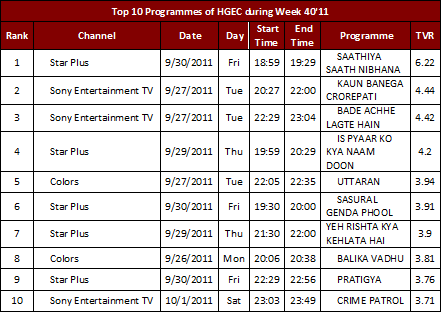
  • TAM data Top 10 programmes on HGEC – Wk 40’11

    Source: TAM Peoplemeter System

    TG: CS 4+ yrs

    Market: HSM

    Period: Wk 40: Sep 25 to Oct 1, 2011

    About TAM Media Research


    TAM is a joint venture between Nielsen Company & Kantar Media Research. Besides measuring TV Viewership, TAM also monitors Advertising Expenditure of Television, Print & Radio through its division AdEx India. Since 2004, it extended its presence in the PR Measurement & Analysis space for Corporate/Marketing Clients by setting up a separate division Eikona PR Measurement.


    In 2007, the joint venture introduced RAM (Radio Audio Measurement) service to track Radio Listenership for the Indian Radio Broadcast Industry. In year 2009, TAM launched a division, called TAM Sports that specializes in monitoring Sports Sponsorship ROI.


    TAM Media Research’s objective is to fuel media insights that will drive the growth of the Indian Media Industry.


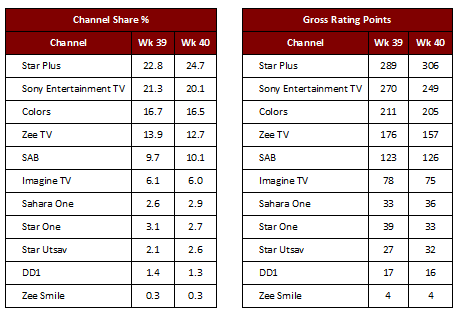
  • GRP & Channel shares of HGECs- Wk 40 2011

    Source: TAM Peoplemeter System

    TG: CS 4+ yrs

    Market: HSM

    Period: Wk 39: Sep 18 to 24, 2011

    Period: Wk 40: Sep 25 to Oct 1, 2011

    About TAM Media Research

    TAM is a joint venture between Nielsen Company & Kantar Media Research. Besides measuring TV Viewership, TAM also monitors Advertising Expenditure of Television, Print & Radio through its division AdEx India. Since 2004, it extended its presence in the PR Measurement & Analysis space for Corporate/Marketing Clients by setting up a separate division Eikona PR Measurement.

    In 2007, the joint venture introduced RAM (Radio Audio Measurement) service to track Radio Listenership for the Indian Radio Broadcast Industry. In year 2009, TAM launched a division, called TAM Sports that specializes in monitoring Sports Sponsorship ROI.

    TAM Media Research’s objective is to fuel media insights that will drive the growth of the Indian Media Industry.

  • IRS Q2 2011 8 Metros

    From Stratagem Media


    Greater Mumbai

    Publications

    IRS 2011 Q2

    IRS 2011 Q1

    % growth in IRS 11 Q2 over 11 Q1

    IRS 2010 Q2

    % growth in IRS 11 Q2 over 10 Q2

    Est. Individuals (000s)

    16979

    16861

    0.7

    16509

    2.8

     The Times Of India

    1588

    1605

    -1.1

    1478

    7.4

    Maharashtra Times

    965

    1020

    -5.4

    971

    -0.6

     Mumbai Mirror

    749

    769

    -2.6

    768

    -2.5

    Gujarat Samachar

    745

    796

    -6.4

    665

    12.0

     Hindustan Times

    716

    688

    4.1

    563

    27.2

     DNA

    653

    644

    1.4

    606

    7.8

    Loksatta

    610

    652

    -6.4

    653

    -6.6

    Lokmat

    532

    560

    -5.0

    637

    -16.5

     Navbharat Times

    490

    491

    -0.2

    485

    1.0

    Navakal

    470

    508

    -7.5

    594

    -20.9

    Delhi

    Publications

    IRS 2011 Q2

    IRS 2011 Q1

    % growth in IRS 11 Q2 over 11 Q1

    IRS 2010 Q2

    % growth in IRS 11 Q2 over 10 Q2

    Est. Individuals (000s)

    15022

    14974

    0.3

    14609

    2.8

     Hindustan Times

    1948

    1954

    -0.3

    1961

    -0.7

     The Times Of India

    1910

    1890

    1.1

    1885

    1.3

     Navbharat Times

    1900

    1853

    2.5

    1724

    10.2

     Hindustan

    1124

    1132

    -0.7

    1160

    -3.1

     Punjab Kesari

    744

    760

    -2.1

    745

    -0.1

     Dainik Jagran

    666

    680

    -2.1

    662

    0.6

     Mail Today

    209

    221

    -5.4

    203

    3.0

     The Economic Times

    192

    185

    3.8

    186

    3.2

    Nai Dunia

    126

    120

    5.0

    58

    117.2

    The Hindu

    113

    115

    -1.7

    102

    10.8

    Bangalore

    Publications

    IRS 2011 Q2

    IRS 2011 Q1

    % growth in IRS 11 Q2 over 11 Q1

    IRS 2010 Q2

    % growth in IRS 11 Q2 over 10 Q2

    Est. Individuals (000s)

    6214

    6163

    0.8

    6011

    3.4

    Vijay Karnataka

    717

    719

    -0.3

    671

    6.9

    Prajavani

    659

    670

    -1.6

    610

    8.0

     The Times Of India

    442

    415

    6.5

    330

    33.9

     Deccan Herald

    201

    200

    0.5

    164

    22.6

     Bangalore Mirror

    156

    143

    9.1

    62

    151.6

    Kannada Prabha

    125

    139

    -10.1

    157

    -20.4

    Udayavani

    118

    112

    5.4

    97

    21.6

     Daily Thanthi

    88

    86

    2.3

    69

    27.5

     Deccan Chronicle

    81

    87

    -6.9

    101

    -19.8

     DNA

    77

    68

    13.2

    117

    -34.2

    Hyderabad

    Publications

    IRS 2011 Q2

    IRS 2011 Q1

    % growth in IRS 11 Q2 over 11 Q1

    IRS 2010 Q2

    % growth in IRS 11 Q2 over 10 Q2

    Est. Individuals (000s)

    5909

    5863

    0.8

    5726

    3.2

     Eenadu

    896

    838

    6.9

    926

    -3.2

     Sakshi

    635

    625

    1.6

    650

    -2.3

     Deccan Chronicle

    491

    473

    3.8

    530

    -7.4

     Andhra Jyothi

    128

    113

    13.3

    143

    -10.5

     The Times Of India

    125

    109

    14.7

    137

    -8.8

     The Hindu

    90

    87

    3.4

    106

    -15.1

     Siasat

    50

    49

    2.0

    60

    -16.7

     Vartha

    49

    46

    6.5

    110

    -55.5

     The Munsif

    42

    47

    -10.6

    47

    -10.6

     The Economic Times

    20

    19

    5.3

    22

    -9.1

    Chennai

    Publications

    IRS 2011 Q2

    IRS 2011 Q1

    % growth in IRS 11 Q2 over 11 Q1

    IRS 2010 Q2

    % growth in IRS 11 Q2 over 10 Q2

    Est. Individuals (000s)

    6795

    6758

    0.5

    6663

    2.0

     Daily Thanthi

    1229

    1181

    4.1

    1133

    8.5

     Dinakaran

    700

    700

    0.0

    609

    14.9

     The Hindu

    498

    508

    -2.0

    544

    -8.5

     Dinamalar

    230

    233

    -1.3

    270

    -14.8

     The Times Of India

    200

    183

    9.3

    200

    0.0

     Deccan Chronicle

    138

    127

    8.7

    145

    -4.8

     Dinamani

    53

    48

    10.4

    56

    -5.4

     Malai Malar

    47

    37

    27.0

    50

    -6.0

     The New Indian Express

    28

    20

    40.0

    21

    33.3

    Malayala Manorama (Daily)

    13

    14

    -7.1

    17

    -23.5

    Pune

    Publications

    IRS 2011 Q2

    IRS 2011 Q1

    % growth in IRS 11 Q2 over 11 Q1

    IRS 2010 Q2

    % growth in IRS 11 Q2 over 10 Q2

    Est. Individuals (000s)

    4396

    4349

    1.1

    4211

    4.4

    Daily Sakal

    1070

    1096

    -2.4

    970

    10.3

    Lokmat

    692

    709

    -2.4

    658

    5.2

    Pudhari

    464

    476

    -2.5

    327

    41.9

     The Times Of India

    190

    196

    -3.1

    204

    -6.9

    Maharashtra Times

    96

    41

    134.1

    13

    638.5

    Prabhat

    89

    71

    25.4

    64

    39.1

    Loksatta

    71

    62

    14.5

    77

    -7.8

    Punya Nagari

    32

    40

    -20.0

    47

    -31.9

     Aaj Ka Anand

    31

    #VALUE!

    Saamana

    31

    35

    -11.4

    36

    -13.9

    Ahmedabad

    Publications

    IRS 2011 Q2

    IRS 2011 Q1

    % growth in IRS 11 Q2 over 11 Q1

    IRS 2010 Q2

    % growth in IRS 11 Q2 over 10 Q2

    Est. Individuals (000s)

    4673

    4639

    0.7

    4538

    3.0

    Divya Bhaskar

    1083

    1084

    -0.1

    1017

    6.5

    Gujarat Samachar

    858

    843

    1.8

    835

    2.8

    Sandesh

    454

    472

    -3.8

    490

    -7.3

     The Times Of India

    124

    124

    0.0

    86

    44.2

     Ahmedabad Mirror

    37

    37

    0.0

    28

    32.1

     DNA

    19

    20

    -5.0

    29

    -34.5

     Rajasthan Patrika

    19

    22

    -13.6

    14

    35.7

     The Economic Times

    15

    16

    -6.3

    10

    50.0

     The Indian Express

    5

    6

    -16.7

    3

    66.7

    Kolkata

    Publications

    IRS 2011 Q2

    IRS 2011 Q1

    % growth in IRS 11 Q2 over 11 Q1

    IRS 2010 Q2

    % growth in IRS 11 Q2 over 10 Q2

    Est. Individuals (000s)

    13129

    13064

    0.5

    12872

    2.0

    Ananda Bazar Patrika

    2699

    2717

    -0.7

    2807

    -3.8

    Bartaman

    1083

    1103

    -1.8

    1002

    8.1

     The Telegraph

    913

    907

    0.7

    883

    3.4

     The Times Of India

    535

    552

    -3.1

    559

    -4.3

     Sanmarg

    442

    468

    -5.6

    470

    -6.0

    Aajkaal

    294

    324

    -9.3

    367

    -19.9

    Sangbad Pratidin

    274

    290

    -5.5

    250

    9.6

    Ganashakti

    219

    222

    -1.4

    274

    -20.1

     The Statesman

    137

    149

    -8.1

    129

    6.2

     Prabhat Khabar

    70

    66

    6.1

    77

    -9.1

    Information courtesy:


  • TV companies can get on board this research bus

    By A Correspondent

    Ormax Media has launched a research omnibus for production houses making fiction and non-fiction shows on television. The product, called Television Omnibus, will address the consumer research needs of production houses in a cost-effective manner.

    Mr Shailesh Kapoor, CEO, Ormax Media said, Today, many production houses are research-savvy. They have the ability to appreciate consumer feedback on their programmes, as well as act upon it. However, unlike broadcasters, production houses may not be able to afford ongoing large-scale consumer research for all their properties. Television Omnibus is a product that will address their needs in a timely and cost-effective manner.

    Research under Television Omnibus will be conducted across the country using focus group discussions and depth interviews. While several production houses will subscribe to the product, each will have access to the findings of only their programmes. Additionally, production houses can also use Television Omnibus to test new programme concepts, as well as understand consumer trends such as weekend programming, mythological shows, youth channels, emerging trends, etc.

    Mr Kapoor added, Television Omnibus will help production houses pre-empt any drop in ratings of their programmes, by being in constant touch with their consumers. Three production houses have already signed up with us, and we expect another three to four to be on board in the next two months.

    Ormax Media, India’s first research and consulting firm specializing in the media and entertainment industry, works with broadcasters, film producers, radio networks, print publications, media agencies, DTH service providers, etc in the areas of qualitative research, quantitative research and consulting.


  • IRS 2011: Metro watch and State watch

    By Ritu Midha

    This article is an attempt at a quick observation of  combined readership of eight metros: Mumbai, Delhi, Kolkata, Chennai, Bangalore, Ahmedabad, Pune and Hyderabad.  The combined data indicates a fall in readership for three publications: Anand Bazar Patrika, Hindustan and Lokmat over Q2, 2010.  All other publications except Daily Thanthi show a single digit growth. Daiy Thanthi shows a sturdy growth of 10 percent.

    If we look at eight metros – The Times of India emerges as the market leader – however, if we look at each metro in isolation, The Times of India leads only in Greater Mumbai. Publications presence in all metros, and that too in the top five, helps it in maintaining leadership position.

    Ananda Bazar Patrika, the number two publication in 8 metros, interestingly, is present in top 10 dailies only in Kolkata – where it is top of the pack.

    Hindustan Times, the number three daily in eight metros leads in Delhi and is number five in Mumbai. It is not in top 10 in the other six metros.

    Navbharat Times, the number four daily is at number three in Delhi and Number nine in Mumbai – it is not there in the top ten in rest of the metros

    Gujarat Samachar is at number five in eight metros  – it is at number two in Ahmedabad and number four in Gujarat. It, too has no presence in top 10 list of any other metro.

    Daily Thanthi leads in Chennai, and is at number eight in Bangalore – and this brings it at number 6 position in eight metros.

    Lokmat at number 8 in Mumbai, is at number 2 in Pune, and occupies number 7 slot in top 10 dailies in eight metros

    Daily Sakal leads in Pune with a big margin, and by its virtue sits on number eight slot in eight metros

    Hindustan Number 4 paper in Delhi is at number 9 in eight metros

    DIvya Bhaskar, the market leader in Ahmedabad completes the top 10 list


    DNA, in the top 10 in Mumbai, Bangalore and Ahmedabad does not find a place in top 10 eight metros.


    Mumbai: In terms of percentage growth – Hindustan Times show the sturdiest growth – a 27.2 percent jump vis-a-vis same quarter previous year. Interestingly all the Marathi publications show a negative growth, while all the English dailies grow positively. However, when compared with previous quarter seven publications show a negative growth.  Top three publications in the city are from The Times of India stable.


    If we look at Mumbai vs Maharashtra – readership patterns are quite different – Punya Nagri, Pudhari and Daily Sakal – among the top 10 in Maharashtra are not there in Mumbai. In its place are DNA, Navakal and Navbharat Times. While in Mumbai, three of the top five dailies are English. One is Gujarati and the other Hindi, in Maharashtra the picture is very different with  The Times of India being the only English daily in top five – and the other four being Marathi publications.


    Delhi: The gap between the market leader Hindustan Times and the Challenger The Times of India narrows as Hindustan Times sees a marginal fall of 0.7 percent, while The Times of India grows by 1.3 percent from Quarter 2, 2010. Nai Duniya needs a special mention as it has grown by 117 percent, though on a small base. Navbharat Times has also shown a double digit growth – some of it, perhaps at the expense of Hindustan, which has gone down by 3 percent.


    Bangalore: The top five publications have shown a positive growth. On the percentage basis growth over quarter 2, 2010, by English Dailies The Times of India (33.9 percent), Deccan Herald (22.6 percent) and Bangalore Mirror (151.6 percent)is much higher than the language counterparts.


    Bangalore and Karnataka top 10 have seven common publications – and the top two remain the same. However, three publications in Bangalore (two of which are English dailies) : Daily Thanthi, Deccan Chrocle and DNA are missing in Karnataka, and in their place are Samyukta Karnatak,  Sanjavani and Tarun Bharat.


    Hyderabad: Hyderabad is the only metro, where all the top dailies have shown a negative growth over the same quarter previous year. Interestingly, on Q on Q basis Daily Munsif is the only daily showing a negative growth, all the other publications show positive growth there, though not enough to cover the shortfall witnessed earlier.


    Andhra Bhoomi and Andhra Prabha are the two publications in the top 10 list of Andhra Pradesh, which are missing in the top 10 of Hyderabad. In their place are The Munsif and The Economic Times


    Chennai :  Six dailies show negative growth, three positive while one remains unchanged. Daily Thanthi, the market leader shows a healthy growth of 8.5 percent and is ahead of number two Dinakaran with a big margin.


    Chennai and Tamilnadu share the top nine dailies – though not necessarily in the same order. There is a change on the tenth position where Malayala Manorama is present in Chennai, while for Tamil Nadu it is, Tamizh Murasu.


    Pune: In Pune market leader Daily Sakal is ahead of its closest competitor Lokmat by a margin of 40 percent – it shows a 10 percent growth vis-a-vis Q2 previous year.  Most noteworthy growth is recorded by Maharashtra Times at a whopping 638.5 percent.


    Pune and Maharshtra, meanwhile have seven publications in common. Three in Maharashtra which are missing in Pune are Deshonatti, Gujarat Samachar and Mumbai Mirror. In its place Pune has Prabhat ka Anand and Samna.


    Ahmedabad: In Ahmedabad, all the English Dailies except DNA show robust growth over Q2, 2010– The Times of India grows by 44.2 percent, Ahmedabad Mirror by 32.1 percent, The Economic Times by 50 percent, and The Indian Express by 66.7 percent. Market leader Divya Bhaskar grows by 6.5 percent and is ahead of Gujarat Samachar by close to 20 percent.

    In Ahmedabad and Gujarat, the top four publications remain same, with Divya Bhaskar and Gujarat Samachar interchanging top two slots.  However three English publications that find a place in Ahmedabad – DNA, The Economic Times and The Indian Express are missing in Gujarat. Only English publication in both Gujarat and Ahmedabad is The Times of India.


    Kolkata: Market leader Ananda Bazar Patrika shows negative growth of 3.8 percent over same quarter previous year. However, in spite of it, it continues to be ahead of Bartaman, the number two daily by more than 100 percent margin. Five Bengali dailies show a negative growth in this duration. Of the English dailies only The Times of India shows a negative growth – of 4.3 percent.

    Kolkata is highly representative of West Bengal as eight publications are same in the capital and the state. Interestingly, the top three are at the same rank. Only two changes are The Statesman and Prabhat Khabar in Kolkata which are replaced by Uttar Banga Sambad and Sambad in West Bengal


    State Watch: Dailies – IRS Q2, 2011

    Here is MXM’s quick observation of the remaining states:

    Rajasthan:  Dainik Bhaskar and Dainik Navjyoti show a healthy growth over Q2, 2010. In spite of 0.9 percent drop when compared quarter on quarter Rajasthan Patrika continues to be the leader, with Dainik Bhaskar close on its heels. Of English dailies Hindustan Times shows the largest percentage growth at 64.1 percent when compared with same quarter in 2010. Five publications show a negative growth over previous quarter. Q on Q, Daininik Navjyoti, Punjab Kesari and Hindustan Times show a healthy double digit growth.


    West Bengal: Moving eastwards, seven of the top ten publications show negative growth over the same quarter previous year. Of these seven Ganashakti is the only one which shows a positive growth over  the previous quarter.  In spite of a 7.3 percent drop in readership over the same quarter previous year, Ananda Bazar Patrika continues to be the leader with a huge margin. Of the English dailies, The Telegraph shows a 1.2 percent growth and continues to be number three in the overall ranking for the state.

    Assam: Only Assam Tribune of 10 leading publications show a positive growth, over the same quarter previous year.  Both the new publications Dainik Jugasankha and Ajir Asom– surveyed from IRS Q1, 2011 also show a negative growth Q on Q.  Asomiya Pratidin, in spite of showing negative growth in both quarters continues to be the market leader with more than three times the size of number two publication Asomiya Khabar.

    Orissa: Unlike other states in East and North East, four English publications find place in the top ten – however The Telegraph is the only English publication to show a positive growth over the same quarter previous year – though on a small reader base. Seven out of 10 leading publications show a negative growth both Q on Q, and over the  same quarter previous year – and fall in numbers is quite substantial in case of Orissa. Sambad, the leader, shows a drop of 6.4 percent as compared to Q2, 2010. Meanwhile, number two, Dhaitri has shown a 10.1 percent growth in the same duration – closing the gap with the number One publication.

    Andhra Pradesh: Moving down South, in Andhra Pradesh, eight out of 10 publications show a down turn over the same quarter previous year.  Sakshi and Andhra Bhoomi are the only two publications to show a positive growth. Market leader Eenadu shows a drop of 2.3 percent over the same quarter previous year. Sakshi, the number two clocks a growth of 9 percent in the same duration – reducing the gap with the market leader.

    Tamil Nadu: Tamil Nadu emerges as an interesting market from a media watcher’s perspective. While six publications show a negative growth over the same quarter previous year, when it comes to quarter on quarter numbers, The Hindu is the only publication to show a negative growth. Daily Thanthi, in spite of a drop of 2.3 percent over the same quarter previous year continues to lead the pack with a massive margin.

    Kerala: Biggest blow in Kerala comes for The Hindu, which shows a percentage drop of 67.8 percent, over the same quarter previous year. Malayala Manorama with a positive growth continues to be the market leader. Five publications show a negative growth over the same quarter previous year.

    Karnataka: Karntaka emerges as the market with most positive growth figures. Nine of the 10 dailies show a positive growth over the same quarter previous year. Only publication to show negative growth is Tarun Bharat with a 36.1 percent fall in readership in this time duration. However, when compared Q on Q, the number of publications with fall in readership goes up to five. Viay Karnataka with a growth of 5.2 percent over the Q2, 2010 continues to be the market leader – however number two daily Prajavani grows at a much faster pace of 31.3 percent and closes the gap with the market leader.

  • Claims and counter-claims start after IRS 2011Q2 release


    By A Correspondent

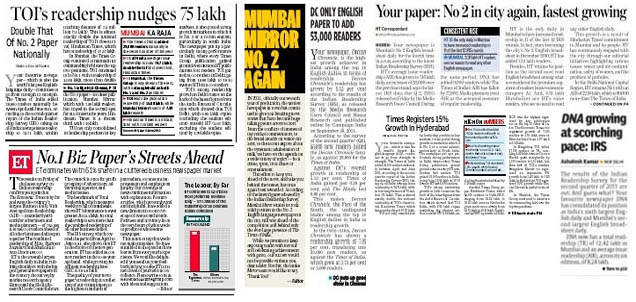
    The claims and counter-claims have begun. In Mumbai, Mumbai Mirror said it’s No 2 again. So did Hindustan Times. Both weren’t incorrect: Mirror may have the second-largest readership, next only to The Times of India, but Hindustan Times is the second-most read broadsheet English daily. DNA’s report too says it’s the second-largest broadsheet daily.

    Sadly, the conferences which the Market Research Users Council and Hansa Research Group would conduct to release every round of the Indian Readership Survey have been done away with. The detailed dump is curiously no longer handed out to the trade media.

    Consequently, what the MRUC and Hansa expect the trade media to do is to either carry unverified claims of various media entities. Or depend on friendly publications and agencies to give out data.

    MxMIndia.com requested veteran media consultant Sundeep Nagpal and his firm Stratagem Media to dig a little deeper and help us come up with a variety of insights given IRS 2011 Q2 data.

    For instance: the DNA report quotes a total readership (TR) figure for itself which most media agencies do not recognise. Media agencies and MxMIndia recognise Average Issue Readers (AIR) as currency. Interestingly,  when you look at the numbers for Greater Mumbai, while DNA is a distant third amongst English language broadsheets vis-a-vis The Times of India, it’s difference with #2 English broadsheet Hindustan Times is just 63,000. For HT of course the growth story in Greater Mumbai is tremendous: 27.2% year-on-year and 4.1% in the second quarter.

    We asked Strategem for the following:

    1. Given the toplines mailed to us by IRS, could we analyse it vis-a-vis the Q1 data for 2011 as well as the Q2 data for 2010 so that we can do a year-on-year analyses?

    2. Can we also similary analyse the data region-wise – Hindi belt and North, West, South and East and North East?

    3. Can we look at the numbers for the 8 metros combined and separately?


    Stratagem has provided us this data, and we present these to you as follows:


    First, take a look at the table withe the Top 10 publications across the country – urban and rural India.


    Publications

    IRS 2011 Q2

    IRS 2011 Q1

    % growth in IRS 11 Q2 over 11 Q1

    IRS 2010 Q2

    % growth in IRS 11 Q2 over 10 Q2

    Est. Individuals (000s)

    889070

    885122

    0.4

    871443

    2.0

    Dainik Jagran

    16393

    15910

    3.0

    15925

    2.9

    Dainik Bhaskar

    14174

    14016

    1.1

    13303

    6.5

    Hindustan

    11985

    11810

    1.5

    10143

    18.2

     Malayala Manorama (Daily)

    9962

    9938

    0.2

    9841

    1.2

    Amar Ujala

    8891

    8747

    1.6

    8417

    5.6

     Lokmat

    7595

    7486

    1.5

    7402

    2.6

     The Times Of India

    7471

    7442

    0.4

    7088

    5.4

     Daily Thanthi

    7290

    7187

    1.4

    7402

    -1.5

    Rajasthan Patrika

    6941

    7033

    -1.3

    6900

    0.6

     Mathrubhumi

    6690

    6800

    -1.6

    6566

    1.9


    Let’s also look at the combined numbers for the eight metros of Mumbai, Delhi, Kolkata, Chennai, Bengaluru, Hyderabad, Pune and Ahmedabad.


    Combined 8 metros-Mum,Kol,Ahm,Bang,Pune,Chen,Del,Hyd

    Publications

    IRS 2011 Q2

    IRS 2011 Q1

    % growth in IRS 11 Q2 over 11 Q1

    IRS 2010 Q2

    % growth in IRS 11 Q2 over 10 Q2

    Est. Individuals (000s)

    73117

    72672

    0.6

    71138

    2.8

     The Times Of India

    5114

    5073

    0.8

    4879

    4.8

     Ananda Bazar Patrika

    2708

    2725

    -0.6

    2821

    -4.0

     Hindustan Times

    2690

    2675

    0.6

    2566

    4.8

     Navbharat Times

    2392

    2349

    1.8

    2216

    7.9

     Gujarat Samachar

    1606

    1641

    -2.1

    1503

    6.9

     Daily Thanthi

    1365

    1319

    3.5

    1233

    10.7

     Lokmat

    1224

    1268

    -3.5

    1295

    -5.5

     Daily Sakal

    1175

    1213

    -3.1

    1089

    7.9

     Hindustan

    1128

    1142

    -1.2

    1167

    -3.3

     Divya Bhaskar

    1124

    1129

    -0.4

    1039

    8.2


    The growth story is undoubtedly that of Hindustan which has grown 18.2 percent over the second quarter of 2010, though the growth in the second quarter of this year has now steadied at 1.5 percent. But the winner of the quarter from the toplines of 2011Q2 for across the country is undoubtedly Dainik Jagran with a 3% growth. On a base of 1.59 crore this is big.  The other stories of the big players is also noteworthy. Bhaskar 6.5% y-o-y, Amar Ujala 5.6% y-o-y and The Times of India too at 5.4% y-o-y. Jagran’s y-o-y is 2.9% and Lokmat has grown 2.6 percent over 2010 Q2.
    We urge you to click on the links below (these will come up later in the day) for detailed numbers.It is important to note that the numbers thrown up in the above table are not truly indicative of the power of the various publications. Remember, these ratings are only for metros, and the picture is dramatically different for an ABP in West Bengal, and Gujarat Samachar in Gujarat or Thanthi in TN and Sakal and Lokmat in Maharashtra. Ditto with Hindustan and Bhaskar.

    Links:

    IRS Q2 2011 Hindi Belt & North


    IRS Q2 2011 – South


    IRS Q2 2011 – East


    IRS Q2 2011 Maharashtra & Gujarat

    Information courtesy:


  • Dainik Jagran is Publication #1 in IRS 2011Q2

    By A Correspondent

    The numbers from the latest round of the Indian Readership Survey are out as the Media Research Users Council and Hansa Research announced the findings of the second quarter of 2011.

    Top 10 Publications 

    (All figues in 000s)

    Publication Language Periodicity 2011 Q1 2011 Q2
    DainikJagran Hin D 15910 16393
    DainikBhaskar Hin D 14016 14174
    Hindustan Hin D 11810 11985
    MalayalaManorama Mal D 9938 9962
    AmarUjala Hin D 8747 8891
    Lokmat Mar D 7486 7595
    The Times Of India Eng D 7442 7471
    Daily Thanthi Tam D 7187 7290
    Rajasthan Patrika Hin D 7033 6941
    Mathrubhumi Mal D 6800 6690


    Top 10 Dailies

    (All figues in 000s)

    Publication Language Periodicity 2011 Q1 2011 Q2
    DainikJagran Hin D 15910 16393
    DainikBhaskar Hin D 14016 14174
    Hindustan Hin D 11810 11985
    MalayalaManorama Mal D 9938 9962
    AmarUjala Hin D 8747 8891
    Lokmat Mar D 7486 7595
    The Times Of India Eng D 7442 7471
    Daily Thanthi Tam D 7187 7290
    Rajasthan Patrika Hin D 7033 6941
    Mathrubhumi Mal D 6800 6690


    Top 10 Magazines

    (All figues in 000s)

    Publication Language Periodicity 2011 Q1 2011 Q2
    Vanitha Mal F 2653 2671
    PratiyogitaDarpan Hin M 2027 2154
    SarasSalil Hin F 1945 2039
    India Today Eng W 1650 1724
    MalayalaManorama Mal W 1413 1393
    Cricket Samrat Hin M 984 1213
    MeriSaheli Hin M 1100 1174
    India Today Hin W 1137 1144
    Kumudam Tam W 1066 1066
    Grehlakshmi Hin M 1031 1010

    There is no change in the rankings of the various publications among the Top 10 in terms of Average Issue Readership. The Top 3 slots are taken by Hindi dailies. Dainik Jagran rules with 16,393,000 followed by Dainik Bhaskar which is at 14,174,000. Hindustan is at #3 with 11,985,000. Malayala Manorama is at #4 at 9,96,2000 while Amar Ujala and Lokmat are in the fifth and sixth positions with an average issue readership of 8,891,000 and 7,595,000 resepectively. The Times of India, the only English newspaper in the Top 10, has an average readership of 7,471,000.

    The others in the Top 10 publications are: Daily Thanthi with 7,290,000, Rajasthan Patrika with 6,941,000 and Mathrubhumi at 6,690,000. The last two being the only publications in the Top 10 which have fallen in comparison to the first quarter numbers.

  • AC Nielsen Jr, father of TV ratings, passes away

    By A Correspondent


    As someone pointed out on his Facebook status, had it been any other day, he would have got more obit notice. One could say significant notice. For, Mr Arthur C Nielsen, Jr, who passed away on October 5 is indeed the father of television ratings.

    Here’s a press statement taken from the Nielsen site:

    October 5, 2011 — It is with great sadness that Nielsen learned of the passing of Arthur C. Nielsen, Jr.  ‘Art’ Nielsen was an early pioneer of the global information services industry, dedicating his life to investing in innovative ideas to understand and measure consumer purchasing and viewing behavior.

    During his tenure as President and Chairman of Nielsen, Art’s passion and tireless commitment to helping industries better serve consumers led to the creation of many innovations we all rely on today, including consumer and performance surveys, market share, department and food index, and television ratings to name a few.

    Throughout his life, Art was a strong supporter of the Chicago Food Bank, the Museum of Broadcast Communications in Chicago, the Arthur C. Nielsen, Jr. Campus of the North Shore Senior Center in Northfield, Gertrude B. Nielsen Child Care and Learning Center in Northfield, the A.C. Nielsen Center for Marketing Research at the University of Wisconsin, the Arthur C. Nielsen Jr. Research Professorship of Parkinson’s Disease and Movement at Northwestern University’s Feinberg School of Medicine, and the Nielsen USTA Pro Tennis Championship.

    Nielsen expresses its profound appreciation and gratitude for Art’s leadership and his legacy, which we proudly continue. The thoughts and prayers of our 34,000 associates in more than 100 global markets are with the Nielsen family at this time


    In India, other than its presence as The Nielsen Company, the television ratings research is conducted by TAM Media Research, a joint venture between Nielsen Company & Kantar Media Research.


    Picture: Nielsen.com

  • Engagement Study may solve magazines’ measurement blues

    By Akash Raha


    Advertisers and media agencies will have more options to choose from in the print industry, as the much-awaited Engagement Study is set to be released at the World Magazine Congress 2011 in New Delhi next month. Mr Pradeep Gupta, President, Association of Indian Magazines (AIM), confirmed this development with MxM India.

    The apex association of magazine publishers is delivering on its promise of the Engagement Study on time. Mr Mitrajit Bhattacharya, General Secretary, AIM informed MxM India that the research for the Engagement Study was conducted by Quantum and IMRB, whereas Quantemplate coordinated the project on behalf of AIM. The research methodology of the study was based on desk research by Quantemplate, qualitative survey (20 one-on-one interviews of 2.5 hours each) by Quantum preceded the large scale quantitative survey (Sample Size: 3600 +, across 10 centers) by IMRB.

    Commenting on the study’s efficacy for the industry, Mr Bhattacharya said, The magazine industry has never been represented well by the large readership surveys like IRS, which are largely designed to cater to the needs of the dailies. The data for magazines has been less robust and highly fluctuating. More so, these surveys do not attempt to cover qualitative dimensions like reader involvement, lower clutter levels leading to higher attention, recall or even the image building capability which are the strengths of the medium. The Engagement Study will be a highly credible tool for the advertising fraternity to understand the engagement of consumers with various media and to evaluate the level of engagement of magazines vis-vis other media. These insights will help the advertisers immensely in choosing a medium like magazines in absence of sound readership data.

    He further added, But let me clarify at this stage that this survey is not attempting to capture any data at an individual title level. It is a very robust survey with a huge sample size, both qualitative and quantitative, trying to address the issues of the magazine industry as a whole, well represented by all major genres and languages.


    The AIM had announced during IMC 2010 its plan to conduct the Engagement Study for magazines, which could act as an alternate source of data for advertisers, after advertisers and media agencies expressed their concerns over the measurement issue that has plagued the magazine industry for long. The study is expected to solve the problem of qualitative measurement that the print industry faces, especially in the magazine domain.

    We have great work available on this subject in countries like the US, UK etc. However, the complex nature of the magazine market like India, with so many titles in so many different languages, makes this survey a unique and challenging one, concluded Mr Bhattacharya.

    Studies have shown that magazines have a completely different level of engagement. Magazine reading is very immersive and concentrated, much more than other mediums. Hence, the study is expected to be a boost for the advertising industry, giving them more options and choices to advertise effectively and efficiently.


  • Luxury mkt grows 20% despite slowdown signs

    By A Correspondent


    The Indian luxury market grew at a healthy 20% during last year, reaching a size of $5.8 billion, despite signs of the reemergence of a global slowdown, says a CII-AT Kearney report on Indian Luxury.


    In 2009, the luxury market in India stood at $4.76 billion and is expected to grow to $14.7 billion by 2015, notwithstanding the infrastructure and regulatory constraints, says the study, which will be unveiled at the CII-ET Luxury summit in Delhi on Tuesday.


    Some segments of the market, of course, have seen runaway growth, compared to others. The jewellery segment, for example, has seen a growth of 30% in the last one year due to increasing prices of gold and diamond.


    The luxury electronics and car segments have seen a growth of above 35%, while fine dining has seen a whopping 40% growth in this period. All of these segments have seen higher growth than expected in the last one year. Apparel and accessories, watches and personal care have also seen robust growth, between 24-30%.


    The only two segments that lagged last year are realty and yachts . The rapid growth in luxury sales can be attributed to the fast growing affluence in the country.


    According to a global affluence study by research firm TNS, India has 3 million affluent households, defined as those with more than $100,000 (around Rs 50 lakh) of investable surplus. In a report released last month, Swiss wealth manager Julius Baer forecast that the wealth of HNIs in India, with assets of $1 million or more, would more than double to 4,03,000 by 2015.


    “Skepticism is being replaced by an increasing sense of buoyancy and promise in the future potential of the market. Consumers are accepting and adopting global trends much faster than anticipated,” says the report.


    Luxury players report that they are making money at the store level, which means that the model is proven and now it is a question of adding growth capital to gain scale.


    Source:The Economic Times

    Copyright © 2011, Bennett, Coleman & Co. Ltd. All Rights Reserved