Category: PR

  • #AAPHEW! | Amith Prabhu: Another election where Public Relations won

    By Amith Prabhu


    It is easy to do a post mortem of an event but rarely possible to accurately predict outcomes before the event. The Delhi election, counting to which took place yesterday, was more historic than the 2014 watershed general elections. It was historic because in 2014 the incumbent was written off and the challenger was going full-steam. Here, in 2015 the victorious Aam Aadmi Party was written off and rose like a phoenix. It was the original incumbent in Delhi which resigned after 49 days in power. The President’s Rule in Delhi gave the national government an opportunity to make an impact but they got most things right. I’m not even making a reference to the other grand old party of India because lesser said the better.


    What did BJP do wrong that led to a massive victory for AAP with a vote share of 54%. The list is long but let’s pick out the key factors:

    a) BJP ran a negative campaign both externally against the opponent and internally with long standing party members. There is no scope for negativity.


    b) BJP imported its CM candidate at the eleventh hour thus creating unrest in the party. There is no scope for haphazard parachuting.


    c) BJP’s leadership allowed the likes of Sakshi Maharaj to spew venom and other sister organisations ran a mindless campaign of reconversion and attack on places of worship. This is no more an option.


    d) The BJP-led government invited the US President not expecting that his final speech in India and his speech at the National Prayer Breakfast would be without mincing words. This definitely played a role in the minds of undecided voters.


    e) The famous million rupee personalised suit of the Prime Minister was the most ill-advised stunt from a man who has been following a playbook. The perception of being elitist was created.


    The list can go on and on. But I’m only focusing on the key factors. Contrast that with the way AAP went about with its campaign:

    a) They figured that ‘the early bird catches the worm’ and launched their campaign much before the election dates were announced, anticipating the event could come upon them anytime


    b) The leader of the party did something very few politicians have ever done. He went about apologising for his ill-fated 49 day government. Imagine politicians in this day and age doing something like that!


    c) They used the Arvind Kejriwal muffler which was otherwise ridiculed to their advantage. They ran a social media campaign to drive home the message that they were truly one like us.


    d) They communicated right at every step of the way. Be it their manifesto, their focus areas, their candidates. They did it with élan.


    e) Last but not the least, they managed to recapture the imagination of the ordinary folks, the common citizens despite all the odds being stacked against them.


    And they did something very basic. They did ABCD: Aimed (to make a difference), Believed (that nothing is impossible), Committed (to the cause), and Dreamt (really Big)…


    In simple terms, they did what Public relations is supposed to do. They organised well, they engaged with the audience, they communicated strategically and built a formidable reputation that got more than half of those who voted to vote for them. They not only won, but Public relations won, as well.

     

  • Amith Prabhu: Time for more meaningful Engagement with the most important stakeholders

    By Amith Prabhu


    Without doubt the customers are the most important stakeholders of an organisation. But more often than not we forget our immediate customers who are internal and only focus on the end user. In communications consulting and inhouse communications management, the CEO for the corporate brand and the CMO for the product brand are invariably the key stakeholders – they are the primary customers of the counsel we offer.


    While inhouse leads and teams interact with the CEO or CMO, whichever the case maybe. And the consulting firm engages with the CEO and CMO either during a media training, or a media conference or a review meeting, we miss out on cross-learnings that a variety of this business leaders can offer to us collectively in the form of a forum of learning and exchange. A conclave style approach that outlines a futuristic outlook for the profession in the short term is missing.


    While events like Praxis are great ways to celebrate the profession and they attract professionals of all levels there is a need for another gathering that is introspective in nature. Wherein the real customer of the communications service spells out his or her experiences and expectations from counsel and support. This could also lead to the fraternity getting a general outlook for the year ahead, if held annually.


    The CXOs need to understand in an increased manner how Reputation Management which is called by different names is a management function and not just another vendor service, just because purchase departments get involved in procurement. An integration of ideas and an assimilation of thought process is definitely a need of the hour for mutual benefits. Where the corporate or brand leadership derives more out of the communications function and communications professionals – both inhouse and in consultancies benefit from the knowledge of the experienced leaders.


    That being said a possibility of organising a day-long annual conclave is on the anvil and may see the light of day before the next financial year begins. To make it easier to pull off, both in terms of budgets and logistics the plan is to host this in one of the three main metros. The format will be straightforward where a group of CEOs, followed by a group of CMOs and then a group of Chief Communications Officers share perspectives either through a panel discussion or through a short presentation.


    The audience will only be senior professionals from inhouse departments and consultancies. The rest of the fraternity can track the conclave through a webcast. The outcome will not only be great insights but also a white paper that guides investments in terms of training, hiring and planning for the year ahead.


    So here’s to another gathering that will help do PR for PR. The profession is getting its due. But it needs to happen in smarter and quicker ways.


  • Amith Prabhu: The PR Business in India needs a school of its own

    By Amith Prabhu


    It is high time that the fraternity of over 5000 professionals get together to invest in the future of the profession. Good talent is becoming increasingly scarce. The handful of premium schools produce talent that is either not looking at jobs in PR firms or corporate communications. The few that do are not up to the mark and I have personally worked with several of them over the past year.


    Where do we go from here? Where do we source trained talent from? How do we solve this epidemic? There is no one clear answer. But there are umpteen possibilities. And we have to make all three come together in a synchronised way. The writing is on the wall. The PR business needs a school of its own. And the time is now.


    It requires the coming together people from big and small organisations, both global and local, from in-house and consultancies and this dream needs to be realized. Quality, affordable post-graduate education for a career in strategic communications is the need of the hour. We need to bring together future talent and organisations to make it happen.


    What comprises a good school? There is no defined answer. But there are indicators. It needs to be run by practising professionals. It needs to guarantee that the programme translates into jobs. And it needs to ensure stickiness, where organisations want more of the talent they hire and the talent dos not want to leave organisations.


    Can hiring organisations offer a reward for loyalty? Perhaps, the comparable low-fee should excite organisations to offer graduating talent the entire sum on completion of a certain number of years in the organisation. For example, students should be nominated to the programme after being interviewed by professionals with a letter of intent to hire them on the successful completion of the programme. These students then spend a pre-defined time in the organisation in order to reap the rewards of loyalty. A retention bonus that is truly meaningful.


    Unless freshers spend three to four years in their first job they are not going to be able to be impactful in the middle to long term. The continuous learning that the early year’s offers is certainly an important aspect in becoming well-rounded professionals. There needs to be a futuristic syllabus that students learn with a focus on understanding creativity and respecting research. The clear message the school should send is that there are no shortcuts. I’m certain a school of this kind will have takers. And I’m hoping it is an idea whose time has come.


    Disclaimer – I’m putting together the building blocks for such a school and I’m hoping it will be the dream come true for those who want to enter the domain of strategic communications and for organisations who are desperately seeking well-trained, well-groomed and well-educated talent. 


  • Amith Prabhu: 15 people to watch out for in 2015

    By Amith Prabhu


    This should have ideally been the first column of the year but it is able to make it in the first month of the year, nevertheless. This is in my humble opinion the list of 15 people in consultancies and in-house in organisations to watch out for in 2015. Most of them donned new hats in the last 12 weeks and are in interesting profiles within their organisations.


    Valerie Pinto – One of India’s few employed female head honchos. By that I mean, most other women at the helm of large firms are founders (Prema, Nandita, Archana). But what makes Valerie stand out is that hers was one of the biggest movements in 2014 when she exited Perfect relations after a very long stint to join Weber Shandwick.


    Amit Misra and Chetan Mahajan – These two low profile gentlemen were in the limelight after the exit of Jaideep Shergill as they were appointed to co-lead the Publicis Groupe’s flagship PR firms in India. It will be interesting to see how Chetan and Amit take MSLGroup to the next level.


    Dilip Cherian and Bobby Kewalramani – Both these pioneers made news throughout 2014 for a proposed sale of Perfect Relations, a company they founded two decades ago from the house of a member of Parliament. One won’t be surprised if they sell out this year.


    Rakesh Thukral – Rakesh was appointed Edelman India’s first Indian CEO in October and continues to build on the legacy that Robert Holdheim leaves behind. 2015 will be interesting for this company in India which is the world’s leading firm in revenues as it consolidates some great wins and deals with the absence of two pillars of the Mumbai office – the late Allwyn Fernandes and Roger Darashah.


    Madan Bahal – Madan’s is a rags to riches story that very few know of. His 17 year old company is India’s number one firm in revenues. One needs to watch closely if Madan will be the first Indian PR firm that will make inorganic inroads into the Americas this year.


    Nikhil Dey – Having spent a decade at Genesis Burson Marsteller, it will be interesting to see how Nikhil under the guidance of Prema Sagar takes the WPP flagship firm to greater heights in the year ahead.


    Manish Kalghatgi – Manish is establishing himself as the aviation communications specialist. After stints at GVK managed Mumbai airport and GMR led Delhi Airport Manish moved to Jet Airways to lead its communications function. With Etihad infusing new lease of life into India’s iconic private airline one needs to see how they handle reputational issues in the months ahead.


    Chhavi Leekha – After a fair amount of time spent in traditional companies Chhavi began the new year by joining Uber Technologies to be the first Director of Communications to this start-up which is in great need of strategic communications support.


    Rohan Vyawaharkar – Rohan became Twitter India’s first head of corporate communications when he moved on from Red Bull late last year. How Rohan, a former journalist brings his learnings to this social networking company will be watched closely.


    Neha Mohanty – Neha will have a daunting task to build a stronger reputation for Air Asia after one of its aircrafts in another market crashed in the Java Sea in the last week of December. Instilling traveler confidence and positioning airline safety will be top on every airline’s agenda, especially those that have faced recent disasters.


    Paroma Roy Chowdhury – As Head of Communications at Google India, Paroma has one of the most challenging and interesting jobs. How Google continues to build on its strengths and conveys that will be important as it expands and grows through numerous ways.


    Sukanya Ghosh – This will be the first full year for the new CEO of Infosys. Handling global communications of the IT giant will be a herculean task after various phases it has gone through during the leadership changes. Sukanya is the only Bangalore based professional to feature in this list.


    Girish Huria – Girish made an exciting transition from Delhi to Mumbai late last year. A transition from Avian Media to eBay India to head the e-commerce portals India communications remit. In an age where Amazon and Flipkart are the flavor of the season positioning and promoting eBay will not be easy but Girish could be the right person for the job.


  • Amith Prabhu: Time for real Reputation Management professionals in Politics

    By Amith Prabhu


    There is an interesting piece of news last week on how the Andhra Pradesh Chief Minister is hiring a plethora of journalists to manage media monitoring and relations in the state. I wish evolved politicians like him thought differently and went beyond media managers to hire reputation managers. People who can advise on what is the right thing to do and also on doing the right things.


    That reminds me of another state which is largely managed by a few bureaucrats and a super chief minister which recently organised an international business event. The event was high profile and one of the biggest organised by a state government. But several shortcomings of the event were in the area of reputation management because the bureaucrat in charge thought he knew too much.


    Then there are states where friends and family are given the task of managing communications and building reputation with or without the support of consultancies. The question I repeatedly ask is why is that politicians can’t professionalise this aspect of their public persona. Of hiring professionals to manage communications and reputation who are trained and are experts.


    Well, the only three answers I can think of are: That politicians do not know that professionals exists. Or if they know they do not want to trust their reputation management with these professionals. Lastly, the professionals that exists are not good enough or according to the politician not well qualified for the task at hand.


    Political communications is tricky and at the same time it can also be a straightforward business. There are few who can pull off political campaigns from a communications perspective and they need to train more professionals to follow suit. I have been contemplating starting a programme to train political communications specialists because I believe it is the need of the hour.


    By the time we head into 2019 there will be a need for over a thousand political communications specialist. This is based on the back of the envelope calculation that at least two candidates in every constituency, if not more is looking for one. I hope this dream of seeing a new professions emerge can see the light of the day.


  • Amith Prabhu: 15 things we need to see in a PR Institute in 2015

    By Amith Prabhu


    The Public Relations business in India is really coming of age. But the education for Public Relations professionals at the entry level has not seen significant evolution. This could be due to a variety of factors. There are a couple of institutes offering integrated courses. But India is seeing a greater demand for good talent than ever before. We need to see good institutes for Public Relations education in India. Here’s my list of 15 things we need to see in a PR institute in 2015


    1. A dedicated academy – India does not have an institute that teaches only Public Relations like it has for law, technology and medicine. PR is an art and a science and needs a dedicated environment for a focused evolution.


    2. An option for mid-level professionals to do refreshers – No institute offers consistent and affordable career development programmes for mid-level to senior level professionals. This is the need of the hour.


    3. Practising professionals as Faculty – Very few PR institutes of repute are located in Mumbai and Gurgaon which is where the best professionals in the business live and work. Hence getting them as visiting faculty to other locations is never easy.


    4. Affordable fees – Any course that costs more than Rs 5 lakh immediately makes students assume that their starting annual salary will be on similar lines. We need more affordable courses because salaries will not rise drastically for freshers.


    5. Smarter curriculum – In an age of unconferences, we need to have two types of curriculum running simultaneously. One that is fixed and the other that the students evolve in the first week of the course based on global trends that are constantly shaping.


    6. A better selection process – Gone are the days of group discussions and written tests held for the masses. The entrance procedure needs to find the best of the best. This needs a contest like approach to attract the finest for the future of PR.


    7. Lesser focus on placements – Students should worry less about placements as good courses and good students will find jobs. The focus needs to be on getting well trained for a bright future.


    8. Radical internships – PR is not an easy career to progress in. A good grounding should include internships in restaurants, news outlets and more out of the box places.


    9. Quality over quantity – Faculty needs to be full-time and fully equipped. A few who teach a lot. Rather than a lot who teach little.


    10.   An international outlook – Programmes need to have international collaborations in terms of exchange programmes, faculty visits and wherever possible internships as well. Eight of the Top 10 PR firms in India are headquartered in USA or France.


    11.   Undoing the factory mentality – Media schools have become factories. Hundreds of students graduate and several are half-baked. The focus should be on high quality rather than high quantity.


    12.   Creating realistic salary expectations – This is the big one. Unless students are sensitized about salaries from the time of admissions they will build unrealistic expectations and won’t want to join PR firms after all the training because the salaries do not match up


    13.   Emphasis on research – An eye for detail and a passion for research must be the be all and end all of good Public Relations. The initial training needs to set groundwork for this


    14.   5 C concentration (Corporate responsibility, Crisis management, Content creation, Communication packaging, Creative thinking) – These need to be taught in theory and practice. These are the future of the profession. These are pivotal for successful career growth


    15.   Making students realize the importance of  Focus, Commitment, Knowledge – From Day one the cornerstone of student achievement needs to be set around Focus on the task at hand, commitment to the profession and knowledge of various domains.


  • Amith Prabhu: Public Communications and Public Reputation – Perspectives for 2015

    By Amith Prabhu


    The two links pasted below are from archives, interestingly written in 2011 about the profession of Public Relations and the PR professional as the authors visualized it would be in 2015:

    http://is.gd/nzkLPy and http://is.gd/fPKtCY


    As we start off a new year here are a few thoughts on what will work and what will not in the year ahead. But before we crystal-gaze, it’s important to look back on the most eyecatching event of the last week of 2014 and how the leader of the organisation led from the front by doing three things most important in a crisis. Hats off to Tony Fernandes of Air Asia who rushed to the site of the incident, who communicated through every step of the way and showed genuine empathy.


    Leading from the front – leaders of organisations prone to risk and crisis need to learn how to lead from the front from this incident and be better prepared when crisis strikes. So starting now on, more CEOs will embrace social media to use it as a tool to communicate with stakeholders. Twitter will remain the preferred social network of corporate leaders.


    Content, content, content – storytelling and content creation will continue to rule the roost. There will be a rising demand for specialist writers who can write on healthcare, finance and technology. Writing skills will be the most important attribute that hiring managers will look for in candidates.


    Stability and longevity in organisations – PR firms will want to hire talent that has spent a good number of years in the previous organisation. People who jump the ship often will find it hard to get well-paying jobs as the strength of the workforce increases.


    School for PR – There may emerge newer academies that teach the art and science of Public Relations, as good talent that is affordable is the need of the hour. This also means retainers are not going to change dramatically, the only exceptions being the Top 20 organisations paying the Top 5 PR firms top dollars.


    High profile movements – Both within consultancies and in corporate communications there will be people movement at the highest level. 2014 saw some interesting changes at two of the leading firms. The trend will continue.


    Events on the rise – High quality events that offer great speaking opportunities will evolve. This will not only offer opportunities to speak but to sponsor and partner as well. Keeping an eye for the right events will be key.


    Feel free to add to this list of trends and share your feedback on this list of perspectives on PR in 2015.


  • Amith Prabhu: Fourteen must reads in 2014

    By Amith Prabhu


    As the year comes to an end, I have compiled a list of fourteen articles that are worth saving and reading that were published in the last twelve months in various portals that are relevant to the profession. Make sure you read them during the next long weekend and share them with fellow practcioners.


    1. 5 PR trends that are going to be making an impact in 2014 -https://www.americanexpress.com/us/small-business/openforum/articles/5-must-know-public-relations-trends-for-2014/

    2. PR’s Battle For Marketing Relevance – http://www.holmesreport.com/long-reads/article/cannes-2014-pr’s-battle-for-marketing-relevance

    3. Why the Future of Digital Marketing Is Pure PR – http://www.marketingprofs.com/articles/2014/24859/why-the-future-of-digital-marketing-is-pure-pr#ixzz3L0C4tIs6

    4. The One Lie That Brought Down Walmart’s PR Chief – http://www.businessweek.com/articles/2014-09-16/the-one-lie-that-brought-down-walmarts-pr-chief

    5. 5 Measurements for PR ROI – http://www.forbes.com/sites/ilyapozin/2014/05/29/5-measurements-for-pr-roi/

    6. Social Media, Marketing and PR: Who’s Responsible for What? – http://mashable.com/2014/03/26/social-media-marketing-responsibilities/

    7. 8 Ways Public Relations Can Fuel Successful Content Marketing – http://contentmarketinginstitute.com/2014/06/public-relations-successful-content-marketing/

    8. The Real Difference Between PR And Advertising – http://www.forbes.com/sites/robertwynne/2014/07/08/the-real-difference-between-pr-and-advertising-credibility/

    9. Edelman P.R. Firm Acts to Correct Faux Pas – http://www.nytimes.com/2014/08/18/business/media/edelman-pr-firm-is-taking-steps-to-address-faux-pas-.html?_r=0

    10. Why Are There So Many Women in Public Relations? – http://www.theatlantic.com/business/archive/2014/08/why-are-there-so-many-women-in-pr/375693/

    11. Public Relations Has a PR Problem – http://www.huffingtonpost.com/molly-borchers/public-relations-has-a-pr_b_5942660.html

    12. Goodbye, SEO: PR is the new king – http://www.prdaily.com/Main/Articles/17726.aspx

    13. The communications industry needs great storytellers – https://www.facebook.com/SachinKalbag/posts/10152882797843013?fref=nf

    14. Time for communicators to build brands by giving proper consideration to the ‘hopeful’ consumer – http://www.ipra.org/itl/12/2014/i-love-advertising-because-i-love-lying-seinfeld-s-barbs-point-the-way-to-consumer-happiness


    And here’s a bonus for 2015: Free articles to read at leisure http://www.cuttingedgepr.com/free_articles.asp


  • Amith Prabhu: A book to remember because the PRactice of PR in India has so few

    By Amith Prabhu


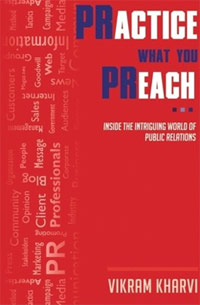
    Fellow public reputation management practitioner Vikram Kharvi has self-published his first book which is commendable. If I ran a reputation management school, I would prescribe it as a text book. The book is indeed a labour of love for the profession that the author displays by the loads.


    The book is a collection of twenty essays and each one ends with an interesting quote by a prominent author or thinker. Aptly titled PRactice what you PReach, the book is a peek into the intriguing world of public relations by a young professional who has worked both in-house and in a consultancy.


    It is a great read for professionals of all ages, from the student to the CEO of a PR firm, from an intern at a corporate communications department to the one heading it. There is something for everyone. The inaugural chapter on comparing our profession to the various facets of Lord Ganesha is very innovative.


    The book acts as a ready reckoner of tips and tricks for the profession. I like the fact that Vikram refers to PR companies as consultancies and not as agencies, which they are not. I also like the focus on PR as a practice rather than a mere profession. A practice makes it both an art and a science.


    The book shows that PR professionals can be creative if they apply their mind to being so. The 20 chapters are in an easy to ride format of seven to eight pages each on an average. I read the book in one go two consecutive flights and would recommend this to every professional as a must read.


    The book could have done with some more focus on editing to make it crisper but as a debut it is worthy of praise nevertheless.  Hats off to Vikram on this effort. May there be more books authored by you.


    The 160-page book is priced at Rs 300 and is available online at a discount. I wish more professionals attempt to write a book. After having compiled my columns into one earlier this year I don’t think it is a hard task. Go write yours!


  • Amith Prabhu: What to do when hit by a Reputation Crisis

    By Amith Prabhu


    There are at least 100 rapes taking place in a nation of 1.3 billion people every day. That is four an hour or one every 15 minutes. It is more like an epidemic and there seems to be no cure in sight. When a corporate oragnisation is involved or when a political organisation chooses to get involved in a big way, one out of 10000 rapes (that is once a quarter) gains national prominence. We saw this during the HP employee’s case in 2005 in Bengaluru and we saw it during the Nirbhaya incident in 2012 in Delhi.


    This week there has been outrage against Uber because the aggregator company did not do a police verification of drivers on its rolls and one of them from among 3000 was a rotten egg. He picked up a passenger and on the way to the destination raped her. What happened after that has really brought the company to its knees. A reputational crisis is not easy to deal with but it is possible to do the right things. A crisis is the final stage when a risk becomes an issue and then the issue becomes a crisis. Most organisations in India including international organisations operating in India do not invest in a playbook for RIC (risk, issue, crisis) management.


    While the flow is not rocket science the important part is in the activation. Here’s an eight-step guide to dealing with a crisis with maturity.


    Be Alert, Admit mistake, Apologise genuinely, Act fair, shun Arrogance, Advertise remedies, Accept criticism, Allow questions.


    Let me explain each of these:

    Be Alert: This involves a lot of listening and customer relationship management. This crisis could have been averted if Uber had taken the complaint from another customer a week earlier regarding the same criminal driver.


    Admit Mistake: As soon as the crisis got full blown the company should have admitted to its mistake rather than sharing a random statement which was full of legal language.


    Apologise genuinely: The apology that Uber gave did not seem like it cared. It was neither properly drafted nor well intentioned. Mentioning financial help in a statement of apology is never a good idea.


    Act fair: This is about not taking sides and calling a spade a spade. While Uber immediately delisted the driver they should have withdrawn the service till they could promise a deadline by which they would offer verified drivers. But before they could delay, the government decided to ban them.


    Shun Arrogance: The company has been in the news for wrong reasons internationally for the last few weeks and it has projected an image of being arrogant. Just the way Richard Branson rushed to the site of the crash of Virgin Galactic, the Uber CEO should have rushed to India


    Advertise Remedies: As a company with deep pockets the company should have released front page ads within 48 hours of the incident reassuring its customers about the steps it is taking to ensure safety.


    Accept criticism: There has been severe criticism but not a word to assuage feelings that have been hurt. This could have happened to anyone.


    Allow questions: Uber should have scheduled a press conference to address queries and answer doubts in people’s minds. But it has lost an opportunity unless it plans to do one soon.


    These steps can be applied to any crisis. But behind all this there needs to be a robust communication plan and flow. Hope other companies learn from this incident to deal with eventualities that are unexpected but possible.


  • Amith Prabhu: People make our business

    By Amith Prabhu


    The first week of the final month of the year was significant in more ways than one. I was saddened and humbled about the two events. It is important to devote half my column to both these for the sake of history.


    First, I woke up to the sad news of the passing away one of the senior most PR professionals in the country on December 2. Allwyn Fernandes was no ordinary professional. He was a professional par excellence. In a career spanning 44 years, he had worked in two organisations. The first 25 years as a journalist with The Times of India Group and from 1994 until his death for 20 years with Edelman Public Relations India which was formerly Roger Pereira Communications.


    The fact that he made the transition from journalism to PR consulting when the profession was taking birth is one aspect. The element of stability is another. In a day and age when people consider changing jobs every 20 months here was a man who had stayed put for 20 years.


    I have known Allwyn for over 10 years given a few shared interests we had outside of Public Relations. He was an activist in the Catholic Church and did a fabulous job of pointing out wrongdoings in the church through an email group that reached the leaders of the church. More importantly, he was an amazing husband to Enid and a proud father to Rohan and Rohini.


    I was delighted to spend some time with him at the second edition of Praxis in Lavasa about 14 months ago. We interacted regularly on email and then a few months ago he stopped communicating. Little did I realise he was battling cancer and was deteriorating.


    In Allwyn’s death not only has Edelman India lost a great asset but the PR fraternity will miss a person that is a rare to find. He never minced words, called a spade a spade and never harmed anyone. May he rest in peace.


    The second event that took place on December 4 was historical too. Twenty leaders of PR firms and measurement companies spent three hours over lunch in Gurgaon talking about the future of PR consulting in the country leaving all professional rivalries aside. As the custodian of the PRomise Foundation I was honoured to moderate this session. And make it possible to get some of the finest brains in reputation management inside the room.


    Among other things that were discussed was how to make Praxis better in its fourth edition. It was a great way to ideate and have a consultation to better plan the event that is now becoming a fixture on the annual calendar of professionals from both sides – consulting and in-house. The next session of PRime Time will take place in Mumbai focusing on senior in-house professionals.


    The takeaway for me was straightforward. That we are a People Business. We are only as good as the people who come in to PR and make a difference. The better we are the more respect we will command. The more united we are the better we will get.


  • Amith Prabhu: My PR Person of the Year

    By Amith Prabhu


    I said it earlier and I say it in a different context again. United Kingdom has a former PR professional as its Prime Minister and India has a Prime Minister who is a PR man as well. The way Narendra Modi has managed the perception of his six months in power is a case study as much as his campaign is a case study. For this reason he is my PR person of 2014.


    I have had strong views against him being the PM probable of the country. However, now that the 30 percent vote share catapulted him to the position we have to accept the reality and move on. I have been branded a Communist and a Congress sympathizer. That is far from the truth. I have had professional linkages with individuals from different parties and ideologies. I am neither pro-Congress nor am I anti-BJP.


    There are individuals who come across as good and many of them genuinely are. I support them. If the PM really walks the talk and brings about a change in the remainder of his five-year term without allowing a communal riot to erupt, I may vote for him in 2019.


    What are the three areas we need to see change at least in the next one year? For me it would be reduction of corruption and poverty – these are interlinked. A safer and secure nation – safe for its citizens especially women and children and security at the borders. And lastly, an equal society where people play fair. Too much to ask for but possible if the Good Days are to see the light.


    Well, the Prime Minister has shown that you do not need to engage journalists to do some great PR. I’m hoping there is a lot of learning here for professionals. He uses the radio for live broadcasts. He uses events to create hype and he uses digital like it will go out of fashion. He has put the public back into Public Relations. And he is not giving journalists too much of a chance to cover him in a poor light.


    One is not sure as to how long the shine will last. People also say that all that glitters is not gold. But for now a large number of India – and I’m not yet part of the bandwagon – are letting him enjoy the honeymoon in power. He has managed to convert several who were against him to be a favorably disposed towards him. For the above reasons he is my PR Person of the Year but, no, at the ballot box he is not getting my vote yet until he proves to be a real change maker in reducing corruption and poverty which are India’s biggest albatrosses.