Category: PR

  • Concept PR acquires I:Connect Enterprise

    By a correspondent


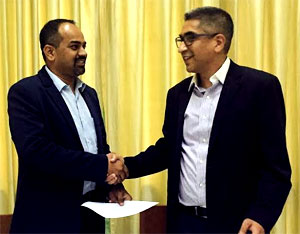
    Full-service PR company Concept PR has acquired I:Connect Enterprise, a strategic PR consultancy, in an all stock deal. All three founding members of the I:Connect team - Lokesh Tiwary, Shantanu Kumar and Shalini Gupta – along with their entire team will merge with Concept PR.


    Over the years, Concept PR has come to be recognized as a formidable force in corporate and financial communication. The team has been acknowledged for its effective media relations and leading financial communications agency. With the current acquisition and merger, they add greater strength in brand, lifestyle, events and sports communication.


    I:Connect, established by Lokesh Tiwary in 2009 was designed to position Public Relations as a strategic communication partner to brands in order to address critical marketing challenges. Over the past four years, the agency has been associated with several big ticket names across industries including – HTC, ZTE, Nuance, GE, SBI Cards, First Solar, Swarovski, Oriflame, BIBA, Gemfields, Rose to name a few.


    Welcoming them onboard, Ashish Jalan,  Director Concept PR said, “The merger with I:Connect is bound to add an extra zest to our team and service capabilities across all PR verticals. With Lokesh, we hope to leverage his tremendous understanding of consumers and communication platforms that comes with his years of experience as an advertising and PR professional. On the other hand Shantanu, an economics major and a hardened strategist, is best placed to boost our Strategy Planning abilities. In the recent past our lifestyle and sports related PR services have gained a lot of ground, Shalini’s vast experience in these areas will be a certain advantage to the team.”


    Speaking on behalf of the I:Connect team, Lokesh Tiwary said, “Concept is a name to reckon with in domains such as Financial & Corporate PR, Crisis Communication and Media Insights. While I:Connect on the other hand has in the last four years developed a strategic advantage in the domain of Brand (PR) Communication. What makes this merger perfect is that it brings together two complementary forces. The scale, business intelligence and client depth of Concept and the domain expertise of I:Connect. The collective strengths would enable Concept to enlarge its appeal. We see tremendous opportunity to benefit from this merger.”


    The Concept Group is a network of Independent Indian agencies specializing in Brand Consultancy, Creative, Media, OOH, Digital and PR services.


  • Adfactors expands Asia operations to Sri Lanka

    By A Correspondent


    Adfactors PR has set up its Sri Lanka office in Colombo. This is Adfactors PR’s third office in Asia outside India after Dubai and Singapore.


    The new company, Adfactors Public Relations Lanka (Pvt.) Ltd., will offer its suite of communications services to Sri Lanka-based businesses – both domestic and international. The firm’s services will be useful to a large number of Indian companies which have business operations in Sri Lanka.


    Rezani Aziz, a Sri Lankan national, will spearhead the consultancy’s foray as the CEO. Ms. Aziz was formerly the Head of Corporate Affairs at Standard Chartered Bank and the COO of Strategic Alliance PR, an exclusive affiliate of Burson-Marsteller, in Sri Lanka.


    Madan Bahal, Co-founder and Managing Director of Adfactors PR, said, “The intense economic activity in Sri Lanka will have a direct correlation with demand for competent communications services. As a multi-speciality firm with expertise in sectors such as banking and financial services, infrastructure, transportation, energy and natural resources, we will be able to provide expert counsel to Sri Lankan, Indian and multinational businesses operating in this beautiful island nation.”


    The launch of Sri Lankan operations was commemorated at an event in Colombo that was graced by Honorable Deputy Minister for Investment Promotion, Mr Faiszer Musthapha, His Excellency Mr Y. K. Sinha, Indian High Commissioner in Sri Lanka, Dr Nalaka Godahewa, Chairman, Securities & Exchange Commission of Sri Lanka, Mr. Ashishkumar Chauhan, Managing Director & CEO, Bombay Stock Exchange, Mr. Krishan Balendra, Chairman, Colombo Stock Exchange, Chairman of Adfactors PR Rajesh Chaturvedi, besides a host of dignitaries from the corporate and financial sector in Sri Lanka.


  • Meet the Pitchfork Partners

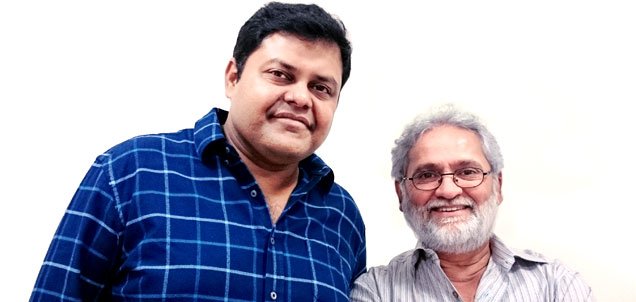
    Sunil Gautam (right) with Jaideep Shergill


    The announcement last November surprised many as Jaideep Shergill had a successful four-year run as CEO of the MSLGroup. He chose to leave the Pubicis Groupe to join former boss and mentor Sunil Gautam, the chartered accountant-turned-communications professional who founded Clear Advertising and PR and later Hanmer & Partners which eventually morphed into MSL India. SG, as he is known in the PR fraternity, was Chairman Emeritus of the MSLGroup. Effective January 1, Shergill and SG have set up Pitchfork Partners, a specialised consultancy which will handhold corporate and start-ups in their marketing service activities.  In an interview with Pradyuman Maheshwari, the duo share their vision and why firms like Pitchfork will thrive in the ecosystem.


    Fifteen years back, you chose Hanmer & Partners as the name of your agency. Now, Pitchfork Partners.  Sunil, what’s with you and your out-of-this-world names. Why Pitchfork?

    Jaideep Shergill (JS): Let me take this one. It’s what the devil uses. It’s his weapon of choice. We were looking for a mischievous, mysterious and magical name. Something that’s out of the ordinary. There are a lot of firms that do communication, creative, PR, digital, but all of them are very tactical and are not really putting their money where their mouth is. After running companies for many years, we’re fairly convinced there’s a vacuum out there. When we were thinking of a name, we wanted to think of something more irreverent. The devil stands for that. Pitchfork is his weapon of choice…


    So in what way does the name convey what you’re going to be doing?

    JS: Yes, it’s more than a name. The Trident, Pitchfork, is like the Trishul. In our scheme of things, there are three verticals.


    You were having a decent time, Sunil, near-retired, you could’ve invested here and there, played golf. Why get into an all-new activity with all the struggles?

    Sunil Gautam (SG): Yes, I was having a great time, but I want to have a better time. There’s lots to do, a lot of fun. I enjoy working, it’s my passion, it’s great to team up with Jaideep, we know each other for 18-odd years now.


    When did you decide to start Pitchfork? Is there an appetite for a business like this?

    SG: We’ve been talking about it for a couple of years but were in no hurry. With markets opening up, we feel the time is right. We hope there is an appetite for business like this. Our initial response has been very encouraging so far.


    Will you charge a retainer fee or…

    JS: Retainers and projects. Some long-term programmes where the client will work with us for six months or a year. If it’s a project, we’ll bill them as per our hours. We’ll have billable hours like a McKinsey. We’ll have hourly models.


    Will people agree to this? They agree to a McKinsey because they expect them to re-engineer their operations and offer high-end consultancy.

    JS: But we have had hourly systems in MSL historically anyway. We had a large number of clients who pay us a flat retainer fee. But even today, a large no. of clients also pay MSL by the hour. It’s not like that model doesn’t exist. It’s not new, but, yes, it’s not yet at a McKinsey level.


    Jaideep, you helmed MSL independently for four years and seemed to be on a high. So why give that all up?

    JS: Three or four reasons. Having been in the mainstream business for a long time, I’ve been through and seen a lot of change. The company we were a part of got acquired, we acquired other companies, I’ve seen the transition from traditional PR to modern communication. I honestly wanted to do something different. There was a wide space there. That’s what Sunil and I were looking at. It’s in three areas. Strategy consulting, because we want to move up the value chain, the second area is aggregation and disintermediary. We won’t work in the traditional PR alone. Given our wide-ranging experience in communications, we’ll be like a business or marketing or brand consultant to a company. That’s the wide space I saw.


    When you were with the MSL group, you had the opportunity to steer the company to do some of these things, right?

    JS: Yes, we did! 96% of our business was traditional. In the last four years, we moved it more significantly than any PR firm. Today 55% of MSL revenue is traditional and 45% is non-traditional. From 5% to 45% which comes from research and insight, creative, content, digital. It’s happening. Where Sunil and I see the gap is when we come in to the equation, we come in as people who can implement, execute stuff. The clients have decided what they want. We come in at a late stage, sometimes even after the ad agencies are brought in. We come in as the last mile. We want to change perceptions. We want to move up the value chain. We want to offer a service that can work directly with the top management, can be more strategic and can work with a complete backward and forward option. Literally from when the client is looking for a marketing director or a CMO or a Corp Comm Head, we want to come in even at that early stage, help the company through that evolution. That’s what we can’t do within a structured environment. You need to be out there on your own and at the end of the day our value is what he has and what I have. It’s two people bringing their collective wisdom, experience. We will give it a shot, this model hasn’t been tried before.


    Were you happy with the way traditional PR agencies have had to change course over the years?

    JS: They can certainly do better. They can do it faster. Speed is of the essence. When we’re together we’re more nimble because there’s just two of us. When you’re in a big institution, everything moves slowly. We want things to move fast.


    All going digital?

    JS: Of course! That’s the reality of life. If they don’t, they’ll die.


    You mentioned when an organisation is too big, you’re unable to do things. But the whole objective of setting up a new organisation would be to grow that big and do various things.

    SG: The whole idea is very few people who’ll be advising CxOs, the top levels, in terms of strategy. When it comes to implementation, may be we’ll outsource it. When you have to involve yourself at top levels to think strategy, you need to really give a lot of time. This is something you don’t want to delegate, which has been happening across agencies. We’ll be a very lean and mean set-up. At the peak, we may have not more than 10 people. Whoever worked with us will be a partner, will be handpicked, will deal with top level clients in terms of giving them strategic advice. We don’t want it to be large because we don’t want to implement things. We’ll get it done for clients, we’ll oversee it, under our advice and guidance.


    Wouldn’t that limit your scope in any way?

    SG: Not really, what we’re here to do is enjoy ourselves. Work closely with fewer clients but give a lot of quality time and thinking for them. Clients are willing to pay top dollar for this.


    Sunil, you’ve been part of the PR business since the time of the IPO boom. Unfortunately, clients do not use the services of PR consultants effectively unless there’s a crisis or a new development. They’re not really partners in their progress.

    SG: I don’ think PR agencies have really worked themselves to reach that level. That’s my opinion. I don’t think they’ve worked that hard to reach that level in terms of rubbing shoulders with CxOs to give that kind of advice. There are various reasons for that. But there are clients who are willing, who want, who recognise there is this gap and some of them are already talking to us.


    But isn’t all the PR advice they seek is getting the news out (or not out) the next day?

    JS: To begin with, we won’t just advise our clients on PR. That’s most important. We’ll be their communications and marketing advisors. It goes much beyond. It’s giving them a path on their communication needs. Advertising, digital, PR, events… whatever they need.


    Both of you known essentially as PR professionals. Do you think you can break that barrier and look at clients – blue chip clients – for their entire marketing services activities?

    JS: Absolutely! There’s no reason, why not? The walls have fallen any way. What’s the difference between the digital work an ad agency or a PR agency does? Everyone is doing everything. Even though we come from a more PR or communications background, there’s enough that we have to be able to guide somebody in the right direction. We’re not the people going to be sitting and writing the copy anyway. So, if a client has a creative requirement, we will find him the best creative talent.


    Tell us more about the start-up part of your business?

    JS: Yes, we will look at tech, digital, PR companies who’ve reached a strength of 20 to 30 people and they don’t know how to grow. Creative, digital companies now want to go to the next level. We’ll come in and guide them through the whole growth process, take them to the point where they can either get acquired or sell out or scale up and then we’ll buy into them early as early adoptors or seed fund kind of structuring. We don’t want to be private equity. We want to be mentors.


    If any of your MSL clients come in, would you entertain them?

    JS: We’d still want them to work with MSL. But if they are looking for something specific which we are doing, why not? You should also know we’re very transparent with Pubicis about what we’re doing. We also offer a complementary service which is also the reason why our relations with the group is as good as they are.


    So will Publicis be your first preference for your clients?

    JS: We’re more than happy to go with anyone. While we’re agnostic, we’ll look at Publicis as the first call. If we find a solution within, why go out? There are certain skillsets it may have not have like market research, for instance.


    Sunil, do you see the communications business headed this way with senior professionals like yourself setting up personalised consulting services?

    SG: I’m very confident the world will move that way. Clients today do not get time from senior guys who can think on their behalf.


    Do you have any targets on what you want to achieve in your business in the first year?

    JS: Not in terms of a number. As Sunil said, we’re in it to have some fun! The third pillar that we have will require us to give a lot of time for mentorship. We’ll be mentoring young professionals who want to grow. All that doesn’t have a revenue stream. There will be a long gestation period. As an example, if we’re advising a startup PR firm, we won’t actually get anything out of it for the next 5-10 years till it grows. We’re not setting business targets but goals we want to meet as individuals and getting to that self actualization place in life where we’re having fun, we’re working and are able to add some value to the people we work with.


    Would you at any point think of getting an investor on board? Maybe after 4-5 years?

    SG: It’s too early to say. This is just our first month.


    A shorter version of this appeared in dna of brands dated January 12

     

  • Amith Prabhu: Reputation is not everything. It is the only thing

    By Amith Prabhu


    It takes a jolt to make amends. The unexpected events that come our way in our public life can prompt us to get drowned with them or take steps to salvage the reputation at stake. The last week was interesting in terms of various incidents in political and corporate India.


    The repercussion of Delhi elections was the subtle blame that BJP put on its leadership attributing it to the famous suit that the PM wore, blaming Obama for lecturing India on religious intolerance and the attacks on places of worship. And the PM who is the master of communicating through actions was quick to act. First, he addressed a Christian event and spoke against religious intolerance, next he put up that ill-fated suit for auction with the proceeds going to charity and lastly attending the wedding of the progeny of his arch rivals (Lalu and Mulayam) in rural UP.


    Just as the Budget session draws near, does the news of the Corporate Espionage fiasco prop up. This incident is a can of worms which will bite many a corporate for a long time to come. The big daddies of energy are involved and it will take a long while to wriggle out of this mess.


    In faraway Patna, Nitish Kumar tried doing a Kejriwal by apologising. But his circumstances were different and how people react to him cutting a sorry figure will be known in the elections. The three stories above are just instances of how people take reputation management seriously.


    While all this played out in the media, it is important to understand that few individuals took decisions to make or break their reputation. It also underlines the adage that Reputation is not everything, most of the time it is the only thing.


    This being the case, several organisations are taking narrative management very seriously and hiring senior journalists to look after corporate communications. While hiring journalists in corporate communications is not new, the number of journalists making the transition has grown exponentially. While they deal with the storytelling and media relations bit, there is an entire bit of strategy and campaign planning where they lag. However, if all that companies look for is relationships that help stop a negative story or to plant a positive story, that will do more harm than good in the long term.


    Well, there will always be tough mazes to navigate. One has to be mindful that there are really no shortcuts. And for every shortcut one is shortchanging oneself in the reputation game.


  • Nitin Mantri appointed President of PRCAI

    By A Correspondent


    Nitin Mantri

    The Public Relations Consultants Association of India (PRCAI) has appointed Nitin Mantri, CEO and Managing Partner, Avian Media, as President till May 2016 when the term of the present Managing Committee ends. Mantri moves from Vice President to President of PRCAI.


    The decision was taken by the Managing Committee members after present incumbent Sharif D Rangnekar, CEO and Director of Integral PR, stepped down from the position of President.


    On being appointed President, Mantri said:  “Sharif (Rangnekar) in last three years has done some great work for the industry and I hope to continue the momentum. PRCAI is a fantastic organisation. I have enjoyed a long and fruitful association with it. In my role as President, I will continue to underline the importance of high professional standards, support communications professionals across the country and try to improve the public perception of public relations.”


    Mantri has been in the public relations industry for over 19 years. He has been one of the most visible proponents of a common code of conduct for the industry in India. To increase awareness about the profession at the grassroot level and stimulate the learning process, he regularly delivers lectures at prominent mass communication colleges in the country.


  • SCoRe gets PRCAI endorsement, both to collaborate

    By A Correspondent


    The Indian School of COmmunications and REputation (SCoRe), India’s first school of Strategic Communications located in Gurgaon and the Public Relations Consultants Association of India (PRCAI) formally announced a collaboration. By way of the collaboration, PRCAI has formally endorsed the programme offered by SCoRe making it the only Public Relations programme in the country endorsed by the association. The association will also promote SCoRe among its members, other stakeholders and public at large.


    Nitin Mantri, President, Public Relations Consultants Association of India said “I am very excited to announce our partnership with India’s first school dedicated to Public Relations. The launch of a Public Relations school was the need of the hour for the industry, as there is a huge scarcity for young and well-rounded talent in our profession. We hope that SCoRe will fill this gap and the communications profession will be able to benefit from this initiative in the long run.”


    As a part of the collaboration, the PRCAI President will be the ex-officio member of the Advisory Board. At least four representatives from PRCAI member firms will be part of the Academic Council. There will be two PRCAI scholarships, where the seats are offered at half the fee.


    Amith Prabhu

    Amith Prabhu, Founding Dean, SCoRe said, “It is great to be supported by the only Public Relations Association of India that represents consulting firms. As the first post-graduate school of Public Relations we have a responsibility to offer a high quality programme. We are fortunate to have the backing of PRCAI. We hope this collaboration stands the test of time and we are able to deliver best in class talent in the coming years.”


    SCoRe was launched earlier this year and will commence its first batch in July. Admissions to the 10 month full-time programme are open. The school will have a focus on corporate communications and political communications. The school is governed by an advisory board and an academic council.


    PRCAI is the association of the leading PR consultancies in India. It consists of various chapters and has over 20 member firms.


  • Introducing a new fortnightly column on PR insights – PReamble by Siddhartha Mukherjee

    By Siddhartha Mukherjee
     

    Advertising is BIG in Size, even BIGGER in Stature. Tracing back many years, one will observe that towards the foundation and gradual development of our Advertising Industry, both in size and aura, the intrinsic role of Public Relations cannot be ignored.


    What has Public Relations got to do with the SIZE of the Indian Advertising Industry?

    Our Indian Advertising Industry would not have been half as rich as it is today had it not been for the Public Relations Industry’s decades of effort to get the multinationals enter the Indian economy smoothly, help them settle and start their operations. I believe that Public Relations has played a key role in transforming our India’s erstwhile Swadeshi Market to today’s India Inc. It is the Public Relations machinery that has worked tirelessly with the media and foreign Investment corridors to ensure the smooth entry of Multinational Organizations before it fell into the lap of the Advertising Industry as prospective Client Revenues.


    Why talk about Multinationals alone? Even the India-based Corporates and Organizations have made a fair use of Public Relations before jumping on the Advertising band wagon. Mergers and Acquisitions, Brand Crisis, Investor Relations/IPOs, CSR, Employee and Trade Relations, Regulatory dynamics, well, many such other dynamics were tackled through Public Relations before those Corporate and Product Brands started using the Advertising tool.


    Ask any PR/Communication professional, especially veterans, and they will have amazing facts to narrate which reiterate the role of Public Relations in creating and stabilizing a brand. PR Consultancy Heads or its Senior Management, Corporate Communication Heads, CXOs, etc., will have an amazingly rich archive of actual, real life PR Effectiveness & Success Case Studies to share – some of which that they themselves ideated or implemented. It is a different story though, that no one has bothered to document these decades of initiatives. All that was needed to be done is to approach the right Industry professionals and Thought Leaders. Case studies will come pouring from various management corridors – Corporate, Human Resource, Marketing, Finance, Manufacturing etc. Function head will have interesting anecdotes to share on how Public Relations helped them in their respective spheres whether it was Business As Usual or Business Not As Usual scenarios.  It really doesnot matter if the case study pertains to a National or Multi-national organization. The important thing here is that every industry vertical will have many case studies buried deep within the wisdom of both veterans & visionary Corporate Business Leaders and Communicators. Each of those stories will somewhere, very humbly, highlight the underlying message of how it helped contribute towards the growing revenues and size of the Advertising Industry.


    Today, if the Indian Advertising revenue size is touching close to 1% of our GDP, well, you know who or rather which Industry to acknowledge!


    How did Public Relations build Advertising Stature?

    My 10-year-old son’s school curriculum has capsules and questions on Advertising, Copy writing, Medium, Slogan etc. It made me wonder & trace back as to what could have been the trigger of all this? Why was my son not being taught about news, news writing, etc. Like advertising, why isn’t he getting the exposure to the world of Journalism as one of the facets of Public Relations?


    Advertising Industry and its Celebrities (well, names like Alyque Padamsee, Sylvester da Cunha, Prem Mehta, Piyush Pandey, Prasoon Joshi, Balki, Vikram Sakhuja, Sam Balsara, Shashi Sinha,…well, it is a long list) have become household names. Parents of employees working in the Industry, their friends and family, social ecosystem, clients, have all acknowledged the  Advertising Industry as a respectable employer, a brand partner and sustainers of brands.


    Well, mind you, this did not happen overnight. This has happened after years of regular use of PR of the Advertising Industry and its Industry Captains.


    Day on day, week on week, Advertising Industry’s credentials, its achievements, plans and yes of course, the Celebrity quotient have an had ominous presence in Newspapers, TV News Channels and Online Networks.


    No wonder then, most of the Management Institutes still continue to believe that when it comes to preparing or revising their marketing course curriculum, Advertising is the nucleus of Brand Communications and Management.


    If anyone doubts on the scientific impact of PR, well, the example is live and all around us. It is one of the best examples to give to establish that PR works, it moves the cheese and how!


    Hopefully! one day, in a similar fashion, PR will have a lot do with PR!


    Siddhartha Mukherjee is a senior PR industry professional and currently Senior Vice President, Eikona – Earned Media Planning, Audit and Advisory. The views expressed here are his own.


  • Siddhartha Mukherjee: It is time for India PRinciples!

    By Siddhartha Mukherjee


    Our fixation with ‘Phoren Maal – Videshi Samaan’ continues even now. It took our PM Narendra Modi to convince us to “Make in India”. India Inc’s marketing and communications machinery has, very successfully, convinced us Indians that definition of words like lifestyle and  aspirations by and large only end with aping the west. Short and simple, Reference = West, copy-paste the West, listen to the West. However, many ground checks are emerging to prove that it is finally those who think local and act global who are emerging as the Dark Horse!


    Let’s talk about our own home turf – the Indian Public Relations Industry. The majority part of our industry has come under the influence of “International” or “Western” ideologies and principles. While the entry and successful establishment of multinational PR firms and associated services in India has been one of the constructive aspects of our industry, my personal view, however, is that the template that we have been applying to plan, execute and measure needs to reflect the personality of India! Western thoughts and principles just do not apply and match up to India! It is a wastage of time for the service provider and wastage of money for the client. It is time for locally customised and centrally localised India PRinciples.


    More so, it is time for the world to know about and learn from India PRinciples. The Indian market, its ground realities, challenges and unique cultural personality makes every stakeholder of the Indian PR/Earned Media Industry – PR firms, evaluation and measurement services and clients – uniquely placed to profess and share learnings with the marketing and brand building community of the world.  It is time we project ourselves inward out. It is time we take centrestage of the world can learn from Indian industry, its adept professionals and the market. It is time India is on the stage…not ‘phoren’ personalities!


    Before I get into some quick thoughts on how we could look at taking this forward, I wanted to share a key reason towards why India should take centrestage in the global arena…Why India principles should be the base of drafting marketing and brand communication syllabus for the western world. A very simple yet key reason is that for decades, the western market enjoyed the advantages of being a homogenous market. Marketing challenges – controllable and uncontrollable, Media Mix and Planning, Targeting, Evaluation etc have been far more smoother and homogenous. Compared to the complex web of heterogeneity of Indian markets, those in the west have been a marketers’ bliss.


    However, now, the same markets have started developing the genetics of heterogeneity. Marketing and communications dynamics have started to convolute. Psychographics and demographics have started to twist and turn. Media and its revolution has been a key trigger towards this change.


    Which is precisely why, our Indian communications industry should start projecting itself as the partner!


    Some quick thoughts on this:

    a. First up, is the belief that India’s PR Industry can take on the world. It can teach and spread its prophecies. While we have had self-created occasions to feel low or belittled, I see no reason as to why we can’t bounce back in the global arena of corporate brand communication and reputation management.


    b. The PR Industry Body (PRCAI) can consider taking up the ownership of authoring the India PRinciples and representing India in the Global arena


    c. Creating India’s PRinciples should include creation of a charter and assigning a character to India’s PR Industry!


    d. The India PRinciples should certainly constitute of principles across key blocks of PR Communication Planning, Execution and Measurement/Evaluation.


    e. While the PR Firms/Consultancies should lead this, it should have healthy representation of Users (Clients) and a Neutral & Holistic Measurement & Audit mechanism.


    f. Communicate (Do PR for) India’s PR capabilities as a Thought Leader in the Global Arena.


    g. Add science of measurement and data authentication to corroborate that why India is one of the benchmark/reference markets to learn from and convert those into Case Studies for Global reference.


    h. Maintain and retain the end objective of INDIA on the Stage, World in the Audience.


    Not just as an Indian, but going by the work PR Firms based in India are doing along with their clients, delivering tangible results despite the ground challenges India offers, I firmly believe that we should not leave any stones unturned to position ourselves in the driver’s seat and on the global stage. It will be a matter of pride and milestone if India and her PRinciples are on stage and the world in the audience.


  • PReamble by Siddhartha Mukherjee: The Shift from “BUY ME” to “WHY ME”

    By Siddhartha Mukherjee


    Talking about “Brand Reputation” and “Reputation Economy” in the Corporate world is becoming a fad. When you come to think of it, well, there’s nothing wrong about it! Compared to our (India Inc.’s and its Agency Machinery’s) state of awareness a decade back, a good start I would say. However, when you look at the reality in terms what we are actually doing towards very crucial dynamics of creating and maintaining Brand Reputation, it very clearly smacks of understanding or seriousness. Very simply put, CEOs, CMOs and all other CXOs need to understand the ground-level implications of what Reputation Economy means. The consumer, our revenue contributor, is no longer agreeing to buy our products/services just because of the Product/Brand’s recall, price promotions, packaging or convenience of place. He/She is no longer getting impressed by our communication push that focuses on “BUY ME”. The consumer has started to flip the product packaging and check who the manufacturer is. Does he/she believe him? The consumer wants to very clearly hear an honest “WHY ME”. They want to focus on the Corporate Brand!


    If one were to look at the total annual Indian advertising spends, advertisers do not spend more than 3-5% of the total on  orporate image. In other words, more than 95% is pure marcom (marketing communication) push. It is a “BUY ME” push. The “WHY ME” part has been missing. By “WHY ME”, I mean information about the maker of the product/service, its philosophy, its business ethics, its culture, its vision & mission, its approach towards the social ecosystem, its governance, quality controls, its commitment to employees, investors, government, society at large, vendors and so on and so forth.


    Corp Comm (Corporate Communications) has to emerge as the frontrunner. CEOs need to be aware that all CXOs, not just the CMOs alone, need to have a say in the brand building process. The long standing excessive weightage on Marcom has to shift and move to Corp Comm! The P/L, toplines and bottomlines simply cannot be the guiding and driving force of an organization’s business and communications planning process. For an organisation/ corporate brand, to put in place a robust reputation management machinery, and further aligning it to a singular reputation building agenda internally is paramount. While CMOs mandate is to obviously focus on BUY ME, the CEO should not do the blunder of losing sight of WHY ME? The onus is on him. In the sense that when the consumer flips the packaging/cover of the product to check on the owner or manufacturer of the product, the consumer should not take much time to recall and thereafter, convinced, place it in his/her shopping cart.


    The potential and deliveries that advertising brought to a brand custodian as a standalone communications tool has lost its firmness. Today, brand custodians need integrated help through earned media. While advertising or paid media, for its own inherent challenges is unable to deliver, earned media/ public relations can well be the custodian of both corporate and product brand reputation going forward. Earned Media/PR can well be the conveyor/spokesperson of not just the brand’s “BUY ME” bit, but more importantly, the WHY ME block.


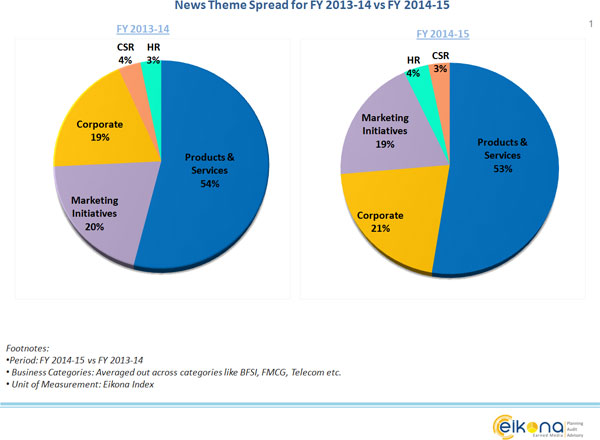
    The Eikona chart, above, gives a sense of what some of the key sectors (averaged out) like Telecom, FMCG, BFSI etc. have focused on. Have they focused on WHY ME or does it continue to be the same story of major focus largely on BUY ME? The following takeaways can be concluded upon:


    a) Things have improved, but Brand ka dil mange more: The above data sets are for the financial year 2013-14 and 2014-15. The above chart splits the total News Push or News Presence of companies across industry sectors and splits them by themes such as corporate image, human resource, marketing initiatives, product and Services etc. If you were to total up product and services and marketing initiatives-related news push, the figure is hovering around a humungous 74%. Which means that a large part of what creates and sustains a corporate brand is missing! However, a silver lining, however, is that these periods are seemingly better when compared with 2011-12 and 2012-13 (not in the chart above). They  used to smack at around 85%. Good news is that the emphasis or push on the “WHY ME” part, comprising Corporate Image, Vision and Strategy, Business Ethics, CSR, Human Resource etc., has increased/improved  as compared to 3-4 years back.


    Further, like I said before, these are averages of some key industry categories. If one were to look at individual sectors, reality in some specific sectors will be harder and much more rude. The message is clear – long-term success is all about corporate brand and not product brand alone! For this, corp Comm has to be in the driver’s seat.


    b) CXOs need to be aware of consumer’s purchase dynamics: Consumer’s purchase dynamics are no longer about Brand Track TOM scores. It is now shifting towards Disposition. It is shifting towards dynamics of strong sustained Messaging which gives away the WHY ME part loud and clear. Any product or service purchase, does’txt matter whether from B2B or B2C category, is about investigating and pivoting the purchase decision on WHY ME. Brand Track survey mechanisms will need drastic revamp. Some of the current ones are archaic and is far from taking care of BTL communication push. Also, the disposition studies will need more robustness.


    c) Why does Earned Media/PR score over Paid/Ad route?: First, the paid/ad route has long lost its credibility. Data sets like ad avoidance, falling Brand Track scores are terrific endorsers of that. Second, the Paid tool is too pricey (let me clarify – I mean money wise! Doesnot justify the ROIs). Third, Ad layout formats doesnot allow me the logistics of laying down details or even relevant snippets of WHY ME. Earned Media scores on ALL!


    d) Can it be measured?: The best part of all this is that Earned Media can be measured neutrally, holistically and continuously and be equated with Corporate and Product Brand Reputation scores.


    Call it Living Company, Loved Company, Successful Company, Lambi Race Ka Ghoda…well, it is time to change. “WHY ME” is the magic wand of long term Business Brand building. CEOs will need to take charge and make amends in the Organizational structure. Communication KRAs and KPIs will need to be recreated with & for all CXOs. Very importantly, they will need to be linked with the Business Objective!


    Siddhartha Mukherjee is a senior PR industry professional and currently Senior Vice President, Eikona – Earned Media Planning, Audit and Advisory. The views expressed here are his own.


  • Amith Prabhu: 10 on 10 for the Modi govt on PR, but…

    By Amith Prabhu


    The central government completed one year last week. The past 12 months have seen much fanfare around several schemes announced periodically. We have seen announcement of Clean India, Digital India and several other schemes. However, 12 months is 20% of the time the government gets as part of the mandate and the heavy lifting needs to be done during this period.


    However, in the 52 weeks gone by I am personally yet to experience any difference from this regime in a positive way. The attacks on churches, the ban on beef, and the careless utterances by politicians of the ruling party are the only thing I can remember. A great project such as Clean India could have been implemented within six months after it was announced with three basic steps.


    Hiring cleanliness marshalls or Swachh Brigade in a hundred Assembly constituencies in the first phase, deploy dustbins (there are hundreds of corporates who will be willing to sponsor these) and install awareness messages to create a mega-cleanliness drive. I live in Gurgaon which has a BJP municipal corporation, a BJP MLA and a BJP MP who is also a Union Minister. Even if the pilot was started in a city like Gurgaon the Government would have walked the talk because it has everything going for it in this part of the world.


    Let me take another promise made by the government. This one is about setting a system that eliminates corruption. Even the basics on this one are not in place and 1/5th of the term has ended. If the system worked then the government should challenge citizens to experience a corruption-free system which is unlikely given that the government has done nothing on the black money issue based on its electoral promises.


    Well, this column is completely based on the Public relations premise of the government which is outstanding given the way it has connected with stakeholders, created content and catalyzed moments. No other government in history has used communications tools available at its disposal to reach out. Most of the time citizens are not bothered whether promises are fulfilled as long as the one who made the promise is communicating.


    The Prime Minister has used owned media – radio, television and social networks to their full potential. He has ensured his figurative Number 2. Arun Jaitley to write periodical blogs on Facebook. He has set the agenda for private news channels every single day. He has created a feeling of fear among those whom he does not consider his voters.


    So as a Public Relations deployment this government gets 10 on 10. However. Public Relations can be sustainable for the doers. And doers show in the first 100 to 200 days. A lot of tall talk has taken place. It is possible that the government will keep the best for last and maybe unleash its potential in the last 110 to 200 days. In that case we will need to wait and watch.


    I’m neither hopeful nor hopeless because if a government does its basics and gets corruption in check, creates more jobs and ensures law and order we will be in good shape. But until these happen we will have to wait with our fingers crossed. There could be someone else who looks at this government that has achieved a great deal in the past one year. But one look at the manifesto will say otherwise.


  • Amith Prabhu: If Public Relations cannot be measured, then what can be?

    By Amith Prabhu


    In my column last week I wrote about how Public Relations should be looked at by understanding the definition of religion. One cannot measure Public Relations efforts. Public Relations covers four spheres and specific activities within the four spheres can be measured. The four spheres I wrote about are: Content creation, Connecting stakeholders, Crisis management and Counseling leadership.


    Almost every activity that is linked to Public Relations will fall under one of these four spheres. Let us look at these four spheres individually and list various aspects that fall under each. That will then give us a sense of what can be measured and what cannot.


    Content creation includes and is not limited to drafting and collating information that goes into the website, on social networks, into annual reports, into media releases, into briefing documents, employee emails, internal branding material and any written word, image – moving or still, musical rendition that represents the organisation or department. These have to always be of high quality which means good grammar, zero typos and fairly well composed. A document can be rated on certain parameters but seldom can it be measured.


    Connecting stakeholders covers all connections the company or the brand makes internally and externally starting with employees, investors, shareholders, community, customers, past and future employees and customers and specifically relevant members of the media who are both a stakeholder as well as a medium to reach stakeholders through the media outlets. The quality of these relationships can be measured in various ways. With internal stakeholders by evaluating a survey or through the outcome of low attrition and higher supply of talent. With external stakeholders by top of mind recall surveys as an output or increase of sales as an outcome. With media specifically when a specific activity is undertaken it is imperative to have a written brief that clearly indicates goals. And the output for a media release and a media conference should be measured based on targeted conversion, tonality and key messages being present. For other media activities like an interview or a story that appears inorganically the same measure of tonality and key message should be considered.


    With the advent of digital media and social in particular anything can be said by anyone at any time. There is the owned and earned media aspect. Not much can be within one’s control for the latter. However, two things are imperative: a) To advise management to constantly do the right things with a playbook that describes the outcomes of a wrong move. And b) To be responsive and be able to respond with facts and figures when there are stray comments in the online world. There are limits to what can be measured.


    Finally, with regard to crisis management and counselling leadership these are similar to what a legal counsel would do in an organisation. Constantly evaluating risks and mapping potential issues with a crisis management plan always in place. These again, cannot be measured unless there are specific metrics for a lengthy crisis management programme that are again specific to activities that are linked to a crisis.


    That leaves very little to be measured in Public Relations. But the billion rupee question on measuring Public Relations which is a non-question to start with persists. Next time someone asks you how you measure Public Relations it would be prudent to educate them that Public Relations cannot be measured but specific activities within the ambit of can be measured and each activity has its own set of measurement parameters and differs from brief to brief.


  • Amith Prabhu: To understand PR better, learn the definition of a religion

    By Amith Prabhu


    People would call me a fundamentalist or would call my writing blasphemous after reading my second paragraph. I have been hesitating to write about this for a while and pushing this thought for later. But two incidents last week have prompted me to share a thought I have been nursing for a while.


    A religion is an organised collection of beliefs, cultural systems, and world views that relate humanity to an order of existence. If I were to compare the concept of Public Relations to a religion it would be no different. Public Relations is a collection of beliefs, it has inherent cultural systems and certainly a world view that relates humanity to an order of existence.


    Well, the point I’m trying to make is that several journalists over the years, who are largely influencers, have equated Public relations with Media Relations. Those who got into Public Relations or Corporate Communications after a stint in journalism have carried forward that belief. This has caused irreparable damage to the profession and to the term – Public relations though all is not lost.


    Last week at two different forums, I heard two very senior professionals refer to Public Relations as Media Relations and I began to cringe. I thought it was time for this column. First, Public Relations cannot be measured in the same way Religion cannot be measured. It is a way of life. Second, we have to appreciate that specific activities that fall under Public Relations can be measured if there are three conditions in place. This does not mean some activities that do not fulfill some or all of the three conditions cannot be measured.


    The three conditions are: a written brief that includes goals of an activity and ways to measure the achievements of those goals; the occurrence of the activity largely as per plan within the specific place and time; and lastly an activity completion report which lists out output and outcomes specific to the goal. This sounds very academic but our problem is that we do not document activities the way other disciplines do. The problem starts there. Moreover, we only end up measuring media output without linking it to business outcomes.


    Public Relations is the umbrella under which different outreach to stakeholders takes place. This can be both external affairs or communications and internal affairs or communications. Companies where the remit falls under the watch of the CEO call it Corporate Communications which largely involves media outreach and when it includes government relations it is called Government or Public or Corporate Affairs. In cases where the requirement for communications management is high within product or brand marketing the reference point is Brand or Marketing communications. The bottomline is that they are all part of the same family.


    Broadly, professionals undertake activities in four spheres: Content Creation, Connecting Stakeholders, Crisis Management and Counselling Leadership. While quality and quantity of content and connections can be measured, a crisis can never be measured because there are always risks, some turn into issues and some issues turn into crises – crisis preparedness needs to be in place and a crisis ends up as a disaster or ends up as a problem solved. Counselling the leadership also can never be measured easily or correctly as it is subjective because it is an ongoing task.


    So all in all, certain activities and sub activities can be measured. But most often the sub-activity under Connecting with Stakeholders which is Media Outreach that takes place in the form of organic and inorganic media output is measured in incorrect ways and the entire exercise is referred to as Public Relations. This is not necessarily an ongoing debate. If we start looking at Public Relations more holistically lie we look at the definition of religion this will be easier to fathom.