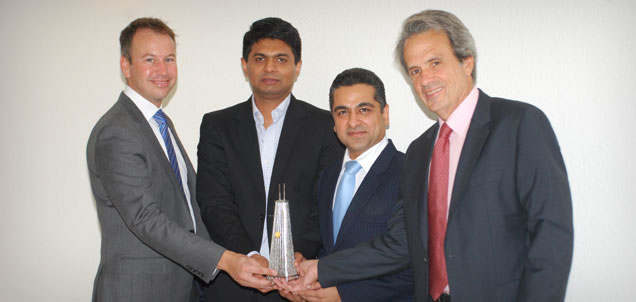
Leading international sanitary fittings brand Grohe India has appointed Value 360 Communications as its official PR agency in India.
Said Ramesh Kaushik, Head-Marketing, Grohe India on the appointment, “We are looking to reinforce our strengths of a consistently delightful consumer experience led by pure Inhouse Designs and superior technology as well as creating new service standards amongst the ever-widening target markets. Our motive is to fortify our position further with a consumer connect strategy that redefines the segment in the Indian market with Value 360 Communications through a fresh perspective.”
Kunal Kishore, Director, Business Development & Strategy at Value 360 Communications, feels his agency will be instrumental in helping Grohe India further consolidate its leadership position in the market. “Our endeavour will be to enable the brand to bolster its position as the leader in sanitary design by carving out a product-led, penetrative strategy that is befitting to the brand, ” he said.
It’s unfortunate that it happens this way. This writer knew of a dentist who had an awful set of teeth. An oncologist who was with afflicted with the Big C. A dietician who was obese. A chef who wouldn’t eat most of things in the world. So, one shouldn’t feel too bad about public relations folks not being good with PR themselves.
Recently, a PR agency bagged an award but didn’t think it important enough to spread the word soonest. Which is fine, but yet another one woke up a few days late and requested for a mention. Not a healthy indicator of how good one is in the practice.
As you read this, the country’s PR frat is getting set to host its first internationally affiliated PR awards. And are they doing anything to promote it? We aren’t sure… we haven’t read much on it, but what we can tell you is that we – MxMIndia being the only media publication which covers the trade extensively – haven’t been invited.
Perhaps they don’t need the press out there. Perhaps they don’t think it’s important to maintain relations with all media. Whatever.
Perhaps they could do with some crash course in PR. Wot?
Until three years ago the Indian PR fraternity did not have more than a couple of sporadic national events to look upto on an annual basis. Then came the IPRCCC that a leading trade media group put together. However, this was held in New Delhi and has since become a day-long annual feature. November of 2012 was a watershed year as two events emerged that hopefully will go onto becoming annual programmes.
While I’m personally involved with one I am sure the other two are trying their best to add value to the profession. The question that crops up very often is why attend the same event, meet the same people and listen to the same speakers year on year? Is it worth the time, effort and money?
I write this column to build a case for events that enhance us as individuals and our profession when we come together to share and learn from each other. I see the following reasons why one should attend:
a) Meet fellow professionals from other organizations and exchange ideas
b) Take a break of a different kind in an exciting destination
c) Support the cause of the profession by coming together
d) Create memories with friends in a relaxed yet professional setting
e) Listen to world-class keynote speakers, panelists and workshop presenters
f) Gain new knowledge and enhance learning in the process
g) Be exposed to the greatness of the profession and take home inspiration
h) Experience first-hand the future of the profession through meaningful interaction
i) Discuss new approaches to Public Relations with professionals across the spectrum and lastly to
j) Celebrate the profession of Public Relations.
Amith Prabhu is the founder of The PRomise Foundation which organises PRAXIS – the annual summit for PR & Corp Comm professionals in India. During the day he is a full time employee at a leading Public Relations firm in their Chicago office. He spent the first eight years of his post graduation career in India and is in the US for two years of which he has completed 18 months. Views expressed here are the author’s own and don’t represent those of his past, present, future employer or of MxMIndia. You can connect with him on Twitter @amithpr
Public Relations over the years has moved on to embrace several concepts. Newer practices and departments have emerged with the onset of a digital revolution. But more importantly a set of trends have begun to gain momentum that will change the way we look at Public Relations as a discipline. Five of those are mentioned below. One can read a lot about these in various media outlets. Hence I’m just highlighting what I see as the future:
The rise of Tablets – India’s tablet PC market is expected to grow at 40 percent to 7.3 million units in 2015-16 from 0.95 million in 2011-12. This is a small number but this is an influential set of the population who will define consumption patterns.
The emphasis on Research and Analytics – In a date driven world a lot of credibility will depend on how well numbers are crunched and information is analysed to make it relevant to the product or media consumer. Research will play a major role in planning, executing and measuring programmes in order to achieve a return on objective.
The focus on Storytelling – PR, at times is about telling stories that build reputation but until a couple of years ago no one looked at it that way. The rise of social media where peers exchange stories about people, events, places and brands has led to a great focus on Storytelling.
The importance of Visuals – These can be in the form of photo captions, infographics and listicles and will require in-house graphic designers or knowledge of basic design software to churn them out. Videos will play a big role in making visuals a mainstay of Public Relations.
The blurring lines between Paid, Owned and Earned Media – This has been happening for a while and we are seeing it ever so often. Ad agencies are trying to work with Editorial departments, PR firms are building digital properties and digital firm are buying media inventory that earlier was the prerogative of media buying companies leading to multiple overlaps.
The above trends will change the way clients plan budgets and pay retainer fees. The traditional role of PR professional of being a media relations maven will cease to exist as media outlets downsize and the print industry shrinks. The super specialist and multi-tasking champ will flourish.
Amith Prabhu is the founder of The PRomise Foundation which organises PRAXIS – the annual summit for PR & Corp Comm professionals in India. During the day he is a full time employee at a leading Public Relations firm in their Chicago office. He spent the first eight years of his post graduation career in India and is in the US for two years of which he has completed 18 months. Views expressed here are the author’s own and don’t represent those of his past, present, future employer or of MxMIndia. You can connect with him on Twitter @amithpr
I was fortunate to be at the World Youth Day event in Rio de Janiero in July, which also marked the first international outing of a brand new Pope. The original estimation of the gathering was 2 million but with the change of guard in Vatican in March this number swelled up to 3 million. This figure has been disputed but the crux is despite all the odds the city of Rio was able to pull off the event without any major glitch. This column is about the Pope and his public relations outreach.
The run up to the Pope’s visit, his week-long presence in Brazil and his journey back were well covered by world media. Almost every local general interest magazine in Brazil had the Pope on the front cover. Even Time magazine had the Pope on its cover in all but one edition. But Pope Francis’ little acts of genuine warmth and care have become a Public Relations case study. People who were present at the event and those who were watching the proceedings online or on television are still talking of the man of the moment who is a front-runner to become the newsmaker of the year. Here are some PR takeaways from the Pope’s trip to Brazil:
a) Not using the bullet-proof pope mobile on his visit to Brazil to allow him more direct contact with crowds despite the security risks. While this is symbolic, it sends a strong message of being down-to-earth, simple and easy. These are attributes citizens of the world look for in a leader. The Pope gets it perfectly right.
b) Pope Francis, who has said he wants to make concern for the poor a hallmark of his papacy, visited the Manguinhos slum in Rio de Janeiro which is an impoverished neighbourhood laden with crime. Â This was not a gimmick but an honest concern from a man who has based his papacy of about 20 weeks focusing on the marginalized.
c) Telling residents of the favela (shanty town) that their leaders must do a better job of helping them is a superb message to locals while being hosted by the government which is in the midst of a storm given the rampant corruption that is plaguing the country.
d) His style changes the storyline. Proof of this is in the way he’d been in the global spotlight for five days by the time Friday night rolled around, and no one had even raised the Church’s child sexual abuse scandals until he did so himself.
e) The Pope plays the dual role of being a spiritual leader and a politician. This second aspect was on display during his visit to the Rio slum, where he said that no “pacification” campaign can succeed without addressing the social conditions that breed misery – an indirect slap at recent crackdowns on violence in the slums by local police. At the same time, Francis didn’t embarrass his hosts. He was gracious with Brazil’s embattled president, Dilma Rousseff.
f) Time for media – On the plane en route to Brazil, he stood for an hour to chat with each journalist covering the trip, then spent the rest of the flight talking to his Vatican aides and making notes. And on his return journey he presided over his first ever press conference where he made comments on sensitive topics including gays and atheists.
As a CNN blog put it recently, polls around the world show approval ratings for the Pope that would be the envy of any politician or celebrity, while vast crowds show up in Rome for even his most routine activities.
I keep telling clients and younger professionals that Public Relations is not only about media coverage and some few thousand dollars being given to build some parks and toilets. Public Relations runs deeper. It is little acts that go a long way in doing everything right and not just doing the right things. If business leaders, politicians and celebrities want to make a sincere difference in their outreach to customers, citizens and fans there is a lot they can learn from Pope Francis.
Amith Prabhu is the founder of The PRomise Foundation which organises PRAXIS – the annual summit for PR & Corp Comm professionals in India. During the day he is a full time employee at a leading Public Relations firm in their Chicago office. He spent the first eight years of his post graduation career in India and is in the US for two years of which he has completed 18 months. Views expressed here are the author’s own and don’t represent those of his past, present, future employer or of MxMIndia. You can connect with him on Twitter @amithpr
Taking off from last week’s column on doing Public Relations the way Pope Francis does it I would like to highlight a few thoughts and observations from being present at World Youth Day – one of the largest global events held at a different venue every three years. The observations are in the realm of delegate outreach as many of us would have had or will have the opportunity to work on huge international events and these thoughts may resonate.
The event held in Portugese-speaking Brazil had to cater to over two million people from five different language groups – English, Spanish, Italian, German, Polish, French and Portuguese. The advent of smartphones enabled the organisers to be in touch with delegates throughout the event conveying venue changes, weather advisories and traffic disruptions. Mass emailers in multiple languages played a lead role. Social media channels were well deployed with Twitter and Facebook used in full force.
The local government put its act together as this was a rehearsal for two global events that Rio will host in 2014 (Soccer World Cup) and 2016 (Olympics). The limited public transportation (metro and buses) were running on extended hours and in higher frequency. All registered delegates got travel cards pre-loaded with eight rides per day which was sufficient for round trips including transfers. The staff at metro stations and conductors on buses were especially trained to deal with millions of visitors. I was lost on more than three occasions and lack of local language skills made matters worse but the friendly locals and bus drivers always were willing to help.
Registered delegates were also given pre-loaded food cards to use at Ticket restaurants with a daily limit of $R40 which is good for two sumptuous meals. Every third restaurant in Rio accepts these cards and hence filing one’s stomach was not difficult. The trick to a successful event is to have good food made available easily to delegates. And this department was a fair success.
The tourist attractions in the city were geared up for the additional inflow of people. The three key spots – Sugar Loaf, Christ the Redeemer and Copacabana is where all roads were leading to and these were kept clean with instructions in more than one language that made the experience of visiting them pleasant.
I have written about communications, transportation, food and the local tourist attractions. One would ask how do these connect with Public Relations. The answer is simple. Visitors to a new city seek that the above four are in order to have a great experience. Â I was not present in New Delhi when India hosted the Commonwealth Games in 2010 but the run up to the event was murky with numerous controversies of mismanagement. Similarly Rio witnessed numerous protests against the corrupt government a few months before this event. Those were aimed at the World Cup and Olympics that the locals feel are being organized with tax payers’ money and citizens believe they are getting no benefit from them.
Well, some of us will be involved in organizing large events in the near future and if we can advise the organizers to focus on the external in addition to the internal that will be a good Public Relations job. I will always talk highly of the people of Rio and the city of Rio because they offered me a memorable experience without hassling me. And I will go back there someday.
Amith Prabhu is the founder of The PRomise Foundation which organises PRAXIS – the annual summit for PR & Corp Comm professionals in India. During the day he is a full time employee at a leading Public Relations firm in their Chicago office. He spent the first eight years of his post graduation career in India and is in the US for two years of which he has completed 18 months. Views expressed here are the author’s own and don’t represent those of his past, present, future employer or of MxMIndia. You can connect with him on Twitter @amithpr
In a movie that’s sure to inspire many others practitioners to hop on to the act, Concept PR has announced the launch of its CSR wing called Concept Community Relations (CR).
“With the new Companies Act making it mandatory for corporates to make CSR spend of at least 2% of their net profits, we expect that the community and social development landscape to witness a sea change,” said Vivek Suchanti, Chairman and Managing Director of the Concept Group.
Said B N Kumar, a former journalist who is now Executive Director of Concept PR and head of the Concept CR initiative: “We have been advising companies on the need to concentrate on CSR as part of their social obligation rather than looking at it as a tax saver. We are now initiating an entire new division which will advise clients with a 360-degree approach on CSR.”
Concept CR will not only rope in select NGOs after a careful scrutiny, but also work on creative and unique ways of making the CSR spend meaningful, a communique added. “BNK’s team, with their vast experience can identify the right CSR project or even customize it to suit a particular company’s business,” Mr Suchanti said.
Want a master class in online public relations? Go no further than the last 50 handles of the 600 followed by Narendra Modi on Twitter. Despite all the controversy he rakes up by things he has done and things he says his inner circle of digital marketers are indeed doing an excellent job of creating the tools that help his outreach. Clues to this avalanche are found in the list of people followed on Twitter
I belong to the group of people who are the harshest critics of a man who presided over one of the best man-made disasters of the last decade. I write this column purely for academic reasons and don’t wish to bring my ideology to the fore. Three to four things stand out and can be insightful to those who plan similar campaigns in the future and this is neither a blog of praise nor a blog to criticize.
First things first – he must be the first and only politician to create dedicated Twitter handles in nine regional languages that target the large states where BJP has a presence. These include Hindi, Marathi, Kannada, Assamese, Urdu, Oriya, Tamil, Bangla and Sanskrit. While most of these handles have less than a couple of thousand followers and some in the hundreds the fact that these exists and are active speaks volumes of the gameplan that he plans to unfold in the days ahead. Even the Pope does not have a presence in as many languages.
The next initiative is the portal india272.com which describes itself as an online and on-ground volunteering platform to help the BJP in its Mission towards gaining a 272+ seat majority in the 545 seat Lok Sabha. In this sentence and elsewhere it is best to read BJP as Modi as these are all initiatives not necessarily by the party organization but by the individual and his supporters. Evidence is in the images used that focus on one person throughout.
Of the 670 Twitter accounts that are followed there are three categories – organizations that are dominantly news outlets, BJP officebearers from across the country of different level and stature and sycophants who have Namo4Pm in their bio or display name. The Gandhi family finally has competition when it comes to people who swear blindly by them. This hero worship will reach its peak in the digital world as the election season gets closer.
The personal website and blog: Very few Indian politicians have managed to copy the Obama style of internet presence the way Modi has and proof of this is in his personal website and blog. This single tool of owned media has neutralized all the negative earned media built up over the last decade. The debate on who writes these blogs is secondary. The fact that these exist is something for all other leaders to ponder on.
The question that everyone asks is how many actual voters do all these outreach tools really reach? And in my opinion the numbers do not matter. Having a presence that enables young voters and the urban population that is well disposed to tablets, apps and the mobile internet is good enough. Modi has taken the lead and politicians from his own party and those from others have a lot of catching up to do. A digital marketing plan so robust will be hard to match because real followers and likes cannot be bought like votes. In the end it is a perception game and the winner may take it all.
Amith Prabhu is the founder of The PRomise Foundation which organises PRAXIS – the annual summit for PR & Corp Comm professionals in India. During the day he is a full time employee at a leading Public Relations firm in their Chicago office. He spent the first eight years of his post graduation career in India and is in the US for two years of which he has completed 18 months. Views expressed here are the author’s own and don’t represent those of his past, present, future employer or of MxMIndia. You can connect with him on Twitter @amithpr
Whoever coined the tagline Incredible India was indeed a visionary. While that was part of a tourism promotion campaign, India has begun to lose its credibility in the eyes of Indians. Credibility follows a cyclical pattern but just as in a cycle getting uphill is no easy feat, the downward spiral can be quick as we have seen in the past few days and it is not just the Rupee tumbling that I am referring to.
One of the major roles of Public Relations is to help restore credibility by using a strategy which leads to undertaking a set of tactics that bring a certain amount of confidence among stakeholders and the leadership in India needs to act now or pay a heavy price in time to come. The only strategy that the Indian government needs to use is – Talk with one voice regularly, loudly and clearly.
There are number of aspects to this loss of credibility and I will touch upon a few.
Couple of years back the speed at which members of Parliament and state legislatures were getting into jails made me think as to how these men and women are elected to frame policy and lead constituencies in the first place. There have been instances of wrongdoing involving elected officials but the pace at which these are coming out in the open leading to arrests across party lines is astonishing. This is bound to affect India’s claim to being the next superpower. Though a cleansing maybe taking place, the country’s image is taking a beating with global press, covering different aspects of corrupt deeds being carried out by top level elected representatives and their associates. The latest skeleton that is tumbling out is that of inflated travel bills that elected officials have been submitting to loot the exchequer.
Selling Incredible India globally won’t do, as tourists will be put off from visiting a beautiful country for fear of being succumbed to an act of crime or corruption during the visit. Despite India being better off than nations ruled by dictators a lot needs to be done to communicate to various sections that India is indeed a superpower in the making. The rate at which rapes are taking place will put a family of rabbits to shame. At nearly three rapes an hour, many of which are not reported and many that are reported don’t end up getting the public attention that some do India is being referred to as the world’s rape capital and this is not pleasing. What India needs a sustained efforts led by the government that instills confidence in its citizens and its partners who come from outside for tourism, trade, healthcare and education.
In the short term, India needs to run a campaign that can bring back people’s belief in governance – a Credible India can alone welcome people to an Incredible India. This needs to be driven with alacrity to send a message that the government means business and is serious about the cleaning up act. The government has seen the power of a citizen’s campaign recently. It can use the same people to be brand ambassadors of the country by fulfilling basic promises it made during the time of elections. Read the manifesto here – http://bit.ly/oanBZk . In a world filled with bad memories a good act at regular intervals is all that is required to build confidence.
Getting more communicative using all the new media available at one’s disposal including radio, television, texting and the internet will restore people’s faith. Create a theme that strikes a chord. In my previous column I wrote about how one of India’s most controversial regional leaders is using all digital resources available to drive an outstanding online PR campaign. There is a lot one can learn from what is being done already.
The least the Prime Minister’s communications advisor could do is to advise him to address the nation on a pre-decided day every month with a report card of good work done and plans for the month ahead and it would be a Public Relations exercise like no other. Â A monthly 15 minute speech maybe too much to ask from a man who is not known for his oratory but that is the least that can be done and costs nothing.
Alternatively, use the next generation of leaders to connect with the youth by putting them up for Town Halls. While a bunch of young politicians made it big because their fathers had untimely deaths or retired early, the four I’m referring to – Jyotiraditya Scindia, Sachin Pilot, Jitin Prasada, Milind Deora  – have fairly important roles in the government and should be assigned significant Public Relations duties. They will definitely put their good education and previous professional experience to good use.
Summing up all it takes is three things. Get the Prime Minister to talk, not just use technology but use it smartly and get the young turks to come out and communicate. Unless the credibility is brought back through simple Public Relations measures the talk of being a future superpower will only remain talk.
Amith Prabhu is the founder of The PRomise Foundation which organises PRAXIS – the annual summit for PR & Corp Comm professionals in India. During the day he is a full-time employee at a leading Public Relations firm in its Chicago office. He spent the first eight years of his post graduation career in India and is in the US for two years of which he has completed 18 months. Views expressed here are the author’s own and don’t represent those of his past, present or future employer. You can connect with him on Twitter @amithpr
(Left to Right) Jonathan Hughes, President, GolinHarris, Joseph George CEO, Lowe Lintas & Partners; Ameer Ismail Executive Director Lowe Lintas and Partners and Fred Cook, CEO, GolinHarris
Where so much is being written and said about the not-too-exciting state of affairs in the M&E sector, it comes as a pleasant surprise when a few buck the trend and manage to prove otherwise. On Tuesday (Sept 3), PR agency LinOpinion announced its joint venture with global firm GolinHarris.
With a 50-50 stake between the two, the new entity will now be known as LinOpinion-GolinHarris. While the two have been associated for the past 10 years given their affiliation under the IPG network umbrella, the new joint venture will enable GolinHarris to expand its reach and bring in some fresh new thinking and ways of working in India.
In conversation with Johnson Napier of MxMIndia, Jonathon Hues – President, International, GolinHarris shared that while the timing of their entry is perfect, what was important was the fact that clients in India are looking for more from their communications agency. In fact that’s what the new integrated model, called G4, will seek to offer them. “At the same time, we are also developing our capabilities across the region and India is an extremely important market,†he affirmed.
Agreeing with Mr Hues, Ameer Ismail – Executive Director, LinOpinion who will continue to head the jv agency said that the plan was to have sensible growth but not at the cost of quality. He affirmed that the focus will be to build on its current strengths and invest in others so that they emerge a bigger and better player, one that is committed to doing outstanding work with its clients. Excerpts from the conversation…
Q&A with Jonathan Hues:
What is your assessment of LinOpinion as a PR & Communications player in India that made you seal a venture with the group?
We’ve been working with LinOpinion for nearly 10 years now so we have always known how good they were and how strong their reputation in India is. So this is very much a natural extension to our relationship and one that allows us to expand our reach into India and to bring some fresh new thinking and ways of working to India.
Were you contemplating an entry in India at this juncture or was it work-in-progress for some time now?
The timing is pretty much perfect now. We think clients in India are looking for more from their communications agency and that’s what our new integrated model, called G4, is designed to bring them. At the same time we are also developing our capabilities across the region and India is an extremely important market.
What is the difference that GolinHarris would seek to offer its clients in India?
The aim would be to integrate and offer the brightest insights, the boldest ideas and the broadest engagement for clients in India. We have a very successful team in India already but we believe the market is ready for more than just media relations. We believe we need to further strengthen our strategic and creative capabilities and over time hire new, diverse talent from different fields so that our campaigns really resonate and engage. The other difference is through the close relationship with Lowe Lintas and the wider services it is able to offer. Together we can offer clients a whole new range of integrated services.
Among the many global markets that you are present in, what are the factors that make India a standout among the others?
It’s a key market in Asia but it’s not just about dots on the map. It’s such a vibrant and creative market and whilst we are bringing new technology and ways of working I think we will benefit from having India fully integrated into our business as there are many areas around mobile and digital, in particular, that India is taking a lead in.
There are already a couple of other PR agencies under the IPG umbrella operating in India. Would you be looking at leveraging resources across verticals or would you be competing head-on with them?
It’s the same in almost all the markets we work in around the world. Where it makes sense for a client then we will happily work with our sister agencies, and not just PR, within IPG. However, we are also happy to compete head-on as we believe we have something very different and distinct to offer.
What are the challenges you foresee for the PR & Communications space in a market like India?
To really demonstrate the value they bring and to compete in areas of strategic insight, analytics and creativity that have long been the domain of others. Today so much measurement is focussed on clippings and coverage and not on the change they bring about. We have several specific tools and methodologies within our strategist community to help benchmark and measure this change.
What according to you are the reasons that the PR & Communications medium in India has not managed to make a mark like the other mediums in terms of the ad pie?
Possibly because we have not shown our clients the same levels of insight and creative thinking that the other disciplines have. We have done great largely around media relations but now I believe communications is coming of age in India. Brands want and need communications to play a central role in helping their brands remain relevant to their consumers. We have to step up to the plate and that is exactly what this JV is designed to help us do.
What is your growth strategy as you begin your operations in India?
There is huge potential here in India and our partners at LinOpinion see no reason why together we cannot double the size of our business in India within a couple of years.
Q&A with Ameer Ismail:
The JV with GolinHarris is big news in recent times surrounding the PR & Communications space in India. How do you see the JV changing the gameplan for your activities in India?
This is a great milestone in our journey and the timing couldn’t be better. Clients in India are looking for sharper partners who can work with them and deliver outstanding, measurable results. We have been a successful agency in this market, with GolinHarris (GH), we will get the tools and the G4 model to deliver a completely unique and differentiated product to our clients.
What do you anticipate GolinHarris to bring to the JV that could make you a differentiator in the Indian PR space
Talent, Technology and Training are the 3 main inputs I see GH bringing to us. We will together upgrade our infrastructure and invest in areas to ensure we have a significant edge. We will also have ‘the Bridge’ in India very soon.
With a rich clientele offering from GolinHarris, do you see yourself leveraging the client/brand footprint in India too?
Without a doubt, we will now have an opportunity to work with their vast portfolio of global brands and likewise, our brands that are looking for global support can now access seamless service across the network.
Will the JV lend you more muscle to bulk up investments in other avenues in India?
This business will be significantly scaled in the next few years and we will be looking at any opportunity to achieve this objective and will be ready to make investments.
You seem to have restructured your service model and made significant investments to strengthen the team with vertical heads. Could you elaborate a bit more on this development?
We have been strengthening our talent pool at the senior level as a part of an earlier plan. We will now be reorganising our teams around the G4 model. Within this there will be vertical areas and experts.
There’s a lot that’s been said of the volatile economic climate gripping the Indian media sector as of now. Will the JV provide you more muscle to fight the survival test facing the sector?
It is my belief that agencies that focus on doing quality work will stand the test of time and economic uncertainty, there is opportunity for PR even in these times.
What are your growth plans for LinOpinion-GolinHarris in the coming year? Where do you see yourself in the player sweepstakes going forward?
We plan to significantly scale this business, however we want to have sensible growth and not at the cost of quality. We are already a leader in some areas; we will build on our current strengths and invest in others so that we are a bigger and better player, one that is committed to doing outstanding work with its clients.
Lately, my columns have been focusing on political themes. Indian politics is my pet passion but I promise after this one will stay away from politics until something major happens in the intersection of politics and Public Relations that merits a column. The last couple of weeks have seen an increase in the number of unusual remarks by certain key politicians who talk and they were a mix of prepared statements and of the cuff statements. Either way they came across as utterances that much thought had not gone into. We will take two or three and then examine why media training is paramount to political public relations as much as it is to the world of business and other disciplines.
First, let’s look at the statement the Defence Minister made in Parliament soon after an attack on soldiers near the border led to loss of precious lives. A K Antony said something to the effect that terrorists dressed in army uniforms carried out the ambush. This may or may not have been true. But the error was in saying it so confidently as if he were at the scene of crime. He was going by the advice given to him by top army officials but the tonality and style could have been more tentative and the choice of words could have been smarter. Had he said that ‘initial reports’ coming in are that a few Indian soldiers have been killed. However the nature of the killings indicate that this could be either an attack by the state machinery or by terrorists dressed in army fatigue. And this limits the exposure one has to taunt and triviality. While reports later confirmed that this was the information he was fed by those on the line of duty who survived.
A few days later, the Indian Energy Minister made a comment at a press conference that there are various austerity ideas being floated. Shutting petrol pumps during the night is one of them. But nothing has been decided. It is just a proposal, urging people to save fuel by using their vehicles sparingly. This was the most stupid statement to make in a nation of 1.3 billion people where 12% own a registered motor vehicle and makes a sizable number that can panic. Was getting into the details with an idea however bright necessary? The gentleman is known to be a lose canon at times. And all this can change with media training.
Political parties have spokesperson training programmes but do these grown up men and women care to learn? The days of having just print journalists are gone. The media fraternity includes those who write, broadcast, telecast and blog. Moreover several international media outlets are also present to cover newsworthy items of the day. Given this scenario it should be mandatory to get the political leadership undergo an intense training in talking to the media because it is not the same as talking to voters at an insipid rally. That makes the market for media training companies lucrative because the time is not far when political parties will have no option but to invest in professional media trainers. Because a large part of Public Relations is built on the bedrock of media training.
Amith Prabhu is founder of The PRomise Foundation which organises PRAXIS – the annual summit for PR & Corp Comm professionals in India. During the day he is a full-time employee at a leading public relations firm in their Chicago office. The views expressed here are the author’s own and don’t represent those of his past, present, future employer or of MxMIndia. You can connect with him on Twitter @amithpr
Stories have been told for as long as there has been life. A story was told through drawings, actions and verbally from time immemorial. The first things that little children start comprehending are simple stories. Storybooks and storytimes are how evenings would come to an end as little kids. The dining table at home is where stories got told as one grew up. Then there was the television around which a family gathered to view and listen to fiction and non-fiction stories. Â But despite this word being so commonly used a new way of looking at it as emerged in the business of Public Relations in the last couple of years, if not longer.
Storytelling does not need to be defined as everyone understands it. But does everyone get how intelligent storytelling can stand out? Is storytelling just an art or is there a science to it? Are storytellers people who acquire a skill over time or are born with a flair to tell stories in a compelling way? This column today, attempts to answer this and more in a basic way. No doubt storytelling is how PR as a business and a profession came to be but somewhere down the line the strategy got lost and it became more a tactical activity. It is regaining its lusture.
Storytelling is both an art and a science. It is an art because how it is told depends on who is telling it. It is a science because a good story has a beginning and an end that conveys a happening. If PR professionals practice writing good stories, mastery of this very important tool will emerge. Press releases can no longer be vanilla information notes with a quote or two. They need to be compelling enough for news outlets to even consider reading them beyond the headline. More important than that is how stories unfold in the new space of information consumption – the world of social media. While Twitter presents the challenge of presenting a story in 140 characters which people work around by tweeting links to larger stories, Facebook has to deal with limited attention span that its users have come to have.
Stories are the new press releases and these are being told in different ways – social media posts, videos, podcasts, talks at events, op-eds in digital and print and through graphic art. People have stopped blindly believing in news media they way they did a few years ago thanks to the advent of paid content. Today, every story about a person, a commercial event or a brand is taken with a pinch of salt because the reader/viewer/listener is not sure if this was a genuine story that emanated from a third party or was paid for to be published. In this scenario telling a story in a way that is credible gains high importance.
The three worlds of Paid, Owned and Earned media overlap time and again. The same story will be looked at differently in these three streams. The only way out is to constantly have one’s ear to the ground, keep narrating stories through the written word and verbally because good stories get better when the storyteller practices long and hard. Storytelling in the way we see it is here to stay. Smart PR practitioners of the future will be those who are good storytellers.
Amith Prabhu is founder of The PRomise Foundation which organises PRAXIS – the annual summit for PR & Corp Comm professionals. During the day he is a full-time employee at a leading Public Relations firm’s Chicago office. Views expressed here are the author’s own and don’t represent those of his past, present, future employer or of MxMIndia. You can connect with him on Twitter @amithpr
 It’s unfortunate that it happens this way. This writer knew of a dentist who had an awful set of teeth. An oncologist who was with afflicted with the Big C. A dietician who was obese. A chef who wouldn’t eat most of things in the world. So, one shouldn’t feel too bad about public relations folks not being good with PR themselves.
 By Amith Prabhu