Category: NEWS

  • Chini-Chini Buy-Buy


    By Mukta Lad


    Years ago, Monty Python wrote a song that went on to become one of their greatest hits. Irreverent, tongue-in-cheek and heavy on political incorrectness, it was called I Like Chinese.


    If you choose not to let the racist bits affect you (They only come up to your knees?!), the rest of the song glorifies China’s contribution to the world – “There’s Maoism, Taoism, I Ching and chess…” they listed. But then, if Monty Python had written this song today, they would’ve definitely added more to that list, like China-made smartphones, for instance.


    If you told Indian buyers five years ago that high-end ‘Made in China’ phones would vie for a significant share in the Indian smartphone market, they would thank you for the good laugh. For long, phones from across the border meant just one thing – cheap rip-offs of Apple and Samsung, with low build quality and poor design. Not too many people aspiring to own the real iPhone would be seen with ‘China maal’!


    The Indian smartphone market: Highlights

    – 84 per cent year-on-year growth in Q2 (Source: IDC)

    – 71 per cent usage of feature phones, possibility of migration to smartphones provides immense potential (Source: IDC)

    – Market shares in India:- Samsung: 29 per cent; Micromax: 18 per cent; Chinese phones: >5 per cent (Source: IDC and CyberMedia Research)


    Then, homegrown companies like Micromax and Karbonn saw an opportunity, importing phones from China and marketing them under their brand in India, a strategy that worked wonders for them.


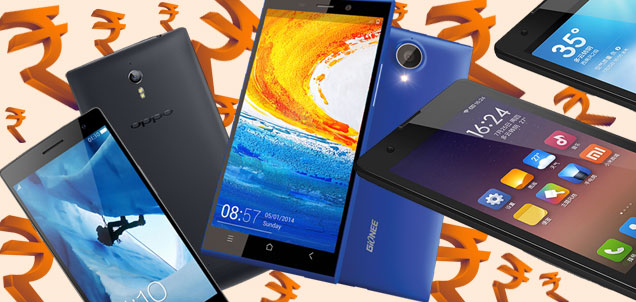
    Cut to 2014, to a time when China’s No 1 smartphone brand, Xiaomi, holds weekly sales for the Redmi 1s (while flash sales for the Mi3 are said to be back this festive season). Try not to blink, though;  it takes anything between 2.4 seconds to 5 seconds for Xiaomi’s phones to get sold out. Meanwhile, another Chinese brand, Gionee, has released a high-decibel campaign claiming a user upgrades to a Gionee every seven seconds.


    Not too far behind comes China-born OPPO Mobile, with 10 models ranging from the affordable to high-end. It even has Hrithik Roshan and Sonam Kapoor as brand ambassadors. As of August, these phones are estimated to have a market share of 5 per cent in the Indian smartphone segment.


    Not much compared to Samsung’s 29 per cent, but then again, six years ago, homegrown brand Micromax was just at 1 per cent, and is now perched at No 2 with a market share of 18 per cent in smartphones. With these numbers, it would seem naïve to write off China’s entry.


    So what is it about these phones that is helping Indians overcome their prejudices? Suman Srivastava, founder and innovation artist, Marketing Unplugged explains “Futurebrand, in its 2014 report, found that China ranks No 9 in the global list of the Best Country of Origin. Brands like Lenovo, Alibaba and maybe Xiaomi, are helping China improve,” he says.


    “Till about five years ago, Chinese companies sold cheap, poor quality phones in India. Despite being the manufacturing capital of the world, the bias against China-made phones obviously grew after one saw these products,” says Manu Kumar Jain, India head, Xiaomi. Arvind R Vohra, Gionee’s India head, adds, “It wasn’t long before Chinese brands realised they could enter the Indian market themselves, considering they had the manufacturing capability,” he says.


    But whether it’s Xiaomi, Gionee or OPPO, they all agree about three things – the power of a great product, innovation and competitive pricing. Forces strong enough to overcome any anti-Chinese sentiment. “The products themselves are the key to success,” says Tom Lu, CEO, OPPO Mobiles India. “Any user looking for a great device and an incredible experience will choose a product based on its features, specifications, looks and ROI.”


    Jain attributes Xiaomi’s success to the build quality, the chipset, the camera and the works. A phone is worth nothing if it doesn’t come with great hardware and software, he says. Affordability is and always has been the Indian buyers’ weakness. Here is where these brands believe they score over established names. “We are an aspirational brand, because of the way we price ourselves,” Vohra elaborates.


    “Our phones cost 10 per cent more than Indian-make phones in the same segment, but 40 per cent lesser than Samsung.” Jain believes that the Xiaomi Mi3, for instance, packs a punch at Rs 13,999. “We are selling a phone easily worth over Rs 40000 at such a low price. Buyers tend to forget their biases when they get value for money.”


    But how has the journey been for the Chinese-origin Lenovo, who forayed into smartphones recently? A brand known for PCs, laptops and tablets, it certainly didn’t have to introduce itself. But then, it couldn’t have been easy to get consumers to associate the name with smartphones, either.


    “We are a company with Chinese origins, but consider ourselves a global brand,” explains Lenovo’s Shailendra Katyal, director – home and small business (India & South Asia). “We have the advantage of a portfolio over price. It also helps that we aren’t an unknown, entry-level brand in the smartphone ecosystem.”


    Mr Katyal believes that consumers aren’t ignorant – they know that the origins of almost everything they purchase can be traced back to China. “Consumers now look for products that are of value to them.” Srivastava believes that cheap products never undermine strong brands, but only create a different market.


    For instance, Nokia did not lose out because of cheaper phones, but because of better technology from Samsung and Apple. Hence, Samsung won’t suffer as long as it keeps investing in both technology and brand. Established brands have another advantage – a nationwide distribution network.


    Brands like Xiaomi, for instance, retail exclusively on Flipkart, while OPPO Mobile is looking to build its offline retail network. But at the moment, the brand relies heavily on e-commerce portals. Most new companies cannot kick things off with a fully developed distribution system; it takes time, effort and huge spending power.


    For these companies, e-commerce portals are a boon. Customers today are open to buying electronics online, what with a cash-on-delivery option and portals like Flipkart and Amazon. Mr Jain has another good reason to embrace online retailing. “Tying up with distributors and retailers means having to hike the price of the product. We would rather save on that margin and pass it on to consumers.” That is also a reason Xiaomi chooses to have zero ad spends, depending only on word-of-mouth and organic social media for promotion.


    Mr Vohra surprisingly has a different point of view. “Online consumers add up to only 6 per cent of the consumer base. How does a brand reach the other 94 per cent without retailing offline? To me, exclusive online tie-ups are a lazy strategy.” He claims that there is close to zero brand recall in the interim period between sales. Srivastava sums this up neatly. “It is hardly surprising that e-commerce brands are willing to pay for valuable mobile desktop space. However, its value will fall as the space gets more crowded. Another method will then be needed to catch the eye of the consumer,” he says.


    Especially relevant considering Indians change their phones once every 1 to 1.5 years. Lu sees the potential in the consistent growth in the smartphone market, driven by enhanced consumer preference for smart devices and narrowing price differences.


    Meanwhile, Mr Vohra is eyeing the 70 per cent market that is yet to migrate from feature phones, as is everyone else, surely. Even if ‘may you live in interesting times’, is not as many believe an ancient Chinese curse or proverb, these are definitely interesting times for these brands to be living through. A chance to rewrite history and a level playing field where just about anyone can be king of the ring.


    How the giants are taking it

    Are the brands from across the border causing a dent in Samsung’s confidence and possibly in its market share? “Not at all,” says Rajiv Mishra, VP – media and spokesperson, Samsung India. “We are No 1 in India for a reason.” He owes the brand’s position at the top to the company’s India-specific focus on R&D, product development and a large consumer touchpoint network.” He admits to competition being great for the consumer, and provides Samsung an impetus to keep innovating.


    Nokia, too, seems unfazed by competition, with India being one of its top four markets for the Lumia series. Raghuvesh Sarup, director – marketing, Nokia India believes that Microsoft has the edge because of its consumer-centric approach with the Lumia.


    “We encourage people to do more and get more out of their devices. People spend on phones only because they want the experience of doing everything they need to in a single place.” End-to-end experiences are a Microsoft differentiator, Sarup believes, something that isn’t easy for the competition to accomplish with ease.


    Source:The Economic Times

    Copyright © 2014, Bennett, Coleman & Co. Ltd. All Rights Reserved

    Licensed to republish

     

  • 1.7 lakh citizens join national online circle for ‘Swachh Bharat’

    By A Correspondent


    Seeking to convert ‘Swachh Bharat Mission’ into a ‘Jan Andolan’, the Ministry of Urban Development has enabled an online platform to enable the citizens network with each other locally and at national level to collectively take up cleanliness activities. In this regard, the Ministry is taking the help of ‘LocalCircles’, a community social media platform.


    A national circle, ‘Swachh Bharat’ has been launched and already 1,70,000 citizens have joined this circle.


    This social media platform enables citizens to easily come together, exchange ideas on cleanliness, take up appropriate cleanliness activities in their neighborhoods, share pictures of collective efforts, engage with elected representatives and take the cleanliness campaign forward. The National Circle ‘Swachh Bharat’ enables participants to know about the best practices for adoption. Further, it also enables considered and collective inputs to the implementing agencies on a regular basis on issues like garbage collection and disposal, promotion of civic sense and interventions, if any, required from the concerned agencies.


    To access the ‘Swachh Bharat’ circle, citizens can visit ‘http://www.localcircles.com’ and use invited code-SWACHHBHARAT.


  • Surewaves reports double growth this festive season

    By A Correspondent


    SureWaves MediaTech Pvt Ltd has reported a 100 per cent surge in festive advertising over the year 2013 across key sectors. The biggest spenders this season are from sectors such as FMCG, Food & Beverages, Automobiles, Personal Healthcare, Financial Services, Online Retail and Cellular Phone Services.


    Vis-à-vis last year, sectors such as Cellular Phone Services, Online Retail, Personal Healthcare, Automobiles and FMCG have increased the ad spend on SureWaves Spot TV Network by 297 per cent, 257 per cent, 137 per cent, 119 per cent and 109 per cent respectively. A large thrust of this spend is coming from brands who are targeting the bullish demand in tier 2 and tier 3 cities of the country. What is noteworthy is that segments such as incense & fragrance along with building materials are aggressively increasing their presence during the festive season.


    Talking about the trend, Mandar Patwardhan, COO, SureWaves MediaTech Pvt Ltd said, “This is the clear indication of the positive mood prevailing in the country and we are glad that large media buyers and national advertisers are now seeing the value of a media platform like ours that allows brands to tap into the combined audience of the highly popular local and regional TV channels in their target markets and also gives them measurable return on investment.”


    SureWaves have developed technology to aggregate local cable and regional satellite TV channels across India allowing advertisers to work through a single platform. SureWaves’ technology is a combination of cloud-based solutions and expert customer profiling. It ensures advertisers have the flexibility to choose their target audience; restrict advertising to a specific region and receive real-time reports on the TV ads placed by them.


  • Helios Media assigned the revenue mandate of EPIC

    By A Correspondent


    The EPIC Channel has assigned the revenue monetization duties to Helios Media. With a clear focus to create unique and original content within the Indian history, folklore and mythology genre, in a very contemporary story telling format, The EPIC Channel is the first ‘segmented’ channel in Indian television. The EPIC Channel will be launched by the end of this year.


    Speaking on the appointment, Mahesh Samat, Founder and Managing Director, EPIC Television Networks Pvt. Ltd, said “The EPIC Channel is on the anvil of revolutionizing the way television is being consumed in our country. The ‘segmented’ content will allow viewers to choose and consume genre-specific content of their liking. This therefore becomes an ideal destination for brands to reach out to the appropriate TG. Helios Media has the understanding of the space and the skill to position brands in the right environment. I am certain that this partnership will add value to an unconventional brand like ours that is creating a new category altogether.”


    The EPIC Channel will have action, drama, comedy, and thrills set against the backdrop of Indian history and mythology. The programming line-up will be a mix of fiction and narrative non-fiction shows, short form content, as well as period films. An original style of storytelling with high production quality, the EPIC channel will have a look and feel that is distinct and appealing to both men and women.


    Divya Radhakrishnan

    Divya Radhakrishnan, MD of Helios Media said “At Helios Media, it’s ingrained in our DNA to look Beyond Obvious and See More. We always swim against the tide and have created success stories of the channels we have been assigned to. It’s our honour to partner with this new leap in broadcast history that will be written by the EPIC Channel”


    Launched in 2011, Helios Media has been providing broadcasters with critical expertise in the areas of revenue management and several allied business solutions. Helios Media currently manages monetisation mandates of MTunes HD, Channel X, FoodFood, Sanjeev Kapoor’s Khazana, Fashion TV and Life Mantra.


  • Mobext appoints Marco Rigon as its global head

     By A Correspondent


    Marco Rigon

    Mobext announced that it has appointed Marco Rigon as its global head, to further develop Havas Group’s overall mobile marketing strategy for its clients worldwide.


    Mobext, Havas Media’s award winning specialist mobile label, has offices in 53 countries around the globe which makes it the largest integrated mobile marketing agency and the first one to offer specialised end-to-end mobile marketing services within the global arena. Marco will work across all areas where mobile has an impact for clients and as Mobext continues to work in close collaboration with the group’s other products and services.


    Prior to joining Mobext, Marco spent six years as Associate Director at Phonevalley, Publicis Groupe’s mobile marketing agency. Previous to this he worked as business development director for Sharp Mobile in Southern Europe, and has also worked as a consultant supporting mobile operators such as Orange and Vodafone.


    With such long-standing expertise in digital marketing and emerging technologies, and having worked in the US, Europe and APAC, Marco, 38, will be charged with developing innovative, non-intrusive mobile experiences which connect consumers with brands across all of the group’s global operations.


    Marco Rigon commented: “It’s been clear from my meetings with Havas that they are serious about their investment in mobile and understand the power and impact it will have for their clients’ businesses. Mobext’s team of technologists, designers and strategists share my passion for creating innovative, meaningful experiences for people. With teams of experts in 53 offices around the world we are already in a great position to leverage its significant international expertise.


    I am particularly excited to join Havas Group as I can see how the group’s more integrated and flexible structure will allow me to push mobile thinking across its teams, without any inter-company barriers or silos.”


  • Stars not on Facebook, Twitter could lose on endorsements

    By Ratna Bhushan


    Last month, a Bollywood A-lister actress lost out a Rs 3-crore-a-year endorsement deal for a multinational beauty brand to a relatively new actor. Reason: the latter was much more active on Twitter and Facebook and the brand wanted to reach out to social media audiences.


    And despite Hrithik Roshan’s new release Bang Bang proving a super hit, consumer goods firm Emami, which signed Roshan for HE men’s deodorants this summer, is looking for a new face for social media. “Hrithik has a huge mass connect on traditional media. But with different audience logging on to social media, we may rope in a new face only for social media,” Emami director Harsh Agarwal said.


    With social media emerging as one of the most popular hangouts for Indians, brand endorsement deals in the country are getting hugely influenced by how active celebrities are on Twitter, Facebook, Instagram and blogs. “Celebrities who engage actively on the social media space are getting paid at least 25-30% higher than those who don’t, even if the latter have huge mass connect,” said Vinita Bangard, promoter of talent management firm Krossover Entertainment, which represents Priyanka Chopra and Shah Rukh Khan.


    “The socially active ones have a clear edge not only in terms of higher fees but also in getting more endorsement deals.” Chopra, with over 7 million followers on Twitter, is a hot favourite, along with stars like Amitabh Bachchan, Shah Rukh Khan, Aamir Khan and Salman Khan who all have more than 8 million followers. Some firms, including Coca-Cola India, have begun inserting a clause in their endorsement contracts that celebrities will popularise the brand on their social media assets, for an additional fee.


    So, Farhan Akhtar, who endorses Coca-Cola, and Salman Khan, who is the face of Thums Up, not only feature on the brands’ advertisements but also are regularly tweeting and posting photos of themselves with the brands they promote. Many brands now go for exclusive social media endorsement deals at just about 10%-20% fees of a television endorsement deal.


    For example, a reigning A-grade actress who charges Rs 1.5-1.7 crore for a television endorsement deal, charged only Rs 30 lakh to tweet for two months about an upcoming consumer brand, a talent firm head said. Endorsement deals exclusive to social media are being inked at Rs 20-50 lakh a year, while top celebrities’ fees for TV commercials range from Rs 2-6 crore annually. “It (social media) completely optimises spends and has become an extremely effective medium,” said Atul Kasbekar, promoter of celebrity management firm Bling Entertainment.


    Chocolate brand Cadbury Dairy Milk has had a series of upcoming faces including Bollywood starlet Hazel Keech and model Karishma Kotak tweeting about their experience of eating Dairy Milk Silk Caramello chocolate. The tweets created the necessary buzz for the brand at about one-fourth the cost that Cadbury would have to otherwise shell out to rope in a well-known star for television.


    Likewise, PepsiCo used hugely popular actor Ranbir Kapoor only on social media earlier this year for its biggest ad platform — the IPL T20 cricket tournament, though cricketers MS Dhoni and Virat Kohli were shown extensively on television ads. “We leverage our brand ambassadors through campaigns and activation via different mediums,” PepsiCo senior director, marketing (social beverages), Ruchira Jaitly said. With social media ad spends rising faster than traditional media, the online celebrity endorsement business is now growing 25%-30% faster than the traditional space. “Digital isn’t an option anymore.


    It’s something we have to do to make ourselves future ready,” said KK Chutani, executive director for marketing at Dabur, which recently dropped Bipasha Basu as the face of Dabur Honey and roped in celebrity chef Vikas Khanna to endorse the brand on social media because he is active on Twitter and Facebook. Chutani said close to half of ad spends of Dabur’s juice brand Real is now directed at the digital space.


    Source:The Economic Times

    Copyright © 2014, Bennett, Coleman & Co. Ltd. All Rights Reserved

    Licensed to republish

     

  • Apple ranks #1 and Google #2 in Interbrands Best Global Brands


    By A Correspondent


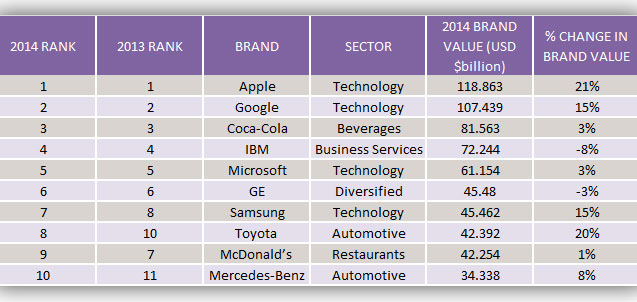
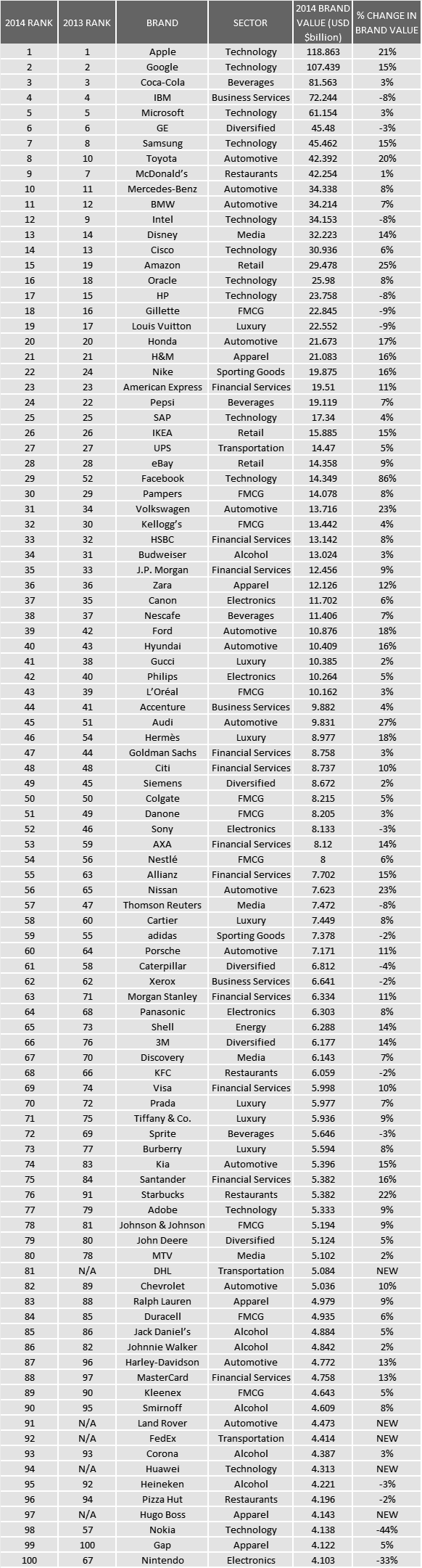
    For the second year in a row, Apple and Google claim the top positions on Interbrand’s Best Global Brands ranking. Valued at USD $118.9 billion, Apple (#1) increased its brand value by 21 percent. Google (#2), valued at $107.43 billion, increased its brand value by 15 percent. For the first time in the history of Best Global Brands, two global brands – not just one – have each earned a brand value that exceeds USD $100 billion.


    Huawei (#94), the Chinese telecommunications and network equipment provider, also makes Best Global Brands history as the first Chinese company to appear on Interbrand’s ranking. With 65 percent of its revenue coming from outside of China and with its earnings continuing to climb both domestically and across Europe, the Middle East, and Africa, Huawei is quickly becoming one of the largest telecommunications equipment makers in the world. The company is currently the third largest smartphone manufacturer in the world-just behind Samsung and Apple. The Chinese brand is one of five new entrants to enter the Best Global Brands ranking this year-the others being DHL (#81), Land Rover (#91), FedEx (#92), and Hugo Boss (#97).


    “Apple and Google’s meteoric rise to more than USD $100 billion is truly a testament to the power of brand building,” said Jez Frampton, Interbrand’s Global Chief Executive Officer. These leading brands have reached new pinnacles-in terms of both their growth and in the history of Best Global Brands-by creating experiences that are seamless, contextually relevant, and increasingly based around an overarching ecosystem of integrated products and services, both physical and digital.”


    Interbrand’s Best Global Brands methodology analyzes the many ways a brand benefits an organization-from delivering on customer expectations to driving economic value.


    When determining the top 100 most valuable brands each year, Interbrand examines three key aspects that contribute to a brand’s value:

    >> The financial performance of the branded product and service
    >> The role the brand plays in influencing customer choice
    >>The strength the brand has to command a premium price or secure earnings for the company


    2014 Overview: Brands Entering the “Age of You”

    In addition to identifying the top 100 most valuable brands, this year’s Best Global Brands report also examines three pivotal ages in brand history that have reshaped business for the better: the Age of Identity, the Age of Value, and the Age of Experience. Interbrand contends that a new, emerging era is upon the global business world: the Age of You.


    “As consumers and devices become more connected and integrated, the data being generated is creating value for consumers, for brands, and for the world at large,” said Mr Frampton. “As a result, brands from all categories and sectors will get smarter-with products and devices working in concert with one another, across supply chains, and in tandem with our own individual data sets. Brands that seek to lead in the forthcoming Age of You will have to create truly personalized and curated experiences, or what we call ‘Mecosystems,’ around each and every one of us. Such brands will have to rehumanize the data, uncover genuine insights, and deliver against individual wants, needs, and desires.”


    Said Ashish Mishra, Managing Director, Interbrand India, “The Age of You era that is upon us will enable micro-segmentation, absolute customisation and personalisation – notions hitherto considered impossible. In the flat world of now, the elements of the future ecosystems are all ready. However disjointed developments around Big data, technology platforms, content, software, devices and apps together have created a complex information over class. The need of the hour is to integrate them around the customer needs and desires. And to do so, we will need to employ both intelligence as well as imagination, thus creating inspiring precedence for the world to follow”


    Key Report Highlights


    2014 TOP RISERS: Facebook (#29, +86%), Audi (#45, +27%), Amazon (#15, +25%), Volkswagen (#31, +23%), and Nissan (#56, +23%)


    Facebook (#29, +86%): The world’s largest social network, Facebook continues to exceed expectations. Reported on its Q2 earnings call, income from its operations was a staggering USD $1.4 billion. One year prior it was USD $562 million. Facebook’s ad business on mobile phones has been particularly strong. For the first time in its history, the company reported that revenue from advertising on mobile phones exceeded half (53 percent) of all its advertising for the quarter. Facebook’s acquisitions of messaging service WhatsApp for USD $19 billion and Oculus VR for USD $2 billion signal a new strategy unfolding. The company is building a vast product portfolio, brimming with competing services and apps.


    Audi (#45, +27%): Audi is the top-rising automotive brand in this year’s Best Global Brands report. It was a record-breaking year for the brand, having sold the greatest amount of cars in its history, and having achieved an operating profit of more than USD $6 billion. The company also awed audiences at the 2014 International Consumer Electronics Show (CES) in Las Vegas, Nevada with its A7 self-driving car. Audi also plans to introduce 17 new or revamped models this year and will move forward with the production of an electric version of the R8 sports car in a push to gain momentum on rival BMW (#11). The company also plans to invest more than USD $30 billion through 2018 in new products, technology, and production sites. Earlier this year, it also announced a partnership with Google, which will allow Audi drivers and passengers to use an Android-powered entertainment and information system that will run on the car’s hardware.


    Amazon (#15, +25%): It was another banner year for Amazon, “Earth’s most customer-centric company.” Amazon’s commitment to responsiveness has become part of the brand’s mythos. It continues to grow its core business through services such as Amazon Prime, which, at one point, garnered more than a million subscribers in a single week. Expansions on previously popular product lines-the new Kindle Paperwhite and Fire Phone-brought more customers into the Amazon ecosystem, while a content licensing agreement with HBO helped it to make a bigger push into the entertainment sector.


    Volkswagen (#31, +23%): Volkswagen, Europe’s leading automaker and one of this year’s top-rising Best Global Brands, is striving to become the world’s leading automaker by 2018. Its latest model, the XL Sport, recently debuted at the Paris Motor Show and served as yet another symbol of the innovative power, passion, and technical competence of the Volkswagen brand. Beyond its manufacturing and design capabilities, Volkswagen’s “Think Blue” concept continues to prove that ecological sustainability remains a top corporate objective.


    Nissan (#56, +23%): Nissan continues to drive up the Best Global Brands ranking with improved financial and brand performance. Nissan’s leadership consistently pushes brand building as a major priority across the organization, clearly identifying the link between a strong brand and market share. Nissan’s recent car launches-Qashqai, Murano, and Rogue-have demonstrated how its “Innovation and Excitement for EVERYONE” brand positioning is shaping its product lineup.


    2014 NEW ENTRANTS: DHL (#81), Land Rover (#91), FedEx (#92), Huawei (#94), and Hugo Boss (#97)


    DHL (#81): The burgeoning e-commerce market has opened a sea of opportunity for delivery and logistics companies. As international online shopping continues to grow-and is poised to grow 200 percent in the next five years-brands like DHL and FedEx have made strides in bolstering their e-commerce capabilities. The most valuable brand of the new entrants to this year’s Best Global Brands ranking, DHL announced recently announced a five-year strategy plan aimed at tapping emerging markets to grow its global market share. As part of its plan, its MAIL division will be renamed Post – eCommerce – Parcel to better reflect its character under the new strategy.


    FedEx (#92): FedEx is also realigning its business to make the most of the booming e-commerce sector. Earlier this year, the company launched a new service designed to make it easier for customers to control when and where packages are delivered. The service is called FedEx Delivery Manager and is available through multiple digital platforms, including a free mobile app. Customers can request alerts via email, SMS text, or phone. FedEx has also developed a host of Web-based services to help brick-and-mortar retailers boost their online sales. Retailers can easily integrate FedEx’s Web Services platform into their own Web systems-allowing them to track shipment information. With FedEx’s Web Integration Wizard, its customers can track the shipments directly via the retailer’s home site.


    Land Rover (#91): British carmaker Land Rover continues to refine its product lineup with fresh styling, high-tech platforms, and downsized engines. Since being acquired by Indian automobile company Tata Motors in 2008, Land Rover has witnessed double-digit growth each consecutive year. This past year, Land Rover’s unit sales rose 15 percent year-over-year to nearly 350,000.


    Huawei (#94): As mentioned previously, Huawei is both a new entrant and the first Chinese brand to ever appear on the Best Global Brands ranking. In 2013, the Chinese telecommunications and network equipment provider reported a net profit increase of 34.4 percent to CNY ¥21 billion (USD $3.38 billion) up from CNY ¥15.6 billion in 2012. As companies, as well as entire industries, continue to shift from legacy storage and equipment to more agile products (cloud services, 3G routing, security solutions, etc.), Huawei is poised to dominate key areas of the IT market-from mobile phones to carrier-grade networks.


    “Huawei’s rapid growth and long-term investments in its brand helped it earn a place among the world’s most valuable brands,” said Frampton. Despite its low brand awareness in the U.S., Huawei has gradually expanded its reach around the world. It continues to demonstrate its technological prowess in both its consumer products as well as in its enterprise solutions-and it remains well positioned to meet the needs of customers in both emerging and developed markets.”


    Hugo Boss (#97): Hugo Boss, the German fashion house, was one of the strongest-performing apparel brands globally in the past year. The company saw revenue grow 10 percent in Europe, where it makes more than half its sales, while the Americas grew 7 percent, and Asia grew just 2 percent, largely due to China’s slowing economy. On the whole, Hugo Boss is moving away from selling through partners and starting to run its own stores, allowing it to have greater control over price points and the way the clothes are presented. This year, Hugo Boss celebrated its 20th anniversary with an exhibit at the Saatchi Gallery in London, a microsite, and a multichannel campaign. The microsite offered a look into the Saatchi Gallery exhibit by illustrating 20 iconic Hugo Boss items and 20 internationally acclaimed artists. Clicking on a product brought consumers directly to the e-commerce site where they could either purchase the product or find it in a store.


    Key Sector Highlights


    Leading automotive brands continue to rethink the future of mobility. A combined focus on energy-efficient products and integrated technology is helping leading auto brands drive brand loyalty and value.

    This year, the collective brand value of the automotive brands appearing on the Best Global Brands ranking increased 14.6 percent. All 14 automotive brands collectively make up a combined brand value of USD $211.9 billion. With three out of the five Top Risers hailing from the automotive sector, the past year proved to be a record-breaking one. This year’s top 14 automotive brands include: Toyota (#8, +20%), Mercedes-Benz (#10, +8%), BMW (#11, +7%), Honda (#20, +17%), Volkswagen (#31, +23%), Ford (#39, +18%), Hyundai (#40, +16%), Audi (#45, +27%), Nissan (#56, +23%), Porsche (#60, +11%), Kia (#74, +15%), Chevrolet (#82, +10%), Harley-Davidson (#87, +13%), and Land Rover (#91, NEW). Toyota, which has been the most valuable automotive brand on the Best Global Brands ranking since 2004, continues to be a leader in green technology development. Since the launch of its first-generation Prius 17 years ago, Toyota has sold a total 3.2 million units of the vehicle globally. Toyota has also expanded its hybrid range to a total of 25 vehicles, including the Prius Plug-in Hybrid. Toyota plans to spend USD $7 billion on environmental technology in the fiscal year ending March 2014, an increase of 11 percent compared to the previous fiscal year. ­With the era of the connected car rapidly approaching, the sector’s Top Risers-Audi, Volkswagen, and Nissan-are working to redefine the essence of the driving experience and build stronger emotional ties with their customers.


    The technology sector leads as the most valuable category overall. Legacy and one-time leading brands struggle to evolve at the pace of change.

    Out of this year’s top 100 brands, 13 hail from the tech sector. The category as a whole grew 11.3 percent year-over-year, and collectively is worth USD $493.2 billion in brand value. While Facebook (#29, +86%), Apple (#1, +21%), and Google (#2, +15%) represent this year’s fastest growing brands, a number of one-time leading brands experienced the steepest decline in brand value. Finnish communications and information technology provider Nokia (#98, -44%) experienced the largest decline in value among the top 100 brands, dropping from its #57 position in 2013 to #98 this year. Once a dominant player in the cell phone industry, it has seen its market share decline steadily since 2010, struggling to compete against rivals Apple and Samsung. Microsoft (#5, +3%) acquired the Finnish brand’s consumer products in April this year, and despite changes in leadership and operational structure, it remains unclear how Microsoft will use the brand and how it will evolve in the future. Japanese consumer electronics company Nintendo (#100, -33%), had another difficult year. The brand fell 33 places this year to take the #100 position, with a brand value of USD $4.1 billion. The company has acknowledged its woes in the hardware space, and CEO Satoru Iwata also publicly stated that the company must evaluate other opportunities, including those in the mobile market. Earlier this year, he announced that the company has plans to start a new health-related business by March 2016.


    Against the backdrop of global economic recovery, financial services brands experience growth in brand value.

    The value of financial services brands has experienced steady growth in recent years. All 11 financial services brands appearing on this year’s Best Global Brands ranking increased in brand value: American Express (#23, +11%), HSBC (#33, +8%), J.P. Morgan (#35, +9%), Goldman Sachs (#47, +3%), Citi (#48, +10%), AXA (#53, +14%), Allianz (#55, +15%), Morgan Stanley (#63, +11%), Visa (#69, +10%), Santander (#75, +16%), and MasterCard (#88, +13%). On the whole, companies within the financial services industry are continuing to build brand value by engaging with their customers and providing more seamless, convenient, and fully integrated experiences. Many financial services organizations have increased investments in mobile marketing, social media, online video, and more-and such efforts, as evidenced by this year’s Best Global Brands ranking, are paying off.


    Leading luxury brands continue to embrace digital platforms. A new era of exclusivity is paving the way for personalization and curated brand experiences.

    While luxury brands have been slower to embrace online channels, the rise of digital sales, online browsing, and brand consideration is forcing them to reimagine their respective customer experiences. As reported by Luxury Interactive and ShopIgniter, 65 percent of luxury marketers expect digital marketing to be the most important form of marketing for their brand.


    Detailed brand profiles, thought leadership articles, interactive charts, and interviews with brand leaders from around the world are available at bestglobalbrands.com.


  • Digital, data & talent dominate at 1st Omnicom India summit

    By A Correspondent


    The Omnicom Group concluded its first summit of India agency heads in Udaipur last week with a full spectrum of creative industries represented by a group of over 35 CEOs and Managing Directors, clients and India market experts.  The summit brought together Omnicom operating companies including DDB Mudra, BBDO, TBWA, CPM, FleishmanHillard, OMG, Interbrand, Flamingo, Ketchum Sampark and others in the creative space to discuss the tectonic changes affecting their industries and clients’ businesses.


    Attendees heard from speakers including KPMG, Deutsche Bank, Google India, PepsiCo, Hindustan Unilever, MicroMax and the Tata Group; regional Omnicom and agency representatives and from digital and e-commerce industry experts such as Amiya Pathak from ZipDial and eTailing India’s Ashish Jhalani.  They discussed the potential of the next wave of digital growth, the e-commerce opportunity and the application of data and creative industries; industry experts focused on the changing nature of the Indian media landscape, the reshaping of the demographic dividend and how the political environment is likely to reboot India’s creative industries.


    Omnicom participants included DDB Mudra’s Madhukar Kamath, BBDO’s Josy Paul, Jasmin Sohrabji of OMG, Vineet Bajpai of TBWA\ India and Mandeep Singh of CPM India.


    Dara Akbarian, Omnicom’s regional CFO for APIMA, explained that the summit was designed to bring Omnicom India business leaders together to strategize how the next wave of growth in India will take shape and how each business can position itself to support our Indian and multinational clients capitalizing on this growth:  “We heard some fascinating points of view and the collective voice was resounding.  Omnicom agency heads firmly believe that our industry has only scratched the surface of the digital opportunity and there is much more to come from India.”  He added that the idea of holding an in-India, for-India meeting was to gather the spectrum of operational companies’ experiences to build a collective strategy for Omnicom business growth in India.  “There are organic and inorganic opportunities that will help all of us to grow in this dynamic market, and our agency heads recognize the potential we need to target to accelerate our position in India.”


    Some of the decisions made at the event include a greater investment in talent programs to find and keep the next generation of creative industry talent, to develop a deeper entrepreneurial culture in keeping with India’s changing demographics, and investments to tap the so-called DRIP effect (data rich, insight poor) that India currently faces with big data and creative sector work.


    Shivakumar, Chairman and CEO, PepsiCo India Holdings Pvt. Ltd., said, “It was a pleasure to take part in the first Omnicom India event especially since Omnicom is a key PepsiCo partner.  The focus on digital, creative and integrated campaigns was enlightening.  The future of marketing in India will be based on these pillars and Omnicom agencies understand and demonstrate the need to come together to deliver work that our business needs. This market is ready and hungry for creativity that challenges and campaigns that go beyond the traditional media reach.”


    Added Rajan Anandan, Managing Director Google India: “It was interesting to meet Omnicom’s full mix of creative agencies at a single event.  And, thankfully, we were able to move beyond ‘the potential is big’ discussions I hear all too often in India.  What these agency heads understand is the future of Indian creative industries is moving beyond the shock and awe of how big digital is or what it can offer, and into the areas of how can Indian companies make the most of this potential.”


  • MxMIndia is closed Oct 23-26 for Diwali

    We understand how important reading MxM is to some of you each weekday. Given the feedback we received to the recent four-dayer at Dassera that we should issue long holiday intimations in advance, we wish to inform you early that there will be no scheduled MxMIndia update or edition from October 23 to 26.


    So make this Diwali break mails-free. Carry your smartphones, but don’t worry too much about what’s happening in the world of A&M around you.


    Also: We do have an edition on Wednesday, October 15, the day of the Assembly elections in Maharashtra and Haryana.


  • Rajshri Entertainment to partner New MSN in India

    By A Correspondent


    Rajshri Entertainment has announced its collaboration with New MSN, Microsoft Corp.’s information and entertainment network. Short form digital entertainment and special interest content, produced and aggregated by Rajshri Entertainment, will be showcased on the New MSN in a comprehensive and powerful way across the web and application experience. The New MSN is comprehensive and broad, bringing content from the most well-respected and influential media sources together in one place.


    Rajshri Entertainment is a digital entertainment powerhouse, which produces content across multiple genres and languages. These branded channels range from lifestyle to e-news and from kids to devotional. All content produced is in high definition. The partnership will ensure the content reaches a wider audience, across the globe.


    Speaking about the association, Inderpal Singh, General Manager, Content Alliances, Rajshri Entertainment Private Limited, said, “We are excited to partner with MSN for their new entertainment service. We are producing over 150 minutes of original video content on a daily basis including entertainment news, food shows, health and wellness, devotional amongst others. Our videos have generated billions of views on leading digital platforms worldwide. We are confident that the new MSN video service will help us reach a wider audience in India and overseas.”


    “Built from the ground up, the new MSN combines comprehensive content from the world’s leading media outlets with powerful tools to help you do more,” said Sanjay Trehan, Executive Producer, MSN India. He added, “We’re excited to continue our relationship with Rajshri Entertainment & continue to inspire people to discover new things about themselves and the world around them.”


  • LinTeractive to manage Woodland’s digital mandate

    By A Correspondent


    LinTeractive, the digital division from Lowe Lintas + Partners has been awarded Woodland’s online business. The partnership comes on the back of Woodland’s close association with Karishma Lintas, a creative agency of Lowe Lintas + Partners that has been handling the brand’s creative mandate for over two decades.


    Woodland is a leading Indian lifestyle brand operating successfully in the footwear, apparels and accessories domain. With the digital expertise that would be offered by the agency, Woodland aims to create innovative digital and social marketing engagements that will further enrich the brand experience.


    Sharing his views on the new appointment, Harkirat Singh, Managing Director, Woodland said, “We’re glad to have LinTeractive as our digital partner. We’re confident of charting out a bullish growth trajectory across our verticals on the back of the expertise and solutions that would be offered to us by the digital agency.”


    As part of the association, LinTeractive would be handling online community management, web development, content development, and media duties for Woodland.


    Sharing his views on the role that would be essayed by the agency for brand Woodland, Vikas Mehta, Chief Marketing Officer, Lowe Lintas + Partners and Executive Director – LinTeractive said, “Woodland is one of the few Indian brands that have successfully built a strong lifestyle stature for itself, especially among youth. You can’t build a youth brand today without innovating on digital platforms and our agency is very excited to enter Woodland’s timeline. We believe the enormous experience of Karishma Lintas, coupled with LinTeractive’s domain expertise should create some compelling brand stories, on and offline.”


    As part of the growth graph, Woodland currently has 300+ company owned exclusive Woodland stores across various cities in India that are growing at a healthy rate of 25 to 30 per cent. The brand also has a presence in more than 3,000 plus multi‐brand outlets in a number of countries. With the new partner-agency, the focus would be to get consumers to experience the brand on a more profound level.


  • Federal Bank launches campaign focussing on Elections

    By A Correspondent


    With the Maharashtra Assembly elections close at hand, Federal Bank is encouraging the people of the state to step out and vote by exercising their right to vote.


    The film exhorts people to exercise their franchise in pursuance of a cause – no matter what it is. The single minded emphasis is on action and the fact that not voting can never be the answer in a democracy. The soundtrack used is Maharashtra’s popular Nashik Dhol to add to the local flavor.


    The full version of the film has been released online. The edited version of the film will be played across theatres in Maharashtra, in association with the Election Commission of India & Collector, Mumbai City.