Category: NEWS

  • Nitin Kukreja: Role of broadcast in growing sports in India

    Nitin Kukreja

    Nitin Kukreja, President – Sports, STAR India spoke at the India Pro Leagues Forum 2013 last Friday elaborating on the ever-growing interest in sports in the country and this interest is directed towards sports other than cricket. Extracts from the keynote:


    I’ll start with a few questions: Does ‘sport’ in India really begin and end with ‘Big Boys’ Cricket’? Or do we just see it that way? Across the length and breadth of India, there are strong communities and pockets of interest where people are passionately engaged with local sports and local players – football in Bengal, hockey in Punjab and Orissa, badminton in Hyderabad, basketball played in schools and table tennis played in clubs, colleges & offices across the country.


    But if a tourist landed in India and turned on the television or turned to the sports page of a newspaper, we could forgive him for thinking that India cares only about international cricket when Team India is playing.


    Why then, has this rich diversity of interest and talent not been harnessed? Why is it that in the media, on television and in the public mind-space, sport equals international cricket? How is it that the English Premier League enjoys such a phenomenal following within the UK when the English national football team has not won an international competition since 1966! Why is it that an average 18-year-old in South Delhi or Bandra is more emotionally connected to the fortunes of Manchester United or Chelsea than say the Mumbai Ranji side (40-time winner of Ranji trophy) or the Indian National Kabaddi team (winner of all 4 World Cups played so far)? You may argue that not many nations play Kabaddi other than India and Pakistan; well – you could say the same about Baseball! The US is the best example of a country that thrives on local sports and leagues – some of their sports are played in no other country – yet they call it “World Series Baseball” and Babe Ruth is an American hero and legend.


    Americans follow their city and college teams with a passion – across baseball, American football, basketball and ice hockey; Italy, Spain, Turkey – all follow their local soccer teams with a fanaticism; tourists visiting Galatasaray are advised not to wear rival team colours while visiting! And note that all these nations consume their sport in their own respective languages.


    In the last 15 years in India, entertainment and movie channels have gone local with a vengeance; the number of regional channels has gone up from just a handful pre-2000 to over 300 today; while Hindi accounts for ~55% of TV viewership; regional language content accounts for ~30% of viewership share; and it’s not just about language; a Bengali, Marathi or Tamil show is rooted in the local culture and ethos with participation from the local creative fraternity


    It is only the sports genre in India that has remained aloof from localization – until 2008 there was no IPL, and until 2012, telecast of cricket was limited to English, a language spoken by less than 10% of India.


    In India then, how can we take local sports and leagues to the next level? Broadcasters have a big role to play in this but more importantly the entire ecosystem – the sports federations, the government and the news media and advertisers need to come together to ensure that our home grown leagues get the money, resources, infrastructure and coverage that they deserve;


    Look at the quality of television coverage for International cricket over the years – the evolution has been amazing – the production quality, the camera work, the graphics, the slow-motion replays and the immensely talented people who narrate the action – all these elements really take the television viewer closer to the game; it is immersive, engaging and a pleasurable experience even for casual viewers who are not dyed-in-the-wool fans; television coverage has played a huge role in growing the fan base and support for cricket; this is despite the fact that for all these years, all coverage was in English.


    But even in cricket – the more local forms of the game – be it Ranji trophy, Irani Cup or university cricket have so far been treated as the poorer cousin – the benchmark for coverage that has been set for international cricket needs to be duplicated in the local forms of the game. The fact remains all the international heavy weights – from Tendulkar to Yuvraj Singh to Kohli – have cut their teeth on and emerged from these local level tournaments;


    The task is even greater for other sports – where even the national level game has not got the coverage it deserves. Consider the coverage that an average hockey or football match gets – you see some indifferently placed cameras and a disinterested narrative; there has been no attempt to make the viewer experience the thrills, the speed or the skill involved; when you watch a badminton match live – it is astounding to see the speed of the game and the agility of the players. The current standard of television coverage does not even begin to capture that excitement and skill;


    In a pre-digitized world with limited bandwidth, TV broadcasters were forced to follow a one-size-fits-all approach and therefore focused on only saleable national-level content at the expense of local content and language; but in a digital world the consumer has ability to access a variety of content in multiple languages and on multiple platforms; broadcasters would be doing a great disservice if they continued to use a cookie-cutter approach and did not use this opportunity to go deeper and serve the interest of all pockets of interests whether by sport, region or language.


    Great production values are not enough, the on-ground event also needs to be organized and mounted like a spectacle – this is where the sports federations have a key role to play. They must enable and nurture talent, and promote and market the game at least in the locales of affinity if not in the whole country. They must do their part to ensure that the sports page carries interesting stories and coverage of the game and the players- and not only controversies! But most important, they need to partner with the other stakeholders in the ecosystem with the long term vision of growing the sport – without the spirit of partnership and the vision; the league or the sport will not grow.


    The government has a huge role to play – by allocating adequate monies, developing stadiums and infrastructure and putting in enabling policies in place. The government allocates around Rs. 1000 Cr. to Sports (and Youth Affairs) which is the budget for the current year. That number is less than what we will be paying only for one tournament -the ICC T20 world cup – that number is less than the number that STAR invests in sports each year. It means that Star is a bigger investor in sports in India than the government of India itself!


    The scale of magnitude of the government’s investment should be at least 10x of that number! Why do you ask? More than half of India’s population is below the age of 25 and 65% below 35; Sports has a crucial role to play in youth development and can even be a huge generator of employment. IPL has opened up career options for 120 players; not just 15. Hockey players can now make up to 60 lacs for one month of play in the HIL; badminton players can make 50 lacs for 3 weeks of work; not to mention the production, support and service staff that works on these leagues. When the hockey union went on strike in Canada a while ago, the prime minister of the country got involved because his fear was that a prolonged strike would have an adverse impact on the GDP of Canada! More than anything, it showed the power of sports and its ability to be a huge economic growth engine.


    Forget about investment, even simple hygiene factors such as easing procedures can go a long way – it cannot take 38 different permissions just to host a hockey match in a certain venue; increase venues and the number of permissions multiplies!


    It’s a vicious circle, since there is no investment, there is no growth and no popularity for local leagues and sports – therefore they attract no money! The common man (or woman) in India does not view “sport” as a viable career option or life choice; it remains a “hobby” to be pursued in free time;


    Star has thrown its weight behind building an enduring viewer proposition around local leagues and sports- and in the language of the people. Our tryst with these local sporting leagues has thrown up some interesting results:

    • We partnered with Calcutta Football League, one of the oldest leagues in Asia and in the world with 157 kolkata based clubs and units to air their league matches on our Bengali movie channel. In the core national male audience, the TV viewership is 4-5x higher than your average EPL match! Even with the current quality of football and coverage, an East Bengal-Mohan Bagan match attracts crowds up to 70000 in the stadium!
    • We also partnered with Hockey India League the first edition of which was held in January 2013. The excitement on grounds was to be seen to be believed. For e.g. grounds in Ranchi were completely packed to support their Ranchi Rhinos team which went on to win the league; there was a lathi-charge 2 days before the match when demand for tickets got out of hand and in fact when the match was on – even the neighbouring stadium that simply had a big screen projecting the match – was full! The excitement rivalled that seen in Wankhede stadium or Eden gardens during high-octane international cricket;
    • University cricket is another great example – during the Jamia vs Bangalore’s Jain university match, stadium was so packed that it took 40 mins to enter; and the crowd was chanting – not “Sachin Sachin”, not “India India” but “Jamia Jamia”!


    The pockets of passion exist; it is on us collectively to harness and magnify them


    The IPL has shown the way in how to mount a successful local league; granted that it was built on an already popular sport – but all the stakeholders have done a great job in coming together to mount it like a spectacle – it is no longer a game but entertainment and a serious alternate to any other movie or television show. Clearly, a “manoranjan ka baap”


    There is a lot more to be done and many challenges to overcome. It will take a spirit of partnership with federations and people with vision to get there – for the benefit of sports, for the benefit of the country and for a healthier and fitter society!


     

  • GroupM elevates Gaurav Hirey to Chief Talent Officer, South Asia

    By A Correspondent


    Gaurav Hirey

    GroupM has announced the appointment of Gaurav Hirey as Chief Talent Officer South Asia. Part of GroupM since 2008 and currently Regional HR Director, APAC, Mr Hirey will relocate to Mumbai with effect from January 1, 2014.


    Mr Hirey will be responsible for driving the agenda on people, culture and values at GroupM which will include employee acquisition, training, development, retention and growth for India, Pakistan, Bangladesh and Sri Lanka. He will be a part of the GroupM South Asia Executive Committee and will report to CVL Srinivas, CEO, GroupM South Asia and Angela Ryan, Global CTO, GroupM.


    CVL Srinivas

    Speaking on the appointment, CVL Srinivas, CEO GroupM, South Asia said, “As we move to the next stage of the People Transformation journey, I am pleased to welcome Gaurav Hirey back as our Chief Talent Officer (CTO) – South Asia. Gaurav has a successful track record of making things happen and is the best person to lead our people agenda. We look forward to having him back with us.”


    Said Mr Hirey: ” Mumbai is home ground and so always a pleasure to be back! I am very excited about the new leadership and the new vision at GroupM South Asia and look forward to leveraging the last two years of my international exposure and the network to help and impact business results.”


  • Indonesian copywriter collapses at work, dies. Overwork alleged

    By A Correspondent


    Mita Diran, a young copywriter, tweeted of working 30 hours, and still “going strong”. Alas, that was not to be as she collapsed soon after and died the following day, reports Advertising Age.


    The social media was scathing in its criticism of young Ms Diran’s employers though there have been some reports of an over-consumption of a local energy drink as having contributed adversely to her health.


    A post on an unverified Facebook page of Y&R Indonesia read:


    Dear Friends and Colleagues in the Advertising & Marketing community,

    It is with a heavy heart and deep sadness that we have to inform you we have lost our friend, sister, and work colleague, Mita Diran, earlier this evening. Mita was a talented copywriter with a gentle smile who will always live on in our hearts.

    We have been to Mita’s family residence tonight and expressed our sincere condolences on behalf of Y&R Group Indonesia. It is a great loss and we wish Mita’s family the faith and strength in each other in going through this extremely difficult time.

    Tomorrow, December 16, we will close the office for the day to pay our last respects to Mita at her funeral at Jeruk Purut cemetery at 10 AM. Let us all take a day of silence tomorrow and give Mita’s family the support and prayers that they need, from the bottom of our hearts.

    Sincerely, Y&R Group Indonesia


    The post led to even more outrage. The incident also reminds the fraternity of a public relations professional based in Beijing who was said to have died of overwork. The agency where the young exec worked denied that it was due to overwork and cited newspaper reports on his medical condition.


    While we will never what the real reasons for the deaths of the two professionals, if overwork is indeed one of the causes for promising careers being cut short, then there is need for a review.


    Our view: The working conditions may not be as grim here in India, but staying back after office hours is considered a virtue, and a failure to spend time till late in the night is often frowned upon. Time to rethink, time for moderation.


  • Aegis Media launches rural marketing cell

    By Ravi Balakrishnan


    Aegis Media has launched Carat Fresh Rural, a rural marketing specialist for the Indian market. The agency will operate as a separate division within Carat Fresh, Aegis’s activation wing. After a soft launch, Carat Fresh Rural counts Bayer Crop Science, Godrej Consumer Products, Pidilite, Mahindra & Mahindra and Sony Max among its clients. It is headed by Keshav Chandorkar, whose previous experience includes stints with Linterland (the rural division of Lintas) and Dun & Bradstreet. The current team strength is 30 people across seven offices. Carat Fresh Rural will also be working with 1,500 operators who are in charge of implementing rural marketing programmes.


    Significantly, Aegis is starting a pure play rural agency at a time when many in the business are opting out of the segment or merging it with urban activation. Rural marketing is expensive and operations oriented, demanding remarkable levels of financial commitment. Besides many marketers with extensive distribution have started using their own networks and local vendors to reach rural segments.


    Ashish Bhasin

    Ashish Bhasin, chairman – Aegis, India, remains bullish: “Many categories are near saturation in urban areas. Rural markets make sense given good monsoons, and government schemes that provide greater disposable income.” He believes this market has been very poorly serviced by the advertising industry but has potential. “The organised part of rural can be half or more than half the mainstream market, valued at between Rs 25 and Rs 30 crore. It is full of challenges but the pot of gold at the end is humungous.”


    Having a team full of veterans, Mr Bhasin intends avoiding many of the pitfalls of rural marketing. One of the largest misconceptions is assuming rural consumers can be served by a dumbed down version of urban communication. The other is underestimating the importance of implementation. Carat intends solving some of these problems via technology.


    Source:The Economic Times

    Copyright © 2013, Bennett, Coleman & Co. Ltd. All Rights Reserved

    Licensed to republish


  • Femina forays into B2B segment with Femina Salon & Spa

    By A Correspondent


    Bestselling women’s magazine Femina  has announced its its entry into the Business-to-business (B2B) magazine sphere with the launch of Femina Salon & Spa.  The magazine will target beauty professionals across the country. It will have 10 issues a year.


    Speaking about the launch, Tarun Rai, CEO, Worldwide Media said, “Beauty is a booming business in India. The numbers of salons and spas across the country are increasing every month. And so are the professionals in the space. Femina, has been in the beauty business itself for the past many decades. It has been advising its readers about the latest trends and products. We decided to leverage Femina’s knowledge of the industry and the Indian woman and produce a specialist magazine for the specialists in the beauty industry.”


    Tanya Chaitanya, editor, Femina , added, “When it came to launching a beauty manual, a go-to guide for all those in the salon and spa business, it became Femina’s prerogative to introduce to the industry a high-quality product that focuses on all trends and techniques that are tried-and-tested for the Indian market.”


    Femina Salon & Spa was launched in Mumbai recently. Other than the flagship English edition, Femina is also published in Hindi and Tamil.


  • Mobile adspends grow 10% of total online spends in 2013: IAMAI-IMRB

    By Our Research Associate


    With Over 930 million mobile users in India and the figure increasing by 8.35 million every month, there is a huge opportunity for small and big brands to explore mobile for marketing their products and connect to consumer in a more efficient way, notes the Internet and Mobile Association of India [IAMAI]. The ability to leverage mobile to target and reach out to the right audiences in the best possible manner is what will make the difference and determine the success or failure and the future seems to be inclined towards mobile marketing, IAMAI adds.


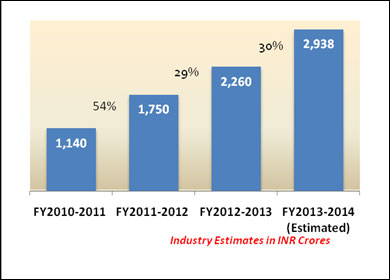
    The online advertising market in India is projected to reach Rs 2,938 crore by March 2014, according to the findings of ‘Digital Advertising in India’ report, jointly published by the Internet and Mobile Association of India (IAMAI) and IMRB International. It is to be noted that during 2012-2013, online adspend amounted to Rs 2,260 crore and advertisements on mobile phones and tablets grew from a 7% share in FY 2011-2012 to 10% of the Indian online ad market in FY 2012-2013, totaling to spends of around Rs 230 rore.


    Figure 1: Indian Digital Advertising Market Growth

    Source: IAMAI & IMRB International


  • IPG Mediabrands’ Initiative bags Reckitt Benckiser mandate in India

    By A Correspondent


    When a top FMCG advertiser moves its media agency mandate globally, there’s a stir in the advertising marketplace. Reckitt Benckiser (RB), which owns 19 big brands like Dettol, Strepsils, Durex, Clearasi, Harper, Bang, Mortein etc, has appointed the Aegis, Havas, Publicis and IPG networks as its global media agency partners. In India, where RB is among the five biggest adspenders, IPG Mediabrands’ Initiative has been appointed the media agency.


    This follows a global review to ensure the company benefits from “best-in-class media planning and buying” across around 60 markets in which it advertises. RB had existing arrangements with Havas and ZenithOptimedia (Publicis). Aegis and IPG are new additions to its global roster. Initative takes over the mandate in India from ZenithOptimedia.


    Said Heather Allen, executive vice president global category development, “Our media investment is critical for our brands to engage with consumers around the world.  Reckitt Benckiser is one of the world’s fastest growing companies in consumer health, hygiene and home and we’re looking forward to successful growth for our agency partners and us going forward.”


    “The learnings that we have got on the RB business will stay with us and we are richer for these. We thank RB for their support and wish them and their new agency all the very best for the future,” said Anupriya Acharya, Group CEO, ZenithOptimedia India.


  • Dainik Bhaskar returns with second edition of ‘Brain Hunt’

    By A Correspondent


    The Dainik Bhaskar group has announced ‘Brain Hunt 2- Challenge your Imagination’ your Imagination as a nationwide initiative to stimulate and encourage the imagination of young minds to a new high of free and constructive thinking.


    Said Vinay Maheshwari, Vice-President, Sales and Market Development, Dainik Bhaskar group: “As an organisation, innovation and new thinking continues to be one of the key pillars of our growth. The youth have always been one of our key audiences with we whom we truly enjoy engaging with. What better way to harness and nurture the potential of this huge force and align it with our philosophy of innovation and change!”


    “We truly believe that Brain Hunt 2 will be another wonderful experience for students and the school community at large while also being a welcoming stress buster”. In 2010, the DB Group created the Bhaskar Champs Club to provide a creative platform to students to interact with other students on a common ground of exciting activities to foster intellect, acumen and brainpower. The Club now has about 10 lakh student members and 4,500 partner schools across the group’s geographical spread.


  • Doordarshan-UNICEF celebrate 10 years of Navjyoti Awards

    By A Correspondent


    Had it been a private broadcaster, it would’ve gone to town about it. But this is pubcaster Doordarshan and not many of us in the trade media watch it. But having read the release which came in, we thought this deserves pride of place.


    A joint venture of UNICEF and Doordashan Mumbai Kendra, the Navjyoti programme aims to recognize initiatives taken by girls despite adverse circumstances. Started in 2003, Navjyoti celebrated its tenth year in a colorfully decked studio in Mumbai’s Doordarshan centre last weekend.


    Stories of ‘girl power’ unfolded and stunned the audience as nine girls from remote Maharashtra were felicitated for resisting child marriages and also helping other girls fight the scourge. They had one common message to share – “Girls are not any less.”


    They received honours from nine eminent and inspiring personalities like Nirmala Sawant Prabhawalkar, Dr. Jamuna Pai, Neela Satyanarayan, Manisha Goel, Priyanka Sinha Jha, Rajeshwari Chandrasekhar, Kiran Juneja, Sucherita Hegde and Grace Pinto. Other dignified personalities present were Dr Jagannath Hegde, Udai Gupta, Ulhas Wagh, Abuzar Zakir and DD Mumbai’s very own Mukesh Sharma.


    DD Sahyadri will get telecast a programme based on this on December 28 and 29 from 10am onwards.


  • Fogg clouds Axe effect, is new numero uno deo

    By Namrata Singh & Udit Prasanna Mukherji


    Where tales of giant killers like Nirma and Ghadi in the detergents space are part of the marketing folklore, a new David vs Goliath story is playing out in the FMCG market. This time it’s in the deodorant space. Fogg, a relatively new brand in the deodorant space from the homegrown Vini Cosmetics’ stable, has toppled Axe, a well-established global brand of Unilever, to become the market leader.


    Fogg has garnered an all-India (Nielsen) value share of about 13% as of October this year. The market share of Axe, which was the leader so far, is just about 8% now. A year ago, Axe commanded a higher share of about 18-19 % of this now highly fragmented market. It’s a case study in itself on how in certain fast-growing emerging categories the sweepstakes are so different that a younger brand bears the ability to overtake the market leader in a short span of time. Fogg is owned and marketed by Darshan Patel, the entrepreneur who, prior to setting up Vini Cosmetics, was the former promoter of Paras Pharma which was later acquired by Reckitt Benckiser.


    As part of the Paras team, Mr Patel successfully launched brands like Krack cream, Itchguard , Moov, Livon and Dermicool , which created a dissonance in the marketplace. Mr Patel appears to be following a similar strategy with Vini Cosmetics as well. Industry experts said Fogg’s unique proposition more sprays in a bottle – has helped the brand break through the clutter, considering that all brands are priced quite competitively.


    While Axe is among the first few brands which created the deodorant category in the country in 1999, Fogg was launched only two years back. Axe could not retain its leadership position in the category despite roping in celebrity Ranbir Kapoor in June this year. When contacted, an HUL spokesperson said: “As a policy we do not comment on market shares.”


    Darshan Patel, on the other hand, said Vini Cosmetics wants to increase its distribution reach which should augur well for Fogg and the other brands in its stable such as White Tone face powder, Glam-Up instant glow cream and Jinjola prickly heat powder. It was only recently that Vini Cosmetics raised Rs 110 crore from Sequoia Capital, a venture capital fund, to drive expansion.


    Interestingly, ITC’s Engage deodorant brand, which launched a range for both men and women in April this year is one of the youngest brands in the category. It too has managed to grab a chunky piece of the market pie. Engage has garnered a share of about 5-6 % in the Rs 2,100 crore deodorant market as of October this year. “ITC personal care’s entry into the deodorants market with Engage has received an extremely encouraging response ,” said Sandeep Kaul, divisional chief executive of ITC’s personal care products division.


    Source:The Economic Times

    Copyright © 2013, Bennett, Coleman & Co. Ltd. All Rights Reserved

    Licensed to republish


  • Is it Goodbye Abby given internal & international awards?

    By Pritha Mitra Dasgupta & Shambhavi Anand


    What happens when an industry loses its faith in its own awards? In the case of Indian advertising, agencies seem to have found a solution by launching inhouse awards.


    While Lowe and Partners launched ‘The True Show’ a few years ago, Ogilvy & Mather just held its first internal award, the Envies.


    With other agencies too planning their own inhouse celebrations, does this mean that the days of the industry awards such as the Abby are numbered? “I don’t think so,” says Arvind Sharma, president of Advertising Agencies Association of India (AAAI) that organises Goafest where the Abby awards are conferred.


    “The last 25-30 years that I have seen, big agencies tend to pull out of award shows. In ad award shows big agencies don’t count.


    It is the creatively hottest agencies that matter. People have come and gone in Goafest. While that decision should be respected, it has no bearing at all on the future of the show. The show will go on.” But the advertising industry remains divided.


    Piyush Pandey

    Piyush Pandey, executive chairman and creative director at Ogilvy & Mather India and South Asia, says that his and other agencies are sending out a message to the organisers of industry award shows by holding their own in-house awards. “If the industry comes up with an award show which is believable and credible then we will participate,” he says.


    R Balakrishnan, chairman and chief creative officer of Lowe Lintas, says that message has been going out for a while, but the ad fraternity hasn’t got it yet.


    R Balakrishnan

    “Advertising has a purpose and how creative you are is that purpose. Who better than the agency that has created it to judge it,” he says, predicting that winning an Envie will make creatives at O&M happier than winning an industry award.


    Raj Kurup, founder and creative chairman of Creativelandasia, which pulled out of Goafest this year, has been vocal about scam ads in Goafest and how the event has lost its focus. “Whether it is an internal award or an industry award, I would welcome anything that celebrates fantastic real work that has made difference to the business,” he says.


    Sajan Raj Kurup

    Leo Burnett, which has a global assessment team and a unique scoring pattern that evaluates the agency’s internal work, has planned something special for its Indian winners in 2014.


    “We have very big plans for Cannes Lion 2014 and we are planning to send 25 people including creative, account management and planners.


    Saurabh Varma

    Teams that will score high in internal assessment will be a part of this, so will be the employee of the month and the previous Cannes Lion winners,” Saurabh Varma, CEO at Leo Burnett India, says.


    While a senior official in Leo Burnett says that the agency will not participate in Goafest 2014 because it has shifted its focus to Cannes Lion 2014, Mr Varma says, “We are still making up our mind on Goafest.”


    In fact, there are many in the industry who believe that while internal award shows of Lowe and O&M make a great statement, the industry award shows will co-exist. Josy Paul, chairman and chief creative officer at BBDO India, believes the two should not be combined.


    “This is O&M seeking external input and I think it’s gonna be respected for that. If more people do things like this, it just shows the industry is more united,” he says.


    Rohit Ohri, executive chairman at Dentsu India Group, says the Goafest is a larger forum for discussing industry issues.


    “So there is nothing like loosing sheen. But yes the competitive spirit that agencies like Ogilvy bring about will be missed,” he says. Agrees Vandana Das, president at DDB Mudra Group.


    “Old forums such as Goafest are places where great minds get together to celebrate great work. But it is not necessary that there will be only one such forum. There can be more,” she says. Like all other issues, the Indian advertising industry will remain divided on this one.


    But if there is one agenda where they unite, it is that the industry bodies should introspect the reason for the plight of the agencies from the award shows and try and bring them back.


    Source:The Economic Times

    Copyright © 2013, Bennett, Coleman & Co. Ltd. All Rights Reserved

    Licensed to republish


  • In Week 50, Colors is No 2 Hindi GEC

    By our Research Associate


    It’s a game of yo-yo at the top.


    So, last week, Zee was No 2 and Colors has marched ahead in Week 50 of the calendar year.


    Star Plus is still the numero uno Hindi GEC. All of this is as per TAM ratings revealed to us, not directly by TAM which has been restrained by the powers that be to give the media get a first-hand update on weekly ratings. Instead we have to get it from our friends who share the info. It’s reliable but, then, we haven’t got it from TAM.


    The following are the numbers:

    Star Plus              579 {561} (548)

    Colors                   449 {456} (479)

    Zee TV                  439 {480} (449)

    Life OK                 313 {325} (334)

    SAB                        291 {260} (269)

    Sony                       267 {241} (239)


    Figures in brace brackets indicate viewership numbers for last week {Week 49} and in regular brackets for the previous week (Week 48).