Category: NEWS

  • Mobile to drive global adspend growth over next 3 yrs: ZO

    By A Correspondent


    Advertising is set to see the strongest sustained period of growth in 10 years with global adspend growth forecast to rise from 3.6% in 2013 to 5.3% in 2014. Growth is then set to increase to 5.8% in 2015 and 2016. The principal engine of this growth will be mobile technology, which is expanding the space for media consumption.


    According to ZenithOptimedia’s new Advertising Expenditure Forecasts, growth in global adspend next year will come from the continued steady improvement in Europe and the three ‘semi-quadrennial’ events: the Winter Olympics, the football World Cup, and the mid-term elections in the US. We forecast that the global advertising market will accelerate to 5.8% in 2015 as a strong broad-based economic growth takes hold, followed by another year of 5.8% growth in 2016. This assumes that the Eurozone’s gradual recovery continues and no new crisis occurs.


    Mobile is expanding overall media consumption

    Mobile is now the main driver of global adspend growth. This the first time in the past 20 years that a new platform is expanding overall media consumption without cannibalising any of the other media platforms. We forecast mobile to contribute 36% of all the extra adspend between 2013 and 2016. Television is the second largest contributor (accounting for 34% of new ad expenditure), followed by desktop internet (25%), which continues to enjoy significant growth alongside that of mobile advertising.


    Despite its sizeable growth, mobile advertising still only accounted for 2.7% of global adspend in 2013. By 2016, however, we expect it to account for 7.7% of adspend, leapfrogging radio, magazines and outdoor to become the world’s fourth-largest medium. We count as mobile all internet ads delivered to smartphones and tablets, whatever their format.


    Rising Markets are growing three times faster than Mature Markets

    The world’s ad markets are growing at two very different paces. Mature Markets are struggling with debt and low innovation, and their populations are ageing, with growing numbers of retirees supported by a shrinking workforce. We forecast these markets to grow at an average of just 3% a year between 2013 and 2016. Meanwhile Rising Markets are improving their education systems, infrastructure, productivity and adoption of technology, and they have a young population with an expanding workforce. We expect them to grow at 9% a year. The Rising Markets currently account for 35% of global adspend, but we expect them to contribute 61% of adspend growth between 2013 and 2016.


    BRIC growth is slowing

    The G7 markets (Canada, France, Germany, Italy, Japan, the UK and the USA) have a median age of 40; they account for 58% of global adspend, but we forecast them to grow at an average annual rate of only 3.6% between 2013 and 2016. The BRICs (Brazil, Russia, India and China) have grown enormously over the last twenty years, and now account for 14% of global adspend, up from 1% in 1993. They are much younger than the G7 (with a median age of 31), and we forecast them to grow at an average of 9.5% a year over the next three years, but this is well down on their average growth of 15.8% in the previous decade.


    “Mobile technology is creating new opportunities for marketers to connect with consumers. Combined with the continued rise of young, dynamic markets, this will spur healthy and sustained growth in global adspend over the next three years,” said Steve King, ZenithOptimedia’s CEO, Worldwide.


    ZenithOptimedia is headed by Anupriya Acharya in India.

     

  • Helios Media expands, elevates Bala Iyengar as COO

    By A Correspondent


    Bala Iyengar

    Helios Media, the speciality services company for the broadcast sector recently completed two years in operations, already carving a niche within the industry as a revenue maximization catalyst. With MTunes HD, Channel X, FoodFood, Fashion TV as the properties it services, Helios is now transitioning to the next level. Business Director Bala Iyengar has been elevated as Chief Operating Officer.


    “As we move forward, our focus will be on getting into deeper partnerships with relevant platform creators to enhance the solutions we offer our clients. A TV channel is not just for TVCs anymore, and we will work with them in the overall revenue management space, going beyond traditional commercial inventory. In addition to inventory sales, we have enhanced our teams to include talent in the areas of content syndication, custom events, celebrity management and strategic digital initiatives, said Divya Radhakrishnan, Founder & Managing Director of Helios Media.


    Divya Radhakrishnan

    “To take this scale of operations forward, it’s only natural that Bala steps up to take charge of our complete offering and provide seamless service to our clients,” Ms Radhakrishnan added.


    Commenting further on his elevated role and plans ahead, Mr Iyengar said: “We will shape ourselves to be the go-to destination for advertisers seeking innovative ways to connect with audiences, and for channels seeking breakthrough strategies to boost revenue.”


  • Ex-Nokia MD D Shivakumar is Pepsi’s India region CEO

    By A Correspondent


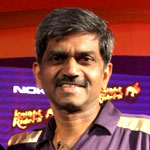
    D Shivakumar

    US food and beverage maker PepsiCo on Monday named former Nokia executive D Shivakumar as its chairman and CEO for India region, a position lying vacant since Manu Anand quit in June.


    Mr Shivakumar – who was managing director at Nokia India before taking over as the handset maker’s senior vice-president for India, Middle East and Africa in 2011 – is PepsiCo India’s first outsider CEO since Rajeev Bakshi, who led the firm from 2001 to 2006.


    “Shiv has a proven ability to take billion-dollar businesses to the next level by maximising innovation, execution and collaboration,” Ms Indra Nooyi, chairman and CEO at PepsiCo, said in a statement. He takes charge with immediate effect. ET NOW business channel broke the news before the official announcement.


    PepsiCo on Monday also announced promotion of Gautham Mukkavilli, currently general manager of its beverages business in India, as senior vice-president, business transformation, for the Asia-Middle East-Africa (AMEA) region. He will oversee strategic initiatives in foods and beverages across the region with effect from March 1, 2014.


    Both Messrs Shivakumar and Mukkavilli will report to Sanjeev Chadha, CEO of PepsiCo AMEA. “Shiv and Gautham will be playing key roles in driving PepsiCo’s business forward in the region,” Mr Chadha said.


    PepsiCo India has been operating without a country head since Manu Anand quit dramatically in June to join foods company Cadbury Kraft. Since then, Mukkavilli and foods division head Praveen Someshwar have been reporting to Mr Chadha.


    An engineer from IIT Chennai and an MBA from IIM Calcutta, Mr Shivakumar’s appointment has come as a surprise to many as his immediate predecessors Manu Anand (India head from 2010 to 2013) and Mr Chadha (2006 to 2010) were chosen from PepsiCo’s internal talent pool.


    Mr Bakshi was the last outsider CEO of PepsiCo India, brought in from Cadbury. Mr Shivakumar’s immediate mandate at the firm will be to accelerate consumption of colas and snacks in an environment when growth has slowed down significantly.


    Growth of soft drinks has slowed down to single digits as early rains cut short last summer on top of weakening consumer sentiment. PepsiCo’s snacks business is facing increasing competition from national rivals, such as ITC and Parle, as well as local players.


    “PepsiCo is in a challenging phase and will test Shiv’s abilities to the hilt,” said Vibhav Dhawan, managing partner at search firm Positive Moves Consulting, said.


    Mr Dhawan, who knows Mr Shivakumar well and has tracked his career, said he is a good choice to lead PepsiCo in India. “Shiv is a rare marketer who has worked both in traditional consumer and new generation mobile consumer sectors. His marketing prowess makes him a great choice for a brand like PepsiCo which targets the youth,” he said.


    Mr Shivakumar, who spent eight years at Nokia, quit the firm in June this year. Before joining Nokia, he worked with consumer electronics maker Philips and top consumer goods firm Hindustan Unilever.


    During his tenure, Nokia’s user base jumped from 80 million to about 900 million but its market share declined from over 70% to about 25% as Chinese manufacturers and some homegrown brands like Micromax and Karbonn eroded its market share in the entry level segment, while Samsung and Apple ate into its share in the smartphone segment.


    Nokia’s biggest failure under Mr Shivakumar was missing out the dual-SIM revolution, which accounted for as much as 50% of handset sales in India between 2009 and 2010.


    Source:The Economic Times

    Copyright © 2013, Bennett, Coleman & Co. Ltd. All Rights Reserved

    Licensed to republish


  • RBNL appoints Lavneesh Gupta as COO for TV biz

    By A Correspondent


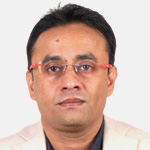
    Lavneesh Gupta

    Reliance Broadcast Network Ltd (RBNL) has announced the key appointment of Lavneesh Gupta as Chief Operating Officer for its television business. Mr Gupta will be responsible for building on consumer insights to create robust content and marketing strategies and drive channel performance, as per a communiqué. He will report to Tarun Katial, CEO of Reliance Broadcast Network.


    Commenting on his appointment, Mr Katial said, “Lavneesh’s vast experience and in-depth market understanding makes him an asset to the organization. We are happy to have him on board and are confident of him leading the television business through the next growth phase.”


    On his appointment at Reliance Broadcast Network Ltd, Mr Gupta said, “RBNL is among India’s most vibrantly growing organizations and I am excited about my new role here. The company has an exceptional potential for growth and I look forward to working with the team at RBNL to make this vision a reality.”


    An engineering graduate from IIT-BHU, Varanasi, and a postgraduate in management from SP Jain Institute Management and later trained at the Asian Institute of Management, Manila, Mr Gupta has worked across leading brands in the BFSI industry ranging from Standard Chartered Bank, ABN AMRO and Tata AIG to Max Life and IndusInd Bank.


  • India ad rev to grow 11.3% in 2014:Magna Global


    By A Correspondent


    Indian media companies will see ad revenues growing by 11.3% next year with the internet again leading the growth at 31.4%, according to Magna Global’s annual advertising forecast for the year 2014.


    The growth in television adspends will be 10.4%, while that for newspapers will be 8.8%. Magazine adspend growth will be 2.3% while OOH will be 12.1% and Radio at 11%. Cinema, given its lower base, will grow at 20%.


    Last December, Magna Global had predicted an 8.7% growth for Indian adspends. This was revised in June this year to 7.8%. The growth for 2012-13, although based on its current estimates, is 7.8 percent. Magna Global is the strategic media unit of global media agency conglomerate IPG Mediabrands. IPG Mediabrands is headed by Shashi Sinha in India.


    The economic environment remained weak throughout 2013 but is still expected to improve in 2014, especially in the developed world which has experienced four years of slow growth and stubborn unemployment, according to the IPG Mediabrands firm. As per the International Monetary Fund’s World Economic Outlook projections, India should re-accelerate at 5.1% following 3.8% in 2013. “That level of economic activity is not particularly impressive by historical standards but confidence indices keep improving and we believe advertising spending will reflect and amplify that economic trend,” said Venkatesh S, EVP, Director Intelligence, Magna Global, India.


    Venkatesh added that the growth estimates of 7.8 per cent for 2012-13 are end-2013 estimates and he does not foresee any extreme changes.


    Mobile share to total internet in adspends is 7.9%: Venkatesh S, EVP, Magna GlobalQ&A with Venkatesh S, EVP, Director Intelligence, Magna Global, India
     

    The annual forecast made in December 2012 had your annual year-on-year growth forecast for India pegged at 8.7%. In June this year, it was revised to 7.8% which has been maintained in your year-ahead report. Since we haven’t yet closed December, do you think this growth of Jan-Dec 2013 will stay at 7.8%?

    These are end-2013 estimates and we don’t foresee any extreme change in growth rates


    Any noteworthy changes in your estimate made in Dec 2012 and June 2013 to what it is now?

    Newspaper and Magazine growth rates have been revised downwards compared to December forecast and the growth rates are pretty the same as it was in June 2013.


    By your estimates now, will India be among the Top 10 markets five years from now? In December 2012, your report said India would be among the Top 10 markets in the year 2017. That was not the case when the mid-2013 numbers. What is the status as of now?

    Following a significant slowdown and given the current market environment, long-term forecast was revised downwards and is not in a hurry to be part of the Top 10 anytime soon. Currently India is the 13th largest advertising market and is forecast to retain its position in 2018.


    How does Indian adspend compare with our neighbours, BRIC countries and internationally?

    The adspend/capita in APAC varies significantly from $558 in Australia to $2 in Pakistan. While India adspend/capita is $5, its BRIC peers are way above – China $29, Russia $67 and Brazil is on par with the global average of $84. India is slightly in the high growth potential zone.


    Internet doesn’t seem to be growing at a significant pace – it continues to hover around 30-odd percent. Comments?

    India has been growing at a phenomenal rate compared to the global average (+15.5%) and also within APAC (+22.4%). Having said this, mobile internet is promising and will overtake desktop internet. However lots of questions need to be answered to see this medium unfold its potential.


    What would you say is the contribution of mobile as against the whole of the internet.

    Mobile share to total internet is 7.9%.


    And how does this compare with developed economies and BRIC countries?

    While BRIC countries are averaging 9%, developed economy is 15%


    Last December, you had predicted a 4.2 percent growth in the magazine sector. That is now 2.3 percent. Do you think there is a trend out there and we could magazines degrow even further?

    A small base of loyalty is a major deterrent for magazine publishers and advertisers, though language magazines still hold ground locally. Staying relevant to digital audience and retaining revenue streams is a challenge.


    Given an election year, shouldn’t we have seen a greater growth for newspapers?

    In 2012, the category saw a lower single digit growth rate. Our estimate for 2013 including political advertising is 6.0% and 8.7% in 2014.


  • Star completes full control on India cricket by turning Team Sponsor till March 2017

    By A Correspondent


    If it’s Cricket, it’s Star. Watch out for its familiar ogo across cricket as Star India extends its broadcast, internet and mobile rights-owner status for July 2012 – March 2018 to the ground.


    Star India has bagged the bid for the Team Sponsorship Rights for various cricketing events including the Senior Men’s Cricket Team title and logo sponsorship rights from 2014 to 2017 at the price of Rs 1.92 crore a match. This is a sharp drop from Rs 3.34 crore that Sahara India is paying as well as the Rs 2 crore that Star India is currently paying for the title and logo sponsorship.


    The base price was recently revised to Rs 1.5 crore from Rs 2.5 crore, and the Star bid was Rs 0.42 crore higher.


    The Team Sponsorship Rights cover BCCI Events, ICC Events and ACC Events, for the period January 1 2014 to March 31, 2017. The rights include the right to be called the ‘Official Team Sponsor’  and to display a commercial logo on the team clothing of the Senior Men’s Cricket Team, the Under-19 Men’s Cricket Team, the Men’s A-Team and the Women’s Team.


    The decision was taken at a meeting of the BCCI’s Marketing Committee yesterday (December 9). The tender document, which was available from November 11, 2013, was picked up by seven prospective bidders (Bharti Airtel, Games Unlimited, Multi Screen Media, Sahara India, Star India, UB Group, World Sport Group). Bids were accepted until 3 pm on Dec 9 at which time the bids were opened and evaluated. Two bidders – Star India Pvt Ltd and Sahara India Financial Corporation – were in the fray. Although Sahara’s bid was higher, it was found to be ineligible.


    “Star is the Title Sponsor for BCCI international and domestic matches for the period October 2013 to March 31, 2014, as well as the Holder of the Broadcast, Internet and Mobile Rights of cricket in India, for the period July 2012 – March 2018. Star has a deep understanding of the game of cricket, and what it means to the nation. We are pleased to extend our association with them,” Sanjay Patel, Honorary Secretary, BCCI, said.


    “Star is delighted to become the Official Sponsor of the Indian cricket team. It’s a team of brilliant talent and we are proud to be associated with them. This is further endorsement of Star’s deep commitment to Indian cricket and Indian Sports in general,” added Uday Shankar, CEO, Star India, said.


    Sanjay Gupta

    Star India COO Sanjay Gupta has indicated that the sponsorship will be used to promote any of his brands – be it the sports channels or even entertainment offerings like Star Plus and Life OK.


    Meanwhile, there have been murmurs that the BCCI decision to award the rights to Star India may be contested. Sahara India is peeved that it was not informed that it was ineligible for the bid given its ongoing litigation with the Board on the IPL team disqualification. The Sahara bid was higher than that of Star at Rs 2.35 crore per match.


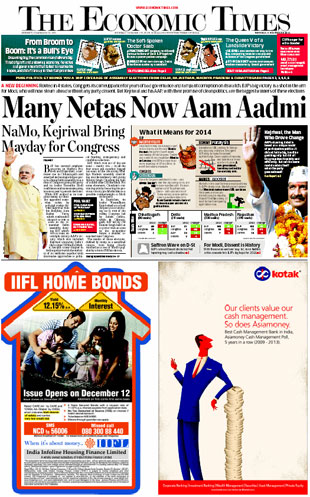
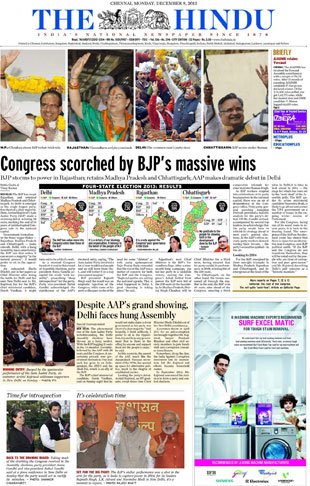
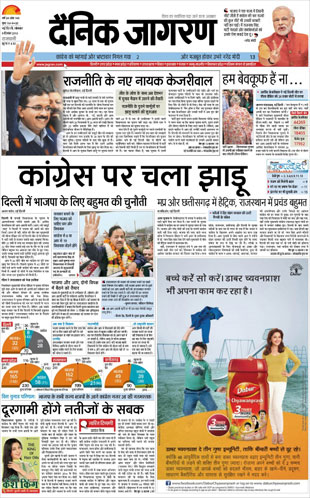
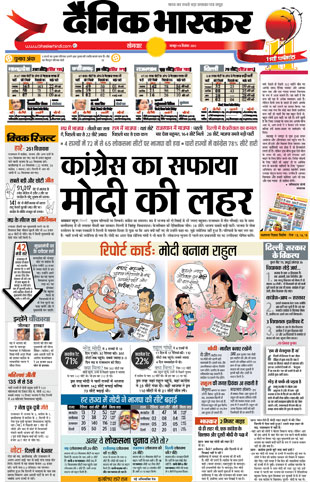
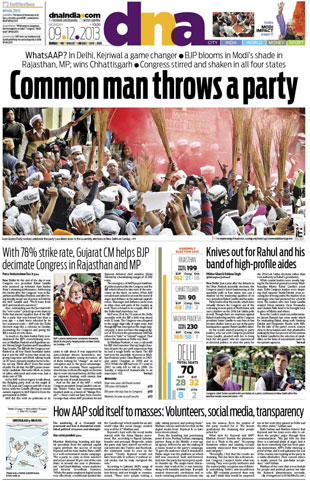
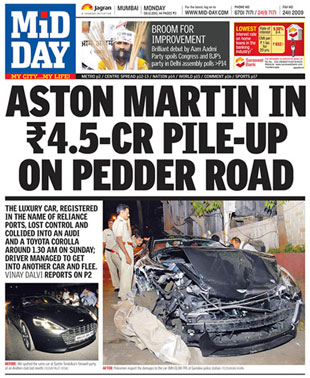
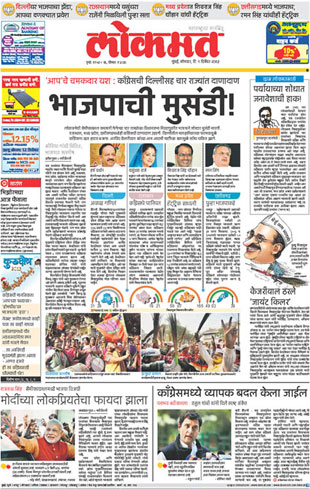
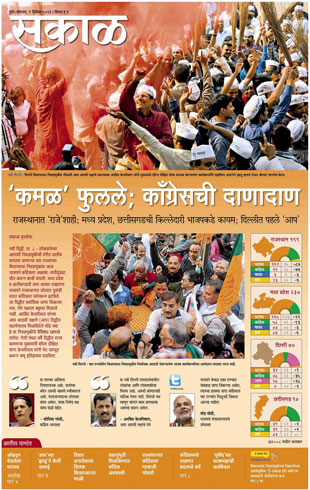
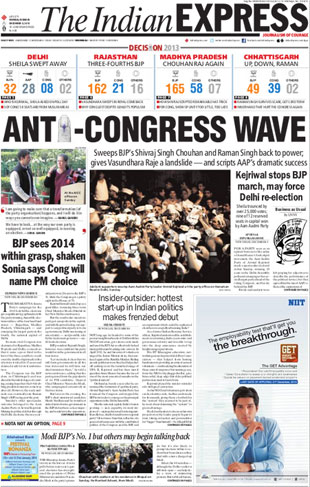
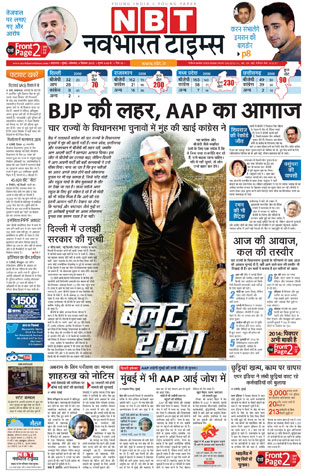
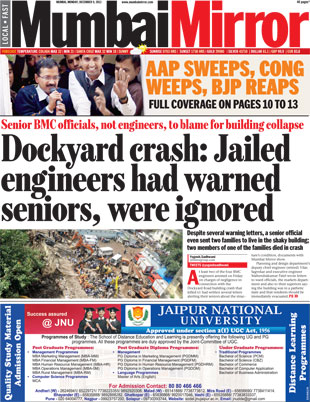
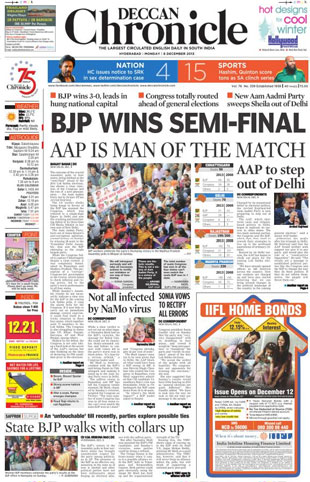
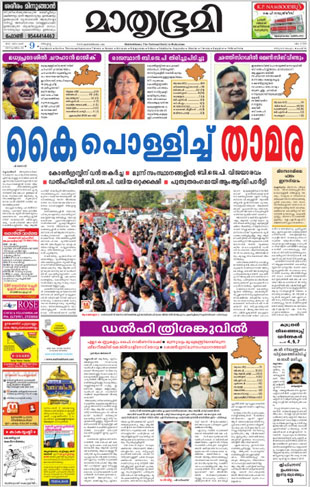
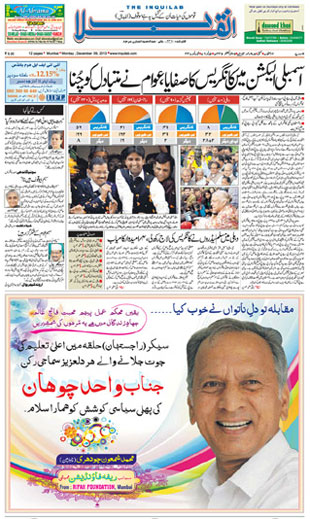
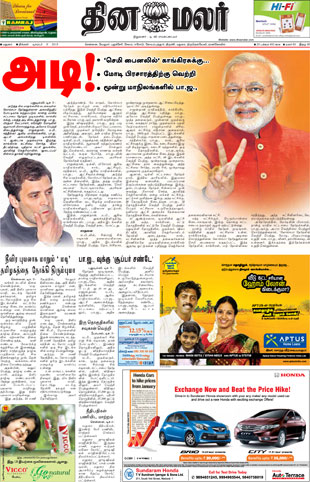
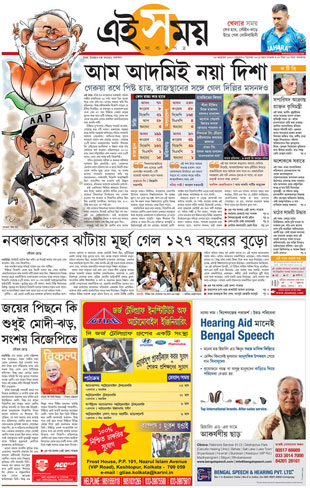
  • AAP appeal! This is how Page 1s of leading dailies looked today

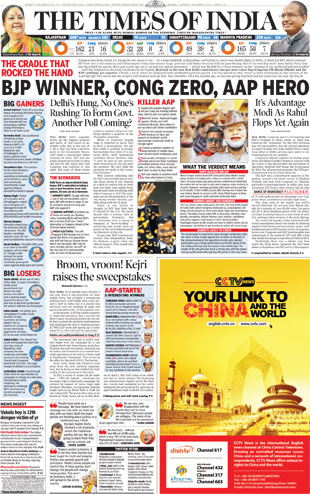
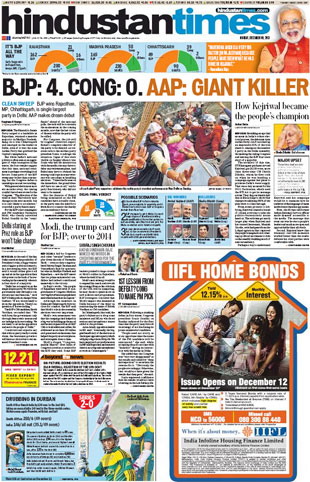
    Every major news event merits a special display by newspapers, as we saw on the morning after the historic Assembly election results on Sunday, December 8. Here are some of the frontpages, in random order.


    The Times Of India

    Hindustan Times

    The Economic Times

    The Hindu

    Dainik Jagran

    Dainik Bhaskar

    dna

    Mid-Day

    Lokmat

    Sakal

    NBT

    Mumbai Mirror

    Deccan Chronicle

    Mathrubhumi

    Inquilab

    Dinamalar

    Ei Samay
  • Zee TV’s Jodha is most popular fiction character on telly: Ormax

    By A Correspondent


    According to the latest findings (November 2013) of the Ormax Characters India Loves research, Jodha from Zee TV’s daily fiction show Jodha-Akbar has emerged as the most popular fiction character on Indian television.


    Ormax Characters India Loves (Ormax CIL) research is conducted in 19 Hindi-speaking markets in India, covering a monthly sample size of more than 3,000 respondents in the 15-44 years age group. Since the start of Ormax CIL in August 2009, Jodha is only the fifth character to have taken the top position, the other four being Anandi (Balika Vadhu), Suhaana (Sasural Genda Phool), Jethalal (Taarak Mehta Ka Ooltah Chashmah) and Ram Kapoor (Bade Achhe Lagte Hain). Jodha is the first Zee TV character to have taken the top position.


    Anurag Bakhshi

    Speaking about the findings, Anurag Bakhshi, Insights Head – Television, Ormax Media, said: “Jodha’s popularity is a result of her unique portrayal of a historical character whose aspirations are relevant to the young audience of today’s evolving India. Her popularity is particularly strong in Uttar Pradesh, Madhya Pradesh and Punjab markets.”


    According to the November 2013 Ormax CIL Report, the Top 5 fiction characters on television are Jodha, Sandhya (Diya Aur Baati Hum), Jethalal (Taarak Mehta…), Anandi (Balika Vadhu) and Mahadev. Kapil Sharma (Comedy Nights With Kapil) is by far the most popular non-fiction character on television.


  • Media is corrupt… govt will rein in if media doesn’t self-regulate, says PMO minister V Narayanasamy

    By Vikas Dhoot


    Minister of state in the Prime Minister’s Office, V Narayanasamy, on Tuesday said the country “is going down” because of the ballyhoo about corruption created by media “which itself is corrupt”, the CBI which has “no corporate knowledge” but hounds even honest industrialists, and the judiciary which gets swayed by media trials and doesn’t want public perceptions to go against it.


    Issuing a terse warning to media houses, Mr Narayanasamy said that media currently enjoys self-regulation, but the government would be compelled to rein it in, if status quo continues. “If self-regulation isn’t followed, some kind of regulation will be brought by the government. We will take a call ultimately,” he said.


    The junior minister in Dr Manmohan Singh’s office said corporate India was the worst affected due to the current situation of interrogations, trial and punishment by the news media and the lack of understanding about technical issues among those “passing judgements and decisions.”


    “Even honest and upright people from corporate houses that invested money are being harassed, not by the government but by the system,” Mr Narayanasamy said, referring to India’s “vibrant” media and online platforms like Facebook and Twitter, where “all information and disinformation” can be put up.


    “The corporate houses are the worst affected, even honest and sincere corporate houses are being framed. Because the people who are sitting for the purpose of deciding the matter, I don’t want to name them, they have no corporate knowledge and they are giving the decision… the judgment,” the minister said at a conference on governance, moral leadership and transparency held in the Capital on Tuesday.


    Though he didn’t directly name the Comptroller Auditor General’s office, which has been slammed by several Cabinet ministers for wrecking investor sentiment and economic growth, Narayanasamy challenged the auditor’s loss calculations on the 2G spectrum scam.


    “As many as 122 circles have been auctioned (for spectrum) – the government got only 20,000 crore. But the whole world was saying it is 1.76 lakh crore. Who is to be blamed? he asked.


    “If I say something about the judiciary, then I will be hauled up for contempt. Someone can file a petition against me,” the minister added as a virtual disclaimer.


    “Unfortunately, people who have nothing to do with administration, who have not seen the public, who are not elected, who are not in the bureaucracy or corporate houses – are taking a view on crime. Ultimately, the result is the country is going down,” he lamented. Turning the scanner on the news media, the minister said media is not corruption-free, as is evident from the scourge of sting operations and paid news. “No media house follows the self regulation. They come to the streets to fight against the government that our rights are being taken away,” the minister said, reminding news organisations that their duty is to give people a correct picture of what is happening and not engage in media trials.


    Source:The Economic Times

    Copyright © 2013, Bennett, Coleman & Co. Ltd. All Rights Reserved

    Licensed to republish


  • Global Advertisers appoints Sudhendu Ram as National Head Marketing

    By  A Correspondent


    Sudhendu Ram
    Sanjeev Gupta

    Leading outdooradvertising agency Global Advertisers has strengthened its team with Sudhendu Ram appointed to head marketing initiatives pan-India. The agency has expanded its business in Tier II and III cities wherein large scale of BTL activities are taking place.


    Commenting on the appointment, Sanjeev Gupta, MD, Global Advertisers, said “The outdoor industry is undergoing tremendous change, brands are now exploring new opportunities to tap consumers of tier II and tier III cities. Therefore, to cope up with the increasing demand, we have roped in several senior professionals and young talent this year. Now we have Sudhendu on our board to maximize our reach and improve the quality of our service. We wish him all the best for his new challenge.”


    Speaking on the association with Global Advertisers, Mr Ram, said “My aim is to take Global to the next level of media engagement and recall with my deep understanding of media and expertise in terms of networking and knowledge.”


  • FoodFood adopts new lifestyle positioning of ‘It’s Sizzling…’ with 11 new shows

    By A Correspondent


    Leading food channel FoodFood has launched 11 new shows in sync with its new lifestyle positioning of  ‘It’s Sizzling…’ focusing on young urban audiences while continuing to serve its broader traditional audience base. With a whole new feel, look, colour, logo in its fresh, new repackaging, the channel aims to be a differentiator in the category of food lifestyle channels. The content is put together in tune for the discerning viewers.


    While the new seasons of some of the existing popular shows like Cook Smart, Turban Tadka, Style Chef, Mummy Ka Magic, High Tea… will reflect the change in the repositioning ,the channel  aims to woo and build a connect with today’s busy, yet health-conscious men and women who are looking for indulgence and adventure when it comes to their palette, notes a communiqué.


    Sanjeev Kapoor

    Said celebrity chef Sanjeev Kapoor who helms the channel: “I’m using food as a way to communicate with people that I never would have known otherwise. While we will continue with some of our extremely popular shows, all now in their new seasons, our content will be in tune with our loyal consumers enjoying the diversity in taste. Our focus is to deliver in multicultural cities, quality content that is compelling and entertaining irrespective of its origin. The channel   with its new shows and repositioning will ensure that the bouquet offered is complete and sizzling for today’s busy generation.”


  • Digitization will help broadcast economics: ZenithOptimedia forecast


    By A Correspondent


    This is the season for annual adspend forecasts and global media agency network ZenithOptimedia unveiled its Advertising Expenditure Forecasts predicting a year-on-year growth in ad spends in India of 11.5 per cent in 2014. The growth number for 2013 (over 2012) is 8 percent. The global ad expenditure growth from 3.6% in 2013 to 5.3% in 2014.


    Anupriya Acharya

    Said Anupriya Acharya, Group CEO, India, ZenithOptimedia group: “Our outlook for 2014 is cautious, though we expect the growth to happen mid-year onwards.” According to Ms Acharya, there appears to be an upswing in the mood since the Assembly election results on Sunday. Added Satyajit Sen, CEO, India, ZenithOptimedia: “All policy-making has been in a limbo, but we expect a spurt in the second half with digitization happening in full-swing.”


    According to the agency’s research team, 2013 has “overall been a turbulent year for the media industry”. “In March/April we saw changes to the TAM panel following the second stage of the digitization process (of which more underneath), followed by changes in the TAM data reporting period from a weekly to a monthly format and finally the flip-flopping over the new 10+2 advertising regulations (a cap on advertising minutage set at 10 minutes of advertising and 2 minutes of programme promotion per hour), which was supposed to take effect from Oct 2013 onwards. However, some channels have been slow to comply.”


    “Growth will be driven by inflation measures and pricing actions due to the 10+2 advertising regulations, as the restriction of supply will lead to rising prices,” it notes. “All of which means that advertisers are looking seriously at redistributing budgets to other media. On the whole, quality of content will improve on TV and we expect a consequent ratings boost thanks to 10+2 regulation. The change comes at a cost, however. There was a two-week stand-off between TAM, broadcasters and advertisers when data reporting formats were in flux. During this period, the top seven advertisers pulled their ad spots from all TV channels.”


    The ZenithOptimedia research notes that digitization will help the broadcast sector: “Following the second phase of digitization of distribution in Q1 2013 in 38 cities, the TV broadcast industry has achieved approximately 77% digitization and expects to reach 100% within the next two years.” The report adds that even though viewership ratings have been impacted, in the long term, digitization is expected to improve broadcast economics significantly.


    Internationally, the research has been bullish on adspends in the mobile sector. Mobile is going to take off big time and has already crossed television in terms of number of units, said Ms Acharya. “The internet consumption is going to increasing on the mobile and even though the smartphone number is not very high, it’s rising rapidly.”


    “The increase in mobile phone connections continues to drive growth of mobile internet penetration in India,” notes the study. “Cheaper mobile handsets and affordable mobile data packages are helping increase content downloads, and millions of users are engaged with wireless internet on a daily basis. FM Radio listenership is rising and it is a key feature used by mobile phone brands to sell handsets,” the report adds.


    On activation and BTL, the report says: “Along with changing lifestyles and the emergence of modern trade and malls in India, there has been an increase in consumption of outdoor advertising. Brands are keen to connect with consumers via experience zones and activations to ensure greater recall and amplification of brand values.


    Activation/Events are becoming more and more of a key offering in the radio and print channels. Live Music Events/Festivals have been successful in attracting widespread audience and engaging youth across key cities. Hand in hand with proliferation has come the challenge of fragmentation among audiences. Hence, advertisers are increasing the number of touchpoints to cater to addressable audiences and are selecting media beyond TV, print and radio.”


    Government advertising spend has begun ramping up as a precursor to the 2014 general elections, the report adds even as the final quarter of 2013 has “seen lower levels of investment than usual because of the soft economic environment”