
Category: NEWS

  • Max Bupa signs on customers via Facebook

    By A Correspondent


    Get Help is a first of its kind engagement platform by a health insurer on Facebook to reach out to its customers and be present wherever they are. This innovative platform enables customers to buy a health policy from their Facebook account, interact and share their experience with Max Bupa and also get instant customer service at their convenience from anywhere, anytime.


    Get Help offers instant response to health insurance related information on products, service requests, queries related to policy purchase, renewal, claims, loyalty benefits and premiums. It enables customers to get a call back within seconds of posting a request and provide them the option to share feedback and get response within 24 hours. It also allows them to access information related to hospitals in Max Bupa’s network.


    Committed to making quality Health Insurance more accessible to customers, Max Bupa is using technology to deliver Health Insurance to customers within minutes, at the click of a button, from the comfort of their home. A recent consumer research conducted across 13 countries by Bupa highlights the growing popularity of social media among Indians when it comes to seeking information regarding their health related needs. It indicates that 51% of Indians use Facebook to search for health related information and 29% Indians access it for sharing positive feedback about a recent healthcare experience, update friends on personal health issue and search for people facing similar health concerns.


    Through this initiative, Max Bupa has taken the lead to transform the perception of insurance as a complex product by using the most interactive social media platform to drive conversations on the category. Max Bupa has been strengthening its online presence to reach out to its customers. Earlier this year, Max Bupa launched online product Health@Companion on its website (www.maxbupa.com). The website has been designed to assist customers in buying health insurance in a well informed way with a unique product recommendation tool and a host of self service options.


  • ABP News launches #AakhriTaar campaign

    By A Correspondent


    ABP News has launched a campaign to keep alive memories of the telegram, and has asked people to share their stories about sending and receiving telegrams and using the telegraph service.


    #AakhriTaar is an initiative by ABPNews.in to enlighten people about the Electric Telegraph Service, and to revisit the telecommunications revolution that it brought about, the role it played in the Indian independence struggle and the importance that it enjoyed in the past.


    Social media is being used to drive the core objective of #AakhriTaar. As Twitter is the telegram of the new world, the campaign is primarily using the Twitter handle @Aakhritaar (https://twitter.com/Aakhritaar/). People can share their telegram stories at ABPNews.in. They may upload a picture/video of the telegram that they have received, the telegram form they filled, the friendly telegram officer they met, or the telegraph office that they visited.


    To boost the social presence of the message, the campaign is using the hashtag #AakhriTaar (https://twitter.com/search/realtime?q=%23AakhriTaar) and a Vine video (https://vine.co/v/hBPOHAjKvYv) on the history of Indian telegram has also been shared. The Facebook page, AakhriTaar (https://www.facebook.com/AakhriTaar), is also a seeing fan activity since its launch.


    More information is available at http://abpnews.in/aakhritaar.


  • Internet influences hair, skincare and beauty buys: Study

    By A Correspondent


    Google India has released its report on a study titled ‘Women & Web’ to understand internet usage pattern and its influence on purchase decisions of women internet users in India. The study was compiled by looking at search query data for top women-oriented search categories in India and independent online research done by TNS Australia, which reached out to over 1,000 women with access to the internet in India.


    Out of the total 150 million internet users in the country, around 60 million women in India are now online and use the internet to manage their day to day life. With easy access to internet at homes, cyber cafes, offices and growing adoption of smart phones, internet is being used by women for a variety of things. The study revealed that women who are online are relatively more affluent and younger. 3 in 4 women in SEC AB are now online and 75 percent are in the 15-34 age group, with over 24 million women accessing the internet daily.


    In terms of top searched categories by women on Google in India, apparel & accessories was the biggest search category followed by food & drink, baby care, hair care & skincare. The study revealed that – Skincare, hair care, food & drink were the fastest growing search categories, with queries coming from mobile phones growing rapidly and accounting for almost 25 percent of total query volumes in these categories.


    The study also revealed data on the growing influence of digital medium on women’s purchase decisions for these categories. Data from the online research conducted by TNS Australia, highlighted that among women who had access to internet, over 50 percent said that internet research influenced their decision before finalizing a product. In terms of most researched category and influence on final purchase decisions – internet influence was the highest for skin care (72%), baby care (69%) and hair care (65%) products.


    Rajan Anandan, VP & Managing Director, Google India said, “With this report, it is clear that the internet is empowering Indian women with easy access to information and helping them to make more informed decisions in their day-to-day life. The top generic searches and most searched brands reflect that women are heavily engaged on the internet and are using it to do online research before deciding on their final purchase for categories like skin, hair and baby care products.”


    In terms of online activity, email, search and social networking were the biggest drivers for women. Downloading music, looking for educational content, job search, watching videos and consuming news were the other top activities. The report also indicated adoption of ecommerce by women in India, with 1 in 4 shoppers buying baby products online. Women also emerged as strong brand advocates – with 80 percent saying that they recommend their purchases to other women and 25 percent stating that they share it online.


    Video on the web also emerged as one the key drivers of internet usage among women in India, with women accounting for 40 percent of the total monthly YouTube user base in India. Apart from music videos, TV shows and film content, beauty & fashion videos were popular among women on YouTube. Education, health and fitness, home care & cooking were also rated among the top 10 video content categories of choice on YouTube.


    The study was compiled by Google India, by combining Google search query data in India for apparel & accessories, food & drinks, baby care, hair care & skincare product categories along with TNS Australia research conducted online of over 1000 women in the age group of 18 to 65 and industry reports. The search query data was compiled for the period of one year starting from April 2012 to March 2013. Other data sources include TGI & IRS.


    Apparels & Accessories – International

    Apparels & Accessories – Indian

    Foods & Beverages

    Baby Care

    Hair Care

    SkinCare & Cosmetics

    Zara Fastrack Coca Cola Firstcry Loreal Oriflame
    Ray Ban Tanishq Amul Babyoye Livon Lakme
    Victoria’s Secret Fab India Cadbury Babycenter Tresemme Maybelline
    Louis Vuitton Van Heusen Pepsi Hushbabies Sunsilk Loreal
    Swarovski Chennai Silks Maggi Johnsons Baby Pantene Avon


  • CMOs believe digital marketing is way forward

    By A Correspondent


    Digital Marketing was the theme of the 9th Marketing Conclave organized by the Internet Mobile Association of India (IAMAI).


    The marketers across categories agreed the digital marketing is the way forward. The common belief among the panelists was that interactivity, engagement and measurability are making the marketers look at it far more seriously now. While they are using digitally differently based on where in the product life cycle their brand really is, they were united in their opinion that digital marketing is here to stay.


    Focusing on the auto sector, Vivek Nayer, Chief Marketing Officer – Auto Division, Mahindra & Mahindra said, “The key to success in digital marketing is content. As the platform allows multiple points for brand storytelling, it is imperative that the space is used judiciously. Digital marketing has made consumer the most powerful person for a brand. The space is all about conversations and how consumers are engaged”. He showed some interesting examples to establish that digital marketing helps in better customer engagement and association.


    Added Vivek Srivastava, Head – Marketing, Renault India, “The best aspect of digital marketing is it helps a brand to create impact and also measure the same, which cannot be obtained by traditional marketing”.


    Addressing a session on Digital Marketing – Retail, Vinay Bhatia, Customer Care Associate and VP, Marketing & Loyalty – Shoppers Stop, emphasized that every company should have its tailor made digital marketing strategy based on its requirements. He said, “There is nothing wrong or right in digital marketing. All of us are in the experimental stage and yes investment in it is already showing benefits”. He went on to add, “Social media provides thinking data. If aptly used, it can turn around business. We have substantially increased our digital marketing budget”.


    Andrew Campbell, Chief Brand & Marketing Officer – Reliance Industries, meanwhile stated that while all customers might not shop online, they use digital platforms to be better informed. He said, “Retail is all about Trust, Value, Service and Growth. What has changed over the years is the Scale and Channels. Digital marketing helps to create a bond with the consumer”.


    Inaugurating the Conclave, Rajan Anandan – Chairman, Internet And Mobile Association of India (IAMAI) pointed out that while India is witnessing great increase in Research Online Shop Offline, at the same time e-commerce sites are doing excellent business.


    According to the IAMAI ‘Digital Advertising in India’ report, the online advertising market in India is projected to reach Rs 2,938 crore by March 2014. The report finds that by March 2013, search advertising constituted about 38 percent of the total online advertising spend, translating to about Rs 850 crore while display advertising form a sizeable 29 percent (Rs 662 crore). Advertisements on mobile phones and tablets have grown from a 7 percent share in FY 2011-2012 to 10 percent of the Indian online ad market in FY 2012-2013, totaling to spends of around Rs 230 crore. Social media, email and video advertising constitute 13 percent (Rs 300 crore), 3 percent (Rs 68 crore) and 7 percent (Rs 150 crore) of the online advertising market, respectively.


  • Shopify enters Indian market with SingTel

    By A Correspondent


    E-commerce platform Shopify (http://www.shopify.in) has announced its entry into the e-commerce market space in India in partnership with communications group SingTel. Available from Rs 750 per month, the solution is an easy way for individuals and small business to set up attractive online shops within minutes, and accept secure credit card payments for goods and services. Shopify is successfully operating in over 100 countries and powers over 50,000 online stores with annual sales exceeding $1.5B USD.


    With Shopify’s web-based solution, storefronts can be set up and ready for business with just a few clicks of the mouse. Merchants can customise their storefronts, keep track of orders and manage customer data via a web browser. The platform provides features such as hosting, beautifully designed templates, a web dashboard to manage products and orders, a secure shopping cart, SEO tools, 24 hours customer service support, mobile optimized stores, and an iOS app which offers merchants the convenience of managing their business while on-the-go.


    In India, Shopify aims to reach out to new entrepreneurs who want to build their business online, established businesses that want to improve their stores with a stronger focus on branding, and brick-and-mortar retailers who want to take their products online.


    Customers in India can enjoy the following features: 

    – Shopify apps that help merchants extend the functionality of their store, and market their business online (e.g. referral apps, e-mail marketing apps, SEM services).

    – Customer support to help with store set up.

    – The ability to collect online payments through their Shopify store. Shopify supports PayPal, DirecPay and PayU in India. PayU conveniently accepts Visa/ Mastercard Credit Card and debit cards from more than 50 banks.

    – Free Advertising credits on Facebook and Google.

    – Sign up to Shopify and enjoy attractive shipping rates in the coming months


    “We’re really excited to announce this partnership with SingTel,” said Harley Finkelstein, Shopify’s Chief Platform Officer. “We built Shopify to allow anyone with a product or a service to easily create beautiful and highly scalable online stores, at an affordable price. SingTel is the ideal partner for us, as we’re both focused on helping small businesses succeed in today’s global economy. Together, we can help millions of small businesses and individuals build profitable online shops.”


    Loo Cheng Chuan, SingTel Group Digital Life’s Head of LocalL!fe, said, “SingTel is excited by the tremendous growth opportunities in the e-commerce market. By 2015, 35 percent of internet users in the Asia Pacific region will make purchases online, and 30 percent of these transactions will be performed on a mobile device. Shopify is an affordable and fuss-free solution to help entrepreneurs in emerging markets expand their reach in Asia and beyond. With more than 468 million mobile customers in 25 countries, SingTel is uniquely positioned to enable entrepreneurs to seize opportunities in the region.”


  • Indian entrants win 33 metals at Cannes Lions 2013. Ramesh Deo bags bronze with Film Craft

    By A Correspondent


    Indian agencies came back their heads held high with as many as 33 awards at the 60th edition of the Cannes Lions International Advertising Festival held in Cannes, France last week (June 16-22).


    Make that number 34 if you also include a film crafted and conceived in India by Lowe Lintas but entered in the fray by Lowe, London. Lowe Lintas, as is known, does not participate in creative advertising awards.


    On Saturday, Ramesh Deo Productions won a Bronze for Nike’s Parallel Journeys (agency: JWT Bengaluru), the last of the metals that can officially be credited to Indian entrants.


    Among the agencies, Taproot leads the tally with 4 Gold Lions, 1 Silver and 1 Bronze. McCann brought home 2 Gold and 2 Bronze Lions while Ogilvy secured 1 Gold, 2 Silver and 7 Bronze.


    However, if one were to account for a point gained for each shortlist which is used by the Lions organizers for the special awards (agency of the year, etc), Ogilvy would perhaps be #1 with 36 shortlists. Taproot would be #2 in this tally and McCann #3.


    Indian Agencies @ Cannes Lions 2013


    Gold

    Silver

    Bronze

    Total

    Taproot

    4

    1

    1

    6

    McCann

    2

    0

    2

    4

    Ogilvy

    1

    2

    7

    10

    Grey

    1

    0

    2

    3

    Leo Burnett

    0

    1

    1

    2

    Publicis

    0

    1

    0

    1

    Ramesh Deo

    0

    1

    0

    1

    BBDO

    0

    0

    3

    3

    DDB Mudra

    0

    0

    2

    2

    TBWA

    0

    0

    1

    1

    Total

    33


  • ABC Award for young PR professionals announced

    By A Correspondent


    Under the aegis of The Promise Foundation for Public Relations, three professionals who are friends of the Foundation have come forward to institute the ABC Award – a first-of-its-kind cash prize to recognize a young professional who is an Ace Business Communicator in the Indian public relations community.


    The three professionals – Chitrangada Somaiya, Bodhisatya Basuthakur and Amith Prabhu -are currently based abroad, working for different PR firms. They started their career together in a leading consultancy, along with 10 others, in a unique programme for management trainees in 2004.


    Speaking on the institution of the award they said, “We have decided to take a small step to commemorate 10 years of being in the profession and to celebrate a decade of knowing each other. We wanted to give back to a profession that has given us immensely. We are delighted to announce The ABC Award for an Ace Business Communicator in the category of Young Professional.”


    They further added, “The objective of this award is to recognize young professionals who hold promise for the future. Over a period of time, the hope is that this group of diverse individuals who win year-on-year inspire a culture of giving back to the profession and to the community, besides setting benchmarks for the business of Public Relations.”


    The criteria to apply to The ABC Award for Young Professional are as follows:

    – Be below the age of 30 as on June 30 2013 and currently be employed by a PR firm

    – Have worked for at least the past two years continuously after graduation or post-graduation and be employed for the last 12 months (as on June 30) in the current organisation

    A three-member jury consisting of in-house Public Relations (corporate communications) professionals will evaluate the one page application independently, to arrive at the annual winner. The founders of the award will have no role to play in deciding the winners. Special mentions of those who are in the Top 5 will also be announced. The winner gets a certificate and a cash prize of Rs 25,000. The bonus will be a fully paid-for registration to attend PRAXIS 2013 (the summit for Indian Public Relations and Corporate Communications professionals which started last year),where the winner will be honoured publicly in the presence of professional leaders and peers.


    There is a plan to add more categories in the future based on partnerships that are being worked out, including a similar award for a young in-house professional and for professionals at different levels of experience.


    Those interested in applying should send a one-page application in a pdf format. It should contain a statement of purpose typed, no longer than 300 words, which describes professional achievements and aspirations for the future, signed by the applicant. This should be followed by a note of recommendation that is not more than 100 words from the branch head of the office, where the applicant is currently based, including his or her name and signature. The application should include links to the applicants’ Linked In and Twitter accounts and  names and email addresses of two individuals from two different organisations that are not part of the applicant’s current organization (preferably clients or media professionals) that the award promoters may contact for a reference check, to enable the jury to make a better decision.


    Entries may be emailed to promisefoundationforpr@gmail.comwith the PDF document attached to the mail, between June 24 and July 31 with the applicant’s full name underscore ABC 2013 (Full Name_ABC2013) as file name and as the subject line. A second attachment may include a proof of birth date in the form of a scanned copy of either a driver’s license or a passport. During the month of August a three-member jury to be announced on August 5 will evaluate the applications and the winner will be declared by September 5. There is no entry fee to apply.


    Contact: promisefoundationforpr@gmail.com / http://bit.ly/ABCAward.


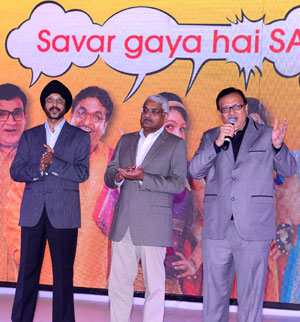
  • SAB TV targets Top 3 slot with new look

    Anooj Kapoor, EVP & Business Head SAB TV along with NP Singh, COO, MSM Network & Man Jit Singh, CEO, MSM Network, unveiled the new look of the channel

    By A Correspondent


    Multi Screen Media’s second GEC SAB TV unveiled a new look of the channel on Friday amidst much fanfare. While retaining the brand colours of red and yellow, the look has been enhanced by Argentinian design studios Steinbranding. The brand promise of ‘Asli Mazaa SAB Ke Saath Aata Hai’ and content strategy however stays the same. SAB TV  has further strengthened its bouquet of offerings with the launch of – SAB Ki Sawari, SAB Ki Paathshaala, SAB Ke Comics to further its connect with viewers.


    Said Mr Anooj Kapoor, EVP and Business Head, “Our new look signifies renewed freshness and a positive move into the future The bond the channel has built over the years will be  strengthened through unparalleled content and consumer engagement initiatives.


    A multiple media marketing campaign has been initiated to complement the relaunch.


  • Madison Media is Raymond’s Media AOR

    By A Correspondent


    Madison Media has been appointed as the media Agency on Record for leading textile, apparel and fashion retailer, Raymond Limited. Madison would be responsible for the entire media mandate for all Raymond group brands, including Digital and OOH.


    Gautam Kiyawat
    Mrinmoy Mukherjee

    Says Mr. Gautam Kiyawat, Group CEO, Madison Media Group, “We are delighted with this new win and are confident that we can add substantially to building the Raymond group brands.”


    Commenting on this development, Mr. Mrinmoy Mukherjee, Director, Marketing, Raymond Limited said, “Madison Media’s leadership status as one of the best integrated media solutions agencies in India and well-integrated service and processes will help our brands scale newer heights of success.”


  • Amith Prabhu: Why can’t our PR firms win PR Lions at Cannes?

    By Amith Prabhu


    This year marked the fourth anniversary of the introduction of the PR Lion at the International Festival of Creativity in Cannes. By virtue of being the biggest gathering of marketing communications professionals from across the world these awards are sought after by the advertising fraternity for a long time and by the PR community for the last five years. The moot question is should PR firms participate in an advertising festival that is bound to be dominated by ad agencies? The rules are open so some do.


    Over the years PR firms have struggled to make headway in this space as advertising agencies have won the PR Lions left, right and centre. Even the largest PR firm in the world won its first Cannes Lions in 2013.  No PR firm has ever won the Grand Prix.  A few firms have managed to grabs some Gold and Silver.


    This column looks at some of the reasons as to why this category has been elusive to PR professionals. And the focus is on India. For a better appreciation one should look at the statistics of Indian entries for the category over the years here - http://is.gd/YM8yo5 and a snapshot in the table below,

    Year Total Entries from India Shortlists from PR firm Winners, always ad agencies
    2009 12 0 0
    2010 12 0 1
    2011 14 0 3
    2012 19 1 0
    2013 27 0 3


    Of the 27 entries from India in the PR category this year only two were submitted by PR firms. The other 25 went from ad agencies. The organizers of Cannes Lions have made it a point to invite the best from India to be on the jury year on year starting with Prema Sagar in 2009, Nandita Lakshmanan in 2010, Veena Gidwani in 2011, Sunil Gautam in 2012 and Dilip Cherian in 2013. The Practice, the firm that Ms Lakshmanan runs is the only Indian PR firm to have made it to a shortlist ever and that happened last year for a campaign for HP.


    What is the reason for this dismal showing? I put together five factors that contribute to this drought.


    Exorbitant entry fee – At Rs 35,000 or Euro 450 per entry most Indian firms are not even considering participation in these awards. Maybe the festival organizers should consider a discounted fee for emerging markets.


    Lack of award-winning worthy campaigns – Due to low budgets to execute great PR campaigns and a great focus on tactics rather than strategy it is possible that Indian PR firms don’t do campaigns worthy of participating in the Cannes Lions.


    Inability to package and produce smart submissions – Packaging and producing storyboards and videos takes a great amount of time and most ad agencies have dedicated teams that focus on this through the year. Imagine what wonders that a dedicated creative group focused on awards packaging can do to a firm!


    Absence of an awards culture – How many Indian PR firms have internal awards to reward the best work done for clients? I would think 2 or 3. That change needs to come about internally.


    PRCAI and the members of the jury should come together – The premier association of PR consultancies and the five stalwarts who have been to Cannes as jury members should come together and offer a workshop in the major metros to share insights with future generations of the profession.


    Until most of the above changes, an Indian PR firm winning a Lion at Cannes will be hard to come by.


    I still don’t see a reason why the top 10 PR firms in India can’t set aside Rs 1 lakh to send three entries every year. If PRCAI mandated all its members to do so Indian PR would be on the world map in no time by just beating the advertising counterparts two times over. Before that it would be great for PRCAI to host an annual workshop on Preparing for Cannes. If not the annual debate will just keep recurring.


    Amith Prabhu is the founder of The PRomise Foundation which organises PRAXIS – the annual summit for PR & Corp Comm professionals in India. During the day he is a full time employee at a leading Public Relations firm in their Chicago office. He spent the first eight years of his post graduation career in India and is in the US for two years of which he has completed 18 months. Views expressed here are the author’s own and don’t represent those of his past, present, future employer or of MxMIndia. You can connect with him on Twitter @amithpr


  • Are Marketers ready for the Digital E-way?


    By Ritu Midha


    The internet has long stopped being Wonderland. Indians are adapting to the ways of the web, and flocking to it for multiple reasons. The third largest internet consumer on the web, India is also one of the largest smartphone markets. Indian marketers are experimenting with the capabilities of the internet and while early adapters are already reaping benefits, others too are looking at getting into a far more serious relationship with it. Flirting alone is not enough!


    First a quick look at some recent internet studies. The numbers might vary from study to study, but the trend they plot is the same:


    – As per the Boston Study ‘From Buzz to Bucks: Capitalizing on India’s ‘Digitally Influenced’, Internet users in India will grow from 125 million in 2011 to 330 million by 2016, nearly a 300 percent jump. This will lead to more purchase decisions being impacted by digital influence.


    As per this report, 40 per cent of India’s 90 million urban internet users already say that what they buy is influenced by online activities such as product research and price comparison. The digital influence right now affects $30 billion of urban consumer spending, and is likely to accelerate further.

    It states that men are far more likely than women to be on the internet (32 percent versus 12 percent) and more than 300 percent likely to be digitally influenced (14 percent versus 4 percent).

    – Kleiner Perkins Caufield & Byers partner Mary Meeker’s report, meanwhile, states that India will have 67 million smartphone subscribers by the end of 2013, a 52 percent growth YoY.


    Interestingly, more than 50 percent of Indian respondents surveyed stated that they share nearly everything online, while the same number for the US is just 15 percent.


    – As per 2013 global ‘Internet World Stats’ report, India is ranked third (following the US and China) in number of active internet users. In sheer numbers it translates to 120 million users (up from 81 million users in 2010). In percentage terms, however, it is only 11 percent.


    As for the smart phones the study estimates that from 18 to 20 million smart phones in 2012, the number will grow to 30 million by 2016.


    – The Google study perhaps is the most interesting of all. It states that of the 150 million internet users in India about 40 per cent are women. It indicates that of these about 60 percent (24 million) are online every day. Among their key activities online are checking email, interaction on social networking sites and online shopping.


    Though the numbers might not sound huge when compared to television viewership or readership numbers, the medium’s continuous growth, India getting younger by the year, and purchasing power of this populace make it a force to reckon with. And then there are the medium’s inherent traits like high involvement, engagement, focused targeting, and measurability.


    Another key reason for the marketers to join the digital bandwagon is reducing cost efficiency of traditional media. States Vivek Nayer, CMO, Marketing Division, Mahindra & Mahindra, “In traditional media there is huge competition for commercial time and column centimetres. With the new guidelines, channels will be able to show ads only for 12 minutes per hour. It might lead to further increase in ad rates. In traditional media due to the high rates, ad sizes and durations are being reduced. Brand stories cannot be shared in 20-30 seconds. The digital platform allows you to tell the brand story. Secondly, there is high spillover. In digital, media interaction is far more targeted.”


    Marketers are not looking at digital just as a medium of brand communication but as a platform to engage with the consumer. Vivek Balasubramaniam Srivatsa, Head Marketing, Renault comments, “Online is not just a media choice, it creates brand experience and drives transactions. The key is to bridge the virtual world with the physical world seamlessly.”


    India getting younger and the young Indian being bolder and far more web savvy than his/her parents too is a key reason for the advertisers to look at internet far more seriously. States Ranju Kumar Mohan, Director & Business Head, JK Ansell – Kamasutra, “Audiences are evolving. Digital is the right medium for targeting bold experimental Indian youth. An effective way to use online is to link offline events with online activity. It immensely helps in growth in conversations.”

     

    Rajiv Dingra

    One of the key reasons digital engages with the consumer much better than the traditional medium is because here consumer is not listening to the story, but is a part of it. According to Rajiv Dhingra, Founder & CEO, WatConsult, “Digital marketing reduces marketers power to control the message – that power here resides with consumer. For the brands to be able to connect with the consumers online, it is important to make them a part of the story.”


    For a brand like Bisleri, which has long seen success via tradition route, too digital is emerging as an important medium to cut the clutter. States Anjana Ghosh, Director Business Development & HR, Bisleri, “For the last 50 years we have built brands like Gold Spot, Thums Up, Limca, Maaza and Citra via traditional media. However, now with more 3000 brands trying to battle for consumer attention on television and print, it is inevitable that one uses digital in the best possible way. It is important to engage with the consumer, and know what the consumer says.”


    Brands are increasingly using web to promote its on-ground activities. It helps in reaching a much larger number of users, and thus increases the RoI manifold. States Mr Nayer, “Amplification of offline events online enhances RoI. Mahindra has formed the Purple Club for Mahindra XUV 500 owners, and we do special events for them. One such event is XUV 500 torque day where we invite XUV 500 owners to drive on F1 track. We do considerable online activity around the event – we put up videos, send mailers and create buzz on FB. During the event, it is not only us putting live updates on Facebook, but also the participants themselves! It increases the buzz manifold. Another event we created was at Auto Expo Delhi – where we used augmented reality. Here a virtual cheetah sitting on the car and moving around became extremely popular not only with those at the venue but also online. The video had wow factor, and so went viral. Besides amplifying the ground event massively, it also won us a gold Abby and a silver Abby.”


    Marketers are emphatic that brands’ online persona needs to be same as the offline one. The interactions and activities conducted online too should be in sync with its offline activities. Any dissonance, they believe, would end up impacting the brand personality adversely. Mr Srivatsa comments, “The online experience needs to be in line with the brand promise. The key is to interact with online users right and to make them our brand ambassadors. There has to be seamless integration with reality.”


    A few brands have taken a leap forward. They are not only using online for brand communication and interacting with the consumer alone, but also to get insights into the consumer behaviour. Vinay Bhatia, VP, Marketing & Loyalty, Shoppers Stop reflects, “Marketers can get interesting and useful insights into their consumers by analysing data. We have a introduced a tab ‘Perfect for Me’ on our Facebook page. Here we display products to the users based on their preferences. Almost 50 percent of the people who use Perfect for me tab are First Citizen Club members. We now have both, their buying data and thinking data. Marrying the two provides useful and interesting insights.”


    Adds Mr Mohan, “One gets sharper data and insights from digital platform. Our product extension in 2010 was based on feedback we gathered from trendsetters. It was done on a closed door FB page.Based on that feedback KS deodorants were created. These deodorants are now doing very well in the market.”


    Marketers are also realizing that while they can talk to the consumer on various platforms, internet is the only place where they can listen to the consumer. Subramanya Sharma, CMO Cleartrip states, “Forums, Twitter, Facebook and feedback are the platforms to continuously listen to your consumers, understand their needs and pain points. What people like and converse about, are clear guidelines to improve one’s products and services.”


    Sanjay Tripathy

    For services the web is a completely different ball game – as the focus here is not on marketing alone but also on providing an excellent online service experience. Sanjay Tripathy, EVP, Head-Marketing, HDFC Life says, “BFSI (Banking, Financial Services & Insurance) is not a product business. Our online presence, to some extent, is about query and interest, which leads to new business acquisition. The web, however, works immensely well as a medium to service the customers.” He adds, “Having said that, for online to work, the right ecosystem is important. The company should have right mindset and right partner.”


    So the inclination is there to use internet as a medium not of advertising communication, but of brand – consumer interaction. Though, there are still only a few examples of path-breaking digital marketing, the learnings are immense. What a brand expects and attains out of online brand-consumer interaction depends on the brand’s PLC, its involvement level, and also on its internet age. As more and more brands put weight behind digital in this tug of war with traditional media, it will get more interesting. However, inclination alone is not enough, brands need to condition themselves to listen to the consumers and evolve. If they just want to convey an advertising message, digital is no match for television.

    Quotes in this article are excerpts from 9th Marketing Conclave organized by the Internet Mobile Association of India (IAMAI)

     

  • Zee 24 Taas Goa Marathi Film Fest begins on June 28

    By A Correspondent


    The sixth edition of the Goa Marathi Film Festival will be held from June 28 to June 30, at Panaji, Goa. Marathi news channel Zee 24 Taas, which has been associated with the event for last three years as a media partner, is one of the presenters this year. The festival is thus called the ‘Zee 24 Taas Goa Marathi Film Festival’.


    The festival will screen around 15 Marathi movies, and as part of the festival Vinsan Graphics has organized a short-film competition to encourage new Goan talent in filmmaking.


    It is also hosting workshops on topics like ‘Catapulting Marathi Cinema’ which will touch upon the dynamics between international film festivals and Indian cinema and will include festival strategies, precautions a filmmaker should take vis-a-vis international film festivals, the kind of films that work and effective marketing strategies. Another panel will be ‘Co-production and International Funding’ and a special workshop for NRI filmmakers.


    Veteran actor Vikram Gokhale will be honoured with the ‘GMFF Kritadnyata Puraskar’ award for his outstanding contribution to the Marathi film industry.


    The event is being presented by Waman Hari Pethe Jewellers, along with Zee 24 Taas.