Category: NEWS

  • ‘Live the Story’ with BBC’s new brand campaign

    By A Correspondent
    The BBC has announced that BBC World News and BBC.com will launch ‘Live the Story,’ a new brand positioning and major global marketing campaign. The activity will include television, press, online, radio, Out of Home and experiential media. The campaign will span consumer and trade media with particular focus on Germany, Singapore, Hong Kong and additional activity across other European markets and the US.


    Chris Davies, Sales and Marketing Director, BBC Global News Ltd said: “Our correspondents and presenters live through the most amazing, terrifying, and sometimes life-changing moments so that they can bring these experiences directly to our audiences. Who better then to be the focus of both our brand campaign and of our marketing efforts. Our journalists often put themselves in danger to tell us the real story and as they live the story, so do we”.


    The campaign creative includes television ads featuring BBC correspondents narrating a news story, telling the audience what it feels like to experience a particular news story, giving insight that only a BBC journalist can share. Focus on Africa presenter Komla Dumor tells of the pride surrounding African football and chief international correspondent Lyse Doucet talks about the immediate aftermath of a car bomb. US correspondent Laura Trevelyan describes nature’s force during hurricanes and science editor David Shukman speaks of the majesty of a shuttle launch after experiencing it up close. There is also a substantial digital element to the campaign that follows the lead of the television creative and offers users an added layer of interactivity. In addition there will also be interactive press ads, digital out of home ads and experiential activity.


    In January, BBC World News had re-launched from Broadcasting House in central London, with new studios, new programmes and a refreshed line-up of presenters including Jon Sopel and Yalda Hakim alongside BBC World News on air personalities such as Komla Dumor, Mishal Husain, Lyse Doucet and Stephen Sackur.


  • Social media users in urban India to reach 66mn by June

    By A Correspondent


    The number of social media users in Urban India reached 62 Million (Mn) by December 2012, and it is estimated to reach 66 million by June 2013, according to a report on Social Media in India, by the Internet and Mobile Association of India (IAMAI) and IMRB. According to the report, about 74 percent of all Active Internet users in Urban India use social media.


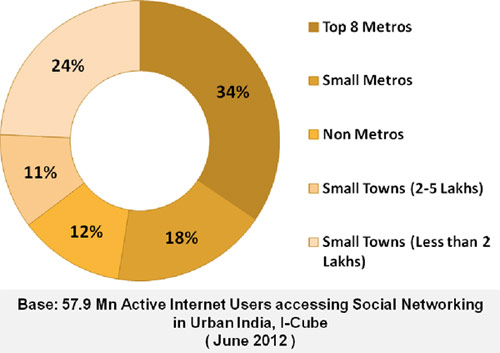
    The report also finds that of the social media users, 34 percent are from the top 8 metros while 35 percent of the total users are from small towns of population up to 5 lakh.


    Figure 1 – Social Networking Profile by Town Class


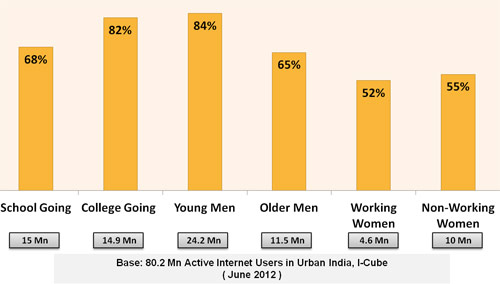
    The report further finds that the highest proportion of social media usage was observed among the demographic segments of “Young Men” and “College Going Students”, with 84 percent and 82 percent penetration levels respectively.


    Figure 2- Social Networking Profile by Demographic Segments (Proportions)


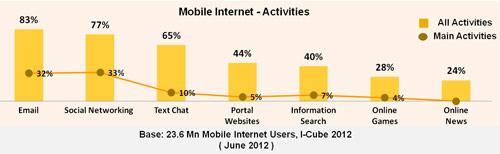
    Social media usage is also fast catching up with mobile internet users. According to the report, 77 percent of the users use mobile for social media. Email, social media, search, app store and chat / IM are used everyday by those accessing internet through mobile.


    Figure 3 – Activities Done by Mobile Internet Users (Top 35 Indian Cities)


  • O&M creates women’s safety campaign for Mum cops

    By A Correspondent


    With growing incidences of attacks on women and drop in safety in public places, the Mumbai Police have reached out to the citizens of Mumbai to reassure them that they are doing their best to keep girls and women safe. This is being done in a campaign created by Ogilvy Mumbai. The agency created an integrated campaign consisting of film, outdoor and radio with integrated messaging that speaks to men as well as women.


    Harshad Rajadhyaksha, Group Creative Director Ogilvy Mumbai, says, “The two-pronged approach is we believe what makes this campaign different and it will also be the reason why it will work. The same ad encourages the women to come forward and not tolerate abuse in any form, and the same ad firmly warns the men that abuse will not be tolerated in any form.”


    The Mumbai police spokesperson in each film first addresses women and then in the second message addresses men. The messaging comprises two parts – an internal as well as in external communiqué. The internal films aim to sensitize the police to everyday incidents/fears faced by women and will be run at all Police Stations in Mumbai; the external films encourage women to report these cases and will be run on media channels. This will make sure the citizens and the force are on the same page.


    Abhijit Avasthi

    Abhijit Avasthi, National Creative Director Ogilvy India adds, “The most important decision was using real police officers, both men and women from within the Mumbai Police Force. The reason for this was that we wanted the campaign to be an honest conversation between the police and the city.”


    In each film the police officer talks candidly to the women and when we think the commercial has ended, the officer returns and talks to the men. Though the words largely remain the same for the two genders, the method of delivery ensures that the message is different for women and men.


    Kainaz Karmakar, Group Creative Director Ogilvy Mumbai points out, “If the message did not sound true it would not work. That was why we discarded many ideas before deciding on this. Every piece is simple and tackles a real fear in the silent victim’s mind. For a variety of reasons, the police station just around the corner is often the longest walk for a victim.”


    Code Red Films and Avadhut Hembade were involved in the process to shape the TV and print campaign, respectively. It was Gajraj’s idea to hold a series of workshops to help the Police Officers get comfortable in front of the camera.


    Gajraj Rao, Code Red Films says, “Team Code Red is proud to be associated with this Mumbai Police and Ogilvy Initiative. This campaign has the promise to bring to the fore the human face of our fellow citizens in khaki. As part of this great city, we felt we had to contribute to an environment where women feel free to reach out to the police for help.”


    Navin Talreja, President Ogilvy Mumbai & Kolkata says, “How can we be in the communication business and not use our talent for a cause like this? What do we expect from this campaign? Nothing will change overnight and it is reasonable to expect that. The journey from fear to faith cannot be completed in one day or with one campaign. However, with this effort we will hopefully move one step closer to making women feel like there is someone watching out for them.”


    Credits

    National Creative Director: Abhijit Avasthi

    Group Creative Directors: Harshad Rajadhyaksha and Kainaz Karmakar

    Creative Team: Rajeshwari Rao, Sagar Parab, Gaurav Kumar and Vishakha Modak

    President Mumbai and Kolkatta: Navin Talreja

    Account Management: Hirol Gandhi, Nikhil Mohan, Sudarshan Srinivasan and Avtar Singh Negi

    Account Planning: Prem Narayan

    Agency film production executive: Vikrant Mishra

    Photographer: Avadhut Hembade

    Production House: Code Red Films

    Producer: Subrat Ray

    Director: Gajraj Rao


  • New, improved IRS hailed by industry


    By Ritu Midha


    The Indian Readership Survey (IRS) has received industry applause for its new avatar, perhaps a first in the media industry. This, however, is after the curtain-raiser – and the real reactions may come when IRS 2013 is out in December this year. Having said that, the detailing that has gone into revamping and reinventing the IRS cannot be faulted – neither can the methodology and the scope it provides for in-depth analysis.

    The sample size for IRS now will be 235,007 users across 95 cities with 5 lakh+ population; 92 districts will be reported individually. And there will be zonal reporting for Delhi, Mumbai and Kolkata.

     

    Lynn de Souza

    Due diligence has been used in the entire process, right from the selection of the new research partner – Nielsen. Explains Lynn de Souza, Chairperson, RSCI, “The search for a partner began with an invitation for RFI (request for information) to research agencies on a global level – which, in itself, is a path-breaking initiative. We received seven responses, which ultimately led to Nielsen being selected based on various parameters.”

    While putting together the methodology for the new IRS, six key priorities were kept under consideration: accuracy, targeting, comprehensiveness, user-friendliness, engagement and granularity.

     

    Prashant Singh

    Said Prashant Singh, Managing Director, Media, Nielsen India, “The focus is not only on accuracy of data, but also on its usage and analysis, and on how easily the users are able to get information.”


    The Four Pillars:

    IRS has now been planned on the four pillars of simplicity, openness, integration and quality – the objective of course is in-depth data that will help in better understanding of the consumer – his/her readership and consumption habits, and beyond. “Shorter interview duration and Double screen CAPI will definitely make life simpler for respondent and interviewer. Intuitive analysis, meanwhile, will definitely work well for all IRS users,” Mr Singh said.

    Here is a closer look at each of the four pillars and the foundation on which these pillars are being built.


    Simplicity:

    Intuitive analytics with world class reporting platform

    Better respondent engagement with 30 minute interviews

    Superior speed and quality with Double Screen CAPI


    Openness:

    Transparent methodology: no black box

    Collaborative steering group

    Seamless incorporation of cross-platform data


    Integration:

    Augmented analytics through fusion

    Access to largest pool of global n local experts

    World class solutions by the world’s leading measurement organisations


    Quality:

    Real time tracking of interviewers for better quality

    Independent audits by 25 dedicated quality control specialists

    To make the process completely unbiased, data acquisition would be done through a rotation of staff every 18 months – completely avoiding the scenario where same people are interviewing same people over and over again.


    The interview process:

    Interviews would be conducted at individual and household level. While part one of the interview would be pertaining to print measurement. For the part two sample has been bifurcated in two parts: sample 2A would be asked questions on usage of TV and Internet in addition to product linkage, while 2B would asked questions on usage of radio and mobile in addition to product linkage.


    Demographic and behaviour hooks would be used for data fusion. The two-pronged approach has been adopted to keep the sample size within the reasonable limits without compromising on research quality.


    Mr Singh elucidated, “Key question on data profile are being asked to all respondents. As for category-specific data, whether it goes in personal interview or HH interview would depend on the product category – for instance a personal category like chocolates would go in personal interview and a category like detergents will go in household interviews.”


    The householder will be selected based on respondents’ responses to the questions, and cannot be selected by the interviewer.


    Publications, interestingly, will be shown on a random basis, and hence the scope of priority based on sequencing is gone.


    The interview process, to put it simply, seeks to get accurate data – and a key factor here is a smooth interview process which is not taxing for interviewer and respondent. Paritosh Joshi, member of the board of governors, MRUC, explains, “Even a bigger concern than respondent fatigue was interviewer fatigue – each interview is a pretty punishing thing, and after a few interviews, the interviewer was almost answering the questions before the respondent.”


    Another expectation from the new research methodology is that upmarket consumers, elusive till now, would be accessible now due to shorter duration interview and use of digital technology.


    Data Analysis:

    While Dual CAPI and tracking of the interviewer make the process sturdier, a key factor is the myriad data analysis options it opens up for users. Rich user interface facilitates the analysis that would definitely help media and marketers if the demo presented at the IRS 2013 Curtain Raiser yesterday are anything to go by.


    Transparency and credibility are two other factors that IRS 2013 has taken care of. Stated Mr Joshi, “A lot of flak that IRS received initially was because people were of the opinion that it was compromised. Security concerns to build an architecture that could not be compromised have been taken care of. Nasty surprises are in store for people who tried to compromise it earlier.”


    Easy-to-use software enables a number of permutations and combinations, leading to multi-level and multi data point analysis. Merging of data, and granular analysis are the buzzwords for publishers as of now – who believe that these would definitely enable them to understand their users and markets better, leading to better revenues.


    “All the non-sampling issues have been taken care of. The need for quasi-qualitative decisions we were taking earlier has been done away with. We are not losing anything that we had in previous IRS, in future if we want to add anymore thing, we can do it,” emphasised Mr Joshi.


    Ms de Souza summed it up: “Capture, storage and dissemination of date would be different – it is a bit like TV measurement moving from diary to people meter.” The key focus, of course, is on providing accurate and granular data through software that will make a much more in-depth analysis possible than in the past.


    Industry appreciation


    Shantanu Bhanja, Vice President – Marketing at Hindustan Times Media Ltd

    On the conceptual level, data fusion will make it really powerful. We will get a far better quality of data. It can also be analyzed along with data you get from other sources – which in turn will help in meeting your business needs better – instead of just one set of data.


    Use of technology will now enable IRS to reach high quality audiences – whom we were not able to reach earlier. New dual CAPI and the size of the survey being brought down to 30 minutes will definitely help in getting people who were earlier elusive due to methodology.


    Digital makes data administration easier – and there definitely is increased accountability as well as freedom from errors caused by surverys being conducted on papers.

    It is an interactive data module. We will be able to dip into data, and analyze it on user apps as they keep coming.


    As for what else is on my wish list, other formats of media and news consumption need to become part of the same integrated IRS. That, as is known, is already work in progress.


    Himanka Das, Senior Vice President – West, Carat Media Services

    It is a much-needed initiative – I am really excited and looking forward to the first set of data. It definitely looks interesting, to say the least, and promising if the curtain-raiser is anything to go by. I have witnessed many changes in industry – from INTAM to TAM, diary system to people meter-readership studies merger, and each change has proved to be for the better.


    Nielsen has enough exposure and knowhow across the globe, and hence any doubts about the robustness of the system are ruled out. I am sure enough thinking would have gone into data fusion.


    What I am keenly waiting to observe is how the new socio-economic classification will be handled, as it was not discussed at length in the session. New classification will go on in parallel with the old classification – and over a period of one year the old one would be phased out and rightly so. It will be interesting to watch how the new one will be used in IRS research, and its impact from the data fusion point of view.


    As for software for data dissemination and analysis, it appears to be very user friendly. Another commendable thing is user feedback they are seeking to make the system more robust.


    Monetizing it is a great idea, however, with a 2.5 to 3% commission structure, it remains to be seen if agencies can fund it.


    Ambika Subramanian, OMD

    The interface is definitely much better, and much easier to navigate. Data slicing too should be much better now. Unfortunately I missed the initial part of the curtain-raiser, and hence I would like to use the new IRs before I really comment on it.


    Navin Singh, Manager – Marketing, Sakal Media Group

    It is a step in the right direction. All the loopholes in the previous IRS have been plugged. We are really looking forward to using it. Data in the new IRS will be better obtained, and finer cut. It will enable us in exploiting our strength in specific markets.


    The most impressive things of course are the much needed change in interview methodology, and the new vistas opened for data analysis at multiple levels.


    Peter Suresh, Head – Strategy, Dainik Bhaskar Group

    The entire process is automated, and that is incredible. Attempt to report individually on a far larger number of geographical units is also very heartening. District cut too has increased – hence the data can be analyzed at a far more granular level.


    Bulk of action of late has been in rest of India, beyond six metros and hence granular cut is extremely important. Data slicing at a deeper level, and multiple ways of presenting it, make far more sense. Readership numbers are the cornerstones of most media marketing and sales strategies – and the finer they can be cut, the more robust they are. And, of course, these will help in delivering better stories to the marketers.


    Sanjay Verma, West Head, Sandesh Ltd

    “It is a step in the right direction. So many options have been provided as far as data analysis is concerned. We now have an option to look at different TGs and SECs. What is more, one can merge data segments as required. Right data slicing is much needed. It definitely helps everyone to get more data permutations and combinations”.
     

  • Digitization to facilitate transparency: Manish Tewari

    Manish Tewari

    By A Correspondent


    Minister for Information & Broadcasting Manish Tewari has said that the ongoing digitization process would help in building transparency in the system. As a mechanism it would also enable the growth of revenue models in the Broadcasting industry leading to the overall growth of the media and entertainment industry in the country. The process would also help broadcasters in identifying a balanced growth model through the increased share from the subscription revenues. 


    The minister stated this while delivering the keynote address at the Seema Nazareth Award function for excellence in print media.


    Elaborating further, the minister said that there was an urgent need for key stakeholders within the media to introspect in view of the trends that had emerged as a result of corrosive discourse on one side and responsible discourse on the other. Referring to the challenges that have emerged due to the social media, the minister said these tools had created an unprecedented potential to connect with target audience for the dissemination of news and information. The impact of this medium was so profound that it had also integrated with the print media in the dissemination mechanism. The changing paradigm in the media landscape had resulted in creating opportunities for the journalistic fraternity.


    Referring to the Seema Nazareth Award, Mr Tewari said that the institution of the award had provided an ideal platform to encourage and inspire young journalists in the print media. The minister conferred the award on Sushmi Dey and also gave two awards as a special mention to Shelly Walia and Debolina Sengupta. The Seema Nazareth Award has been instituted by Business Standard.


  • #Frames2013: Need for reforms to take centrestage

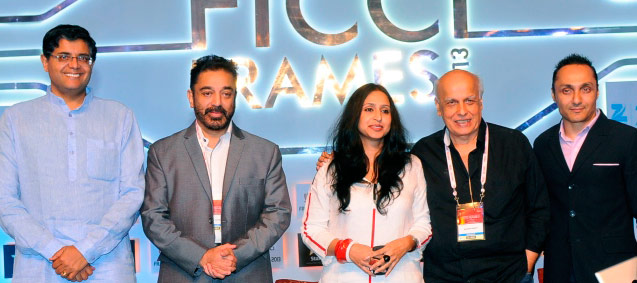
    L-R – Jay Panda, Hon’ble Member of Parliament, Lok Sabha, Kamal Haasan, Chairman of FICCI Media & Entertianmnet Business Concalave (MEBC),Shoma Chaudhury, Managing Editor, Tehelka, Mahesh Bhatt, Film Director,Rahul Bose, Actor


    By Kshama Rao


    Day 2 of FICCI-Frames started with a session on ‘The Gag Orders: Are we stifling creative expression?’ Managing editor, Tehelka, Shoma Chaudhary moderated the session which had Kamal Haasan – who was recently at the receiving end when his ambitious 90-crore film, Vishwaroopam met with some opposition from certain religious quarters – MP Jay Panda, “liberal intellectuals” Mahesh Bhatt and Rahul Bose.


    Ms Chaudhary who admitted to believe in “absolutist freedom” had the panelists talking about the very definition of freedom, the role of art in society, on whether the Indian constitution is robust enough to tackle the various groups and diverse ones at that who get easily offended by any piece of art – be it a book, a piece of music, film or art. Mr Panda talked about how while the constitution doesn’t provide us with absolute freedom it does come close. What worried him were the Supreme Court rulings being defied by high courts and state governments when they should be tried for contempt of court. “The job of leaders is to resist lynch-mobs and not pander to populist measures.”


    While Kamal Haasan confessed to have curbed his daughters from always following their minds, he said as a filmmaker, he felt “curbing creativity and freedom is not a dignified thing. It shouldn’t be just about me. It should be about anyone and everyone irrespective of where he comes from who shouldn’t be pushed to a wall like I was.”


    Mr Bhatt said that the notion of absolute freedom is still a fantasy. “Right from the time I made Arth, which had people from my own fraternity ganging up against me for making a film that threatened the institution of marriage, the very bedrock of our culture and our being, I am still waiting to be free.”


    He added how the “offenders who are most often than not engineered to disrupt and disturb things” ensured that a little fear went a long way and did an irreversible damage to the society. “Timidity has now become a philosophy and every filmmaker lives with that dread of facing a lynch mob outside his door,” he said.


    The discussion also veered to demanding a film certification board rather than a censor board. Kamal Haasan observed, “Why should there be representatives from political parties on film certification boards? They are in no way connected with the aesthetics of cinema.”


    Mr Panda called for an urgent need for political reforms which could only be put in place with the rising middle class. “Their sensibilities are worthy of emulation and I do see a hope in the middle class who have already begun a movement for change if you go by the protests they recently staged in the case of the rising rape and violence.”


    Mr Bhatt rubbished Mr Panda’s trust in the middle-class, who, he saids are interested only in fighting battles they are comfortable with. “They will stand up for a Kamal Haasan but not a Kamaal Khan, a big Hindi film but not a Bhojpuri one.” Mr Bose agreed with him saying, “The middle class will come out in large numbers outside the PM’s house to fight for a rape victim but I wonder if they will be equally passionate about an issue that’s bothering some other part of the country.” Kamal Haasan added that sensibility is not the sole bastion of the middle-class. “It can come from any strata of society, from anyone.”


    The rather interesting conversation was ended with Chaudhary calling for everyone to first define the very idea of freedom and if the entire nation was ready to fight for it every time it was threatened by a few offending groups. She also placed the onus on the film and television industry to rise above their roles of mere entertainers and instead bring about social change through cinema.


  • #Frames2013: It’s the best time to be in the content business: Andy Kaplan

    By A Correspondent


    There’s so much that has emerged in the recent past that it is mandatory for the broadcast industry in India to stay updated and geared for a promising tomorrow. Most of these developments have come from multinational brands which have made quite an impact on the way the M&E ecosystem functions in India.

     

    Presenting the experiences and practices adopted by his network, Andy Kaplan, President, Worldwide Networks, Sony Pictures Television had the stage to himself at a special session on ‘The future of television’ on the second day of FICCI Frames 2013.


    Sharing his outlook he said, “I think there has never been a better time to be in the content business. A few years there were barely any players that you wanted to sell your content to but today there are hundreds of players available that provide us many more opportunities. In the US market, there is a change that has been observed in the secondary revenue stream where if a show is there on a network long enough then there is syndication carried out with cable and TV stations but now there are a lot of new players in that world that are supplementing their revenue streams or are replacing them like Netflix, Amazon etc. So the way the content providers are looking at the world is completely different. It is providing them enough opportunities and is thus a good place to be in.”


    Highlighting his opinion on the issue of revenues facing the business, Mr Kaplan said, “Where revenues are concerned around content I do not think they are going down but are rather coming in from other places. But there are the challenges of infrastructure because one needs to be equipped with different areas of expertise from the distribution side that allows one to monetize these opportunities and have more sophistication and knowledge and transparency into all of these other businesses.”


    On the influence that localization has over global, Mr Kaplan said, “From an international network standpoint there is the localized model that we follow around content. So while we buy a lot of programming from our own we also buy from other studios as well. Our job is to pull in the best programmes that we can and deliver the best networks to our audience and maximise our ratings and eventually revenues as well. The good news is that there are a lot of people in the content business who want to sell their content and as we become more successful in these markets we want to become more important buyers. Also each of these markets throws up different nuances where content acquisition is concerned and where we are concerned we are always faced with a challenge of balancing the local with global. We resort to using research and focus groups and whatever local knowledge we get about our networks in each market to maximise our ratings. As an adjunct to the global programming we also have our own local programming because that is what will drive higher ratings and give us an opportunity to have a broader conversation with the advertisers.”


    On the ways that Sony has managed to stay relevant and close to its consumers, Mr Kaplan said that it is important for broadcasters to keep themselves available across platforms. Sharing his experiences from his offering, Crackle, Mr Kaplan said, “Crackle has been around for five years and is a non-linear network where one can watch movies, television programmes etc. It is streamed content and is advertiser-supported. While most players have a subscriptional or transactional role we are a purely advertiser-supported entertainment website. It’s all about being available on all platforms and being able to garner more eyeballs. That’s what the advertisers too look out for. The good thing is that the advertisers are dying to get into this world either because they think that they have the audience matrix they want to reach or either because it is the next big thing. But whatever it is, Crackle in the US caters to male 18-49 yrs and that’s where most advertisers are also comfortable being focused towards.”


    Mr Kaplan went on to highlight the role of India in fostering his growth in the region and the role that content will play in making broadcast a space to vie for.


  • #Frames2013: ‘For digital to excel, freemium has to make way for pay’

    By A Correspondent


    The past two years have seen the digital ecosystem in India take off in a big way. Whether for the medium of mobile or web, the fast-paced growth sweeping this medium is making other developing economies around the world sit up and take notice.


    The session on ‘Digital content consumption: developing a robust paid ecosystem’ on day 2 at FICCI Frames saw panelists discuss the advantages, opportunities and challenges facing the medium. The panelists comprised, Neeraj Roy of Hungama Digital Media, Devraj Sanyal of Universal Music, Manish Agarwal of Reliance Entertainment – Digital, Sidhartha Roy of Hungama Digital and Boaz Ben Yaacov of Catch Media Inc.


    Neeraj Roy

    Neeraj Roy, CEO, Hungama Digital Media Enterprise started off by presenting a positive picture of the medium. He said, “India is today the third largest internet market in the world and is likely to be the second largest market with 600 million internet users in the next 3-4 years. The industry is adding about 5-6 million users every month and most of this is largely from the mobile device, especially smartphones that saw about 60 million new users this year. India will also be one of the rare nations that will transition from 2G to 4G this year. In India there was a single ecosystem that was created around the mobile which had got to do with micro-transactions. Unfortunately there are a lot of regulatory hurdles that are impeding the rapid growth of the sector. We are now at the cusp of moving away from voice to data consumption. What the industry needs to do is contemplate ways to develop an ecosystem that will bring in robust growth and provide an impetus for the industry to move forward swiftly.”


    Devraj Sanyal, MD, Universal Music said that it was exciting to see three ecosystems in digital co-existing well with each other. “It rarely can be seen in other parts of the world. For me, the death of voice is the beginning of a much bigger phenomenon – data. The entire future will ride on data. In a country as diverse as India there are two kinds of consumers – the first being pay consumers who are very few in number and the other kind of consumers being those who will pay for nothing and want everything free. As a content creator, I want to see a lot of this ecosystem thriving on the pay model. For me, having 1 million paid viewers is much more valuable than having 500 million viewers who are fence-sitters/pirates. The future will be pay along with value-added services.”


    Manish Agarwal

    Manish Agarwal, CEO, Reliance Digital said, “There’s no doubt on the huge impact that mobile will have on our lives. It is a device of the future and will be accessed for a host of things including content, gaming, etc. The market is very appealing and has just about taken off. I travel a lot around the world and have often heard things like if there are 20 million mobile users in Japan and if that economy is where it is today on that medium, imagine what potential the Indian market has which has more than 600 million mobile users and counting. While there is no doubt on the loyalty on behalf of the customer, we have to see how the medium will benefit the business across the formats that they will operate in.”


    According to Boaz Yaacov, CTO & Co-founder of Catch Media Inc, “The question we need to ask ourselves is whether we are still living in a world where a customer pays a dollar for a song when there are others who get it from Bit-torrent or even a youtube for free. If we are to sustain the technology or content we need to find practical solutions. We all know how the business of credit cards started about three decades ago and how they charged micropayments to give convenience and access to our money. Today one such player – Visa, is worth about $ 250 billion but the point is that we consumers do not know of these payments.” Adding further Boaz said, “What we are trying to do is build technologies to give people very convenient and mobile way to access their content. If we are able to deliver content to consumers where they are and at their convenience they won’t mind paying for it.”


    The panel went on to discuss the challenges confronting the medium and also how ‘pay’ would be a preferred model in the future compared to the model of ‘freemium’ that is currently what the players are taking a preference to.


  • #Frames2013: Indian M&E must take a global stance: Dominic Proctor

    By A Correspondent


    That the media and entertainment industry in India is making steady progress is known, but whether it is able to deliver advertising value to brands in a manner that gives them maximum bang for the buck is still questionable. For brands to remain interested in the medium and empower them to play a larger role in steering the ecosystem forward would require a great deal of recalibration from the industry and its stakeholders.



     

    The session on ‘Will advertising still be the key growth driver for the converged ecosystem?’ by Dominic Proctor, President, GroupM, Global threw up interesting insights on the role that the advertising and media industries had to play in helping the sector achieve remarkable growth.


    Taking off on the key theme that had been drawn up for him Mr Proctor said, “If you ask me, will advertising drive growth in the converged ecosystem – the short answer to that is yes! But the real question is – we all know that India is an emerging entertainment superpower, but will the growth come from just from extending business in India or will the business grow because of the global ecosystem? We believe that the Indian entertainment business is at crossroads and they can make a choice of whether to stay as a relatively inward-looking business or join and be a part of world entertainment business.”


    Questioning the reasons for the industry being under-valued, Mr Proctor stated, “I often wonder why the media business as not managed to do what the IT business has in terms of its growth and size. While the IT business is about $ 100 billion the media business is still about one-fifth of that size. The reason why the IT business has become what it is because it has taken a global stance.”


    Presenting another interesting facet about the media industry, Mr Proctor said that the thing about India is that it is a powerhouse of strong content. “If you look at the sector, the country produces more than 1000 films every year, has more than 700 channels, has more than 7 DTH platforms, about 900 million mobile downloads, has a huge base of consumers who access content online or through a mobile device… all these are factors around which India could build itself up in the global entertainment value chain. Right now what is happening is that a lot of programming on television or music on platforms or even sports is being produced for local consumption; that approach has to change and a more global route needs to be taken,” he said.


    Adding further, Mr Proctor said that where content is concerned it is obsessively dependant on things like Bollywood, cricket, stars etc but it was important to see whether these options were going to be sustainable in the long run. “For example, cricket in all its form is seeing a downfall in viewership over recent months. This poses a serious threat to its profitability and sustenance in the long run. But what is interesting is that Indian sports is expanding its horizons and looking at options such as football, hockey, golf, etc. But it is still not what is observed in other markets like the US and UK where each sport has become an entity of its own, be it in terms of viewership or revenue generation. So sports marketing in India will require a broader base for the long term.”


    Sharing his observations on the medium of films, Mr Proctor said, “If you look at films, the problem with that sector is that it hasn’t really moved at a pace that benefits brands more than it does from cricket. This is despite movies having a larger viewer base than sports. The tie-up as of now between the two is still very clumsy and they need to find new ways to take it to the next level. One way they could do it is through the web, which presents massive opportunity. Other avenues include hyper-targeting through STBs that could also change the way the ecosystem works. The way forward for our business is to move from inventory planning against demographics to specific audience planning and buying because the technology that we have at our disposal allows us to optimise our offerings by serving different advertisers and consumers.”


  • #Frames2013: Making Phase 2 of TV digitization a reality

    By Johnson Napier


    When phase 1 of digitization became a reality in India there was a sense of accomplishment that was witnessed amongst most factions within the broadcast industry. Apart from the huge advantages that it presented to the broadcasters and allied interests, it was also seen as an exercise that enabled the consumer to become empowered like never before. But while issues remain about the impending challenges emanating from phase 1 of the rollout exercise and also the non-interest shown by some metros, the industry seems to be waiting with bated breath for phase 2 of the rollout to take shape.


    In the session on ‘The second phase of TV digitization’ noted panelists from the sector came together to discuss and mull options of making the exercise a more robust and achievable one. The panellists comprised of N Parameshwaran of TRAI, Sameer Manchanda of DEN, Sunil Lulla of TTN, Man Jit Singh of Multi Screen Media, Raman Kalra of IBM, Tarun Katial of Reliance Broadcast and Anuj Gandhi of Indiacast. The session was moderated by Vivek Couto of Media Partners Asia.


    N Parameswaran

    N Parameswaran, Principal Advisor, TRAI began by highlighting the outcomes witnessed by rolling out of P 1 of digitization. “We all know what has happened with P1 of digitization where metros like Mumbai and Delhi have recorded a remarkable conversion rate. We may have questions about the metros of Kolkata not yet achieving their target and Chennai not yet taking off but rather than the negatives we should focus on the positives from this exercise, including the role that the industry players and stakeholders played in making this dream a reality.” According to Mr Parameshwaran, while P2 digitization would be kicked off from March 31, 2013 it would again require the coming together of industry players, trade bodies, MSOs/LCOs and the government itself in making this dream an achievable one.


    Sameer Manchanda

    Sameer Manchanda, Chairman and MD of DEN began by appreciating the efforts put in by all from the industry and added that “digitization has been the biggest change that has ever happened to our industry. While there are a lot of positives from this exercise, one of the big drawbacks as been lack of accountability. The MSO/LCO operators have to ensure that the KYC forms are filled by the consumers as it is mandatory and binding on them. There is still some time to go before that becomes a reality. Where I see it, P2 of digitization is a transition phase and will start rolling out over the next 60 days.”


    Anuj Gandhi

    Without wanting to sound too cynical, Anuj Gandhi, Group CEO, Indiacast said that while digitization has bought about a positive change for the industry there was some serious thinking that is needed. “If P1 of digitization is taking us about 7-8 months to become a reality we can imagine what P2 would be like. The onus lies on the MSO/LCOs to make this rollout a reality but I can assure you that this won’t be possible without the coming together of all from the industry.”


    Man Jit Singh

    Man Jit Singh, CEO, Multi Screen Media had a similar feeling to share as he voiced his excitement at the good that was seen from rolling out P1 of digitization. “Due credit should be given to one and all from the industry who made this a possibility and we can hope for a similar outlook from P2 as well. Even the government’s role has been encouraging but there are a few shortcomings that have to be worked upon if further rollout is to become more successful. There are issues that are cropping up at the MSO/LCO level regarding filling of KYC forms, data collection etc. All these have to be addressed immediately.”


    Raman Kalra

    Raman Kalra of IBM Global Business Services said, “We have entered an era where it is the end of digital. By that I mean that we are already in the know-how of how digital works and the benefits that the medium presents but the challenge now is how do we take it to the next level. There is need for the industry to come up with strategies to cater to the ever-evolving ecosystem.” Pointing out that the consumer today was faced with an array of choices to access entertainment, he said that consumers won’t mind paying more money to access content but it is essential that we know who our customer is and what are his likes/dislikes.”


    Tarun Katial

    Tarun Katial, CEO, Reliance Broadcast said that what DAS has done is enabled channels to have a wider reach and get carried more easily. “Early data has shown how most channels, especially those offering niche offerings, have benefitted in terms of ratings and acceptability from DAS. For new players, as you sharpen your positioning there are high chances of they getting lapped up more easily. The exercise has also opened new avenues for advertisers who will be looking at niche channels with renewed interest. I guess the advertisers will have to shell out more advertising dollars where niche channels are concerned.”


    Sunil Lulla

    Sunil Lulla, MD & CEO, TTN highlighted that the current economics do not fund the ecosystem as the industry is going through a transition and there is need for change. According to Lulla, it would do the industry a lot of good if the prices were to be lowered but that is not a logical thing to do. “In fact it is commendable to see how the industry has come together in making phase 1 a reality and the same can be expected from phase 2 too. At the end it is essential that we keep the customer at the centre of all that we do and keep on satisfying him so that he comes back to us for more.”


  • #Frames2013: Text of Uday Shankar’s keynote

    Good morning and welcome everybody. Secretary Uday Kumar Verma, Honorable Minister Dr.Soon Tae Park, Andy Bird – who has flown down all the way to be here, my dear friend Karan Johar, Rameshji, ladies and gentlemen.

     

    I take this opportunity to say that I am honored to be here in my new role as the chairman of FICCI Media and Entertainment Committee. I am stepping into the big shoes of the late Yash Chopra who was a leader of the Indian film industry for four decades. Yashji played a pivotal role in building Media and Entertainment as a cohesive community with a clear identity, and made FICCI FRAMES its most distinguished platform. Your presence here today is a testimony to his contribution. My goal will be to work with you all to further reinforce this community and accelerate the growth of the industry.


    And hence, the choice of the theme for this year’s FRAMES: “Engaging a Billion Consumers”.


    A concrete manifestation of this aspiration is reflected in the next big milestone that we have identified for the Indian film industry: to produce a 1,000 crore blockbuster. Celebrating its 100th year, Indian cinema has shown proof of its enduring followership and in recent times has set new benchmarks at the box office. It is time for the next audacious leap. And, there is no better consensus builder and no one more enterprising than my friend Karan Johar to steer this ambitious task. I am confident that both Karan and I will benefit heavily from the sage counsel of Ramesh Sippy.


    I remain convinced that such quantum leaps are possible across the media and entertainment sector. We all have tremendous progress to show for the last two decades: as a community, we have shown an admirable commitment to enthrall Indians and the Indian diaspora with compelling content. But, in business and creative terms, the Indian media and entertainment sector still remains much smaller than it should be in a country of 1.2 billion people. Our collective and individual ambitions should be taking wings around this big opportunity.


    I am confident that in the next three days we will come up with big ideas to make media and entertainment economically more robust, creatively more vibrant and socially more meaningful. However, in my view the single most important enabler towards all this would be a strong alignment within the industry, and with other stakeholders in the Government and the policy establishment. Our most recent experience with digitalization is a superb evidence of the power of alignment. Despite many hurdles, the unthinkable is beginning to happen in television distribution, with the first phase of digitalization well underway. As we speak, over 10 million cable homes have gone digital and in the next 2 years, 80 million homes will be digitalized. It will be the fastest digital transition anywhere in the world. How did this happen? It was because all of us within the industry and in the government were strongly aligned behind a move that was good for the industry and great for consumers.


    But, let me be honest – our experience with consensus building hasn’t been great. Usually, we disagree more than we agree. So, I want to highlight today what I see as the four big problems facing the industry around which we need consensus. And, in the days ahead, I hope to focus my own and the FICCI media and entertainment committee’s energies towards forging a consensus on how we can address each of these challenges.


    Firstly, media and entertainment is a real economic enterprise not just a vehicle of glitz and glamour. This industry is an economic enterprise like the best of them and is capable of creating employment and wealth much faster than most other sectors and with the ability to be a force multiplier, like it is in most countries. It is particularly relevant in India because it can be an employment generator without massive public investments and without being hampered by the deficiencies of public infrastructure. Just to put things in perspective, as a 15 billion dollar industry, we employ over 6 million people. This can be so much more significant and meaningful.


    Let me explain this further: according to official estimates, about 15 million people are entering the job market every year while the country is generating only about 3 million new jobs a year. This means that we are adding, as my friend Shekhar Kapoor eloquently put it, a city of unemployed people as big as Delhi every year.


    And yet, the lens often used to look at this industry is largely one of glamour and propaganda and the biggest debate is on how to control and contain it. As a result, the growth of M&E has not been supported by policy and regulatory initiatives. With full recognition of the government’s constraints, this year’s budget is a case in point. Instead of giving fiscal support to digitalization which can unlock huge economic value, there is an imposition of additional customs duties on boxes and of withholding taxes on content rights. Why would you not nourish an industry which has the potential to become a huge employer? Why would you not fuel an industry that can grow with more policy support than resource support? The time has come for all of us to make sure that it is not just industry status that we seek; it is a fundamental change in mindset.


    Confusion on basic facts

    This takes me to the second big challenge. How can we seek support from the government when as an industry we do not even have the basic facts in place?


    It is not my desire to add fuel to the debate on TAM. However, it is indeed a matter of concern that the credibility of the most prevalent currency of all transactions in TV enjoys so little credibility. Imagine if the automobile sector didn’t have consensus on the number of cars sold or the railways did not know the number of passengers transported or the tonnage of freight carried. The lack of reliable data is not limited to TAM. In fact, as a TV executive, I am surprised sometimes how I am even able to function. I do not know enough about my viewers – in fact I don’t even know how many of them are there. There are 140 million cable and satellite homes but the measured universe is 62 million households. I do not know how many subscribers I have with a particular MSO and the MSO doesn’t know how many households his LCO delivers the signals to. Same is true in advertising too. The country’s premier media agencies can’t even seem to agree on a fact as basic as the size of the advertising market. One leading agency estimates the total market size to be ~35,000 crores, while the other, equally illustrious, estimates it to be ~29,000 crores. A variance of no less than 20%! I don’t even want to get into projections for next year, where this variance is even more bizarre! The ambiguity in data for other sectors of the media and entertainment is no less. For instance, no film producer seems to know accurately how many people actually bought tickets to watch his film. How can this industry function without a shared and non-controversial view of the most basic facts? Numbers are supposed to be the foundations of rational business decisions but how can we make decisions when professionals in the business of numbers can’t get their numbers straight?


    Crisis of talent

    The third issue that must keep us awake at nights is talent. We have a real crisis on both supply and quality. While it is not unique to Media and Entertainment, what is different is the lack of recognition of the scale of the challenge. While other fast growing sectors like IT and financial services are actively working to find the right talent and building the right skills, we, as a community are complacent in our belief that this sector is different. We hide under the pretense of creativity and have convinced ourselves that creativity gives us the license to be informal and chaotic. It is this informality and chaos that has seeped into our approach to spotting and grooming talent. This is dangerous. We must realize that discipline and formality are not antithetical to creativity and if anything they are necessary ingredients to fostering the creative process.


    In the last 10 years, there has been a manifold increase in the content we have produced, the number of channels, the number of newspapers, the number of radio stations, and the number of films – but there is not even a nominal increase in the number of quality training institutions to support this kind of growth. Fly-by-night training shops have mushroomed, making the problem even worse.


    Even in what are considered “established” disciplines like management and technology, the situation is not any better. Not a single premier management institute has a proper course on media and entertainment.


    No industry without free expression

    While these are all big challenges, for me, the most important issue at the moment is the one on freedom of speech. This perhaps is the only major democracy in the world where, after over 60 years of independence, there continues to be a debate on how much freedom can be given to the media. I am shocked that there are still groups and interests who continue to debate on the right amount of freedom that can be granted to media; as if this is something to be granted and as if this is even negotiable.


    There is a strong positive correlation between creativity and the space for free expression. There is no greater evidence than Silicon Valley that culture is destiny. The Valley’s preeminent role in global media and technology can be directly attributed to the freewheeling culture of the 1960s and 1970s California. So, what is troubling to me is that in a very competitive world, we are questioning the scope of free speech – one of the few real sources of advantage for us. China and Russia are way ahead of us in most areas of business and industry. But we, as a democracy, should be unquestioningly leveraging the democratic advantage that we have over them and many other competitors to become a global media and entertainment giant.


    What is interesting to me is that we all agree that the role of media is to question the status quo. But with the right to question must come the right to provoke and the right to offend. In the absence of these, there is no debate and without debate there is no clarity. But we seem to be regressing in this area.


    When Satyamev Jayate points to weaknesses in the medical system, doctors are offended. When Jolly LLB creates a courtroom satire, lawyers are offended. Even when a precocious teenager posts a comment on Facebook, some people start baying for her blood. We are not far from a point where someone’s sneeze or a cough on a television show will be source of offense and outrage for many. What makes it worse is that increasingly the democratic institutions have more patience for those who promote intolerance. It is time for us to recognize that free speech is what is sacrosanct, not the right to be offended.


    In conclusion, I want to go back to the idea of the 1,000 crore blockbuster – mainly because of the scale of its ambition, how bold and daring it is. Just in the last couple of years we had major Hollywood movies – like Life of Pi and Slumdog Millionaire – where everything was Indian except production and direction, and these went on to become world-wide successes. There is no reason why those movies should not have been made in this country by one of us here.


    It is that kind of ambition that needs to fire up all the sectors in their pursuit of the next big leap. Today, let’s commit ourselves to this goal.


    Thank You.


  • #Frames2013: Need to grow the kids’ pie further

    By Johnson Napier


    While increasing importance is being given to Hindi GECs and sports broadcasting in India, a genre that has been steadily pushing itself up the growth chain is children’s entertainment. Accounting for nearly 7 per cent of the growth pie, kids’ channels in India have been throwing up interesting growth trends over the past few years.


    At the session on ‘Trends in Children’s Entertainment’, panelists presented their viewpoints on the genre and what was the way forward. The panelists comprised Harpreet S Tibb of Kellogg India, Vijay Subramaniam of Disney UTV, Ashish Karnad of IMRB, Krishna Desai of Turner, and Pradeep Hejmadi of TAM.


    Harpreet S Tibb, Marketing Director, India & South Asia, Kellogg said, “The focus for marketers is to strengthen our brand and also that the message gets conveyed to the desired TG. The thing about kids today is that they are increasingly gravitating to newer mediums and it is therefore essential that the broadcasters come up with content that is valuable and meaningful. There is also a need for players to create content that is interactive and relevant.”


    Vijay Subramaniam

    Vijay Subramaniam, Executive Director, Kids Network, Disney UTV highlighted how the focus by his group was to tell stories that are great.” We have always been known to present stories that are innovative and pioneering. While much of our content is centred around kids, it is also made keeping the family audience in mind. The challenge facing the genre is of financial viability.”


    Ashish Karnad, Group Business Director, IMRB International presented his outlook as he said that boys consumed different content while the girls too consumed content that was different from boys. “There was not much differentiation that was observed between the two subsets earlier but that is seeing a change now. And as we all would be aware, there is a huge demand for locally produced content.”


    Krishna Desai

    Krishna Desai, Director-Content, South Asia, Turner International India elaborated on how the broadcast players were waking up to providing new content options for the kids of today. “Admitting that animation as an industry is still in its infancy, Mr Desai said that it was indeed picking up in growth. “Overall the kids’ genre is still small compared to the other genres as the ad spends around the medium are still very low. But there are other positives that are emerging inclusing its ability to ship content to outside markets. The industry is evolving and it is up to us to unite and take it to the next level.”


    Earlier Pradeep Hejmadi of TAM went on to present his perspective of the kids’ genre in India and what was in store for the players in the years to come.