Category: NEWS

  • #Frames2013: Unlocking M&E’s true potential for a billion consumers

    By Johnson Napier


    That the media and entertainment sector in India is one of the liveliest and has been delivering a robust growth year-on-year is what makes it a favourite for many. Little doubt that when the economy is just about struggling to stay afloat the M&E industry surprised one and all by posting a 12.6 percent growth rate in 2012 (according to data from FICCI-KPMG).


    There have been a stream of avenues that have led the industry to achieve the kind of growth it is seeing thanks largely to the emergence of new mediums and technologies which in turn have led to a growth in the number of audiences out there to consume such mediums. The challenge going forward would be how the industry can engage a billion people in an era when the consumer will be king and would be faced with an array of choices for consumption. The panel discussion ‘Engaging a billion consumers in the M&E industry’ saw a high-profile display of knowledge and mantras from speakers including Ravi Dhariwal of Bennett & Coleman, Punit Goenka of ZEEL, Sidharth Roy Kapur of Disney UTV, Sudhanshu Vats of Viacom 18, Rahul Johri of Discovery and Shailesh Rao of Twitter Inc. The session was moderated by Uday Shankar, chairman of FICCI Frames 2013.



    Uday Shankar

    Uday Shankar, chairman of FICCI-Frames 2013, began by warming up the audiences on the quality of panellists that had assembled at the session who according to him were among the best in the business. “If any change has to happen in the M&E industry then it has to begin with us (pointing at the speakers) and if we cannot do it then nobody else can and it will eventually be a failure,” remarked Mr Shankar.



    Ravi Dhariwal

    Presenting the mantras that get practiced at his workplace, Ravi Dhariwal, CEO, Publishing, Bennett & Coleman began by saying that for him it was important to concentrate on the smaller audiences, which is roughly about 1 per cent of the total population, and try and make a business model out of it. “To get this going we lay more emphasis on hiring good creative people and give them the freedom to do what they feel like. Ours is a very federal system where we let our people do what they want to do whether it is television or Radio Mirchi, TOI etc. With this, we also make it a point to hire good marketing professionals as we believe that the creative people also need to understand where the market is moving and be able to hear the voice of the customer. We try and make this combination come together to develop brands.”


    Sudhanshu Vats

    On the question on whether the industry is geared to cater to the entire range of diversity in terms of content, Sudhanshu Vats, Group CEO, Viacom 18 Media said that the emphasis going forward would be to be able to build more of this ability and be able to segment and target. “In order to cater to a billion Indians we sharply need to segment and target them.” Pointing out to three trends that were helping the industry move forward, Mr Vats said, “The first trend is the mega-consumer trend where people generally tend to fall under the ‘collectible’ category and believe in sharing with the others around them and the ‘I’ category where people focus more on themselves and what they desire. The other trends include multiple screens that are here to stay and also the role that digitization will be playing in delivering focused content for both the mediums of television and print.”



    Punit Goenka

    For Punit Goenka, CEO & MD, ZEEL, the industry has just about taken baby steps and there is still a long way to go. “In fact if we are not geared for it then fragmentation is going to be the order of the day. And if do not do something about this then the consumer is going to go away.” Adding further he said, “From a television POV we have to stop calling ourselves as broadcasters and call ourselves content creators and aggregators. As in the end we will have to customise content even to the last individual. The problem is that the industry does not believe in working together today and if the entire value chain cannot work together then it cannot be done.”


    Sidharth Roy Kapur, MD – Studios, Disney UTV said that where films is concerned what has happened in ten last 7-8 years is that commercial and parallel cinema have learnt to co-exist and also become popular too. “Films have managed to bridge the gap where you have audiences who like a Rowdy Rathore and are also enjoying a film like Barfi at the same time. And these are not two different set of audiences. I think the massive gap that we have in our country is infrastructure. In India there are only 12 screens per million viewers compared to the US who have 130 screens for the same number. So you can see the unlimited potential that exists in our country. Even the scope of catering to the outside diaspora is large but we hardly are doing anything to cater to their needs. The thing is that we haven’t even scratched the surface of where we want to go with our content and as we keep experimenting I think our job is to keep expanding the footprint and it needs to be done collectively.”

     

    Rahul Johri

    Rahul Johri, Sr VP & GM, India – Discovery Networks said, “Where localisation of content is concerned we have our channels available across multiple languages. The fact is that we need to have a right mix today; the way we are looking at the market is that people come to our brand to see what is happening around the world. Today about 60 per cent of the population is in the youth category and how do we engage this set of audiences that is an important TG is what is core to us. For us it is not about ratings and creating sensationalism but about building strong brands.”


    Putting forth his observations, Shailesh Rao, Head of Global Operations, Twitter Inc remarked, “Where the Indian M&E industry is concerned I honestly think that it is one of the finest in the world in terms of creativity and diversity of content and product that’s brought out in the market. So while we have huge assets at our disposal we have to see what is it that will make us aspire to deliver more. And I think it is technology that will help us deliver that.” According to Mr Rao the way technology can  help connect the dots is in the following manner: “We have always seen broadcast and print as a push medium but I think there is a role for something like Twitter that is used to pull. We have to ask the audience what they like and communicate with them on a continuous basis. The other thing is to use technology for effective distribution. I see mobile playing a huge role in the way we communicate with the consumers, especially SMS.”


    The panel proceeded by discussing other ways, including regulatory challenges, that would make this industry amongst the most preferred and profitable for the economy.

     

  • #Frames2013: The key is to know your markets and its demands: Anne Sweeney

    By Kshama Rao


    At the first keynote of the 14th FICCI-Frames convention, Anne Sweeney, co-chair Disney Media Networks and President, Disney-ABC Television group spoke about creativity and the importance of localization in creativity. She talked about how local markets and local culture play an important role for any programme or format to work in different countries.


    To source out local talent so that the character-actor fit is perfect for the said market is another important aspect of making a good show, she said, recounting how the creative team had short-listed two girls to play the role of Hanna Montana. While one was an experienced sit-com actress, the other was this shy, inexperienced girl who went on to be known to the world as Miley Cyrus aka Hanna Montana. “The key is to know what your market is and its demands. When we make or adapt shows to the Indian market, we have to know what’s important to an Indian audience and how different is it than any other viewership we might have catered to. The core values are universal is what we have found out time and again aligned perfectly with the Disney themes,” Ms Sweeney said.


    She then went on to cite two popular shows in the Indian kiddie show market – Best of Nikki and The Suite Life of Karan and Kabir, the latter being a desi take on The Suite Life of Jack and Cody. “The reason these two shows have best worked for us and the Indian market is because they celebrate culturally relevant things say a festival like Diwali or Holi. The theme is kid-centric and family-inclusive.”


    She said advancement in technology has only made story-telling much more compelling and magical. “It has helped us to push story-telling in the right direction just like it did several years ago when Disney made Snow White!”


    She said the key is to empower the audience and “give the consumers content which is what they want, when they want and how they want.”

    In a q&a session that followed with Man Jit Singh, CEO, Multi-Screen Media and Chairman, FICCI Broadcast Forum, Ms Sweeney also reiterated that as much as they love to adapt foreign content to Indian screens “the key is also to balance it with original content. It’s not just about recreating these shows for a different market but make it original too. Like some of the properties were created in Europe but adapted later to the US market. We are also looking at Indian content we could adapt to foreign markets.”


    Lastly, she said that while there is always the business challenge, difficulties in understanding the market, sourcing local talent and understanding the needs of the audience, it’s shows that are family-inclusive that work the best. “When we worked closely with children in focus groups to know what they were watching and when we asked them who their favourite heroes were, they never mentioned a superhero, it was always either the father, mother, brother or sister in their family. So family-inclusive shows are key for children’s programming!”


  • JWT makes Virat don boring avatar to sell Nestle Munch

    By A Correspondent


    JWT India has launched a new campaign with cricketer Virat Kohli as brand ambassador for Nestle Munch 4X4.


    “The foundation of the campaign is the idea that the crunch of Nestle Munch 4×4 is so exciting that it makes everything else exciting as well. After some vigorous head-banging we hit upon the idea of having Virat Kohli playing a very unexciting look-alike of his, named Balakrishnan Vaali. In the commercial, Vaali eventually turns out to become the unlikely hero in the end, all thanks to the crunch of the Nestle Munch 4X4,” said Bobby Pawar, Chief Creative Officer JWT on the new campaign.


    The launch of the new Munch campaign in leading dailies coincided with the day Virat Kohli scored a century in the first cricket test match of the India- Australia series. The roll-out was very well supported by innovative activity on digital media.


    Nitin Pradhan, Executive Creative Director, JWT commented, “Our main challenge was to use the celebrity in a way that was never done before yet had mass appeal. We were clear that it’ll be fun to bring out Nestle Munch 4×4’s proposition of the crunchiest excitement ever in a way that’s unique and innovative. The idea of a celebrity playing his own look-alike was fresh for anyone to discover. And Virat did full justice to the part. Without speaking a word in the story, he did everything to make Balakrishnan Vaali look convincingly real, innocent and an enjoyable character.”


  • Bolt Media’s ‘boni’ with ad films for food brand

    By A Correspondent


    Bolt Media Limited, a wholly owned subsidiary of Balaji Telefilms Limited (BTL) has completed the production of eight brand customization ad films for a leading food brand. The films have begun telecast at various prime times on Zee TV, one of India’s leading General Entertainment channels. This is Bolt’s first project since its incorporation in November 2012.


    Bolt has been incorporated to independently create and produce cutting-edge TV concepts across mainstream and regional television. The firm proposes to cover genres like youth, humour, neo-mythology, reality, scripted reality and factual entertainment, besides exploring branded content like digital brand solutions and short form programming. It will also look at creating IP in the space of formats, events and digital content. In addition, it will offer creative or line production expertise to other production houses including regional content. Additionally, it proposes to explore partnerships with international format owners.


    Vaibhav Modi, CEO, Bolt Media Ltd. said, “Bolt is a young production house with a highly experienced and capable team. Our focus is on identifying and executing new concepts and formats across the television media spectrum. In just a short time since our incorporation, we have already completed work with a leading food brand. With some more programmes being planned and a few more under negotiations we are confident of soon having a diverse content pipeline across various shows.”


    Bolt is also working on two fiction shows, one mythological and the other a historical documentary drama.


  • Nimbus Sport seals SFL production deal

    By A Correspondent


    Nimbus Sport has bagged the television production rights for the new season of the Super Fight League (SFL) starting March 29. The deal with India’s only professional Mixed Martial Arts (MMA) property, SFL, is for a period of five years.


    The Fight League has had a successful run across four seasons of stadium events and an MMA reality show with a focus on developing world-class Indian fighters and giving them a platform to showcase their skills.


    The plan is to bring fans closer to the action and to this effect, the league will be produced in high definition with a significant upgrade in the camera setup. Innovations will include a super slow motion HD camera that will vividly capture the fights and bring action replays to life.


    Raj Kundra, Chairman of SFL, said, “We are delighted to partner with Nimbus Sport to produce the live feed of the Super Fight League (SFL). We can’t wait to bring to our fans some of the biggest MMA stars in an innovative, slickly produced new season.”


    Sunil Manocha, COO of Nimbus Sport, said, “Our legacy of producing top-notch live feeds for sports events continues with the signing of this new deal and the SFL is a worthy addition to our bouquet. Through the commitment of its organizers, SFL has quickly established itself as the pre-eminent pro Fight League in India. We are thrilled to have the opportunity to present this action packed property in a manner that befits the best global standards of production for the sport.”


    Nimbus Sport is the full service sports marketing division of Nimbus Communications Ltd, specializing in television rights distribution and management, television production, sponsor services, event management, new media content and on-air advertising sales.

  • ESPN Star Sports bags SFL broadcast deal

    By A Correspondent


    ESPN Star Sports has announced a five-year broadcast deal with Mixed Martial Arts property Super Fight League (SFL), which is the brain child of Raj Kundra, owner of Rajasthan Royals and Sanjay Dutt, Bollywood action star.


    The network will cover 23 SFL Fight Nights live on a fortnightly basis from the 2013-14 season which kicks off in Mumbai on March 29 and will continue all year round till March end 2014.


    Ever since its launch in 2012, SFL has gained a lot of traction amongst MMA enthusiasts in the country. This year a total of around 250 fighters, male and female, from India and abroad will fight it out for the coveted Championship Title Belt and the right to be crowned SFL World Champion. This season will see participants from top notch MMA playing countries like Japan, Brazil and USA. A lot of NRI MMA fighters from countries like Australia, UK, Canada, Germany and USA will also be in seen in action and add a lot of flavour in this high octane contact sport.


    Vijay Rajput, Chief Operating Officer, ESPN Software India Pvt. Ltd, said, “We believe in offering the best of sporting content to the Indian sports fans across genres and this acquisition firmly reiterates our constant endeavor in this direction. This acquisition enables us to expand our content in MMA fighting and we think this property will get a lot of traction with fight fans across the country. We will soon start a high decibel marketing campaign across our entire network leveraging top fighters of the league and Bollywood star Sanjay Dutt to build up to the season launch.”


    Raj Kundra, Founder Chairman, Super Fight League, said, “The broadcast tie-up with ESPN Star Sports will provide a major boost to our efforts to promote this property across South Asia. We are very enthused with the response that SFL has been able to generate in its very first year of operation. The league is today ranked amongst the top five MMA leagues in the world. As a result, we have seen a lot of interest from leading MMA fighters to compete in SFL season 2. Good quality fighters from India and abroad will help the league reach new highs. We are also expanding in a big way. The new season will see 11 title belts on offer, up from 5 title belts in the first edition. Male participants will fight it out across eight weight categories from bantamweight to heavyweight while the ladies’ section will see action in three weight categories from flyweight to featherweight.”


    Sanjay Dutt, Co-Founder, Super Fight League, commented, “SFL is about real heroes, real fight, real action. SFL fights are also intense where one good move can help an underdog come up triumphant over an established champion. One has to be alert as there are no second chances here. I get inspired when I see these fighters prepare for action. The broadcast deal with ESPN Star Sports will give SFL a big boost especially riding on the success of the first year.”


    M C Mary Kom, Brand Ambassador, SFL, added, “People need to understand that it is very difficult to be an MMA fighter. It is a full contact sport that allows the use of both striking and grappling techniques, standing as well as when you are on the ground. MMA includes Boxing, Wrestling, Brazilian Ji-Jitsu, Muay Thai, Kickboxing, Karate, Judo and other styles. I get dazzled every time I see actual MMA action in front of my eyes.”


    SFL season 2 is set to kick-off in Mumbai on March 29 this year and will take place every fortnight till March end 2014. More information is available at www.superfightleague.com.


  • Draftfcb Ulka creates new TVC for Amul Ice Cream

    By A Correspondent


    Life is increasingly hectic and people have less time to spend with family and friends. Amul Ice Cream’s new TVC urges people to squeeze out time for their family and friends, and celebrate the simple joys of life with ice cream in the new range of take-home tubs. The TVC, created by Draftfcb Ulka, urges consumers to slow down and catch up over an Amul Ice Cream tub.


    [youtube width=”400″ height=”220″]http://www.youtube.com/watch?v=gFnm970P_iU[/youtube]

    Haresh Moorjani, Group Creative Director, DraftfcbUlka, said, “Amul encourages you to step out and re-connect with people over a tub of ice cream. The film says that though life is fast paced but there’s no reason why we cannot slow down for a moment and catch up to share good times, memories over, of course, a tub of Amul Ice Cream.”


    “The new Amul range is a great opportunity to encourage consumers to connect over a tub of ice cream,” said Nitin Karkare, Chief Operating Officer, Draftfcb Ulka, Mumbai.


    R S Sodhi, Managing Director, GCMMF Ltd. said, “With a strong network across more than 800 cities in India Amul Ice Cream reaches every Indian. It also ensures that we cater to the varied preferences of consumers through the country. The take-home ice cream segment is the fastest growing as the consumer is no longer having ice creams just for special occasions. Ice creams are a great way to catch up, connect and enjoy the small moments of joy. The new Tub TVC captures just that.”


    CREDITS

    Brand: Amul Ice Cream

    Agency: Draftfcb Ulka (Mumbai)

    National Creative Director: K S Chakravarthy

    Group Creative Director: Haresh Moorjani

    Creative team: Bhushan Pandit, Jitesh Ramakrishnan, Samiksha Saxena

    Account Management: Ruta Patel, Pranay Merchant, Shweta Tiwari, Tejashree Savant

    Agency Producers: Alpa Jobalia, Stanley Christian, Sukirth Rao

    Production House: Blue God Films

    Director: Vivek Chauhan

    Producer: Ravneet Mahajan

    Account Planning: Mubina Quraisshi


  • #Frames2013: Business of sports demystified

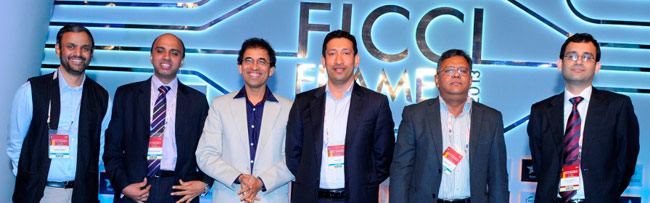
    L-R – Sundar Raman, CEO, IPL, Prasana Krishnan, COO, Neo Sports, Harsha Bhogle, Sports Commentator, Venu Nair,Head-South Asia,World Sports Group, Kushal Das, Secretary General, All India Football Federation, Nitin Kukreja, President, Star India Pvt. Ltd.


    By A Correspondent


    The third day of FICCI-Frames 2013 saw some of the key stalwarts of the business of sports and sports broadcasting industry come together to address and touch upon issues surrounding the sector. The session examined the hurdles plaguing the business of sports, which has evolved and yet lacks the direction to plunge ahead.


    With a regime beset with escalating costs, restricted prices and little IP protection; offering compelling content to Indian viewers remains a challenge, what are those enabling policies that will take sports business and broadcasting to its next level. The panel consisted of Sundar Raman, CEO, IPL; Kushal Das, Secretary General, All India Football Federation; Prasana Krishnan, COO, Neo Sports; Venu Nair, Head-South Asia, World Sports Group and Nitin Kukreja, President, Star India Pvt. Ltd.  The session was moderated by one of the most famed names in the commentating world, Harsha Bhogle.


    The initial part of the session stressed on some of the most common issues faced by broadcasters in the industry, ie the battle of Cost Vs. Revenue, if revenue is keeping pace with costs of the sports properties and whether they are viable. The session also touched on how broadcasters fair between airing cricket which has already established itself as a national sport and non-cricket sports which are still developing in India. Ultimately boiling down to the discussion whether costs on cricket properties are going on an upward spiral and if revenues are keeping pace with it.


    Sharing his views, Nitin Kukreja, President, Star India Pvt. Ltd said that his network has committed over Rs.38.50 billion over the last 6 years to acquire the rights to Indian cricket. He said “I think the challenges on the revenue part are manifold and are present in almost every field. The advertiser is always looking for continuous stream of content that he can count on for viewership. It’s the nature of the game, the format, the schedules which are different for sports hence influencing habit formation and therefore to get a consistent stream of advertising is a challenge. On the distribution front, the regulatory environment for sports is such that the catch up doesn’t happen and each step is a struggle. Also if you look at price caps every genre of content is treated similarly whether entertainment or sport or news. Any sport is bucketed together irrespective of viewership, so once again distribution has become a challenge and even monetizing a new form of content is a struggle because technology has emerged at a faster pace than regulation. The revenue stream is difficult to unlock in the value space.”


    Commenting on whether revenues and costs were pointing in different directions Prasana Krishnan, COO, Neo Sports added “The reality is that the revenue stream is still a little slow to catch up to today. The revenue streams are still not ramping up to costs. The DTH explosion has been slow and has not taken place at the rate we were expecting to. So you can say that the basic challenge is the cost structure, as it is slight above what is justifiable in the market at this point of time.


    The next phase of the session stressed that when rights are being purchased, broadcasters are fully aware of the environment and are therefore making rational choices. Venu Nair, Head-South Asia, World Sports Group said, ” Most people who bid on the rights, bid on basis on data which they think will come up to performance, the question when you go out and bid, can it be recouped?  The point is that unless you don’t bid on a cost that is unreasonable, you will not chase on its revenues. I believe this industry, like real estate, there is a price to every value point, if you can decide on a value point and stick to that, then you have a chance to make money.”


    Taking a look on the positive side and supporting the claim that there is no crisis in the industry Sundar Raman, CEO, IPL said “I personally don’t think there is a crisis as stated out for cricket or for any other sport.  There is a lack of opportunity in the industry and issues which need to be addressed and FICCI provides such a platform to address such issues. Today the amount of money that you notice in the markets such as UK, USA, South Africa or even Australia that a broadcaster gets paid is from subscription revenue. One of the major point broadcasters should look at is understanding the market size they exist in, once you are on track with that and recognise it you can understand the potential of revenue.”


    India now is getting influenced with the western world and is opening up to sports outside the world of cricket. The challenge is to develop these sports in the Indian environment where cricket is so strongly rooted. On that, Kushal Das, Secretary General, All India Football Federation said “The problem with football in India is football itself, you have every professional football league broadcasted across channels, if you compare the Indian league with other world class league you will see that it is not compelling. So if you look at it there are a host of problems as to why football is not being able to develop into a promising product. The challenge is to develop football as a compelling product through talent development and infrastructural improvements.”


    To summarize the discussion, Harsha Bhogle stated that the industry as is still at a crucial stage where sports broadcasters are trying to balance and justify their rationale of purchasing sports rights in the country, brace for developments into non-cricket sports and look forward to the digitization boom.


  • 3-day informational event fulfils tryst with destiny, almost!

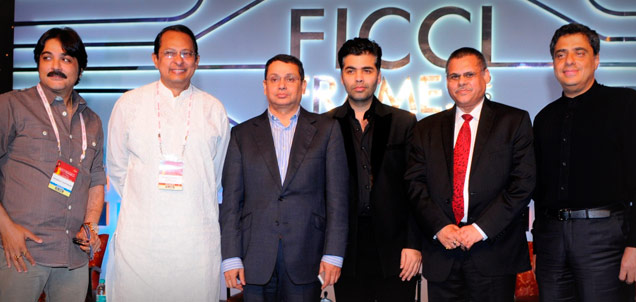
    Actor and Convenor, FICCI MEBC East Prosenjit Chatterjee, Bangladesh Information Minister Hasanul Haq Inu, FICCI M&E chair Uday Shankar and co-chair Karan Johar, I&B secretary Uday Varma and Ronnie Screwvala, MD, Disney UTV


    By Johnson Napier


    If there was ever a platform that was going to foretell the future that lay ahead for the M&E industry in a manner that was befitting, it had to be at the FICCI-Frames 2013. After an invigorating, insightful, challenging and forward-looking three days of deliberations, the biggest informational event for the M&E industry in India came to an elaborate end yesterday.


    While the day began with a series of interesting sessions that centred around topics like the economics of running a sports business, long versus short form of content consumption, skills in the M&E sector, unleashing the power of data, single window clearance for films, reinventing regional media and electronic news media among others, an equally power-packed panel of speakers made sure that the delegates had a lot to take away as learnings from the sessions.


    Perhaps the mood that was prevalent over the entire three-day event at the venue was summed up at the valedictory session on day 3 at FICCI-Frames. The session once again saw a line-up of dignitaries who had words of wisdom and promises to make to the gathering.


    Union I&B Minister Manish Tewari was not present at the event but shared a recorded message with the audience. Affirmed the minister, “The I&B ministry exercises various limits – we are licensors, we are players and stakeholders and are also regulators… so it’s a mixed bag of duty for us. But it’s incumbent upon the government to try and play the role of a facilitator and enabler in order to ensure the growth of this sector takes place at a more rapid pace than what it has witnessed over the past few years.”


    Highlighting his observations over the entire digitization exercise and the demand to do away with the hike in duty on STBs the minister said, “In the first phase we went through a digitization process in the four metros and what was observed was that the STBs are important from also a regional point of view – South East Asia. In order to give a fillip to the Indian manufacturers the Union Finance Minister therefore decided to hike the duty from 5 to 10 percent. So while a rollback is not possible we should see it in the perspective that we as a country also have a duty towards seeing that the other sectors are also benefited and a robust mechanism be established. To achieve success in the second phase across 38 cities all the players, stakeholders and MSOs and LCOs have to come together and make it a reality.”


    Adding further Mr Tewari said, “The other issue that had been highlighted was the issue of pricing of talent and that is something I feel has to be handled between the private-public players jointly. While the government has its own institute for providing training and other skill-sets it will take the combined efforts from the private sector to make that dream a reality.”


    Sounding a word of caution to the industry, Mr Tewari said that where the issue of freedom of speech and expression was concerned, it is something that is guaranteed by the Constitution but it also carries certain restrictions. “The challenge is to see how we can find the golden mean between liberty and the reasonable caveats that have been imposed by the Constitution. If you ask me the freedom of speech and expression does include the right to offend but we also need to ask ourselves the question – what about the remedy? As we unfold the debate further, it is worth that the industry also introspect that there is a distinction between a debate that is honest, candid and something which can be corrosive to the national spirit.”


    Next it was the turn of Ronnie Screwvala, MD, Disney UTV to put forward his predictions as he presented the keynote address. “Some of the good things that have happened in the recent past is the onset of digitisation that has had a huge impact on us. But I think we should hold on to popping the champagne as it will be another 2-3 years before the monetisation from this exercise comes about. So while we have made the investments, the consumer doesn’t necessarily reflect them. But it’s good news that after 20 years of waiting the move has finally come to fruition,” said Mr Screwvala.


    Adding further he said, “Where new media is concerned there is a lot to celebrate about, but unfortunately we have not been able to monetize it. The fact that we are going to be a 150-200 million smartphones market in less than two years, and the fact that large digital and mobile players look at this market as the second or third in the world is phenomenal. There is a need to take this growth further.”


    According to Mr Screwvala the future will belong to dominance from a single screen. “We all talk about the second-television household but that will become irrelevant as it is going to be our personal screen. We will be surprised to see how consumers from all corners of India wake up to using mobile as their primary source for entertainment. The issue is going to be of bandwidth and pricing,” asserted Mr Screwvala.


    Taking over from Mr Screwvala, Uday Verma, Secretary, I&B Ministry began by thanking the industry and the stakeholders for the response that was elicited for the digitization exercise. He said, “The digitization exercise has come about to be because of the alignment of the industry and the stakeholders. It was a difficult task but we are satisfied with what we have managed to achieve. It is something that has happened in a record time and has happened in a smooth manner. Also, it is something that has happened with no intervention from the government where cost is concerned; it has all been borne by the industry.”


    “Where Phase 2 is concerned the progress has been satisfactory with more than 60 per cent conversion having already taken place. There are 21 cities that have reported more than 50 percent digitization and about 10 cities have reported more than 75 percent digitization. There are just four cities that have been posing problems with a conversion rate hovering around 30 percent,” added Mr Verma.


    On the issue of measurement, My Verma said that the option of the industry making its own rating system is already there and the IBF is working hard towards making it a reality. “If there is a consensus that the government should intervene in this matter in terms of guidelines we can do so for the benefit of the industry.”


    Mr Uday Shankar, chairman of FICCI Frames summed up the proceedings by announcing the rollout of a Centre for Regulatory Excellence in collaboration with the industry. “This won’t be limited just to M&E but the entire corporate sector. It will also act as a facilitator in aligning corporate India’s objective with that of the goals of the government and policy establishments. We hope we receive active participation from all quarters.”


  • Delhi HC upholds Star India’s cricket rights on mobile phones

    By A Correspondent


    The Delhi High Court has prohibited Telecom Operators and Mobile Value Added Service (MVAS) providers from exploiting Star India’s exclusive cricket media rights by providing live updates of matches to their subscribers. Star India has the exclusive media rights to cricket matches organized by the Board of Cricket Control in India (BCCI) until 2018.


    The court, in its order on Wednesday, reaffirmed Star India’s exclusive digital rights to BCCI cricket matches on mobile as well and barred telecom operators from using match and score updates for commercial gains. It asked telecom operators and MVAS providers to either disseminate score updates with a lag of 15-minutes or pay a fair share of revenue generated through broadcast of live and contemporaneous scores to Star India by procuring a license. This is a vindication of Star India’s stand that match information and facts generated from a sporting event is a proprietary right which accrues to the event organizer in the digital space.


    “The honourable High Court has vindicated Star India’s stand by passing this historic judgment. The lack of clarity was severely compromising the ability of rights owners to invest to create great experiences for sports fans.  This decisive verdict finally creates clarity on who owns the rights and a mechanism for monetization and fair revenue share. For me, this is a huge boost to the entire digital and mobile space. Finally, we have a foundation on which to build great products as well as successful businesses and the biggest beneficiary will be the consumer,” said Uday Shankar, CEO of Star India.


    Hearing Star India’s petition, the High Court also observed that providing live score updates prevents Star India from effectively monetizing its exclusive rights.


    “It would be just and reasonable for the defendants to either obtain a license and gain equal rights to their subscribers, or make them wait for some time, in order to not prejudice the right of the plaintiff (Star India) to earn revenue from the match information,” the court said in its order. “Those who do not obtain a license from the plaintiff, may not disseminate the score update or match alert before 15 minutes from the moment such score update or match alert is telecasted or broadcasted by the plaintiff (Star India).”


    Star India intends to provide content to sports fans through multiple engagement platforms, including web, mobile phones and tablets.

  • #Frames2013: ‘Dependency on data unavoidable’

    By A Correspondent


    The ongoing 14th chapter of Asia’s foremost conclave on Media & Entertainment, FICCI-Frames 2013, Day III, hosted a session on ‘Unleashing the Power of Data’. The panelists consisted of some of the big names in the business of numbers. These include Ashish Khanna, Managing Partner, Communications and High Tech, Accenture; Lousie Chater, Audience Research Consultant & former head of research, Walt Disney Studios; Atul Phadnis, Founder CEO, WhatsonIndia; Anandshiv Paramatma, EVP, Consumer Rights, Star India; Nick Burfitt, Head, Global Business, Kantar Media,UK; Rajesh Rai, Partner & India Smarter Commerce Leader, IBM GBS and L V Krishnan, CEO, TAM who was the moderator for the session.


    “Data is king and it will drive the revenues of the entertainment industry,” said Ashish Khanna, Managing Partner, Communications and High Tech, Accenture. Ashish went on to add that data has become very dynamic and the challenge before the industry is to get this data together. “Today, data should be an enabler to provide real time content for a great consumer experience,” he said.


    L V Krishnan, CEO, TAM added that we are living in a digital world, surrounded by data be it phone, television, radio, movie, internet. In real life we live with data and are surrounded by this data matrix. He added that data has become an integral part of our livelihood.


    The discussion further moved around the increasing importance of data collation and market research in the media and entertainment space. “Data has become very critical in film making and marketing to make the movie a box office blockbuster,” said Lousie Chater, Audience Research Consultant & former head of research, Walt Disney Studios. “Today, movies are scripted and produced based on the researched data available; which makes the film projects viable and profitable,” she added.


    The panel also discussed the perspective of data in today’s scenario where there is an explosion of technology. Atul Phadnis, Founder CEO, WhatsonIndia said, “Today content is very critical and available across platforms be it television, movies, social media, mobile content and other available mediums.” He added that with the increasing number of channels in India, almost touching 700, audiences are becoming more cautious of watching the relevant content. “With the increasing number of channels, the need for enhancing the diversity of content is becoming more and more important,” he said.


    The session further went on to showcase the importance of data, fascinating ways in which both online and offline research and data can be harnessed to understand audience preferences and behavior so that the country can witness a real media revolution.


  • GroupM India launches Y-Co to leverage talent of youth

    By A Correspondent


    CVL Srinivas

    Media agency network GroupM has announced the launch of a unique initiative aimed at leveraging the talent of its younger executives. Last week it nominated a committee of 14 individuals from across all its agencies and specialist units to a youth executive committee called Y-Co. All the individuals nominated to Y-Co are star performers in their 20s. They are social actors with skills and capacities to bring about constructive resolutions to their own problems. The Y-Co will help GroupM India drive its strategic agenda forward with creative, youthful ideas and initiatives; it will complement the Executive Committee (Senior Leadership team) and work like a mini EXCO.


    Sonali Vaidya

    GroupM South Asia CEO CVL Srinivas said, “In a dynamic and digitally charged industry like ours, the youngsters have a much better grip of whats going on. We felt it was time we gave them a platform for full and effective participation in decision making. Implicit in this commitment is an acknowledgement that young people are part of the solution and catalysts of change.”


    Talent Head of GroupM Sonali Vaidya said, “We have a great talent pool of high performers amongst our younger staff. We plan to give them all a chance to be a part of Y-Co by rotating membership. We hope to build a better connect between the seniors and juniors of the organisation through this initiative.”


    Naina Shewakramani

    Naina Shewakramani one of the Y-Co members said after being nominated, “I feel empowered that my ideas for making GroupM a better place might now be actualized. I feel fortunate that I was nominated amongst all others. This opportunity also gives me assurance that I am on the right path of choosing a career with GroupM.”


    Y-Co was formally launched by Dominic Proctor, President, GroupM Global during his recent visit to India. GroupM has launched several innovative initiatives in the Talent space in the past. GroupM’s training program Aspire launched many years ago has evolved into a best in class product. GroupM India was awarded the 2nd Best Employer Brand of India for 2012 at Employer Branding Awards.