Category: NEWS

  • GroupM HR Team frontrunners for 6th Regional Employer Branding Awards

    By A Correspondent


    Adding to an already exhilarating show on the awards front in 2011, GroupM also emerged as the frontrunner in the western regional round of Employer Branding Awards held at Indira Group of Institutes last week.


    The team talent from GroupM walked away with a total of five awards, making them the favourites for the finals to be staged in February 2012.


    The Employer Branding Institute is an organization that recognizes the best practices in HR employer branding and work of outstanding professionals who are contributing to talent development, management and innovations.


    Every year a Top Employer Brand list is released and in the run-up to the World HRD Congress, regional rounds are held in every metro city before the final National Round in Mumbai.


    In the Regional Round for West, GroupM won five of the 10 awards in the Organisational Category.


    Commenting on the wins, Gaurav Hirey, Human Resource Head, GroupM – South Asia, said: “The consistency at which we have been winning awards clearly reflects GroupM’s commitment to our people. We are now closer to our objective of being not just the best place to work, but the place where the best work.”


    The five awards that the agency bagged included Award for Talent Management, Award for HR strategy in line with Business, Award for Innovation Retention Strategy, Award for Excellence in Training, and Award for Innovation in Career Development.

  • Polaris India appoints LinOpinion as PR partner

    By A Correspondent


    LinOpinion, the PR division of Lowe LintasIndia, has added yet another powerhouse brand to its portfolio with Polaris India Pvt. Ltd., a wholly owned subsidiary of Polaris Industries INC.


    Polaris Industries is the Minnesota-based off-road vehicles company. It is a recognized leader in the production of innovative, high quality off-road vehicles. These include all-terrain vehicles (ATVs) for recreational and utility use, snowmobiles, military and government vehicles, motorcycles and on-road electric powered vehicles.


    LinOpinion will partner with Polaris to develop the best communications route to assist the brand’s foray into the Indian market. Although off-roading as a concept is still in a nascent stage inIndia, Polaris, with their sector expertise and world-class products, are all set to take the Indian market by storm.


    “We are very confident that through our association with LinOpinion and their expertise we will be able to create a distinctive identity for the brand. Our aim is to build awareness not only for the brand but the entire category. We are confident of LinOpinion’s strategy and we look forward to a strong and long-term relationship with them,” said Mr. Pankaj Dubey, Managing Director, Polaris India Pvt. Ltd.


    “We are extremely proud and eagerly look forward to work with a prestigious brand like Polaris India. This feeds into our objective to represent the world’s best brands. We hope to partner the brand by supporting them with their business and communication objectives,” said Mr. Ameer Ismail, Executive Director, Lowe Lintas.


    LinOpinion, the public relations division of Lowe Lintas, was established in 1994. It is the exclusive Indian affiliate of Golin Harris, the leading international PR firm of the Interpublic Group. It provides brand image consultancy to leading MNC and Indian companies.

  • IRS 2011 Q3: TOI still the No1 newspaper, India Today lead the magazines pack

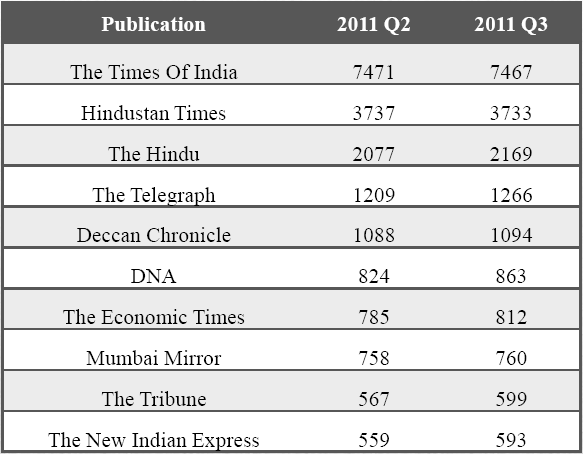
    Top 10 English Dailies:


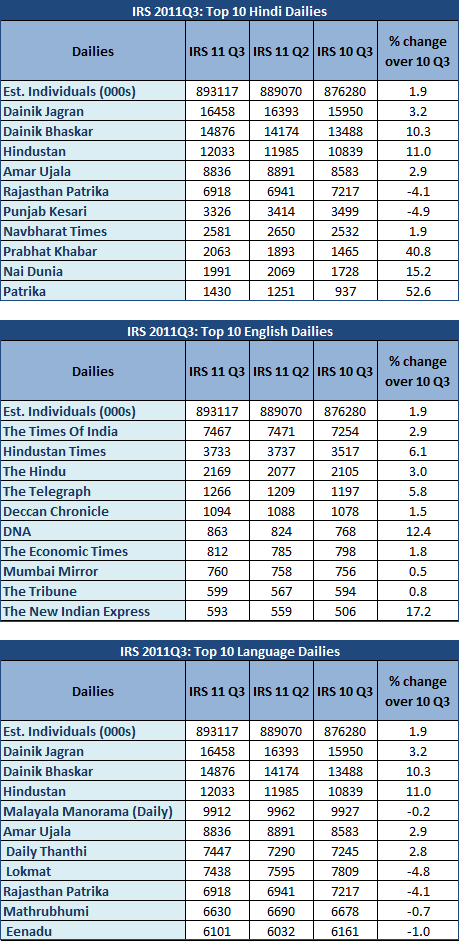
    Besides Times of India and Hindustan Times, all the other English Dailies in the top 10 have witnessed growth in their AIR (Average Issue Readership) figures. The decline in Times of India and Hindustan Times AIR is however marginal.


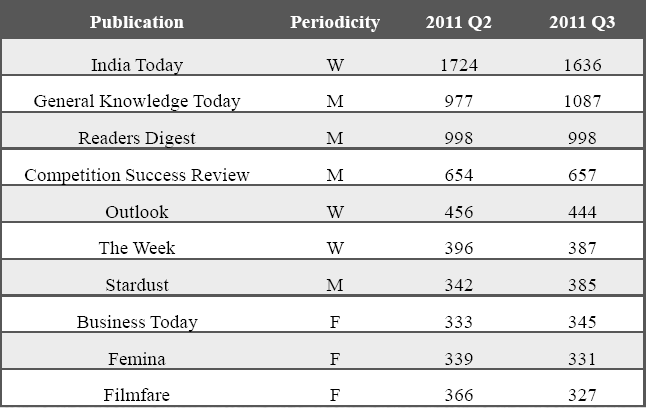
    Top 10 English Magazines:


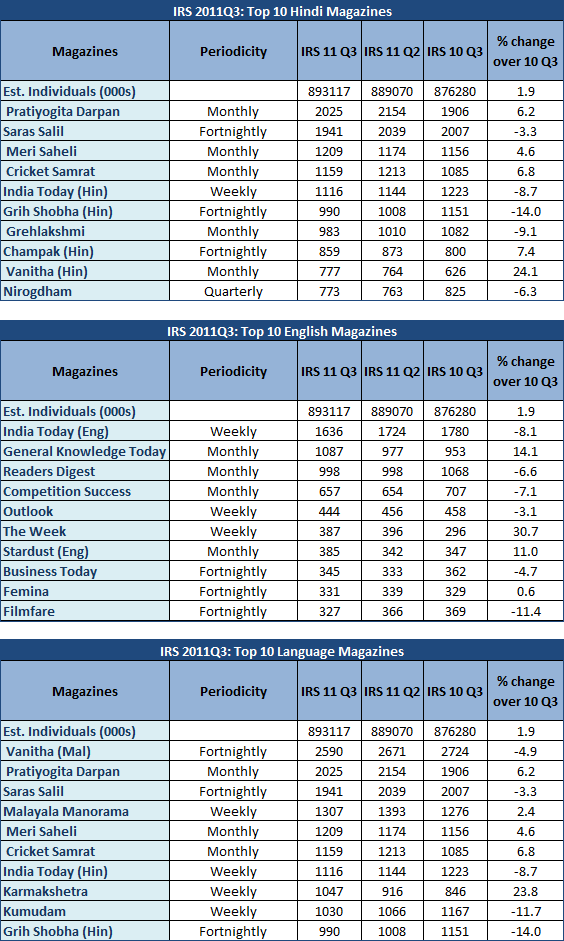
    Five out of the top 10 magazines, namely General Knowledge Today, Readers Digest, Competition Success Review, Star Dust and Business Today saw growth in their AIR. General Knowledge Today climbed up to number two with a growth of 11.26 per cent whereas Readers Digest slipped to number three and remained stagnant in their readership.


    All figures are in Average Issue Readership. Like media buyers, MxMIndia only endorses Average Issue Readership as the currency for readership measurement. Please note that these are only topline figures which have officially been supplied to the media. Sensible buying and planning happens when more data is available.

  • IRS 2011 Q3: Top three Hindi dailies witness growth in AIR

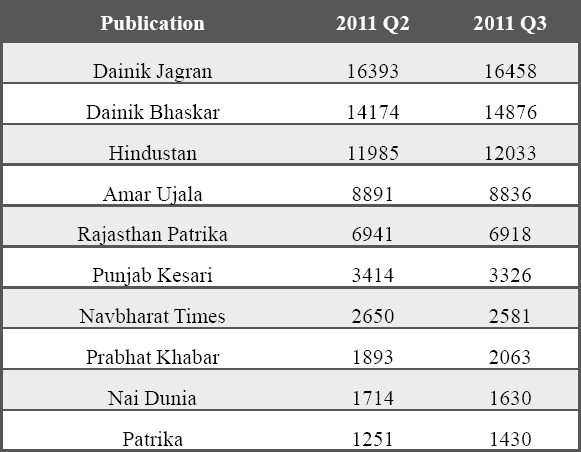
    Top 10 Hindi Dailies:


    There is no change in the pecking order here. Dainik Jagran rules, Bhaskar is second and Hindustan is third, and all three have shown marginal growth in IRS 2011 Q3 as compared to IRS 2011 Q2. Amar Ujala, Rajasthan Patrika, Punjab Kesari occupy the fourth, fifth and sixth slot respectively. Amar Ujala, Rajasthan Patrika, Punjab Kesari, Navbharat Times and Nai Dunia are the only publications in the top 10 Hindi Dailies to have shown negative growth in their Average Issue Readership (AIR). Patrika, a new entrant at the tenth spot, emerged as the fastest growing Hindi Daily with a  14.31 per cent growth.


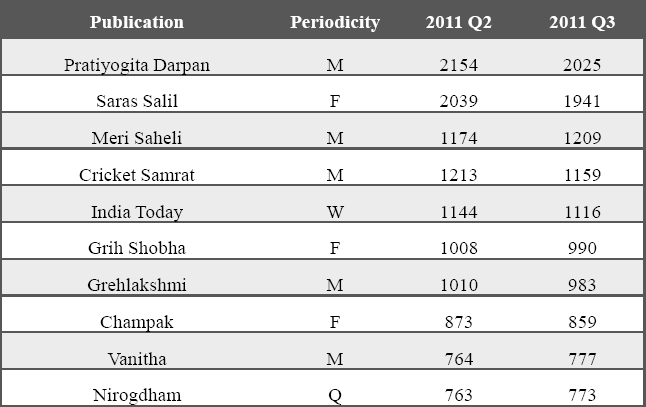
    Top 10 Hindi Magazines:


    Most of the top 10 Hindi Magazines showed decline in their AIR figures. Pratiyogita Darpan and Saras Salil were the top two magazines, but their AIR declined marginally in IRS Q3 2011. Ranked third Meri Saheli, is the only Hindi Magazine in the top five to have witnessed growth. The other Hindi Magazines to have witnessed some growth in their AIR are Vanitha and Nirogdham.


    India Today, ranked five, is the only Hindi weekly to have established itself among the top 10 Hindi Magazines. With an AIR of 11,16,000 in IRS 2011 Q3 as compared to an AIR of 11,44,000 in IRS 2011 Q2, it saw a decline of 2.45 per cent.


    All figures are in Average Issue Readership. Like media buyers, MxMIndia only endorses Average Issue Readership as the currency for readership measurement. Please note that these are only topline figures which have officially been supplied to the media. Sensible buying and planning happens when more data is available.

  • India is a long-term play for us: Sukanti Ghosh, APCO

    By Johnson Napier


    In a day and age where PR agencies are grappling with each other in offering services with a differentiated touch, US-based APCO Worldwide has its own unique formula of approaching the Indian communications space. Far from being referred to as a PR agency, the firm would rather let each of its verticals, be it corporate advisory, government affairs or civil, act as individual competitors versus the other full-time agencies in the space.


    Entrusted with the task of bringing a differentiated tactic to the market is Sukanti Ghosh, MD, India for APCO, who has donned several communication hats across the sectors of radio, advertising, and banking & financial services. In conversation with Johnson Napier of MxM India, Ghosh elaborates on the tremendous scope for agencies to make it big in India and how government relations & public affairs would be a large space to reckon with in the years to come. Excerpts:


    In a largely blurred communications space where agencies try to play the differentiating game very cleverly, how would you categorise APCO Worldwide as an agency in India?

    If you look at the Indian communications industry, it is at the various stages of maturity; it’s along a continuum. So on one hand, we have a lot of the commoditised services in India, and frankly speaking, there is no bottom to that pit – there is always another mom-and-pop agency who will offer a service at a cheaper rate – and there is another end of the spectrum that is highly evolved, extremely mature and as good as any other global market. So it depends on which end of the market you want to play in. APCO, nowhere in the world, really plays in the commoditised end of the communications industry. So like there are many Indias within India, similarly, there are many communication industries within the communication industry. It occupies and lives in various forms of maturity. You have to decide which slice of the market you want to play in.


    So what is it about APCO in India that you would say is different?

    What has defined APCO since I have joined is that we are very clear about the market that we want to play in. APCO looks at communications very differently. If you are aware of the Venn diagram that we studied in school (three intertwined circles), we typically turn around and say, if you look at the three circles – one is business strategy of any company, the other is public perception or civil society and the third is government regulations – there is an interplay between the three and whenever there is an interplay between the three that is where we are the strongest.

    So to begin with, if you remove the government element and look at the other two elements of business strategy and civil that is where you get marketing communications. Frankly, that’s not an area where we are the strongest and that is not an area that we would want to play in. Then if you take out the part of civil society, and look at the interplay of government and business only then that’s where you get the issues that keep arising every day.

    Today if you look at India and where we are as a country, civil society and the voice of civil society is here to stay and it will only become stronger going forward. Again, that is not an area where we want to play.

    We are very clear that at the outset, we are US FCPA (Foreign Corrupt Practices Act) compliant, we are UK Bribery Act compliant; we believe in ethical representation and in the sphere of ethical representation, we are the single largest ethically-owned firm in the US, and also the eleventh largest around the world and that’s where we want to grow.

    If you look at the third element, where if you remove out business and look at the interplay between government and the people, that’s where public awareness advertising from the government arises. Again, if you look at the government and business, that’s where you have a number of government initiatives to try and rope in business, that’s where we are again strong. An example is the vibrant Gujarat campaign that won few awards despite being pitted against some brilliant campaigns from around the world. So that’s going to be our focus at this point in time.

    Do we really see ourselves as a marketing communications agency – perhaps not. That’s not an area we want to focus on. We would want to focus on selective areas of communications in the broader sense and do well in that.


    How would you analyse the performance of your core businesses in India?

    Globally, we are a market leader in public affairs, we are a market leader in STG (service to government) practices and we hope to replicate that model out here in India. It would be fair to say that we have got off to a very good start in India. We have more than doubled our revenues from the year before, we are working with some of the finest Fortune 500 companies in India, we are fortunate to have worked with the government of Gujarat and are seriously looking at growing business in that space. Also, even as we speak we are working with several companies, advising them on public-private partnerships; helping them work alongside the government because we believe the Indian government is at a stage where it is more than ready to look at and listen to global leaders to hasten the pace of progress in this country. That is something unique because most companies that have come into India have a misconception with regard to the government and the way it works.


    While it seems to be a merry-making affair for you in the government and public affairs space in India, it is not the case with other players who appear apprehensive of making it big into this space. Then there are also allegations of red tape and corruption. Your comments?

    Frankly, in the last sixteen months, we have never faced a single problem working with the government. Part of it is misconception and part of it is reality, but the fact is that it is only when a company wants to take a shortcut that the problem arises. The government has very clearly defined processes and companies need to understand and work the processes. The fact is that India is a long term play; so you’ve got to work here to stay and proceed accordingly.

    We also help companies in understanding policies and regulations. The latest example being the FDI norms in retail being discussed lately. So the output does not have to be limited to the media; there are cases where you will work with the media and that is only right, but it does not have to be limited to only the media.


    Increasing number of multinationals are evincing interest in India while India continues to look up to the outside world for encouragement. What are the trends that you foresee currently on that front?

    There are a couple of things happening on that front. If you look at the STG space – I am referring to outward investment as well – there are a couple of things being observed. One is the government bodies or the economic development boards, are today trying to woo Indian companies and get Indian companies to invest in their markets. If you look at the policies space, there are so many Bills that are being talked about, there are so many changes in terms of legislative reforms and these are throwing up hundred different opportunities for companies. So that in itself is humongous.

    Globally, if you look at APCO, we focus on a number of areas and those are the areas that we will continue to focus on. We focus a lot on energy and renewable energy, on telecom, on food & consumer products…we are probably the single largest player in the healthcare space. So we would be bringing and developing a number of these practices in India.


    How is APCO Worldwide performing outside of India? Also, what are your plans for India outside the two metros that you are already present in?

    Apart from Washington, US, which is our largest office around the world and 2-3 regional offices, our London office has a few odd people, Dubai has 40-odd people, Brussels has 40-odd people, and all the other offices are around 20-odd people in operations.

    In India we see ourselves moving to three offices by next year, we see ourselves adding one more office in the south besides Mumbai and Delhi. We would grow to be about 50 people soon.

    If you see recent industry reports that classify firms from small, medium and large, I think without trying too much in the span of one year, we are very much already in the middle. We are very confident of growing very quickly into the so-called large segment very soon.


    How would you rate the fee structure that agencies command in India? There are allegations of it being under-par compared to other countries?

    We are expensive and our clients know that we are expensive. Clients know that they will get firms for half the cost but they come to us for the quality and value that we deliver; they don’t come to us for the fees that we charge. In certain parts of the business we compete with the big four, in certain parts of the business we compete with law firms, with the communications industry, and so on but the fact is that we have never had an issue with fees. It is made out to be an issue primarily because you are on the wrong end of the value chain. So you won’t see our people running around with press releases, issuing statements or chasing people.


    Do you largely agree with the claim that the PR industry in India is largely unorganised?

    I thing the PR agencies have brought it on themselves because they have become so tactical at the bottom end of the spectrum that there is always a cheaper option. And when you are at that level, you would never command a premium and it will always be unorganised. But does that mean that there is no organised side of the business, of course there is. The thing is, India is a large country and is big enough for everybody. Even the largest PR agency is India is around about 40 crores or so, according to Holmes report. This despite them being very big in the communications space and having a large clientele. So you can imagine the opportunity that exists in the communications space.


    What is the emphasis that you lay on digital?

    Globally, we are very big in the digital space. We have a unit called APCO Online, a pureplay social media unit that has won more than 300 awards across the world. So those are resources that we would be bringing to India. So it’s one of the units that we would be looking at very closely in 2012.


    Given your diverse presence across industries, who would you cite as competition?

    I can’t name any one firm. In corporate advisory we compete with management consulting firms, in the public affairs space we compete with some of the large law firms; there are very few communication agencies that are doing serious public affairs work. The thing about APCO that strikes me the most is the number of clients who have been with us in upwards of ten years and also the number of people who have been with us average around 10-15 years. So it’s largely a firm that is relationship-led; it is largely a firm that is culturally very strong and frankly speaking, you either fit into the culture or you don’t.


    Is the current economic scenario casting its toll on the industry?

    We grew at a rate of 6.9 per cent in the last quarter which was the slowest in the last 8-9 quarters, but the fact is, how many countries have grown by that per cent around the world? We may be going through a bit of a rough patch, but we will get out of it eventually. Is it a period of concern for us, I guess not. I think there are austerity measures that have been undertaken and there is a note of caution everywhere.


    What are the imminent challenges facing the industry?

    There are two big challenges that face the PR industry, the first being the PR industry itself. The second being people. The skill gap that we keep talking about for other sectors is very real for our sector as well. The trend internationally is that people are very focused when it comes to taking selective career paths and so they go ahead and specialize in that from the beginning. That’s not what is happening here. In India, it is still an emerging profession and with all emerging professions there is a period of instability but there will be a shakeup. We need to elevate the status of the industry. Unless we get PR out of being just press releases into being something a lot more sophisticated and holistic, we will not get the right people.


    What are the trends you foresee for the industry, and for APCO, in 2012?

    For 2012, I see fierce competition and a certain degree of consolidation taking place. I foresee a lot of foreign companies coming to India and a lot of Indian firms willing to sell out. As for us, we are fiercely independent and we prefer to remain that way.
  • IRS 2011Q3. Digital growth bestest. Cinema, Radio decline

    By A Correspondent

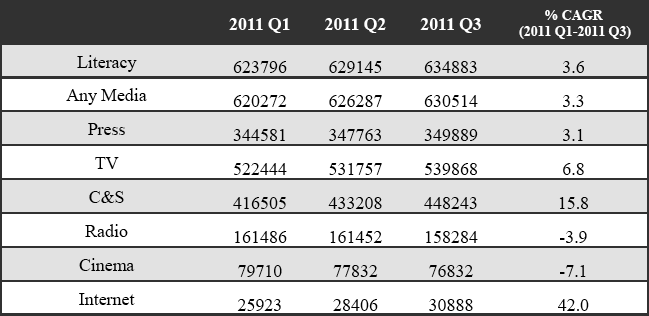
    As per the Indian Readership Survey (IRS) 2011 Q3 data, Cable & Satellite (C&S) and Internet are the two sectors which have shown the maximum growth in total reach. Radio, on the other hand, showed negative growth of 3.9 per cent CAGR with numbers declining from 161.45 million to 158.28 million. Internet, the fastest growing sector, recorded a growth of 42 per cent CAGR with the reach going up from 28.41 million in Q2 to 30.89 million in Q3.

    The total reach of the television media has also gone up by 6.8 per cent CAGR to 539.87 million in Q3 from 531.76 million in Q2 making it the third fastest growing sector.


    The Cable & Satellite (C&S) sector recorded a growth of 15.8 per cent, the only other sector to record double digit growth. C&S total reach is up at 448.24 million in Q3 compared to 433.21 million in Q2 2011. Cinema also recorded negative growth of 7 per cent with reach declining from 77.83 million in Q2 2011 to 76.83 million in Q3.


    All figures are in Average Issue Readership. Like media buyers, MxMIndia only endorses Average Issue Readership as the currency for readership measurement. Please note that these are only topline figures which have officially been supplied to the media. Sensible buying and planning happens when more data is available.


  • IRS 2011Q3: Dainik Jagran rules yet again

    The numbers from the latest round of the Indian Readership Survey are out as the Media Research Users Council and Hansa Research announced the findings of the third quarter of 2011.


    Dainik Jagran rules amongst all daily newspapers in the country while Vanita is the Magazine #1


    Top 10 Publications

    (AIR numbers; All figures in 000s)


    Top 10 Publications

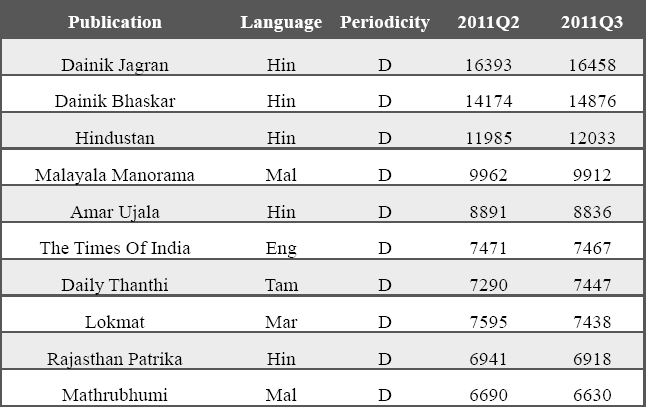
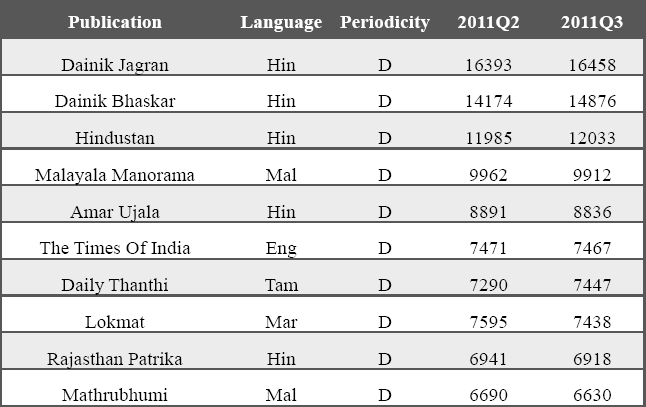
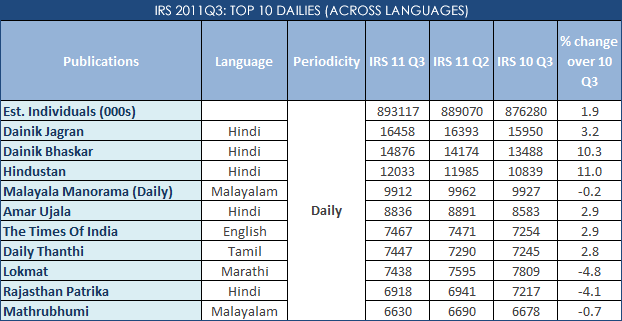
    There is no change in the rankings of the various publications among the Top 10 in terms of Average Issue Readership (AIR). The Top 3 slots are taken by Hindi dailies. Dainik Jagran rules with 16,458,000 followed by Dainik Bhaskar which is at 14,876,000. Hindustan is at No. 3 with 12,033,000. Malayala Manorama is at No. 4 at 9,91,2000 while Amar Ujala is the fifth with an average issue readership of 8,836,000. The Times of India, the only English newspaper in the Top 10, with an average readership of 7,467,000, is in the sixth position.


    The others in the Top 10 publications are: Daily Thanthi with 7,447,000, Lokmat with 7,438,000, Rajasthan Patrika with 6,918,000 and Mathrubhumi at 6,630,000. If you compare IRS 2011 Q3 with IRS 2011 Q2 then the top three dailies namely, Dainik Jagran, Dainik Bhaskar and Hindustan, and Daily Thanthi saw growth in their Average Issue Readership (AIR), whereas Malayala Manorama, Amar Ujala, Lokmat, Times of India, Rajasthan Patrika and Mathrubhumi, on the other hand, witnessed slight drop in their AIR.


    Top 10 Dailies

    (AIR numbers; All figues in 000s)


    Top 10 Magazines

    (AIR numbers; All figures in 000s)


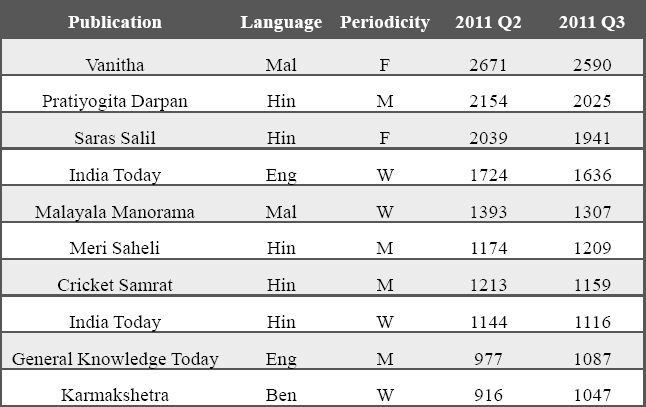
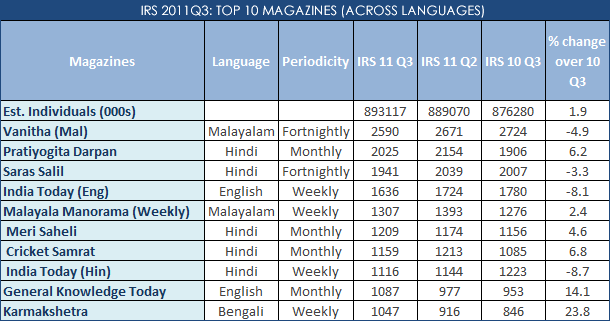
    Vanitha continues to be the most read magazine,  followed by Pratiyogita Darpan, both have witnessed a slight decline in their AIR figures. Meri Saheli, General Knowledge Today and Karmakshetra are the only magazines in the top 10 to have witnessed any growth in their AIR.

  • Palasa now creative partners with KG Beverages


    Sandeep Bomble
    Nitin Gupta

    By Shubhangi Mehta


    Palasa has managed to win the creative mandates for KG Beverages, RESTLESS and BUZZ. Along with creative mandates, Palasa will also be involved in the packaging and marketing of both the products.


    RESTLESS is an action drink which will be competing with the likes of Red Bull and Cloud 9. KG Beverages will also be launching range of carbonated drinks like Lemon Clear drink,Orange, Green Apple Cola and Jeera Masala. BUZZ is premix alcoholic beverage which will be available in three exciting flavours.


    Sandeep Bomble, founder, director, Palasa, said: “We have been associated with KG beverages since 8 years and we have created this product range together. Many others wanted to be a part of it but no one else could win it, as it is our baby”.


    Nitin Gupta, CEO/founder, said: “I have worked with Sandeep for almost eight years for SYKZ and having seen his work, there was no question of calling other agencies to pitch. Sandeep’s work has always impressed me and we are already quite happy with whatever they are doing for the brand.”


  • Claims, counter-claims rule IRS again


    By A Correspondent


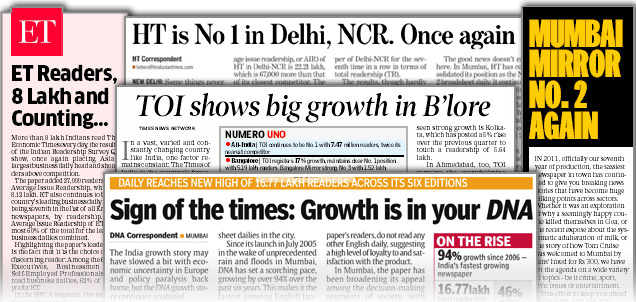
    It’s ironic. Mumbai is where most of the biggie media agencies exist. Some of the largest spenders are headquartered here. Still, publications pull out all stops to make crazy claims.


    Okay, they aren’t incorrect and the initiated amongst them can obviously see through the claims, but those who don’t – the lay reader, the young homemaker or the senior citizen who is not in the know – is sure to wonder what the truth. And if he/she subscribes to more than one paper, we are sure there will be some confusion.


    Obviously, the belief is that the reader is an ass. But this is a policy that can backfire terribly.


    But the confusion in a city like Mumbai is thanks to the two types of data that MRUC throws up in its IRSes – Average Issue Readership (AIR) and Total Readership (TR). Publications put up the data which throws them in better light. Also, newspaper X is a compact (tabloid- like-sized) newspaper while Y is a broadsheet. So one may be the #2 overall, another may be #2 broadsheet. Z may be #2 by TR and Y may be #2 by AIR.


    Fact is AIR is the accepted currency and there is a section which believes that a newspaper that comes free with another paper shouldn’t be taken for review. But there is a section which says that if a newspaper is able to attract revenues separately, that’s decidedly the best yardstick for the product’s utility. Perceived or otherwise.


    Sadly, the conferences which the Market Research Users Council and Hansa Research Group would conduct to release every round of the Indian Readership Survey have been done away with. The detailed dump is no longer handed out to the trade media. All of this charade of X, Y, Z could’ve been avoided had we got city and region-wise numbers from the MRUC (or via Hansa), but that’s not to be.


    Let’s look at the tables in detail (that we have based on the toplines publicly available).


    There’s no need of words. The growth or degrowth percentages tell the story. Some spectacular successes. Others not so.

  • Anil Thakraney: An open letter to the PM

    By Anil Thakraney


    Dear MMS,


    You complain that India Inc’s negative comments are disappointing. You are apparently displeased about what the suits have to say about your government. That the UPA’s policies are quite depressing for business in India.


    Well, Sirji, the industry leaders have every reason to feel disheartened and negative about theIndiastory. If at all, I would say they are being pretty mild and cautious in their observations, because they can’t afford to upset the assorted politicians and bureaucrats in your team. Backlash from an upset government can be rather hurtful.


    Before you sulk over their comments, let’s examine your own track record since UPA-2 came to power: In the last one year alone, fuel prices have spiralled out of control, sending the economy for a toss and making the inflation figures go through the roof.


    As if that was not bad enough, the rupee is getting weaker by the day, and has now hit an all-time low. What is particularly pathetic, is that all this is happening under the leadership of a man touted as a master economist.


    I am not going to discuss the crashing infrastructure in the metros (many firang suits are known to take a sharp U-turn the moment they emerge from the Mumbai airport) because it’s too damn depressing. But I must point out that the multiple financial scams under your rule have not just tarnished the nation’s image, they have made India a highly suspect destination for business.


    In fact, the Anna Hazare campaign has made India look like a global clown on the world stage. And by the way, your complete mishandling of the Anna team hasn’t helped matters at all.


    And oh, just what happened with the FDI in multi-brand retail idea? You did not have the skills and means to push it through. At the very first sign of protest from the opposition leaders you ducked for cover. How encouraging is that for India Inc? It doesn’t end here. Your various ministers are often at war with each other, and as a leader you seem to have no control over their bickering.


    Sir, it’s a long list of gripes, and frankly I don’t want to put out the laundry list and destroy the New Year festive mood. But let me just say this: Instead of feeling bad, you should be thrilled that despite your government’s abysmal performance and dubious policies, many business leaders continue to be bullish on India.


    Thank them rather than complain. Happy New Year!


    * * *


    PS: Fantastic presentation at the BAFTA by acclaimed screenplay writer Charlie Kaufman. Totally from the heart, and an eye-opener. A must watch not just for those in the movie business but for all creative people.


    Link: http://video.bafta.org/services/player/bcpid1089742060001?bckey=AQ~~,AAAABxWZS7k~,uLPjGIDNpTm4SaHbu0n1-QlyJhJ3l3ls&bctid=1314090439001

  • Imran Khan to endorse MTS in Rs10 crore deal

    By Ratna Bhushan & Gulveen Aulakh


    Telecom service provider MTS India has roped in Bollywood actor Imran Khan as its brand ambassador for two years. The 10-crore deal makes the Delhi Belly star the latest one to join a long list of celebrities, including Shah Rukh Khan, Abhishek Bachchan and MS Dhoni, endorsing telecom service companies. While it’s the first time that Sistema Shyam TeleServices’ brand has taken the celebrity plunge, Imran already endorses Coke and Levi’s jeans.


    MTS India spokesman and celebrity management firm, Kwan Entertainment, which doesn’t manage Khan but helped him striking this deal, declined to comment.


    “Imran will promote MTS through mass media, online and below-the-line promotional activities. He will also be part of Red Energy, a youth-centric online activity for the brand,” an official directly involved with the developments said.


    While the 2G scam has not deterred telecom firms from wooing celebrity endorsers, it has impacted their ad spends. Eight of the country’s top 10 TV advertisers during January-September this year were consumer goods makers. Idea Cellular was the only telecom firm in the ranking, according to the media research firm TAM.


    The telecom sector has been facing tough times with raging controversy on 2G spectrum allocation, rock-bottom tariffs, sliding average revenue per user, thinning margins and falling profits. High interest costs, banks shying away from lending and 3G roaming agreements being disputed by the government add to the sector’s problems.


    Approval and introduction of the new telecom policy that would have allowed liberal merger and acquisition norms and helped in consolidation of the sector, has been pushed back by nearly half a year. This may further add to telcos’ woes.


    Source: The Economic Times

    Copyright © 2011, Bennett, Coleman & Co. Ltd. All Rights Reserved

  • Small regional brands get modern retail push

    By Sagar Malviya


    Small and regional brands are tying up with retail giants to push their merchandise, as middle-class Indians shift from mom-and-pop stores to the comfort and variety of modern retail.


    The latest to join the bandwagon is ayurvedic products maker Baidyanath Ayurved Bhawan. The 95-year-old company has tied-up with Future Supply Chain Solutions, the logistics arm of retail giant Future Group to widen its consumer base and boost its position in the health products segment where it competes with Dabur and Emami. The Kolkata-based company will use Future Supply Chain’s network to sell its ayurvedic medicines, tonics, hair oils and toothpastes in more than 2,000 outlets in the country.


    Future Supply Chain serves several large retailers besides the parent group’s Big Bazaar.


    “More than just sales, modern trade gives a very high visibility that’s important to us. Also, it’s an easy way to break into newer markets without investing substantially in distribution,” said Ameve Sharma, president of the over 350-crore Baidyanath.


    This strategy is not only giving smaller brands a pan-India presence, but also helping them reap dividends. Within a year, the share of organised retail in total sales of brands such as Wagh Bakri tea, Super-Max shaving products, Nilon’s pickles, Dukes biscuits, NR Group’s Ripples fragrances has risen from near zero to about 15%.


    “Due to consumers moving and settling across geographies within the country, we are able to support small and regional brands get national footprint and also where relevant communities stay,” said Devendra Chawla, president of FMCG and food at Future Group. “For several small vendor partners, setting up distribution networks can mean lot of resources and costs. Modern trade is the quickest route to market in relevant markets,” he added.


    The move is also partly driven by the need to be where the competition is. “You have to be where your competitors are,” said Ravi Chandra, general manager, sales and marketing at Super-Max Personal Care, which earned 2% of sales from modern trade from just 0.2% a year earlier. “We have heightened our focus on modern trade as our product portfolio matched the target consumers of these stores,” Mr Chandra added.


    Nilon’s, the country’s largest pickle brand that was available in some 100 stores two years ago, is now available in 400 stores.


    “We were hardly present earlier in Mumbai and Tamil Nadu. We realise that the future in big cities is through large outlets,” said Nilon CEO Rajheev Agrawal. The company has seen sales from modern retail rise from 7% to 15%. Future Supply Chains, which works with 20 such clients, has added half of its clients over the past one year.


    “No distributor has an all-India presence, and that’s where we come in. We also take care of shelf and merchandise management,” saidAnshuman Singh,MDand CEO of Future Supply.


    However, firms say that jump-starting sales has its own problems. The margin for modern trade is higher than that of general trade, and small brands end up paying about 10% more than their bigger counterparts. But they are not complaining. “The fallout of margins is basically on the return on investments calculations and large stores are increasingly giving higher throughput,” said Mr Chandra.


    Also, these firms are getting into premium products, which need the platform of modern trade. For instance, Baidyanath is entering soaps and shampoos while Wagh Bakri Tea is focusing on tea bags and instant tea.


    This trade route has another plus: when a retailer expands, it carries the product with it. “Retailers have almost doubled their stores. This means more sales of our products,” said Anik Mukherjea, chief business creator (fragrances) in NR group, the Mysore-based maker of Cycle Agarbattis and Ripples.


    Source: The Economic Times

    Copyright © 2011, Bennett, Coleman & Co. Ltd. All Rights Reserved