
Category: NEWS

  • Jalsha Movies records 154 GRPs on its opening day

    By A Correspondent


    Jalsha Movies, which launched on December 16, clocked 154 GRPs on its opening day. The first movie on the channel, Awara, scored 5.3 TVR. According to press communique, the channel’s 154 GRP rating in its opening week was higher than the combined ratings of ETV Bangla (80 GRP) and Zee Bangla Cinema (65 GRP).


    Jalsha Movies has also helped STAR India strengthen its foothold in Bengal. The network has a firm hold on both no. 1 and no. 3 slots in the Bengali television market with Star Jalsha and Jalsha Movies.


    With a vast collection of all the big Bengali blockbusters, Jalsha Movies is proving to be a haven for Bengali movie lovers. Jalsha Movies Movies boasts of the biggest library of most loved Bangla super-hit films and aims to delight viewers by bringing Bengal’s biggest cinema hall right into their homes.


    Kevin Vaz, President and General Manager – Star Jalsha and President – Ad Sales at Star India said, “Jalsha Movies is now the preferred destination for the best of Bengali movie entertainment. The channel is already setting new benchmarks and is redefining the pleasure of watching movies for our audiences within a week of its launch. This is a stepping stone for us and we hope to further live up to the expectations by offering a never before entertainment experience to our viewers.”


  • Affle grabs ‘2012 Red Herring Top 100 Global’

    By A Correspondent


    Affle Group, international smart media company, has won the prestigious ‘2012 Red Herring Top 100 Global’ award. After announcing the Top 100 region-wise two months back in September, Red Herring announced its Top 100 Global award in recognition of the leading technology companies across the globe, celebrating the pinnacle these entrepreneurial ventures have reached in their respective fields.


    Speaking on the achievement, Anuj Khanna Sohum, Founder and Chairman, Affle Group, said, “Winning the ‘Top 100 Global’ is both humbling and inspiring. I’d like to thank and congratulate the Affle and ad2c teams for their passion and commitment towards building technology innovations and enabling our exponential growth that deserves this recognition.”


    “Choosing the companies with the strongest potential was by no means a small feat,” said Alex Vieux, publisher and CEO of Red Herring. “After rigorous contemplation and discussion, we narrowed our list down from hundreds of candidates from across Global to the Top 100 Winners. We believe The Affle Group embodies the vision, drive and innovation that define a successful entrepreneurial venture. Affle should be proud of its accomplishment, as the competition was the strongest it has ever been.”


    Red Herring’s editorial staff evaluated the companies on both quantitative and qualitative criteria, such as financial performance, technology innovation, management quality, strategy, and market penetration. This assessment of potential is complemented by a review of the track record and standing of start-ups relative to their peers, allowing Red Herring to see past the “buzz” and make the list a valuable instrument of discovery and advocacy for the most promising new business models globally.


    Chairman and Founder of the Affle Group, Anuj Khanna Sohum and CEO of ad2c, Madan Sanglikar were also recently recognized as the Impact Digital Power 100 Icons of the India digital industry. The consistent achievements and industry recognition reinforces the significant impact and the tremendous growth potential of the Affle Group in the digital advertising industry regionally and globally.


  • Vuclip helps Nokia, Maxus trendify social media sharing

    By A Correspondent


    Independent mobile video and media company Vuclip has announced that it has been selected by Nokia and Maxus India to promote the much touted Trendify brand campaign for Nokia Lumia 510 on Vuclip’s mobile video portal and social networks. As many as 65 percent of Vuclip’s 14 million Indian users share videos primarily through Facebook and Twitter, making it the ideal platform to integrate Trendify and allow users to experience what Trendify means in the language of Nokia Lumia 510.


    Social users in general and the youth in particular are in the age of ‘discovery’ enabled by the proliferation of internet-enabled mobiles in India. Identifying this, Nokia, Maxus India and Vuclip have joined hands to empower the youth to discover and create new trends in time and spearhead innovative social media campaign on mobiles. As part of the product innovation involving a seamless integration with Vuclip, for the first time, the ‘Share’ button has been changed on a video portal to reflect the brand campaign. The ‘Share’ button for each video has temporarily been replaced with ‘Trendify’, encouraging users to now trend their videos directly on m.trendify.in at the click of a button, which in turn can be shared on Facebook, Twitter and other social sharing sites. More than 55 million videos on Vuclip are expected to be viewed in 2 weeks through this campaign. Besides its mobile portal, Vuclip has also integrated Trendify with its own social media properties to further amplify the campaign leading to virality, where it has extended Nokia’s opportunity for lucky users to win a Nokia Lumia 510.


    Viral Oza, Marketing Director, Nokia India said, “Through the Trendify campaign we wanted to connect to the urban youth on a platform and space that is relevant to them. The youth today are socially connected 24×7 and have their own take on life. They experiment to express their originality, creativity and individuality. Topics that trend affect their lives in a big way and is their tool to express themselves on the bigger stage. This was the genesis of the Trendify campaign. We believe that anyone can begin a trend by sharing, following, liking through social platforms. The Nokia Lumia 510 is designed to empower the Indian youth to start their own trends. By leveraging Vuclip, world’s leading mobile video platform, we wanted to bring the Indian youth even closer to the Trendify campaign. Creating trends requires a 360 degree approach, and with its exponential growth in India, leveraging entertainment snacking was a clear choice for us.”


    Unny Radhakrishnan, Digital Head (South Asia), Maxus India said, “Nokia wanted us to craft a campaign which exemplifies trendifying in the DNA of each of its core elements. Leading the curve in mobile video sharing, Vuclip fitted well with our strategy in helping us connect the Nokia “Trendify” campaign with millions of users in a fun sharing way almost instantly. One of the essential criteria that worked in their favour was that besides being a leader in mobile video sharing, their team was quick to internalize the core philosophy of our novel campaign, think out-of-the-box with creative application of technology, and adapt to make functional enhancements that added value to our campaign, instead of just cosmetic changes. Looking at the results, we are confident that this agile integration will help us optimally amplify the campaign across regions.”


    Commenting on the integration, Meera Chopra, Vice President – Head of Advertising Sales (APAC & ME), Vuclip said, “We are delighted that Vuclip has been chosen to showcase and integrate Trendify. This fun and path breaking campaign is yet another proof of how Vuclip is fast becoming an integral part of aggressive digital campaigns for leading brands like Nokia. In one of the most unique ways of perfect integration on the site, Vuclip has temporarily renamed the social Share link on all its videos as Trendify. This not only helps build a stronger brand recall but also builds a ‘cool quotient’ for the youth who now Trendifies, instead of just sharing.”


  • ZeeQ brings Amar Chitra Katha universe to TV

    By A Correspondent


    ZeeQ, the children’s edutainment channel launched by Zee Entertainment Enterprises Ltd, has acquired 26 episodes of Amar Chitra Katha (ACK) from Ideas Box Entertainment Pvt Ltd. Ideas Box is an independent subsidiary of Amar Chitra Katha Pvt. Ltd.


    ZeeQ has plans to beam the 26 episodes of ACK, over 26 weeks, till April 2013.


    Subhdarshi Tripathy, Business Head of ZeeQ says, “ZeeQ has acquired this property of ACK from Ideas Box for three years.” Ideas Box is a content, activation, education and television company which has conceptualized and produced the 26 episode series. He adds, “ZeeQ had planned to bring the class room lessons of history in engaging animated format on small screen and ACK is the first step in that direction.”


    ACKs episodes capture the Indian heroes of Amar Chitra Katha from the comics and create a first of its kind comic format which is fresh and interesting. This program will help children develop values and harbor integrity in edutainment way.


    To name a few, the bouquet of 26 episodes on ZeeQ will consist of Birbal the wise, Ashoka, Prithviraj Chavhan, Chanakya, Shivaji, Vivekanand, Subhash Chandra Bose, Bhagat Singh and Mother Teresa, to name a few.


    Every episode will explore two heroes and Itihaas, the voice of History, will tell the tale.


    ZeeQ, the 32nd channel from Zee was launched in early November and now is available to the Indian kids’ audience on the platforms of Dish TV (channel no.510) and Videocon d2h (channel no. 525).


  • Students impress Coke in Draftfcb Ulka Comstrat 2012

    By A Correspondent


    The finals of the seventeenth edition of Draftfcb Ulka Comstrat 2012 were held in Mumbai in December 2012, in association with K J Somaiya Institute of Management. The case study contest for management schools involves a live case study, and this year’s competition was on the energy drink Burn from the Coca-Cola Company.


    Draftfcb Ulka Comstrat, (Communication Strategy in short), is a reflection of the strong tradition of strategy-based advertising that has been practiced by Draftfcb Ulka over its 50 year life span. The uniqueness of Draftfcb Ulka Comstrat lies in the fact it is the first competition launched in the area of advertising and communication strategy based on a real life marketing situation, on a live brand.


    The competition offers an excellent opportunity for students to work on a live case and build an interface with senior advertisers, marketers and academia. It is designed to help all the constituents, the company gets fresh, inspiring new ideas and perspective, students gain and learn from industry stalwarts and Draftfcb Ulka furthers its academic connections.


    This year it received participation entries from over 50 teams out of which five were shortlisted for the final round. The five shortlisted teams this year were from IIM Indore, JBIMS (Bajaj), MICA, SIMC (Symbiosis) Pune and SIMSR.


    Out of these teams SIMSR Somaiya Institute of Management and Research emerged as the winner by presenting a scintillating demonstration of strategy to increase off trade sales of the energy drink Burn. They brought out clarity of thought in their idea of ‘Turbocharge your passion’, based on the analysis conducted by them.


    The jury for this year included Ajay Konale, (Senior Manager – Brands, Coca-Cola India), Dorab Sopariwala, (Consultant – Consumer Behaviour, and Editorial Advisor to NDTV), Kinjal Medh, (COO, Cogito Consulting), and Vidyadhar Wabgaonkar, (Senior Vice President, Head – Strategic Planning, Draftfcb Ulka Advertising (West and South)).


    Kinjal Medh, COO, Cogito Consulting, and a long time jury member of Draftfcb Ulka Comstrat said, “The competition has grown tremendously in terms of number as well as quality of participants and student’s enthusiasm.”


    Calling it an exciting competition Mr Konale added that “We looked at three parameters, first the relevance and richness of the content, second the structure of thinking, the clarity of thought and hence the clarity of recommendations and third presentation and the communication.”


    This year’s winners SIMSR (Somaiya Institute of Management & Research) received a cash prize and a host of gift vouchers. The sponsors for the 2012 edition are Amul, Act II Popcorn, Croma, Kansai Nerolac Paints, ITC Sunfeast, Wipro and Zodiac Clothing Company.


  • Milestone Brandcom rolls out OOH for Binani

    By A Correspondent


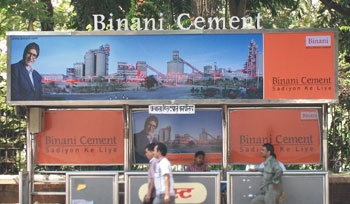
    Milestone Brandcom has rolled out Binani’s new Out-of-home campaign. Along with extended reach, the brand boasts a number of creative executions spread across circles.


    The communication objective was to ensure that the campaign be distinguished on OOH and also associate with people’s lives and be part of festive cheer. The brand ambassador for Binani Cement is Amitabh Bachchan, to further aggrandize his personality, only high impact media touch points were taken up. The campaign was executed for four weeks in 400+ towns across a wide array of 1200+ large format touch points like billboards, gantries, wall wraps, mall facades and unipoles. Extended presence was built using bus shelters and kiosks across all major junctions and arterial routes. The campaign was also taken onto the airports of all major metros for greater reach.


    There were a number of innovations executed for this campaign. Large 3D LED letters of ‘Binani Cement’ were installed over numerous billboards and bus shelters across the country. The campaign creative featured one of Binani’s manufacturing plants in India, the creative was enhanced with the help of LED lights aptly installed behind media to light up the windows in the creative. These ensured dominant visibility not only in the daytime, but even at night.


    “Milestone’s forte lies in their planning and innovations. The best part about Milestone is that they put the brand before the budget. They always provide us with an in-depth understanding of the market. Their OOH strategy is not skewed to the traditional planning route, but altered to suit what would work best for the brand,” said Bina Verma, Managing Director, Media Magix Braj Binani Group.


    Imtiyaz Vilatra

    Commenting on the campaign, Imtiyaz Vilatra, Founder Member & Managing Partner, Milestone Brandcom said, “The media mandate given to us for this campaign was to build salience for the brand and maximize impact through visibility and scale. In a highly cluttered media space, it was essential for the brand to stand out. We took an approach unconventional to the brand’s image and executed a number of innovations to ensure visibility and recall, and filled every city with a dominant presence of Binani Cement.”


  • LOOK-IN 2013: An exciting year ahead for Pepsi and Coke

    By Amit Bapna


    2013 is set to be an exciting year for colas, what with Pepsi stepping into role of title sponsor at IPL, Coke celebrating two decades in India (and almost certainly thinking of ways to derail its competitor’s official sponsor status), and Thums Up now backed by serial Bollywood hit-man Salman Khan. However the excitement around the category and its appeal to the youth is of an even earlier vintage as the first edition of Most Exciting Brands proves. (The Most Exciting Brands survey findings are published in the Brand Equity section of The Economic Times dated January 2, 2013 – Editor)


    The findings of the first ever Most Exciting Brands survey reaffirm that in spite of supposedly sexier categories like mobile phones and tablets, excitement about colas continues unabated. Three cola brands feature in the Top 5 rankings: Coca-Cola emerges as the most exciting brand followed by Pepsi at 3 and Thums Up at 5.


    Not bad for a category that was created way back in 1886, when Atlanta-based pharmacist Pemberton stirred up a fragrant, caramel-colored liquid and combined it with carbonated water. As per legend, the concoction initially sold a measly 9 glasses at five cents a glass for almost a year. Today Pemberton’s creation, famously known as Coca-Cola, is a ubiquitous brand, selling in over 200 countries and all set to celebrate 20 years of its return to India after being exiled from the country in the late 1970s.


    Competitive brand battles are nothing new, but few have been waged as consistently as the cola wars. To the people working on these brands, there is seemingly never a dull moment. Says Santosh Padhi, cofounder, Taproot India, “In a category like this, where the product is not there to sell (unlike a mobile where the features are being sold) what is being pushed is the imagery and all three brands have done a damn good job, when compared to any other category.”


    The cola brands have been on a journey of constant reinvention, building their brands around cultural references, including cricket, football, adventure, music and films.


    Says Tanuka Ghoshal, assistant professor – marketing, Indian School of Business, “For a low involvement product that’s often purchased on impulse, and where brand loyalty is typically low, sales thrive on one and only one thing: salience and top-of-mind recall.” In her view, this is what leads to a category that is overactive with each brand vying to outdo the other on share of voice and consequently share of mind. The brands strive to achieve this through a plethora of exciting and creative campaigns.


    For Coca-Cola, the leader of the pack in this survey, what worked well was the insight of integrating the brand with popular culture, through its campaigns and on-ground properties, informs Anupama Ahluwalia, VP – marketing, Coca-Cola India. Campaigns like “Ummeed wali dhoop, sunshine waali aasha” that exhorted people to believe in a “better tomorrow”, followed by the summer campaign, which profiled cricket as India’s most loved sport and featured the iconic Sachin Tendulkar, and finally the Coke and meals campaign, which spoke of happiness around mealtimes, seem to have worked well for the brand in creating buzz.


    Pepsi positions itself as “a curator of pop culture across the world.” The excitement has been kept alive by carrying forward it’s iconic ‘Change The Game’ plank shares Homi Battiwalla, EVP – Colas, Hydration & Mango Drinks, PepsiCo India. The campaign re-energised the brand. In 2012 the same central thought was carried forward in all communication.


    Piggybacking on the growing popularity of football as a sport in India, Pepsi created campaigns that set the world’s most popular sport against cricket and cricketers. The first commercial ‘Ab badlega game’ featured the brand ambassador Ranbir Kapoor arguing with a young football fan about why cricket is better. The other campaign featured cricketers and footballers playing against each other – Chelsea’s Didier Drogba, Frank Lampard and Fernando Torres against Mahendra Singh Dhoni, Virat Kohli, Suresh Raina and Harbhajan Singh.


    The idea was to showcase the possibilities in a country which is cricket-mad but also very football-interested. For the T20 series that was held in Sri Lanka, the campaign was all about “Na tameez se khela jata hai na tameez se dekha jata hai” (roughly translated as the rules of the game have changed – it is no more played or viewed in the same decent manner as it was done earlier). All the campaigns have the same irreverence and tongue-in-cheek tonality.


    Views Samir Gupte, president, OgilvyAction, the brand activation arm of the Ogilvy Group, “While advertising tries to create imagery for these brands non-traditional media, be it activation, events (sporting and others) or concerts help build differentiation and association with the brands especially in this category.” Come 2013, Pepsi is set to jump headlong into its IPL association as the title sponsor.


    Thums Up is one brand that has been keeping the testosterone levels high with its macho star associations – on TV and print as well on ground. The signing of Salman Khan as brand ambassador in 2012 has worked particularly well, especially with his dream run at the box office with Ek Tha Tiger and Dabbang 2. Prior to Khan coming onboard, the brand used the South-based star Mahesh Babu as its face with the campaign Aaj kuch toofani karte hain (let’s do something exciting today).


    The challenge for all these brands is to adapt to a world in which one-way communication is giving way to two-way consumer engagement and participation. Shares Samyak Sanjoy Chakrabarty, chief youth marketer, DDB Mudra Group, India, “It would be harakiri to take this target audience for granted, and that’s why the cola brands are always engaging with them whether through presence at the key touch points such as canteens, bars, college events, or live events and properties like the Coke Studio etc, which ensure top of mind recall.”


    In this task, the role of digital and social media is pivotal. Today’s youth is consuming multiple screens and brands are cognisant of this reality. Different brands are doing this with varying degrees of success and engagement. For instance, Pepsi’s football campaign generated a huge volume of conversation on social media – it reached out to more than 150+ million users online and garnered close to 570 million impressions across all platforms. Pepsi T20 Football Facebook activation got 2.5 million engaged users and added 1 million new fans. The way forward for cola companies, will be to invest extensively in creating experiences that allow on-ground activation and digital media to converge seamlessly.


    Source:The Economic Times

    Copyright © 2013, Bennett, Coleman & Co. Ltd. All Rights Reserved

     

  • 2013 – 365 days of engagement


    By Kartik Iyer


    It was a year that began with hope. Hope that we were well past the depressed market, the global turmoil and the poor fiscal reports. Hope that predicted media growth in the range of 12+ percent.


    But as 2012 wore on, it became clear that this was not to be. While it began well, by the end of the first quarter itself signs of what was to come were being seen. Signs of continuing depression, poor fiscal reports for many European countries and signs of uncontrolled inflation within India. All of this meant that the consumer would react and probably postpone purchase. And so it was through the year. With even the festival season not being able to change the trend. Media growth projections dropped to the 7+ percent levels.


    All of this meant that Advertising investments would continue to be challenged for Efficiency. The one word that decided the trends of media in India. So while TV and print continued to be the big boys albeit with low growth numbers, their role was questioned. Digital media became a core part of planning instead of being a media for the leftover budgets and grew at a burning pace of over 35+ percent. Out of Home encompassed the large billboards as well as the Malls, Multiplexes and market places thus growing at a rate of over 10 percent. Social media was no longer about digital alone but also about the various points of social connect like malls, multiplexes etc. And the key objective was to maximize earned media. Which meant that the effort was for every medium to connect with the other and work in tandem to deliver greater effectiveness and engagement.


    In this evolving media space, let’s take a closer look at each medium.


    Print – Will hold but would definitely face growth challenges. This could be the year when TV overtakes print in terms of ad volumes. It is now for media owners and advertisers to redefine the role for the medium and use it for its inherent strengths. Gimmicks aren’t what Print is for. It’s time it played a role as the ultimate Stature medium. As well as a medium that is with the times and is the fountainhead of details.


    TV – Would continue to grow. However audience fragmentation is real and needs to be managed. Digitization will hopefully deliver more realistic information on the consumption trends of the medium and one could see clear niches being carved out. Niches that have their own individual appointments with audiences. Appointments that today have become extremely valuable in the efficiency paradigm.


    OOH – Is no longer a single medium but is split into large format on the road OOH, Ambient OOH in malls, multiplexes and market zones and Retail space Out of Home. Another variant is that of Urban and Rural activation. A medium that enables true one to one engagement with consumers who are curious and focused. All of these will have their own unique capabilities and would probably see the highest rate of technology influx. The medium has come of age and it’s now time for advertisers and agencies to understand the capability of the medium and design communication accordingly.


    Digital – There is a reason that I have mentioned this last amongst all media. And that is because this medium is ready to take on the role of being the backbone of all communication. Very often one gets to see data that clearly shows that the medium has a limited reach which may be true to an extent. However one must bear in mind that even the latest researches on the medium are dated considering the rapid growth the medium enjoys in being adopted. This medium again can be split into a number of areas like Digital display (static) Digital Video, Search (which can lead to display) and the most underused version which is Mobile.


    Mobile – This is the one medium that provides the reach which is wider than any other medium available in the country spanning all of India across Urban and Rural geographies. It is now for the advertiser to get innovative and design communication depending on the capability of the device. And all of this has to be done while encouraging the consumer to opt in for communication. There are already very many cases of brads that have managed to engage across geographies using this medium and it’s time that all advertisers learnt from these pioneering initiatives.


    At an overall level, all media will move from being categorized by the material form to the interaction form. So it will no longer be print, TV, Radio, Internet, OOH etc.


    It could be categorized as Written, Visual and Engagement. This would mean that a TVC (Video) would play out on TV as well as Digital (Pre rolls etc) and OOH (Ambient spaces, Large format OOH etc). A static ad would be released in dailies, magazines, websites and close format ambient media. Audio would be played out on radio and internet and malls and so on. Furthermore, the ads in dailies and magazines would have QR codes or Layar codes built in so that with the use of mobile devices the static ad could lead to video. Similarly with OOH advertising. And all of these things are happening now. Not in the near future but now.


    The die is now cast. Future directions have been defined and 2013 will only see all of the above growing. And digitization will give advertisers more realistic numbers to work with. TV and print will continue to be challenged. Digital will continue on its rampant growth path. Out of Home will become core to engagement plans. Digital will be available in ambient spaces thus merging Digital and Ambient. Brands will start thinking of Integrated Communication Plans rather than media plans. And media will become performance focused and more exciting every day. The good news is that shopping in the last few weeks has seen a significant upswing which could be read as a more upbeat consumer which would be a good point to start from for 2013.


    And finally let’s not forget the Consumer who is now the Emperor. India’s youth is impatient and has no time for the old world order. They are moving and want to be seen with brands that are moving at their pace or leading them. They are continually bombarded with communication and don’t have the patience to remember every piece. It is the ones that engage with them regularly and innovatively which will be remembered and those are the brands which will emerge as winners.


    Kartik Iyer is Managing Director, Carat. Carat, the world’s largest independent media communications specialist, is part of the Aegis Media Group. Carat is Campaign’s Media Agency of the year 2012 for India as well as South Asia. Other companies in the group include Vizeum, Posterscope the global OOH sector leader, Brandscope, Hyperspace (Retail), Ambient (Ambient Media), Carat Fresh Integrated (Activation), PSI (Airports), Doosra (Creative), Isobar, the global communications agency with digital at its heart and iProspect – Communicate 2, the global leader in search and performance marketing.


  • Vodafone, Idea, Philips and others bring TV commercials to life to double impact

    By Rajiv Singh


    Location:  Barbershop

    Script: A bunch of youngsters briefing the barber on what hairstyle they need


    What one may have seen on TV-telecom service provider Vodafone’s commercial for its ‘121 Made-For-You’ offers-came alive in select shopping malls in Delhi, Mumbai, Pune and Ahmedabad last month.


    Recently, Dutch consumer electronics maker Philips put ‘live mannequins’ on display windows at key retail locations in Delhi when bodybuilders demonstrating Philips BodyGroom products replaced regular mannequins at its stores.


    Several brands are now replicating their TV commercials on ground or mixing their mass media promotions with direct consumer-engagement activities to create an extra buzz.


    “While above-the-line promotion provides mass media coverage, below-the-line promotional techniques give necessary depth to the campaign,” says Smitha Sarma Ranganathan, a brand communication specialist who teaches marketing management at IBS Bangalore. “Integrating both these aspects via staged events helps marketers realise the best of both worlds.”


    Coming back to Vodafone mall activation, it roped in hairstylists from Jawed Habib beauty salon chain to give customised hair cut or hair styling to young boys.


    Vodafone created a web application and displayed a huge LED wall at the malls. The ‘before’ and ‘after’ images of select participants were uploaded and tagged with their names, and it was updated every hour with a new “look of the hour and hairstyle of the hour’.


    It’s not only Vodafone and Philips that are connecting with consumers on ground.


    The latest brand to replicate its TV commercial on ground is Idea. The telecom service provider rolled out a consumer connect programme in Hyderabad to create a buzz for Honey Bunny commercial.


    A Toyota Innova with five dancers dressed in costume and character representing different states of India went to hotspots across the town and danced to the tune of Honey Bunny.


    In Ahmedabad, it formed a ‘Flash Music Band’ that planted itself at the popular hangout spots. After singing the 2.5-minutes jingle, it moved on to another location.


    Greenlam, one of the largest laminate brands, undertook an innovative marketing campaign at select malls a few months ago. It created an outline of Taj Mahal on LCD touch screens and invited people to beautify the monument with their favourite colours, designs or patterns of Greenlam laminate.


    Such activities, says Ranganathan of IBS Bangalore, lend credibility to the brands in terms of making promises in TV commercials and fulfilling them.


    “By breathing life into the contexts of commercials via staged events, brands get to cement the belief that after all ‘what you see is what you get’ besides achieving customer engagement,” she says. “Overall, it reinforces the strength of the brand in the consumers’ eyes.”


    Source:The Economic Times

    Copyright © 2013, Bennett, Coleman & Co. Ltd. All Rights Reserved


  • New year, new job scene?


    By Tuhina Anand


    We know that 2012 was not a great year as far as the job market was concerned, hence a general sense of uncertainty prevailed. That holds true for those in the creative business too. However, the year did see some movement of key leaders of an agency to another, and hence it was not really devoid of any such hype that surrounds when a biggie moves from one agency to another. Year 2013 is also being touted as a year where caution will be the mantra, thus job opportunities will be available but not in abundance, and hiring will be done after much consideration.


    Understanding the current scenario, we at mxmindia decided to talk to few creative people who made the transition from one agency to another last year and understand how easy or difficult that transition was for them. Also we try to take a peek and understand some rules that would help those looking at a transition in the year 2013 and what would be few key attributes that would help them in making a smooth shift and adapting to a new environment. Besides, we also try to understand that while everyone is lamenting the lack of jobs available in the market, what really made these professionals make that leap and make them a desirable candidate in such a gloomy job environment.


    Bobby Pawar

    At the start of the year in 2012, Bobby Pawar took reins as the Chief Creative Officer and Managing Partner of JWT India. He was moving from a biggie Mudra which was undergoing a transition to another biggie thus there was speculation galore. He was in fact welcomed by his ex-agency on his first day at work at JWT thus making some wonder whether Mudra was so very happy to bid goodbye to Mr Pawar.


    However for Mr Pawar, his agenda was clear. He had come on board with a vision to raise the bar at JWT and bring in few changes that would help him to that. Along with Colvyn Harris, Mr Pawar went on executing his plan. Talking about the transition, Mr Pawar said, “Understanding and adapting to a new place takes time. It is about understanding how much are you willing to push boundaries in a new set up as you are still getting to know the people you get to work with and understanding the culture of the place. However, at a senior level, if you have come on board that is with a view to bring in few changes and that is a challenge as to when, how and to what extent are you going to bring about that change without bringing a disruption among the existing talent pool.”


    He said, “One has to learn to be patient in adapting to a new place. While I might like to take out a pen and start doing my own things to expedite results but that should not be the case as it will deter others working with you. It’s a fine balance that one has to maintain. Understanding the new clients and their issues too requires patience. I think one has to be absolutely clear as to what one wants to do when one makes a shift. There is no scope for half measures to go ahead in your career, that’s just not done.”


    Sanjay Thapar

    Another shift that got the media buzzing was of Sanjay Thapar moving from Ogilvy to Bates India as its CEO. For Mr Thapar, the move is significant not because of the lofty designation he acquired but because of the task ahead at Bates. Beset with issues where the agency saw many of its senior resources move out, the task for Mr Thapar clearly is to catapult the agency to the big league. On the move, Mr Thapar said, “Both Bates and Ogilvy are from WPP so there is culture that runs common. Having said that, if you ask me if it is as good or bad as I had expected, let me say that the job has just begun. But one thing is clear that in terms of opportunity there is immense potential.”


    He says that when one is looking for a change it clearly has to do with the individual’s aspiration and what he or she wants to do ahead in life with respect to his or her job. For those looking for a change in 2013, Mr Thapar suggests that one has to keep in mind that when one moves to a new place consider starting from ground zero, so basically start from the scratch and second attribute that’s necessary is to have an ability to take quick decisions and make them work.


    Manoj Kandoth, Chief Consultant at Urjja which is a human resources and business consulting company and does lot of hiring for the agency points that while job scene was conservative in 2012, he seems to be bullish about 2013 especially in the telecom and FMCG sector. He points that telecom has seen a robust growth which then also reflects on the ad spends thereby also in the way hiring is done by agencies to service this sector. He said, “When making a shift, one should not think of the size of the agency but clearly the portfolio of clients that one gets to handle at the new job.” There has been rise on the spends on the digital media hence one will see a demand for professionals who understand and cater to this medium.


    Rana Barua

    While we have seen the adaptability issues when one moves from one agency to another, what really happens when one moves from a different media to advertising? Rana Barua who joined as the COO of Law & Kenneth from the radio industry, said, “For me it was coming back to advertising after spending few years at a different medium. Still, I would say that it does take almost a month to get into the groove. But I see the move as a positive comeback where I have acquired a multi-dimensional experience and been on the other side thus coming with a different perspective.”


    He said, “At a new place one has to be open minded and be ready to embrace the new culture besides try to value add to the new organization every single day however small that addition may be.”


    Interestingly he points that in today’s time advertising needs people who are multi-dimensional hence a person who cannot just think TVC but print and be a digital expert too. So according to him while the job scene will continue to tight in 2013 but there will be demand for such multi-talented people. The classical strait-jacketed people might find it difficult to make a switch only because the way talent is being looked upon now is different.


    So the year might look tough but not for those who are willing to take risks. As Mr Pawar of JWT rightly said, “I might have the visiting card with a designation that looks impressive but unless I demonstrate how I can make things happen, nobody will take my visiting card seriously.”


    So the year may be tough but not for those who are willing to push boundaries and show that they are made of tougher stuff. If you demonstrate that then a job switch might just seem like the easiest issue in 2013.


  • O&M mingles with Center Fruit

    By A Correspondent


    Perfetti Van Melle India (PVMI) has launched a new product: dual-coloured, dual-flavoured liquid-filled gum – Center Fruit Mingle. Center Fruit Mingle comes with dual flavours of pineapple and green apple in one gum. Commenting on the launch Mandar Keskar, Category Head, Perfetti Van Melle India said, “We at Perfetti have always emphasized on getting more and more innovations in the market, to surprise and delight our consumers. Our latest offering provides not only a taste, but also a visual differentiation, never seen before.” The launch will be supported with an extensive television campaign created by Ogilvy & Mather.


    The insight for this TVC came from the fact that two flavours are together ‘miley hue’ in one gum. The TVC shows a serious cricket match in progress. The batsman hits the ball into the air and to his surprise,the non-striker dives and catches it. The batsman turns desperately to the umpire to seek resolution and is aghast to see the umpire himself celebrating with the non-striker. The commentator exclaims ‘Ye dono miley hue hain’ (these two are in it together)’.


    Anurag Agnihotri, Group Creative Director, Ogilvy & Mather said, “We wanted to create an advertisement that breaks all the common norms adopted for two-in-one commercials. This ad is both funny and crazy, a combination that has always worked wonderfully for us.”


    Positioned as a lip-smacking, rib-tickling chewing gum, Center Fruit has a number of memorable campaigns with wagging tongues like theATM Commercial (teller dispensing money from his mouth), Jugalbandi (a musical face-off) and the recent Guide TVC with tagline ‘Kaisi Jeebh Laplapayee’.


    Client: Perfetti Van Melle India Pvt. Ltd.

    Agency: Ogilvy & Mather

    Creative team: Anurag Agnihotri

    Account management team: Antara Suri

    Production house: Tubelight Films

    Director: Prashant Issar


  • CRY to host corporate responsibility summit

    By A Correspondent


    Non-governmental organization and and child rights advocate CRY (Child Rights and You) plans to bring together key voices on the corporate responsibility debate in order to build greater convergence between stakeholders. The event will see dialogue between leaders of major companies in India, members of civil society as well as representatives of the Government. TheCRYCorporate Responsibility Summit (CCRS) will be held in Mumbai on January 11 2013 at the JW Marriott, Juhu.


    The summit will feature prominent corporate leaders including Harsh Mariwala, Chairman and Managing Director, Marico Limited; Anand Kripalu, President, India & South East Asia for Mondelez International; Santosh Desai, CEO, Futurebrands India Ltd; Ronnie Screwvala, Founder of the UTV group; Kiran Khalap, Founder, Chlorophyll brand Consulting; and Sandeep Singh, Deputy MD, Toyota Motors, among others. They will discuss various aspects of corporate responsibility including the criticality of a centrally held CSR vision by the leader, employee engagement and the evolving Indian consumer’s expectations.


    In addition, John Elkington, the acclaimed author, strategic thinker and creator of the term ‘triple bottom line’, will anchor sessions aimed at giving the audience hands on learning through case story based examples and interactive exercises.


    CRY is also instituting theCRYChild Rights Champion Award for corporate commitment to children the first such award of its kind in India. This award will recognize companies that show extraordinary commitment to children by ensuring that all their business practices recognize this vulnerable and critical stakeholder. The awards will be presented at the summit.