Category: NEWS

  • Dish TV adds two Bengali channels to its ‘Free Offer’ package

    By A Correspondent


    Even as Kolkata struggles to reach 100 percent digitization, DTH operators are leaving no stone unturned to attract consumers. Dish TV is offering special digitization delight to its Bengali viewers in Kolkata by adding two more leading Bengali news and entertainment channels to its lifetime free offer, in addition to the game-changing initiative aimed at viewers in the four metros which fall under the digitization. Under this offer, the customers will be eligible to receive a basic channel tier comprising of 70+ channels free of cost for life. The channels that will be available along with 70+ Free Channels offered under Lifetime Free offer to only customers in Kolkata include Rupashi Bangla and Kolkata TV.


    Salil Kapoor

    Commenting on the development, Salil Kapoor, Chief Operating Officer, Dish TV said, “Dish TV has always stood up to its promise of providing maximum width and depth of content with an overall of 400+ channels & services. This is a unique facility for valued subscribers who will choose our services during digitization, and is a highly differentiated and extremely consumer-friendly move. And now by adding two exceedingly popular Bengali news and entertainment channels to the lifetime basic tier free offer, we’re extending ourselves as a more personalized option to Dish TV subscribers in Kolkata.”


    Viewers availing this offer have to remain active by subscribing to a regular package at least twice during a year. The offer is not available with any other DTH or digital cable, and Dish TV claims that it has encouraged thousands of people to shift to them. For the record, Lifetime Free offer spans five years.


  • Dentsu in talks to buy out digital agency Webchutney

    By Ratna Bhushan


    Japanese advertising agency Dentsu is in advanced talks to buy out leading digital advertising agency and consulting firm Webchutney.


    This will be Dentsu’s first local acquisition in the digital agency space. Network18, which holds 70.06% stake in the Sidharth Rao-promoted Webchutney Studios, is looking to exit from the alliance, two officials with knowledge of the development said. The deal size is estimated at between Rs 40 crore and Rs 60 crore for Network18’s 70.06%, which values the agency at roughly Rs 90 crore on the higher side.


    “Dentsu is expected to buy out Network 18’s stake in Webchutney. The promoters of Webchutney will continue to hold their stakes,” one of the officials quoted earlier said.


    Rohit Ohri

    Rohit Ohri, Dentsu India group’s executive chairman said: “We are looking to scale up our digital capabilities in India. Obviously, acquisition is one of the options. We are currently discussing the various options and putting together our plan.” Officials close to the development say Webchutney, which was ranked the No 1 digital agency in the latest Brand Equity Agency Reckoner, is the front-runner in Dentsu’s quest for inorganic growth in this space.


    Network18 had invested in Webchutney through its investment arms, Capital18 Ltd and Capital18 Fincap, in 2007. The agency, which services firms like Airtel, Microsoft, Hindustan Unilever, Marico and Titan, posted a profit of Rs 6.35 crore in the financial year 2011-2012 on revenues of Rs 21.55 crore. Network18 owns 49.42% of the shareholding through Capital18, Mauritius and 20.64% through Capital18 Fincap.


    Webchutney’s Rao said: “It’s very early to talk about any new alliance… nothing has been finalised as we are evaluating many options.”


    Sarbvir Singh, Capital 18 MD, too neither denied nor confirmed if Network18 was exiting Webchutney. “In the normal course of business, at any given point in time, we are approached by several interested parties and we speak to them as appropriate. We have no other comment to offer at this point.”


    Webchutney was set up in 1999 by entrepreneurs Sidharth Rao and Sudesh Samaria. The agency’s area of work includes online advertising, website design, mobile marketing and social media. Its employee strength is about 200.


    In July, globally Dentsu had acquired British media buying group Aegis for $4.9 billion. Back home, too, the Japanese agency has been on the prowl. In August, it acquired majority stake in creative hotshop Taproot.


    Founded by ad men Agnello Dias and Santosh Padhi, Taproot has created clutter-breaking ads including PepsiCo’s ‘change the game’ and Airtel’s ‘jo tera hai wo mera hai’.


    Denstu also has an indirect alliance with mobile marketing agency ad2c, a collaboration between Japan’s D2 Communications and Singapore-based Affle, led in India by Madan Sanglikar. In mid-August Aegis had acquired D2 Communications, a digital marketing and search agency. Indirectly, this deal gave Dentsu access to the digital space.


    Dentsu’s clients include car maker Toyota and electronic firm Panasonic whilst Aegis services brands such as Adidas and Philips.


    Digital agencies are increasingly being wooed by traditional ones. Earlier this year, Publicis Groupe bought out digital and performance marketing firms Resultrix and Indigo Consulting in two back-to-back deals. And in mid-June this year, WPP Group bought out a majority stake in Hungama Digital Services through its agency JWT Singapore.


    Source:The Economic Times

    Copyright © 2012, Bennett, Coleman & Co. Ltd. All Rights Reserved


  • Innovative programming did the trick for Suvarna post-Kotyadhipathi

    By Tuhina Anand


    Kannadada Kotyadhipathi is gearing up for its second avatar on Suvarna, the Kannada General Entertainment Channel from Star Network. The channel plans to launch the show in March of 2013 with the host of its previous year Kannada superstar Puneeth Rajkumar. For the channel, Kotyadhipathi has been a big property which has propelled the channel to be a leader in the prime time category thus giving Udaya (the undisputed leader for long) much to worry.


    Post Kotyadhipathi, the channel revamped its prime time offering with new shows. It launched Amrutavarshini at the 9:30 pm  slot which Suvarna puts it as the number 1 show of Karnataka with an average TVR of 6.0 (CS4+, Karnataka market). In the 8:00 pm slot it launched Akashadeepa, Chukki at 10:00 pm and Pancharangi Pom Pom at 10.30 pm and all the shows are slot leaders.


    Anup Chandrasekharan – Business Head of Suvarna Channel, said, “For this year we had a conscious strategy to strengthen our fiction offering and the response for our newly launched fiction shows has been exceptional. We have firmly established ourselves as a family entertainment channel.”


    He elaborated, “In the year 2012, the channel conquered the key genres including Kannadada Kotyadhipathi which is the leading non-fiction show of the year, Amrutavarshini as the leading fiction show of Karnataka and Hudugaru our premier movie was the highest rated movie of the year.”


    While the current season of KBC in Hindi has generated a lukewarm response, there has been no such concern for its Kannada counterpart. The channel has witnessed repeat interest from its advertisers.


    Anil Narang – Head Marketing & Strategy, Suvarna, commented, “We are very confident about the success of the show. Hindi is a different market and that cannot be compared to Karnataka. Also we are in the second season of the show unlike Hindi which is in its 6th Season. Moreover, we have not made any changes in the telecast schedule like Hindi where they have made it a weekend show.”


    Mr Narang said that for Kotyadhipathi, there is big expectation from both audience and advertisers. In fact this year it is learnt that the client is coming with a premium.


    “Having been able to prove its success to both the trade and audience, in its second inning the Kotyadhipathi is seeing interest from all brands associated in its first time to come back,” Chandrasekharan added.


    The claim is that post Kotyadhipathi, the market share of the brands associated grew. In fact,  Sunfeast which had limited itself to computer branding is now the title sponsor for season 2.


    The show has been the number one show in Karnataka and has generated revenues in excess of Rs 35-40 crore. The plan for this year is to have revenue generated in the vicinity of Rs 40-45 crore.


    The numbers shared by Suvarna points that 11.3 million people has consumed the show making it biggest in Karnataka. Chandrasekharan, said, “Kannadada Kotyadhipathi had made Suvarna the No.1 channel in Week day Prime time, this show also led to increase in sampling of Amrutavarshini which we launched immediately after KK at 21:30. KK  brought in new viewers not only to Suvarna but also to Kannada General Entertainment. We are very happy with the response for season 1 and the on ground buzz for season 2 is exceptional.”


    For this year again the premise will be that the show will continue to change peoples’ lives. The channel will bank on emotional connect just like last year but the change this year will be that each week the focus will be on one district of Karnataka showcasing its rich culture and tradition. The tagline for this season of Kotyadhipathi is “Questions that can change your life”


    Here’s a look at Kotyadhipathi Season 1 numbers


    • On an average has been the No# 1 show of Karnataka since its launch
    • Has an average TVR of 5.5 (CS 4+, Karnataka Market)
    • Has a cume reach of 11.3 million people
    • 81% of the Karnataka Television audience has seen the show
    • Has a slot share of 43%
    • Maximum weekly avg rating is 7.1 (CS 4+, Karnataka Market)


    The auditions this year has seen more than 50 percent increase than the last year for calls for registrations. The show which will run for 20 weeks will see spend close to 4-5 crore on marketing.
    While KBC may have not done much for other regional channels but surely it has helped Suvarna. Their smart and consistent programming strategy has helped the channel continue the rise in numbers post KBC thus able to sustain the high wave. Udaya TV which has been traditionally leader has seen much change in in numbers especially during KBC period. With KBC 2, Suvarna hopes to further consolidate its position and if the focus on programming continues especially because of Star Network’s strength the numbers will become more consistent and Suvarna can be ahead of Udaya TV. But content is the key to this success.


    Expert Talk

    Karthik Lakshminarayan

    Karthik Lakshminarayan, COO, Crest- Madison Media
    Suvarna is the leading channel in Karnataka and is propelled by KBC alone. The channel did well in terms of numbers during the time of KBC (see data).

    Their programming strategy is sound as of date and if executed well should see them emerge as clear leaders. The channel has taken the step in trying different things and this approach of being different while being risky is a sign of a leader and it should help differentiate them from the others.


    Anilkumar Sathiraju

    Anilkumar Sathiraju, AVP and Head South, DDB Mudra Group

    Suvarna has been doing well over the last few months. Yes KBC has done the trick for them, not only that, few serials are also doing quite well. Among female audiences for one of our brands, Suvarna ranks at No.2 which is good. With better programming am sure Suvarna will reach the number one position.


  • Chitkara is new LG CMO, Agarwal sales head

    By Writankar Mukherjee


    LG Electronics India, the country’s largest electronics company, has replaced its heads of marketing and sales as part of a top-level reshuffle seen as a reaction to its failure to keep pace with revenue target.


    LK Gupta, chief marketing officer, has put in his papers after leading the role for five years and will be replaced by Sanjay Chitkara, who was earlier heading sales administration. Amitabh Tiwari, who was heading sales, will switch roles with Sanjeev Agarwal, who was the head of business excellence.


    They will report directly to company MD Soon Kwon, a senior company executive said.


    “Probably, the headquarters felt a big change was required since LG India is falling short of its revenue target,” the person said, requesting anonymity. “While changes in top management is an annual affair undertaken every December, but never before have there been such sweeping changes like now.”


    A detailed questionnaire sent to LG India’s corporate communications team on Wednesday to confirm the management changes and its business plans remained unanswered.


    The company has also made some changes in its product group heads and split the role of the head for refrigerators.


    Manish Gupta, the product group head for televisions, will now head microwave oven. Vijay Babu, who was heading microwave ovens, will look after frost-free refrigerators while Praveen Gosain-presently regional manager for East zone two that includes markets like Orissa, Jharkhand and Bihar-will head direct-cool refrigerators. Vishal Karan, who was the regional manager for Bengaluru, has been made the chief of modern trade. All the changes will be effective from January.


    While LG India is yet to give any indications about its sales this year, trade sources expect the company to fall short of its revenue target of 20,000 crore for the current fiscal. Last year, it grew marginally to 16,200 crore from 16,000 crore in 2010, falling short of a target of 20,000 crore.


    Trade sources say during Diwali, LG sales grew by 10% against a target of 15%-20% growth.


    LG has been trying to reposition itself as a premium brand. However, industry insiders say it has made limited success in this regard and Indian consumers regard Sony and Samsung more premium brands. The only major exception is the 3D TV segment where LG has emerged the market leader with 37% share, as per GfK-Nielsen retail audit for January-October 2012.


    India is identified as one of LG’s key growth markets and the company had earlier expected its Indian operations would outgrow the parent company by 2015.


    Source:The Economic Times

    Copyright © 2012, Bennett, Coleman & Co. Ltd. All Rights Reserved


  • How safe are women in media – Part II


    By Ananya Saha


    Even as we brought you the views of women in news media on how safe they feel, yesterday (http://www.mxmindia.com/2012/12/how-safe-are-women-in-news-media/), we also got in touch with women in non-news fields to share their views.


    Rita Verma

    Media seems like a glamorous business. And probably it is, minus the harassments that go unnoticed or unreported. With stringent HR policies being put in place, it might just be a thing of past. We reported yesterday on how safe and unsafe women in news media feel in their respective cities. Today, we bring you the views of the females in non-news media.


    The industry coherently believes that the country is getting unsafe for women. Rita Verma, Senior VP, Organisation Development, DDB Mudra, voiced her angst, “With all the current issues going on across the country no women feels safe. And in odd hours it only gets worst. It does not matter if you are in an urbanIndiaas all these major cases are happening in the major metros.”


    ‘Learning self-defence is important’


    MxMIndia staffer Shruti Pushkarna weighed in: “As a working professional, I am pretty used to driving around the city on my own even in the late hours but yes, it would be wrong to say that I never worry about getting back home safely. There have been several incidents in the past when I have been stranded on the road with a punctured tyre or something else, and no one to help. This one time I remember, I was waiting for help to reach me and to be safe I locked myself in my car and then I saw a cop cross by, Hoping that he would help me, I rolled my window down to ask for his help, but he just told me, ‘Push your car to the corner of the street and stop blocking the road!” I was shocked and told him I had a flat tyre and needed help, but that didn’t seem to have any effect on him and he walked away saying it wasn’t his job!


    “Well this was when I still had a car to lock myself in, a helpline car service which came to my rescue twenty minutes later, but it was worse a couple of years earlier when I had to use public transport to commute across the city. And my only hope then, were a bunch of safety pins I kept handy. Small things women carry around in their bags turn out to be useful weapons at times, and I have used those safety pins many a times to guard myself on DTC buses.


    “In a previous job, we were provided with office cabs to go home from late night shifts. One night as I stepped into the car, a guard also joined us. I asked him if he was headed in the same direction as I was but turned out that the HR had decided to let a security guard (a man) travel with me and the driver (another man) for ‘my’ safety. I don’t know if it crossed anyone else’s mind but the only thought that crossed my mind was, “If the driver tries to rape me there’ll be another man to help/encourage him.” So I went and told the HR next morning that it’s obviously more difficult to guard myself against two men at the same time!


    “The news is full of how rapists are on a power trip, how the police are inefficient, how the politicians and the government don’t take any strict action and so on. I feel the logical thing to discuss and perhaps propagate via national media, is the need for women to be prepared for these things. It’s important for them to learn self-defence methods and have self defence devices handy.  I for instance, took a short Krav Maga self-defence course. It’s an Israeli martial art form which helps you defend yourself and also teaches you to be more cautious and guarded against odd/dangerous situations. I think it’ll take a lifetime to change the men in our society so let’s start with the easiest and the most logical solutions.


    Sagorika Kantharia

    Sagorika Kantharia, Chief People Officer, Radio City 91.1FM, opined, “We really need to do something to make women safe in this country. Nowadays when you open the newspaper only thing you get to read is crime, rape cases, murder stories. Really ugly stories like father raping daughter, man throwing acid on woman’s face etc. One of the news reports on “Crime against Women” shows rape cases have grown by 30 percent since 2007, molestation cases have gone up by 52 percent and sexual harassment by 50 percent. I think the offenders should be punished with capital punishment in such cases of crime. Today women are working and demands of work is just increasing day-by-day wherein women have to travel outstation, work late hours at times how does one manage if the country is going to unsafe for women.” To make the women employees feel safe and protected, “At Radio City, we do have facilities for women employees who work late hours. Special arrangement like a re-imbursement for a private cab booked post 11pm etc. are provided for employees,” she said.


    However, it is not difficult to guess how safe urban India is before 11pm.


    Ambika Sharma

    Ambika Sharma, MD and CEO, Pulp Strategy said, “Women in India are not safe, especially not post-dark. One has only to read the papers to realize this. Those of us in media who keep odd hours at work need to be extra cautious. Delhi in particular is not a place to be out at night, and its getting worse every year. If you are to be late at work ensure that the organization is responsible enough to drop you to your doorstep.” At Pulp Strategy, it is a rule that women colleagues be escorted to their homes if leaving office post dark. “I personally would not recommend public transport post sunset, its difficult but there is no other choice, safety comes first,” she said.


    But there are bosses who do not care. Megha Swarup (name changed on request) works for a PR company in Delhi, said, “We are not given cabs unless it is for official meetings or media rounds. Since our boss is stringent with proper filing of papers, minutes of meetings etc, we usually get late in office. Our office is in a commercial complex that empties out by 7 pm. There have been times when we have had to ignore lewd remarks within the complex, but bosses do not care. And the bizarre fact is that our boss is a female. They do not even ask if anybody wants a lift to a certain point.” One of the female colleagues of Ms Swarup, gets picked up by her husband every single day after office.


    Vivek Srivastava

    But then there are bosses who do care. Vivek Srivastava, Joint MD, Innocean Worldwide, said, “This heinous crime has shaken us all. It has definitely made us reassess the security of our women colleagues once again. Ours is a professional space that truly accords importance, equality and respect to the efforts of the women folk. Advertising is a service industry driven by client imposed deadlines which can be difficult and late nights at office happen often. At Innocean we ensure that women take utmost precautions when working late. They are provided safe taxi services verified for their antecedents whenever they work late. In some cases the other office colleagues accompany them as well wherever routes are common. Moreover we do occasionally issue advisories to our colleagues to maintain their safety not just from sexual crimes but road rage, avoiding driving when under the influence of alcohol and avoiding over crowded places during times of alerts as well.”


    Prerna Uppal who handles MTV Consumer Products at Viacom18 in Mumbai said, “I do not feel safe when I am travelling on a business trip especially to Delhi, Gurgaon and Noida. I usually wind up all my meetings before7pmespecially when I am travelling alone. I feel very unsafe and sadly, I end up ordering room service rather than experiencing the great gastronomy the city offers.”


    MxM View


    MxMIndia has a clear view on the issue of the safety towards women in the news media. The people who run the newsrooms – owners, CxOs, editors, team leaders, and commentators — must ensure that we provide for the safety of our women colleagues. We know that the world outside our offices – including our public transport — is unsafe. We also know that expecting people around to protect women is too much to ask as we discovered when a senior news journalist was mute witness to an excess on a Mumbai local train.

    So, while it’s good to see the news media playing up the Delhi gangrape story, it’s critical that stiff laws are created. Our newsrooms must work towards taking care of the staff as they work odd hours.


    If you think your newsroom or that of a friend is not taking good care of its women employees, write to us at editor@mxmindia.com. While we don’t guarantee a solution, we will take it up the bosses of the news media entity to ensure a better, safer world.


    - Pradyuman Maheshwari

    Editor-in-Chief and CEO, MxMIndia


    Mumbai-based Lekha Saluja (name changed on request) manages corporate communications for a media house. She said, “I feel safe in Mumbai, no matter what time of the night. The roads are buzzing, there are people and I think it is largely safe. Having said that, it has to do a lot with me having my own car and driving. I am not sure the trains or the rickshaws will be as safe. Regular patrolling of the cops and better security is required. My office ensures late night travel for women employees.”


    A corporate communications manager in Bengaluru for a media company (who did not wish to be named) said, “There is no security. But due to the cab pick-up-and-drop-facility that I have arranged for myself, picks me from my building’s gate and drops me to office gate, I feel safe. To each, its own, is the norm here.” Apparently, she worked in Delhi earlier and depended on male colleagues to go back home if leaving late from office. Echoing her thought is Bengaluru-based advertising professional, Astha G, who said, “The whole feeling of being safe in media is more of a mindset. HR does not provide any safety measures. Only your own methods can help you feel safe.”


    Another corporate communication woman who works in Delhifor a news website, said, “What safety are we talking about? I have to catch hold of one colleague at least to go back with me when I drive back home late at night. Even though my office provides a cab post 8 pm, I do not feel safe going in one.”


    Cab services are a precaution, which every organisation must have. While no one can make females feel safe on roads, it becomes imperative for organisations to take stricter measures for them. If they won’t, who will?


  • FM Radio: Facing challenges, embracing growth

    By Ananya Saha


    The Confederation of Indian Industry (CII) organised the CEOs Roundtable on Radio in New Delhi last week, to discuss and chart the growth of the radio industry with the Phase III auction of the FM spectrum coming up, though dates are yet not out, and the ministry is said to be tweaking the loopholes. The conference saw private FM operators being critical of govt policies that did not allow them to carry news on their stations. The event also saw the release of CII- E&Y report – ‘Poised for growth: Fm radio in India’ (Read about it here: http://www.mxmindia.com/2012/12/fm-radio-will-generate-rs-14bn-in-coming-year-ey-report/)


    Prashant Panday

    Amit Khanna, Chaiman, CII Committee on Media & Entertainment and Chairman, Reliance Entertainment, requested the government to encourage diversity in programming by giving incentives. He said, “The existing policy has created clones of same station and has stalled the exponential growth of FM that could have happened.” He also spoke about how the cost of reach of radio was much higher than the cost of reach of radio, thus pushing the FM operators to stick to mainstream genre of Bollywood music to generate revenues.


    Prashant Panday, CEO, Radio Mirchi advocated multiple channels, 25 or more for cities such as Delhi and Mumbai for efficient usage of spectrum and diversification in genres. He pointed out, “FM gets only 40 lakh listeners per week. And daily only about 25 lakh people tune into FM. Why is that we reach 25 percent of population? The population needs variety, and we are often compared to TV when it comes to programming.” He also said that in 4-5 years FM radio will lose business to digital radio as consumer moves to internet radio. “The numbers are clearly growing. Saavn currently commands 10 million listeners. FM spectrum has finite life span. It is important to re-consider spectrum policy before broadcasting goes kaput,” he said.


    Anurradha Prasad

    Anurradha Prasad, President, AROI and CMD, BAG Networks, opined that the all stakeholders related to FM industry are missing the larger picture. “We sell airspace one-hundredth of TV ad revenue. It is clear that nobody is taking it seriously,” she said. She pointed out how advertisers look at radio as a ‘bonus’ medium and not as a serious medium.


    However on a positive note, Ashish Pherwani, Partner, Advisory Services, M&E, Ernst & Young, said, “Phase 3 is going to be imperative for growth of the industry. There are good things happening in the industry that will allow consolidation. Yes, it is important to extend licensing by 10-15 years. The lack of inventory is happening because of lack of licensing. But even then, one out of two campaigns currently use radio is a medium, even when ROI is not as well-defined in this medium.”


    Uday Varma, Secretary, Ministry of Information & Broadcasting, began on a very candid note. He quipped, “If the industry itself is calling a 10-12% growth bleak, what percentage of growth will make it look bright? The industry in itself is not clear what it wants – whether it wants fast growth or slow growth. Of course, the business aspirations of the industry and national interest will not go hand in hand and meet, and it should not for good.” He also pointed out why there is a delay in the auction of Phase III licenses, “There was an issue of migration fee. The process and auction will be done in very transparent manner. There are trade-offs but I am sure we will sort them out with the industry and other stakeholders like TRAI.”


    Mr Varma on a lighter note said, “If you as an industry player are sure that it will die, why expand at all? And if it is so, the government should re-look at the FM policy. We, as an industry, need to begin on a far more positive note. Of course, you cannot wish government away. There is a divergence of motive here – the industry is working for profits and we have to look at the working of the industry as a whole,” while responding to Mr Pandey’s statement that the FM industry will face the music the next 4-5 years. On the question of allowing private FM to air news, Mr Varma asked the industry to begin with AIR news feed and give it a time of 4-5 years.


    The Secretary and Rajesh Kumar Singh, Joint Secretary) Broadcasting (MIB) assured the delegates that Phase III was on the top of their agenda. Mr Singh said, “My agenda was to get the Phase III rolling by March 2013. But we hope to work on the areas that cause concern and do it thoroughly.”


    Harshad Jain

    Harshad Jain, Business Head, HT Media (Fever FM) said, “The market size is roughly Rs 12-1500 crore, for a medium (radio) that is absolutely free for the consumer. Compared to overall media industry, this is the fraction of revenue. The bidding cost for Phase III is unfair to the industry that is so small. While the numbers might look impressive when you see CAGR, the prices of this medium have actually declined keeping inflation in mind.”


    Anil Srivatsa

    Adding to the debate was Anil Srivatsa, CEO Radiowalla Network who said that the reserve price will deter new entrants into the industry. He recommended more frequencies with lesser space between two frequencies. To this, Wasi Ahmad, Advisor (B & CS), TRAI, responded that number of FM channels should be consummate to how many channels can a market absorb while Harrish Bhatia, CEO, My FM wished to make the industry more investor-friendly while pointing out “stations that are backed by news media houses should be allowed to carry news.” On an optimistic note Mr Jain of Fever FM wished that “radio industry becomes a $ 2 billion industry,” while Uday Chawla, Secretary General, AROI, wished for a level-playing field between radio, print and TV.


    Harrish M Bhatia

    The panel and delegates also pointed out how the industry is facing the dearth of good talent. On a positive note, Asheesh Chatterjee, CFO, 92.7 Big FM concluded, “We are going to grow at 30% in Phase III when 245 FM stations would result in four times in inventory with more comprehensive spectrum. Radio is set for huge jump. The ad revenues are falling because we are selling cheap. We, as an industry, have to focus on good content. The growth and the ability to grow lies within us. We need better and concurrent movement.”


    A Must Read for every Professional in Media Industry ….

    Extracted with permission from Authors of ‘The Advertising Mess’


    Universe Projections and a well-known Listenership Survey

    The existing Radio listenership survey from a ‘credible and trustworthy research organisation‘has shown utter carelessness and total lack of responsibility which has hindered the growth of this nascent medium.


    The listenership survey, which launched in 2007, used NRS 2005 universe estimates without applying growth rates for the intervening two years, which means its figures were two years out of sync with reality. This lethargic output was produced after charging humongous fees from the client for subscriptions.


    Logically, in any such media currency, the critical factor is the ‘estimation of the universe’, which needs to be done as accurately as possible. This can be done by using the latest available census figures and applying the intermediate growth rate to arrive at the current universe, OR by using IRS figures (since IRS provides updated universe estimation by demographics on a quarterly basis.)


    Moreover, this listenership survey continued to report these wrong universes for the next 3 years till the end of 2010. Not only was the universe underestimated but the radio penetration figures were also wrongly reported as compared to the baseline.


    When this ‘credible and trustworthy research organisation‘ finally updated the universe in January 2011, some markets showed growth in population by 143% over the previous year. (Obviously, since for five years, the research agency had not bothered to update universe, now there was a sudden leap).


    The basic demographics such as gender ratios changed almost inversely for male : female from 57 : 43 to 41 : 59, socio-economic classes observed stark differences. For example, upper socio-economic class demonstrated a drastic drop where as lower socio-economic classes showed significantly unrealistic rise over the previous year.


    Conventional wisdom says that the demographic proportion takes almost one full decade to show the kind of change in proportion that this listenership survey showed in a single year. Such drastic changes in gender ratio were last witnessed during World War II, when millions of members of the male population were killed in a single year of warfare at the front. They cannot radically change in just one year.


    Can we expect such blunders from an organisation which is looked upon as the ‘Messiah’ of media research in India? Unfortunately, YES.


    Such are the follies of these surveys which are unfortunately highly respected by the industry and form the basis on which most of the MarCom investments are made today.


    Different methodologies lead to different results with disastrous consequences (Diary v/s DAR)

    Different methodologies for the same objective appear to provide different results in research surveys. Each of these methods has their own disadvantages and advantages and that includes how the market perceives them. The different numbers emanating from the usage of different methodologies mean different opportunities to advertisers, broadcasters and agencies for revenue impact, visible return on investment and content formulation.


    Obviously all these methodologies cannot be giving the accurate results. Let’s take an example of MRUC which started India’s first radio listenership survey, ILT (Indian Listenership Track). MRUC had conducted a research to evaluate which methodologies out of DAR (day after recall) and Diary were the most robust and with minimum error. It was found that DAR reported a 55% inaccuracy, whereas Diary reported 85% inaccuracy.


    Post the results of these findings, TAM media research released the first round of Radio Audience Measurement with Diary methodology, pitching hard for real-time capturing of data.


    The radio station which according to ILT was the undisputed market leader for two consecutive years, suddenly dropped to number four position according to RAM, whom do we believe ILT or RAM? Further, this discrepancy occurred when there were only a total of 7 private FM stations available.

    The question is whether real time capturing of data (Diary), which was developed to overcome the inaccuracies of the previous methods (DAR), truly presents the actual picture.


    Another example which can be looked at is a famous radio station which recently converted from 100% Hindi content to 100% English content in Mumbai. When comparing three months of Hindi content (Pre-Launch) with 3 months of English content (Post-launch), the existing listenership survey conducted by a ‘renowned media research agency’ reported NO significant changes in either demographic consumption of the station across age groups, gender and socio economic class OR in tune-ins and time spent. On the contrary, lower socio-economic class showed growth for 100% English content for the same radio station.

    This either shows that all listeners are deaf or it shows how real time capturing of data could mislead due to some lesser known reasons or leakages in validation process or it shows that the data capturing and analysis are being done in a thoroughly unprofessional manner. Or could it be that there is a short-coming in the methodology itself and that fresh, new methods are urgently needed?


  • India TV conducts campaign countering Crime against Women

    By A Correspondent


    India TV launched a nationwide awareness campaign called Mission Damini across most major metros to lend what a communique calls a “high-decibel amplification” to voices being raised against the growing menace of crime against women.


    As a part of this initiative a signature campaign was conducted on Sunday, December 23. Huge signature boards were set up at key locations in Delhi, Mumbai, Lucknow, Ahmedabad and Jaipur.


    People from all walks of life came forward and pledged to do all that is required to prevent crimes against women. The initiative is being done in the backdrop of the heinous and barbaric gang rape that took place in Delhi recently.


    Many key personalities including top politicians, social activists, academicians, Bollywood and TV personalities and literary personalities were amongst those who attended the peaceful initiative of vowing to support and show solidarity to the cause.


    Talking of the initiative Ritu Dhawan, MD & CEO of India TV said, “This is our miniscule contribution to amplify voices for justice against the recent ghastly & heinous act but also to demonstrate the way of peaceful but effective protest.”


    “We sincerely hope that authorities will take concrete steps so that not only justice is done in this case but also that no such incidents take place in future,” she added.


    The signature pledges will now be sent to the Union Home Minister as a whitepaper on aspirations of the citizens of the country along with suggestions on ways and means of curbing the peril.


  • MxM Monday: Expectations from Phase III FM radio licensing


    By Ananya Saha


    FM Radio is set for exponential growth. Even as advertisers are yet to take this medium seriously, the industry players are waiting for Phase III with anticipation. The industry is positive that the third phase would result not only in differentiated content but will also interest the advertiser and listener alike.


    We speak to private FM players for their expectations from Phase III of licensing.


    By Ananya Saha


    Harrish M Bhatia, CEO, DB Corp Ltd - Radio Business (94.3 My FM)

    We all want Phase III to happen. It is an industry’s requirement to grow. But it is important for the government to remove hurdles like the issue that happenedinChandigarhor not allowing us to carry news. What is the objective of taking AIR news? If it the issue of keeping tab or administering the news we carry, they can ask us to keep our news recordings for 30 days and they can review it. How does the government control cable telecast? Why cannot they trust us?


    From the advertisers’ front, I am sure that the advertising in the medium’ will continue to grow. What is required is proper decisions by the government to ensure that the private FM players also gain.


    Asheesh Chatterjee, CFO, Reliance Broadcast Network Ltd (92.7 Big FM)

    The more number of Spectrum licenses in Top A, B cities will only benefit the industry. It will add to content loyalty. Phase III licensing will result in closure of music royalty issues when the tariff rates will resolve the ambiguity issues that exist at the moment. And yes, the FM players will be investing in Category C and D towns. Kozhikode, Chandigarh and the South will make the things uncomparable. Those areas need a bit of correction.


    These three are broadly the issues, apart from smaller issues such as news. Even while protecting the identity of your brand, we will be able to cover news in the same manner or better manner. Otherwise you are too restricted in communicating it in the same manner.

     

    Harshad Jain, Business Head, HT Media (Fever FM)

    The highest bidding of Phase II will becomes the lowest bidding price in Phase III and that is a cause of concern. I hope the government understands the fact that the cost of doing business is high. And I hope they do pay attention to this fact apart from solving the issues such as transmitter and infrastructure.


    It is no doubt that the Phase III is going to do better to the industry, but the back-end processes will have to be taken care of and sorted.

     

    Anurradha Prasad

    Anurradha Prasad, President, AROI and CMD, BAG Networks

    We want the processes of Phase III radio licensing to begin as soon as possible. We, as an industry, do not want something that becomes unviable. Hence, we are awaiting the process to begin soon so that industry gains. You cannot compare telecom and radio spectrum together. The consumer does not pay for radio. The medium requirements are different.


    It looks like the issue of music royalty will get sorted as Phase III licensing comes into play. However, I am concerned that in Phase III, the bidding prices might go haywire and people will not be able to pay, nor would they be able to make it profitable.



    Prashant Panday, CEO, Radio Mirchi

    The objective of any policy should be to ensure growth of the sector. In the case of FM radio, Phase-3 policy should attempt to expand FM in a big way.


    The Phase-3 policy as it stands today only partially addresses the objective. It does seek to expand geographically into some 250 new towns. However the auction methodology (electronic ascending auctions) and high reserve fees (highest bid received in Phase-2 in a similar category town in the same region) will frustrate this goal. The radio industry believes that FM auctions will be a flop with most new cities not being taken up. The industry prefers electronic tendering, just like done successfully in Phase-2. This would also take care of the problem of reserve fees, since they are set post-auctions (25% of the highest bid).


    The policy allows for networking across the network, which should help cut operating costs in small towns. It also allows broadcasters to operate more than one channel in the bigger cities, which should help in consolidation. The policy also allows news broadcast, but limits the content to AIR feeds. This is blatantly unfair, since news without restrictions is allowed to all other media.


    However, the biggest problem is conducting auctions under scarcity conditions. There is only 1 channel in Delhi, Bangalore, Chennai, Ahmedabad and Pune and 2 in Mumbai. This will lead to exorbitant “desperate” bidding. Further, this high bidding will become the base for the next round of auctions, which will put the radio industry into a cost spiral. Instead, the government should accept TRAI’s recommendation of halving “channel separation” to 400 KHz and doubling the number of channels. This way, the government will get more overall license fees, the public more programming variety and the broadcasters reasonable license fees.

     

    Suresh Sanyasi, National Sales Director, Radio Indigo

    Our expectation from Indigo are fairly simple: we are looking at larger market space in terms of international quality music available pan India. We current fall into very niche A+ segmentation. We are looking at Mumbai,Delhi as a market and may be a couples of Town A and B where we see potential like the way we got Goa where we can harness our brand and give listeners good music. Invariably connecting them with good brands and advertisers and giving them pan-India reach. Currently, if any advertiser wishes to advertise with us, they have to locally listen to our station in Mumbai and Goa. Once, we get license, the advertisers will be able to connect with our brand pan India. We already have offices in Delhi and Mumbai and once we get license, we will start expanding horizontally. We have, maybe about 20%, of business coming out of Mumbai and Delhi irrespective of the fact that they do not have touch-and-feel of Radio Indigo and they have only heard about our brand.


    Once Phase III begins, the market will grow. More radio stations coming in, licensing will become larger, the government is definitely going to get lot of revenues and a lot of employment will be created. There is huge amount of growth that we are looking at.


    However, radio in India has not reached maturity yet. By maturity, I imply, consumption of radio is not a very-well accepted norm right now. I say it comparing it to more mature medium like a television. People buy in terms of brand and advertising people do not know how to use radio. Radio is a very tactical medium. Advertisers do not understand the medium since it is not a visual medium, even as it remains the most cost-effective medium to advertise and there is a definite return that comes through. With larger number of stations coming in, people would like to try out and understand the value of radio in itself.


    We are looking at Phase III with much positivity and optimism.
     

  • Will Sachin’s ODI retirement diminish his brand value?

    By A Correspondent


    Master blaster Sachin Tendulkar’s retirement from one-day cricket will set the stage for a new phase in the life cycle of one of India’s most iconic celebrity brands. As his form has dipped in the past few months, many big brands and consumer goods companies have dropped Sachin or significantly reduced the number of his television advertisement spots from their media plans.

     

    Coca-Cola, for instance, does not use the legendary cricketer – who in his prime humbled bowlers of the calibre of Wasim Akram, Glen McGrath, Shane Warne and Brett Lee – as its youth icon, but only as a happiness ambassador. Other big brands such as ITC, Adidas and Aviva also took his ads off air, even as Canon and Jyothi Labs did not renew their contracts, clearly echoing the views of cricket commentators who have said it was perhaps time for Sachin to hang up his gloves.


    The Economic Times has argued – and Sachin has rubbished – that many of his advertising and brand endorsement deals are tied to his form, and for the number of years he stays at the crease. Tendulkar, who made his debut for India in 1989, has been the country’s highest-paid sportsman for the past two decades. At present, Tendulkar is the face for about 17 brands and earns between Rs 5 crore and Rs 8 crore per brand annually. Many of his endorsement contracts are set to expire between now and 2014.


    Marketing experts and celebrity agents say Tendulkar’s retirement from the shorter form of the game is likely to dilute his image as a youth icon and discourage companies to employ him as their brand ambassador. But he might continue to be an attractive proposition for more mature categories such as banking and financial services.


    When contacted, World Sport Group – the company that manages Sachin – refused comment. “Sachin will need to reposition himself in the brands space. He can’t be the cool youth icon which may be the requirement for a lot of brands he’s involved with. Going forward, more mature categories such as banking or insurance would want to be associated with him,” said Shailendra Singh, joint MD of talent management and marketing firm Percept.


    Banking major RBS confirmed that its brand deal with Sachin at the moment is unlikely to undergo any change. According to Future Brands CEO Santosh Desai, the nature of Tendulkar’s appeal will change. “As Sachin moves from being a hero now to more like a mentor once he retires, he will certainly attract more corporate brands rather than trendy and hip ones. He will stand for perseverance and experience,” said Desai.


    To a certain extent, that process has already begun with companies such as Coca-Cola. “Sachin is involved in campaigns that spread happiness or bring about social change, and continues to feature in promotions and activities around the campaign,” said a spokesperson for the soft drinks company.


    Camera-maker Canon, which had inked an endorsement deal with Tendulkar in 2007, has decided not to renew the contract when it ends this month, citing a “change of strategy and youth focus”. Consumer goods maker Jyothy Laboratories, too, did not renew its contract with Tendulkar a couple of months ago. A spokesperson for insurance firm Aviva said while its contract is not up for renewal, it will evaluate the contract details “closer to renewal”. While Tendulkar will continue to play Test cricket, if his poor run continues, it is possible that he may hang up his boots altogether after the series against Australia next year.


    For a cricketing genius who has hogged headlines for over two decades and at times has been considered a legend on a par with Don Bradman, walking off the field will not mean the end of the brand endorsement road. Ironically, some companies feel his brand value may get a boost after retirement. “Sachin’s brand value might actually go up as people start missing him on field. But it all depends on what he does outside his cricketing career in terms of business or supporting social causes,” said an ITC Foods official. Tendulkar signed up with ITC Foods in 2006 and the contract will expire next year.


    Several leading Indian cricketers who have retired in the past few years have seen their endorsements shrink dramatically as companies switched to younger and more promising players such as Virat Kohli. But experts say Tendulkar could be an exception. “Unlike many of his predecessors, who weren’t signed by brands for ads after retirement, Sachin is in a different league and brands would still want to be associated with him. Besides, his endorsements have been chosen very well. Many are mature, global brands which would like to continue with him,” said Sangeet Shirodkar, director, Off-Spin Sports and Entertainment.


    A similar point was made by cricket legend Kapil Dev, who compared him with Amitabh Bachchan. “People don’t relate Sachin to any particular brand. He is brand India for consumers and will earn dividend or pension throughout his life for being that. Like Amitabh, his brand value will not diminish. The only person who can kill his brand is Sachin himself,” said the man who led India to its first World Cup win.


    And for now, many of Tendulkar’s sponsors are standing behind him. “Our relationship with Tendulkar continues… he continues to engage with the bank at various events in London, Gurgaon and Mumbai,” said Kavita Sonawala, country head of marketing, RBS India.


    Source:The Economic Times

    Copyright © 2012, Bennett, Coleman & Co. Ltd. All Rights Reserved


  • Chitralekha upbeat on social media

    By Ananya Saha


    It took two years for Chitralekha to reach two lakh fans on its Facebook page. According to the official numbers provided by Chitralekha, 96% of these fans are from India with 87% under 34 years. Close to 35,000 active fans make it a highly interactive community. While the group has focussed on FB till now, and is present on Twitter, it will be looking seriously at the latter in 2013.


    Mitrajit Bhattacharya

    While many media brands are taking the social media route to be interact with the audience, it is known that beyond the ‘likes’, not many engage with them on a regular basis. However, Mitrajit Bhattacharya, President & Publisher, Chitralekha Group is upbeat about the statistics. “We are very active on FB as a community. We inform, entertain and empower our fans. For instance, the songs in a specially-compiled music CD with our anniversary issue were chosen by our fans, questions to celebs in our popular FB activity – “Chhoti Si Mulakat” are normally contributed by our fans etc. We also share jokes, pics and breaking news regularly. All these translate into an engaged fan base,” he said, while adding, “Regional brands have a huge power to connect with their audiences as friends. We have been a friend to the Gujarati community for over six decades. Social media helps us to be in touch with them closely, particularly the younger lot. Gujaratis are also very heavy users of digital devices, which help the process of connectivity.”


    The social media strategy of the group extends to Chitralekha’s brand philosophy “of being friend to our fans and being loved to a completely new younger audience.”


    Does an engaged fan base imply an engaged advertiser community as well? Mr Bhattacharya said, “Monetizing social media is a tricky issue, however there are many marquee clients who are actively looking at our online offerings currently.” He insisted that Facebook has played a large role in helping traction onto Chitralekha’s websites.


    With no choice but to be present on social media to stay in the game, Mr Bhattacharya concluded, “Digital is the future. All our major titles are available on tablets and smart phones. Our print copies get delivered to over 100 countries (sometimes, we learn about small countries from our subscriber’s database). Just imagine the power of digital, which avoids the problems of physical distribution due to geographical distances, both within and outside the country!”


  • Santa TAM has come to town today!


    By A Correspondent


    Oh! You better watch out,

    You better get set,

    You better not pout,

    I’m telling you that:

    Santa TAM is coming to town!


    He’s making the list,

    Checking it twice,

    Gonna tell us who’s popular or nice.

    Santa TAM is coming to town!


    He sees you when people are sleeping,

    He knows when people are watching.

    He knows if your shows are bad or good,

    So be good for goodness sake!


    Oh! You better watch out,

    You better not cry,

    You better not pout,

    I’m telling you why:

    Santa TAM is coming to town!


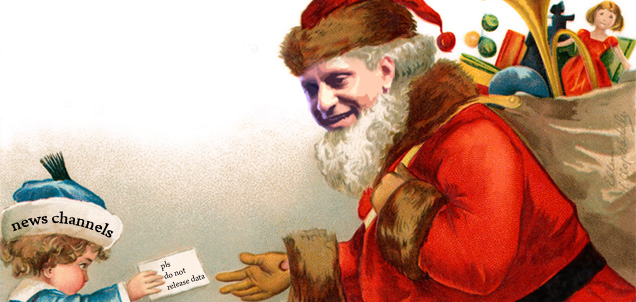
    With apologies to all for mauling the famed Christmas carol.  And we hope TAM CEO LV Krishnan and his team also take the doctoring of a Microsoft Clipart in the right spirit.


    For, it’s Christmas eve and the day when the ratings for the last week and that of the last two-odd months will be released.


    A settlement was reached in the first half of Saturday (Dec 23) where it was decided that the ratings of all channels save those news channels who produce a letter asking TAM not to share their individual channel’s numbers. These numbers which will not be disclosed are to be clubbed together in under an ‘others’ category.


    Before we bring you the numbers of the all-important Hindi GEC category, here’s a disclaimer: It may be noted that from around mid-May 2012, TAM Media has not been giving out the ratings numbers proactively to the media. While the ratings we bring you are hence unverified by TAM, we assure readers that the source is reliable and the information is not incorrect. However, we would urge readers to make their own enquiries before being influenced by the numbers.


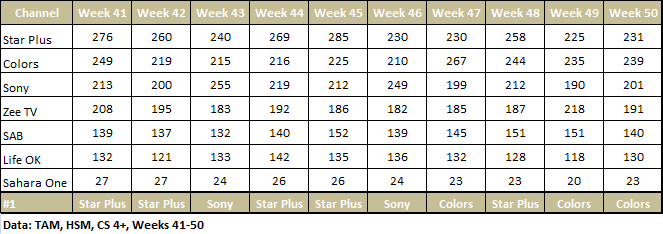
    General entertainment channel Colors has been #1 in Weeks 49 and 50. It also generated the highest in ratings in Week 47 as well. While Colors is #1 in three weeks, #2 in 4 weeks & #3 in three weeks, Star Plus has been a close #2 except in Week 47.  Sony was #1 twice while the highest rank Zee could attain was #2. Yes, there’s a neck-and-neck fight between #1 and #2.


    On Star Plus, the ‘Yeh Rishta’ leap on Dec 3 generated 5.4 TVR and the ‘Dabangg 2’ integration in ‘Diya Bati’ on Dec 12-13 got it 5.1 and 5.3 TVR respectively.

    On Colors, reality show Bigg Boss season 6 opened with 4.1 TVRs and has averaged 2.5 Monday to Friday in Week 41-50. The premiere of OMG generated 3.5 and 3.4 TVR delivering 39 GRPs.

    On Zee, Qubool Hai  opened with 2.5 TVR (Mon-Fri 9:30pm),  with latest week average  being 2.7.


    For Sony, the premiere of ‘Rowdy Rathore’ on Sunday Oct 21 garnered 5.1 TVR at the 12noon slot and 5.6 TVR at the  8:30pm slot  delivering 68 GRPs in all, whereas the premiere of ‘Ek Tha Tiger’ on November 11 fetched 3.3 TVR at the noon slot and 4.6 TVR at the 8.30pm slot delivering 55 GRPs. Kaun Banega Crorepati has been averaging 3.3 TVR.


    Earlier, the music genre numbers reached us, courtesy of 9XM. The flagship music channel has done remarkably well outwitting competition on most weeks.


    Meanwhile, you better not cry, you better get set… for Week 51 ratings are going to be out a day after Boxing Day. Yup, December 27! Week 52 data will be out on Jan 3 and the news channels on Jan 9.


    Imaging: Rafiq


  • Madison Media appoints Amit Duggal as Director Digital

    By A Correspondent


    Madison Media has announced the appointment of Amit Duggal as Digital Director to head its Delhi and Kolkata Digital business. Mr Duggal joins Madison from Mindshare, and will report to V Achuthan Kutty, overall Digital head of Madison.


    Mr Duggal has about 10 years of experience in advertising and digital, having worked with agencies like Indiatimes.com, Yatra online, Travelguru.com, Geodesic, Attano.com on the digital side and Rediffusion DY&R, Leo Burnett and Percept on the agency side. His last position was with Mindshare where he was Partner Invention, leading the Digital practice for Pepsico.


    Said Gautam Kiyawat, Group CEO, Madison Media, “We are delighted to have Amit lead our team in Delhi and are confident that he will be able to add a lot of value to our digital clients and help them make Digital a significant driver of their business and also win new business”.


    Mr Duggal said, on his joining Madison, “I am excited with this new opportunity and looking forward to contribute to an impressive roster of clients that Madison has.”