Category: NEWS

  • After TVCs, the next best thing


    By Shubhangi Mehta


    Commercial advertisers often seek to generate increased consumption of their products or services through “Branding”, which involves the repetition of an image or product name in an effort to associate certain qualities with the brand in consumers’ minds.


    The marketing mix has been the key concept in advertising. Suggested by Professor E Jerome McCarthy in the 1960s, the marketing mix consists of four basic elements, famously called the Four Ps. They are Product; Price, representing the process of determining the value of a product; Place representing the variables of getting the product to the consumer like distribution channels, market coverage and movement organization; and Promotion, the process of reaching the target market and convincing them to go out and buy the product.


    There is a plethora of ways to do this. The modes of advertising include television, radio, online, OOH and then these further have various categories in them.


    Television is generally the first choice for most of advertisers, but what about radio, digital and OOH?


    Prasoon Joshi
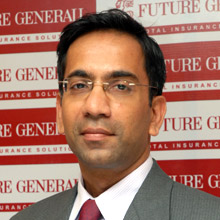
    Abraham Allapatt

    Prasoon Joshi, Executive Chairman, McCann Worldgroup, commented, “It’s all about the requirement of a brand, it depends on a particular brand as to what marketing mix is to be used. There might be a brand for which I may not even use television, but might go in for a local newspaper etc. Hence it is not possible to choose a particular medium over others across the board.”


    Abraham Allapatt, Head – Brand & Corporate Communication, Future Generali India Life Insurance Company Limited, said, “Frankly, one cannot definitively state that one of these mediums is the best (after TV) simply because each of them has pros and cons. Radio is good if one wants to reach out to young/upwardly mobile urban customer prospects with a limited budget – especially if you have a powerful/simple message and creative to deliver, but it’s limited in terms of reach.


    “Similarily when we talk about print, it can target specific audience and is quick in reach but again it is a little expensive as compared to other media (cost per reach) and it is relatively limited in terms of reach at an overall level versus TV.


    “OOH is a powerful reminder medium for topical messages but is a relatively disorganised sector/medium. There is no science to measure impact/effectiveness. Large agencies use some tools to add some science to measurement, but it is still not too dependable.


    “Digital is focused down to the individual and is measurable accurately and instantly. It is very good for reaching young, urban, upmarket segments, plus it is cost-effective and an image driver. The only issue is that it is still limited in reach to large cities/income segments.”


    Apurva Purohit

    Apurva Purohit, CEO, Radio City 91.1 FM, said, “Radio as a medium has the ability to impact millions of Indians due to its wide coverage. And that’s just one of the multiple benefits of the medium! It enjoys a deep personal connect with listeners, allows marketers to create customized and local communication for pocketed audiences, and offers extensive on-ground engagement prospects to supplement advertising campaigns. Such offerings make the medium superiorly effective and attractive for marketers.


    “Radio has an edge over other media due to the local relevance that the medium offers. Advertisers seek to maximize efficiency of their marketing spends by looking at micro targeting communication to consumers in focus markets. Radio serves as a key medium to fulfil this need with its ability to create customized and local communication for the relevant target audience.


    “Another important feature that gives radio a one-up is that it’s an anytime access medium. Hence, advertisers can reach their consumers anywhere, anytime. Different sets of people tune into radio at different points of time and therefore the medium is consumed across the day. This is unlike print which is mainly consumed in the morning and TV which is mainly consumed at night.


    “Of course, the medium’s cost-effectiveness is unquestionable. Radio is far more inexpensive than print. If you need a local media plan you will pay six times on print, while at one-sixth you will get the same kind of reach and frequency on Radio.”
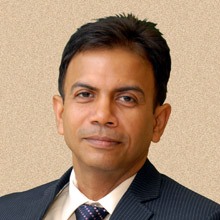
     

    Sanjay Tripathy

    Sanjay Tripathy , Executive Vice President – Head Marketing and Direct Channels at HDFC Life, said, “Choosing a medium will always be the prerogative of a brand marketer depending on his/her key objectives. While Television is the most preferred medium for marketers because of the kind of reach and opportunity for quality of communication it provides, Print comes a close second because of its ability to provide detailed information about the product/ service. This medium is also hugely preferred because the circulation and readership numbers are measurable unlike Radio and OOH, which are usually used for local, last mile reach. Contrary to popular perception, in a highly populous country like India, print still has a lot of scope for growth in the interiors where literacy is still catching up. Print provides flexibility in terms of customisation as per the regional target audience. However, the characteristics of the target audience influence hugely in terms of ‘where’ would the marketer best capture their attention, leaving a lot of scope for exploring different media channels. Especially in case of digital – the new-age innovative medium, which is my personal favourite and which, I believe, has a lot of potential over all the other media. Going forward, as most people are spending more and more time online and on social media, these will emerge as preferred media for brand engagement.


    Kalyan Kumar, CMO Games 24×7.com, said, “Being an e-commerce company, our vote will definitely go to digital. Digital is growing rapidly and has a great future scope. If there was a medium to be chosen after television, then hands down, my vote goes to digital.”


    Ranjeev Vij, Vice President, Head – Proximity, said, “We cannot isolate and say that digital is the only preferred choice. It works best when used in tandem with traditional media. For example look at “Quaker Mission to Make India Heart Healthy Campaign” done by BBDO/Proximity India in 2009 where TV and print ads were linked to the website (www.goodmorningheart.com) and the website led people to social media sites, which helped create buzz, conversations and relationships between consumers and the brand. What digital does brilliantly over other medium is that it helps build relationships and brings customers close to brands by enhancing user experience. Digital is best used to ‘amplify’ everything we do to the power of millions.


    “For marketers Digital provides real-time access to data and analytics, instant feedback on campaigns, product/service quality, etc. along with better understanding of consumer journey and behaviours. This data if mapped properly can help brands massively multiply the results of their marketing initiatives.”


    News paper image: Nuttakit

  • Tata AIG focuses on building strong foundation

    By Shubhangi Mehta


    Tata AIG Life Insurance Company Limited (Tata AIG Life) has released the first in its series of a new communication campaign envisaged by Bates, that restates the importance of indoctrinate strong values and foundations by parents amongst their children. The crux of the communication leverages a strong insight that when the foundations are right, the future is protected.


    Tata AIG Life has a long-term brand-building programme, which commenced in 2004 and is supported each year.


    Tata AIG always emphasises on creating a future by nurturing a strong foundation. Whether it’s the way Tata AIG life runs its business, the way it equips its employees or the way it looks at its customers, it makes sure that every relationship stands on solid foundations. For Tata AIG, when the Foundations are right, the Future is protected.


    Vikrant Ramachandra, Vice President, Brand Marketing, Tata AIG Life Insurance Company Limited said, “At Tata AIG Life, we have always believed in creating a future by nurturing a strong foundation. The principle that a strong foundation means a protected future is at the core of the new brand strategy. Our focus on Protection is reflected in the slew of products launched in the recent times, like Tata AIG Life Gyan Kosh, Tata AIG Life InvestAssure Maximizer and the new products about to be launched. The brand communication strategy will reflect this. One of the critical initiatives recently launched by Tata-AIG Life is the launch of the Premier agency. This will foster skills development with a view to creating a professional and productive agency force through mandatory and structured training targeted at ensuring they focus on the customer need.”


    There is a huge and latent need for financial instruments for long-term savings and protection in India. A Swiss Re report on ‘Mortality Protection Gap’ in Asia Pacific indicates a sizeable mortality protection gap in India. The gap which was to the tune of US $ 2045 billion in 2000 had more than tripled to US$ 6676 Billion in the year 2010. This is the third highest amongst countries in Asia Pacific after China and Japan. Tata AIG believes that right now India needs long-term savings and protection products and so their offerings will emphasize these two aspects driving alignment with customer’s needs.


    For their ongoing campaigns, Protection of Life and Health will form the backbone of the Marketing Program. Mass Media Advertising will be extensively supported by intensive Training Program for its Premier Agents at Tata AIG Life. Additionally, Ground Events like Healthy Living Program, which raise awareness on healthy living amongst school students, will make the strategy vivid.


    Its creative mandates are handled by Bates and media mandates by Madison.


    Vijay Sinha, Senior Vice President & Head of Marketing of Tata AIG Life said, “Our core competence is in the area of managing an individual’s financial risks by developing relevant, compelling and differentiated protection-centric products to meet this staggering Protection Gap in India. In line with our core competence, we at Tata AIG Life have always prominently echoed the need to create a sound and steady future by building and nurturing a strong financial foundation. This very principle is at the heart of our latest communication.”


    Commenting on the creative idea, Sonal Dabral, Regional Executive Creative Director & Chairman (India), Bates, said, “If we look at the world around us today, with its rampant consumerism, the thought of the fundamental values passed on to us by our parents getting eroded in the near future is quite scary. The ‘Thank you’ film is relevant in such times not only from a brand point of view but also from a social point of view. Inculcating the right values in our children in today’s fickle times is what will help our nation achieve her true potential. The idea of imparting the right fundamental values, along with the opportunity of engaging the consumers in a relevant manner is what is most exciting about this campaign.”

  • The world according to JWT, in 2012


    By A Correspondent


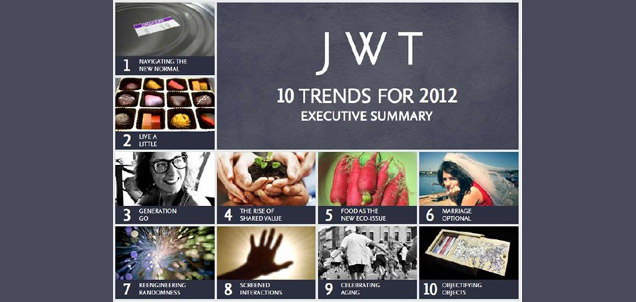
    Ad hotshop JWT feels that in 2012, the economy will push brands into opening up more entry points for cost-sensitive consumers as the “new normal” becomes a prolonged normal in the developed world while at the same time, tough times will generate an unprecedented entrepreneurialism, with the so-called Lost Generation of youth becoming a uniquely resourceful group that creates their own opportunity. The above findings and plenty more, are the result of their annual forecasting exercise – the seventh in the series – of key trends that will drive or significantly impact consumer mindset and behaviour in the year 2012.


    JWT’s ’10 Trends for 2012′ is the result of quantitative, qualitative and desk research conducted throughout the year for the report. It includes inputs from nearly 70 JWT planners across more than two dozen markets and interviews with experts and influencers across sectors including technology, luxury, social responsibility and academia.


    “With our annual trends forecast, we aim to bring the outside in-to help inspire ideas beyond brand, category and consumer conventions-and to identify emerging opportunities so they can be leveraged for business gain,” remarked Ann Mack, director of trendspotting for JWT. “Trends, like any complex and dynamic human phenomenon, are not preordained-once they are spotted, they can be shaped.”


    Previous trends that have been forecasted over the past years include: “De-Teching” in 2011 (more people logging off, at least temporarily, to get a break from technology); “Location-Based Everything” in 2010 (the explosion of location-based or -aware services that leverage data from mobile phones); The Small Movement” in 2009 (the shift away from “bigger is better” in everything from homes to cars to mobile technology); and “Radical Transparency” in 2008 (the “nothing to hide” ethos seen in some online behaviours).


    The top 10 trends that have been predicted for 2012 are as follows:


    1. Navigating the New Normal

    As the new normal becomes a prolonged normal in the hampered developed world, more brands in more categories will open up entry points for extremely cost-sensitive consumers. Marketers will find new opportunities in creating stripped-down offerings, smaller sizes and otherwise more accessible products and services.


    Example: In the US, Heinz is introducing several reduced sizes at a suggested retail price of 99 cents, including a 10-ounce ketchup pouch and a 9-ounce yellow mustard, as well as mini Worcestershire and Heinz 57 sauces.


    2. Live a Little

    Faced with constant reminders about what to do (exercise more, eat better) and what not to do (smoke, overspend), and fatigued from several years of austerity, consumers will look for ways to live a little without giving up a lot. People have been exercising more self-control, and increasingly they are looking to let loose once in a while: indulging in sinful things, splurging on treats and escaping from today’s many worries.


    Example: Whiskey in South Africa, premium beer in the U.K and cheap eclairs in India are small indulgences that consumers with little to spend are enjoying.


    3. Generation Go

    While twenty-somethings in the developed world feel they’ve been dealt an unfair deck, many are finding opportunity in economic adversity. Out of continued joblessness or discontent with the status quo will spring an unprecedented entrepreneurial mindset, enabled by technology that obliterates traditional barriers to entry. A so-called Lost Generation will transform itself into a uniquely resourceful cohort.


    Example: More than half of Millenials in the US agreed that if they lose or have trouble finding a job, they’ll start their own business, according to a JWT survey, up from 25 percent in 2009.


    4. The Rise of Shared Value

    Rather than simply doling out checks to good causes, some corporations are starting to shift their business models, integrating social issues into their core strategies. The aim is to create shared value, a concept that reflects the growing belief that generating a profit and achieving social progress are not mutually exclusive goals.


    Example: Philips is partnering with the Dutch government in a bid to provide affordable, sustainable energy solutions to some 10 million people across 10 sub-Saharan African nations by 2015.


    5. Food as the New Eco-Issue

    The environmental impact of our food choices will become a more prominent concern as stakeholders-brands, governments and activist organizations-drive awareness around the issue and rethink what food is sold and how it’s made. As more regions battle with food shortages and/or spiking costs, smarter practices around food will join the stable of green “best practices”.


    Example: U.K. supermarket Sainsbury’s featured a summer promotion in 2011 offering customers who asked for cod, haddock, salmon, tuna and prawns an alternative, more sustainable species such as herring or mackerel for free.


    6. Marriage Optional

    A growing cohort of women is taking an alternate life route, one that doesn’t include marriage as an essential checkpoint. Both in the West, where this trend is building, and in the East, where it’s gaining momentum, “happily ever after” is being redefined as a household of one, cohabiting or single motherhood.


    Example: In 2010, a third of Japanese women entering their 30s were single, while 37 percent of all Taiwanese women 30-34 were single.


    7. Reengineering Randomness

    As our individual worlds become more personalized and niche-and the types of content, experiences and people we are exposed to become narrower-greater emphasis will be placed on reintroducing randomness, discovery, inspiration and different points of view into our worlds.


    Example: Airtime, due to launch at the end of 2011, is being touted as a random real-time video chat platform where strangers will be “smashed together”.


    8. Screened Interactions

    More flat surfaces are becoming screens, and more screens are becoming interactive. Increasingly, we’ll be touching them, gesturing at them and talking to them – and becoming accustomed to doing so as part of our everyday behaviours. This is opening up novel opportunities to inform, engage and motivate consumers.


    Example: In New York, a restaurant at high-end department store Barney’s features 30 individual screens in a large communal table that’s covered in glass; diners can digitally order their meal, then browse the store’s catalogue while eating.


    9. Celebrating Ageing

    Popular perceptions of ageing are changing, with people of all ages taking a more positive view of growing older. And as demographic and cultural changes, along with medical advances, help to shift attitudes, we’ll redefine when “old age” occurs and what the term means.


    Example: To appeal to Gen Xers and Boomers, Polish beer brand Zywiec launched a campaign with the tagline “The best is ahead of you”. Commercials showed older male celebrities including actors, a boxer and a cartoonist, speaking about their lives, offering insights and advice.


    10. Objectifying Objects

    As objects get replaced by digital/virtual counterparts, people are fetishiZing the physical and the tactile. As a result, we will see more “motivational objects”, items that accompany digital property to increase perceived value, and digital tools that enable creation of physical things.


    Example: Sincerely’s Postagram app allows vacationers and others to turn snapshots into snail-mailed postcards. Similarly, Postcard on the Run reminds potential users that for recipients, a physical card is “a real keepsake they can hold close to their heart, put up on the fridge or display at work”.

  • 4 Indian names on Young Guns shortlists for 2011 awards

    By Shubhangi Mehta


    The shortlists for Young Guns 2011 have been announced and this year India has four nominations on the shortlist; Leo Burnett with three and Ogilvy with one.
    Leo Burnett’s Amod Dani and Ganesh Nayak have three nominations. Two for Tide Fold A Stain in the Art direction and Print Crafts category and one for Heinz Sketchup in the Consumer magazine campaigns category.


    Ogilvy & Mather’s Anupama Sirsalewal has received one for Unbearably Sour, Gun, Snake, Gullotine in the Illustration Campaigns category.


    Speaking on the shortlists, Arvind Sharma, Chairman Leo Burnett said, “We always believe in giving responsibilities to young and upcoming talent. We shall continue to do the same. We are happy that Amod and Ganesh are shortlisted in three categories and glad that the world is also recognising their talent”.


    On being nominated Amod Dani, ECD, Leo Burnett India, said, “The Young Guns award is a very prestigious international award. It is an extreme honour to be shortlisted for our efforts. We hope to convert this into a metal and continue to pursue creative excellence. Leo Burnett has always been at the forefront of promoting young talent, and this honour speaks a lot about the same”.


    Anupama Sirsalewal, Copywriter, Ogilvy & Mather, on her nomination said, “It’s a great feeling to be nominated. Piyush Pandey is God for me and I have grown up watching his ads, and now working in Ogilvy is anyway an award for me. This year has been great for me, be it Cannes Lions or Abby’s. Hope this one falls into my kitty too but there is still a long way to go.”


    Young Guns International Advertising Award is the world’s first and only award forum that is specifically for 18-30 year olds.


    To be named “Young Gun of the Year” is to be named the best young creative under 30 in the world.


    The “Young Gun of the Year” gets invited to join next year’s Young Guns jury.

  • Govt approves Walt Disney’s shareholding in UTV to 100%


    By A Correspondent


    The Cabinet Committee on Economic Affairs of the Government of India has approved the proposal of Walt Disney Company (Southeast Asia) Pvt. Ltd., Singapore for increasing its shareholding of UTV Software Communications Limited, on fully diluted basis, from 48.02 per cent to 100 per cent, pursuant to the Foreign Investment Promotion Board recommendation in its meeting held on November 15, 2011.


    This approval is expected to result in FDI inflows amounting to Rs.8250 crore.

  • Rediffusion subcontracts Tata work to SBU with Edelman

    By A Correspondent
    We told you so. Rediffusion-Y&R and Edelman India announced a strategic alliance to take care of the Tata group business that starts today, November 1.

    The alliance brings together ad agency Rediffusion and PR firm Edelman. Edelman India is an independent public relations (as against others like Hanmer, Genesis and Sampark being part of international networks). The alliance will involve the formation of a separate business unit within Edelman to operate as Rediffusion/Edelman. Note: the SBU is part of Edelman. So, for all practical purposes, the Tatas have awarded the PR contract to Rediffusion which in turn has let it out to Rediffusion/Edelman. A spokesperson clarified that although the unit has been set up for the Tata account, in future it could also take on other businesses. A la Vaishnavi, which started out with the Tatas and took on other accounts.

    “The complexity of the Indian market favours an integrated communications approach that needs to seamlessly combine multiple marketing disciplines,” said Arun Nanda, Chairman and Managing Director, Rediffusion-Y&R in a communique. “Our partnership with Edelman allows us to partner one of the world’s finest PR companies and offer our clients the best in class thinking and capability in this area. This will enhance our already existing offerings in Advertising, Direct Marketing through Rediffusion/Wunderman, Media through TME/MPG and Digital. We will be able to add greater value to our clients across all of their marketing and communications requirements.

    “We believe this alliance will further enable us to push the boundaries of how PR is practised in India today” said Robert Holdheim, Managing Director, Edelman India in the statement. “We are seeing a significant shift in strategic stakeholder communications. An integrated marketing approach is crucial in addressing today’s communications challenges.”

    The spokesperson from Edelman was tightlipped about the staffing and who would be incharge of the SBU. It will evolve, he told MxMIndia.

  • Business Standard joins the iPad gang

    By Akash Raha


    Business daily newspaper Business Standard has extended its digital presence with the launch of its new iPad Application. Attracting readers for its business content, Business Standard has translated this phenomenon into a very strong presence on the web with over a million unique visitors from around the world accessing its website. According to Business Standard sources, a fifth of its online visitors are from outside India. A mobile website that can be accessed on most handsets has also been providing news feeds on the go to readers for a while now.


    Talking about the development, Arun S Natesh, Head – Marketing, Business Standard, said, “To cater to the fairly evolved, widely travelled and tech savvy Business Standard readers’ requirements, and to keep pace with the emerging content consumption landscape, an iPad application has been designed keeping their interests in mind. The BS iPad application chooses to focus on the selection of key breaking stories, incisive analyses and insightful opinion in an easy-to-navigate, clutter-free format.”


    A highlight of the app is its coverage of stock market information. Readers can access stock price information, charts and news on India’s top 500 companies through a simple search. The app also features videos on top business events of the day and updates on the stock market. Sharing stories on social and professional networks apart from emailing is a one-click exercise.


    The app can be downloaded for free from the App Store, and is optimized for iOS4 and above. The Business Standard iPad App can be downloaded at: http://itunes.apple.com/us/app/business-standard/id482532990?ls=1&mt=8

  • History soars to No 1 in genre

    By Rishi Vora


    History, the channel from Network 18 and A+E Networks joint venture, has worked its way up to the No 1 position in the factual entertainment genre if one looks at the six metros market cluster. The channel’s market share is 33 per cent as against Discovery’s 31 per cent and National Geographic’s 13 per cent share in the same market.


    What is seen as a significant achievement for the channel is the fact that it has reached this peak in a timeframe of three months after launch. As a result, the genre too has expanded, say officials from the company.


    Sangeetha Aiyer, General Manager-Marketing, A+E Networks and TV18 JV, said, “While we are happy about the leadership status in the 6 metros, I think the real big story is about the growth of the genre. And that was pretty much our objective – to see if we can expand the genre from the current 1.5 per cent that it is at, to maybe 3 to 4 per cent, or even five. Given the genre growth of 57 per cent, led by History, I think we will be in a position to be able to achieve this sooner than later. Also, the leadership status in the six metros is an indication that all our endeavours in programming and content, marketing and distribution is resulting in rewards as planned.”


    She added, “Going forward it will be our conscious and concerted effort to hold on to our leadership status in the six metros market and consolidate leadership in other market clusters (1mn+ and All India) as well. We believe that our differentiated programming line-up, innovative marketing and focus on distribution will propel us in the direction of widening the gap and consolidating our position as the leader in the factual entertainment space.”


    The channel, according to Ms Aiyer, garners the highest time spent per viewer (40 minutes) vis-a-vis Discovery (29 minutes) and National Geographic (16 minutes). “History’s success is a result of differentiated programming and the stickiness quotient of its content,” she said.


    History reaches out to 50 million homes and 40 million viewers across India on cable TV platforms such as Hathway, In Cable, Den Networks and DTH platforms such as Tata Sky, Dish TV and Airtel.


    Source: TAM, Week 49’11, CS AB 15+, 2400 hrs

  • S Shriram is Indiaplaza’s SBU Head-Life Style

    By A Correspondent


    Indiaplaza.com, the company that pioneered online shopping in India since 1999, has appointed S Shriram as the SBU Head – Lifestyle.  A retailer by profession and choice, as he terms himself, Mr Shriram is passionate about retail. As SBU Head for Indiaplaza, he is responsible for building the Lifestyle business including men’s, women’s and kids’ apparel and accessories, jewellery, watches, sunglasses, home furnishings and furniture.


    According to K Vaitheeswaran, Founder & CEO, Indiaplaza.com, “We are very happy to have Shriram on board. I am confident his rich experience as a retailer will help position Indiaplaza as the leading online shopping destination for lifestyle also, just like for books and electronics.”


    Online shopping in India is booming across books and electronics. With the Indian internet population crossing 100 million recently, the next wave of growth is expected in the area of lifestyle. With a loyal base of customers and fast growing traffic, Indiaplaza is aiming to quickly establish leadership position in online retailing of lifestyle as well.


    Prior to joining Indiaplaza, Mr Shriram was the National Head of Business Development at Cafe Coffee Day and was responsible for their expansion among Key account partner-locations. Earlier to this, he was leading the Travel Retail and Consumer Businesses at Bangalore International Airport Limited as part of the Core Committee that was involved in selecting the operators across various commercial businesses such as Domestic and International Retail, Duty Free, F&B, Forex, Landside Traffic Management, Ground Transportation, etc.  He also had the privilege of working with United Colors of Benetton, one of the leading fashion brand and some of India’s prominent retail organizations : The Future Group and the RPG Group.

  • Corporate crisis? Call the PR firm


    By Johnson Napier


    (With inputs by Tuhina Anand)


    Murphy’s Law states, “If anything can go wrong, it will.” And adversity has a way of striking when least expected. From individuals to small establishments to large corporate houses and even celebrities, many have been at the receiving end of the turmoil unleashed when bad times arrive. Often it is expected that the individual will pull themselves out of the crisis, but not many are successful in fighting their way out of the mess as well as later avoiding being consumed by the negative aftermath.


    Ajay Sharma

    Enter public relations. Crisis PR, to be precise. From being a dormant activity within an agency and playing minnows to their bigger counterparts, crisis PR today is emerging as a critical and strategically important unit for most agencies. Such is the need for handling crisis situations that a few big players have gone ahead and launched separate divisions to handle crisis-related affairs. Recent examples include Hanmer MSL that went ahead and launched Crisis Network last month while Ad Factors already has Crisis 24×7 that has been functional for a couple of years and more. According to Ajay Sharma, Managing Partner, Ketchum Sampark, it would be fair to say that 15-20 per cent of the time spent on PR programs for across the industry would be dedicated to crisis. When analaysed in numbers, this would easily mean revenue in excess of Rs 100 crores given that the size of the organized industry is around Rs 500-600 crores.


    What is important to understand here is that PR should not be brought in after a crisis hits. In fact, given today’s media speed and its impact it is prudent to have a robust PR edge at all times. Take the case of Cafe Coffee Day or CCD as it popularly called which was embroiled in a sudden crisis when a customer complained of service at one of its outlets on a social media platform. Now it’s a case study on how CCD handled this criticism. K Ramakrishnan, President Marketing, Cafe Coffee Day, emphasized, “I believe that you can’t just wake up one day when crisis strikes and get your PR machinery active. There should be a consistent conversation with all medium of influence and media and not just when tough situation arises. It should not be crisis PR but consistent PR and if a situation arises it’s better to come clean. Anybody can make mistakes but its important to accept the mistake, correct it and try not to repeat it.” CCD has been using the social media effectively to listen, nurture and even co-create with its consumers.


    While the origins of crisis PR could be traced not only to corporate misconduct or accidents or natural disasters as it used to be, increasing conflicts with different pressure groups, rising customer activism, customer fraud and regulatory changes among others are some of the frequent causes of crisis for most organizations today. A quick dive into history and we won’t be surprised as to why crisis PR has emerged to be what it is today. Imagine Nira Radia walking unscathed for a long time when major telecom players and a few famous personalities were being hauled up for their role in the alleged 2G scam or Vijay Mallya going about his everyday chores with the same flair and exuberance despite Kingfisher Airlines, seeing red or even the case of telecom operator Vodafone attracting more subscriber base despite facing on online backlash for wrongly promoting its 3G services a few months ago… Even celebrities – who come under flak more often than not, often emerge victorious after a few days of bashing by the media et al (Shiney Ahuja being the most classic example of them all).


    “Crisis PR is a super specialised function that needs a certain attitude of being able to partner with clients during such demanding situations. It is a combination of expertise, experience and above all a dependable team that can make good on its advice and planning. The agency believes that the testing time of a crisis is the best time to showcase the agency’s capabilities, reach out and stand by the client at the crucial time. A well managed crisis situation will go a long way in forging relationships and improve the agency’s acceptability and utility amongst the clients at the top level which is relatively lower in routine times” said Venkatesh Somayaji, who heads Crisis 24X7, a specialist crisis communications unit of Adfactors PR.


    Asserted Ajay Sharma, “Anticipating the kinds of crisis that an individual or an organization may face, given the nature of the industry and the specific stakeholders/issues, crisis is an important part of planning for any client PR program. At Ketchum Sampark, we believe that Reputation Risk Management is as important as building reputations. Crisis communication if not handled effectively can ruin years of good work put into building reputations.”


    According to him, to meet up to the challenges organisations of today now work towards putting in a) crisis preparedness training among key managers at the head office and location levels b) crisis scenarios planning c) internal systems and processes to get early warning signs for crisis and d) proactive communication with media and other constituents to reduce speculation and any snowball impact.


    Varghese M Thomas, Director – Corporate Communications – India & SAARC, Research In Motion India Pvt. Ltd in fact goes to say that crisis communications is probably the most challenging part of this role and it keeps the adrenalin pumping, brings all your training and knowledge to the fore (sometimes exposing embarrassing gaps in your capabilities!) and has the ability to save businesses and reputations. He said, “As a professional, when you think of creating an impact, there is nothing like a crisis to test your mettle. But this is something we pray, that it doesn’t happen too frequently. There is always some learnings from such situations, it is important to keep your ears and eyes open to feedback and more importantly to ensure you learn from the past mistakes.”


    When asked on the need for his agency to float a new vertical for crisis management, Jaideep Shergill, CEO, Hanmer MSL said, “We’ve only now started calling it by a separate name. Actually we have been doing it for a long time. The reason we have decided to package it and launch it like this is because we see that the world is changing very quickly and crisis and issues is becoming an integral part of people’s and companies lives and futures. 10-15 years ago nobody cared as such when a crisis broke out as there was no social media – digital was largely undeveloped. So something would happen in the US and we in India wouldn’t know about it until later. But today the rate at which it spirals is a matter of concern.”


    Pascal Beucler

    Citing the emergence of digital and lack of trust as the core reasons for the surge in crisis PR, Mr Shergill remarked, “People don’t trust companies as much as they used to. So when there is a lack of trust, an issue or crisis can become much bigger.” According to Pascal Beucler, SVP & Chief Strategy Officer, MSL Group said that “it is mostly as a consequence of the Social Media revolution, I believe, as this is where it all starts, and spreads very fast. In recent cases we could see in Europe, it took only hours for a crisis to go mainstream media after having emerged on a blog or on a forum.” Echoing Mr Beucler’s sentiments, Ajay Sharma remarked, “An important factor is also the rapid growth of media, especially electronic and internet that picks up such issues more quickly than ever before and then transmits it across wider audiences almost in real time, creating a snowball impact. Such rapid transmission of news means that organizations frequently risk losing control of the opportunity to present the true picture and avoid any speculation.”


    On claims that doing PR in crisis situations could also mean hiding the wrongs of the client in concern, Mr Sharma replied, “No extent of crisis PR can defend the guilty, but effective crisis PR can certainly help an organization’s reputation not being damned as guilty even before it has a chance to state its side of the story.” Mr Shergill retorts that the best thing one can do is have a point of view. “If there is a negative sentiment floating around a company, it’s their job and that of the PR agency to correct that and give the right perspective or message. But that doesn’t mean that media or people can be gagged or stopped from writing; I don’t think that should be the approach.”


    And what about claims that agencies inflate their budgets to get the client out of their miseries? After all, a client would go the distance in splurging huge sums to be portrayed in a positive light or risk being shunned by the market and media. Says Mr Shergill, “I wouldn’t say that clients are over-charged; it’s just that we charge them the right amount of money. What happens is that because it’s a crisis, the PR agencies and clients are willing to invest more time in more people and more money because they have to make it work. I am not saying that they would be overcharged but that you will have to spend a certain amount of money or resources or people to make the crisis work in your favour.” Presenting a more scientific stance, Mr Sharma states, “Crisis PR needs resources with substantial experience in issues or crisis on hand, some of them even outsourced for the duration of the crisis. Costs of managing a crisis are significantly higher and hence the outlays on a crisis PR program are higher than usual client engagements.”


    On the future for crisis PR in India, Somayaji of Crisis 24×7 explained that Crisis PR is emerging as a strategic tool for clients to safeguard from uncertainties that are routine as well as unexpected and ward off actions of competitive forces. It is also gaining acceptance for providing competitive edge by bringing ability to address issues more effectively. “Eventually we foresee Crisis PR to become a critical partner to clients,” he concluded.


    What is clear is that crisis is no longer the prerogative of only the client – the victim of a circumstance. It’s now become the mandate for PR agencies to step into the shoes of the clients and do everything to rid them of their miseries. So what if a few egos are hurt and questions are raised on the ethics of the approach? So long as the damage is being plugged.

  • ESPN acquires Cricket Australia rights

    By A Correspondent


    ESPN Star Sports has announced a five-year contract for the exclusive rights to broadcast Cricket Australia’s (CA) domestic and home international matches across various platforms including television, internet, mobile and radio, covering the entire Asian region.


    As a part of this deal, the current Future Tours Program (FTP) sees ESPN Star Sports broadcasting more than 191 days of live International cricket action from Australia, which includes 27 test matches, 44 one day internationals and 12 twenty-twenty games.


    This is the first time ever that a broadcast deal with Cricket Australia will give ESPN Star Sports rights to showcase two India series. India is slated to play four Test matches and a tri-series with England as the third team in the 2014-2015 season. This tri-series, featuring India, Australia and England and scheduled right before the ICC World Cup in 2015, is positioned as the ‘Clash of the Titans’. India will visit Australia again for seven one-day internationals and two twenty-twenty matches in the year 2015-2016.


    Over the next five years, all of the leading teams will be visiting Australia. In addition to the Ashes between arch rivals England and Australia in the year 2013-2014 which, based on the current FTP, will see 5 test matches, five ODIs and three twenty-twenty matches; other top cricket nations including South Africa, Pakistan, Sri Lanka, West Indies and New Zealand will tour Australia to test their mettle in the fiercely competitive environment of cricket down under.


    James Sutherland, Chief Executive Officer of Cricket Australia, said, “We are delighted that a telecaster of ESPN Star Sports’ standing and class will be putting Australian cricket in front of many cricket fans.”


    Manu Sawhney, Managing Director, ESPN Star Sports, said, “We are very pleased to announce this partnership with Cricket Australia with whom we share a very strong relationship. Australian Cricket has always been exciting and is played with utmost competitiveness in a super charged atmosphere which makes for every fan’s delight. It is therefore not surprising that it is called the ultimate test for any cricket player”. “This partnership with Cricket Australia is a testament to our commitment to serve our fans with more action packed cricket for years to come, he added.


    In addition to the cricket action, ESS also plans to broadcast Cricket Australia’s domestic cricket over 280 days. This includes popular tournaments such as the KFC Big Bash T20, the four-day Bupa Sheffield Shield tournament and the Ryobi One Day Cup.

  • Rocky road for Digital OOH?

    By Robin Thomas


    The ‘Global Digital Out-of-Home Media Forecast 2011-2015’ revealed Digital Out-Of-Home media as the fastest growing media in the world with the US as the largest global market and China, the fastest growing.


    However, in India, the medium is yet to make a huge impact. Advertisers are said to be sceptical about investing in the medium due to the lack of an effective measurement system, which is seen as the single biggest challenge. In fact, the effectiveness of digital out-of-home, as per experts, is not evangelized to advertisers and media planners, and as a result, India has not been able to catch up with some other markets.


    Ishan Raina, MD and CEO, OOH Media observed, “The OOH TV medium in India is still in its growth phase. India provides tremendous opportunities to advertisers to reach out to their target group. This has also resulted in the development of various new media formats, and digital OOH being one of them. In general, digital OOH space is expected to see a tremendous growth in the future, given the expected infrastructural growth, increased amount of time spent outside home, and the general economy boom in the coming years.”


    According to industry estimates, the OOH industry, estimated to be around Rs 1,500 crore, commands around 15 to 20 percent of the total advertising share, of which digital Out-of-Home commands 1 to 2 percent and is expected to further grow to 4 to 5 percent in the next two years. It has telecom, banking and finance as its top spenders, among other categories such as retail, FMCG, consumer durables, education and media.


    OOH media players are very optimistic about its future in India, and feel that as infrastructure develops, the economy grows and consumers spend more time out of home, there is high possibility for the medium to grow tremendously.


    Gourav Tandon, Managing Partner, Apex Integrated Marketing said, “India is still at a very nascent stage; however I strongly believe that digital OOH has immense potential in the Indian OOH scenario. The transition has already begun and we do have very large format digital media in places like Gurgaon. Clients today are immensely demanding and the onus is on the agencies to provide high quality mediums.”


    For Digital OOH to grow, there has to be significant number of innovations in the medium, the effectiveness of the medium also has to be evangelised to the advertisers and the media planners, and most of all the industry must come together for an effective measurement tool for digital out-of-home.


    R Venkata Subramanian, Senior Director-Investments, MPG India said, “Advertisers are still sceptical about Digital OOH as there is no effective measurement in place. It is a very good medium and its future is bright, the only draw is the lack of effective measurement to showcase the effectiveness of the medium. However Digital OOH is growing and one of the reasons is because consumers are increasingly spending most of their time out of home.”


    But not all are so positive about the potential of the Digital OOH industry. Ashish Pherwani, Associate Director, Advisory Services Ernst & Young said, “I currently don’xt see Digital OOH crossing 4 to 6 percent of the total OOH segment in the next two years. It requires a different mindset to create ads for Digital OOH, as well as a separate sales technique.”


    Harish Bijoor, CEO, Harish Bijoor Consults Inc, underlined the need for a scientific exploration of the Digital OOH space. “Digital OOH is a medium with potential, but I do not believe the potential has been exploited. What is needed is a scientific exploration of this space. It is time for digital OOH companies to do pressure tests in limited number of cities to prove the efficacy and true value of the medium. As of today, there is a gap in terms of acceptance and faith in this medium, and in the bargain, the medium writes a self-fulfilling prophesy of stagnation in terms of value and use,” he said.