Category: NEWS

  • Viacom18’s ‘Sonic’ plan to dominate TV-land

    By Rishi Vora


    After announcing the launch of Comedy Central, Viacom 18 has now unveiled yet another offering in its bouquet: Sonic, a sci-fi entertainment channel catering to young adults, falling in the age bracket of 10-17. The channel will bank on Action, Adventure and Animation – the three main areas around which the programming strategy will revolve.


    What Sonic’s launch does to the market is extend its scope a bit. With other channels in the kids’ genre typically falling in the age group, largely between 4- 14, Sonic extends that to slightly older kids, up to 17 years – a segment which constitutes 30-40 percent of the 4+ market, and the one which is underserved in India. For Viacom 18, it is a significant development, for now as a group it caters to every segment in the Indian entertainment industry. Colors – the Hindi GEC, MTV in the youth category, Nick catering to kids aged between 10-14, and Comedy Central – a comedy channel for 14 + audiences.


    But it is too early to tell, whether Sonic will make an impact. A senior member from one of the kids’ channels, who did not wished to be named, said, “While we welcome one more channel in the genre, these are early days to comment on what it does to the segment – will it succeed, will it not? So it is only fair to wait and watch. Coming from the Viacom stable, all I can say is it’ll be interesting to see how the channel progresses.”


    Nikhil Rangnekar, Joint CEO, Spatial Access said, “It’s going to be challenging for the new player to establish itself, with its new positioning of catering to young adults. It will be interesting to see what differentiation they bring to the genre, as animation and adventure is a game that existing players are already playing.”


    Viacom 18 execs, however, are confident of putting up a good show. Mr Haresh Chawla, Group CEO, Viacom 18, said in the official communique, “Sonic further expands Viacom 18’s presence in a demographic bracket that has remained un-tapped, but is probably the biggest influencer on family purchase decisions. Like our other businesses, we are confident of Sonic establishing a dominating presence within the first year of its operations.”


    He further added, “The next 12 months will see Viacom 18 in an expansion mode and Sonic is the first step in that direction.” Mr Bob Bakish, President and CEO, Viacom International Media Networks said, “The launch of Sonic is significant in many ways. Not only does it further expand the Viacom 18 Network in India but it also opens up an interesting category for both viewers and advertisers. The Viacom 18 Network can now take pride in being the only entertainment network that has specific brands to entertain viewers across every possible age segment.”


    Mr Chawla’s comment on reaching a dominating position is a clear indication that the channel will pump in distribution monies, and of course investments on content acquisition. The plan is to reach 40 million households in India. So distribution and content acquisition are two key areas of investments the channel is looking into, in its bid to be a significant player.


    Executive Vice President and General Manager, Ms Nina Elavia Jaipuria said that the channel’s efforts will be to have a large set of loyal viewers and keep them engaged through never-seen-before digital initiatives. Elaborating on the TG, she said, “It is going to be a challenge to hold the attention of our TG – the young adults – ones who are on the cusp of adulthood. They’re rebellious, impatient, tech-savvy, hyperactive, confident and competitive. They’re early adapters, experimental, extremely opinionated and big influencers on matters such as purchase decisions.”


    Revenue-wise, it will be both advertising and subscription. Though digitization will help, the channel’s foremost challenge is to bring a wide variety of advertisers, from different categories on the channel.


    The tagline for Sonic is ‘Thrills. Guts. Glory.’ For presentation and packaging aspects, UK-based company – Red Bee has been hired. Scarecrow is the creative agency and Vizeum will handle media duties.


    December 2011 is when Sonic will go on air. The marketing will roll out soon, it’s going to be a 360-degree campaign to start with and digital initiatives as an on-going strategy to engage and interact with tech -savvy young adults.


    As history suggests, in other categories of course, many channels have launched with a bang. On being asked what her expectation were at launch, Ms Elavia Jaipuria chuckled, “Wish I could get 30 percent share and even surpass Nick. On a serious note, it will be only be right to review the channel’s performance post four to five weeks of launch.”

  • Kiranas key to service breadth of Indian consumers, says Kishore Biyani. But big, organized bazaars are cheaper

    By Sarah Jacob & Sagar Malviya


    Ram Agarwal, a kirana store owner at Kolkata’s Salt Lake area, every fortnight walks up to competition in the locality-in his case Big Bazaar and Spencer’s Retail outlets-to spy on their product prices. Without surprise, lower prices greet him at every visit.


    “The kind of deals these retailers provide in some products is impossible to match,” says Mr Agarwal, who has been running his shop, Radhe Shyam, for 24 years now. But he does match the retail goliaths when it comes to small pack sizes, which makes up the core of his sales basket.


    Mr Agarwal knows what opposition parties seem to ignore while opposing the government decision to allow 51% foreign investment in food and grocery retail-that modern retail helps consumers save their precious pennies amidst relentless rise in prices all around. The Economic Times visited popular kirana stores across Kolkata, Gurgaon, Delhi, Mumbai, Bengaluru, Hyderabad and Chennai to compare their prices of day-to-day items with big retail chains in their cities. Modern retail won hands down.


    In branded items such as detergents, wheat flour and edible oil, modern trade prices were 4-20% lower than general trade, which primarily sold them on MRP. And in unbranded staples such as sugar and onions, larger stores were cheaper anywhere between 10-35% in different cities. Take the case of onion.


    In Bengaluru, Aishwarya department store sells it for Rs 20 per kg, while Aditya Birla Retail’s More on the same road charges Rs 16.90. In Chennai, Star Bazaar, a hypermarket chain run by Tata’s Trent in a franchise agreement with UK’s Tesco, sells onion at Rs 18.50/kg, but at Jyothi kirana at T Nagar it costs Rs 24. The reason for this, say big retailers, is that they are able to cut through various levels of middlemen while sourcing. Also, these chains can bargain for lower prices with manufacturers because of their large purchase orders and pass on the savings to the consumer.


    “Modern retail generates up to 10% of the sales for consumer goods companies and can source products at lower prices,” says Mr Kishore Biyani, chairman, Future Group. He says that a big retail outlet, on an average, stocks up to 60,000 stock keeping units across categories, while kiranas store up to 4,000 SKUs.


    Does this mean modern retail will ultimately drive mom-and-pop stores out of business? No. Mr Biyani feels that kiranas are essential to service the breadth of Indian consumers. Analysts agree that consumers need both the formats, to always have an option to choose between the convenience of a neighbourhood store and value deals of a big retailer. They say consumers will always prefer aroundthe-corner kiranas for low-volume purchases.


    “Kiranas deal with consumer goods brands in low volumes. Since these firms do not share good margins, kiranas make it up by charging the MRP without discount,” says Mr Anand Ramanathan, associate director at management consultancy KPMG. Organised retailers, however, have to make it worth the consumer’s while to drive out, brave traffic and parking hassles and shopping queues. This is where their unique selling point of low prices comes in.


    “To draw consumers, retailers squeeze suppliers and ensure efficiency in categories that drive footfalls. They balance it out by enjoying higher margins in categories where impulse buying is high,” says Mr Ramanathan.


    As the table suggests, organised chains retail at lower prices even at a time when food inflation hovers at 9%. “It is all about offering consumers a hedge against rising costs,” says Aditya Birla Retail CEO Mr Thomas Varghese.


    For its Bengaluru stores, More sources half the produce directly from farmers and the remainder from traditional mandis or markets. “When the cost of procurement increases, kiranas raise prices. But we take a hit on margins and put pressure on the procurement channel instead,” says Mr Varghese.


    Experts say big retailers’ ability to offer lower prices will increase when international retailers open hundreds of stores and build backend infrastructure. “FDI in retail can, to some extent, compress the huge difference between the farm or factory gate prices and consumer prices in India, benefiting both producers and final consumers,” says Mr KT Chacko, director at IIFT.


    (With inputs from Writankar Mukherjee, Ratna Bhushan, Madhvi Sally, Jayashree Bhosale, Sangeetha Kandavel, Deepika Amirapu and PK Krishnakumar)


    Source:The Economic Times
    Copyright © 2011, Bennett, Coleman & Co. Ltd. All Rights Reserved

  • Chuckle-worthy ads from Ideas@work for BigRock

    By Shubhangi Mehta


    Big Rock.com,an internet business providing web-presence solutions, has launched its latest advertising campaign.


    The campaign consisting of three TVCs, created by Ideas@work promotes BigRock.com’s offer of having a complete website for Rs. 499. The idea, “Got a business, get a website”, is a continuation of the campaign BigRock had rolled out in January this year.


    ideas@work and Big Rock started working together in September 2010. They have worked on TVCs and a few print campaigns.


    The dead-pan humour has found likeability to a lot of people’s sense and sensibilities. The treatment of a depicting a real business for whacky/imaginary products and services evoked humor and also drove home the message, subliminally, no matter what your business is, getting a website is essential.


    There is a continuation down the path of highlighting unusual businesses in a humorous light and in a way that connects with Indians everywhere. The campaigns are being launched in 5 languages because BigRock is a well-regarded pan India brand. The communication campaign that comprises of TV commercials, and viral campaigns are being unveiled across tier I, II and III cities with the simple message – ‘Got a Business? Get a Website.’ The communication showcases small businesses that have benefited with a website from BigRock and inspires the business owner to think – ‘if they can have a website, so should I.’


    The research insight for the campaigns was that there are an estimated 100 million users of the internet in the country. India is projected to become the third largest globally in terms of internet users by 2013. To give perspective, the top country’s in terms of internet usage today – China and US – have an internet user population of 485+ million + and 480+ million +, respectively.


    The total number of domains registered in India is only about 3 million. The ratio of the total internet users to the total domains registered in the country thus is an abysmal 1:45. In a country such as the USA that number would be 1:5 – thus there is every indication that the headroom for growth in this industry is enormous.
    Bhavin Turakhia, Founder, BigRock, said, “The ad was communicating a brand and a message which the TV Viewer has never been exposed to. Hence we had to take utmost care of keeping the concepts simple, relatable and humorous.


    “If you see any of our TVCs, they have 3 stages. The first stage talks about the funny / imaginary business which then leads to the business owner’s website name and the message – Got a business? Get a website. The last part is the product offering / offer window.


    “In totality, we tell the TV viewers that there is a wacky/unbelievable business which has a website and that every business should have their website and finally finishing with the offer that at BigRock, you can get a complete .COM Website at just Rs. 499.”


    He adds, “If you were to compare the BigRock ads to any other .COM Company ad, you’ll notice that the treatment and the concepts used for BigRock are highly disruptive, simple to understand and have a clear call to action. The look and feel of the ad is also highly real. We believe that the brand is for everyone who has a business/ has thought of setting up a website. There is a definite risk that when the campaign is this catchy, the consumer gets more engrossed in the campaign rather than focusing on the product but if you’re not entertaining the TV viewer, there are more chances of your brand being forgotten. The balance between the story and the product window has to be optimized to drive home both, the brand name and the communication”.


    The campaigns will be a 3-3.5 week affair on TV, Digital Media and Print.
    Sharing his views on the campaign Amod Dani, ECD, Leo Burnett, said, “Some really interesting stuff here by bigrock.com. The campaign has humour nicely woven into it and the Savitri Bai and Rambo acting classes commercials are very well crafted and funny. The “Newspaper… Toilet paper” touch and “Mere ladke ko julab ho gaya hai” got me ROFL!


    BigRock really stands out thanks to some good honest and simple execution. Nice to see humour well done, after a long time. Though I feel all of them are not as funny as Savitri Bai and Rambo acting classes, but overall the work is far better than what we’re seeing on the idiot box. Give me also a two now!”

  • Dial MSL if you’e a client in a crisis

    By A Correspondent


    MSLGROUP has announced the launch of a global Crisis Network of 50+ experts, to provide the best advice, guidance and support for clients in troubled times. Connected to each other by a proprietary real-time platform, the network is devised to help business leaders prepare for a new normal: today’s fundamental reset in dynamics between individuals, influencers and institutions around trust, power, risk and crisis. Alongside 24×7 access to the platform, the crisis experts are also able to leverage the network’s crisis planning framework and crisis simulation workshop — to help clients plan for and respond to crisis situations effectively. MSL is represented in India by Hanmer MSL and 20-20 MSL amongst others.


    Pascal Beucler, MSLGROUP’s Chief Strategy Officer commented, “Today, business leaders must master the three key interplays shaping crisis in the “new normal”: the interplay between mainstream media and social media, the interplay between local and global dynamics, and the interplay between crisis planning and response. MSLGROUP’s Crisis Network is a one-stop shop to help guide companies and institutions to do just that.”


    Marking the Crisis Network launch, the team has also published its first report, an e-book titled When Every Crisis is Global, Social and Viral. Section one explores how social media is changing trust, power, risk and crisis. Looking first at the role of social media in societal upheavals in the West, the authors then move to the East and review how social media is changing the news ecosystem in China, eroding the wasta system of personal influence in the Middle East and uniting the Indian middle class in a grassroots movement against corruption.


    The second section outlines how corporations can leverage social media to manage risk and reputation. The team of experts then take a look at how social media can play a role at each stage in the crisis curve, describe the art and science of crisis simulation, recommend engaging third party influencers in crisis planning, share lessons from managing the global Crisis Command Center for BP, provide a playbook for handling a crisis on Facebook and end with tips and tricks on crisis management.

  • Viacom 18 uses Measat for Asia beaming

    By A Correspondent


    Viacom 18 has tied up with MEASAT Satellite Systems Sdn Bhd to use the Measat-3a satellite for the international distribution of Viacom 18’s channels across the Asian region.


    “With wide coverage and a powerful Asian footprint, Measat -3a is the obvious satellite choice for distribution of our international services,” said Piyush Gupta, Chief Technology Officer, Viacom 18.


    “Measat is excited to be working with Viacom 18 to distribute its popular international channels via Measat-3a” said Yau Chyong Lim, Senior Director, Sales and Marketing, Measat. “The addition of Viacom 18’s channels further enhances the assortment of premium channels on Measat’s 91.5°E Asia video neighbourhood.”


    Viacom 18 is a 50/50 joint venture operation in India between Viacom Inc. and the Network 18 Group. The joint venture includes leading brands across television, film and digital media to build one of India’s leading multimedia entertainment powerhouses. The brands include MTV, Nick, VH1, Colors and Viacom18 Motion Pictures.


    The Measat -3/3a satellites distribute News, Lifestyle, Music, General Entertainment, Sports and Documentary channels across Asia over a bouquet of SD, HD and 3D channels.

  • Emgee group gives Quadrant creative mandates

    By Shubhangi Mehta


    In a multi-agency pitch, EMGEE Group has provided Quadrant Communications with the creative mandates for their property in Goa called Anantham.


    The account size is estimated to be around Rs 15 crore. Though no confirmation could be attained from the agency, industry sources close to the development have confirmed the news to MxM India.


    Poised for scaling greater heights in India and abroad, the EMGEE Group, with its solid financial roots and invaluable experience spanning 25 years, is spearheading the dreams of millions. The Group has raised the bar for quality construction, through modern homes strapped with luxury, astutely laid out commercial complexes and self-contained townships in vantage locations.

  • Change is the biggest challenge, says Divya Gupta (now @ Dentsu Media)

    By Tuhina Anand


    Divya Gupta, who has joined Chief Executive Officer, Dentsu Media is back in the media agency side of the business after a gap of almost seven years. She has been away from the agency set up but not really away from the industry as she was gaining experience being on the other side of the fence. First with Reliance ADA Group as Media Advisor to the Chairman’s Office providing strategic advisory on media investments for the group; later at Hindustan Times Media as Business Head – West with the mandate of building the business. Just before joining Dentsu India, Ms Gupta was an independent consultant advising and consulting marketers, media agencies and owners in the media business.


    In seven years, a lot has changed in the media landscape and MxM India deicided to catch up with Ms Gupta and find out what changes in the industry she can outline. She puts it concisely, that the changing environment presents both challenges and opportunities for the industry.


    Ms Gupta says, “First, I think the changing environment allows for having meaningful dialogues with consumers, almost on a one-on-one basis. Media today allows us to actively engage, build and nurture rich relationships with our consumers. And both the message and the medium can be tailored and served to each consumer.” For example she cites that the advertisements that are served to the consumers while accessing mail, search, etc, is basis their past interests and behaviour. Hence, the targeting goes beyond the demographics and makes a marketer’s and media professional’s job much more exciting.


    “Second would be about harnessing collective media synergies, seamlessly, in real time. Media roles are changing and no single medium, even TV, will be self-contained. The opportunity lies in media blending; combining and harnessing each medium in a digital chemistry that delivers across all, paid, owned and earned media,” continued Ms Gupta. “Centered on the brand engagement idea, the focus will be to get better “earned” dividends and the ultimate goal being allowing our consumers themselves to carry forth our crusade.”


    Also she emphasized that today’s landscape allows for realtime, instantaneous consumer feedback. If on the right track, one can march forward or do some quick course correction if need. No more waiting for months to understand the impact of advertising that used to happen some two decades ago, as now the response is instant.


    “Lastly, it is about tightening ROI from computing mere eyeballs to an engagement metric. Reach that is layered with engagement, in both planning and pricing, is a step forward in computing actual ROI. Today, computing eyeballs alone is sub-optimal. Think about it, how often do we check our mobiles while supposedly viewing TV? Dual screens are here to stay. Or how often do we read and register (keep click aside for the time being) all advertisements that get served to us on a search page?” said Ms Gupta.
    Concluding she said, “To encapsulate, it is exciting times, with media posing huge challenges and opportunities in building engaging consumer connections, experiences and nurturing relationships.”


    Talking about her task at Dentsu Media, she shared that it is to first stabilize and deliver to their current clients and then harness their global experience, to the way they work and their suite of media tools to deliver an integrated, multi disciplinary, channel solutions to their clients.

  • UTV Movies India to launch in UK

    By A Correspondent


    UTV Movies India is set to launch on December 12 in the UK. Premiering on the Sky platform, the Hindi language movie channel, which will also carry English subtitles, draws on the universal passion for Bollywood.


    The channel upholds the promise of ‘Jeeyo Bollywood’ – living the Bollywood dream, giving viewers a direct experience of the spirit of Bollywood. The channel has a library of more than 400 titles.


    Advertising representation for the channel in the UK will be handled by Sky Media. Richard Hawking – Operations Director commented, “It’s a fantastic opportunity for us to add UTV Movies India to our portfolio of channels; it adds a new dimension to our offering for advertisers and great content for a growing and important audience.”


    Commenting on the expansion in UK, MK Anand, CEO – Broadcasting, UTV said, “With the launch of UTV Movies India in the UK we further expand our international footprint. The UK is a vital market for us as it has a large South Asian diaspora who are avid Bollywood movie lovers. We are proud to be associated with the UK’s largest media sales house – Sky Media, which comes with extensive media prowess in the region. We look forward to a successful entry into the region.”


    Kamlesh Patel, CEO, TVMedia3.com who concluded the deal between Sky and UTV said, “UK television viewers will be able to enjoy a rich and vibrant Bollywood movie experience that will appeal to mainstream television audiences. Bollywood movies are massively popular in the UK and with UTV Movies India we hope that this popularity increases further. It has been a real pleasure working with the teams at Sky Media and UTV Movies India.”


    Along with the United Kingdom, UTV Movies International is now also available in Canada on Rogers Digital Cable TV. With this development, UTV Movies’ international footprint now encompasses the United States, Australia, New Zealand, Malaysia, Sri Lanka, Nepal, the United Arab Emirates, East Africa, the United Kingdom and Canada.

  • Citing profitability, Mid-Day bids ‘ta ta’ to Delhi & Bengaluru editions; to concentrate on Mumbai

    By Rishi Vora


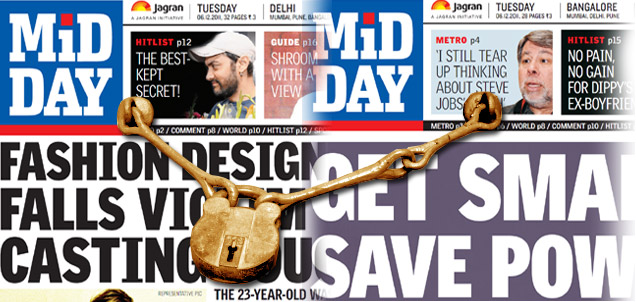
    Mid-Day, Mumbai’s leading English daily, has announced the shutting of its Delhi and Bengaluru editions. The reason: profitability. Mr Manajit Ghoshal, MD and CEO of the company, confirmed this to MxMIndia. “Both Delhi and Bengaluru editions will shut down with immediate effect. Tomorrow is the last time the papers will be circulated in the respective markets,” he said.


    Elaborating on the reason behind the decision, Mr Ghoshal  said, “We have decided to shut down both editions in the strategy to be more profitable. Advertising revenues in the two markets was on the decline, and so we decided to focus on our Mumbai edition.”

  • Magnaglobal predicts 15% ad growth in India

    Magnaglobal, a division of IPG Mediabrands, released updated Global Advertising Forecasts, showing media owners’ revenue growth for 2011 and 2012 to be slower than previously projected, but still resilient.


    Key and detailed Findings, all from the Magnaglobal communique

    -2011 global growth is revised down to +4.7% (downgraded by -0.5%), totaling $427 billion.
    -2012 global growth is revised to +5.0% (downgraded by -1.5%), totaling $449 billion.
    -Quadrennial events, combined with the scale and dynamism of the BRIC countries will help sustain global growth despite worsening economic outlook. They contribute to 45% of the global growth in 2011.
    -Internet will become the second biggest media category in 2011, reaching a 20% global market share in 2012.
    -China will become the second largest advertising market in 2012, outgrowing Japan.


    2011: The Slowdown
    In 2011, media suppliers around the world will see their advertising revenues grow by +4.7% to total $427 billion (constant USD 2010 basis). That estimate is down slightly (-0.5%) from our +5.2% forecast published in June 2011, due to the softening of some markets in the second half of the year. Our media suppliers advertising revenue projection includes: television (pay and free), Internet (search, display, video, mobile), newspapers, magazines, radio, cinema and out-of-home (traditional and digital). It excludes direct marketing categories such as direct mail or traditional “yellow page” directories. We monitor media suppliers’ revenues in 63 markets (including all major markets), representing more than 95% of the world’s economy.


    The geography of growth. More than ever, emerging economies drove global advertising revenue growth in 2011, posting an average +15.0% growth during the year. Among these developing economies, Latin America posted the strongest growth rates, averaging +13.2%, closely followed by Central and Eastern Europe (+13.0%). Developed markets, meanwhile, grew at much slower rates, such as +1.6% in Western Europe and +3.1% in North America, due to a number of factors including: a strong 2010 comparison (revenues were up +8.2% compared with 2009); macro-economic slow-down and persistent financial uncertainties; the absence of major sporting events or U.S. elections; and natural disasters in Asia. Among individual countries, the strongest growth rates came from: Argentina (+37.9% in the context of a strong inflationary economic growth), China (+22.5%), Kazakhstan (+25.6%), Russia (+20.4%), India (+15%) and Brazil (+10.2%).


    Eleven countries (out of the 63 analyzed by MAGNAGLOBAL) suffered a decline in advertising revenues, including countries in Southern Europe hit by protracted economic turmoil and political instability (Greece: -19.3%; Portugal: -6.9%; Spain: -6.3%; Italy: -2.5%); emerging markets temporarily destabilized by the Arab Spring (Egypt -21%); and Asian countries hit by natural disasters (Japan -2.0%, Thailand: -2.0%). Many of the large markets of Western Europe and North America wound up in the middle, typically showing low single-digit growth (UK: +1.8%; Germany: +3.0%; U.S.: +2.9%).


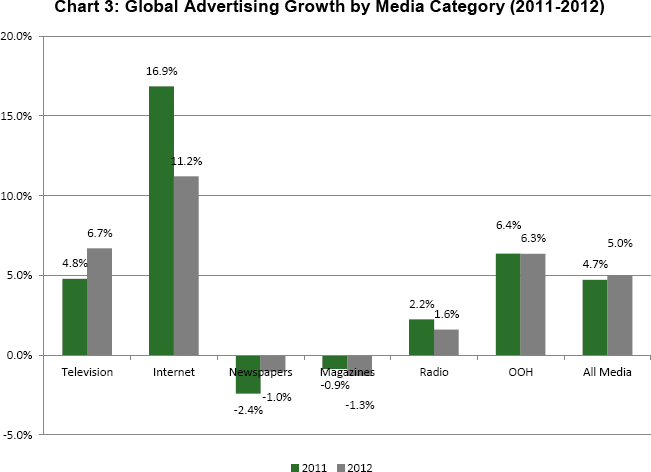
    Among media categories, television, an unexpected winner in 2010 (+12.7%), continued to show strength in 2011, despite the absence of cyclical sporting events or elections in the U.S. Broadcasters’ advertising revenues grew +4.8% to $175 billion, in 2011, maintaining TV’s leadership with a 41.0% market share globally. Strong audience levels and audience measurement improvements – such as the integration of time-shifted DVR viewing into ratings for the first time (e.g. France) – made the medium attractive. Out-of-home (OOH) media fared even better. Including cinema, OOH grew +6.4% globally, driven by the incremental revenues generated through digital billboards (+19.9%), which have rolled out in various parts of continental Europe and Asia. Other traditional media categories, however, had a tougher year. Radio grew only +2.2%; newspapers’ revenues were down -2.4% and magazines declined -0.9%.


    Declining circulation, shrinking readership, Internet competition and short term media buying patterns (which penalizes monthly magazines), all contributed to print’s decline in developed markets. Things are different in emerging markets, however, where literacy is still increasing and broadband access is still relatively low. In those markets, magazines are growing along with the middle class, and there is enough advertising demand for every media beyond TV to benefit. Overall, print advertising revenues are up by high single digit percentage points in emerging markets.


    The big winner of 2011, however, was Internet media. Total Internet advertising revenues increased +16.9% to $78.5 billion. While Display subcategories increased +15%, Paid Search reaped the benefits of usage growth and algorithm improvements to reclaim its position as the largest digital revenue driver (+19%). Within Display, online video continues to show impressive growth (+58.5%), reaching $4.7 billion in revenues.


    Pre- and mid-rolls in online videos now generate 6% of total Internet advertising revenues and one percent (1.1%) of global advertising revenues. Even more than online video sharing specialists, TV broadcasters offering free, ad-funded online “catch-up” of long-form, full-length episodes are driving category growth.


    Overall, coming after a strong 2010 and in a poor macro-economic context, media suppliers displayed a resilient performance in 2011. But the global market is barely back to where it was in 2007 ($423 billion in constant USD), and still smaller in the case of Western Europe (2007: $112 billion, 2011: $106 billion). This reflects that media costs that are still low from a historical perspective.


    2012: The BRIC Engine
    For 2012, we now forecast media owners’ advertising revenues to grow by +5.0% to $449 billion. This is -1.5% below our previous prediction published in June 2011 (+6.5%).


    This downward revision is due to deteriorating macro-economic perspectives. Our forecast model is based on current, official economic forecasts that are generally predicting weaker – but still positive – growth next year. However, the uncertainty remains high, especially in Europe. In September, the IMF reduced its global output forecast (real GDP growth) from +4.5% to +4.0%. Although that forecast suggests the world economy would still grow, it’s an awkward average between emerging economies that are growing at healthy rates and developed economies that are still sputtering (average +1.9%, US: +1.8%).


    In late November, OECD revised its own global output forecast to +3.4% (including +1.6% for OECD countries and only +0.2% for the Euro area) warning that 4Q11 and 1Q12 could tip negative in most European countries, in line with 3Q11 slowdown. Greece, Italy and Portugal, in particular, are now expected to suffer full-year recessions in 2012. Other economic indicators (industrial production, personal consumption and business confidence) have been similarly downgraded in recent months and some independent forecasters have expressed increasingly gloomier views.


    Despite the worsening economic outlook, we are still projecting a positive growth rate based on a few factors:
    -First, the well-known “quadrennial” cyclical driver is back, and we believe it will be stronger than ever. The incremental ad spend generated by major sporting events (London Summer Olympics, Poland/Ukraine European Soccer Championship) and the U.S. Presidential Elections will bring an additional +1% to +2% on top of organic revenue growth across markets. In the U.S., Political and Olympic (P&O) money will account for three billion dollars of incremental ad spend, mostly on television ($2.4 billion related to the Elections, $600 million generated by Olympic Broadcasts). Meanwhile, major sporting events will help in European markets that are otherwise hit by economic stagnation, such as the UK (which is hosting the Olympics, although the games are broadcast on the ad-free BCC) and Italy (where the Games and Soccer tournament will mostly be broadcast by RAI, one of the few European public television groups still allowed to carry a full, all-day advertising load).


    -Second, big emerging countries will increase their share of global economic and advertising influence. At the end of 2012, emerging markets will represent 24% of global advertising revenues (compared with 7% in 1999) and the four BRIC countries alone will account for 14% (compared with 3% in 1999). Adding scale to dynamism, the BRIC markets have the capacity to offset part or all of the Western weakness. The four BRIC markets equated to only 10% of Western Europe’s advertising revenues in 1999. That ratio will grow to 59% by the end of 2012, and by 2016 the BRIC countries will almost match the size of Western Europe (94%). The BRIC countries contributed to 45% of the global market growth in 2011 ($9 billion out of $19 billion). With a growing proportion of the BRIC countries’ population adopting Western-style media consumption patterns, and with Western and local brands competing for top-of-mind among the emerging middle class, media demand is in excess of supply and inflation reigns. BRIC countries lag behind the global average advertising spend per capita ($80) – Russia: $70, Brazil: $60; China: $21, and India: $4. With such structural factors, we expect advertising spending and revenues in those markets to keep growing faster than the general economy, supporting global revenues in their wake.


    -Thirdly, some lessons learned in 2009 may help avoid a replay. Some major advertisers, e.g. in FMCG, have since admitted that they may have over-reacted back then by cutting advertising expenditures too hard and too quickly, harming their brands. We believe that this time, even if sales forecasts are being revised downwards, marketers will remember that market shares are subject to losses or gains, including – and perhaps even more so – during a recession, as consumers reconsider their choices. In addition, the Western advertising market is still smaller than five years ago, which means prices and net costs per thousand – despite some inflation in 2010-2011 – are still competitive and attractive by long term standards. Therefore, brands in various sectors have both the incentive and capacity to invest smartly to boost or defend their market shares.


    In 2012, advertising revenues will grow by +12.4% in emerging economies, with Latin America still leading the charge (+13.0%) followed by Central and Eastern Europe (slowing down at +7.7%). Asia Pacific will re-accelerate to +8.3% due to the recovery of Japan and the continued growth of China. Western Europe will slow down at +1.1%. The sports driver will not be enough to offset recession in many European countries: Greece, Portugal, Spain, Ireland will decrease again (between -2% and -6%); Italy and France will be flat at best. UK and Germany will grow below +2%.


    The biggest growth rates of 2012 will come from Argentina (+26.4%), Ukraine (+21.0%), Indonesia (+16.0%), China (+16.1%), Brazil (+12.0%), India (+13.5%) and Russia (+9.6%).


    In terms of media market share, Internet will grow by 11.2% and outrank newspapers to become the second biggest media category globally, accounting for nearly 20% of global advertising dollars (19.5% at $87.4 billion). The category already stands at 23% in both North America and Western Europe (where it even takes the #1 spot in a few markets, such as the UK). Television will receive the bulk of the “quadrennial” bonanza and will benefit from the typical concentration of advertisers into leading media at the expense of secondary media during harsh times. TV will grow by +6.7% globally to $187.1 billion. Newspaper and magazine revenues will shrink by an average -1.0% and -1.3% respectively, with much deeper drops in Western markets, where circulation losses of 2011 will be reflected in 2012 ad pricing. Radio will grow by +1.6% to $30.4 billion. OOH will also benefit from the “quadrennial” events and the roll-out of new digital (+6.3% to $28.3 billion) platforms. In the UK, the innovative upfront auction process conducted last summer to allocate the most premium London inventory during the Games did not quite meet the high expectations, but the industry is still expected to grow healthily next year.


    China Takes the #2 Spot
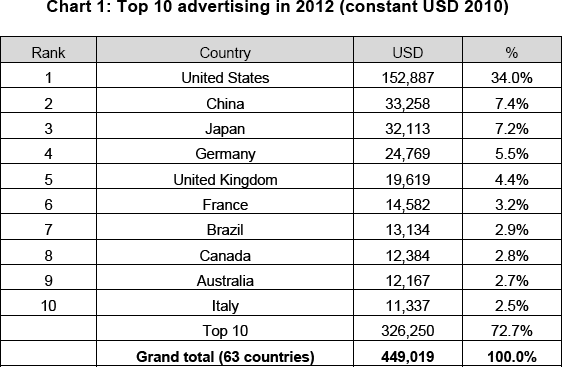
    China’s advertising market is expected to continue outperforming its already impressive economic growth in 2012, with a +16.1% growth. At $33.3 billion, China will become the second biggest advertising market, ahead of Japan, now third at $32.1 billion. Germany remains the fourth biggest market, some distance behind ($25 billion). Other top 10 markets are – in order – UK, France, Brazil, Canada, Australia and Italy. Russia will enter the top 10 in 2013, at the expense of Italy.

     

  • Move to promote South Indian film industry globally

    By A Correspondent


    The Federation of Indian Chambers of Commerce and Industry (FICCI) recently concluded the third Media and Entertainment Business Conclave (MEBC) 2011 in Chennai. The two-day conclave in Chennai welcomed the recommendation from Wizcraft International, that the South Indian film industry join hands to create a global platform which presents the South Indian film industry at key markets across the world.


    Sabbas Joseph, founder-Director at Wizcraft International, the global event management and communication company, shared the IIFA success story, wherein key global markets were opened and quantum growth was achieved by the Hindi film industry. The IIFA story also demonstrated the attention that is being given to Indian culture and business by global counterparts, he said.


    The weekend for the South Indian film industry would be a huge step towards recognizing the growing importance of South Indian cinema, by celebrating it on a global platform. Joseph spoke of IIFA being a channel for the expansion of the regional film business, generating revenues from International avenues.


    Mr Joseph added, “The talent in the South Indian film industry is enormous. We wanted to seize this opportunity to establish a platform for talent to be promoted and honoured on a national level and international level for South Indian films. Regional Indian cinema has grown into a global phenomenon and we would surely look at promoting and leveraging it on a global platform through brand IIFA.”


    Pioneered and executed by Wizcraft International, the International Indian Film Academy (IIFA), is supported by key members of the Indian film fraternity. IIFA is the most respected South Asian film academy and its main highlight, the IIFA Weekend and Awards, are India’s biggest media event, with a viewership of almost 600 million worldwide.

  • Mid-Day shuts Delhi & Bengaluru editions, to focus on Mumbai


    By Rishi Vora


    After having tried out the Delhi and Bengaluru markets for a few years now, MiD-Day has finally decided to shut its editions in the two metros. The focus, as company officials inform, will be on Mumbai from now on, where the idea is to increase the paper’s circulation and enhance profitability.


    Mr Manajit Ghoshal, MD and CEO, Mid-Day Infomedia said “Advertising revenue in the two markets was on the decline, and so we have now decided to focus on our Mumbai edition.”


    Addressing the staff, he wrote in a mail on Monday evening, “It’s with a heavy heart that I have to announce the closure of MiD-Day – Delhi and MiD-Day – Bangalore editions. Tomorrow’s issue will be the last issue for both the editions. This has been necessitated by the prolonged losses we had to incur on these editions. The idea behind starting these editions was to establish these brands in these cities and make a difference in the lives of the citizens there. We had begun well and were appreciated for the quality of product we put out. However, in a corporate scenario, the books need to be balanced. Due to the ever increasing competition in the print media space, the funds required for breakeven in these cities kept escalating. Finally, we had to take this call. We will however, continue to maintain a news bureau in Delhi and our sales offices in Bangalore and Delhi.


    “By cutting our losses in Delhi and Bangalore editions, we will be able to bolster our circulation in Mumbai. Apart, from the plan to channel these investments, Jagran group (our parent company) will invest a large sum in boosting MiD-Day’s circulation in Mumbai. This will give our sales guys across the country to pitch Mumbai MiD-Day to clients and agencies in a new light. We need to now concentrate on building brand MiD-Day in Mumbai and monetizing Mumbai MiD-Day’s large increase in circulation and in this our sales colleagues in Delhi, Bangalore and Pune will have to play a significant part. Gujrati MiD-Day and Inquilab continue to go from strength to strength. We are increasing the circulation of GMD at a brisk pace and will continue to do so. Inquilab has flourished in the north and we now have 14 editions in all and are far ahead of any competition in the Urdu space.


    “MiD-Day Pune is an extension of MiD-Day Mumbai just as the Pune city is an extension of Mumbai. MiD-Day Pune will continue to run at an ever increasing pace and we will be monitoring the Pune media market keenly to spot opportunities to improve the circulation of MiD-Day Pune.


    “We will continue to invest aggressively in our digital properties as we believe that this is a medium whose time has come.


    While the shutting of the Delhi edition has been rumoured for a while, the same cannot be said for Benguluru. A senior member from the MiD-Day Benguluru office who did not wished to be named said that the letter took everyone by surprise.


    The paper was launched in the garden city in 2006. On why the edition failed, Mr Anil K Sathiraju, AVP and Head – Mudra Max Bengaluru said, “MiD-Day is a Mumbai paper, positioned as the traveller’s paper. The reason it didn’t work in Bengaluru is before it was launched, there were newspapers that had been in the market for ages and MiD-Day came with a different positioning which wasn’t right for a market like Benguluru.” He further added that the paper’s stagnant circulation was an indication that brand MiD-Day wasn’t very popular among readers, which led to a greater perception problem.


    The Delhi edition, as is known, was first launched in 1986, and within three years of launch, it was sold to industrialist Lalit Suri’s family. Then again in 2006, it went up for sale and was bought back by Mid-Day Multimedia. Madison Media CEO Ms Basab Datta Chowdhury feels that it was purely on the basis of market reality that the Jagran Group chose to shut the Delhi edition. “It’s a call that you need to take. If a product is not delivering as per expectations, and if you feel that shutting shop is the only way, then the sooner you do it, the better it is. The paper tried its best in Delhi, it didn’t work out. It’s doing well in Mumbai, so the decision to focus there.”


    Citing similar reasons is Mr Sundeep Nagpal, Director of Stratagem Media and a veteran planner who has been following the print media (and MiD-Day specifically) closely. In fact, he is of the opinion that the daily could have done better in its marketing efforts, especially in Benguluru to increase circulation and readership. Mr Nagpal said, “The scope for a No 4 or No 5 newspaper in any language category, to generate both readership or advertising revenue, especially in a cosmopolitan market/ metro, is quite minimal. Both, Delhi and Bengaluru were already dominated by giant groups like TOI, HT, and even Deccan Herald, not to mention others like Indian Express etc. And so they proved to be the big hurdles for Mid-Day, despite the fact that Mid-Day was always supposed to be an evening paper. Also, given the landscape of the public transport in these cities, vis-a-vis that in Mumbai, the scope for Mid-Day to find traction as a commuter’s paper, was also considerably lower than that in Mumbai. And lastly, as a late entrant in these markets, the paper also required very aggressive promotion, perhaps of the likes that we saw in the case of DNA and Hindustan Times in Mumbai.”


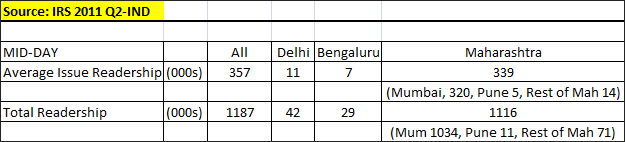
    The recent IRS figures (2011, Q2) indeed don’t show a good picture. The papers average issue readership in Delhi stood at 11,000, while in Benguluru, it was 7,000 (see table). Now that the two non-performing markets have been shut, and with investments to pretty much go to Mumbai, it will be interesting to see how the paper picks up on circulation in the city and whether it is able to pose a greater challenge to the market leaders.


    Lock image: Nuttakit