Category: NEWS

  • Pocket FM teams up with ElevenLabs

    Pocket FM, an audio platform, and software company ElevenLabs have joined forces with the launch of AI Audio Series, a Voice AI capability now accessible worldwide.

    Said Prateek Dixit, CTO and Co-founder of Pocket FM: “This is a game-changing, industry-first innovation, disrupting the norm by enabling writers to seamlessly transform their stories into captivating audio series with a single click of a button. By enabling this, we’ve not only empowered the writing community but also made audio series creation faster and simpler, making storytelling accessible for everyone.”

    Added Mati Staniszewski, CEO, and Co-founder of ElevenLabs: “We are excited to collaborate with Pocket FM in shaping the future of audio entertainment. Combining our Voice AI expertise with Pocket FM’s innovative approach to audio series promises to take content production to new heights of efficiency and creativity. It’s an exciting journey ahead, one that we believe will set new standards in the entertainment industry.”

  • Virat Kohli campaigns for Digit Insurance

    Go Digit General Insurance Limited (Digit Insurance), has aunched its latest brand campaign titled ‘That’s it!’ with its brand ambassador Virat Kohli. The campaign, which focuses on transforming ‘Doubt to Delight’ when it comes to filing of insurance claims, was launched ahead of Super 8 matches at the ICC T20 World Cup.

    Notes a communique: “The ad campaign will play throughout the Super 8 stage of T20 World Cup and will also be showcased in multiple cinema theatres pan-India, apart from various OTTs and social media.”

  • Why are we building products and not brands?

    Why are we building products and not brands?

    With apologies to none at all


    Vikas MehtaA very interesting article popped into my inbox this morning. It spoke about the role of product managers in consumer-facing tech companies. The article was triggered because Zomato had placed a live order count which a consumer can see after s/he places an order. You can see it here.

    It seems that the feature was dissed on social media, mostly by the Product Manager types. Most were questioning the use of this feature. Did it help the consumer? How does it add value? Why is Zomato wasting time on features which do not help the user? You get the drift.

    The author of the piece moaned the fact that product managers are becoming too bureaucratic. Everything that is build into a product today, has to be justified with metrics or some quantitative outcome. Everything has to be about productivity and efficiency. Unlike, say, Google which in the 2000s encouraged its employees to spend 20% of their time working on things, besides their projects which may benefit Google. Or the Google Doodles which are an intrinsic feature of the brand today.

    The author said that product managers forget that some things can be done for fun. Or to give the product a cool quotient. That’s what the Zomato live order count was doing.

    Fun? Cool? Let the consumer have an emotional connect?

    Sounds familiar?

    I may be a bit old-fashioned but isn’t that what a brand does regularly.

    The problem is that new age products are just products. Not brands.

    That’s why they are being run by product managers. Not brand managers.

    That’s why the obsession with product feature which creates a better value for the product. Never mind if it will be copied soon.

    You don’t believe me.

    Ok, then. Here is a small test.

    You prefer Ola or Uber?

    Do you use only Zomato or Swiggy too.

    Can you actually differentiate between Blinkit and Zepto?

    I bet you use all these products that I mentioned above.

    You have all these apps installed on your phones.

    And you use all depending upon an offer or a cheaper option or just because someone gives you a better loyalty programme.

    And I am not even getting into Vivo or Oppo!!!

    So, the question is why are we building better products and not great brands?

    Why are the new age products not building brands?

    The easy answer is that the obsession with data and quantitative metrics, while being a welcome change from the days when marketers would struggle to gauge the efficacy of an advertising campaign due to lack of data, has made us jump to the other end of the spectrum. If anything cannot be explained by data then it’s of no use.

    A product differentiates with its features. All the new age products and the products which have thrived due to the proliferation of data focus on this aspect.

    But a brand differentiates in many other ways. It could differentiate with its pricing or distribution strategy. Air Deccan or Indigo and sachets do it well.

    It could differentiate with its advertising and emotional appeal. Remember Amazon with Aur Dikhao campaign or Flipkart with kids acting as adults? Remember the Vodafone Zoozoo campaigns? Or Abhishek Bachchan with what an idea sirjee for Idea.

    Or brand can differentiate with its service. In appliances, Philips has done an amazing job by harnessing local electricians to start service centres available in every nook and corner of the country.

    And brands also differentiate on the basis of their personality. Coke is fun but more in a family way. It’s a bit more mature. A bit more real. Pepsi on the other hand is fun which is rebel. Fun which appeals to the non-conformist. Fun which is flamboyant and maybe even in your face.

    That’s why the shift happened from product management to brand management. That’s why a Hindustan Unilever could have more than four brands of soaps. three brands of detergents, four brands of tea, three brands of skin care……… The difference was what each brand stood for and whom it targeted. And that helped HUL gain leadership in each of the product categories.

    By having brand managers and not product managers.

    These brand managers would build differentiating brands.

    But the new age products, and I cannot bring myself to calling them a brand, are too focused on building better products.

    Let me tell you for brand managers also the big challenge was to innovate their product regularly. In categories like soaps and detergents. And they would.  But because they would focus on brand and not just a product, they would look beyond the packaging, or the fragrance or an enticing offer. Sometimes it would be just memorable advertising.

    Fun anyone? Cool anyone?

    Or sometimes it would be combination of packaging and pricing.

    Godrej No1 launched Buy-3-Get-1 free, not as a promotion but as the only option available. It was a win-win for everyone. The retailer would gladly tear the combined pack and give individual soaps to consumer. Remember, he had one soap free so on that he would get full MRP as his margin. Or he could sell the one piece below MRP. So, even the consumer was happy.

    Brand building is also strategic. Jio launched not with the conventional pricing strategy of talk time plus sms plus some data but with data-led pricing. Calls and smses were free. The strategic thinking was that data was the real deal, not talk time. So, the whole product was built around data. And the product was turned into a brand with data lead pricing. And with the brand being free for first nine months, data users were happy to buy a new sim. The total nine-month free offer coupled with the earlier cheap plans created a perception that as a brand, Jio was cheaper. Today, when Jio is not really the cheapest, the brand perception of being inexpensive persists. And sponsoring IPL year after year helped gain massive exposure

    Phew! See the well-thought-out strategy that covered almost all aspects of marketing.

    To me, building products and not brands is also the sign of times.

    Brands take a longer time to build. Products can come and go. Already Zomato is saying that its revenues from Blinkit will overtake Zomato this year. So, why build a brand when new products can be arrived at. Why worry about brand extensions or line extensions when one can just name a new product and call it a brand.

    Avoiding brand building is being lazy. Quick results. Not necessarily in terms of profits. But in terms of valuations, Gross Merchandising Value or even IPOs. Targetting a focused customer is not the deal but targetting VCs is.

    So, will the new age products change?

    They better. Because the first new age product Google, built a brand and is still going strong. But Yahoo search and many such others built products which just disappeared.

    Will Zomato, Uber and Blinkit survive by the time your children grow up? That is the million-dollar question.


  • Crocs launches monsoon campaign

    Crocs footwear has unveiled its new campaign, ‘Splash Your Style. It is conceptualised and produced by Kulfi Collective.

    Commenting on the new campaign, Yann Le Bozec – Crocs EMEA/ LATAM/India and Hey Dude International Marketing Vice President said: “Monsoon season is a unique cultural moment, filled with significance, that deeply connects with our audience. Our new campaign is crafted to honor this lively season and perfectly aligns with our brand’s vision of promoting genuine self-expression and comfort. Through music and dance, and by partnering with popular local figures, we’re engaging with Gen Z in a way that is authentic, engaging, and reflective of their dynamic spirit. This campaign highlights our commitment to creating meaningful connections and celebrating individuality through every splash.”

    Added Mitali Sharma, VP Production at Kulfi Collective: “With ‘Splash Your Style,’ we wanted to capture the spirit of the monsoon season and the individuality that Crocs celebrates. By blending dynamic dance sequences with the unmistakable joy of rain, we’ve created a campaign that not only highlights the versatility and fun of Crocs but also resonates deeply with their young audiences across India. This film is a testament to the power of music, movement, and unfiltered self-expression. At Kulfi Collective, we pride ourselves on creating culture-shaping content, and with this campaign, we’re redefining how brands can connect with their audience through authentic, vibrant storytelling.”

  • Space Matrix launches #ThinkDesign Campaign

    Space Matrix, a design and build firm, has recently launched the #ThinkDesign campaign. The initiative aims to inspire companies worldwide to prioritise inclusive, sustainable, and people-centric workplaces, encapsulated in the A to Z of design concepts.

    Speaking about this, Akshay Lakhanpal, CEO- India, Space Matrix said: “At Space Matrix, we believe that innovative design is the cornerstone of a thriving workplace. The #ThinkDesign campaign reaffirms our commitment to revolutionising workspace environments and empowering businesses to create spaces that inspire creativity, collaboration, and productivity.”

  • L’Oréal unveils CGI OOH campaign

    L’Oréal Paris has showcases its revolutionary CGI Out-of-Home (OOH) campaign, ‘See Life in Panorama,’ starring global icon Kendall Jenner. The creative is a part of the larger launch campaign of the Panorama Mascara in India. It is conceptualised and executed by Tonic Worldwide and Posterscope India.

    Said Dario Zizzi, General Manager of L’Oréal Paris India: “We are thrilled to unveil this innovative OOH campaign to launch the gold-star Panorama Mascara in India.  Panorama Mascara, all wrapped in its glossy gold packaging is here to give a luxurious experience to all our consumers, with every coat. With the launch of this campaign, we aim to set new benchmarks for product & marketing innovation because we believe – you’re worth it!”

  • Rajit Gupta is VP and Creative Head for Cheil X

    Rajit Gupta
    Rajit Gupta

    Rajit Gupta has been hired as a VP and Creative Head for Cheil X, Mumbai, which is an independent full-service agency under the Cheil SWA group. Gupta will report to Vikash Chemjong, CCO, Cheil India. His appointment comes at the heels of the agency beefing up its Mumbai operations to increase their focus on exploring new expansion opportunities in the region.

    Said Vikash Chemjong, CCO Cheil India: “There is a lot that Rajit brings to the table. His understanding of brands. His sense of design. His typography. His experience at some of the best agencies in the country. His tally of metals. Not to mention his eloquence and effortless good looks! But these aren’t the only reason we at the agency were impressed about him. He has this vibe. An edge. A mojo so to say. Or simply put, an X factor!  Which probably is what makes him such an excellent fit for Cheil X! We are lucky to have him. And I’m sure our clients will feel the same very soon.”

  • Gaurav Banerjee to take charge of Sony

    Gaurav Banerjee
    Gaurav Banerjee

    Sony Pictures Networks India (SPNI) has announced the appointment of Gaurav Banerjee as the new Managing Director and Chief Executive Officer (CEO), effective on or before August 26, 2024, pending regulatory approvals. Banerjee will succeed NP Singh.

    Said Banerjee:  “I am deeply honoured to take on the role of MD & CEO at SPNI. Under N.P. Singh’s remarkable leadership, SPNI has achieved tremendous success and innovation in the entertainment industry. I am excited to lead talented teams as we explore new frontiers in original programming, enhance our viewers’ experiences, drive our distribution footprint across India, and significantly boost our revenues. Together, we will set new benchmarks in entertainment and deliver exceptional value to our audiences and stakeholders.”

    NP Singh
    NP Singh

    Added Singh, who with this appointment will move into the role of Non-Executive Chairman to support this transition through the end of the fiscal year: “I am immensely proud of the success and innovation SPNI has achieved. I am confident that Gaurav will elevate SPNI’s impressive portfolio to new heights. His visionary approach will undoubtedly continue our legacy of excellence and creativity. I look forward to supporting him and our talented team as we further our impact in content creation, audience engagement, and digital media initiatives. And most importantly, I would like to thank the entire SPNI team for being the fulcrum of our growth and success.”

    Said Ravi Ahuja, Chairman of Global Television Studios and President and COO of Sony Pictures Entertainment: ” NP Singh’s leadership has been instrumental in shaping SPNI into the powerhouse it is today. I am confident that Gaurav Banerjee, with his proven track record and visionary approach, will continue to drive SPNI’s success. Gaurav’s expertise in content creation and strategic leadership will undoubtedly lead SPNI into an exciting new chapter of growth and achievement. We are thrilled to have him at the helm and look forward to the continued success of SPNI under his leadership.”

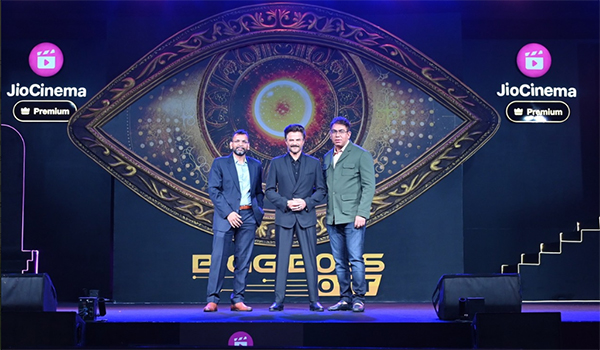
  • Jio Cinema says Jhakaas as Bigg Boss OTT Season 3 nets big bucks

    L to R Alok Jain, President – General Entertainment, Viacom18, Anil Kapoor and Deepak Dhar, Founder Group CEO, Banijay Asia EndemolShine India


    JioCinema Premium has announced the reality show Bigg Boss OTT Season 3 starting tomorrow, June 21.

    The new season stars actor Anil Kapoor and a score of interactive features, with the 24-hour live channel. So Bigg Boss OTT 3 is co-presented by Too Yumm!, Siggnature Finest Silver Elaichi; co-powered by Oppo and Sofy; with beauty partner Lotus; Sanitaryware Partner Cera; with many more identifying opportunities to integrate.

    Speaking about the new season, Alok Jain, President – General Entertainment, Viacom18, said: “Over the years, Bigg Boss OTT has witnessed exponential growth, solidifying its position as one of India’s most popular reality entertainment shows. With Anil Kapoor as the host of Bigg Boss OTT 3, we aim to deliver unmatched value to our stakeholders – viewers, advertisers, and content creators. This season’s increased interactivity will amplify engagement and excitement, broadening our reach, taking the show to extraordinary new levels and offering viewers an unprecedented front-row experience of over-the-top entertainment.”

    Speaking on bolstering JioCinema Premium’s offering, Ferzad Palia – Business Head, JioCinema, added:  “With Bigg Boss OTT 3 we expand our JioCinema Premium offering into the highly consumed Reality genre. In addition to Hollywood, Original Series, Movies, Kids, Anime & TV, our rapidly growing base of members will now witness one of the biggest digital entertainment shows, with a brand-new experience. We’re certain that this season will be a whole new level of entertainment.”

    Added Deepak Dhar, Founder & Group CEO, Banijay Asia and EndemolShine India, the makers of the show: “Bigg Boss has been a flagship show for us, constantly innovating and setting new benchmarks in entertainment year after year. With this season of Bigg Boss OTT, we are taking it a notch higher for our audiences. We are excited to have Anil Kapoor as the host this season and cannot wait to see how his charisma, energy, and connection with audiences brings a fresh dynamism to the show. Viewers can expect an electrifying season this year with an exciting theme, new twists & high-voltage drama.”

    So how will so many sponsors get a bang for their megabucks on a premium streaming offering? Obviously not those intrusive 5-/10-/20-seconders, but integrations within the show. Hmmm.

  • Brand Storytelling agency Anecdot debuts

    Mohit Kharbanda
    Mohit Kharbanda

    Mohit Kharbanda, a brand storytelling leader with over 20 years of experience across diverse industries, has announced the launch of his new venture, Anecdot, set up with a vision of humanising brand storytelling. With headquarters in New Delhi and a global presence spanning New York and Paris, The agency aims to disrupt the traditional cookie-cutter approach to brand storytelling by creating resonant stories that deliver measurable impact for clients.

    Said Kharbanda: “Consumers today crave authenticity. Anecdot helps cultivate a culture adjacent to your brand by crafting stories that resonate on a deeper level, building genuine connections and driving measurable results for our clients. We’re not here to create fleeting trends. Anecdot is all about crafting timeless brand narratives that capture hearts and minds on a global scale. Our team’s diverse experience allows us to tell stories that transcend cultural barriers and leave a lasting impact.”

  • Deepshikha Dharmaraj to head Burson in India

    Deepshikha Dharmaraj
    Deepshikha Dharmaraj

    Burson, the recently reconfigured communications network of WPP, has announced its leadership for APAC. Deepshikha Dharmaraj to head Burson in India. Dharmaraj has been with Burson (and its various avatars) since over three decades.

    Said HS Chung, North APAC CEO, Burson : “In today’s fast-evolving environment, clients need the best talent and capabilities to solve their most complex challenges. With our extensive footprint and reach across APAC, clients will gain access to a diverse team of specialists with decades of experience building and protecting reputation for multinational businesses in Asia and Asian enterprises overseas.”

    Added Adrian Warr, who will become South APAC CEO, Burson, as of September 16: “Innovation and creativity are at the heart of our commitment to delivering unparalleled value for our clients in APAC.  Our world-class talent will lead through exceptional creative thinking and bring innovation in action to build reputation capital as a competitive advantage for our clients, today and into the future.”

    Other than Dharmaraj, the other leaders are:

    • Tom Horn, Market Leader, Burson Australia & New Zealand
    • Claire Li, CEO, Burson Greater China
    • Marianne Admardatine, CEO, Burson Indonesia
    • Tsuyoshi Takemura, CEO, Burson Japan
    • Justin Then, CEO, Burson Malaysia
    • Rikki Jones, CEO, Burson Group Singapore and President, GCI Health Asia- Pacific
    • Cindy Lim, CEO, Burson Singapore
    • Wachiraporn  Pornpitayalert,  Market  Leader, Burson Thailand

    Chung will continue to lead Burson Korea as CEO in addition to her role as North APAC CEO.

  • 11.8% growth to touch Rs 1.2tn in 2024: Magna forecast

    11.8% growth to touch Rs 1.2tn in 2024: Magna forecast

    The Indian advertising industry will grow from ₹1.1 trillion (US$13.1 billion) in 2023 to ₹1.2 trillion (US$14.6 billion) in 2024, 50% higher than pre-pandemic period, as per estimates released on Monday by Magn Global. However, print, radio and cinema are lagging 2019 levels. The advertising revenue is forecast to grow +11.8% in 2024 . It was +11.2% 2023..

    The digital media is poised for a +15.9% growth with share growing  from its current 47% to reach 50% of the total revenues by 2026. Social will overtake search to become the second-largest media after television. Traditional media is also experiencing growth year-over-year. Linear formats are likely to grow at +8.4% (8.7%, 2023) in 2024. Magna estimates +10% growth in 2025 and continue to grow at a CAGR of 10% to reach ₹1.7 trillion (US$21.1 billion) by 2028.

    Said Venkatesh S, SVP, Director – Intelligence Practice, Magna India: “The Indian advertising market is set to expand by 11.8% in 2024, reaching ₹1.2 trillion, driven by a robust 15.9% growth in digital media. Traditional media formats are also growing, enduring the relevance of Print, OOH and Radio in addition to Television. The government’s emphasis on digital public infrastructure is propelling digital ad spend to nearly half of total revenues by 2026. Our forecast highlights social media’s significant rise, overtaking search as the second largest media format after television.”

    Here is the rest of the information as received from Magna Global:


    Growth in India is projected to remain strong at 6.8 percent in 2024 and 6.5 percent in 2025, with the robustness reflecting, continuing strength in domestic demand and a rising working-age population according to IMF. With the per capita income increasing multifold, consumer spending outlook remains positive. India has been evolving as one of the world’s most dynamic consumption environments and is expected to maintain steady economic growth. The fastest growing economy is projected to surpass China’s growth rate by over 2% points. India, by 2028 is expected to become the 3rd largest economy leaving behind Germany and Japan.

    Inflation is projected to decline from +5.4% in 2023 to +4.2% in 2024 and long-term inflation estimates remaining anchored, monetary policy stance of central bank is expected to support growth.


    In 2024, total advertising revenue from ₹1.1 Trillion (US$13.1 billion) will touch ₹1.2 Trillion (US$14.6 billion). Digital formats or new media contribute over 60% to the incremental revenue. Digital is estimated to grow +15.9% and linear growth will be at +8.4%. In a normal year, H1 contribution is generally less than H2, however general elections scheduled from March to May followed by ICC T20 Cricket World Cup in June-July will boost H1 growth (+11.8%) equal to second half of the year (+11.9%). Both general elections and live sports will lead to a significant growth in adex across both Digital and Linear media.


    In 2023, listed companies’ average income and profits have grown in double digits. This is encouraging as private investment in capacity building and marketing activities will increase. Auto sector demonstrated significant growth across all segments in 2023, this is expected to boost marketing and advertising budgets in 2024. CPG continues to rise as more people start to move up the economic ladder and the benefits of economic progress become accessible to the public. The urban segment is the largest contributor, however, in the last few years, the growth has come at a faster pace in rural India. With normal monsoons expected, rural demand will pick up and this bodes well for the sector. Retail sector is experiencing exponential growth across pop strata. Sizeable middle class, changing demographic profile, increasing disposable income, and urbanization are some of the factors driving organized retail. E-commerce has transformed the way business is done and has enabled newer segments like D2C. Rapid expansion into Tier-2 and Tier-3 cities will aide sectoral growth.


    CPG, Auto, Retail, Government & Political advertising, and Finance are expected to be the most dominant sectors contributing to India’s adex growth in 2024, followed by Pharma, Education, Real Estate, Media & Entertainment and Building Materials making up the top ten sectors.


    Consumption trends continue to favour digital media. The liberal and reformist policies of the Government have been instrumental in developing digital public goods. All digital formats are growing at a healthy pace specifically social, video & audio streaming and online gaming. With the democratisation of content consumption, Ad-supported video on demand platforms have transformed viewership by providing easy and affordable access to live sporting events. As of 2023, wireless base stood at 1.15 billion subscribers and 95% of the data consumed have come from 4G connections. Rise in mobile penetration and decline in data costs is expected to add to the internet base. In 2024, digital ad spends will grow +15.9% to top ₹580 billion (US$6.9 billion). Social & Search with 34% and 33% shares drive the digital pie followed by Display & Video at 19% and 14%. In terms of growth, Social (+21.9%) and Video (+19.1%) are the fastest growing formats.


    Television reaches 778 million viewers (759 million 2022) and overall time spent has increased to 230 mins (218 mins 2022). Close to a third of homes do not have television and linear TV has potential to grow. Probable launch of Direct-to-mobile will increase the reach of Television, trials for this home-grown technology would soon be planned across cities. Overall Television ad revenues in 2024 will grow +8.7% to reach an estimated ₹393 billion (US$4.7 billion). Elections will drive advertising growth for TV, specifically for news and T20 World Cup will further boost revenues.


    Print media has reinforced itself as the most trustworthy source of information. The circulation in 2022-23 has gone from 391mn to 402mn copies and the largest local media is still relevant providing the geographical spread and audience size. Advertisers’ belief in this consumption story led to a handsome growth of +7.0% last year. In 2024, ad sales revenue will grow +6.1% to ₹188 billion (US$2.2 billion) but it is still 11% below pre-covid levels. Digital print revenue is estimated to be ₹13 billion (US$159 million). Drop in social media referral traffic as Meta dissociated itself with news is hurting publishers. Print advertising growth will come on the back of national elections and local elections in 8 states.


    Radio is still ailing from the slowdown caused during covid, recovering only 86% of the 2019 levels. While there is enormous increase in volumes, ad rates have remained soft. The long-standing challenge of audience measurement capabilities is hurting the medium. Increase in Government ad rates will help growth considering this is an election year. Government recommendations on News broadcast, reduction in license fee and mandatory FM tuner on mobiles will bring windfall to the industry. The revenue for 2024 is estimated to be ₹19 billion (US$231 million) reflecting a growth of +9.0% over previous year.


    OOH media is on a growth trajectory and is expected to cross 2019 levels this year. All 3 forms, Traditional, transit and DOOH is showing incremental revenues. Government push on infrastructure and urbanization will boost OOH inventory especially premium formats. In 2024 OOH revenue will increase +16% to reach ₹34 billion (US$402 million). DOOH share to total OOH is at 6%, growing at a CAGR of +33%, by 2028 share of DOOH will touch 11%. Roadstar, a unified audience measurement tool for the OOH industry developed by the national body for Outdoor Media, is likely to see light, this should help demonstrate effectiveness of the medium and facilitating growth. In-cinema advertising was the biggest casualty of covid which has recovered to the extent of 72%. Successive come back from all languages with box office hits in 2023 and good inflow of content in 2024 will drive both demand from advertisers as well as surge in audience foot falls. In 2024, the growth is estimated to be +19% to reach ₹8 billion (US$95 million).


    Added Hema Malik, Chief Investment Officer, IPG Mediabrands India: “India’s advertising industry is gearing up for an impressive 2024, with significant growth driven by pivotal events like the general elections and ICC T20 World Cup. We expect substantial ad spend increases across sectors such as auto, retail, and CPG. The anticipated 11.8% growth in ad revenues highlights the market’s resilience and potential. With rural demand expected to rise due to favorable monsoons and digital ad spend projected to reach ₹580 billion, the convergence of traditional and digital media presents unique opportunities for advertisers.”