Category: NEWS

  • Excess is success

    Excess is success

    Avik Chattopadhyay

    Avik ChattopadhyayWhile a significant part of the nation was busy with discussing dance moves and dresses of the rich and famous gathered in a little town on the west coast of India, a bunch of medical students danced around in joy on the east coast of the US. While one of the richest people on this planet spent a whopping 100+ million dollars on a family function, a retired professor at the Albert Einstein College of Medicine in the Bronx donated a mere billion dollars to ensure free tuition for all medical students, almost for life.


    It is cultural. Very very cultural. The two nations make up the world’s largest democracies, and have their own share of unemployment and poor, yet the two are poles apart. In a discussion with a social scientist who requested anonymity, I was reminded that we are basically a monarchy in the garb of a democracy. We celebrate 75 years of becoming a republic yet are deeply servile. We boast of some of the world’s biggest people movements, yet revel in creating demigods of the rich and the powerful. “We will always be a land of confluences, cross-connections and contradictions”, the social scientist commented, trying to explain to me how Indian brands are thereby quite different in their DNA from ones from the US or France or Germany or Japan.


    “Indian brands love to show-off. We love to live in the now, more than for the future. For us, excess is success!”


    What is wrong with showing off? Or for that matter, living in the now? Nothing wrong. It is just a matter of perspective. The same rich person who gave a pre-wedding bash will also go ahead and build a hospital or school, but the bash is very important as that sets a context. It is like when the ‘benevolent despot’ of an emperor used to throw silver coins in the air for the commoners to scuffle for at his child’s wedding. While the poor would get their clinics, night shelters and rations, they had to be reminded of the grandeur and graciousness of the mighty powers from time to time. The living in the present moment is a clever diversion from the present state of life into a world of make belief, with the subliminal message that this is a life that one could aspire for.


    When the personality of the brand is derived from the personality of the ‘promoter’, things get very heady. The socio-economic and cultural background of the promoter clearly determines the way the brand behaves. If one’s legacy has been mired in a fair bit of controversy, the need for periodic demonstrations of power and pomp are crucial to establishing authority. If the background has been less than average, then the attempt is always to go over the top. “It’s a natural response of the reptilian brain,” explained the social scientist, born out of some kind of inferiority complex. The need to set the narrative from time to time is important or such personalities suffer from inadequacy.


    This is why most Indian brands come across as more pompous than proud, more combative than competitive, more conflicting than collaborative. We see that in most of our communication. We experience it most in our service experience. We see that in the way most business leaders present themselves. We have an obsession with using terms like “#1” and “the best ever”, be it a toilet cleaner or an automobile. We love using pompous words like “unbeatable” and “unmatched” because, somewhere, the promoter or brand custodian is insecure and needs such posturing to reaffirm potency and power.


    “It is like a stand-up comedian starting a show with the words ‘Mind you, I am the world’s funniest guy’”, said the social scientist, to put things in perspective. An American brand is running an enterprise. An Indian brand typically wishes to run an empire. It could be a response to the fact that we were a colony for close to 200 years that we are yet to be out of the mindset while our colonisers have adjusted with a post-colonial world.


    We react positively to symbols of regality, power and authority. Which is why both our politicians and judges sit on quasi-thrones whether at a function or in judgment. Simple chairs will not work for either. It is the same with corporate India. Most board rooms I have peeked into have a larger chair and a fixed place for the leader. Everyone knows who the leader is yet the symbols are needed as constant reminders. The chair plays the role of omni presence.


    It is the very same mental wiring that makes millions of us take voyeuristic pleasure in an exhibition of excess that thrives on our culture code of the need to overtly establish leadership. And nothing really can change that. We thrive on contradictions. While we believe in rebirth and the after-life, we prefer to live as if there is no tomorrow. While we revere saints and seers who excuse themselves from worldly pleasures, we choose overt displays of wealth and grandeur. While we preach the power of ‘karma’, we portray the potency of the ‘fruit’.


    Avik Chattopadhyay is a Gurugram-based brand and business strategist and commentator. He is currently also working along with XLRI to set up the Indian School for Design of Automobiles. He writes on MxMIndia every other Thursday. His views here are personal. 

  • Avik Chattopadhyay: Bidrohi Rahman!

    By Avik Chattopadhyay


    Avik ChattopadhyayA fair amount of controversy has been stirred up amongst Bengalis about a song in the recently released Hindi movie ‘Pippa’ about the 1971 Bangladesh Liberation War.

    The song, ‘Karaar oi louho-kopat’ written and composed by Kazi Nazrul Islam, one of the most celebrated literary comets of Bengali literature, has been freshly rendered and presented by AR Rahman in the movie as it was one of the key driving literary forces for Mukti Bahini and the then East Pakistanis. Composed by the popularly termed ‘Bidrohi Kobi’ or revolutionary poet in 1922, it first appeared in a Bengali magazine called ‘Banglaar Kotha’ [Stories of Bengal] and was then included by Nazrul in his compilation called ‘Bhangaar Gaan’ [Songs of Breaking Free]. It is an integral part of the Bengali psyche, on both sides of the border.

    A large section of Bengalis have not liked what Rahman has done with the song. In fact, some have called it sacrilege and showing utter disrespect to the poet and his legacy. How can someone just put an iconic composition to new music and change the meter of the song? This is sheer blasphemy, some scream. They have even gone to the extent of wanting the song removed from the movie. What a storm in a tea cup, literally!

    Can iconic creations not be freshly interpreted? Can venerable ‘brands’ not be reviewed to be made relevant to present situations and circumstances? Are things cast in stone? Are creations so rigid that they cannot be recast?

    In this context, it is important to understand the very brand Nazrul. He is the revolutionary poet. He is the one who broke all preconceived shackles of faith and dogma to go ahead and compose close to 500 songs that are part of some of the biggest Bengali Hindu festivals in the form of Agamani gaan, kirtans and Shyama sangeet. In fact, in the last genre of poetry, he is considered the uncrowned king. Nazrul was an iconoclast and humanist rolled into one bright flame, full of passion for freedom and compassion for all. He had criticised both the Khilafat movement for its “hollow religious fundamentalism” as well the Congress for soft-pedalling on the independence issue. He was a poet, a composer, a dramatist, an editor, a founder of a workers’ party and also an army man in his youth.


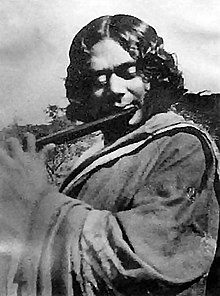
    Kazi Nazrul Islam
    Kazi Nazrul Islam


    In his landmark poem ‘Bidrohi’ [The Rebel], he roars…

    I am the burning volcano in the bosom of the earth,

    I am the wildfire of the woods,

    I am Hell’s mad terrific sea of wrath!

    I ride on the wings of lightning with joy and profundity,

    I scatter misery and fear all around,

    I bring earthquakes on this world!

    I am the rebel eternal,

    I raise my head beyond this world,

    High, ever erect and alone!

    The last thing that Nazrul would ever want is to narrowcast an idea or straightjacket a thought into chains under the garb of ‘tradition’. Tagore and Rumi were huge influences on his thinking and the philosophy he conjured up through his genre of poetry called ‘Nazrul Geeti’. He sent Tagore a composition called ‘Tirtho-Pathik’ in admiration of his writings. Tagore had famously said that darkness shall be banished when the first issue of ‘Dhumketu’ [The Comet], Nazrul’s bi-weekly publication was released. Tagore dedicated his play ‘Basanta’ [Spring] to Nazrul.

    Nazrul was invited to be the music composer by Naresh Chandra Mitra for the film adaptation of Tagore’s ‘Gora’. The Visva Bharati Board was of the opinion that the seven songs used in it did not do justice to the writings putting the film’s release was at risk. When Nazrul did a special screening for Tagore, he commented, “You have adapted my songs, and in what sense do they find you at fault? Do they understand my music better than you do? Can they honour it more than you have?”

    This is exactly what makes an iconic creation and a brand timeless – the flexibility to interpretations, the openness to debates, the ability to recast and the liberty to modify as appropriate. Brands have guidelines, not rules. Brands are open to evolution and modifications over time, not be cast in stone and locked away in a vault.

    The country today sings a particular tune of ‘Vande Mataram’ that has no connect with the original written by Bankim Chandra Chattopadhyay in 1882 and set to tune by Jadunath Bhattacharjee in 1883. What the cricket fans across India in the current ICC Men’s World Cup swing to is the 1997 version, interesting by Rahman.

    If we could so lovingly accept the new version of our National Song, wherein lies the problem in at least allowing the larger populace listen to the adaptation of Nazrul’s iconic song? The problem lies in letting go our own shackles in our minds and hearts under the garb of heritage, legacy and convention. Which is exactly what the Bidrohi Kobi fought against.

    Only the insecure and inept cannot cope with the shackles in the mind being broken. For, in the shrouds of convention and tradition lie their very existence.

    It is important to read the entire poem to smile at the sheer paradox of the current storm. The first two paragraphs of the original in Bengali are followed by an excellent translation of the entire composition by Sajed Kamal

    কারার ঐ লৌহকপাট

    ভেঙ্গে ফেল কর রে লোপাট,

    রক্ত-জমাট শিকল পূজার পাষাণ-বেদী।

    ওরে ও তরুণ ঈশান

    বাজা তোর প্রলয় বিষাণ,

    ধ্বংস নিশান উড়ুক প্রাচীর প্রাচীর ভেদি।

    কারার ঐ লৌহকপাট

    ভেঙ্গে ফেল কর রে লোপাট,

    রক্ত জমাট শিকল পূজার পাষাণ বেদী।

    Destroy those iron gates of prison,

    demolish the blood-stained stony altars

    of chain worshipping!

    O youthful Shiva,

    blow your horn of universal cataclysm!

    Let the flag of destruction

    rise amidst the rubble of prison walls

    of the East!!

    Play the music of the festival of Shiva!

    Who’s the master? Who’s the king?

    Who is it

    that punishes the truth of freedom?

    Ha! Ha! Ha! It’s a laugh–

    God is to be hanged?

    Rumour-monger–

    who teaches this pitiful “truth”?

    O you forgetful Madman —

    shake — shake the prisons

    with your forceful cataclysmic pulls!

    Send your Haidari call,

    play your war-drums–

    call Death

    towards Life!

    There, the Baishakhi storm is dancing–

    are you just going to sit through your days?

    Let’s see

    you shake up the foundation

    of that terrible prison.

    Kick – break the locks!

    All those prisons–

    set them on fire,

    burn them down, uproot them forever!

    Carry on, Bidrohi Rahman!


  • Avik Chattopadhyay: By BMKJ, it’s ISRO!

    By Avik Chattopadhyay


    For the last one week the nation has been obsessed with the moon, and for the right reasons. After all, a bunch of unsung people who have dedicated their lives to true scientific research were about to perform a feat that brings adulation and accolades for the nation from all corners of the world. There would be no divided opinion, no detractors and no sceptics for this. This was pure ingenuity combined with dedication and determination, ably supported by a frugal budget, out to once again prove that the “Indian” can and is above caste, politics, isms and polarisation.


    ISRO is a unique brand, in a brand called India.

    It is unique in its very history and legacy…right from being set up by a man who understood what scientific temper would mean for future generations, supported by a Prime Minister much maligned and ridiculed now, to inducting people purely on merit and passion, to constantly punching above its weight in the missions it takes up.


    ISRO is what the public sector undertaking was envisaged as by the ridiculed PM when he called the PSU the ‘temple of modern India’. It is all that a newly independent country’s aspiration was… building world-class institutions, filling them with the best talent from within and the world and then giving them the freedom to go ahead and achieve…for collective benefit and progress. That is the model of true nation building.


    There are no ‘reservations’ in ISRO. There are no quotas. Politicians do not recommend appointments. There are no hidden agendas to cater to. At the same time, it is very un-private enterprise like too. It works on shoe-string budgets for “launches”. It typically shuns the limelight. It believes in nurturing its employees for life, and it has 16,000+ of them. And it does not make investor pitches or shareholder presentations.


    In this context Chandrayaan 2 has been a curious exercise, for me as an observer. Never before has there been so much hype generated for any Indian space mission.


    This looked like an event manager’s delight with an omni-channel overdose of “space science”. The social media was alive and clicking with all types of messages and memes. Television programmes were created with otherwise boundary-line jesters at cricket matches being flung at us. There was even one ex-NASA astronaut who was roped in for one such circus. Poems were written. T-shirts were made. News channels found a reason enough to fill in 24 hours of content, day after day.


    And then the marketing wunderkids from the government flew in onto this entire jamboree being conjured. Their MBA schools had taught them about focused communication. And that had to be the moment Pragyaan would imprint the Indian national symbol and ISRO’s logo on the lunar south pole! So, the entire Chandrayaan 2 mission came out to be that single defining moment when we Indians would leave our imprint on the moon. Just like we do on historical monuments! “Ravi loves Archana” kind of stuff, literally. The entire focus was on Vikram and Pragyaan. “Fifteen minutes of terror” as the national lapped up. This was “national pride” re-defined. Thankfully the Pakistanis have had nothing to do with space or we would have had another occasion to bash them up digitally.


    Someone, just someone, had to step back and tell these spinmeisters to back off and give the entire mission the proper perspective it deserves. The Prime Minister sitting with the scientists there and texting away to the nation is not camaraderie. That comes from increasing the mission budgets and allowing the team to truly flex its muscles without constraints. Frugality is not a virtue expected from a space mission. It very much is from government spending on MPs’ salaries. And there is no need to have every moment of the Prime Minister’s sojourn recorded for the “wow” moments to be beamed up to the world. Some events need their correct dose of gravity and sterile distance. They need to be accorded that level of respect. Not everything is to be instagrammed or tweeted upon. Not every event is a photo opportunity until the mission is complete. Wish the same level of collective national excitement could be built on the 1st day of the harvesting season.


    A milestone space mission is not a ‘Mata ki chowki’.

    And for the Prime Minister to conclude his pep-talk with “Bharat mata ki jai”…completely off the mark and inappropriate.


    Obviously, the scientists at Bengaluru know their jobs and have already dusted off this little trespass!


    Avik Chattopadhyay is a senior marketer and strategy consultant. This column appears on MxMIndia every Thursday. His views here are personal


  • Are ‘Trust in News’ & ‘Happiness’ interconnected?

    Are ‘Trust in News’ & ‘Happiness’ interconnected?

    Avik ChattopadhyayTwo very interesting global reports have been published over the last one week. The first is the Reuters Institute Digital News Report 2023 and the second is the 2023 edition of the World Happiness Report. As a marketer and ‘brand-o-phile’, I see a subliminal connect between the two.


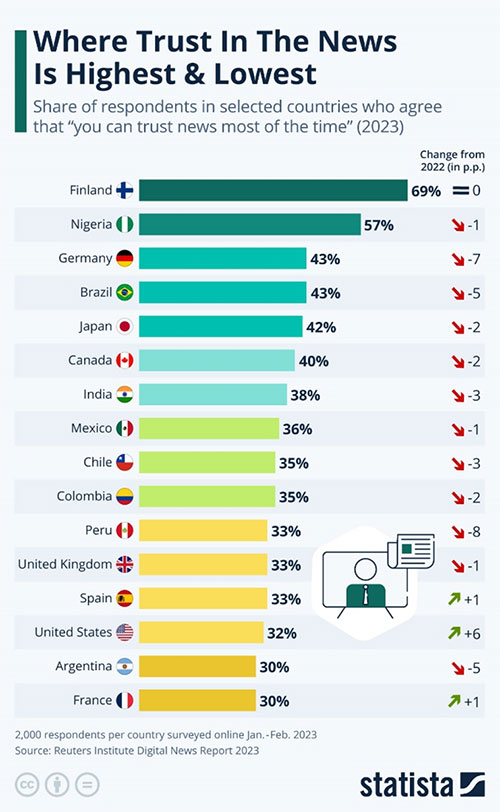
    The Reuters Institute Digital News Report is an outcome of more than 90,000 responses across 46 countries on how much one trusts news, through conventional as well as digital media. While the overall global trust score has dropped a few percentage points, the report states that “it is not surprising that news consumers are increasingly feeling overwhelmed and confused, and many are turning away temporarily or permanently. Selective news avoidance and news fatigue have been exacerbated by the challenging times we live in.”


    India is somewhere middling with 38% of news consumers trusting what they read and see. It has dropped 3 % points since the 2022 report. Now with the election season looming upon us, one can expect a sudden drop in the score with every political party resorting to downright unethical and fake communication without batting an eyelid on the impact on an already tense social fabric.

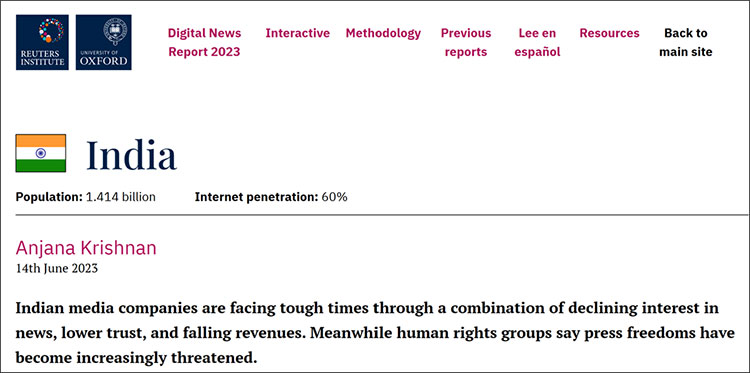
    The special note on India in the report is quite telling.


    Credibility is a huge factor. With the latest Press Freedom Index ranking of 161 out of 180, however much one may want to downplay the Reporters Without Borders study as being driven by agenda and deliberately disparaging towards the world’s biggest democracy, one cannot cross one’s heart and denounce it.


    The note states that “our Digital News Report survey finds steep falls in both the consumption and sharing of news. There was a sharp decrease in access to online news (12 percentage points lower than last year), particularly through social media (-11pp), the main sources of news for a predominantly younger audience. Television, popular among a large section of the population, also saw a 10pp decline as a news source with our younger and more urban-based sample.”


    While the government has brought checks and measures for media platforms, especially digital, on the authenticity of the news and its possible impact on factors like social harmony and national security, there are none for the social media teams of all political parties who deliberately churn out one-sided or fake posts, with the clear objective of misleading the populace and even instigating it into unrest. When the digital platforms dig up and expose these untruths, there is no legal recourse to punishing these people. All the Johnnies are consuming too much sugar without remorse.


    As the judiciary at the highest level seems to be the only panacea for most ills in the country, some sane citizens should file a PIL against such lie-spinners and let the court pull them to task.


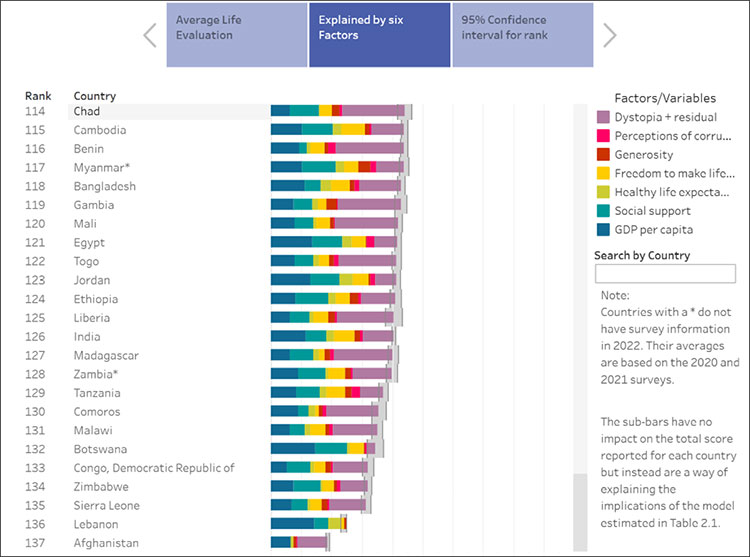
    The second report is the much debated and hated World Happiness Index by Gallup wherein certain sections of our thought leaders and citizenry cannot understand how can people in Pakistan, Bangladesh and Sri Lanka be happier than us, especially when we are going through our “Amritkaal” towards becoming the undisputed “Vishwaguru”. They need to understand that once again, this global report is not being undertaken with the sole purpose of showing India in bad light, but to help us introspect.


    If we study our score across the seven parameters in the second chart below, we will observe that we score badly on factors like life expectancy, corruption and generosity. These factors may not be as easily measurable like per capita income and are largely perceptual, but strong enough to take our score down. Also, the dystopia score is significant enough implying an undercurrent of social stress, possibly amongst certain communities.


    How are these two reports interdependent? Happiness is an active ingredient for trust. The lack of the first leads to increased scepticism and therefore the tendency to discount what you consume as news. You may put up a brave face in one report but the mask comes off in the other one.


    You posture to amplify the news that you opt to believe in as it shows you in better light. That is a fundamental defence mechanism, borne out of deep down insecurity and an inferiority complex. It is not that you openly consume and debate all sorts of news and digital content to logically establish that you are in the right. Similarly, you pose as happy, taking selfies next to objects, visiting places or doing things that take you away from your uncomfortable harsh reality. When it comes to responding to a survey, your disappointments with aspects of life around you get exposed. It is not the proverbial bed of roses.


    No external intervention can work in this case. Only a slow and gradual improvement in collective consciousness can shake the citizenry out of this sucrose-induced slumber.


    As a common citizen, you too are consuming enough sugar without even admitting to yourself. That is far worse than the media magnate spinning fake stories to drive you into a frenzy.


    The festival of democracy is less than a month away. Look before you leap.

    Jai Hind!


    Avik Chattopadhyay is a Gurugram-based brand and business strategist and commentator. He is currently also working along with XLRI to set up the Indian School for Design of Automobiles. He writes on MxMIndia every other Thursday. His views here are personal.
  • Emvies to be held on March 22

    The Advertising Club is gearing up to host the latest edition of the Emvies. With a total of 1892 entries received, Emvies 2024 will take place on Friday, March 22, 2024, in Mumbai.

    Of 1892 entries received, 471 were shortlisted. The final round of judging was evaluated by seasoned marketing professionals and select creative directors. Emerging as a gold standard amongst media awards, the Emvies 2024 has over the years grown in scale and strength.

    Said Rana Barua, Group CEO of Havas India, South East, and North Asia, and President of The Advertising Club: “At The Advertising Club, we take immense pride in promoting excellence in the field of Advertising, Media, and Marketing and the Emvies is a testament to our continuous effort. I’d like to express my gratitude to the jury for giving their precious time, and to the media agencies and brands for demonstrating strong ideas to foster growth of the Advertising, Media, and Marketing industry.”

    Added Punitha Arumugam, Chairperson Emvies Committee: “The increase in the number of entries for Emvies 2024 underlines the industry’s unwavering commitment to pushing boundaries. We are delighted to recognize the dedication and strategic brilliance reflected in these entries. It has always been our endeavour to celebrate groundbreaking media campaigns that have significantly contributed towards building resonance for brands.”

  • Warner Music partners JetSynthesys’s Global Music Junction

    Warner Music India has expanded its partnership with Global Music Junction (GMJ), the music and entertainment subsidiary of JetSynthesys.  The companies struck a distribution deal in 2021, but this new agreement sees Warner Music make a strategic investment in GMJ, giving it a seat on the Board.  The move, notes a communique, will establish Warner Music India to become the largest player in the central Indian music market.

    Says Alfonso Perez Soto, President, Emerging Markets, Warner Music: “This is a significant milestone in the expansion of our presence across India.  Working with the amazing team at GMJ last year not only strengthened our partnership but enabled us to better support artists from the central regions of India, bringing them the best artistic support that any company can provide, and helping them connect with fans across the country and around the world.  India is one of the most exciting music markets in the world and with GMJ as a partner we’re right at the heart of it.”

    Added Rajan Navani, CEO and founder of JetSynthesys: “Our journey with Warner Music has been remarkable, highlighted by some successful collaborations. The indigenous languages in which we operate, such as the Bhojpuri, Haryanvi, Oriya, Kannada and Gujarati language markets in India, have seen incredible growth in the recent past. Warner Music’s investment in Global Music Junction and its continued collaboration with us will fast track the increasing expansion of India’s regional music industry. With our combined collective vision and understanding of audience preferences, we aim to strengthen the ecosystem by meeting the growing fan demand in the music and entertainment space. We are looking forward to more successful outcomes from our longstanding collaboration.”

    Said Jay Mehta, Managing Director of Warner Music India: “Our partnership continues to have a significant presence in the places in the Indian market which are growing most rapidly, and so enables us to be the fastest music company in our expansion.  GMJ is a leading player in five language markets in central India and works with some of the biggest names in Indian music and show business.  This is a critical moment in our expansion across the country as we seek to position Warner Music India as the number one choice for all discerning artists and labels.”

  • John Jacobs eyewear unveils campaign film

    John Jacobs, the eyewear brand by Lenskart, has unveiled a new campaign film to bring back Gentlemen’s Edit 2.0, featuring the journeys of actor Arjun Mathur and entrepreneur Varun Duggirala.

    Commenting on the campaign’s launch, Apeksha Gupta, CEO of John Jacobs said: “Gentlemen’s Edit 2.0 isn’t just about eyewear; it’s a tale of success intertwined with the essence of a true gentleman. Joined by Arjun Mathur and Varun Duggirala, we redefine modern elegance, weaving enduring values—integrity, kindness, and authenticity–into our narrative.”

  • Big FM & Centuary Mattresses host Qoolest Sleep Concert

    Centuary Mattresses hosted the Qoolest Sleep Concert on World Sleep Day, March 15, 2024. The event, conceptualised and designed by Initiative India in collaboration with Big FM, aimed to raise awareness about the importance of sound sleep for overall well-being and provide attendees with an immersive sleep experience.

    Said Vijay Kumar Mikkilineni, GM Marketing, Centuary Mattresses, said: “We are thrilled to present the largest Qoolest Sleep Concert in India. This unique event aims to educate people about the paramount importance of sleep for our overall well-being. By integrating music, relaxation, and expert insights, we aim to highlight the crucial role quality sleep plays in our lives and nurture healthier lifestyles across the nation.”

    Added Dhirendra Singh, EVP and Mumbai Head, Initiative India: “Centuary Mattresses’ Qoolest Sleep Concert isn’t just an event; it’s a strategic masterpiece. By tapping into the trend of sleep deprivation, we, along with BIG FM, crafted a narrative that resonates deeply with consumers. This initiative positions Centuary Mattresses as a brand that understands and cares about the well-being of its audience, forging an emotional connection that transcends transactional relationships. It’s a testament to Initiative’s commitment to delivering impactful campaigns that resonate beyond traditional advertising, leaving a lasting impression on consumers and elevating Centuary Mattresses’ brand stature in the market.”

  • Vivo launches ‘Be the Pro’ Campaign

    Vivo, the smartphone brand, introduced its latest campaign, ‘Be the Pro’, for the all-new Vivo V30 Series. It is crafted by VML India.

    Commenting on the campaign, Geetaj Channana, Head Corporate Strategy, Vivo India, said:  “The idea is based on an interesting insight – who says everyday moments of life can’t be memorable. You can find delight in the daily, and surprises in the routine when you see it like a Pro. Vivo is committed to placing consumer orientation at the core. With our latest launch, we aim to empower users to elevate their everyday moments into Pro moments. Our collaboration with ZEISS reflects this commitment, allowing users to effortlessly capture portraits like a professional. The campaign film perfectly encapsulates our brand ethos of creating technology that brings joy to our consumers.”

    Added Sundeep Sehgal, Senior Vice President & ECD at VML, Delhi: “When you see magic in everyday life, find joy in every moment, and feel warmth in the ordinary, you make every day delightful, and you become a Pro. Our latest film celebrates the idea of ‘Be the Pro’ with an emotional story, showcasing how everyday moments become delightful and memorable.”

  • Ykone agency acquires Barcode

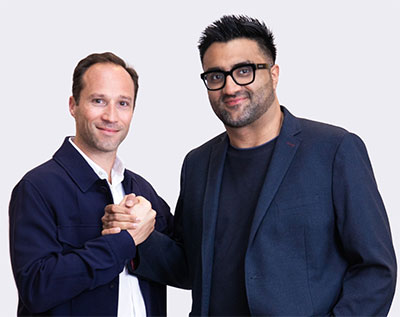
    Olivier Billon and Rahul Khanna

    Ykone, the influencer marketing agency, has announced the acquisition of 70% of the Indian agency Barcode, a content and influencer marketing agency.

    Said Olivier Billon, Founder and CEO of Ykone: “The acquisition of Barcode Agency is a significant step for Ykone and its international expansion. Ykone YKONE already had a presence in India with an office in Bangalore since 2017. With the addition of Barcode’s operations in India, Ykone ‘s reach in the country and the broader Asia-Pacific region expands even further.”

    Added Rahul Khanna, Barcode’s CEO, added: “We express our heartfelt appreciation to our customers and collaborators in India. This acquisition empowers us to provide worldwide services to our Indianclientele while simultaneously promoting India’s unique narrative globally. We are very proud to join forces Ykone ‘s talented teams. My ambition with Olivier is to achieve worldwide supremacy in the field of Influencer Marketing. We are happy to introduce CAMPAYGN to the Indian market. This innovative tool shall help fill the gap of Indian customers planning their content & social commerce strategy with Barcode and Ykone.”

  • Dentsu & Arthur D. Little ink partnership

    Dentsu India has embarked on an industry-first strategic partnership with the global strategy consulting firm Arthur D. Little (ADL), aiming to deliver end-to-end solutions to enable growth for their clients. The partnership will be led by Narayan Devanathan, President & Chief Strategy Officer, South Asia, dentsu, and Amit Dakshini, President & Sector Lead (Automotive & Mobility), ADL.

    Narayan Devanathan
    Narayan Devanathan

    Commenting on the alliance, Narayan Devanathan said: “What happens when customer-centricity and creativity meet the consulting mindset? You get the opportunity to create unprecedented value for clients and their customers while creating new futures. And that’s precisely what the alliance between Dentsu and ADL will create for businesses everywhere – by creating a custom range of demand chain solutions. As businesses look to create sustainable futures for themselves, it’s critical that they are able to map and size demand in new ways and then nurture and fulfil that demand in engaging ways. Our clients look to us to solve their business problems – either by ourselves or in partnership with other experts. The Dentsu + ADL alliance is us walking the talk on this promise to our clients to truly be their partners.”

    Amit Dakshini
    Amit Dakshini

    Added ADL’s Amit Dakshini: “The timing aligns perfectly with the industry’s evolution towards increased software and connected content in modern vehicles, especially with the influx of global brands in India. True market leaders will distinguish themselves by finely targeting demand, crafting unique customer experiences, and fostering strong brand associations across physical and online channels. Partnering with a global leader like Dentsu empowers us to deliver end-to-end, outcome-driven solutions for accelerated sales growth, personalised customer experiences, and market leadership. We envision this partnership supporting Indian brands in establishing a robust global presence.”

    Harsha Razdan
    Harsha Razdan

    Said Harsha Razdan, CEO South Asia, Dentsu: “We are incredibly excited about expanding our offerings to clients. Dentsu’s commitment lies in adopting a holistic, customer-centric approach towards clients’ growth. Facilitating further brand transformation requires collaboration with industry-leading providers, and the partnership with ADL epitomizes this principle. Together, we are forging a truly synergistic offering poised to drive growth for both our clients and organizations. ADL commands a well-established reputation in its domain and introducing a complementary range of services will round off the circle of value-driven solutions for clients.”


    Satya Easwaran
    Satya Easwaran

    One final quote. From Satya Easwaran, Partner and Country Head, Arthur D Little India: “We are extremely thrilled with this one-of-its-kind strategic partnership in the industry. Our alliance with dentsu will pave the way for us to nurture and build long-term associations with clients while driving clear business outcomes. Starting with the Automotive & Mobility space, we plan to take this relationship further across multiple sectors including Consumer & FMCG, Energy, Technology, and BFSI.”

  • Havas launches Conran Design Group network

    Left Top Anti Clockwise Ludwig Duran, Rana Barua, Anaïs Guillemané Mootoosamy, Thom Newton, Lee Hoddy
    Left Top Anti Clockwise Ludwig Duran, Rana Barua, Anaïs Guillemané Mootoosamy, Thom Newton, Lee Hoddy

    Havas has announced the launch of the Conran Design Group network, a new global offering dedicated to brand and design, based on the long-standing expertise and talent at Conran Design Group, and W, Havas’ leading creative branding agency in France, which will be renamed W Conran Design.

    With studios in London, Paris, Mumbai and New York, the network’s team of 250 strategists and creatives will use their expertise in brand strategy, brand design, experience design and communications and engagement to inspire progress for clients and empower brands to make a meaningful impact.

    The network launch also marks the release of Conran Design Group’s new proprietary study, Citizen Brands, an evidence-based brand and design framework that identifies which brands are achieving balanced growth.

    The study finds that the top 20 ‘citizen brands’ – those able to meet the needs of both individual and society – earned £8bn more in revenues on average yearly than their lowest-performing counterparts. They also achieved equity price increases that are on average five times higher than those of the lowest performers.

    Said Yannick Bolloré, Chairman and CEO, Havas: “Conran Design Group is uniquely equipped to lead this new network with more than 60 years of experience in strategic brand and design, a holistic approach, and the benefit of global scale with a local touch. W is the natural partner to support the success of this initiative in France with its 25-year track record of helping companies transform to remain at the heart of the conversation and make a positive contribution to society.”

    Added Thom Newton, Global CEO, Conran Design Group: “We’ve entered the era of expectation inflation – and brands are under huge pressure to deliver growth and good.This will only intensify amid ongoing uncertainty and heighted economic and environmental pressures. Brand leaders will be expected to take an even more active role in how their brands meet and balance these pressures. Our study shows that all companies across all sectors need to find a way to achieve balanced growth, critical in an increasingly unbalanced world. But rather than prioritising growth alone – growth at any cost – the focus should be on progress, progress that’s both balanced and sustainable. Our new global network, supported and informed by the Citizen Brands framework, will help brands achieve that.”