Category: NEWS

  • 53 Days to D-Day | Govt addresses industry concerns over digitization

    By A Correspondent


    The Cable Television Networks (Regulation) Amendment Act, 2011 has made it mandatory for switch-over of the existing analogue Cable TV networks to Digital Addressable System (DAS) by December 2014, in a phased manner. The digital switch-over is to be completed by June 30 in the four metros -Delhi, Mumbai, Kolkata and Chennai.


    Concerns had been raised by some stakeholders regarding the quality of Set Top Boxes (STBs) and the redressal of grievances of the cable TV subscribers. The necessary provisions have been incorporated in the Cable Television Networks (Amendment) Rules, 2012 to take care of these concerns. As per these Rules, the STBs to be supplied by the Multi System Operators (MSOs) must conform to the quality standards specified by the Telecom Regulatory Authority of India (TRAI).


    The MSOs are also required to devise a mechanism for grievance redressal, as specified by TRAI, and inform the details thereof to the subscribers. The Telecommunication (Broadcasting and Cable Services) Interconnection Regulation, 2012 has a provision that the STBs must be BIS compliant. During a Ministry review meeting with the national level MSOs, it was revealed that out of about one crore STBs required in the four metros, over 22 lakhs STBs have already been installed, about 25 lakhs STBs are available in the stock which are being installed and the orders have already been issued for the balance requirements of STBs.


    MSOs have confirmed that all the indigenously manufactured STBs conform to the BIS standard and the imported STBs not only conform to the international standard but also the BIS standard. Regarding the repair of defective STBs, the MSOs have intimated that within the warranty period of one year, a defective STB will be replaced immediately free of cost. After the expiry of warranty period, a faulty STB will be taken back for repairs by giving a replacement from the available stock.


    The MSOs have further confirmed that the Grievance Cells are being set up for resolution of disputes, if any, and the telephone numbers of the Grievance Cells would be notified.


  • Sanjay Thapar is new CEO of Bates India

    By Amit Bapna


    Sanjay Thapar, currently the Group President, North and East, at Ogilvy India is tipped to take over as CEO, Bates India. He would be relocating to Mumbai to take over the reigns at the much-in-news agency.


    Mr Thapar is known to have turned around Ogilvy’s Kolkata office some years back and has also been known to have turned round the Delhi office of Ogilvy in the recent years. The IIM-Lucknow alumni started his career at Bata India, moved to Mudra Advertising and then to Ogilvy where he has been around for 14 years.


    Confirming the news of the appointment Mr Thapar said: “I am very excited and am looking forward to take on this challenging Chairman, Bates Asia.” On being asked why he was chosen for this position which has been much in news for a while, he laughed it off saying that the people who selected him – Ranjan Kapoor, chairman, Bates India & country head, WPP India and Tim Isaacs – Chairman, Bates Asia – would be best positioned to answer this.


    Mr Thapar has now been entrusted with the ‘turnaround’ job at the ailing WPP agency that has seen some high profile movements in the last few months, that include its former CEO Sandeep Pathak and regional executive creative director and chairperson, Sonal Dabral.


    It would be interesting to see Mr Thapar’s recipe for success at the agency that has had mixed fortunes in most of the APAC region, with some strong pockets and many weak ones.


    As recent as last year, the agency had announced a rebranding of its identity as well as its philosophy to become the ‘Changengage’ agency.


    Source: The Economic Times
    Copyright © 2012, Bennett, Coleman & Co. Ltd. All Rights Reserved


  • Shoppers at retail chains buy premium items

    By Sarah Jacob & Writankar Mukherjee


    Shoppers at food and grocery retail chains appear disconnected from the overall weak consumer sentiment in the country as they upgrade to premium products and buy bulk packs, helping big retailers and consumer goods firms boost average realisation per sale.


    Daily use products like hair oil, refined edible oil and toothpaste, and impulse-driven categories such as biscuits, beverages, salty snacks, instant noodles and chocolates are growing much faster in sales value than the number of units sold in modern trade, a report by market tracker The Nielsen Company says.


    Modern or organised retail within food and groceries refers to convenience stores, supermarkets and destination outlets called hypermarkets. This is opposed to the traditional kiranas or neighbourhood stores.


    Modern retail shoppers seem to be less impacted by economic factors like inflation, high interest rates and slower growth, says Nielsen’s April report.


    Industry officials say this trend also has to do with consumer’s shopping motivations. “Consumers are purchasing larger packs, and more value-added products in modern retail since they are showing a tendency to complete their monthly shopping in such stores. They are topping up with smaller purchases from kiranas,” said Dabur India CEO Sunil Duggal. Value growth of one-litre Real juice pack is almost double in modern retail than kiranas.


    Manish Tiwary, executive director-sales and customer development at the country’s largest consumer goods company Hindustan Unilever, said modern retail consumers are comparatively better off. “The profile of shoppers in modern trade clearly reflects a higher living standard measure. This is one of the main reasons for the slightly more premium portfolio (in big chains),” he said. HUL’s largest brands within the personal wash category in modern trade are Dove and Pears, while Lux and Lifebuoy rule the roost overall.


    Nielsen says stronger purchasing power of modern trade consumers and wider product assortment at such chains encourages impulse purchases and deal-based large-pack buys. “This mix of affluence and experimentation is an invaluable asset for all stakeholders. This can be useful in times of uncertainty like 2011 since the sharp increases in value growth indicates resilience amongst them,” said Adrian Terron, Nielsen Company’s executive director (retailer and shopper).


    He said refined edible oil and instant coffee are examples of categories where value growth outpaced volume growth by 2-3 times. Of course, product prices have increased 2-8 per cent over past year, but Nielsen says the effect has more to do with shopping behaviour.


    Spencer’s Retail chief (operations and merchandising) Mohit Kampani said nearly 30 per cent of growth that Spencer’s Retail posted across its 189 outlets was from consumers upgrading purchases last year. “This is also because the price points of products being stocked have widened considerably. A year ago, skincare brands would have been priced between 10 and 800 while today it is between 10 and 2,200,” he said.


    Devendra Chawla, president (Food Bazaar category) of India’s largest retailer Future Group, said value-added categories are incubated at modern trade outlets: “A lot more cookies, cream and health biscuits have been launched in the past 18 months than mass biscuits, which makes value contribution higher, although the category is growing double digits by volume.”


    Even in personal care, anti-ageing and performance creams are growing much faster than general-purpose creams.


    HUL’s Tiwary said it sometimes launch certain pack sizes in modern trade first and then in other channels. Future Group’s Chawla said launch of international foods is also contributing to this trend. This includes packaged cheese, international pasta and brands like Choco Pie among biscuits and Ferrero Rocher in chocolates that are resulting in faster value growth than volume. Overall, modern trade is proving more profitable for marketers because profit margin is higher on premium products and large packets.


    Meanwhile, mobile phone and durable makers too report higher sale realisation in large chains due to rising demand for premium products. Research in Motion (RIM), makers of the BlackBerry smartphones, said Indian consumers are upgrading from feature mobile phones to smartphones. “This is boosting the average selling price of the handset market, even though overall demand is yet to pick up,” RIM India Managing Director Sunil Dutt said. He estimates that the smartphones market is growing 60-70 per cent a year in the country, while feature phones at 10-15 per cent.


    Panasonic India Managing Director Manish Sharma said: “Consumers are increasingly going for large screen televisions, which is pushing up value sales.” The average selling price of the company’s flat panel TV business has gone up by more than 5 per cent in six months.


    Korean brand Samsung too says sales of its high-end split ACs, frost-free refrigerators and smartphones are growing faster than lower-end products.


    Source: The Economic Times
    Copyright © 2012, Bennett, Coleman & Co. Ltd. All Rights Reserved


  • Vogue announces first fashion fund with FDCI

    By A Correspondent


    After years of success in several countries, the prestigious Vogue Fashion Fund makes itsIndiadebut this year. VogueIndia, in collaboration with the Fashion Design Council of India (FDCI), is launching this annual event to give centrestage toIndia’s next generation of fashion designers. The Vogue Fashion Fund was originally conceptualised by US Vogue, spearheaded by the iconic Anna Wintour.


    Announcing the launch of the Vogue Fashion Fund inIndia, Priya Tanna, Editor, VogueIndiasaid: “For a country that takes great pride in its indigenous fashion and boasts such a stunning array of embroideries, textiles, and craftsmanship, it’s no surprise that we consistently produce exceptional design talent. With the launch of the Vogue Fashion Fund, our endeavour is to strengthen the foundation for these designers and help marry their creativity with commercial success. It is a truly special project for VogueIndiaand I look forward to the fund changing the lives of promising young designers in the years to come.”


    Mr. Sunil Sethi, President, FDCI said: “I once heard the proverb, ‘Give a man a fish and you feed him for a day, teach him to fish, and feed him for life.’ It’s an apt metaphor for the Vogue Fashion Fund, which supports the winning designer through a one-year mentorship. With this initiative, Vogue is putting its weight behind young talent-I look forward to seeing what’s in store for many years to come.”


    The judging committee comprises an eclectic mix of fashion authorities, including Sunil Sethi and the Vogue India experts – Priya Tanna – Editor, Anaita Shroff Adajania – Fashion Director, Bandana Tewari – Fashion Features Director and Oona Dhabhar – Marketing Director, Conde NastIndia. The jury also features renowned fashion designers Manish Arora, Sabyasachi Mukherjee and Suneet Varma as well as retail experts like Alka Nishar and Tina Tahiliani.


    Sabyasachi Mukherjee commented: “This is a wonderful initiative. It is fantastic that Vogue India recognizes this fact and is creating the platform to nurture upcoming design talent. I feel privileged to be a part of the jury panel. Hopefully, I will be able to use my aesthetic skill and business acumen to make Vogue zero in on the right choice.”


    VogueIndiahas invited entries from emerging fashion designers based on pre-defined eligibility criteria. The judging panel will shortlist 20 designers at first from the entries, further narrowing this list down to top 5 finalists based on interviews and the creation of a special capsule collection.


    The winner will have the opportunity to be featured in VogueIndiaand also win a grand cash prize. Besides this, the design talent will also get a chance to commercialise his/her brand with a leading retailer, and gain access to prominent platforms in the industry like Wills Lifestyle Fashion Week and a one-year business mentorship with an industry professional.


    Vogue, the ultimate fashion bible, which launched inIndiaon September 22, 2007 is the 17th edition of the ultimate style bible and is a 100 per cent owned subsidiary of Conde Nast International. VogueIndiais a monthly magazine and available across 100+ towns.


  • Manish Bharil joins Madison Media as GM

    By A Correspondent


    Madison Media has announced the appointment of Manish Bharil as General Manager to lead the Britannia account in Madison Media Omega based in Bangalore.


    Mr Bharil has over 12 years of experience in media and joinsMadisonfrom Mindshare Bombay where he was Senior Director – Invention. Mr Bharil previously worked in Madison Bombay for 7 years.


    Gautam Kiyawat, CEO, Madison Media Group said: “I  am glad to have Manish join our team in Bangalore and I am sure he will be able to add a lot of strategic inputs to one of our leading clients – Britannia.”


    Manish Bharil, on his returning toMadison, said: “I am delighted to join back Madison and I am looking forward to this new role in leading the Britannia account.”


    Madison Media was recently in the news for winning the Crompton Greaves and Dixcy Textile’s Media AOR.


    At the recent Goafest 2012 awards, Madison Media won 4 awards, including a Gold for Best Use of Newspapers & Magazines for Parachute Advansed Ayurvedic Hair Oil; 2 Silver’s for Best Use of Internet & Digital Media for Airtel and Best Use of Branded Content for Cadbury and a Bronze for Best Use of Events and Stunts for Cadbury Celebrations.


    Madison Media Group is India’s foremost media agency handling media planning and buying for blue chip clients.  The gross billing of Madison Media is Rs3,000 crores.


  • HUL to launch Mission Bushfire in 8 cities

    By A Correspondent


    Consumer goods major, HUL is launching Mission Bushfire 2012 this week to cover about 40,000 outlets (including general and modern trade) spread across 8 cities in India- Mumbai, Pune , Delhi ,Gurgaon, Bangalore, Chennai, Kolkata and Hyderabad.


    Mission Bush Fire’ is an employee-led market execution and customer interaction exercise initiated in 2010 to get the home & personal care giant to connect with the market place.


    This year the emphasis will be on the launch of skin care brand, the New Fair and Lovely. HUL employees from across functions will be participating in Mission Bushfire 2012 which will be held for the third successive year.


    HUL CEO Nitin Paranjpe and every member of the company’s management committee participates in this project to get direct feedback on how HUL brands are faring.


    In 2010, over 4000  HUL employees had participated in this mission to interact with the trade and consumers covering 14,000 outlets.


    Bush Fire has resulted in a 40 per cent spike in sales in store wherever the initiative has been implemented, according to internal company estimates. Mission Bushfire is an HUL employee led initiative that aims to create ‘Perfect Stores.’


    A research by HUL shows that 70 per cent of the brand purchase decisions are made

    at point of purchase. Perfect store programme is an initiative started in 2010 with objective of bringing the HUL brands from consideration set to the purchase basket of the shopper. The project is being driven through two initiatives called IQ and Better Stores.


    Project IQ has been instrumental in increasing the assortment and driving placement of new products through strong analytics and customization of tasks at an outlet level.


    Better Stores Project drives the visibility of the brands at the point of purchase through the right visibility mix, focus on plannograming (share of shelf) and advanced merchandising process using hand-held terminal (HHT) technology.


    Source: The Economic Times
    Copyright © 2012, Bennett, Coleman & Co. Ltd. All Rights Reserved


  • Of Haldi, Chandan & all that makes Santoor

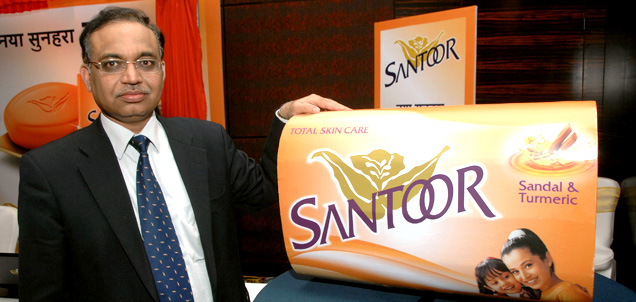
    Consistency in Communication: Anil Chugh, Senior VP, Wipro Consumer Care with a Santoor signage


    By Tuhina Anand


    Did you know that Santoor is the third largest soap brand in India? The brand, belonging to Wipro Consumer Care, has done well for itself by beating the international biggies and carving a niche for itself since it was launched in 1986. In the past 25 years, the run for the brand was not always so good, but a consistent and strategic communication has played a pivotal role in its success. Santoor is a Rs1,000 crore brand and has been growing at a CAGR of 23 per cent for the last five years.


    The communication has always focused on ‘younger looking skin’, but the portrayal has changed with the times to appeal women, who were earlier seen as homemakers to now those who excel in various professions – mirroring the changing aspirations of Indian women.


    Giving an insight into the Santoor story, Anil Chugh, Senior Vice President, Wipro Consumer Care, said: “Santoor is the third largest soap brand in India and the largest selling brand in the South + West India (value MS – 13.5 per cent). The ‘ageless skin’ campaigns and innovative marketing strategies have helped Santoor grow faster than the industry and gaining share over the years. One of the reasons for this is the consistency in communicating our core proposition of younger looking skin while keeping the message contemporary over the years. Also, our focus on providing the right value to the customer has contributed significantly to the brand’s success. The growth was also achieved on the back of a strong distribution network and communication in rural areas.”


    He added: “The strength of Santoor has been its promise which is consistent, powerful and eternally relevant to consumers. For over 25 years, the brand has delivered on the promise of ‘younger looking skin’ through superior product offerings which have used deep acting and trusted natural ingredients. Our campaigns have reinforced this message consistently. Over the years, Santoor has carefully chosen celebrities to endorse the brand and it has worked well for the brand.”


    While factors like distribution cannot be overlooked in the success of Santoor, the communication has been one of the key pillars. However, this was not the case always. MG Parameswaran, Executive Director & CEO, Draftfcb + Ulka elaborated: “When Ulka Advertising was assigned the brand in 1988, it was in a bit of a limbo, growth had stalled. The agency evolved the ‘younger looking skin’ and ‘mistaken identity’ as the key pillars for the brand. The advertising created history of sorts. The brand growth picked up momentum and Wipro has ensured that marketing money was well spent, through judicious correction in the messaging of the brand.”


    “In 1989, Santoor was basically selling in two states of Kerala and Karnataka. It was selling a fraction of what brands like Hamam, Rexona, Cinthol and Liril were selling. By focussing advertising on one promise and evolving it over time, Santoor has become one of the top three soap brands in the country.


    The advertising has evolved in many ways, but the core message of ‘natural ingredients for a young looking skin that will get you accolades’ has not changed. But the Santoor woman has evolved from being a pretty woman at a wedding to a confident woman who is doing aerobics, to a woman who plays cricket with her daughter, to a dress designer, to a TV anchor to a choreographer to a photographer. In a sense, the brand has reflected the aspirations of the new Indian woman,” added Mr Parameswaran.


    He is very clear that the success of its communication is purely because it tells a timeless story that always appeals. As he puts it succinctly, Santoor is about consistency in communication that adds a new layer with every new piece.


    In fact, as Santoor completes its 25 years, it has come out with a new campaign that is the Santoor anthem, giving it a contemporary look and feel yet telling the same story about a mother and daughter. The new advertising campaign features two ads – an anthem film that celebrates the achievement and pride of millions of Santoor women and a new theme film with new brand ambassadors – Saif Ali Khan and Mahesh Babu.


    Over the past few years, Santoor has grown from a single soap brand to talcs, deodorants, soap variants, liquid soap, facewash and so on. Mr Chugh said: “We will continue with our quest to keep the brand relevant and contemporary even in the future. The aim of new campaign is to take the Santoor brand to the ‘next level’. We are constantly looking at consumer needs and expanding/enhancing the brand to meet such needs. The brand has grown ahead of the competition in its core states and is now trying to break out of its traditional stronghold and make quick gains in other markets.”


    As a concluding note, Mr Parameswaran, who has been associated with the brand for almost two decades, said: “I am proud to have been associated with the brand for almost two decades. What is unique about the Santoor story is the great trust and regard this brand has spawned between the agency and client. It is has been a wonderfully rewarding experience and all of us in Draftfcb Ulka are proud of the association. It is not easy to take on large well-heeled multinational FMCG behemoths; we took them on and managed to find a place for Santoor under the Indian sun. The story is far from over. Santoor won against all odds and it will keep winning. I am sure of that.”


  • Hungama earns Facebook’s ‘Most Preferred Marketing Developer’ badge

    By A Correspondent


    The Digital Services division of Hungama Digital Media Entertainment Pvt Ltd was conferred with the Preferred Marketing Developer (PMD) badge by Facebook. PMD is given to developers that have demonstrated value-added capabilities in one or more of the following qualification areas: Pages, Ads, Apps, and Insights. The badge is for companies that have clearly demonstrated unique capabilities that help marketers scale and achieve efficiency and extend measurably beyond the functionality of Facebook’s native tools.


    Commenting on this Siddhartha Roy, COO, Consumer Business & Allied Services, Hungama Digital Media, said: “Being among the few companies worldwide to earn ‘Preferred Marketing Developer’ badge underlines our ongoing investment in providing cross-channel interactive solutions to clients across various verticals. In a digitally connected world, it is important to engage the consumer where he spends most of his time; the social media platform, especially Facebook, has emerged as the new media real estate where brands can build greater engagement and interaction with the consumer.”


    Hungama Digital Media helps brands build awareness, engagement and loyalty, using a full range of digital skills, including campaign strategy and creative development, website design, online media planning and buying, viral marketing, social media strategy and optimization, mobile marketing, search engine marketing, gaming. On social media, specific to Facebook, the agency provides page management and publishing, community management, applications development, social plugins, advertising (ad creation, auto bid optimization, target segmentation, creative, conversion tracking, reporting), monitoring and reporting (insights).


    Hungama has built digital campaigns for clients that include Mahindra & Mahindra (Automotive), Mahindra Racing, Bacardi, Yum Restaurants, LG and Nokia amongst others; that utilizes the Facebook ads API such as Bacardi Together Club, Black List Application, Celebrate Life, ICC World Cup Fever, Zinger Application, Create Your Comic Strip, Valentine’s Day, to name a few.


    Hungama Digital is the No.1 Digital Advertising agency in 2011 according to The Economic Times Brand Equity Agency Reckoner 2011. The parent company, Hungama is the largest aggregator, developer, publisher and distributor of Bollywood and South-Asian entertainment content in the world. With partnerships with over 305 content creators, across record labels, studios, broadcasters Hungama has licensed worldwide exclusive digital rights to over 2 million music and video titles. Hungama has successfully managed more than 2,000 mobile and digital campaigns for as many as 300 brands globally.


  • Halfway through, IPL 5 ratings stabilize

    By A Correspondent


    The downward slide continues though not as stark as it is made out to be. Numbers released by TAM Sports for the first 48 matches of IPL 5 have shown the ratings to be the least recorded thus far compared to previous four seasons. At 3.40 TVR (CS 4+, all India), IPL 5 is faring poorly when compared to 2011 where it recorded a TVR of 3.54, 4.53 in 2010, 4.05 in 2009 and 4.72 in 2008.


    It may be recalled that for the first 36 matches, IPL 5 delivered a TVR of 3.41 per cent, for the first 27 matches, it delivered a TVR of 3.53 per cent and the first 16 matches, a TVR of 3.65 per cent.


    What has shown improvement is the cumulative reach for these 48 matches in IPL 5 that stands at 151 million. This is nearly the same for IPL 4 where the reach was 152 million and far better than IPL 3, 2, and 1 where the reach measured was 137 million, 118 million and 98 million respectively.


    Delving on the suggested trend, Janardhan Pandey, Associate Vice President, DDB Mudra Group said: “Despite what is being said, the sport remains most popular and the reach deliveries also seem to be in line with our expectations. Maybe it’s a period of stabilization for IPL20 viewership. It cannot be doing excellent forever after all. There were many issues to start with such as overdose of cricket & the consistent poor performance by Indian cricket team. Keeping all those factors in mind I will give thumbs up to overall performance of IPL 5.”


    On the reported rise in reach numbers, Mr Pandey said: “This shows the strong appeal that the game of cricket enjoys in India. The ever increasing eye balls for cricket are testimony to this fact.”


    Program TVR %
    IPL5 Opening Ceremony 1.16
    Viewership of IPL Seasons for first 48 matches
    Year Season No. of Matches Avg. TVR % Cum Reach 000s
    2008 IPL 1 *47 4.72 98988
    2009 IPL 2 *46 4.05 118698
    2010 IPL 3 48 4.53 137049
    2011 IPL 4 *47 3.54 152720
    2012 IPL 5 *46 3.40 151585


    (Source: TAM Sports; Market: All India; TG: CS 4+ yrs; Period: Wk 14 to 18, 2012; this data is for first 48 matches of all IPL seasons.)

    * In IPL 1 one match (47th) was abandoned due to rain

    * In IPL 2 two matches (7th & 13th) were abandoned due to rain

    * In IPL 4 one match (20th) was abandoned due to rain

    * In IPL 5 two matches (32th & 34th) were abandoned due to rain


  • Taproot delivers a fragrant tale for ‘Z talc’

    By A Correspondent


    Having charmed some of its large clients with awe-inspiring ideas and execution, creative hotshop Taproot India has just finished work for another brand called ‘Z talc’. The talc is from the stable of Argus Cosmetics, the manufacturers of a range of personal care products.


    Explaining the rationale for the ongoing promotional activity, Mr Sundar, Managing Director, Argus Cosmetics Pvt Ltd said: “We launched “Z” Magnetism talc for men in April 1992. Our strategy at the time of launch was to create premium cosmetic products for the discerning male consumer. ‘Magnetism for Men’ is our endeavor to build on this strategy, and offer more personal care products for upwardly mobile men.” Mr Sundar added that they intended to target the metrosexual male as it is common to find men these days going to the parlours for a facial or dying their hair, and so on.”

    Throwing light on the new commercial, Mr Sundar said: “We have created this TVC to accelerate our growth, and create a strong brand. Thus far, our growth has come from building distribution, we now want to create heightened awareness and pull for brand ‘Z’.”


    On the objective set out for the agency, Manan Mehta, Managing Partner, Taproot India said: “With the business growth plans in place, the attempt was to consolidate the current market and look to engage with the fence sitter in the future markets. The overall exercise was to refresh the brand without losing its essence and present it in an alpha avatar that reflects today’s consumer aspirations and their lifestyles.”


    Providing a more analytic insight, Santosh Padhi, CCO, Taproot India said that according to research, about 30 per cent females use the product not because it’s lying on the dressing table, but because she is in love with its fragrance. “The positioning ‘Magnetism for Men’ was carved on the brand two decades back, since than they have been using it on retail space, hence we too decided to take the same positioning forward.” He added: “The brand name “Z” sounds very international, strategically we decided to keep the perception of it being a international brand hence the whole treatment of the film is very international.”


    The campaign is currently on air in Maharashtra and Andhra Pradesh and is expected to go national soon.


    Credits:

    Agency: Taproot India

    CD: Santosh Padhi, Agnello Dias

    Writer: Santosh Padhi

    Client Servicing: Manan Mehta

    Director: Razneesh Ghai

    Producer: Anju Vaswani

    Associate Producer: Bhavna Singh

    DOP: Kavin Jagtiani

    Editor: Jay Chandran

    Post Production: Prime Focus


  • Cable cos expect major hike in subscriber revs

    By A Correspondent


    TRAI’s argument that carriage fees paid by TV channels to cable MSOs are necessary to fund their digitisation appears to be falling apart scarcely a week after it was made. Instead, large cable distributors have themselves said that one factor alone – a huge six-eight times hike in subscription revenues alone as declarations spiral with addressability – would significantly buttress their already profitable balance sheets.


    With additional revenues from broadband and VAS, industry estimates also say that a bundled digital and broadband + VAS business model will result in the payback period being reduced by a year to 24 months, as opposed to 36 months under a standalone digital cable TV proposition. This comes even as industry reports –including one released five months ago– have been pointing out that all major national MSOs are already adequately funded for Phase I digital deployment (mandatory only in the four metros from July 1).


    Given that the government is also shortly planning to hike FDI for MSOs from 49 per cent to 74 per cent, industry analysts have questioned why TRAI assumed MSOs and cable distributors needed money in the form of mandatory carriage fees by TV channels – an annual recurrence – to fund their upgradation, which is only a one-time investment. This is especially inexplicable, as TRAI’s own April 30 Explanatory Memorandum to the DAS Regulations states: “In the addressable systems, due to transparency in ascertaining the number of subscribers, the subscription revenue is expected to go up. Therefore, the dependence of MSOs on the carriage fee, as a source of revenue, is likely to be reduced.”


    It has been well known that the cable distributors are the profitable, cash rich last mile, with even many smaller operators who under-declare subscribers/taxes, expanding into other activities like real estate, auto agencies, ancillary services, and so on — while most broadcasters have turned sick due to a killer combo of low ad rates, gross subscriber under-declaration and huge carriage/placement fees.


    The national MSOs, are, in fact, almost all profitable, with even newer ones like Den Networks having posted a 20.7 per cent yoy revenue growth in Q3 of the fiscal just ended, including a 6.6 per cent rise in its net profit. That is why the added bonanza of TV channels having to now mandatorily pay MSOs carriage fees caused MSO share prices to jump after the TRAI tariff order was announced– even as listed broadcaster scrips sank.


    Shares of Hathway Cable and Datacom had closed on May 2 at Rs185.40, 19.23 per cent above its previous BSE close, missing the upper circuit by a small margin, Den Networks also touched an intraday high of Rs116.90, before closing at Rs110.80, 2.12 per cent above its previous close.


    Earlier, a Media Partners Asia (MPA) report (Investing in Digital India) of December 2011 had projected a six times increase in subscriber revenues for MSOs, albeit with a 20 per cent subscriber churn to DTH – but MSOs themselves reacted very positively over the TRAI tariff order.


    Hathway Cable & Datacom MD & CEO K Jayaraman told a business daily last week, that his company expects revenue to go up by 250 per cent post-digitisation. “We have 9 million homes and, at the least, we expect to double the subscriber base as 80 to 90 per cent of the carriage revenue will go to MSO. Broadly, after taking churn and loss in the carriage fee, we expect revenue to go up by 250 per cent “, he said. The company’s CFO, G Subramaniam, said during the same interview, that while carriage fees would reduce, the subscription revenue would rise from 10-15 per cent of the revenue mix currently. “This increase is likely to be six-eight times, and will make up for the loss of carriage fee”, he added. Both said that digitisation would help them grow their broadband business – already significant, given that as per Mr Jayaraman,

    Hathway already had 4 lakh broadband subscribers and a Rs 150-crore topline, which he expected would double in the next couple of years.


    Mr Jayaraman also outlined the many sources for his company’s digitisation upgrade: IPO funds and a mix of internal accruals, debt and vendor finance. He said: “The capex will be Rs1,000 crore. Of this, Rs300 crore will be spent in Phase-I and the rest in Phase-II. Phase-I is to be financed from initial public offer proceeds. A mix of internal accruals, debt and vendor finance will be deployed in Phase-II. The funding plan for the second phase is yet to be finalised,” he added.


    The MPA report – which was released five months ago – also states clearly: “According to MPA analysis and interviews, all major national MSOs are adequately funded for Phase I digital deployment. The cost of digital software and hardware has also fallen since 2007, ensuring set top boxes plus the CA card will cost about $30-40 per unit in total including duties, compared with $60 three years ago”, and adds that a number of the MSOs (like Hathway, DEN) are also ordering digital STBs in larger volumes like 1 million per annum, by which costs are lowered to at least $30 per unit.


    For instance, this report also gave company-wise details on the impressive progress they had already made on digitisation, and outlined their excellent financial situation to achieve the same. For instance, it said that Hathway had a debt to equity of 0.3x and a high promoter holding (67 per cent), hence “the company has enough head room to raise further capital”. While it said that DEN had a “comfortable debt to equity stand of 0.2x with a net cash of Rs9.5crore”, it also had sanctioned loans of Rs200 crore, which had not been drawn at the time of the report’s release. Even regional MSOs like Ortel, which might have a comparatively higher debt to equity at 1.6x as per the report, appeared comfortable placed to take care of their digitisation upgrade.


    Source: The Economic Times
    Copyright © 2012, Bennett, Coleman & Co. Ltd. All Rights Reserved
     

  • ‘Content not big celebs get in numbers’

    By Meghna Sharma


    Ashish Golwalkar

    Zee TV danced its way to the #2 slot amongst Hindi GECs as its Dance India Dance Little Masters (DID L’il Masters) leapfrogged to ratings of 6.2. Commenting on the reason why kiddie reality shows work, Ashish Golwalkar, Non Fiction Head, Zee TV, said: “The kids’ versionsof both Sa Re Ga Ma Pa and DID have done well. Kids bring out the universal emotion that connects with all; and with the holiday season on, the show makes for great television viewing for families. The talent that has auditioned for the show is superlative and watching them makes it aspirational for the kids and emotional for the parents.”


    The network which has various non-fictional shows to its credit believes in focusing on different genres. “We’re the pioneers of shows like Saanp Seedi, Sa Re Ga Ma Pa, Antakshari, Khana Khazana, and others and our non-fiction has always delivered. The feeling that only big celebrities garner high ratings is not true. It’s the content that connects with the audience and that’s what gets in the numbers,” added Mr Golwalkar.


    Akash Chawla

    The channel has done extensive marketing for the show. “Understanding the power of dance as an audio-visual treat, we wanted to promote DID L’il Masters through various audio visual means and hence, strategically focused on television and active online engagement. Through this, the extreme talent, skills, intrigue and the innocent attitude of the kids was highlighted which made the promos entertaining and endearing. The ‘Dance ke baap’ philosophy from the first season was further extended to ‘Yeh Badon Ke Bas Ki Baat Nahin’,” said Akash Chawla, ZEEL – Marketing Head, National Channels.


    Exclusive dance acts were showcased on the DID Youtube channel and also promoted across active social communities of DID 3. Glimpses of the show were integrated into DID 3 and other fiction shows on Zee TV creating high anticipation for the show. Talking about retaining the same ratings for the show in the coming episodes, Mr Golwalkar said: “Due to its nature, the audition episodes always rate higher, but we will try to maintain/sustain these ratings after the Top 16 are announced.”


    The channel also has plans to launch a few more new non-fictional and fictional shows for weekdays and weekend slots. Talk shows being one of the genres which the channel doesn’t mind exploring in the near future. “The television landscape has changed since the first season with more time bands, more shows and varied reality genres,” added Mr Golwalkar.