Category: MxM JOURNALISM REVIEW

  • Media & 2 Years of Modi Rajya


    By Ranjona Banerji


    Two years ago, the Bharatiya Janata Party won the Lok Sabha in historic fashion. After decades of coalition rule, one single party won with a huge majority. The victory was attributed to a campaign that ran on the promise of one person: current Prime Minister Narendra Modi. “The Modi Wave” the media called it and indeed it was a tsunami in some areas.


    Most of the media immediately went into adulatory mode – that is, those who had not already become Modi cheerleaders during the campaign itself. One of the finest examples of the media’s Modi Media Fan Club at work was seen during the prime minister’s first US trip. The event at New York’s Madison Square Garden for non-resident Indians saw the Indian media calling him a “rock star” (was it Barkha Dutt who started it?) and getting brainwashed by such immense popularity.


    Most cynics know that such a honeymoon cannot last. It might be fair to say that in Modi’s case, the honeymoon lasted a little longer than most. Years ago, India Today (the magazine) had a cover on how cartoon depictions and caricatures of Rajiv Gandhi had changed in a year as he went from Mr Clean (after the Congress won with a massive majority following Indira Gandhi’s assassination) who promised youth and change to the same old same old. Made worse of course by Bofors.


    With Modi, the shift from “rah rah” to “ha ha” has been more subtle and incremental. Television and social media have changed the discourse and the news cycle. And the left-right-centre divide of Indian society has become more pronounced. Therefore, we still have news channels that are overtly pro-government, we have prominent journalists who are pro-government and we have websites pretending to be news websites that are almost government spokespersons.


    Let’s take a look at columnist Tavleen Singh who has a popular column in the Indian Express on Sunday. She promised her readers that Modi’s victory would bring a massive and wonderful change to India, as the nation needed to be rescued from the evil Congress and the even more diabolical Sonia Gandhi. But as time has changed, her column has made certain shifts. As the Modi government did not deliver on the promises she made, she started by blaming everyone around him.


    First, the Congress was to blame for its legacy. Then bureaucrats were to blame. Then other ministers were to blame. Then extreme Hindutva organisations were to blame. But now, two years in, now and then Singh finds that Modi himself is to blame. For a fan like Singh, is that a reality check or her fine journalistic prowess from the past re-asserting itself?


    The Times of India has declared itself a “federal” state. This means the newspapers say one thing, often critical of the government, and Arnab Goswami, ruler of Bennett Coleman’s news channels (Times Now, ET Now) says something quite else – hyper nationalism and a tendency to hold the Congress to account for this government’s failures.


    The Indian Express sticks to the old journalistic principle of holding a government in power to account. So does The Hindu. The Telegraph has perfected the fine art of holding a government in power to extreme ridicule, whether at the Centre or the state.


    Our other news channels walk their confused path. NDTV is accused of being anti-Modi and pro-Congress but often that just means that the channel tries to be balanced. The new avatar of CNN-News18 is far more balanced than it has been for three years – all the fears of Mukesh Ambani being only pro-Modi have not come quite true. With R Jagannathan leaving firstpost.com for Swarajya, the flagship website is also less tilted to the right. In fact, one might say Raghav Behl’s Network 18 was far more pro-Modi than the Ambani one. CNN-News18’s choice of “resident commentators” might give one a clue: Swapan Dasgupta (pro-BJP), Vir Sanghvi (not pro-BJP), Ajoy Bose (not pro-BJP) and Ayaz Memon (balanced).


    India Today TV remains the most everywhere. The cartoon series So Sorrry lampoons everyone equally. Rahul Kanwal and Gaurav Sawant are the best pro-Modi pro-BJP pro-nationalist and Super Patriotic TV journalists – my due apologies to Goswami for saying this – with Sawant having a slight edge over Kanwal. These two are balanced by the acerbic and sharp Karan Thapar and the even tone of Rajdeep Sardesai. So depending on time of day, you get a different India Today TV.


    News18 remains in a constant race to become Times Now with Rahul Shivshankar emulating his former boss Arnab Goswami as best he can. Which is not good enough by a long shot.


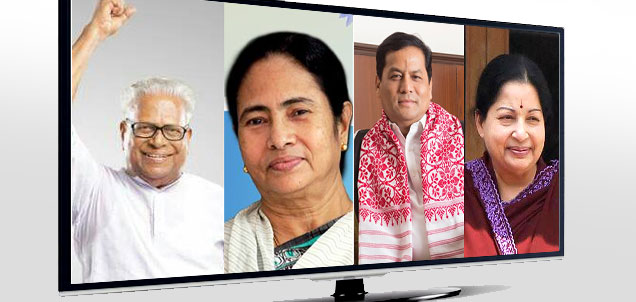
    May 19 and elections results of five states will be announced. Let’s see how many jump various ships then.
     

  • Two reviews of Results Day 2016


    Election Results Coverage: A Mix Of Hits & Misses 

    By Shailesh Kapoor


    There are very few tentpole days in television news these days. The debate format has homogenised the genre, bringing it down to personalities rather than the news or its coverage itself. And if you are a regular news viewer, you would get the feeling that something of utmost national or global importance is happening everyday. There are no slow news days anymore.


    The only real tentpole days left are those of election results coverage, which is just about one day every year. 2016’s election results day just passed by, this Thursday. Four states and the Union Territory of Puducherry went to polls over a couple of months, and it all came down to May 19, the day of the counting and the results.


    The results themselves did not have the edge-of-the-seat element or kahaani mein twist. Tamil Nadu was not as close as some had predicted. West Bengal, Kerala and Assam went on expected lines. Early trends held on till the end, and no Bihar-like moment happened, where several channels, including NDTV, wrongly predicted the outcome in favour of BJP, much too early, based on very thin and almost irrelevant data.


    The English news coverage itself was a case of hits and misses. Over years, election results coverage has started testing the multitasking skills of viewers, which is never a great idea. At one point of time, you may have to pay attention to five things – the ticker with the state-level seat leads, a second ticker with seat-level details, the graphic on the screen trying to analyse a key trend, the anchor talking you through all of this, and a voice, often of a panelist (one of many waiting patiently to get themselves heard), trying to add value to it all.


    When there is no major excitement in the results, like this time, this format exposes its weaknesses. It puts the onus of comprehension on the viewer, instead of the channel taking the responsibility of simplifying things for its viewer, in a way that’s easy to comprehend yet not dumbed down.


    Times Now used some new graphics, under the fancy branding of ‘Data Journalism’. There was too much branding and build-up to it all, but the actual content of these innovations ranged from mildly interesting to banal. While these new properties, with names borrowed from a math class, were a bit of a miss, the channel relied on Arnab Goswami’s unrelenting energy and enthusiasm to have another good day. His gentle rebuking of his panel members, when they entered side conversations, was particularly endearing.


    NDTV was the only English news channel that did not expect you to multitask. They typically had (like always) limited data on the screen, and spoke at a pace (like always, again) that needs to be fast-forwarded 4X to match Goswami. Much as this idea of de-cluttering has merit, there is something soporific, Doordarshan-like about the NDTV coverage over the last few elections. That roundtable set and the casual style just doesn’t bring purpose to the proceedings. In contrast, their analysis shows in the evening have a lot more going, with the best talking heads and some interesting, often lateral, questions.


    One of the more interesting segments of the day featured Arjun Jaitley and Shashi Tharoor debating the results on India Today in the evening. While Tharoor had the tougher job to do (defending Rahul Gandhi is never easy), the debate had depth and civility that’s a scarce commodity these days. Perhaps because the more eloquent talking heads have stopped appearing on television debates barring an odd day like this. Can you really blame them?


    We have a few key states lined up for elections in 2017-18, led by UP, Punjab and Gujarat. Hope we see more hits and less misses in that coverage.


    Why waste monies on Exit Polls 

    By Ranjona Banerji


    Most exit polls showed Mamata Banerjee winning a second term in Bengal. And indeed, the Trinamool Congress and Banerjee did win. But there’s the thing. On May 16, at around 7 pm, the ABP-Ananda poll said she would win 163 seats, C-Voter said 167, India Today said 243, Chanakya said 210, News Nation said 153. As everyone knows by now, Banerjee won 211 seats, higher than her majority of 184 in 2011, when she had formed a government in alliance with the Congress.


    In Tamil Nadu, on May 16 at 8 pm, here were the exit poll predictions: India Today DMK 132, News Nation DMK 116, C Voter DMK 78, NewsX DMK 140, ABP Nielson 132. That is, incumbent chief minister J Jayalalithaa of ADMK was losing, except according to C-Voter who said she would win 139 seats. J Jayalalithaa won 134 seats.


    In Bengal, we see confusion over the number of seats with only Chanakya coming close to reality. In Tamil Nadu, other than C-Voter, we see the exit polls getting it completely wrong. I am using only two examples but they should be enough to bring up once more the point of this exercise. Newsrooms spend a lot of money on exit polls, now almost essential it seems in the hysterical run to be first with breaking news. The range of seats for the Trinamool and the absolute distance from reality in Tamil Nadu are only two examples of how either the process or the presentation is faulty.


    This is not a critique on polling agencies. But it is an indictment of newsrooms which tend to rely so much on them, especially since so many of these exit polls go so wrong. More reporters on the ground may perhaps be a better way of balancing these surveys. The Bihar assembly elections of 2015 and the general elections of 2014 both quite drastically showed that exit polls cannot be fully reliable.


    As far as television coverage of the election results themselves are concerned, we were back to nothing different. You could argue that there is no other way of doing it. But it is still much of a muchness. TV is what most people depend on at times like this and yet there is a limit to how much of the same old stuff the viewer can handle.


    Is it necessary for instance for anchors and experts to start jabbering at a TV studio from 7 am? As usual I opened the Election Commission website at 8 am and tracked the results there. As usual, the EC was at variance with news channels since it showed nothing till around 8.30 am. TV channels by this time were running ahead with all kinds of numbers all different from each other. However, after the Bihar assembly debacle of last year where exit polls, TV pundits and trends on screen had no connection with reality, all our experts and commentators were far more circumspect this year.


    There is a tendency amongst some loyal TV viewers to stick with NDTV and Dr Prannoy Roy for election results and budget coverage. And since NDTV got it so wrong in early in the day for Bihar, this time they ran a script saying that early trends included postal ballets which are not always reliable. A sensible move at some damage control.


    If TV is about the way the way things look and sound – if not necessarily whether it makes any sense – then CNN-News18 was the most sober. Not hundreds of numbers and talking heads vying for attention. Times Now wins that battle hands down as usual — sound, fury and symbols clashing ceaselessly. NewsX remained copycat, as it must. India Today TV was in the middle.


    By the end of the day, they all looked really tired but I must admire the way guests and anchors talked and talked all day though I have no idea what they said. I watched Masterchef, I cannot tell a lie.

  • Ranjona Banerji: Lies, Damned Lies and Data Journalism

    By Ranjona Banerji


    Data journalism is the big thing in this digital age, they tell me. Basically, this means interpreting numbers to present a picture to the reading or viewing public. Alternatively, it is about revealing what is hidden in the crevices between “lies, damned lies and statistics”. You might argue, as I did to myself when I started writing this, that “data journalism” is not therefore new. It has existed long before it got a suitably trendy name. I use the word trendy advisedly and slightly mockingly because in this “digital age” you have to sound both trendy and important. I explain what I mean because in this “digital age” you are also regularly in touch with some of humanity’s most dense specimens.


    There, now that I’ve insulted enough people, let’s get on with it.


    How did data journalism or attempts at data journalism present the recent Assembly election results (Assam, Bengal, Kerala, Puducherry, Tamil Nadu)?


    “On the face of it data journalism” is simple: The Congress lost Assam to the BJP and Kerala to the Left; Mamata Banerji and J Jayalalithaa retained Bengal and Tamil Nadu respectively and the Congress got Puducherry.


    The takeout from this: The BJP is on the rise, having also won three seats in Bengal and one in Kerala, not their normal hunting ground. The Congress’s decline continues since it has lost two states. The Congress-Left alliance did not work in Bengal although the Congress did better than the Left. However, the Left far overtook Congress in Kerala. No one seemed to be bothered by what happened in Puducherry.


    And then there’s “behind the scenes data journalism”. This tells you that the Left contested 452 seats, won 124 and therefore had a success rate of 27.4 per cent. The Congress contested 363, won 115 and had a success rate 31.6 per cent and the BJP contested 696 seats, won 64 and had a success rate of 9.1 per cent. Data will also show you that the BJP’s vote share has come down compared to the general elections of 2012. Further, 450 BJP candidates lost their deposits in these assembly elections.


    You can also compare the BJP’s strike rate in 1984 and now and conclude that it has improved dramatically since then. You can also compare Congress in 1947 to now and conclude an even more dramatic fall.


    Therefore, these numbers can mean anything you want them too. And that is why “data” is not enough – although it is vital – and some real journalism is required for perspective and interpretation. One of the fallouts of social media is that every other person you come across is an expert on journalism without having read a newspaper let alone spent 10 minutes in a newsroom. To them, being a journalist means being a TV anchor or a columnist.


    I would put forward the reporter as the star journalist in this context. Reporters with their noses twitching, ears tingling and their feet stomping on the ground are invaluable. They can present an accurate picture on how people think, feel, act and this helps in interpreting data. The reason why opinion polls – especially when it comes to voting in India – can go wrong is that people lie. But the rigour in the practice of journalism and the advantage of a vigorous and experienced newsroom means that you have to root out the lie and corroborate the facts.


    I should not however have to tell any journalist all this. Journalism is not economics where you can claim all is well with the economy because the Wholesale Price Index has come down even though the price of everyday pulses has gone through the roof and there is drought everywhere.


    And at the end of the day, the BJP won more in real and perception terms than the Congress. And Mamata Banerjee and J Jayalalithaa won more than the BJP most emphatically and dramatically. Data journalism or otherwise.


  • Ranjona Banerji: Has Times Now’s News Hour gone totally beyond journalism as we know it?

    By Ranjona Banerji


    Times Now remains India’s favourite English language news channel, or so it seems. And much of this popularity has to do with Arnab Goswami, its editor-in-chief and star anchor. Goswami has evolved a very particular combative television style, full of the sound and fury of the righteous. Often, he asks the moral question: should people behave like this, should we tolerate that and so on. Often it works. But more and more regularly, especially recently, Goswami has ventured into territory that is no longer strictly journalism by usual standards and is more a combination of a hectoring pulpit preacher, a government spokesperson and Jerry Springer-type talk show host.


    We realise that almost all “prime time” debates on news channels are platforms for cacophony and bad manners. We realise that little is to be gained or learned from watching these except the enjoyment of drama and spectacle. Many people I know, myself included, have stopped watching Times Now because of the noise and nonsense. However, there are times when we need to take stock.


    According to Asad Ashraf, a journalist who has done stories on the Batla House “encounter” and studied at Jamia Milia University, he was invited to Times Now for a discussion on the encounter after a recent IS video was made public. However, according to his report, the discussion turned into the usual yelling match – so far so normal. But then Ashraf was accused by Goswami of being a cover for the terrorist group Indian Mujahideen. Other guests on the show also agreed. Ashraf was not allowed to defend himself. Now, the video of the debate has been taken down from the website.


    This is Ashraf’s account of what happened:

    When Arnab Goswami called Muslim journalist cover for Indian Mujahideen


    This is what I found when I went to the Times Now website:
    http://www.timesnow.tv/Debate-BatlaManInISIS/videoshow/4489589.cms


    This is not the first time that Goswami has let loose on his own panellists or encouraged his guests to attack each other beyond all norms of civilised behaviour. But each time, it is getting more and more dangerous and less and less convincing as any form of journalism. It seems a bit over-the-top to call the programme “News Hour”…


    **


    The Guardian has issued an apology to its readers about the work of a freelance contributor accused of fabricating quotes and information. Unfortunately this remains a problem for all newspapers and news agencies, even those with fact-checking departments. A person’s opinion is one thing. But a person’s ethics is quite another. It is sad and indeed problematic for all good freelancers when these bad apples spoil the pool.
    Incidentally, what is taught in journalism schools these days?
    http://www.theguardian.com/commentisfree/2016/may/26/open-door-column-note-to-readers


    **


    Since the Narendra Modi government completed two years in office on May 26, every news channels scrambled to get any Union minister they could to talk about the government’s achievements. As usual, no perspective, more like PR efforts. As some wag on Twitter pointed out, the only way you could escape a politician was by watching a sports channel!


    Newspapers and websites concentrated more on editorials, columns and analyses to assess the government but here too, we were treated to BJP president Amit Shah and Venkaiah Naidu, Urban Development minister, extolling the party’s and government’s virtues. Still, better than those loooooong TV interviews.


  • Ranjona Banerji: No news is not good news

    By Ranjona Banerji


    A severe storm on Saturday took with it several power lines in Dehradun. The result was a power outage that lasted over 48 hours. The further result was that all regular channels for news and information slowly trickled down to word of mouth, hearsay, rumour and gossip. No electricity leads to phones running out of charge – obviously. What little you have, you save for emergencies.


    So how much did we miss the news? Well, we did want to know what has happening to us. But we got no newspapers on Monday, whether because of the power outage or the local vendor’s inefficiency, we have no idea. According to word of mouth news and the electricity department, prominent areas of Dehradun city had no electricity at all for between 24 and 50 hours. Empirical evidence showed trees and electricity poles uprooted all over.


    Yet, Tuesday’s newspapers – Tribune, Times of India – which usually have extensive city coverage had nothing at all in them about Dehradun’s plight. There was one story about the damage in Uttarkashi and Tehri regions in Tuesday’s edition of the local TOI as well a box about the possibility of more heavy rain. The Tribune had even less than TOI and concentrated on the heavy rain warning.


    I expected nothing from The Hindu, Indian Express and Asian Age because they do not present themselves as local papers although they did cover the rain warning. I have met some of the Times of India reporters and find them to be committed and on-the-ball. So who does the news editor’s job? Any rookie will tell you that local news is paramount and when you are suffering locally, you do not really care about general and political news of “national importance”!


    The Hindustan Times which has some excellent reporters and good Dehradun coverage also fell short as far as Dehradun news is concerned. Here again the focus was Uttarkashi.


    The Pioneer, again with good reporting staff in Dehradun, is the only newspaper website which mentioned Dehradun’s problems on Monday morning. On Tuesday however, the power outage was not mentioned and instead we were told that Doon residents were happy with the fall in temperature after the rain and that jaundice cases were rising.


    It is not surprising that Uttarkashi got prominence, given that there was extensive damage and casualties. Even more important for the rest of India is the fact that the Char Dham Yatra is on and therefore pilgrims from all over India are affected.


    But what does it cost any newspaper to have a small 400-word story on how the citizens of parts of Dehradun suffered after the storm? After all, local news pages told us on Tuesday about the following vital news stories: officials in Udham Singh Nagar were unhappy with the transfer of the district magistrate, a fight over the Uttarakhand Rajya Sabha seat, a boy who did well in his board exams, a woman who climbed Mount Everest, writer Bill Aitken’s birthday plans, traffic jams thanks to political rallies, apart from the Uttarkashi damage. You know what? Barring Uttarkashi, I don’t really care.


    I know that my gardener got hit on the head by a flying tree and the local grocer had to throw away Rs 15,000 worth of ice-cream. I know that hundreds of trees fell down or were damaged, some on buildings and others on roads and power lines. I know people were who trapped inside their homes for 24 hours because of debris and related damage. This is what I’m interested in. And I suppose I have to go back to my days as a reporter to write my own story!


  • Ranjona Banerji: Fun and games on news telly

    By Ranjona Banerji


    Last night (Thursday) on English television news, between 7.30 and 9 pm, was all fun and games as usual. That is, both Times Now and India Today TV had exclusive sting operations on how MLAs can be bought and sold, with a focus on Karnataka. It’s deeply embarrassing when two news channels have done “exposes” on the same subject and when they are placed next to each other by the cable operator or satellite dish service. O dear.


    But perhaps what is more interesting is what was not covered in this time frame by most channels – the allegations of a corrupt land deal against senior BJP leader from Maharashtra, Eknath Khadse and the verdict in the Gulbarg Society case. This was one of the more vicious attacks during the Gujarat riots of 2002, when 69 people were killed by rampaging mobs.


    Barring Karan Thapar on India Today, who hosted a sharp and no-holds-barred discussion on Khadse, what did we have?


    There was lawyer Indira Jaising and the BJP’s GVL Narasimha Rao – who has evidently been told by someone he should smile more – on Barkha Dutt’s show, discussing how Jaising’s NGO has had its licence cancelled.


    Times Now was very angry about corruption in politics over its exclusive but shared with India Today expose on the MLA market. Ads scrolling at the bottom of the screen promised us that Arnab Goswami was going to be even angrier. Rajdeep Sardesai appeared on screen with sombre gravitas – unlike Times Now’s shrill invective – to discuss political corruption and greedy MLAs.


    CNN-News18 was on another tangent with people complaining about how they haven’t got their flats on time. A most welcome show of helpfulness perhaps better suited to the daytime. NewsX had star anchor Rahul Shivshankar screaming at some panellist to take a stand – it looked so absurd that I did not bother to wait to find what he was supposed to take a stand on. Probably never to appear on NewsX again.


    CNN-News18 did however take on Khadse and Gulbarg in its 9 pm show.


    **


    As usual though, some TV journalists were obsessed with allegations about Khadse’s purported calls to gangster Dawood Ibrahim rather than the political outfall of his land deals – which are likely to be extremely significant for Maharashtra.


    It is intriguing though that while corruption consumes our self-righteous TV colleagues they stop suddenly when it comes to going further. They have some pet subjects. Like MLAs and horse-trading. But accusations of financial irregularities by Maharashtra minister Pankaja Munde are easily forgotten. It was The Indian Express and my former colleague Sandeep Asher who investigated Khadse’s land deal, so once again, hard work requires more than waving a few papers in viewers’ faces and showing us grainy videos with garbled voices.


    I am not drawing the obvious inference of fear of government anger but…


    **


    Meanwhile I’m starting to feel really sorry for government spokespersons. How long can they keep saying what amounts to: “I know nothing but I am sure the government/party will do something”. Also interesting is the trend of having a “BJP supporter/Modi fan” as part of a television panel. (Do they do this with other parties?) Either these supporters know more than the government spokesperson also on the panel or they are there as ballast to prove that no one knows anything.


  • Ranjona Banerji: Is it right to expose Bihar ‘toppers’ on news television?

    By Ranjona Banerji


    Of all the news stories that have grabbed our attention in the last few days – the inexplicable cult at Mathura being top of the list – one has stood out as an example of media overreach, to me at least.


    At first glance, you might consider the TV interviews with students from Bihar who “topped” their Class XII a great scoop of a story. By demonstrating on camera how little these students know about the subjects they studied – prodigal science for political science which is about cooking, not knowing the connection between H2O and water – this report proved that exam results are likely fudged, that undeserving students become “toppers”, that the Bihar education system is in the doldrums. The photograph of parents, friends and relatives scaling up the walls of a building in which exams are being held to help students cheat comes to mind.


    But you probe a little deeper and what has this “expose” achieved but to publicly humiliate young people who are themselves the victims of a system. There may have been many ways to do the same story without making nationwide laughing stocks out of these students. Their public takedown is going to live on the internet forever. It could be argued that the students were intimidated by TV cameras, that their minds went blank at the excitement of being interviewed for their “achievements”, it could be that they were genuinely ignorant. To me at least the journalists posing the questions sounded very intimidating and judgmental. A set-up most likely.


    And since when is either ignorance or stupidity such a big crime? The bigger criminal to me seems to be the education system that they went through. Why not put the teachers and examiners through the same TV interview test as these students.


    There was also an underlying tone to the first story and several subsequent ones that the education system in Bihar was particularly to blame. But come on. Almost every state and central education system is faulty, destroyed by political will and administrative apathy. First tackle why such a small percentage of every budget is spent on education and then have some national chest-beating on the stupidity of students.


    But as every journalist with half a conscience knows, no one is really interested in such stories. And in a typical inversion of logic, we spend much time and effort on higher education, asking for more and more. But without sound primary and secondary education, what else will you get but duffers? Again, we in the media will focus on scores and toppers and when we go beyond that, we make students the target of our scorn.


    A short visit to village schools in India will demonstrate that often it is a miracle that anyone gets educated at all. One teacher for all classes who usually hasn’t been paid for months, if the students are lucky two teachers, teachers who have to make the mid-day meal so cannot teach, toilet blocks which are blocked and locked, no equipment, buildings which most likely have no chairs, tables, windows and doors.


    I don’t want to sound like a hypocrite about this. There is nothing wrong with journalists putting people on the block. But there is a difference between being tough with the head of the Maharashtra Navnirman Sena Raj Thackeray, which as we saw with Times Now does not really happen, and taking on some poor kids.


    Here’s a welcome follow-up story from The Indian Express, which underlines the cruelty of this “expose”:

    http://indianexpress.com/article/india/india-news-india/a-child-who-faces-camera-for-the-first-time-can-get-nervous-bihar-topper-ruby-rais-grandfather-2836594/


    **


    As a last comment, as a person who conducted entry level tests and interviews for journalists in more than one newspaper, do I have some stories to tell about the stupidity of journalists! O boy!


  • Ranjona Banerji: The world’s media bids farewell to boxing legend Mohammad Ali

    By Ranjona Banerji


    The death of boxing legend Mohammad Ali on June 3 was one of those rare occasions when most of the world mourned. Ali was 74 and had been suffering from Parkinson’s for years. His larger-than-life persona, his boxing prowess, his fight against racism, his conversion to Islam, his refusal to fight in the Vietnam War at great personal cost, his kindness to strangers, his philanthropy and the ups and downs of his personal life all made him much more than a beloved and talented sportsperson. He was a symbol of so many things that it is hardly surprising that so many agreed that Ali was correct when he called himself “The Greatest”!


    Front pages of most newspapers all over the world and top of the news for most news channels were therefore to be expected and were definitely well-deserved. Here in India, many wrote charming pieces about their encounters with Ali, when he visited India for instance, and elsewhere and others wrote angry pieces about how our sportspersons did not and do not have Ali’s courage of conviction.


    As is the norm, international writers did not whitewash Ali’s mistakes and contradictions and the seamier parts of his life and personality. This is important because often in India, we expect all people we ourselves have placed on a pedestal to be perfect. And once we do that, reality disappears. The Indian media is especially guilty of this and most particularly with film and sports personalities.


    It was interestingly, our resident BJP fans on Twitter who were the most critical of Ali. It was interesting because Ali’s links to India were minimal but mainly because of this desperate need of the rightwing on Twitter to jump onto any bandwagon to get noticed. Ali’s chief crime for them appeared to be that Cassius Clay converted to Islam, which given the Hindu majoritarian ideology of the BJP is hardly surprising. What this has to do with Ali on the day he died is another story.


    But for the most part it was appreciation of a great person and an outpouring of sadness at a loss. One of the better days for a media watcher.


    **


    “Trending” on Facebook this week, have been some interesting stories. Like Virat Kohli hugged Anoushka Sharma. And how Shilpa Shetty’s husband surprised her on her 41st birthday. For all of you who fulminate on how trivial newspapers and news television has become, remember, “trending” on Facebook meant that Facebook users liked these news items. Cricket and Bollywood and Bollywood and Cricket.


    This is what people read no matter how much they pretend that they are desperately concerned about the education system in Bihar. OMG, did Virat really drop Anoushka to the airport? And did he kiss her? And whatever Raj Kundra got for Shilpa Shetty which to be honest I did not bother to read. My interest in glamour trivia is often at abysmally low levels.


    It was even more interesting therefore to see the anger and frustration with the Film certification board’s tendency to act as a censor board almost 30 years after the Emergency ended. Everyone has spoken out about the rash of cuts suggested in the film Udta Punjab by certification board chief, especially on Twitter and later on television. Of course, people have been ranting about Nihalani for ages and it has made no difference which might point to the limits of media protests or the intractability of the government.


    Director Anurag Kashyap also producer of the film Udta Punjab appeared on Twitter and television to tell us that he felt he was living in North Korea and that the experience was Kafkaesque. Most journalists took him at face value because the space for Kafka in an atmosphere dominated by a possible kiss from Virat Kohli is very limited.


    At any rate, the media has kept us fully informed on the fight over a film on the drug problems in Punjab, with analysts tackling issues of politics, freedom of speech and expression and the travails of film-making. In all this I did not notice anything from the Chief Upholder of the Government in The Film Industry, Anupam Kher. Did you?


  • Ranjona Banerji: An award for those who can watch TV debates every night!

    By Ranjona Banerji


    The shooting at a gay nightclub in Orlando, Florida which has left 49 people dead and 53 injured – at last count – quite rightly dominated news cycles in India and abroad. Although in India it did compete with the fight over censorship, freedom of expression and the film Udta Punjab.


    Reports started with the death of a singer at the nightclub Pulse, but it soon became clear that the attack was more horrific than that. Once the identity of the shooter became clear – Omar Mateen, an American born US citizen of Afghan origin – the focus shifted to Islamic terrorism, especially since Mateen had pledged allegiance to IS.


    However, there was a seemingly conscious attempt by American investigators and government spokespersons not too walk too far down that road without evidence. This attitude was reflected in the media as well. Barring Republican presidential nominee Donald Trump – who has a good future as an Indian politician – most were not willing to stick their necks out so far.


    But even then the media and social media reflected the various aspects of this crime. For one, it was the largest mass shooting in a country which has more mass shootings than most others. For another, it was a vicious attack on the gay community and on people having fun. For a third, there definitely appeared to be some religious angle. For another, was the focus on the perpetrator taking away the pain of the victims’ and their families?


    This is how a story unfolds and that is why initial caution is more advisable than jumping into the deep end at first instance. Western TV news has shown some signs of initial caution in such instances – especially since Anders Brevik’s mass shooting in Norway but Indian news television perhaps still has some lessons to learn.


    Current news stories suggest that Mateen was himself gay and a regular at Pulse and his ex-wife says he was violent and bi-polar. CNN meanwhile has decided to focus on the victims and not the shooter.


    **


    The Bombay High Court may have ended the whole fight over the film Udta Punjab, but it provided much grist to news television’s mill. We had “debates” on the matter for almost a week. Like most TV debates, they reached no conclusion, they had various party spokespersons shouting at each other, they confused political one-upmanship with the problems of drug-dealing and addiction with the concept of freedom of expression with the need for a certification board to behave like a censor board.


    More and more I admire people who can watch these TV debates night after night. They deserve the highest civilian awards for bravery.


    **


    A diary item in Coomi Kapoor’s Sunday column in The Indian Express tells us that the Prime Minister, his Cabinet and his party were very upset that the media did not focus enough on an award that he received on his recent trip to Afghanistan. Instead, the headlined story was the follow-up of a hit and run accident involving a teenager at the wheel of a Mercedes and the death of pedestrian. Apparently, several tweets were sent from ministers questioning the news priorities of the media.


    Two points to note here. The first is would such a miss of the PM’s foreign travels and honours been possible two years ago?


    And the second is India has one of the highest mortality rates when it comes to road accidents. According to government figures, some 400 people die every day on Indian roads.


  • Ranjona Banerji: Rising prices sees end of media’s love for Modi govt

    By Ranjona Banerji


    The general perception of the media in India, especially the English media, is that it is a monolithic structure paid for by the Vatican, the Saudis and remnants of the USSR (never China, mind you) with the sole purpose of denigrating and destroying India’s great culture and past. All journalists are part of this conspiracy which has its origins in the Congress Party, Jawaharlal Nehru’s family and the university named after him and thus deserve to be called “presstitutes”, “newstraders” and so on.


    Luckily for the media’s diversity – if not for its sanity – once Narendra Modi’s run to the prime ministership began, many journalists in the English media saw him as the messiah. Because public memory is so short – and journalists sometimes top this list – this is not the first and only time that the media has shown itself in different colours (shhh, don’t tell the conspiracy theorists!).


    During the Emergency, many journalists objected to restrictions on Constitutional rights. Journalists also supported VP Singh in his rebellion against Rajiv Gandhi – many of them starry-eyed women as some cynics today like to point out! I still remember the excitement at the Bombay Union of Journalists’ office when he came to address us. In the Bofors exposures, it was the media that ran fastest and longest with the story of bribes paid to Rajiv Gandhi and his friends, long after politicians of all hues preferred to forget about it.


    Badly paid as journalists were, it was somewhat inevitable that many were concerned with the problems of the less fortunate. Glamour journalism as we know it today did not exist. Even when it came to film stars, magazines like Stardust were far more cynical and critical and sometimes wickedly funny than today’s rah-rah form of journalism. And when you looked around you in India, what did you see but the miseries of your fellow Indians. How could you in any good conscience decide that they deserved no help?


    It was LK Advani’s Ram Janmabhoomi movement which saw a big religious schism appear in journalism in India. For the first time, many realised that so many of their colleagues were in fact distinctly pro-Hindutva and anti-minority. Everyone knew, for instance, that Girilal Jain, the iconic ivory tower editor of The Times of India was vaguely sort of, maybe, you know pro-Hindutva. But those were different times, with less scrutiny and frankly, less media.


    Economic liberalisation in 1991 and the advent of television changed the country’s ethos and the country’s media. We were told that Hindus, long forgotten and ignored by our evil secular socialist Constitution, were now coming into their own. I even contributed to a story for India Today magazine on the “saffron-clad yuppie”, a new and intriguing phenomenon for us.


    But ideological schism or no schism, most journalists are just journalists. Things get back to status quo sooner or later when stories have to be done and somehow, a balance is found. When I was deputy resident editor of the Times of India in Gujarat in the 2000s, the various branches of the same newspaper reacted differently to the riots, with Mumbai being the least interested in what has happening – until some of us protested that a story that the world was interested in was being ignored. In India Today, the local bureau chief swung for the rioters while the group’s new channels told the story like it was. But the group itself at the time was seen as pro-RSS.


    My main point is that nothing of what we are seeing now is new. Much closer to our time, we have seen that the same news channels that lionised Arvind Kejriwal during the India Against Corruption movement are now the most critical of him as chief minister of Delhi.


    And as far as India’s messiah Narendra Modi is concerned, for the first time since 2014, I have begun to notice a change in the tide in previously pro-Modi journalists and media houses. The sticking point is one that has been a problem for all governments: rising prices. The cost of dal did not cut it but tomatoes at between Rs 80 to Rs 100 a kg and the obfuscation of government spokespersons, have many more questioning where that “achche din” promise has gone.


    And thus the cookie crumbleth.


  • Ranjona Banerji: The News via Facebook

    By Ranjona Banerji


    No newspapers arrived yesterday and only Yoga Day on the news this morning. And then people wonder why you have to go to the internet to find out what’s happening in the world. “Trending on Facebook” is my current favourite source of news. Right now, as I write this, these are the top three news items of paramount interest to a Facebook algorithm near me.


    1 Fantastic Beasts and Where to Find Them: Poster Released for Upcoming Harry Potter Spinoff Film.

    2 Ishant Sharma and Pratima Singh: Cricketer and Baseball Player Engaged, Photos Show.

    3 Finding Dory: ‘Finding Nemo” Sequel Breaks Box Office Record with $135.2 Million Opening Weekend


    And once more this proves to me that people are really not interested in serious matters and that Facebook really believes in “upper/lower” although we were taught that upper/lower is not an easy reading format.


    And also I am seriously surprised that Game of Thrones has not found a mention. Although that may well only prove that the Facebook algorithm follows the wrong people. There is hardly an issue of Time magazine that goes by, for instance, without a #GoT reference. (If you gotta say it, you gotta hashtag it.)


    The other day, when the newspapers had arrived, I read about an interaction between the Hindu’s Readers’ Editor and the Hindu’s readers. As usual, the questions from the readers were the same: why is all news negative news and why is your newspaper mean to the people I like?


    Much as readers are pained when they feel that they only get bad news from the media of their choice, “good news” is a frothy myth of nothingness. I’ve said it before and I’ll say it again. No one would read any newspaper which only said, “Six people went for a nature walk today in my neighbourhood and were very happy when they noticed two butterflies” on a day when there has been a terrorist attack in their city.


    However, judging from Facebook, absolutely anodyne information about entertainment and famous people, is top of the pops for your average person. Think of that every time someone you know blames “the media” for concentrating on the frivolous and for publishing sections like Bombay Times and so on.


    **


    As for “the media” being prejudiced about people you like, this is one of the sweetest and most plaintive little whines you can hear. About 90 per cent of the time it comes from some pro-rightwing person who surprisingly reads the edit pages. I say surprisingly not because pro-rightwing people do not normally read edit pages but because newspapers managements routinely tell editors that no one reads edit pages.


    However, thanks to the internet where opinion – whether from impassioned and well-intentioned bloggers or seasoned commentators – matters, people feel strongly about how people think. I doubt that newspaper managements – often sadly never the brightest crayons in the pack – will realise this, but viewpoints continue to rule social media. As for the sad readers who feel their favourite opinions are being given short shrift, the only consolation for them is that one day the wheel will turn their way.


    **


    A tweet from Rahul Kanwal of India Today TV sometime last week was amusing and intriguing. Kanwal accused Times Now of stealing a story 24 hours later with the “same guests, same story” about an ACB report. Since I rarely watch either news channel, except Karan Thapar on India Today TV, can anyone please clue me in?


  • Ranjona Banerji: Does the BBC think Indians aren’t interested in Brexit?

    By Ranjona Banerji


    I was going to start this with a rant against the BBC World Service and with other foreign news channels which broadcast to India. All of Thursday, as the world wanted to know about Britain’s vote on staying or leaving European Union, international news channels were quite on their own usual pet news subjects. This appears to be part of a misconception on the part of editors or managers that the countries which these channels broadcast to are not interested in what is happening in the countries they originate from.


    That is why, I imagine, the extraordinary Democratic Party “sit in” over control was not seen as top news by CNN International yesterday. And the German channel DW was more concerned with some football league as news of a gun attack in Germany was breaking across other news channels.


    The BBC World Service is perhaps the best at this misconception. From an ex-colonial point of view (mine), it almost appears like “white-splaining” – that is, I the BBC, know better than you (the brownie) want to know about. That is why, I assume, anything to do with British royalty gets maximum and endless play on the BBC World Service. The BBC weather service is best at this – people dying all over India from drought and lack of rainfall and the meteorologists ruing areas where there are chances of rain while glorying in all that killer sunshine. I am also happy to discover that Astana has the maximum number of BBC World Service weather forecast viewers.


    But while from Thursday to Friday morning India time, CNN International was ahead of the BBC on the “Brexit” vote, luckily by 9 am India time, the BBC woke up to the Brexit results and provided blanket coverage, presumably from the BBC newsroom itself and not the World Service.


    And when they get it right, they do it quite well: Sober discussions with people being allowed to have their say without hysterical interruptions – not to mention a choice of intelligent and articulate guests. Even better, politicians with opposing viewpoints sat next to each other without screaming their heads off, without bringing everything down to an uncivilised cacophonic civilisational crisis.


    A quick look at international news channels at 10.30 am on Friday saw every channel (CNN, BBC, DW, RT, TV5Monde Asie, France 24, ChannelNewsAsia, Al-Jazeera and Australia Plus focusing on the UK referendum.


    All Indian news channels were on the top news except for the delightful News 9, which had local Karnataka News. Surprisingly, even business channels which normally operate in a separate galaxy from all other news channels had the UK referendum as top news. Yes, I know I know, markets have a role to play here.


    One can only hope that the results themselves – UK to leave the European Union – will be debated through the day. It is highly likely that we will go back to Syria and Astana.


    **


    The film star Salman Khan is known for his popular movies and loyal fans but also for his controversial behaviour and for several court cases against him for manslaughter and killing endangered animals. His latest comment that a tough shooting schedule which left him feeling like a “raped woman” has created enormous outrage on social media and in the mainstream media.


    What has saved Khan every time is his clout within the industry and in larger circles of influence, not least in the media. Thus, no sooner did his unsalutary remark become public than his apologists within the media swung into action. That his remark was unsalutary is undoubtedly my opinion and we can debate that. But questions need to be asked about those in the glamour media who cannot distinguish between journalism and fandom.