Category: MxM JOURNALISM REVIEW

  • Journalism suffers as cash crunch impacts newsgathering


    By A Correspondent


    Every year, for the last decade-odd, the Pew Research Center, a non-partisan source of data and analysis, presents a report on the health and status of American journalism. So what’s it got to do with us in India?


    After all if there’s something that we haven’t blindly copied from the US of A is American news media practices. Some practices like paid content are homegrown and are flourishing.


    But as the Indian news media suffers from a liquidity crunch, it’s interesting to look at the impact that cash-starved news outlets have on the American public. Here’s a look at the major findings which we have taken from the Pew Research Center communique: In the news media, a continued erosion of reporting resources has converged with growing opportunities for newsmakers, such as political figures, government agencies, companies and others, to take their messages directly to the public. The public, for its part, is not very aware of the financial struggles that have led to the news industry’s cutbacks in reporting, but nearly one-in-three (31%) say they have stopped turning to a particular news outlet because it no longer provides the news they were accustomed to getting.

     

    Ranjona Banerji: Disquieting news for mediaAlthough the Pew Research Centre’s State of the Media report doesn’t paint a rosy picture for American media, it applies to journalism and journalists everywhere, notes Ranjona Banerji

    The report pinpoints multiple signs of shrinking reporting power. For newspapers, estimates for newsroom cutbacks in 2012 put industry employment down 30% since its peak in 2000 and below 40,000 employees for the first time since 1978. On local television, where audiences were down across every key time slot in 2012, news stories have shrunk in length, and, compared with 2005, coverage of government has been cut in half and sports, weather and traffic now account for 40% of the content. On cable, coverage of live events during the day, which often requires a crew and correspondent, fell 30% from 2007 to 2012, while interview segments were up 31%. And among news magazines, the end of Newsweek’s print edition coincided with another round of staff cuts, and Time, the only general news print magazine left, announced cuts of roughly 5% in early 2013 as a part of broader company layoffs.


    This adds up to a news industry that is more understaffed and unprepared to uncover stories, dig deep into emerging ones or to question information put into its hands.


    “There are all sorts of contributors in the evolving landscape of news and, in many ways, more opportunities for citizens to access information,” says Amy Mitchell, acting director of the Pew Research Center’s Project for Excellence in Journalism. “But there are more signs than ever that the reduced reporting power in the news industry is having an effect and may weaken both the industry’s capacity to produce in-depth journalism and its credibility with the public at the same time that others are gaining more voice.”


    A video summary of lessons from the presidential election, documents this trend. Campaign reporters acted more as megaphones, rather than as investigators of the assertions put forward by the campaigns. In the 2012 race, only 27% of statements in the media about the character and records of the presidential candidates originated with journalists, while roughly twice that many came from political partisans. That is a reversal from a dozen years earlier when half came from journalists and a little more than one-third came from the campaigns. At the same time, the campaigns also found more ways than ever to connect directly with citizens.


    Now, we may not necessarily see this happening, as our news media will continue to deploy heavy resources on the 2014 elections. Ratings and readership typically see a new high around every election and no news media organization can really afford to lose out. However, it would be interesting to see if the bigger papers and channels and magazines cut back next year due to pressures of monies.


    Here are the key findings from the Pew Center report (the notings in italics at the end are our comments):

    :: Limited Public Awareness of News Industry Challenges: Fully 60% of Americans say they have heard little or nothing at all about the financial problems besetting news organizations. Even so, 31% have stopped turning to a news outlet because it no longer provided them with the news they were accustomed to getting. Men have left at somewhat higher rates than women, as have the more highly educated and higher-income earners-demographic groups that past Pew Research studies have shown to be heavier news consumers.

    The alternatives to traditional media are few in India, but there is a growing class of people who don’t like the nightly studio fights and corrupt practices in some the newspapers


    :: On CNN, Fewer Produced Packages; On MSNBC, Opinion Dominates. CNN-which has branded itself around reporting resources and reach-cut its primetime story packages in half and daytime live event coverage nearly in half between 2007 and 2012. Even so, in an analysis of coverage across the entire day, CNN was the only one of the three big cable news channels to produce more straight reporting than commentary. At the other end of that spectrum lies MSNBC, where opinion filled a full 85% for the days studied. On Fox News, opinion accounted for 55% of the newshole. The report also finds a changing cable news landscape: Daytime programming now resembles primetime, with interviews and opinion replacing coverage of live events and breaking news.

    Our primetime news is already full of studio discussions and hardly any news reportage. That’s a format we’ve had for some years now.


    :: Despite Political Ad Windfall, Local TV Newly Vulnerable. Viewership of local TV was down in every key time slot in 2012, with an average loss of more than 6% for local affiliates of the four major broadcast networks. Local TV remains a top news source for Americans, but the percentage who say they watched it yesterday is dropping-and dropping sharply among younger people. Advertising revenues were up for the year, but were largely a result of the record $2.9 billion in political advertising. And a content analysis of local television finds that the growing areas of the newscast-sports, weather and traffic-are also those that are becoming increasingly available on-demand from a wide variety of digital sources.

    Not very relevant in India. Local cable news is patchy in India, with content integrity suspect. However, there are a few bright sparks. Few and, regrettably, far between!


    :: Two New Areas of Digital Ad Revenue Already Moving Out of the Reach of News. In the rapidly growing market for mobile display advertising, six companies already draw 72% of the market share-none of which produce news. Facebook is one of the six, and though its first mobile ad product came in mid-2012, the company says mobile display already accounted for 23% of its fourth quarter ad revenue. Local digital advertising, a critical ad segment for news as the majority of outlets cater to a local audience, is also growing-up 22% in 2012. But improved geo-targeting is allowing many national advertisers to turn to Google, Facebook and other large networks to buy ads that once might have gone to local news media. At the same time, Google and Facebook are also moving directly into local ad sales. Google is now the ad leader in search, display and mobile.

    In India, digital news media were never really as hot as the matrimonial, job and travel sites. And even if the general portals are popular, it’s because of the girlie pix upfront.


    :: Sponsored Advertising Increases Nearly 40%-And Is An Area Where News Organizations Have Taken Early Steps To Move In. Though it remains small in dollars, this ad category grew 39%, to $1.56 billion; that followed a jump of 56% in 2011. Promoted tweets on Twitter account for some of the growth, along with the rise of native ads-the digital term for advertorials containing advertiser-produced stories-which often run alongside a site’s own editorial content. This may come with some risk, though, as certain news outlets have found this type of advertising can cause confusion among readers who cannot differentiate between advertising and news content.

    In the US of A, they are at least tagging them sponsored/ native/ whatever. Out here there’s a general ‘advertorial/promotional feature’ label put somewhere. Paid content rules, not just on news media, but also in the form of informercials… like the paid-for Radio Jockey mentions on FM radio!


    :: Paid Digital Content Experiments on the Rise. Some 450 of the nation’s 1,380 dailies (33%) have started or announced plans for some kind of paid content subscription or paywall plan, in many cases opting for the metered model that allows a certain level of free access before requiring users to pay. This is already helping rebalance the print industry’s heavy reliance on advertising over subscription revenue. Indeed, digital advertising for newspapers grew only at an anemic 3% rate in 2012. At the New York Times, circulation now accounts for more than advertising revenue – attributed in large part to its two year-old digital subscription program. Small and midsize papers, while not near an even split are seeing success as well.

    Note: paid digital content not to be confused with the paid content we have here. Paid-for online content hasn’t really worked very well, though it’ll be interesting to know how some specialized websites are doing.


    :: Friends and Family Spur News Consumption. Two-thirds of Americans at least somewhat often seek out a full news story after hearing about an event or issue from friends and family. Fully 72% get most news from friends and family via word of mouth. But social media is a growing component: 15% of U.S. adults get most of their news from friends and family through social media; that number rises to nearly a quarter of 18- to 29-year-olds.

    This number isn’t as large here, but suffice to say that social media and Twitter are increasing in importance and a fair number of regulars depend on social media for their news updates.


    The 2013 State of the News Media  includes an infographic of the major trends of the year, an essay on digital news developments over the last year and detailed chapters on seven major media sectors – newspapers, cable news, network TV, local TV news, audio, magazines and for ethnic media this year, African-American news outlets. There are also four special reports: a content analysis examining changes in television news in the last five years; two new national surveys examining news consumers’ attitudes and behaviors; and a video revealing five major lessons from the 2012 election. Please visit: http://stateofthemedia.org/
     

  • Ranjona Banerji: Sad, as newswallahs have a blast over Dutt

    By Ranjona Banerji


    As expected the whole news cycle became about film star Sanjay Dutt after the Supreme Court ruled on the sentences handed out in the 1993 Bombay bomb blasts case. Never mind that 257 people died in the serial blasts or that over 700 were injured or that this was the worst such attack the country had ever seen until then or that the blasts were a reaction to the demolition of the Babri Masjid and the riots that followed. What can all that matter when a film star’s conviction was upheld?


    There was little new there either – Dutt had been given six years by the TADA court in 2006 which was upheld by the Bombay High Court and now the SC had reduced it to five years. The chance of a pardon was slim given the enormity of the entire case. But did our esteemed TV colleagues care? Having spent an hour or so cursorily examining the death sentence to main accused Yakub Memon, it soon became all about Dutt with Bollywood celebs weeping and bemoaning their fate. It took film critic Rajeev Masand to put things in perspective on CNN-IBN: “Bollywood does not think logically”. Indeed.


    Many channels also ran retrospectives of Dutt’s life in the movies and pulled out old interviews with him, including with Arnab Goswami being so sweet and nice on Times Now unlike the fire-breathing dragon he turned into last night. Odd, because Goswami’s interview with Dutt was also after the star had been convicted…


    Kudos to Headlines Today for digging into the Living Media archives and pulling out a video interview with Yakub Memon in the days before Headlines Today or indeed private TV was invented in India. Some excellent news sense on display there and a break from the boo-hooing over Dutt.


    What does one make of Press Council of India chairman Markandey Katju’s letter to the Maharashtra governor begging for clemency for Dutt? Katju thinks that since Dutt quoted Mahatma Gandhi in his “Munnabhai” series of films, he deserves the sort of mercy described by Portia in Merchant of Venice. Even I who knows nothing about Bollywood might venture that it was the film-maker who came up with the famous “Gandhigiri” concept. Still, here it is: http://www.thehindu.com/news/national/katju-seeks-pardon-for-sanjay-dutt/article4535084.ece


    Also as expected, most newspapers barring The Times of India’s Mumbai edition fell short. The reason in simple — most newspapers in India have done away with institutional memory and got rid of (or refused to higher) anyone above the age of 45. This means that few staffers were around when the bomb blasts happened 20 years ago and for all I know their best source of reference is the film Black Friday. I have worked with these bright young people with no more than about seven years experience in journalism in 2006 when the TADA court pronounced its sentences, many of whom have tried to teach me about the events based on viewing the film. I hasten to add that I was in Bombay on March 12, 1993 and I did cover the aftermath for Mid-Day. And I haven’t seen the film. I reckon most people incharge today were either being fed Farex in their mummies’ laps or drinking Bournvita on their way to school when the blasts happen. TOI for all its faults and unlike the rest usually hangs on to some old fogeys.


    I was surprised to see that the Indian Express also led with the Dutt saga. Also, I would have thought that someone would have pulled out Bollywood reporters of yore to recount all the exciting love drama that happened around Dutt at the time. Possibly all those oldies have also been put out to pasture.


    Almost no one mentioned the mysterious circumstances under which Yakub Memon returned to India, which did cause much comment at the time.


    Well, you can’t have everything and when it comes to the Indian media, usually you won’t.


    **


    Siddharth Vardarajan, editor of The Hindu, has gone where (almost) no man or woman has gone before. He has directly taken on Arindam Chaudhuri of IIPM for falsely using an advertorial article as an endorsement. The clarification states that IIPM paid for material which was put into a special supplement marked “advertorial”. It then used the so-called article in an ad, claiming that the Hindu had called the institute a “B-school with a human face”. Vardarajan contends that this article was written by IIPM and therefore Hindu had nothing to do with it. The clarification ends with these words: “The Hindu hereby would like to make it clear to current and prospective students of IIPM that it has not made any such editorial endorsement of the institution. We have now formally written to IIPM asking it to refrain from repeating the claim, and putting it on notice of our intent to proceed suitably against it if it persists in doing so.”


    It is well-known that because IIPM advertises heavily in the media, most media organizations are wary of criticising owner Chaudhuri. There have been several instances where editorial has been forced to hold back articles and comments. Chaudhuri also has the habit of filing cases against media houses and journalists all over the country to harass them.


    It will be interesting to see whether this clarification will mean that Vardarajan spends a lot of time now in Sikkim! http://www.thehindu.com/news/national/iipms-claim-on-the-hindu-a-clarification/article4530742.ece


    **


    The Mumbai Press Club has for some time now been at the forefront of several journalistic initiatives and is setting itself up as an institution of some repute and meaning – beyond the excellent cheap booze!


    The talk by editor-in-chief of The Guardian Alan Rusbridger on journalism in the digital age on Tuesday was an eyeopener for the Indian media on how the online world has to be embraced and enhanced by mainstream journalists and organisations. As a result of its ground-breaking efforts, The Guardian which is the seventh or eighth most read paper in the UK is the third most read paper online (in the world that is) fast catching up on the New York Times. It also gets some 25 per cent of its revenue from its digital efforts. Rusbridger’s speech was witty, informative and revelatory. And a warning for the Indian media of getting lost in the wilderness if it keeps snoring in the digital space for much longer.


    Ranjona Banerji is a senior journalist and commentator. She is also Contributing Editor, MxMIndia. The views expressed here are own. You can post your messages below or reach her directly via Twitter at @ranjona


  • Ranjona Banerji: Katju’s heart is beating for the wrong reasons!

    By Ranjona Banerji


    Press Council of India chairman Markandey Katju has now been making the rounds of TV studios to explain his stand on Sanjay Dutt. The former judge thinks that the film star has been punished enough for his transgressions during the Bombay bomb blasts of 1993 and needs to be pardoned rather than being made to endure his jail sentence. On Times Now’s News Hour with Arnab Goswam, Katju and Mahesh Jethmalani were supposedly engaged in a “debate”. But it wasn’t much of a debate since Katju said he was a kind-hearted man who was willing to plead for mercy for all kinds of people not just celebrities and Jethamalani also said Katju was a kind-hearted man but then said that he had appeared for Dutt in the early days and then said Dutt should acknowledge what he had done.


    It made for a very dismal debate since no arguments happened and Katju never veered from his set three lines and Jethmalani seemed a bit wary of offending the former judge thus ensuring there were no fireworks. Indeed, no illuminating or enthralling argument either and nothing to be gained. It is true that those yelling matches can become tedious but a boring discussion is well, a boring discussion.


    But rather than take on Katju over his kind heart, the media needs to understand Katju’s stand on the media. The Press Council chairman may or may not be right when he says that 90 per cent of Indians are idiots; there are times when one is inclined to agree with him. But when he says that a special kind of educational qualification is needed for journalists, one wonders at the advice he is being given.


    If there is a problem at this moment it is with the abysmal quality of journalism schools and courses in the country and the fact that HR departments are in charge of hiring since they cannot see beyond their noses. A journalist among other things needs to have a grasp of language and a wide range of interests and a sense of curiosity. By doing a journalism degree after school, a prospective journalist misses out on that mind-widening experience of delving into subjects without the restrictions imposed by the school system. That is why several senior journalists have argued that those who have studied in the school of life are better suited to the job than those with bogus journalism degrees.


    Here is Katju’s defence on his stand, which seems a bit plaintive, but he has still not understood the issue and why journalists are angry: http://www.indianexpress.com/news/how-not-to-be-a-journalist/1092798/0 I am unaware of how far the brief of the Press Council stretches in this regard and how much power media houses want to give it. But Katju seems to be an influential and intelligent man. In which case, he needs to broaden his base of advisers and listen to more journalists from all over the country rather than limit himself to a few influence-pushers in Delhi.


    And then of course, there’s the biggest problem facing the media which Katju could do something about: paid news. Here the culprits are owners and managers and perhaps the Press Council might want to negotiate with the Indian Newspaper Society and the Editors Guild to try and understand the issue.


    The chairman’s heart may well be in the right place but right now it’s beating for the wrong reasons


  • Reviewing the Reviews: Himmatwala

    Himmatwala

    Key Cast: Ajay Devgn, Tamannaah, Paresh Rawal, Mahesh Manjrekar

    Directed By: Sajid Khan

    Produced By: Vashu Bhagnani, Siddharth Roy Kapur


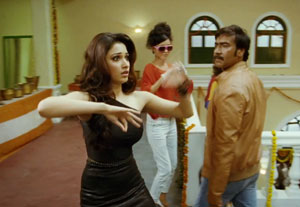
    Sajid Khan shouts from the rooftops that he doesn’t care about critics; the feeling is mutual. This time the arrogant director with an enviable and entirely undeserving row of hits, took a bit of a fall this time. His remake of the eighties hit has got uniformly bad reviews, mostly one or 1.5 stars.


    Everybody has wondered why anyone should even want to remake THAT film. And then, do nothing to it – neither tribute, nor spoof.


    Shubhra Gupta of the Indian Express asked the right questions. “At the end of two excruciating hours, the questions I had carried into the theatre remained unanswered. Why remake Himmatwala, which wasn’t exactly scintillating cinema in the first place? What were the studios, producers, directors and stars thinking? And last, but not, as they say, the least, when, oh when will Bollywood’s blind love affair with the 80s masala movies get over?”


    Rajeev Masand of IBNLive wrote, “It must take a special kind of skill to remake a mediocre film like 1983’s Himmatwala without even marginally improving on it. Director Sajid Khan’s pot pourri of excessive melodrama, puerile humor, cartoonish action, and garish songs plods on for two-and-a-half hours with little concern for your bladder or your mental health.”


    Sukanya Verma of rediff.com saw some tiny measure of merit in it. She commented, “Expectedly, it’s all very over-the-top but here’s the thing. The 1983 one established Jeetendra as a professional, an engineer, a man of purpose striving to bring change within a terribly feudal set-up while engaging a personal vendetta. It didn’t always work but the script fuelled his heroism. Devgn, on the other hand, loiters about doing nothing and relies purely on physical might to make an impact. For a man who brags about having so much faith in oneself, he sure wears a lot of stones on his fingers.”


    Madhureeta Mukherjee of the Times of India, usually kind, ranted, “Hark back to taaki taaki and tap dance to tathaiyya as the (r)awful 80s are re-awakened from their garish grave and served re-heated; as old wine in an old bottle. Vintage? Not truly. Just as we thought Jeetendra’s white shoes and coloured wigs were laid to rest in filmi museums, Sajid Khan dips into his cookie jar of movies, masti and ‘naus-talgia’ for yet another peek into the petty-past.”


    Saibal Chatterjee of NDTV quipped, “Director Sajid Khan may lack the courage to take risks but he is a very optimistic man indeed. He believes what worked in 1983 will click in 2013 too. Come to think of it, he might actually be right. Sad! Having been at the receiving end of the mindless excesses of the loud and laboured comedies that he specializes in, we know exactly what to expect from his latest foray into the terrain of tastelessness – zilch. And that is such a huge advantage for a filmmaker. If you, in the manner of the director, accept that unalloyed bunkum can be legitimately passed off, and gleefully lapped up, as cinematic entertainment, you might even come away pleased as punch with Himmatwala. The film lacks punch, but it loses no opportunity to pun on the word and the act.”


    Karan Anshuman of Mumbai Mirror questioned Sajid Khan’s motives. “Even though somewhere on the poster it might say “the 80s are back”, the real tagline of Himmatwala is “A Sajid Khan Entertainer”. It seems even Khan has relented that his piece of work does not deserve to be called a film. Here is his secret, coded message of what to expect in Himmatwala and what he means by when he says he will “entertain”.


  • Ranjona Banerji: Can DNA get back into your dna?

    By Ranjona Banerji


    The most welcome aspect of today’s news is the return of the edit page to DNA. The page was done away with a couple of years ago but returns – together with a re-design – in the April 2, 2013 edition of the newspaper.


    Rumours suggest that it was the arrival of new CEO Bhaskar Das which brought the edit page back but there is no way of confirming that and it could well be a decision taken by the new editorial dispensation – one of the many which DNA has had in its lifespan of almost eight years. Either way, the prognosis is positive.


    The edit page is called ‘dna of thought’ – a clear tip of the hat to the domination of the internet and its language, as is evident in ‘dna of mumbai’ and so on. There are two leaders – as is the trend these days – and two columns. Or, that is, it is too early to tell whether the lead article will be an analysis on current affairs rather than a comment as it is now. Cartoonist Manjul is the lead on the edit page with his ‘Politickle’ comment. A section called ‘net pickings’ presents snapshots of columns and opinions from around the world and there’s the mandatory nod to ‘positive thinking’, usually beloved of newspaper owners who feel or are told by their friends and family that their “products” are too negative.


    On the whole, the return to the edit page is an excellent decision. It anchors the newspaper and makes its own viewpoint clear to the reader. In fact, the second edit the welcoming the IPL is a refreshing change from all the usual fake breast-beating that this cricket tournament brings. (Also ironic, as IPL was verboten in DNA for first season because the then part-owner of DNA had started the Indian Cricket League!) As to why DNA stopped the edit page, those interested in history can look back at a discussion at the Mumbai Press Club which was organised by exchange4media when mxmindia.com founder-editor Pradyuman Maheshwari was editor there:

    http://www.exchange4media.com/40971_edit-page-gone-with-the-winds-of-change.html


    As far as the whole paper is concerned, the design will take some getting used to. Every DNA page always had too many elements in my opinion – a complaint I made even when I worked there – and now that has been compounded by a plethora of fonts. However, I also find Hindustan Times to be a bit cluttered as far as design goes and I have got used to that. DNA is clearly looking to blend with the digital media as well as with up the branding quotient – the DNA name is repeated in various forms through the newspaper. The concept of a large front page photograph is great – if they stick to it.


    I rather like the gimmick of having the old style on the front page which then reveals the new look as you turn the page and get a letter from the editor. It says, among other things, “…we have made the new paper more navigable, readable and classier”. The website is also going to be more “responsive” which means all that phone-tablet stuff.
    There are few questions for the newspaper. DNA was once the second-read paper in the city of Mumbai by a pretty good margin, until it lost that advantage to Hindustan Times. Will this design help to regain its status or is it just window dressing? The content has not so far changed and unless that improves no design can save you. And how do you re-engage with readers who have moved on from you?


    DNA has many challenges ahead. One can only hope for the sake of the industry that it will find a way to fight an effective battle.

    I have to confess here at the end that I worked for DNA for some years, soon after it was launched. Most of that, as it happens, on the edit page!


  • Ranjona Banerji: And this is how journalism works, thanks to The Indian Express!

    By Ranjona Banerji


    The Indian Express’s lead story on Thursday was the winner of the day: “Global media investigation finds 612 Indians among thousands with firms in tax havens”. The Express was one of 38 international media organisations which collaborated with the International Consortium of Investigative Journalists to work on a 15 month investigation into offshore tax havens. The Guardian and the BBC, the Washington Post, Le Monde and the Canadian Broadcasting Corporation were some of the other organisations in the collaboration.


    This is one of those times when journalists can legitimately take a little time to pat each other on the back. The investigation involved 250 GB of data in 2.5 million secret files with details of over 1.2 lakh offshore firms/trusts, 12,000 agents spread over 170 countries and territories. This effort involved 86 journalists from 38 media organisations in 46 countries.


    It is a mind-boggling effort and shows how much can be achieved through cooperation and common goals. It also reiterates that all journalism need not be about negotiating the minefield of owners and advertisers.


    For those who do not read Indian Express (shame on you!), here are links to the story. Will be interesting to see if the rest of the Indian media pick up on the business people mentioned in the exposure or just allow them to get away with it and keep on pretending as if politicians are the only scourge in our society…


    http://www.indianexpress.com/news/global-media-investigation-finds-612-indian-firms-in-tax-havens/1097501/0

    http://www.indianexpress.com/news/an-indian-expressicij-investigation-vijay-mallya-ravikant-ruia-others-in-tax-havens/1097494/


    And this is how the story unfolded:

    http://www.indianexpress.com/news/an-indian-expressicij-investigation-vijay-mallya-ravikant-ruia-others-in-tax-havens/1097494/


    **


    The possible maybe I don’t know boss Congress candidate as the next prime minister of India spoke to a bunch of Confederation of Indian Industry members. This is the latest trend for the media to follow mainly because most of them were not alive when we had to sit through interminable Films Division of India documentaries about politicians inaugurating coal-based power plants. So every time a politician makes a speech at a school, college, chamber of commerce, park or shower we have to be there.


    And so it was with Rahul Gandhi, who was also referred to as Rajiv Gandhi but we’ll forgive that. As he spoke about an inclusive India which has poor people and compassion was required, twitter exploded with laughter at the irony of saying all this to industrialists and business people.


    Intriguingly, as just about every news channels was focused on Rahul Gandhi, Times Now was busy patrolling the Mumbai coastline where it found a suspicious ship and took it into custody thus most effectively saving the nation. Also, Headlines Today showed a speech by Narendra Modi but it did not specify where this speech was taking place or whether it was old or new footage.


    **


    West Bengal chief minister Mamata Banerjee and her now expected callous remarks about the death of a student protestor got the usual amount of flak from the media. She and her close associates however continue to brazen it out as they take West Bengal down some specially chosen perilous path. Even Shri Goswami seems at a loss to ask what Bengal wants to know.


    **


    For those who want a break from our respected news anchors might take a remote trip to Comedy Central where they will meet Rajbeep Mardesai and Ornob Goswimming who discuss pressing issues of the moment: Is Comedy Central this funny or is Comedy Central that funny. Worth a few giggles.


  • Reviewing the Reviews: Chashme Baddoor

    Chashme Baddoor 

    Key Cast: Ali Zafar, Siddharth, Taapsee Pannu, Divyendu Sharma, Rishi Kapoor, Lilette Dubey & Anupam Kher

    Directed by: David Dhawan


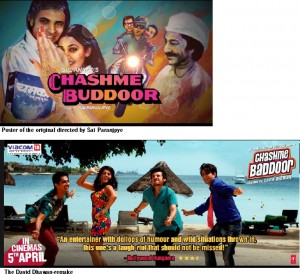
    Last week, when the new Himmatwala came out, the question on everybody’s lips was: why remake a bad film.  This week, with Chashme Buddoor, it’s why remake a good film?


    Then, in a wicked move, a restored print of Sai Paranjpye’s 1981 Chashme Buddoor was released at the same time as David Dhawan’s Chashme Baddoor, and as can be expected the latter took a battering from critics, most of whom had refreshed their memories of the original.


    Sukanya Verma of rediff.com, sounded outraged. “Paranjpye’s film is a master class in deft writing, the manner in which she seamlessly combines buddy humour and young romance while noting the minute but colourful details that add zing to day-to-day life and casual conversations. Her artistry lies in making all those extensive inputs appear so deceptively simple.  When a director has access to this much imagination, he ought to show a lot more responsibility than Dhawan does. Loud in sight, sound and sense, this Chashme Battering is an assault to the original with its line-up of gaudy aesthetics (think Rohit Shetty’s All The Best), actors hamming to the hilt in boxers and ghastly, GHASTLY writing.”


    Sanjukta Sharma of The Mint hated it too. “In Dhawan’s version, the jokes are loud and facile, and piercing in the bad literal way. Characters and performances are accordingly doltish. Remember Dhawan’s early 1990s’ films like Raja Babu and Coolie No. 1? Chashme Baddoor has the exact template-mindlessness and regressive humour as motives for mass appeal-but set in an India where there are malls. The characters are as sexist as those Govinda staples; the writing uses stereotypes only for insipid jokes. The production value is abysmally low-cinematography, costumes, choreography and even some locations are eyesores.”


    Shubhra Gupta of the Indian Express, wrote, “Dhawan’s film is a series of forced contrivances, not a story that grows out of a place and time. His characters don’t feel like they are good friends who live together. They feel like they have just come together for the shot. Neither do they mesh well, nor do they work Individually as well as they should: Ali Zafar’s laid back tone is all too familiar, Divyendu is not half as funny as he was in his debut, Pyaar Ka Punchnama, and the very energetic Siddharth contorts himself a bit too much. Taapsee is the only one who feels real, and stays likeable despite the occasional fumble with lines.”


    Rajeev Masand of IBNLive says that he didn’t find the film unbearable, but, “Like a battering ram, David Dhawan’s puerile and frenzied remake, Chashme Baddoor, shatters and mauls your memories of Sai Paranjpye’s charming original. Light-hearted humour and innocent romance makes way for sexist jokes and cheesy puns and the merits of keeping things simple are lost in the cacophony of screechy performances.”


    Karan Anshuman of Mumbai Mirror, reviewed the old and the new films side by side, and obviously found the Dhawan film sorely lacking. “Dhawan pays tribute to his own work in the form of the lead pair dancing to “Dekha Hai Pehli Baar’ fromSaajan and “What is Your Mobile Number” from yet another Karisma Kapoor-Govinda starrer. Add to it some wholesale in-film advertising and entirely expected garish production design and voila, the pitiable representative of the modern day comedy.”


    Janhavi Samant of Mid-Day commented, “Everyone’s hamming it in this film; even the most senior and most accomplished ones in the cast. They are all talking and emoting wildly like overwound-up toys. One youth keeps quoting SMS-forward shayari, another one takes his rape scene auditions too seriously, a grandma (even if it is a tad difficult to believe Bharti Acharekar as Anupam Kher’s mother!) who keeps slapping her son every two dialogues, a father-and-uncle twin squabbling jodi who are called Chikku and Santra, and a heroine who keeps saying, “Dum hai boss,” for very dum-less things that the hero does.”


    And then, there’s the TOI’s Srijana Mitra Das going against the tide, giving it 3.5 stars and raving, “The answer’s yes – love can be remade and so can a lovely film like 1981’s Chashme Buddoor (CB). This version’s as different as paapri chaat from a dhokla. But it retains the original’s madness, masti and movie-mania.”


  • Ranjona Banerji: Modi and the battle of hashtags

    By Ranjona Banerji


    The television news cycle through Monday was consumed partly by the speeches of Narendra Modi and then by death of former British prime minister Margaret Thatcher. Both have some similarities – Thatcher was a strong, dictatorial leader and so is Modi. However it remains to be seen whether Modi’s legacy will be quite as lasting as Thatcher’s.


    The Modi speeches were amusing for the battle of the hashtags (#) that was played out on Twitter and by the capitulation of the news channels. The internet and social media in India are usually dominated by the rightwing and the controversial chief minister has a massive online fan club. For perhaps the first time – though one is loath to make pat statements like that – the anti-Modi brigade managed to pull one over his supporters. The hashtag #Feku – signifying someone who’s talk is all fake – was top of the Twitter “trending” worldwide list while the #ModistormsFICCI hashtag was at a lowly five, although it later climbed up. Kudos to firstpost.com for picking up the trend and putting out this story: http://www.firstpost.com/politics/on-twitter-anti-modi-feku-beats-modistormsficci-690166.html


    **


    The news channels were straight on the messiah has arrived route after Modi’s speeches to the women’s wing of the business/commerce/industry organisation FICCI and later at a conclave organised by TV18 (which owns CNN-IBN, firstpost.com and other media outlets). Wit, charm, wonder and so on were the adjectives used.


    The waffling and the long-drawn-out examples were glossed over. Although The Times of India in all its genuflecting did carry a piece dissecting the FICCI speech from a feminist point of view and found it lacking. The Indian Express was quick to point out that while lauding women entrepreneurship in cottage industries, Modi did not mention Ela Bhatt and Sewa, surely the most remarkable success from Gujarat and also that he laid claim to the success of the Lijjat Papad cooperative which as everyone should know started in Mumbai. If Markandey Katju, chairman of the Press Council of India is listening, he might work on a way to ensure cynicism and scepticism as the first hiring requirements for a journalist…


    Some newspapers did mention the fact that these speeches – Modi’s and Rahul Gandhi’s to CII earlier – amount to little in our democratic system. But so enamoured is the Indian media of what they see of the presidential form of government as practised in the US (is civics taught in school any more in India?) that they imagine little Barack Obamas everywhere.


    **


    The Goafest is over and has been much talked and written about – including on mxmindia.com. I caught an episode of Brand Equity on ET Now which discussed scam ads made for awards in light of the Ford Figo JWT scandal. I discovered that not only are scam ads now called “proactive work” but was slightly dismayed to find that the advertising industry was dissembling on the issue. Everyone seemed to acknowledge there was a problem but banning the practice of making ads only to win awards seemed out of the question.


    The fact that the essence of advertising is to sell a product or service successfully has been sidestepped in this rush to get awards. But ads that are never seen by the public winning awards for successful selling – that’s bogus in the extreme!


    The sexism inherent in the Ford Figo ads is another worrying factor – and what caused the controversy — but that seems to have taken a back seat to “proactive work”!


  • Speaking of Which | Respectfully Yours

    By Vidya Heble


    Last week Speaking of Which was trudging through the sand at Goafest, hence the column got pushed a week forward. But even amidst adland frenzy, we were “on duty”, as it were, and spotted boo-boos here and there. Such as “Intergrated” on the display slides during the Abbys. But as we were told, the presentation was put together at record speed, so a typo here and there is very overlookable. Perhaps it’ll serve to “nazar utaarne ke liye” considering that the rest of the fest went off blisteringly well, even in light of the JWT-Ford scandal.


    Which brings us, as it happens, in the direction of our topic.


    Apart from the fact of the scam ads (ads created solely for entry into awards and not actually released by the client), what was disturbing was the image of women gagged, bound and stuffed into a car boot. In the light of atrocities on women, many of them in moving vehicles, this revealed a line of thinking which must not be allowed to proliferate. Partly, I blame language.


    We speak how we think. And often, in reverse, when we say something often enough we also begin to think that way. Think of “Chicks in the dicky”. Let us imagine that the creative brainstorming team at the agency threw out this, or a similar phrase.  It sounds fun and edgy, not “bad” like, say, “Women in the boot”.


    When I was cutting my teeth in the newspaper world my boss yelled at us for using the word “kid” instead of “children”. “A kid is the young one of a goat!” he would thunder. “Are we goats?” He hardwired, into me at least, some degree of awareness about words that we casually toss out, such as kids and cops. Though language has loosened up to a great extent, I still say “children” at first mention, and if there are many mentions then I turn “kids” into “children” intermittently through the copy as well.


    Another thing that I learnt is that the way you use language reflects on you as well. It does not have to change what you say; you can still write about police high-handedness without referring to them as “cops” (headlines are different). It just means that you are a polite person, and that’s not a bad image to project.


    I don’t know what transpired at the creative meetings (if there were any) that led to the horrible Ford Figo posters. But there must have been something leading up to the thought that images of women gagged and tied in a car boot is funny. Maybe the creative team needs to leave their desks and come out to, say, the real world. Maybe they need to stop using terms like “chick” and “babe”, and tell it like it is.


    Use language with respect, and you will eventually treat the subject with respect, too.


  • Ranjona Banerji: Debates on primetime news have failed

    By Ranjona Banerji


    The ‘Modification’ of Indian TV news took a little break this week as Indian news watchers were no longer treated to sound bytes of the Gujarat chief minister ordering breakfast from his cook or singing in the shower. The news cycle did a little hop, skip and jump. TV critic Shailaja Bajpai’s Indian Express column expressed TV’s obsession with Narendra Modi perfectly: http://www.indianexpress.com/news/much-ado-about-narendra-modi/1100493/ India has 28 states but of course it is highly unlikely that even if the chief ministers of the 27 other states think they also deserve to become prime minister that the TV media will pay too much attention to them. On Twitter it seems that the pet names “Feku” for Modi and “Pappu” for Rahul Gandhi are on their way to being entrenched.


    **


    The hop, skip and jump in the news took us back to 1984 and the anti-Sikh riots unleashed in Delhi after Indira Gandhi was assassinated. Now if people like me complain that media houses have no institutional memory about the Babri Masjid demolition and its aftermath, can you imagine how far back 1984 is?


    Anyway, the Congress’s Jagdish Tytler, whose name was associated with rioters from day one, was back in the dock. The courts will relook at the witnesses but Tytler had to face the wrath of TV anchors. Twitter told me that Arnab Goswami of Times Now managed to corner Tytler better than Rajdeep Sardesai of CNN-IBN or Rahul Kanwal of Headlines Today. Later, Twitter felt that Barkha Dutt of NDTV also did a good job.


    However I saw Times Now, CNN-IBN and Headlines Today and felt that Tytler was not remotely ashamed or remorseful or abashed. He brazenly made counter-allegations against the witnesses and claimed that in fact he had been helping Sikhs during those terrible days. It is true that Tytler and Goswami got into several spats where Goswami told him sternly: “You will not patronise me”. Tytler played a game where he alternated between being aggressive and wheedling.


    The story of the riots of 1984 is of failure on almost every count – political, social, investigative and judicial. This sort of television drama does not add any dignity or indeed anything worthwhile to the proceedings. Tytler has managed to withstand all kinds of storms since then and probably relishes the chance to be on TV having his say. Our news channels took a tragedy and typically tried to turn it into a melodramatic farce.


    **


    The other news of the day was West Bengal and the attack by Trinamool Congress workers on the prestigious Presidency University (my alma mater, Asia’s first western-oriented educational institution and once India’s premier college). Times Now ran with it all day as it urged us to take our country back from goons. Newshour however turned into a most ridiculous battleground. No one from Trinamool Congress appeared on the show – Derek O’Brien had apparently already been the day before. Goswami wanted the show to be about the attack on an educational institution and political violence. Instead it turned into a slanging match between the Left and Trinamool with Swapan Dasgupta and Jayanto Ghosal of the Ananda Bazaar Patrika batting for Mamata Banerjee and her party. (If anyone wanted more proof that the BJP was trying to cosy up to Banerjee, here it was.)


    The only voice of the citizen was a young film-maker – the only female on the show – who finally had enough of Dasgupta and got into a fight with him. Goswami could not seem to control what was going on. Finally, they were all screaming so much that you had to laugh and I reminded myself once again why I’ve stopped watching primetime news.


    The debate format has failed and Indian news channels must now reinvent the evening format. It’s not even that amusing any more.

    **


    The best joke that I heard on TV yesterday came from the Left’s Sitaram Yechury who told a bemused news anchor – I forget which – “what you call violence, we call a class struggle.” Indeed.


  • Ranjona Banerji: Disturbing account, but a pleasure to watch

    By Ranjona Banerji


    Kudos to Headlines Today for its investigative report into the Gujarat riots of 2002, based on police wireless reports which the Gujarat government had claimed had been destroyed. Ashish Khetan, editor, investigations trawled through pages of police reports to put together a picture of what happened in those days after compartment S6 of the Sabarmati Express was attacked at Godhra station. The Gujarat government has maintained that the riots which broke out were a “spontaneous” reaction to the 59 deaths of passengers, mainly kar sevaks returned from Ayodhya, where the Vishwa Hindu Parishad was building a temple to replace the Babri Masjid demolished by various factions of the Sangh Parivar.


    The Headlines Today investigation showed message after message from the state Intelligence Bureau as well as local police stations reporting of Muslims being attacked, incendiary speeches by VHP and Bajrang Dal activists and mobs on the streets, from the afternoon of February 27, only a few hours after the train was attacked. The Ahmedabad police commissioner PC Pande – in whose possession these papers were found – on the other hand maintained to the Special Investigative Team and others that he found no reason to believe that anything untoward was about to happen.


    Headlines Today took us back to those days with careful detail and minus any overblown hype or hysteria. Rahul Kanwal as anchor was sober and serious, an attitude he carried over to the now mandatory television panel discussion whenever anything at all happens in India. He was firm and sober with his guests as well and did not allow anyone to dominate proceedings or run away with the discussion in order to push forward their own agendas.


    At periodic intervals in the discussion, Kanwal went back to Khetan to analyse and explain the findings and to the details of the investigation itself. It bears mentioning that these police wireless reports were released to Zakia Jaffrey, a riot victim who has been tireless fighting the Gujarat government, by the Special Investigative Team only after a court intervention. As Khetan pointed out, an SIT interim report in 2010 complained that the Gujarat government was being uncooperative but in its final report appeared to give the government a “clean chit”.


    In spite of the disturbing nature of the investigation, this was one TV news programme that was a pleasure to watch. http://headlinestoday.intoday.in/programme/gujarat-riots-took-place-due-to-cops-ignorance-india-today/1/262417.html


    **


    Other news channels concentrated on the supposed rift within the NDA as the BJP and ally JD (U) wrangled over the possible ascension of Narendra Modi to the prime minister’s chair. These discussions amounted as usual to nothing, with the usual suspects fighting it out. Frankly, after the work put in by Headlines Today, all other orchestrated debates became irrelevant. The IPL was a better bet if you wanted relief.


    However CNN-IBN did take a detour to the horrifying story of a woman bleeding to death on the road in Jaipur after she was involved in an accident – no one stopped to help


    Tuesday morning’s newspapers stuck to the same theme, with the BJP-JD (U) spat dominating headlines. The Headlines Today investigation was not picked up, although most papers reported that Zakia Jaffrey had filed a protest petition.


    **


    Economic Times continued with the stories coming out of Goafest and on Monday had this rather disconcerting story about allegations of plagiarism against McCann’s creatives which won it the Grand Prix. http://articles.economictimes.indiatimes.com/2013-04-15/news/38556065_1_agc-awards-governing-council-ddb-mudra


    Clearly, the advertising industry needs to do more than introspection. It needs a thorough spring cleaning.


    Ranjona Banerji is a senior journalist and commentator. She is also Contributing Editor, MxMIndia. The views expressed here are her own. Follow her via Twitter at @ranjona


  • Ranjona Banerji: Move over FBI, NIA: Indian TV news can solve both Boston and Bengaluru bombings!

    By Ranjona Banerji


    The way journalism can be practised is always up for scrutiny and rightly so. Because there’s a lot that the media does to mould or at least suggest to public opinion. Well, enough of all that. Let’s get down to it. Two bomb blasts in two cities and two completely different reactions. A bomb goes off towards the end of the famous Boston Marathon, killing three and injuring many others. A bomb goes off outside the BJP office in Bengaluru, injuring many. The US authorities and media have been careful and circumspect not to jump to conclusions and apportion blame before due investigation. One media outlet which did leap to a finding was made to quickly leap back.


    Quite another story in India of course. Within minutes of the Bengaluru blasts, our politicians, investigating agencies and our television channels knew who had done it and why they had done it. In fact, since the Boston bombings were suspected to have involved pressure cookers, the Indian media was quite willing to speculate and advise Barack Obama, the CIA, FBI, Boston Police department on who was responsible for those as well.


    A lesson for the media here ought to come from the embarrassment (actually there is no evidence that anyone was embarrassed except me, on behalf of all media!) of jumping to the wrong conclusion after the Norway bomb blasts and shootings. The BBC World Service even had experts on air within a short time telling us which Islamic group was responsible, even while the Norwegian authorities were clear it was too early to tell. A few hours later of course, Anders Breivik was seen shooting teenagers.


    **


    Thursday on Twitter was a very amusing day. It started with noted feminist and social commentator Madhu Kishwar who a while ago made a little segue from left to right. She tweeted that someone senior in the Gujarat government had told her that there was a death threat to Gujarat chief minister Narendra Modi from the Congress and social activist Teesta Setalvad. When this created an uproar, she deleted the tweet. However, nothing on the internet is lost forever so of course someone had taken a picture of the tweet which then did the rounds. Then Kishwar re-issued the same tweet with some modifications.


    It’s a difficult world out there in 140 Character Land and sometimes, discretion seems a bit more sensible than extravagant expression. This episode was still bubbling away when former Pakistan president Pervez Musharraf ran away from the court which ordered his arrest. This act of extreme bravery from the former dictator caused great hilarity on the social networking site.


    Then the Supreme Court decided to show the same “mercy” to seven other 1993 bomb blasts convicts after it showed such heart for film star Sanjay Dutt the day before. Afternoon TV anchors were very pleased with the phrase “course correction” by the Supreme Court, which they used again and again.


    **


    Increasing incidences of public apathy caught on camera caused much hand-wringing on TV debates. There have been a couple of horrific instances of a woman bleeding to death on the road and another woman being beaten up while bystanders did nothing. Police harassment was seen as the main reason for people not wanting to get involved. But there are also enough examples of people going out of their way to help so sociological assumptions made on two stories seems to be more bubblegum pop than hard rock.


    **


    Kolkata’s Presidency University made it to Sagorika Ghosh’s Face the Nation on CNN-IBN to discuss the way the recent vandalism allegedly by Trinamool Congress workers had affected the institution. As a former student of Presidency College (as it was then) I was very proud and all but I am not sure that the programme served much purpose. Why Presidency was and is so important was not properly explained and since there was no government representative on the panel of students, staff and alumnus Aparna Sen, it became something of a self-congratulatory trip. Still, it was nice to see the old college again.


    Ranjona Banerji is a senior journalist and commentator. She is also Contributing Editor, MxMIndia. The views here are her own. You can reach her via Twitter at @ranjona