Category: Events

  • No crisis for magazines in India: Chris Llewellyn

    Chris Llewellyn, President and CEO, FIPP, UK spoke to Akash Raha and Shruti Pushkarna of MxM India at the recently held World Magazine Congress. Mr Llewellyn spoke about the future of magazine, future events of FIPP and about the recently held World Magazine Congress in New Delhi, India.  Federation of the Periodical Press (FIPP) is a worldwide magazine media association, which represents companies and individuals involved in the creation, publishing, or distribution of quality content, in whatever form, by whatever channel, and in the most appropriate frequency, to defined audiences of interest.


    Q: FIPP has been taking up the interest of magazine publishers around the globe. What are the upcoming events that we can expect?

    FIPP exists to help its members construct better strategies and to build better media businesses. And the way they do that, is by finding what is happening around the world. So we come together at various meetings and events, share experiences and share knowledge, and go back better informed. I am really pleased to be able to confirm that next year September 19 to 21, Seoul Korea will be holding the third Asia Pacific Digital Magazine Media conference. And that will be specifically geared towards the Asian market and the hot topics of the time then; and we are talking digitally, so a year from now god knows what they’ll be, but they’ll be on the top of publishers mind. We will bring in some international speakers and we will engage with the Korean market which itself is incredibly digital. So that is an exciting new event next year. On top of that, we will be doing in early November, an American conference, out of Central America. In fact, I can even confirm that it is going to be in Costa Rica, which is a very attractive venue. And again that will be talking about the hot issues of the day, appropriate for the publishers of that territory.


    Q: How do you think the Indian magazine marketing is shaping up?

    The issue at the moment is that we have these two huge forces at play. One is this structural change that the digital revolution is forcing on our thinking and the second one is just the cycle of poor economy. You know, India, which is still booming, still ‘incredible India’, and yet people in India think there is a crisis. But it is not a crisis in India, believe me. This is just the cycle and this will turn around. How long, well, if I knew how long I will be a very rich man. But the truth is, it will change. At the same time, I think the publishers are responding magnificently to the digital changes and realizing that the strong magazine brands that have an emotional engagement with the audiences can be taken to different platforms and it just deepen the engagement. Don’t confuse content with how you deliver content. Content is an art and that content can be on magazines and it can be on any other format that we want it on. But it will still be the magazine publisher’s knowledge of his audience, which is the key, and that’s not going away.


    Q: How do you think digital will affect print?

    Hollywood films have never being bigger – huge blockbusters. Hollywood is making so much more money but not at the box office … their business model has changed. Today, Hollywood is built on the sales of popcorn, the sales of the food and drinks when you visit the cinema. It’s the full cinema experience, not the box office that entails profits. Similarly, in the magazine industry too, we will see a change in the business model, that’s certain. But the medium will still be there because of the strength of the medium. The emotional engagement of turning the pages, fresh magazines, just the way that we represent images is fantastic.  The women’s fashion sector needs glossy magazine too. So magazines are not going away, but the business models will change.


    Q: One can say that the World Magazine Congress has been immensely successful. What are the important points that have emerged from the conference?

    There is still a huge print industry and print is not at all dead. Innovation in print, as we have seen in several publications, is there, creativity is there and it will get more creative. And we have a bigger train set to play with now with all these new mediums and that’s exciting. So print is fine and we have a world of opportunity that is opening up. That is the big take away from the conference I feel.


    Q: What has been the feedback from the World Magazine Congress?

    You know, when we planned this conference two years ago, coming to India and quite a few people were saying ‘that could be interesting’. They clearly meant it in both ways… It could be interesting because it’s exciting and it could be interesting because it is quite a logistical challenge. I can’t tell you how difficult it is to get a visa to come to this country. My word, I am British and we left you bureaucracy which you have taken to another level (he jokes). However, the feedback I have got is really good. The opening reception just got the energy into everyone; The Bollywood dancing, the charisma of Shahrukh Khan. A lot of international people had never heard of him, they do now. I was told that the programmes were fantastic and there was lots of value to it. Many international visitors are extending their stay in India and are going to see a little more of this country. I am going to have the pleasure of seeing the Taj Mahal too. All in all, the congress in India has been absolutely wonderful.


    Watch Chris Llewellyn:

    On the magazine market
    [youtube width=”350″ height=”250″]http://www.youtube.com/watch?v=5rgYpWMJhjU[/youtube]


    Magazine business model might change, but the medium isn’t going anywhere
    [youtube width=”350″ height=”250″]http://www.youtube.com/watch?v=rCMEvZtioqc[/youtube]


    Takeaways from WMC 2011
    [youtube width=”350″ height=”250″]http://www.youtube.com/watch?v=Gtgers8eSAw[/youtube]
  • All the World Magazine Congress videos

    David Hill, President & CEO, International Publishing Services, IDG, USA and the new FIPP Chairman


    On becoming the new FIPP Chairman [youtube width=”400″ height=”250″]http://www.youtube.com/watch?v=DLtfwVV8jYQ[/youtube]
    On the outgoing FIPP Chairman, Aroon Purie [youtube width=”400″ height=”250″]http://www.youtube.com/watch?v=eD7YFZdY89M[/youtube]
    On the future of magazines [youtube width=”400″ height=”250″]http://www.youtube.com/watch?v=W3iQuijzoY8[/youtube]
    On the future agenda of FIPP as he takes on as Chairman [youtube width=”400″ height=”250″]http://www.youtube.com/watch?v=jQiqMJPPW_Q[/youtube]


    Tarun Rai, CEO, Wordwide Media, India and new President, Association of Indian Magazines


    On his AIM Presidency and things on top of his agenda [youtube width=”400″ height=”250″]http://www.youtube.com/watch?v=mhPNt1g3SXU[/youtube]
    On the attempt to change the mindset of advertisers and media buyers [youtube width=”400″ height=”250″]http://www.youtube.com/watch?v=ZfANp6vxVQ0[/youtube]
    On launching Good Food [youtube width=”400″ height=”250″]http://www.youtube.com/watch?v=KKPL01uKuDA[/youtube]
    On the prospects of Indian mags becoming international brands [youtube width=”400″ height=”250″]http://www.youtube.com/watch?v=-gdT17SBAtk[/youtube]
    On take aways from WMC [youtube width=”400″ height=”250″]http://www.youtube.com/watch?v=VrNFqocrqNU[/youtube]
    On the potential for mags in India [youtube width=”400″ height=”250″]http://www.youtube.com/watch?v=TLEfoXF1fjk[/youtube]


    Chris Llewellyn, President & CEO, FIPP, UK


    On the upcoming FIPP events [youtube width=”400″ height=”250″]http://www.youtube.com/watch?v=aAWNhbrXZ5o[/youtube]
    On the magazine market, Indian market [youtube width=”400″ height=”250″]http://www.youtube.com/watch?v=5rgYpWMJhjU[/youtube]
    Magazine business model might change, but the medium isn’t going anywhere [youtube width=”400″ height=”250″]http://www.youtube.com/watch?v=rCMEvZtioqc[/youtube]
    On take aways from WMC [youtube width=”400″ height=”250″]http://www.youtube.com/watch?v=Gtgers8eSAw[/youtube]
    On the feedback from delegates on the congress and the Indian experience [youtube width=”400″ height=”250″]http://www.youtube.com/watch?v=PCEmmKmPrdI[/youtube]


    Pradeep Gupta, Chairman & MD, Cybermedia and the outgoing AIM President


    On his journey as AIM President [youtube width=”400″ height=”250″]http://www.youtube.com/watch?v=4xAaeDwh0Pk[/youtube]
    Suggestions on focus points for AIM in the future [youtube width=”400″ height=”250″]http://www.youtube.com/watch?v=CTiINmiMEhQ[/youtube]
    On the PRB recommendations [youtube width=”400″ height=”250″]http://www.youtube.com/watch?v=Q0PjQmZjBqg[/youtube]
    On take aways from WMC [youtube width=”400″ height=”250″]http://www.youtube.com/watch?v=1RxZq6ShZso[/youtube]
    On the need to look at a brand approach and multiple media [youtube width=”400″ height=”250″]http://www.youtube.com/watch?v=ucck–hZd5c[/youtube]


    Vikram Sakhuja, CEO, Group M, South Asia


    On the falling share of AdEx [youtube width=”400″ height=”250″]http://www.youtube.com/watch?v=GSS2j9PQMkU[/youtube]
    On the engagement study [youtube width=”400″ height=”250″]http://www.youtube.com/watch?v=RhdD-vPnStY[/youtube]
    On the future of magazines [youtube width=”400″ height=”250″]http://www.youtube.com/watch?v=eXx1uUtjPz8[/youtube]
    Philip Thomas, CEO, Cannes Lions, UK


    On what advertisers want from magazine media [youtube width=”400″ height=”250″]http://www.youtube.com/watch?v=1i_qUImjYB8[/youtube]
    On the future of magazines [youtube width=”400″ height=”250″]http://www.youtube.com/watch?v=OoX1M6kN9SE[/youtube]


    Tomas Ernberg, Managing Director, Volvo Auto India


    On what advertisers want from magazines [youtube width=”400″ height=”250″]http://www.youtube.com/watch?v=XyYQZEWhdGM[/youtube]


     Juan Senor, UK Director, Innovation Media Consulting
    On the theme of the congress- 360 degree [youtube width=”400″ height=”250″]http://www.youtube.com/watch?v=t_s-VFGfO5E[/youtube]
    On the future of print- no medium ever dies [youtube width=”400″ height=”250″]http://www.youtube.com/watch?v=oepk4aS1uZA[/youtube]
    On the Indian magazine market and future prospects for print [youtube width=”400″ height=”250″]http://www.youtube.com/watch?v=oSYNEZB57KA[/youtube]
    On the need to focus on the content [youtube width=”400″ height=”250″]http://www.youtube.com/watch?v=qdkYu4ZAOdY[/youtube] 


    Kalli Purie, Chief Operating Officer, India Today Group Digital
    On having WMC in India [youtube width=”400″ height=”250″]http://www.youtube.com/watch?v=TOsMAe4x5i0[/youtube]
    On the theme of the congress- 360 degree [youtube width=”400″ height=”250″]http://www.youtube.com/watch?v=BpPeL1grthY[/youtube]


    James Tye, CEO, Dennis Publishing, UK
    On choosing the right app for your publication [youtube width=”400″ height=”250″]http://www.youtube.com/watch?v=wYyVQBfbk0o[/youtube]


    Voxpop@ World Magazine Congress Day 1
    On expectations from WMC and experience in India [youtube width=”400″ height=”250″]http://www.youtube.com/watch?v=KuT6DwoMFMg[/youtube]


    SRK dancing to Chhamak Chhallo [youtube width=”400″ height=”250″]http://www.youtube.com/watch?v=mTxOmOwhVjw[/youtube]


    Pre-event: Mitrajit Bhattacharya, CEO, Chitralekha
    On the upcoming WMC [youtube width=”400″ height=”250″]http://www.youtube.com/watch?v=w4wq2LulVWc[/youtube]
    On the prospects of business transactions on the sidelines of the 38th FIPP World Magazine Congress [youtube width=”400″ height=”250″]http://www.youtube.com/watch?v=VMgjob9NwfU[/youtube]


    Pre-event: Ashish Bagga, CEO, India Today Group
    On hosting World Magazine Congress & AdAsia, two broad format events in the same month [youtube width=”400″ height=”250″]http://www.youtube.com/watch?v=T7zC5_yLkbs[/youtube]
  • Pay up or face the music, PPL tells major hotels & pubs

    By A Correspondent


    The city may fall short of venues to welcome the New Year this time as the Phonographic Performance Ltd. (PPL) has served notices to many well-known hotels and pubs. These legal notices have been issued to venues that have not paid the requisite music license fee to play music at their year-end events. PPL plans to initiate strict legal action against defaulters in case the license fee is paid ahead of their planned events. The following hotels have been given interim injunction by the Delhi High Court: Radisson Blu Hotel, Paschim Vihar, Hype at Shangri-La Hotel, QBA, Sheraton Hotel, Hilton Hotel, Double Tree Hilton, ChalChitra, Crowne Plaza, Wyndham Hotel, Club Sirocco, Nautica, Play Lounge Bar, 3 Stories, The Glassy Junction, Hang Out, Club Headquarters, Pritampura. PPL has issued notices to all prominent places which have failed to pay music license fee across the country.


    Vipul Pradhan, CEO, PPL said: “New Year parties attract people promising them a good time through a combination of entertainment, food and beverage. A significant component of the sum charged from the customers is for music. Therefore, the music companies whose sound recording is regularly used have a right towards claiming their due because their product is also getting consumed.”


    Any performance of Indian or even international music, in public places or commercial establishments such as hotels & resorts, restaurants, bars, pubs, discotheques, cruise liners, cinema halls, shops, offices, and so on, rendered without first having obtained a licence from PPL constitutes an infringement of Copyright under the Copyright Act,  1957. Under the statutory sanction of section 35 in the Indian Copyright Act, playing commercial music in public without paying the requisite license fee is an offence liable to contempt of court. Section 35 grants exclusivity to PPL to issue licenses to hotels/ pubs for playing music during the events in their respective premises. The tariff for the same is calculated on the basis of the number of hours the music is to be played and the number of people expected to attend the event.


    “Musical nights and customized New year events rake in huge revenues for organizers. A year ending event cannot be imagined without music! Yet, when it comes to paying for the commercial use of music, the event organizers chose to evade the license fee,” said Mr. Sowmya Chowdhury, Country Head, PPL.


    Mr Avinash D’Souza, National Sales Manager, PPL feels: “Music labels have complete authority over the sound recordings and using them without a proper license can bring the events & parties to a standstill. People should also act proactively and check with their chosen properties to avoid a last minute inconvenience or embarrassment. To prevent such situations, this year we have expanded our operations to a National Campaign in all major cities.”


    Every year pubs/ hotels target revenues with customized New Year packages but are reluctant to pay a nominal license fee (which varies depending on the number of hours for which the music is played) to PPL. Thus, flouting the norms and eating into the royalties of the music labels. DJs, too, need to abide by PPL guidelines if they continue to play music without paying the license fees.


  • Magazines need to be more open: Volvo MD Tomas Ernberg (Video)

    By Shruti Pushkarna

    In today’s digitalized world where advertisers and marketers have options aplenty to choose from, when it comes to their vehicle of communication, traditional media has a tough battle to fight, feels Mr Tomas Ernberg, Managing Director, Volvo Auto India Pvt. Ltd.

    Speaking at the 38th FIPP World Magazine Congress 2011 in New Delhi, Mr Ernberg said, “The world is going for the digital and that’s why there’s a scary scenario for magazines, so to say…”

    Sharing a client’s perspective, Mr Ernberg said that the marketer feels a bit blind when it comes to ROI from putting an advertisement in magazines. “If magazines could be more open and could find more information about the customers, the subscribers…especially psychographics, it would give the marketers a very good platform to decide which magazines to advertise in”, added Mr Ernberg.

    Advertisers and marketers, emphasized Mr Ernberg, are looking to engage their audiences in entertaining and effective ways, so even though creative content is at the heart of all communication, magazines which are proactive and transparent in sharing information with clients, are the ones which will survive.

    Having spent 17 years at Volvo, Mr Tomas Ernberg took over as company’s Managing Director in July this year. In his last position as the Regional Marketing Director in Dubai, he managed 13 markets in the Middle East and North Africa. Mr Ernberg started his journey with the Swedish auto manufacturer in 1994 as the Tourist and Diplomat Sales Manager at Volvo Cars, Turkey.

    [youtube width=”350″ height=”250″]http://www.youtube.com/watch?v=XyYQZEWhdGM[/youtube]

  • IRS 2011 Q4: Media consumption grows but Radio and Cinema continue to decline

    By A Correspondent


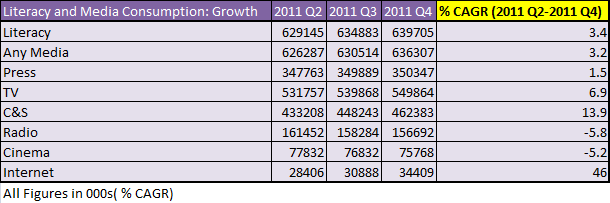
    IRS Q4 2011 findings have revealed that the literacy rate and media consumption in India has witnessed growth when compared to IRS Q3 2011. The other media categories to have grown are Press, Television, C&S (Cable and Satellite) and the Internet. While Radio and Cinema consumption have witnessed a decline, the Internet has emerged as the fastest growing medium in the country.


    Press has seen a marginal increase of 1.5 per cent in the CAGR (Compound Annual Growth Rate) whereas TV grew only 6.9 per cent of the CAGR. After the Internet, C&S is the second largest medium to have grown in double digits i.e. a CAGR of 13.9 per cent. Radio and Cinema on the other hand declined -5.8 per cent -5.2 per cent respectively.


  • Comment: Jehangir Pocha on Media’s new Moguls

    By Invitation


    By Jehangir S Pocha


    Among all the transformations taking place in media, here’s the crucial one – the media baron is being replaced by the media conglomerate.


    Corporations are buying news properties once owned by individual proprietors at a rapid pace. Expectedly, media mavens and professionals are crowding conferences to express their angst: Are these oligarchs becoming media’s new moguls only to protect their empires and project their interests? Will they interfere every time a story is done on their favourite babu, minister or party?


    But this holier-than-thou approach that automatically assumes a media baron is better for journalism than a media conglomerate is as reactionary as it is wrong.


    A corporation owning a news property can be expected to slant or kill a story inimical to its core interests.  But those are few and far between.


    After all, how many core interests can a corporation have? On the other hand, many media barons have been notoriously whimsical, politicized, opinioned and ideological, slanting almost every story almost every day, and killing (or overlooking or underplaying) almost every story out of sync with their ideology, views or interests.


    In all democracies, the most slanted and ideological journalism has always been driven by media barons, from William Randolph Hearst, to Ramnath Goenka, Thaksin Shinawatra, Rupert Murdoch, Silvio Berlusconi, Michael Bloomberg and others.


    Their news properties have openly, sometimes shamelessly, displayed their biases.  Compare Murdoch’s Fox News with its corporate-owned competitors, NBC News (owned by General Electric), CBS (owned by Westinghouse), ABC (owned by Disney) and CNN (owned briefly by AOL). Which is most slanted? Which is most protective of vested interests? Which would any unbiased media professional rather work for?


    Yes, a media corporation might protect its pet politicians and restrain its news properties from covering its other businesses fairly. But many media barons do the same. Some appear to have more pet politicians than any corporation. In fact, often the “other business” of media barons is politics (consider Berlusconi, Thaksin, and Bloomberg).


    When it comes to coverage of oneself, it is India’s media barons who have constructed the self-serving maxim that “media mustn’t cover media”, leaving them free of all public scrutiny. That’s what’s allowed some of these tycoons to injure Indian media and dupe their viewer/reader by introducing poisonous practices like “paid news” and “private treaties”.


    It is highly unlikely that any media conglomerate would allow such practices precisely because of the fear of public scrutiny that publicly-listed and/or publicly known corporations naturally have. Companies run by professionals and overseen by a board of directors that includes independents and representatives from government-owned institutions are generally forced to put in place the systems and standards needed to run a business right.  Media barons exempt from oversight rarely do so.  This is why Murdoch’s newspapers spy on people and others don’t.


    This doesn’t mean concerns over how corporations will manage their new media enterprises can be ignored.


    As Indian media comes of age it must codify its journalistic standards and rigorously implement them through an independent body akin to Britain’s Media Standards Trust. Such a body should give India’s journalists protections, such as the legal right not to disclose a source, and freedom from prior restraint (attempts to prevent publishing/airing of an opinion/idea/story before it is published/aired).


    Every news organization must also be required to have an independent Ombudsman charged with ensuring fair and balanced coverage.  At the same time, this Ombudsman and/or the standards authority should also ensure journalists and news outfits respect the rights and reputations of others (anti-defamation), separate news from views, eschew ‘paid news’ and private treaties, protect national security, public order, and public health, and prevent incitement to hostility, violence or discrimination.


    Stringent regulations that prevent any monopolistic control of news are also essential to any democracy. To some extent, digital technologies and social media already ensure this. A smart line on Twitter or great video on YouTube can become more influential than an op-ed in the Times of India. But the government must still work to ensure there are enough voices in the media and that no one voice dominates the national discourse.


    Corporations enter (and sometimes dominate) the media business because it is highly capital-intensive. So, one effective way to maintain a plurality of views in news is to keep entry barriers and operating costs in the business low. For example, existing distortions in media policy, such as exorbitant “carriage fees” that benefit the well-heeled and hurt small news operations must be ended. Banks must be encouraged to lend to smaller media companies, capital requirements in the industry should be eased and more journalism schools built to develop a larger talent pool. Building stronger news-related services, like more text and video wire services, freelancer organizations, and shared news infrastructure, would also help newer and smaller players. Lastly, the government must pass laws to separate carriage from content, and control media cross-holdings.


    Ultimately, every kind of media owner – the government, individual, the public trust and the corporation – comes with pros and cons. India knows well the short-comings of the first three.  We will now discover the dangers of the fourth.  But as long as all four kinds of news organizations are allowed to exist and flourish – and are subjected to firm and fair regulation and oversight – the news media in India will remain strong and vibrant.


    Jehangir Pocha is CEO, INX News.

    The views expressed here are the writer’s and not necessarily those of MxMIndia.


  • Over 3800 participate in DNA’s women half-marathon

    By A Correspondent


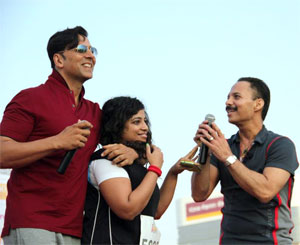
    Actor Akshay Kumar with radio jockey Malishika and fitness expert Mickey Mehta

    All roads in India’s new corporate district of the Bandra Kurla Complex led to the flag-off of the DNA women’s half-marathon on Sunday. It was the festive day of Mahashivratri, but that didn’t deter the 3800+ women who participated in the three runs (21km, 10km and 5km) which were part of the Stayfree Women For Change DNA I Can Women’s Half Marathon.


    Just the second edition of the event, the half-marathon drew participation from regulars in the running circuit as well as first-timers. Actor Akshay Kumar led a committed showbiz contingent at the event. While cheering participants, he said his key to fitness was getting to early to bed and rising early.


    Uttarakhand’s Kiran Tiwari from Western Railway won the Half marathon in 1 hour, 24 minutes. Ms Tiwari won a bronze medal in 2009 Asian Championships in China in the 3000 metre staple race. The others who followed Ms Tiwari were: Nilam Rajput (1:28:3), Nikite Nagpure (1:29:1), Rashmi Gurnule (1:33:6) and Sunite Wasghmode, (1:36:2).  In the 10 km run, the winners were: Supriya Patil (38:35:7), Heena Mali (39:10:9) and Priyanka Patil (40:43:0). And in the 5 km run, the winners were:  Teja Naik (21:22:7), Mrudula Bhande (24:37:5) and Rekha Haldipur (25:25:0) (Info source: DNA news report)


    Johnson & Johnson’s Stayfree was presenting sponsor along with a host of partners and associates. SportzConsult executed the event.


  • Business, networking & more @ Frames 2013


    By Johnson Napier


    While you may be taking some time out to browse through this story, hundreds of delegates from different corners of India, and a few from around the world, would have converged at Hotel Renaissance in Mumbai. In fact it would suffice to say that those who have anything and everything to do with Media & Entertainment would have made it in large numbers today to be part of the biggest and only convention for the sector in India – FICCI Frames 2013.


    In its 14th edition, the event has a host of activities that have been planned out over a three-day course. To begin with, Day 1 would begin with a bagful of high-profile dignitaries who would be presenting their viewpoints and observations on the way forward for the industry. It would begin by a welcome address by Naina Lal Kidwai, President, FICCI and would be followed by a theme address by Uday Shankar, Chairman, FICCI Media & Entertainment Committee. Joining the two dignitaries on stage would be Uday K Varma, Secretary, Ministry of Information & Broadcasting, Govt. Of India who would be providing a vision statement for Information & Broadcast Industry. He would be followed by Guest of Honour Dr. Soon Tae Park, Deputy Minister, Ministry of Culture, Sports & Tourism, Republic of Korea who also would be highlighting his observations on the industry. Andy Bird, Chairman, Walt Disney International would be the next to hog the limelight as he would be presenting the keynote address at the event. Preneet Kaur, Union Minister of State for External Affairs, Government of India would be the other high-profile guest who would be delivering the inaugural address at the opening ceremony. The event will also see the felicitation of Subhash Chandra, Chairman, Zee Entertainment for his two decades of contribution to the broadcast industry.


    According to the organisers of the event, the aim of FICCI Frames 2013 would be to deliberate on the growth of the industry and find ways to maximize both its creative and economic potential by engaging with the billion strong consumer base in our country. To do that, there are key international thought leaders, studio heads and academics who’ve been lined up to speak on a range of topics covering the main objectives of the sector – digitization, making big budget films and being successful in Bollywood, censorship, marketing, exhibition, distribution, viability of the sports broadcasting business, the future of content consumption in an era progressively getting defined by the digital media, innovation and planning required in various policy issues within TV, cinema, animation and gaming.


    Uday Shankar

    Sharing his viewpoint on the event, Uday Shankar, Chairman, FICCI Frames 2013 said, “While the industry has made spectacular progress in the last 20 years in increasing the intensity of engagement with the Indian consumer through superior content, there is still a gap in our ability to monetize the engagement and use the resources generated to advance both access and content. The year 2013 is one of many milestones in the media and entertainment industry and Frames will offer an opportunity for us to put these developments into perspective, look at the larger picture and engage on such a bold and important theme.”


    Leena Jaisani

    Speaking on the core theme that has been shortlisted for the event, Leena Jaisani, FICCI senior director – M&E remarked, “This year the theme is ‘Engaging One Billion Consumers’. We work to make sure the entire media and entertainment sector takes the next big leap in maximising monetization, therefore the theme of engaging a billion consumers.” Adding further, Ms Jaisani said, “While the industry has made spectacular progress in the last 20 years in increasing the intensity of engagement with the Indian consumer through superior content – there is still a gap in our ability to monetize the engagement and use the resources generated to advance both access and content. Frames will offer an opportunity for us to put these developments into perspective, look at the larger picture and engage on such a bold and important theme.”


    Karan Johar

    Highlighting his outlook for the event, Karan Johar, co-chairman of FICCI Frames 2013 said, “It is a platform that brings best of the creative and business minds to engage with delegates. Delegates come to the event to seek different things. Someone’s agenda is to scout talent and another person may have just come to look for finance. Whatever time I have spent in attending sessions, I have learnt the most from them. In fact, I admitted this on the podium last year. There are certain things you are not aware of and sitting on the panel or in the audience you imbibe new things. This must be the experience that others also go through I guess.”


    In fact Mr Johar has a larger agenda that he’d be taking up where the film fraternity is concerned. He affirms, “The Rs 100-crore benchmark is limiting the growth and content of our films and we have to aim for Rs 1,000 crore from a film. It may not be possible today but we have to have a mandate to achieve that. FICCI will work towards a roadmap for Indian films to gross Rs 1000 crore for a film. It is not an impossible task. In fact we have a session on planning and creating a Rs 1000-crore blockbuster that promises to be interesting.”


    One of the reasons why the event manages to attract so many delegates is the quality of speakers who land up at the venue to share and dish out mantras and growth strategies. This year too there are a host of stalwarts that have been lined up including Andy Bird, Chairman, Walt Disney International, Anne Sweeney, Co-Chair, Walt Disney International & President Disney ABC Television Group; Bob Bakish, CEO, Viacom Media International, Teri Schwartz, Dean, University of California, Los Angeles (UCLA), Colin Maclay, MD, Berkman Center for Internet and Society, Harvard University, Andy Kaplan, President, International Networks, Sony Pictures Television, Mira Nair, film-maker, Dominic Proctor, President, Group M Worldwide, Seymour Stein, Vice President, Warner Bros Music, David Womart, the Producer of the Oscar-nominated Life of Pi, film maker Gurinder Chaddha, Jonathan Taplin, Director, Annenberg School of Innovation, The University of California school of communications and journalism, Andy Weltman, the international head of Pinewood studios, and Graham Broadbent, the British producer of the Best Exotic Marigold hotel.


    As is the norm, this edition of Frames too has a partner country and South Korea has bagged the honour this year. Pointing out the advantages of the association, Ms Jaisani said, “South Korea is the partner country at Ficci Frames 2013 and this year is significant as Korea and India celebrate the 40th year of the establishment of diplomatic relations. There is huge potential for collaboration in films, animation, gaming, technology and service offshoring between the two countries. Leading Korean companies in animation, broadcasting, mobile gaming and film will be available for biz matching. There is a huge synergy as India is looking at innovation from Korea and vice-versa they are looking at engaging Indian media companies for offshore services – especially in animation, gaming and VFX.”


  • Decoding Digital with Rajan Anandan


    It’s not always that industry folk get an opportunity to be upclose digital luminarie and get them to answer all their queries and address all their doubts. Well, almost. The only limiting factor is the time.


    The platform provided by the International Association of Advertisers (India Chapter) facilitates that with the ‘World Goes Digital’ webinar series.


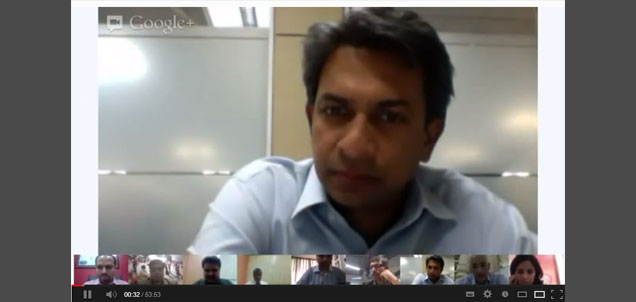
    The inaugural webinar got off to a stimulating start last week (April 26). The platform chosen was Google Hangout which allows for simulatenous ‘meeting’ of 10 people in a ‘virtual’ room. With Rajan Anandan, Managing Director, Google India, as the first guest, the series struck a discerning chord as a cross-section of the fraternity congregated online and many more watching him live on the Youtube. They heard Mr Anandan share his version and vision of the growth of online space and also posed a few questions on the scope and challenges facing the medium in India.


    Srinivasan K Swamy, President, IAA India Chapter, began with an introductory note on the role of IAA in steering such initiatives and promised more such debates in time to come. Abhishek Karnani, co-chair and Director, Free Press Journal group also spoke on the webinar initiative.


    Other than Messrs Swamy and Karnani, other panelists included: Manish Advani, head – marketing and public relations, Mahindra Special Services Group (also co-chair of the the IAA webinar series), Vishaka Singh, Executive Director, Aurora Comms, Nishad Ramachandran, Vice President, Hansa Cequity, Mudit Singhal, Founder and Business Head, Storycentre, Gaurav Mendiratta, CEO, SocioSquare and Jay Sampat, M&E practice at Accenture. Mr Advani proposed the vote of thanks and the panel was moderated by Pradyuman Maheshwari, Editor-in-Chief, MxMIndia.


    Execerpts from the conversation:

    Q: Several companies in India are reluctant to start their own digital enterprise as they feel that if something nasty is posted about them, their business will get affected. What is your advice to these companies?

    Rajan Anandan: I’d like to say that there are 150 million users on the internet and about 95 per cent of the SEC A, B 15-44 yr-olds are on the internet and are spending more time on the internet than any other medium. If you happen to sell products or services that cater to these audience group then if you are not on the internet you won’t be able to reach them. More importantly, if you do not engage with them and other companies engage with them who turn out to be competitors then the users may migrate to those other brands.  We have seen this happen in other countries as well and what’s interesting about India is that despite being at 12 per cent penetration, it already has a 150 million users. For many of us, the industries where we mainly focus on SEC A, B 15-44 this has become a must-have medium. The important thing to realize about the medium is that in the digital arena consumers are the ones that propagate brands. It used to be brands talk to consumers in a one-way dialogue but that has completely changed with the advent of the internet.


    I see two kinds of companies from the umpteen that are present on the medium.  One that says that now I can get instantaneous feedback when something is not going well or when there are opportunities for improvement and those companies are able to leverage this medium in incredibly powerful ways not just for building awareness or driving transaction but also for getting feedback from consumers. Then there is another group of consumers who say that if something goes wrong then consumers will talk about it and the whole world will find out about it. But the reality today is that with the advent of the internet, social networks and online video users are able to stay connected. There are 2.4 billion consumers on the internet today and by 2020 that number will become 6 billion. So everyone will be connected to internet by that year and unless you are selling to people outside of planet earth, it’s important to be on the internet and leverage the medium well.


    Q: A large number of SEC A, B audiences are online and in the Indian context what matters is the language.  Is all of that coming online now for brands to engage more deeply with the consumers?

    Rajan Anandan: The simplistic way to look at this is there are 150 million users in the country who speak, read and write English today. So every new user who comes to the internet today is outside of that bastion. Local language content is important today.  Some of the fastest growing websites on the internet are local-language driven. If you look at videos, especially YouTube which has 50 million unique users per month, more than 80 per cent of the views are actually non-English. We are seeing a large amount of user-generated content in local languages that are being uploaded. Also there are many web-only content creators that are emerging… but the point is that it is still very early days but the content ecosystem  will develop very rapidly. There will be three things that will be witnessed: the first is the underlined infrastructure that will enable local language content at scale. One of the important things is standardized open source fonts. Today, there are not so many open source fonts in our country but that problem will get solved over within the next one year. There are several industries that are working together…the other thing is that there is a lot of content that exists in Indian languages which is not on the web. That content we are seeing it come on to the web.  We think the news print industry has led that wave and we are seeing a lot of publishers etc come online. The third thing that will be a breakthrough in 5-10 years is web-only content creators. Today we have about 40,000 Indian content partners on YouTube and almost all of them are non-English. We are now seeing an interesting trend where content creators are focusing on creating content only for the web. As the ad ecosystem grows such models will get more interesting. Over the next 3-4 years we will see a tsunami of non-English content come to the web.


    Q: How can content creators and creative people use the online video medium effectively in terms of ROI? Also, can you reveal details on the captivity of audiences watching non-English videos on YouTube?

    Rajan Anandan: Let me share with you some statistics on that front with respect to YouTube. We have about 11,000 full-length movies, we have about 90 per cent of Bollywood music catalogue, about 80 per cent of all the regional music catalogue, TV shows of the Top 6 TV networks and live sports as well. Clearly, all this wouldn’t be there on YouTube if there wasn’t a way to monetize it. Now the monetization rates on online today are significantly lower than on TV. If you look at the TV rates, they are in the north of 3 billion dollars while digital advertising is about Rs 2500 crores till last year. So we are 1/6th the size of the ad industry in digital excluding classifieds compared to TV. But the only thing is that digital is growing at 50 per cent while television is at about 12-14 per cent I guess. So there is a way to monetize. The second part to it is that if you want to become a digital-only content creator can you make that viable and how does that compare with say being a content creator in the television space. The simple way to think about the internet is that if you are going to have the same cost structure that you do in the TV industry to make content in the internet industry your toast, because effectively the monetization rates are actually quite low and what we are seeing is that the successful content creators who are already building multi-million dollar business literally starting from scratch. They have a very different cost structure and therefore they are effectively able to make good returns. It’s very important to understand the economics of the medium and therefore build a content business that aligns with the economics of the business. The good news is that there are thousands of digital-only content creators today, which is an encouraging sign. But at the same time if you want to make say an 80-crore movie and say that you are not distribute anywhere else but only on the internet – can I breakeven on that, probably not yet. That’s going to take some time as the CPMs have to catch up and so on and so forth.


    In terms of the users and quality of broadband, the thing is that there are 50 million users including mobile. There are about 10 million unique visitors who access YouTube on mobile while about 40 million view us directly on the web. The TG is 15-44 SEC A, B and this is an interesting audience set. For example, it’s been about two weeks for IPL so the time spent on YouTube on IPL has doubled year-on-year. But my view is that with not so great connectivity India is already at the state of connectivity that there is. As broadband begins to scale out the consumption of viewer-based online content will go through the roof. If there is one thing that is preventing the internet from realizing its potential, it is broadband.


    Q: Google has been doing a lot of activities to bring new businesses online. Will you be able to share data on the kind of agencies that are coming and sticking on with the medium? If they are not hanging around then what are the reasons for the same?

    Rajan Anandan:  To give you an insight, there are about 12 million businesses in India that have more than 5 employees. That is the third largest in the world next to China and the US. Despite that huge number only 1,50,000 businesses advertise in any media. So in print at least 1,50,000 people advertise at least once in a given year; about 10,000 businesses advertise on television and about 7000 businesses advertise on radio. If you look at digital advertising, it is orders of magnitude bigger than television but less than print in India. To grow the digital and mobile advertising market the first step is for businesses to have a mobile or online presence. Over two years ago, when we launched the ‘India get your businesses online’ initiative there were only about 400,000 businesses that were online but when we looked at the quality of those website only 100,000 of them were decent. When we did a little more research behind this, we found that what works in India is generally a free model.  So we built about half a million websites for businesses for free. This was supposed to be a three-year initiative and I am excited to state that we have crossed 300,000 websites which is a three-fold growth and we are confident of achieving half a million quality websites by 2014.


    Also, businesses that are able to generate leads from the internet like travel agencies or doctors or lawyers, etc…if you see today there are half a million doctors in India but less than 50,000 of them have decent quality websites. But the ones that have a website are seeing a significant shift in the way their practice is being run. Basically, consumer-focused businesses that can be used to get leads will be the best way to move forward.  By 2015, there will be more advertisers that will advertise on digital than and by any other medium.


    Q: You have been talking about internet penetration and I have been desperately waiting to hear some bit on mobile internet penetration. Today, mobile internet penetration has crossed pc internet. There are some wonderful examples of mobile projects like M-pesa in South Africa. We hardly hear any story on mobile internet in India. What initiatives should we be taking to drive consumption through mobile internet as compared to PC.?

    Let me start by presenting some facts. There are 150 million users of which 50 million are desktop/notebook users, 50 million users access the internet through a mobile device and the other 50 million access the internet through both a desktop and a mobile device. If you look at the last 6-7 months most of the new users who are coming to the internet are mobile-first and mobile-only. We are essentially starting to see a mobile-only option taking off in India. As I said earlier, all the new users who will be added this year will be from mobile-only. They are doing pretty much the same thing as what one would do on desktops or notebooks. The only thing difficult as of now is video on mobile due to bandwidth issues but outside of that there is an explosive growth that is being witnessed in the mobile space. To quote an example, there are about 25 million smartphone users but the average user is spending about 120 minutes per day on the internet.


    For businesses there are certain implications that come along. For example, today e-commerce is at an inflection point; most e-commerce sites in India are getting between 3-10 per cent of transactions from a mobile device. However the traffic to such sites has now crossed 25 per cent. That is a huge number. Going forward we expect to see a phenomenal jump coming from a mobile device to such websites. It means that if you are a mobile company you will need to have a mobile optimized site. I am surprised to see some companies that do not have this facility. The second thing is that it is important to have native apps. Also, mobile is a very important medium top leverage branding and the good thing today is that one can have very exciting mobile ads. Our view s that the time for mobile has arrived and there is no going back now.


    The webinar can be accessed at https://www.youtube.com/iaaindiachapter
     

  • Speaker line-up announced for third edition of Social Media Week

    By A Correspondent


    Approaching its third edition in India and second edition in Mumbai, Social Media Week (SMW) has announced key speakers, who are set to captivate the audience this September, in Mumbai. The line-up of speakers includes social media influencers, bloggers, politicians, authors and international experts, each of whom will share their views on the domain, through presentations panel discussions, debates, workshops, and more. Some of the experts expected at the event, include Rishi Jaitly of Twitter, Vikram Menon of OgivyOne Worldwide, Anaggh Desai of 1+99 Experience Consulting, Mohandas Pai, Manipal Group, Raheel Khursheed of Twitter, Kunal Jeswani of Ogilvy & Mather India, Navdeep Suri, Ambassador to the Arab Republic of Egypt, Sean Gardner, author, co- founder of the Huffington Post “Twitter Powerhouses Series”, Jeff Bullas, a Social Media Marketing Blogger, Strategist & Speaker, Arvind Gupta, Hibernation Innovation Evangelist & The National Head of BJP’s IT Cell, Deepali Naair, CMO, Mahindra Holidays & Resorts India Limited, Prem Panicker of  Yahoo, Vasantha Kumar, Director Marekting & Communication India & South Asia, IBM, Viral Oza, MD, Nokia India Pvt. Ltd., Richard Lui, Asian-American journalist and news anchor for MSNBC and NBC News, Sanjay Tripathy, Sr.EVP Marketing, Digital & eCommerce – HDFC Life.


    Based on this year’s theme for SMW, ‘Social media for Social Change’, the renowned speakers will share their insights and knowledge through various sessions, including those on managing diplomacy through social media, social media and politics, building  a career in social media, and New age fight club-Social Media, Disruption & Viral.


    Rohit Varma, Founder & Managing Partner, R SQUARE Consulting Services Pvt Ltd, said, “­­­­­­I’m very excited to see many organization & brands from different industries coming on board to curate sessions and making it the biggest crowd-sourced festival. Look forward to the five days social media festivity. I’m quite sure the there is lot more awaiting the audience.”


    In addition, SMW has partnered with leading media and integrated communication agencies, including Social@Ogilvy, chlorophyll, UB, TiE Mumbai, The Express Group, The Indian Networker, Construkt festival, mXm India, PageTraffic, AVID Learning, Yellow Seed Content Solutions, Fratelli wines and Steerttalk, to organise the event in India.


  • IAA to host ‘The Mentorship Program’ in Mumbai

    By A Correspondent


    The International Advertising Association (IAA) India Chapter has invited Sangita Jindal, Chairperson of JSW Foundation to launch its Mentorship program for 700 young professionals with about 35 leaders on Friday, September 19 at Bombay Stock Exchange’s International Convention Hall. The Mentorship program will be launched right after interactive session on “Engaging with the Audience – Lessons from the Entertainment Industry” between R. Balki, Chairman & CCO, Lowe Lintas + Partners and Stefan Haves, renowned Director from Hollywood from 4 pm onwards. Anish Trivedi, renowned Theatre personality and Author will moderate this session.


    The HBO South Asia is the Presenting Partner and Mahindra Special Services Group and NASSCOM are the knowledge partners of the IAA Young Turks Forum.


    Srinivasan K Swamy

    “IAA is for the first time doing a double event – an high energy interactive session followed by a mentorship programme where 20 young executives will have their questions answered on their personal career issues by one of the 35 seasoned professionals/entrepreneurs assembled at the event. The interactive session too will be a very engaging one since Balki and Stefan are well known professionals. Balki in addition to award winning advertising work has also directed two successful Bollywood films “Cheeni Kum” and “Paa”. Paa won 5 awards out of 14 nominations at the 16th Star Screen Awards. Stefan Haves on the other hand is also an acclaimed director, creator and producer of circus, theater and film whose creations have appeared across the globe,” said Srinivasan K Swamy, President IAA India Chapter & Vice President, Development, Asia Pacific.


    Monica Tata

    “HBO has always had a strong connect with youth audiences and we are delighted to be associated with this thought exchange platform for young leaders,” said Monica Tata, Managing Director HBO South Asia, Presenting Partner of the IAA Young Turks Forum.


  • Good Relations and UNF to host Clima Film Fest ’14

    By A Correspondent


    At a time when climate change debates around the world is reaching a new crescendo, Good Relations India, a strategic communications consultancy and Ennovate Global, a specialist in climate change research and communication in partnership with the United Nations Foundationare hosting the Clima Film Fest 2014 to broaden awareness on climate change issues across India.


    The three-day event will take place at M.O.P. Vaishnav College for Women, Chennai on September 12-13, 2014 after a grand inauguration by His Excellency Dr. K. Rosaiah, the Governor of Tamil Nadu at Raj Bhavan in Chennai on September 11, 2014.


    With over 3000 Registered participants, 16 Films screened, 14 Issues in focus, 13 Environmental and media experts, 12 Filmmakers, more than 10 Settings explored across India; several international platforms showcased; and with 6 Partners, 4 Venues, 4 Thematic sessions, 4 Film Sessions, 3 Festival days with an encompassing platform, the event will present a collection of compelling stories across India highlighting evidences of the real impacts of and adaptations to climate change directed by some of India’s most eminent filmmakers during the festival.


    Commenting on the awareness campaign, Dr. Iris Good, Deputy Chairman, Good Relations India said, “Good Relations has recently effectively and strategically managed the communication of Assessment Report (AR-5) by Intergovernmental Panel on Climate Change (IPCC) in India pertaining to impacts, adaptation and vulnerability (Working Group II); and mitigation options (Working Group III). It is an absolute honour for us to organize and host an event of global significance with distinguished partnership of organizations representing the cause of Climate change in India.  An opportunity that I feel will demonstrate GRI’s expertise in Strategic communications and CSR management.”


    Clima Film Fest ’14 aims to integrate science, creativity and communication via films to show evidence of the real impact of and adaptations to climate change.  The film fest is supported by renowned environmental and academic organizations including C P R Environmental Education Centre (CPREEC), Panos South Asia and M.O.P. Vaishnav College for Women.   In the run-up to the Secretary General’sClimate Summit at UN headquarters on September 23, 2014, the film fest aims at creating maximum buzz about the impacts of climate change on our lives.