Category: Events

  • 3 days to World Magazine meet


    By Akash Raha

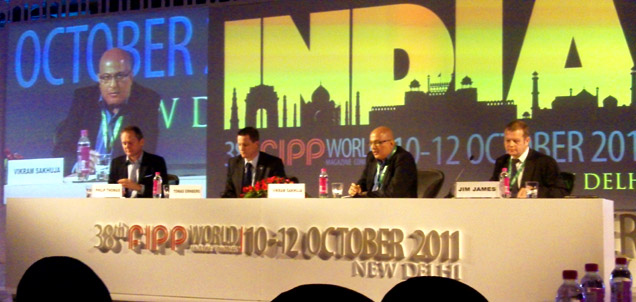
    The FIPP’s 38th World Magazine Congress is only three days away and is going to be held for the first time in India. Approximately 600 delegates from 50 countries (including India) will be attending this event. The conference will be held from 10-12 October, 2011 at New Delhi,and the biggest names of the media and advertising fraternity, from India and internationally, will be present at this event.

    Chris Llewellyn, President and CEO FIPP, UK, speaking on WMC India edition to MxM India said “The World Magazine Congress is FIPP’s most iconic event, gathering together the great and the good from our industry and is always special. Being held in India for the first ever time is a wonderful endorsement of how the market for magazine media is developing in this country and I’m looking forward to some great interaction between the local and international publishers. More generally, being able to understand how to balance the array of opportunities that new digital platforms bring together with the many strengths of the traditional magazine is the obsession of the magazine media world, and I’m sure that our New Delhi Congress will provide real insight and guidance as to what’s working, where, and why.”

    In a conversation with MxM India Mr Mitrajit Bhattacharya, General Secretary, AIM said, “We have a huge number of delegates coming in from all over the world; from the far-east, from Europe, from America. So I think, this is going to be one of the most successful World Magazine Congress in the last decade or so. India is the toast of the world for anything and there is a lot of interests for delegates to attend the WMC 2011.”

    When asked if business transactions can be expected in the WMC Mr Bhattacharya added, “I think there is a large amount of work which is happening in the digital space, and there is a lot of business which could be driven in that area in the World Magazine Congress with the magazine publishers of India. So there would be a definite angle of business in World Magazine Congress and I know that publishers are already full with the dates in their calendar with meetings with international delegates. There is a very nice appointment dairy that we have offered to every delegate and that is getting full for many publishers. So there will definitely be business transactions in the World Magazine Congress.”

    The World Magazine Congress will begin with the opening address by Mr Aroon Purie, Chairman of FIPP, and Chairman and Editor in Chief, India Today; Mr Chris Llewellyn, President and CEO, FIPP and Mr Jussi Pesonen, CEO, UPM. This will be followed by an interaction with Mr Shahrukh Khan, who will talk about ‘My Tryst with Magazines’.

    The next two days will be packed with speakers of renown from across the globe. The key note address on the second day will be given by Ms Ambika Soni, Minister of Information and Broadcasting, India.

    The Congress’ theme for this year is ‘The 360-degree Opportunity’. The congress will showcase various innovation and means to success in today’s dynamic market. The conference agenda contains some of the world’s biggest media names, giving their own personal insights. In addition, the 2011 Congress will incorporate a large commercial exhibition, providing the opportunity for delegates to learn about new products, developments and opportunities in a highly-charged business environment.

    India is an essential market as it has 73,000 magazines, including weeklies, fortnightlies and monthlies. The market is dominated by Hindi and regional publications. About 34 percent of the overall magazine industry publications are in Hindi, followed by English publications accounting for 13 percent of the total pie. The remaining 53 percent of the market comprises regional languages such as Marathi, Bengali, Tamil and Telugu.

    FIPP’s World Magazine Congress is by far the biggest magazine event that is organized across the globe which brings forth magazine publishers and business media providers from across the globe. The biennial Congress has taken place in many different locations over the years, including United Kingdom, London (2009), Beijing, China (2007), New York, USA (2005), Paris, France (2003), Rio de Janeiro, Brazil and Buenos Aires, Argentina (2001) and Hamburg, Germany (1999).


    For more information: www.fippindia11.com

  • Engagement Study may solve magazines’ measurement blues

    By Akash Raha


    Advertisers and media agencies will have more options to choose from in the print industry, as the much-awaited Engagement Study is set to be released at the World Magazine Congress 2011 in New Delhi next month. Mr Pradeep Gupta, President, Association of Indian Magazines (AIM), confirmed this development with MxM India.

    The apex association of magazine publishers is delivering on its promise of the Engagement Study on time. Mr Mitrajit Bhattacharya, General Secretary, AIM informed MxM India that the research for the Engagement Study was conducted by Quantum and IMRB, whereas Quantemplate coordinated the project on behalf of AIM. The research methodology of the study was based on desk research by Quantemplate, qualitative survey (20 one-on-one interviews of 2.5 hours each) by Quantum preceded the large scale quantitative survey (Sample Size: 3600 +, across 10 centers) by IMRB.

    Commenting on the study’s efficacy for the industry, Mr Bhattacharya said, The magazine industry has never been represented well by the large readership surveys like IRS, which are largely designed to cater to the needs of the dailies. The data for magazines has been less robust and highly fluctuating. More so, these surveys do not attempt to cover qualitative dimensions like reader involvement, lower clutter levels leading to higher attention, recall or even the image building capability which are the strengths of the medium. The Engagement Study will be a highly credible tool for the advertising fraternity to understand the engagement of consumers with various media and to evaluate the level of engagement of magazines vis-vis other media. These insights will help the advertisers immensely in choosing a medium like magazines in absence of sound readership data.

    He further added, But let me clarify at this stage that this survey is not attempting to capture any data at an individual title level. It is a very robust survey with a huge sample size, both qualitative and quantitative, trying to address the issues of the magazine industry as a whole, well represented by all major genres and languages.


    The AIM had announced during IMC 2010 its plan to conduct the Engagement Study for magazines, which could act as an alternate source of data for advertisers, after advertisers and media agencies expressed their concerns over the measurement issue that has plagued the magazine industry for long. The study is expected to solve the problem of qualitative measurement that the print industry faces, especially in the magazine domain.

    We have great work available on this subject in countries like the US, UK etc. However, the complex nature of the magazine market like India, with so many titles in so many different languages, makes this survey a unique and challenging one, concluded Mr Bhattacharya.

    Studies have shown that magazines have a completely different level of engagement. Magazine reading is very immersive and concentrated, much more than other mediums. Hence, the study is expected to be a boost for the advertising industry, giving them more options and choices to advertise effectively and efficiently.


  • Engagement Study holds hope for magazines

    By Akash Raha

    With the World Magazine Congress round the corner, New Delhi is set to host magazine publishers, marketers and advertisers from all over the world.

    However, with news doing the rounds each year that the future of magazine is in doldrums (at least on print and paper), a lot of hopes are likely to be pinned on the Engagement Study conducted by Association of Indian Magazines (AIM), which is to be announced at the congress. The study aims to become a robust currency for advertisers.

    Media planners and buyers whom MxM India spoke to about the study feel that it will herald a change for the better.

    Premjeet Sodhi, President, The Collaborative, Lintas Media Group said, “Yes, the currently available syndicated research studies in India are not adequate to take fully informed decisions about selection of magazines from a media planning perspective. A lot of additional inputs are derived from proprietary research by agencies to be able to make prudent recommendations. Overall, there is a huge scope for enhancement of the syndicated data sources from the perspective of magazines. While, I am not aware of the research design of the Engagement Study, I am sure it will fill a critical void of information for magazines and will be a valued input for media planners and advertisers. I hope that going further the research does not stay at the ‘Category Level’ and does provide information at the ‘Individual Title Level’ else the applicability of the information will always be limited.”

    S Yesudas, Managing Director – Indian sub-continent, Vizeum India said, “Personally I was shocked to see the numbers of some of the magazines when the Registrar of Newspapers of India publicized the print order claim made by magazines on its website, presumably through an oversight, as it was subsequently withdrawn.  Coupled with this is the reality of IRS certifying a consistent southward trend.  There are too many titles fighting for the same share of the audience pie, unlike the newspapers, they themselves are currently feeling the pinch.  While the engagement study might help differentiate one against the other in the same area of operation in terms of affinity, it will not make any substantial changes in the current perceptions and judgments by media planners, from an overall industry perspective. At best it will result in the publication with the highest affinity, scoring over the others compared to the current judgment allocation where the one with the perceived audience retention possibility gets 80 percent and the rest 20 percent. With the engagement study it might become 90/10 or 100 in favor of the one with highest affinity.”

    With digital being the watchword for the future, this year’s theme of the magazine congress is ‘The 360° Opportunity’.

    Dinesh Vyas, Business Head, MEC India said, “If you look at the way the print medium has been faring of late, I wonder how much of a difference the Engagement Study is going to make. The situation has changed drastically over the years and today, digital is taking away massive part of the advertiser’s money. According to me, digital is a very engaging medium, perhaps more than print as a whole. Whether Engagement Study will make a difference or whether clients will buy into a medium which is already losing interest amongst consumers, only time will tell.”

    A few questions arise here: Will the media planners and buyers appropriate the study? Will they be able to trust a survey conducted by the very group on which the study is being conducted? The answers to these questions are close at hand.

    Also Read:

    http://www.mxmindia.com/2011/09/engagement-study-may-solve-magazines%E2%80%99-measurement-blues/

  • Industry expectations from WMC2011

    By Akash Raha

    As the World Magazine Congress gets underway today, the industry awaits lessons which will lessen the woes of magazine publishers in India. The topic of this year’s congress is ‘The 360° Opportunity’ and with the advent of digital, the publishers will be interested in sharing and gaining knowledge on how to monetize the digital space better and leverage the brand on multi-media platforms effectively. MxM India spoke to several members of the media industry to know what they are expecting from the congress and express their views on it.


    Suresh Selvaraj, President, Outlook and Marie Claire.


    “WMC kind of events should provide practical solutions to safeguard the magazine industry in its original avatar – i.e., the print version. Increasingly everyone suggests how digital could change the landscape and why one should invest in it etc. but what about the returns? Show me one website of a popular Indian magazine that makes equal amount of reach or turnover or the potential to do so in the next couple of years. When international magazines make a beeline to enter into India, how many Indian magazines venture into the neighboring countries, at least? Can Indian magazines use WMC to open the doors to the world – especially when we have some very successful titles and talent?”


    Rasina Uberoi, Vice President, Media Transasia Thailand Ltd.


    “At the World Magazine Congress we are looking forward to meet all our global partners. Although we meet them on a regular basis, WMC gives us a platform to meet everyone at the same time. We are looking forward to exchange of thoughts and ideas with our partners. However, my biggest expectation here is how we are going to monetize our digital business. Everybody has been talking about digital business and social media for a long time. And everybody is still toying with the idea. So I am keen to learn from WMC and from other publishers what a successful revenue model in digital is.”


    Anant Nath, Director, Delhi Press and Managing Editor, The Caravan.


    “My expectations from World Magazine Congress are the same as before – To re-establish and re-articulate the cause of magazines and help it stay relevant. Magazines have to grow in the right eco-systems in a multi-media framework, and be relevant for the various digital offshoots. I am eagerly looking forward to exchange of ideas and learning with our international counterparts. Since the congress, for the first time, is being held in India there is going to be a lot of participation from Indian publishers. The publishers will have a lot to learn from their international counterparts, who will share their learning and insights to what the future might hold for Indian publishers.”


    R.Rajmohan, Publisher, Open Media Network Pvt. Ltd.


    “WMC, held every two years, is a very significant conference for magazine publishers across the world. It is an achievement for AIM and Indian magazine publishers that India is the venue for WMC, this time. It also reflects the growing importance of India as a magazine publishing market. FIPP has brought together eminent panelists, making the congress a must-attend for magazine publishers. Opportunities magazine publishing offers in the digital ecosystem is tremendous and the conference will discuss this and far more, which will be a great learning experience. I look forward to meeting fellow publishers from all over the world and to the exchange of ideas and thoughts.”


    Sandeep Khosla, CEO, Infomedia18.


    “Since World Magazine Congress is an international event and several international publishers are coming from around the world, we are looking forward to interacting with them. There is a lot happening internationally and there are some new vehicles which we can possibly tie up and bring to India. Apart from that we are looking forward to understand, as to how publishers co-exist with technology too. We want to understand what various publishers are going to do with ipads and android platforms and how will we co-exist with them… what sort of a revenue model is one looking are looking at to remain relevant. We will be looking forward to understand that in the light of dropping readership, a sort of recession that we are seeing, how do we survive and make profits.”


    Riyad Mathews, Senior Assistant Editor and Chief General Manager, Malayala Manorama, Malayala Manorama


    “Well, it’s not often that you can get all leading publishing houses under one roof. The World Magazine Congress gives us all an opportunity to interact, meet and discuss issues facing the magazine industry and it also gives us business opportunities.”

  • Chalo Dilli!


    By Akash Raha

    Delhi is all set to host two mega international events back to back – The World Magazine Congress and AdAsia. It almost seems like Delhi has become the new hub to host such grand events, perhaps taking over the role from Mumbai, the financial capital of India. Nevertheless, the upcoming month assures to be grand and promising for Delhi, which is bound to receive a lot of attention with several international business honchos from the media and advertising industry attending the two events.

    Speaking about the two events in a recent conversation with MxM India Ashish Bagga, CEO, India Today Group said “The World Magazine Congress is in early October followed by the Adasia; it is a big month and there is a lot of activity around both these conferences. The learning is amazing; the energy levels are very high. We are all very excited and we hope to pull off two very successful broad format events. And we are all looking forward to it.”

    Talking about the two events scheduled to take place in Delhi Prathap Suthan, Chief Creative Officer/Chief Explorer, iYogi, said “Well, the expectations from WMC is not much as it’s an era of digital. The only time a person reads a magazine these days is when travelling in a plane. I do love print but it is no more reasonable these days to subscribe for it or carry it along. When it comes to Adasia, yes, I will be going for it with a couple of my agency people. We are expecting to hear the best of experts on ‘uncertainty is the new certainty’ as in my opinion the world has always been uncertain hence nothing can be regarded as certain, Steve Jobs death was not certain, anything that happens to anyone is never certain.”

    [youtube]http://www.youtube.com/watch?v=T7zC5_yLkbs[/youtube]


    Thereafter, Mr Suthan went on to praise the city of Delhi and said. “As far as having the events in Delhi is concerned, Delhi has a better infrastructure, better airport and better accommodation facility than Mumbai. In addition to this, every industry person makes a weekly Delhi visit. The only thing that Delhi doesn’t have is a sea but that is compensated with the nearness to mountains and desert. Hence Delhi is the perfect place to have such events.”

    In the two events several international deals and business transactions are also likely to happen. And that they are happening in Delhi is only good for the city. In the future too, it shall entice and lend confidence to the media, marketing and advertising fraternity to organize such events in Delhi.

    Talking about the two cities Mr Arvind Sharma, Chairman of India Sub-Continent, Leo Burnett said “Adasia is a major event happening for the advertising fraternity, it will bring a lot of great advertising minds under one roof. I’m hoping it will be a great event and I’m really looking forward to it.   I have been saying this for a very long time that the advertising industry in Delhi is growing double the rate than the Mumbai ad industry growth. Hence, it is the perfect venue for such a big advertising event.”

    But is Delhi’s gain Mumbai’s loss? This, only time will tell… But for the moment, it is time for the industry in Delhi to indulge in fun and frolic, amidst few of the biggest names of our industry as the city hosts World Magazine Congress and Adasia.


    Photograph: Fotocorp

  • SRK does a ‘chhammak chhallo’ as World Mag Conf gets underway in style (Text & Video)


    By Akash Raha (text) and Shruti Pushkarna (Video)


    The 38th FIPP World Magazine Congress began on October 10 in New Delhi with huge fanfare. The first ever India edition of the World Magazine Congress is being attended by over 600 delegates from 50 countries (including India). The biggest names of the media fraternity, from India and internationally, were present on the inaugural day of the WMC which is scheduled to last till October 12.


    The welcome address was given by Mr Aroon Purie, Chairman of FIPP and Chaiman and Editor in Chief, India Today, India along with Mr Chris Lewellyn, President and CEO, UK. Mr Purie said, “It is indeed a matter of pride that India was showcasing the FIPP WMC 2011. The conference is possible because of the hard work of FIPP and AIM members. We welcome you all to, what the advertisement slogans rightly call ‘Incredible India.”


    In his short note Mr Lewellyn said, “There are three reasons why it is going to be a great congress. Firstly, the Indian magazine association has worked very hard to put it together. Secondly, it is for all our sponsors, especially UPM. Lastly, it is for you (the delegates) for whom the congress is going to be successful.” He concluded by saying that “FIPP World Magazine Congress is a place where some of the biggest deals are forged”. He termed the interactions at the WMC the “speed dates” of the business world.


    [youtube]http://www.youtube.com/watch?v=mTxOmOwhVjw[/youtube]

    Thereafter, Bollywood actor Shahrukh Khan said that being on the cover of over 8000 issues of magazine was a privilege, but his tryst with magazines had come much earlier when he was not as famous. “As a child, magazines were the window of my world,” he said, “long before I was on them.” In an enjoyable and witty talk, Mr Khan said it began since the time he saw Samantha Fox on the cover of People magazine when he was still very young. He asserted that even though life is becoming faster with the digital age, “this form of writing is not going away; not in our lifetime.”  He emphasised his faith for magazines and whished magazine publishers from around the world luck, as it was a vital medium. Mr Khan thereafter entertained and enthralled the crowd with this dance performance on ‘Chamak Challo’, the song from his upcoming movie Ra-One.


    Apart from dancing to contemporary Bollywood numbers, dance troupes presented classical Indian dance forms and Bhangra. This was followed by a networking session over dinner.

  • WMC2011: Soni sees bright future for mags

    By Shruti Pushkarna

    After the smashing opening of the 38th FIPP World Magazine Congress with King Khan dancing to “Chammak challo”, Day 2 opened with optimistic assurances from the Minister for Information and Broadcasting, Ms Ambika Soni. Chairman of FIPP and Chairman & Editor-in-Chief, India Today, Mr Aroon Purie invited the I&B minister to grace the opening of the second day with her address.

    A self-confessed “avid magazine reader”, Ms Soni was extremely optimistic in her views on the future of magazines and print media. Addressing the Congress, the Minister stated, “…With 77,000 registered publications, including magazines in different languages, we are one of the major magazine hubs of the world. India represents one of the developing markets for magazines globally, and (are together) expected to contribute about 31 percent of the global advertising expenditure this year, and 67 percent of the growth of this crucial segment of the media.”

    The minister also emphasized the diversified nature of the India market. “We also probably have the greatest possible diversity represented in our magazines in terms of genre and content, not only language. From the glossiest and most sophisticated luxury magazines to those making effective use of the latest digital trends, to the more simply and cheaply produced publications… all co-exist in a highly diversified, highly segmented, highly stratified market.”

    Ms Soni showed that she is not oblivious to the threat that the digital revolution poses to the magazine segment. But she assured the audience that the danger was not as grave as it seemed in, perhaps, the last Congress. She summarized the solution to the problem in three words – innovation, expansion and adaptation. “There will always be room for innovative ideas, in terms of content and format. Adaptation of course to internet age, to tablets, to phones, to developing new revenue models… But there are also significant gains to be made by expansion; this is especially true in developing markets like India.”

    The minister also shared some interesting figures, reiterating the prospects of growth in the magazine segment. “While the print market in India is dominated by newspapers which accounted for 94 percent of all print revenues in 2010, the important point to note is that the overall pie is growing and the magazine segment is estimated to grow at a CAGR of 4.8 percent in the period from 2010 to 2015.”

    And donning the role of a ‘government representative’, she shared with foreign delegates how liberalized government policies are aiding the growth of the print medium: “For the benefit of all the delegates who’ve come from outside, I would like to emphasize that we’ve come a long way, a long way since the basic premise of our print media policy of 1955 which did not allow any kind of foreign publications, either newspapers or periodicals. The policy which was subsequently reviewed in 2002 and then again in 2005 has paved the way for a spurt in the magazine sector. The liberalization of our print media policy has not only attracted foreign direct investment, it has given a growth perspective to the magazine industry in India as well.”

    The minister also assured the AIM members that their “longish wishlist” is being carefully examined and all issues will be addressed soon.

    On a lighter note, she also promised the foreign delegates to “again look at the government’s policy on visas on arrival”.

    Ms Soni left the audience with an interesting question to ponder. She said, “With over 90 million copies in circulation daily, the print industry is among the largest in the world. But the vast untapped potential in this industry is even greater. More than 300 million literate individuals don’t read any publications. These 300 million individuals have rising levels of income and aspirations. Will all these be diverted straight to the internet?” With internet access in India still quite low and broadband access even lower, the minister added, “…Today there is a large window of opportunity for the print media that Indian publishers should therefore capitalize upon.”

  • WMC 2011: Mag publishers have eye on future


    By Akash Raha

    Future trends, changing media dynamics and measurement issues were discussed during the October 11 session of the 38th FIPP World Magazine Congress. After  addresses by Mr Aroon Purie, Chairman FIPP and Chairman and Editor in Chief, India Today and Ms Ambika Soni, Minister of Information and Broadcasting, a series of interesting and intriguing sessions on various issues followed.

    How tablets are re-inventing the future of magazine media

    The session discussed the various current trends in the tablet publishing. The panelists showed how the audiences are viewing the experience of tablets through their presentations. Ralph Buchi, Head of International Division, Axel Springer, Germany said that the penetration of tablets and smart phones are growing each day. “Tablets are creating new reader base every day. Those who did not read us before are now reading us on tablets. Also, it creates newer audiences in a new age group. People are willing to pay for the content and we are able to garner good advertisements too.” The case study of Axel Springer showed that paid content strategy is paying off as they can boast of significant sales figures of the title with as many as 134,000 digital sales per issue across all our titles.” Mr Buchi pointed out two important reasons for this; increasing willingness to pay for premium content and growing penetration of the devices.

    Neil Morgan, Managing Director, McPheters and Company, UK spoke about imonitors, which was launched in June 2010 to allow publishers and agencies to share the cost of thoroughly monitoring developments of apps. Talking about tablets he went on to say, “Penetration of tablets is expected to triple over the next three years. The number of publication-related apps is expanding rapidly too. Apple still dominates the app marketplace, providing yet another reason for the consumer to prefer the iPad over other tablets; however, Android is growing rapidly to increase competition.” Peo Strindlund. Vice President of Sales – Europe and Asia, Magplus Sweden observed, “Tablet ownership among 35-54 year old is changing drastically. Nearly two-thirds of respondents spend approximately two hours with the device regularly. It is essential to understand this changing behaviour to make profits.”


    Social Media Phenomenon: How magazine brands can benefit

    It’s a truth universally acknowledged that social media can make or break a brand. This session portrayed, through case studies, how magazines can take advantage of social media. “We have to understand that times have changed. The consumer wants relevant content and social media is one such medium to provide that. Today, consumers want everything in real time. The question is that how can media take advantage of that? We have only nine seconds to win the attention of the customer, and if we don’t want to lose that opportunity. Content is king, but content in a context is what is important today,” said a speaker from Meridth, USA. He went on to say, “To be successful in social media we have to adopt an editorial mindset and breed hybrid thinkers. Secondly, keep it fresh and find an innovative angle to the story.”

    Sergio Zalis, Editor in Chief, Contigo Groupo Abril, Brazil, a weekly magazine, said that his group has three major platforms, magazine, internet and events. He said events is one of the most important vehicles in a country famous for its carnival, and spoke about how they have created a community around it. “We create news during carnivals. We have good sponsors that bring us good revenues. We have almost 200 million people in Brazil out of which 80 million people are connected to the internet, 87 percent are connected to social networks. We are a social brand and wanted to interact with our readers. Contigo’s Facebook page had 105,000 followers in only 15 days. Eighteen percent of the traffic that comes to our site comes from social networks.” Svida Alisjahbana, President director and CEO, Femina Group Indonesia said, “In Indonesia, mobile accounts for 62 percent of digital exposure. One of the reasons for that is Blackberry’s penetration in Asia with Blackberry messenger being a craze… Social media has been a powerful medium for us. Our Chief Editor is also Chief Community Officer where she is managing a lot of different type of communities on the social space. Content, Community and Channel is important to us. Content is king, but conversation is the kingdom.” Feng Xincheng, Executive Editor in Chief, News Weekly, China said, “Being a weekly magazine, earlier we communicated with our readers only once a week. But with social media and internet, we refresh our news each day and can communicate whenever we want.”


    Magazine media innovation is a 360° environment

    Mr Juan Senor, UK Director, Innovations, UK spoke in this session about the imaginative ideas being employed not only with the emerging opportunities that digital technology brings but also in the traditional magazine disciplines. “He said that it is time to start charging because ‘free’ can prove to be expensive is very expensive and there is a cost burden… We are moving towards an app based world, but we are not at the tablet world yet. Mobile is still bigger than websites and tablets and will be for some time to come. Digital today is important, yes, but digital alone is not enough. The print has to co-exist with it. The future of paper is a premium future and it will exist for decades.”


    Changing Face of Retail

    Inventory management, efficient print runs and managing the changing retail environment are the key to enhancing profitability. Frederic Chevalier, EVP, Strategy Innovation and Sustainable Development, Lagardere Services, France spoke in length about his company and other success models. Talking about the issues concerning the industry he said, “Declining retail sale or single copy sale poses a major threat to the entire industry, to the publisher, distributor and retailers. Single copy sales are of outmost importance and newsstands are the best places where you can show and showcase your magazine to your audience. The consumer can see, read and browse through your magazine.” He added, “We must collectively adapt our business to the changing world. We must try and make the industry more efficient to reap profits. Also, adopt retail businesses best practices and incorporate newer technologies to make our business profitable.”


    Audience metrics: How to measure multi-platform brand reach

    Advertisers are demanding ever more sophisticated targeting and measurement analytics, particularly of brands operating on several platforms. The point of debate was, what are the trends in audience measurement and what are the criteria advertisers value the most. Ambika Srivastava, Chairperson, Vivaki Media Exchange and ZenithOptimedia, India said, “Brand experience correlates with market share. People positively disposed towards the brand looked at the ads more closely. Without experience, we cannot survive. The brand experience of magazines and the internet is significantly higher than ad share. There has been a lot of action in the automobile sector, for instance, where not only the trade magazines but even general magazines have been preferred for advertising.”


    Emerging markets

    This session discussed through case studies some of the areas where rampant growth can be witnessed. Didier Guerin, CEO, Media Convergence Australia moderated the session and introduced the panelists. Colin Crowell, General Manager, Ringer Vietnam spoke about how the growth opportunity in Vietnam, owing to strong internet penetration, is immense. “We focused on our print product first and thereafter, grew at a steady pace as the print ad revenues kept flowing. The only problem that we faced at the beginning was perhaps to   find the right partner.” Michael von Schlippe, President, Partners Media Group, Kazakhstan spoke about his success story of his magazine in the largest landlocked country lying between Russia and China, and invited the audience to invest in 20 percent (according to government norms of foreign media ownership) of his company. Likewise Chang Eui Lee, CEO, Chosun Magazine, South Korea too narrated his success story and the rapid growth the magazine saw. He stressed on the importance of being ahead of the times and gave the audience and insight to his five-year plan (2012-2016) of increasing the magazine market which includes steps such as improving distribution system, strengthen global competitiveness, support digitization and improve quality of magazine content.

    Paid content and paywalls

    High quality content comes at a price, yet many publishers hesitate to introduce charges on their websites. Mahesh Murthy, Founder and CEO, Pinstorm India was the moderator of this session and gave his invaluable insights on the topic of paywalls. According to Alessandro Cederle, President ANES Italy, CEO Ediemme Gruppo Editoriale, Italy, “Making money with content is an increasingly big challenge for publishers nowadays and hence it is important to define or rather redefine the issue. It’s not about making money but about understanding how content can create value; and if content creates value, then you can automatically make money out of it.” James Tye, CEO, Dennis Publishing, UK said, “It is not possible to put all brands, and we have 30-40 brands, into an iPad-specific app. So when you choose them, choose the one with the most glam potential, choose the one with the highest brand recognition, the most advertising potential, and critically the most assets; so you must have video assets, extra pictures, great content.” He went on to say “All we do as a company is produce good content. I give it to people in the way they want to consume it. So if they want to read it in print, we’ll be there. If they want to read it on the iPad, we’ll be there.”


    The future of international magazine brands in the 360° media world.

    Publishers need to ensure that the consumer experience is a consistent brand wherever they might be in the world, in whichever language they might consume the magazine in and on whatever device they might consume it on. The issue in this session was how publishers are handling the brand across multiple platforms. The session was moderated by Barry Mcllheney, CEO, PPA, UK. Torsten Klein, President, Gruner+Jahr, Germany noted, “We had given content for free on the worldwide web, but we can’t afford to make the same mistake again with tablets. We must put a premium on content from the very beginning and not give it for free.” Roberto Briglia, Chief Content Manager and General Manager of International Activities, Mondadori, Italy said, “The big question still remains how to monetize digital. We have to change the way we sell advertisement and reconceive the way in which we produce content. We must use digital to successfully create new business opportunities. When asked by Mr Mcllheney, whether magazine is at the absolute heart of it, or is it merely one of the platforms, Duncan Edwards, President and CEO, Hearst International, USA said, “Magazines are at the absolute heart of it all and the rest of the mediums are build around it. Magazines as a product will be efficacious for several decades and that is where we will make most of our revenues from. The other mediums will only be alternate sources of revenue.”

    Magazine: The medium of the future

    Despite the drive towards digital media, researches has repeatedly shown that magazine continue to be a relevant and trusted medium and hence, a medium of the future. Susan Kaufman, Editor, People StyleWatch, USA presented a case study citing the success story of StyleWatch. She said, “The success of any brand (magazine) lies in how well does it emotionally relate to its readers… The main reasons for the success of StyleWatch are that we respect and connect with our readers – that’s probably how we managed to sail through the recession as authenticity is one key factor. We are not a regular celeb gossip magazine; our magazine uses celebrities as aspirations and inspirations. Our celebs help validate the trends we cite. We know how to delight and surprise, our magazine is like a present to the reader.”

    Nicholas Coleridge, Managing Director, Conde Nast, UK said, “The first magazine congress I ever attended was 21 years ago, and it had the same theme. This was long before digital was invented. The keynote at that congress was a ‘guru’ from Henley Centre who gave the most apocalyptic speech I had ever heard. Magazines, he said, have no future. But thankfully I got into the business and figured out the optimism in reality.” He pointed out that average issue publication from 1971 to 2011 has been on a constant rise and the statement that magazines have no future is one of the great untruths of our century. He went on to say, “We are bringing out digital versions, apps etc, but we haven’t forgotten that print is foremost. The sheer beauty of the printed page can never be replicated in any other media. Seventy percent people prefer print to digital and this in the age group of 21 to 27 yrs; 81 percent think images look best in print.” Thereafter, MS Min Liao, Editorial Director, Trends Group, China cited the case study of Trends to drive her point that the future of magazine is bright. “Our strategy is brand focus and audience focus. You need to provide something unique to the consumers, as they have greater expectations now.”


    Also Read: http://www.mxmindia.com/2011/10/soni-sees-bright-future-for-mags/

    Photograph: Video grab picture of I&B MInister Ambika Soni with Aroon Purie (to her left) and Tarun Rai.


  • WMC 2011: We have to be innovators as much as publishers: Aroon Purie

    By Shruti Pushkarna


    Addressing delegates at the 38th FIPP World Magazine Congress in New Delhi, Aroon Purie, FIPP

    Chairman and Chairman and Editor-in-Chief, India Today, said much had changed since he first joined FIPP at the Paris World Magazine Congress 2000. He believes, “India has arrived at the world stage and the fact that the World Magazine Congress is being held in Delhi is a reflection of that.” Mr Purie leaves the chairmanship of FIPP at the end of the Congress.


    Compared to 2000, when the Indian media space had not opened up to the world, in 2011, the media space in India is bustling with activity. With 10, 500 newspapers and 58,100 magazines registered in this country, Mr Purie emphasized, “Although newspapers are shutting down in most parts of the world, and most cities have only one newspaper; in a place like Delhi, you can get 16 English newspapers delivered to your doorstep and there are 10 Hindi language newspapers. I don’t think that’s possible anywhere in the world.”


    The demographics in the Indian market, assured Mr Purie, will make any publisher “salivate”. We have 22 official languages which means you have that many more languages to publish in. In that sense, we are like Europe, except Europe has a population of only 739 million and ours is 1.2 billion.”


    India, Purie further added, is a country “straddles many centuries simultaneously”. “That is our

    uniqueness in a way. Not far from here you’re likely to see a bullock cart on the road next to a Bentley, both stuck in the same traffic jam. So it is in the media space. We happily straddle digital as well as traditional media and both are growing rapidly.”


    Citing the latest numbers, Mr Purie added, “Consider that magazine advertising is slated to grow by

    a compound annual growth rate of 13 percent for the next five years. Internet connectivity, although

    now low in terms of penetration, still has 100 million people accessing the net. This is expected to grow to 237 million by 2015. Smartphones now constitute only 5 to 6 percent of the total phones but this is expected to grow to a 25 percent by 2015. India has 31 million Facebook users which makes India the third largest market for Facebook. India is a country rich with promise.”


    But the uniqueness of Indian market does not take away the need to innovate. Mr Purie recalled, “When I took over FIPP two years ago as the Chairman, the mood among publishers was truly dismal. It was like watching terminal cancer patients just biting their time. There is now an aggressive optimism and a growing realization that the new technology is not a cancer but one of those injections that offer rejuvenation.”


    Mr Purie believes that tablets will be both “the saviour and the biggest challenge for magazine publishers”. “For us to succeed we have to know now to design content for eyes, fingers and ears too, and provide an immersive experience to our consumers,” he said.


    Drawing a parallel with this year’s theme, ‘The 360 Opportunity’, Mr Purie reiterated the need to

    integrate the traditional models of content with new technology and new platforms.

  • David Hill is new FIPP chairman (Video story)

    By A Correspondent

    Videos: Shruti Pushkarna

    David Hill on becoming the new FIPP Chairman
     David Hill on key points to look at on assuming the role of FIPP Chairman


    Mr David Hill, President and CEO, IDG International Publishing Services was named the new Chairman of FIPP. Mr Aroon Purie handed over the reins of his Chairmanship and announced it at FIPP World Magazine Congress 2011, New Delhi.


    Mr Purie had been the Chairman of FIPP for the last two years. This was his second term as a Chairman of FIPP. Before announcing the name of the new FIPP Chairman, Mr Purie congratulated everyone for a successful magazine congress.


    Mr Hill thanked Mr Purie for his dedicated service to FIPP. Mr Purie took over as the Chairman of FIPP two years ago, while the industry was threatened by recession.


    The next magazine congress is set to take place in Rome, Italy, announced Mr Maurizio Costa, Deputy Chairman and CEO, Arnoldo Mondadori, Italy.

  • Mags hold their own in dynamic times


    By Akash Raha

    The 38th FIPP World Magazine Congress ended on an emphatic note on October 12, 2011, with several engaging sessions discussing various aspects of magazine publishing ending with a gala evening at Kingdom of Dreams.

    One of the major sponsors of the event Jussi Pesonen, CEO, UPM gave the welcome address at the Kingdom of Dreams.

    The day began with Mr Chris Llewellyn, President and CEO, FIPP, UK speaking about FIPP. He explained the various aspects of it, such as meetings and events, information and professional developments. The properties of FIPP include Worldwide Media Marketplace, Digital Innovation Summit, FIPP Research Forum 2012. FIPP also encourages researches such as Innovations in Magazine 2011 World Report, Magazine World and World Magazine Trends etc. Speaking about the efficacy of FIPP, Mr Llewellyn said, “I would especially like to mention the influence of FIPP in a fast-developing market, where we have helped several publishers grow better and faster.”  He also said that Korean publishers had approached FIPP and it is now planning an Asia-specific event next September apart from one in Central America next November.


    What advertisers want from magazine media

    Mr Jim James, Director, Haymarket Media Group, UK moderated the session which discussed what the advertisers want magazine publishers to do in these times of dynamic changes.  He said, “Perhaps it is a most important question what advertisers want from the magazines. Philip Thomas, CEO, Cannes Lions, UK began the discussion by talking about what advertisers want not only from the magazines but from the whole media mix. He began by talking about Cannes Lions and, which is event that celebrates creativity of communication. “Over the years we have seen more and more marketers, who were earlier, obsessed with ROIs, attending a creative event. Why is that so? It is because creativity drives effectiveness…So the question is not really what the advertisers want from the magazine. Rather, what the magazine publishers can grab from what the advertisers have to offer.” Citing examples he said, “Clients value creativity, it drives their business.” Mr Vikram Sakhuja, CEO, Group M, South Asia said, “In spite of the ad revenues seeing a growth, the growth of magazines has been rather stagnant, and that is a cause of worry. The question is where does the surplus go?  Lately, it has gone into digital mediums.” He went on to say that “Even though Indian magazines publishers are a very creative bunch, they are apologetic about numbers. Content and creativity is the heart of the business, and all they need to do is be passionate about their product.” He also observed that a lot more innovations are happening on digital mediums than on magazines. Mr Tomas Ernberg, Managing Director, Volvo Auto India said, “I think the future of magazine industry will be like what happened with the locomotive industry after a while – based on consolidation… The three important questions that one focuses on, is when we are going to advertise, what we are going to advertise and what is the mix we are going to advertise. Also, it is essential to know the psychography, belief and habits of the customer. If a magazine publisher can tell us exactly what his audience is like, there is no reason why an advertiser won’t advertise.”


    B2b Publishing: Keeping the community engaged in a 360-degree environment

    There are significant changes which have happened in the b2b space since the growth and acceptance of digital. The panelists of this session deliberated on this at WMC2011. Ms Yuko Tanaka, Director, International Sales, Marketing and Communications, Nikkei BP, Japan spoke about her group’s 39 periodicals, 17 websites which are both free access and paid access. She stressed on the importance of 3 key points of focus for Nikkei BP in 2011, Social Media, Smart phones and integration. She said, “Smart phones are gaining popularity as a device, so a need to create to content for that platform. Our research shows that different users access our website through different devices at different times in a day. There are evident trends, for instance, that show more users are accessing Nikkei BP info through iPhones in the day and more on iPad at night. There is a need to not just develop apps for smartphones but also optimize views from smart phones.” She said that there is a need for integration of digital marketing with content and users at the core. “Deeping engagement is like filling a glass with water, except earlier print was the only water you could fill your glass with. It is important to understand your glass or your audience to deepen their engagement with your brand (publication),” she concluded.

    Mr Kevin Costello, Chief Executive, Haymarket Media, UK said, “We have used technology to develop and engage our audience –  60 percent of our revenues come from print, 27 percent from digital and online, and 13 percent from face to face… Internet/Digital meant we had to compete more aggressively to get audience attention. We were faced by the sheer complexity and uncertainty of how technology would evolve. The issue is not just providing content as experts, but how to package content in a certain way that engages users at a greater level. We need to gather enough data on our audience to engage them. If we ask our audience something, we also have to listen to them and provide answers; we should know how our audience wants to interact with us.”

    Mr Pradeep Gupta, Chairman, Cyber Media, India said, “If you look at a 360 degree environment, then changes in b2b publishing have happened far before changes in b2c publishing. Out of 55 percent revenues that come from ads, 15 percent comes from Digital and 30 percent from events. We have been continuously experimenting with new technology, so that we can continually engage our audience… Adding to this revenue model, we are coming up with a new category, ‘Integrated Programmes’. These will be across media, and we plan to get 10 percent of our revenues from this category. The advantage in this model is that advertisers can engage right across to their audience with integration of different media.”


    Successful business model for multi-platform publishing

    Traditional magazine business used to be simple at one pint of time; however, it is not so any more with multiple platforms. The debate at hand was what a successful business model in such an environment is. Mr Paul Keenan, CEO, Bauer Media, UK presented what he called ‘A new dynamic for a new economy of ideas’. He started off by giving a brief overview of this dynamic. Procurement and consolidation forms the dynamic leading to commoditizing the media. “One of the biggest challenges we face is the explosion of media with multi platforms. Hence, magazine today needs to scale outstanding products that are different and better. Moreover, they have to do that with creativity.” He gave several examples of magazine innovations and multi-platform creativity to drive home his point. Thereafter, Mr Peter A Kreisky, Chairman, Kreisky Media Consultancy, USA, spoke about the integration of modern technology with old media. He said, “One of the questions that we ask in the dynamic environment of change is, what are the constants? Our trusted magazine brands, curated and valued content, and our relationship with our readers are the constants and that is something which me must focus on. And between and around that we have to build various business models… Moreover, we have to learn to harness digital eco systems. Ms Kalli Purie, Chief Operating Officer, India Today Group Digital, India gave several examples from her group and explained how multi-platform publishing works, and all that to create a successful business model. India Today is one of the largest media conglomerate with a newspaper, a few channels, digital, several magazines, events etcetera. Talking about news she said, “We try to do more exclusives. Exclusive in a world where news is commodity can make or break a media house. Celebrity power is something we understand. For example, a brand like Shahrukh Khan can help sell not only Bollywood movies but magazines too.” She added “We are a big group and we often believe in curating rather than creating. That helps in cutting costs and yet generating revenue. We don’t want to add our cost burden. We want to be lean and thin and curate content across the group and yet make profits.”


    Editorial challenges and opportunities in a 360 degree environment

    Speaking on the topic Mr Chris Johns, Editor-in-Chief, National Geographic, USA said, “It is important to build a community to keep the promise of your brand – a community of editors, photographers, designers, assistants etc… In a 360 degree environment, the need is to integrate. It is ridiculous to leave out editors, photographers saying that they don’t understand video, or they don’t understand the new platform. How can you say let’s turn it to someone else because they don’t understand the medium.” He said that there are creative people who are out to tell stories and they will do so irrespective of the medium. “At Nat Geo we take good pictures, because our teams are motivated to do their jobs, introducing video is not going to change anything about a good photographer. He will still take good pictures.”

    Mr Mathias Plica, Managing Director, CHIP Xonio Online, Germany said, “CHIP Magazine and CHIP Online – one international brand but two successful complementary products. Brand CHIP is about digital consumer technology. While the Brand strategy is common to CHIP magazine and CHIP online, they have different product strategies. While CHIP magazine is premium paid for content, online is about free content for mass consumer market. The content strategy for CHIP Magazine is to understand what is going on in digital technology, more investigative. But content strategy for online, is about answering three questions. What should I take? Where can I get it? How do I use it? It’s about answering millions of users as opposed to magazine, where you are talking about overall trends.”

    Jim Jacovides, Vice President – International, Time Inc, USA citing Sports Illustrated as a case study said, “SI was first published in 1964, so it’s as traditional as a magazine can get. Some content will overlap in traditional and new media but some will have to be crafted especially for the new media. If we look at the print and iPad workflow, edit, art and photos are common to both. Change sets in when looking at layouts, and some extra content. For instance, the ipad app of SI introduced more photos (additional to the print mag), videos, podcasts, links etc… While the idea remains the same behind content, it just gets enhanced in the digital in a different way, because it is specifically designed to be interactive.”


    Paper’s dynamic future

    The session discussed the future of print in the current media mix. The session was moderated by James Hewes, Publishing Director – Magazine, BBC Worldwide. Ulbe Jelluma, Marketing Manager, Print Power, Belgium said, “Print Power is an initiative that started two years ago. The idea is to promote print media to advertisers and media buyers. We believe that print media has a role to play in an integrated media plan. Research shows that pro print campaigns have been effective. We also have support of major advertisers, some of whom write testimonials on how they use print media in their integrated plan. Research also shows that importance of ‘online advertising’ as a subject for search (Google searches) is declining. Research also shows that perception magazine effectiveness is increasing, which mean magazines have grown in confidence. The challenge print media faces is how will Generation Y influence marketing, advertising and media decisions? Media consumption in this gen y is shaped by multi-tasking. So you’ll have to keep your content like that- more pictures, no long articles, because this gen Y doesn’t have the attention span to go through lengthy articles. Research also shows that magazine-reader relationship has grown steadily. Print media engage readers- readers have a strong relationship with magazines; and as a result, advertisements benefit from this strong relationship. Print media also has better recall content.” Jyrki Ovaska, President, Paper Business Group, UPM, Finland said, “The important issue to address is, can paper and print be dynamic. In this digitalized world? We’ve got to adjust to new demands. Some of the successful magazine editions, have adapted to new unique technology integrations, like Vide magazine, came out with an edition, in which an ad was powered with a chip, so it would play when you flipped the page. These kind of technological advances can be easily integrated into the traditional format to make a lasting impact. The need is to mart new technology ideas or forms with paper. Research shows that uniqueness of printed paper appeals to all five senses. The paper consumption might have seen a decline with an onset of broadband, wifi etc. but there is research that shows, printed magazine is the most preferred way of reading magazines in every age group (in US). Print is seen as an effective media with high advertising reach.  18 percent media use will get 42 percent of advertising revenue.”


    Engagement and magazine Media

    In a country like India, engagement in social media and digital media is limited to a handful of titles. The panels discussed how will the environment change with the advent of 3G and the expected proliferation of tablets. Also, a comparison was made with the Indian experience vis-à-vis what is happening in the international markets. Mr Guy Consterdine, CEO, Guy Consterdine Associates, UK was the moderator of the session and said, “Engagement can be measured in term of behaviours and attitude. But is engagement universal across the globe? Is engagement from magazines in India same or different from that in USA and Europe?” Mr Tarun Rai, CEO, Worldwide Media, India said that magazine are an engaging medium which, unfortunately for the publishers can garner only 3 percent of the ad revenues. He said that the quest of magazine publishers is to want more of the ad pie, hence they have come out with the ‘Engagement Study’. He said “There are expectations from the ‘Engagement Study’ that we have done, and our fraternity has a lot of expectation from ES too.” Giving a background to the Indian media scenario Mr Rai said “The speed at which media in India has galloped is immense. Only a few decades back, three decades ago we had only one television channel. Even in 1990’s there were only six television channels. Today in India we have 515 television channels. As a matter of fact, recently a study proves me wrong and said that there are 745 TV channels in India. And it’s not just TV channels; it’s all forms of media that is growing at a staggering pace. We have 400 radio stations, third largest internet user population in the world, mobile and now ipad too has a lot of penetration. And then there is YouTube, Twitter, Facebook and gaming too. And I have yet not included the large number of print publications (NP and magazines).”

    He went on to say, “Since there is so many medium it is leading to ‘unconscious filtering’ on the part of the audience. Because there is so much information one does not know what the right information is any more. This leads to the consumer being anxious. A lot of this information came from the quantitative research we did. And It is proven by research (not just by our research but many others) that the consumer today multi tasks and is involved on several mediums at the same time. Always being on media is contributing to a lot of noise. There is so much noise that there is a huge risk of the message getting lost… We believe that magazine gives the message minus the noise and is engaging. But why believe a magazine publisher and someone from the industry body? Hence we did a study conducted by two independent research organizations.” Thereafter, in a video presentation he showcased the finding of the engagement study.

    Thereafter, Ms Esther Braspenning, International Advertising Resource Manager, Sanoma Media, Belgium said that researches across the world suggest that magazines are extremely engaging, much more than other forms of media. At an average, the pickup of a magazine is 6 times and each time the reader reads it for 15 mins. She gave examples and quoted figures from various researches to drive home her point. She went on to say that “Magazines are close to people, like a personal friend and create a world of their own. Magazine can engage in different way and it is a guide, a status symbol etc.” She also said that digital magazine is an opportunity which publishers must try and appropriate. She said that very little research has been done on it yet, still the scope seems immense.” She ended her presentation by saying “Despite the difference in language and culture the character of the medium appeals the same everywhere.” Mr Consterdine ended the session by saying “We are fundamentally getting the same result in terms of engagement in both India and abroad. Clearly, engagement is a worldwide phenomenon and is a characteristic of the print magazine.”


    The 360 degree opportunity: View from the top

    In the following session a panel of leading CEO’s addressed how their companies are responding to the issues and opportunities facing media companies today. Aroon Purie, Chairman of FIPP, and Chairman and Editor in Chief, India Today Group was the moderator of this session and he asked the panelist several intriguing questions. When asked how he will spend his monies between digital and print, Mr Pierre Lamuniere, Chairman and Group, Publishers, Edipresse, Switzerland said, “We will like to develop and launch news magazines. However, we are as much of a believer of print as in internet. Hence we will give them a 50-50 priority and that is how we will spend our money on the two.”

    On how the business model of his company was changing Mr Maurizio Costa, Deputy Chairman and CEO, Arnoldo Mondadori, Italy said, “For us one major issue for us was international development. For a long time we were limited to Italy. However, now we have about 35 percent of it outside Italy in both magazine and books. Grazia, for example, is available in many markets of the world.” When asked how much of digital spends (in terms of percentage) the group will do in the next 2-3 years , Mr Costa said that the ideal number for them would be 10-15 percent of digital and the rest in print.

    When asked to contrast pint and digital Phil Scott, Managing Director, ACP Magazines, Australia said, “We are chiefly magazine publishers and we are very happy doing that. As a matter of fact we are very good at it too. We are very comfortable to stick to print being our chief product. We will continue to invest in print.  We will be launching not only print magazines but applications for tablets too. Digital is absolutely vital for the future but our chief concern will remain print.”

    Rupert Heseltine, Chairman, Haymarket, UK said, “We have to fight the traditional label of traditional media that has been thrust upon us. There is nothing traditional and old about us. Nothing that I saw in the last two days is traditional.   As a matter of fact, we are new, innovative and creative in all the way.”


    Conclusion

    The day was concluded by Mr Llewellyn who thanked all the delegates for making it a wonderful congress. He also commemorated Mr Tarun Rai for becoming the new AIM President. Thereafter, Mr Aroon Purie congratulated the audience for the wonderful conference and thanked FIPP board for giving him the opportunity. Mr Purie handed over the Chairmanship of FIPP to David Hill, President and CEO, IDG International Publishing Services.

    The next magazine congress is set to take place in Rome, Italy. Mr Maurizio Costa, Deputy Chairman and CEO, Arnoldo Mondadori, Italy, made this announcement.


    Closing Ceremony

    The closing ceremony of the World Magazine Congress 2011 happened over a gala evening at Kingdom of Dreams. Mr Jussi Pesonen, CEO, UPM gave the vote of thanks. The evening included great performances at the Kingdom of Dreams followed by spectacular fireworks. It was followed by dinner and cocktail.

  • Magazines deserve more: Tarun Rai (with video)

    Story by Akash Raha and video by Shruti Pushkarna


    [youtube width=”325″ height=”225″]http://www.youtube.com/watch?v=mhPNt1g3SXU[/youtube]

    Mr Tarun Rai, CEO of Worldwide Media, recently donned the role of President of Association of Indian Magazines. In a conversation with MxM India, he spoke about the development and the role of AIM in the magazine industry.


    Reacting to the development Mr Rai said, “It’s an honour… I have been a part of AIM for four years now, pretty much as soon as I joined the industry. For me it has been a fantastic experience. I come from advertising and I had no idea about the magazine business. Thanks to my membership of AIM, very quickly I was co-opted to the magazine industry. I have learnt a lot from my peers in AIM and I owe a lot to them.”


    Mr Rai was earlier the Vice President of AIM and took over from Mr Pradeep Gupta, Chairman and Managing Director, Cybermedia. He said, “Mr Pradeep Gupta the outgoing President, has had a terrific run in the last two years and as I take over from him I hope to continue the good job that AIM has done over the last two years. We are a small organization but I think we have learnt a lot to collaborate and make sure that we do things that are beneficial to the entire industry. Right now we are too small. We are just 3 percent of the total ad spends. We deserve more, but just by saying that we deserve more we are not going to get it. So we have to do things to convince the advertisers about the strength of our media. That is the reason we instituted the engagement survey and we are going to take it to its right conclusion by having a proper campaign around it and material which will convince the advertisers. That’s just one of the things. Generally speaking, the magazine industry can do with a higher profile.  So my attempt will be to raise the profile of the magazine industry by doing activities. One of the things it will do is to bring more talent to our business. The way our industry is growing we need a lot of people very fast. We need different kinds of people; with this digital opportunity that has come up we need different and varied kinds of young people to come to our business. By raising the profile of the industry we will also attract new talent to the business. That is going to be one of my important priorities.”


    The AIM names were announced at the annual general meeting of the apex association of magazines, held soon after the proceedings of Day 1 of the World Magazine Congress concluded. The current office bearers are Mr Mitrajit Bhattacharya as Vice-President, Mr Rajmohan as General Secretary and Mr Paresh Nath as Treasurer. Mr Rai and his team will hold office until 2013.