Category: TV

  • Digitization: The media agency view


    By Ananya Saha


    Phase I of digitization has been a challenged ride. Even as MIB believes that as on November 5, 2012, 22.4 lakh Set Top Boxes (STBs) were installed in Mumbai, 25.15 lakh in Delhi, and 17.74 lakh STBs in Kolkata; analogue signals still continue to beam in the four cities. The Chennai matter is sub-judice in the Madras High Court. To top it all off, the sunset date for the second phase has already been announced. It is no doubt that 100 percent digitisation of the four metros is still a huge task.

     

    Anita Nayyar

    Anita Nayyar, CEO, Havas Media, India & South Asia said, “The current state will carry on over the next eight weeks until stabilization sets in and state government and consumers realize it’s here to stay. The change to digital, now or later is eminent in waves if not crests and troughs. Hundred percent digitization across India will certainly take much longer and there will be many more extension dates.” Raj Datta, Senior GM, MPG-Kolkata also opined that reaching 100 percent digitization in Kolkata will take close to three months.



    Raj Datta

    While the broadcasters are happy with the numbers, since it will give them additional revenues and save them the carriage fee, the advertisers are still apprehensive. The cost of set-top box (STB) and infrastructure are the primary concerns of the industry. The suspension of TAM data, simultaneous beaming of analogue and digital signals is only adding to the confusion during the festive season. Mona Jain, CEO, Vivaki Exchange opined that the advertisers are wary of the fact that visibility will drop due to the transition. She said, “For the advertising fraternity, the festive season is the key period for them. Due to transition to STBs and digital signals, there are going to be shortfall and shifting in terms of visibility. This is a big concern for them. They are not able to predict the shifts in their current plan and that is an issue.”


    Mona Jain

    Kolkata has been grappling with low transition numbers. While Mr Datta predicts that digitisation might shoot up due to the impeding cricket season, he is quick to point out, “We do not know what the numbers will show because TAM data has been suspended and will be available only after December 15. Anything and everything is an estimate. It remains to be seen how channel scenario will change. I am guessing that the viewership of niche channels such as History, Nat Geo might shoot up. Post digitization, illegal connections will also drastically drop, also because they will have to shell out money and take a connection. Thus, I feel that the whole scenario will change towards what SEC A likes.” He also said that the sampling of SEC A, B has also increased and this might result in shift of advertisers’ money.


    “Advertisers as rule will have to adopt a more segmented and targeted approach sub-slicing their segments. With access to more channels, viewership by TG, will get spread, people will experiment and consume more even if it is not focused consumption and this will happen across genres. Marketers and advertisers if they want immediate results will be looking at incremental spend than earlier budgeted as they will have the option to follow the spread,” opined Ms Nayyar, adding, “Underreporting of C&S households has been an issue and resulted in loss to the exchequer. Further there is the deferring of the TAM data which clients are used to even though digitization will allow more refined information, but while this is already being done it will take a while to become a norm.”


    She also said that advertising will increasingly get localised and spill over to local print and radio in the long run.


    According to Mr Datta, advertisers are apprehensive about believing the historical data and the current situation. “As a media agency, we have to depend on historical TAM data that we have till October 7, but we do not know if it is giving the correct picture. But we do feel that overall viewership might drop because of digitisation. These issues are coming up repeatedly since we work with cost effective measure called CPRP, and broadcasters are a little apprehensive. It is a complete wait-and-watch kind of scenario. Something definite is quite difficult to predict,” he said.


    While the planners and buyers feel the broadcasters are co-operating, it remains to be seen who emerges unscathed in the digitization fracas.

     

  • Star CJ Alive appoints Kenny Shin as CEO for India

    By A Correspondent


    Star CJ Alive, the 24×7 home shopping channel from the Star Group, has announced the appointment of Kenny Shin as the new CEO for India.

     

    Taking charge of his role at Star CJ Alive this year, Mr Shin joins from CJ O Shopping, the Korean conglomerate, where he was in a key leadership role, having been with the company since 2002. Based out of the Mumbai office, his key mandate is to provide strategic direction for Star CJ’s long term India growth plans.


    Mr Shin started his career at Dong-Suh Research Institute before moving on to complete his MBA from the University of Rochester. Post that he held various senior leadership positions in his stellar career at reputed companies such as Eastman Kodak Company, Rochester, NY; Hansol M.com, Seoul, Korea and HansoliGlobe, Seoul, Korea.


    Under his able guidance at CJ O Shopping (world second biggest home shopping company in terms of revenue), the company went to the No 1. position in the TV home shopping segment in Korea in a span of two years. He successfully managed various divisions within the company including Merchandising, Digital, Quality Assurance, call center amongst others. Not only that, he also launched the mobile phone vertical and successfully built it into a highly profitable category as a result winning the CJ O Shopping Best Award in 2009. He was also responsible for creating many path breaking TV programmes such as Shopping Star Living King, the Greatest Beauty Show, Digital Pak Pak Show where he created record sales history. At HansoliGlobe, he led the Business Development function in addition to spearheading Strategic Alliances and overall strategic direction for the Company.


    Commenting on his appointment, Mr Shin said, “I am delighted to have the opportunity to spearhead the India operations. The challenge is very exciting given the complexity and diversity of the Indian market. I want to make STAR CJ as ‘Shopping Himalaya’ of India in future.”


  • Neo Prime to air Windies tour of Bangladesh

    By A Correspondent


    Neo Prime has sealed the broadcast rights for the West Indies tour of Bangladesh beginning November 13.


     

    The series is expected to produce some exhilarating cricket as the West Indies, fresh from winning the recent World Twenty20 Championship – their first major title in eight years, aim to continue their ascent in the world rankings as they tour Bangladesh for 2 Tests, 5 One Day Internationals and 1 T20.


    Prasana Krishnan, COO, Neo Sports said: “West Indies cricket is on a high after their World T20 victory and we are thrilled to have stalwarts like Chris Gayle, Marlon Samuels and Shivnarine Chanderpaul playing on Neo for our viewers in the Indian Sub-continent and the US to enjoy.


    Neo has been home to many memorable moments in international cricket, and a winning West Indies side is great news for cricket fans as they are compelling to watch. They took the honours the last time these two sides played a series in Bangladesh, but the hosts have always battled hard on home turf, and this has all the makings of an entertaining series.”


    Fans can look forward to some explosive batting performances as Gayle will be playing Tests against Bangladesh after 7 years and with an average of nearly 70 against them, he will be the player to watch out for.


    Bangladesh have never beaten West Indies in a Test match at home and they will want to correct the record this time around.


    The action is live on Neo Prime.


  • India TV’s new trade campaign

    By A Correspondent


    India TV has come up with a unique communication to further reinforce its leadership position in the Hindi News genre. The campaign, which is constructed to communicate countrywide reach and varied viewership of India TV, is unique in more ways than one.


    “Bharat Se India Tak”, as the name suggests, will talk about India TV’s ability to crossover to the right audiences across length and breadth of the nation; audiences that are worthy target groups for a wide array of national & international brands trying to reach out to the vast and rapidly evolving Indian market. India TV has planned a highly innovative execution to communicate this proposition and it is sure to catch the attention of the entire industry.


    India & Bharat, the two words are usually used to emphasize the rural-urban divide in our great nation – where India cues genteel, urbane and upwardly mobile even as Bharat connotes the rustic and perhaps backward hinterland. Of course, reality is scarcely that simple and beneath the superficial contrasts, there are strong linkages that bind the two together. India TV, as this campaign reveals, is one such common denominator. Looking forward, it is critical that this exaggerated segregation be retired and this campaign takes a step in the in the direction of unequivocally asserting, “Bharat or India – We are one people.”


    The campaign reminds stakeholders of India TV’s history of consistent leadership, in the towering skylines of metropolitan India – the great cities of Delhi and Mumbai that are home to a vast consumer base with high disposable incomes. At the same time, it talks about channel’s loyal and committed viewership in the rapidly transforming prosperous interiors of the country where burgeoning incomes are creating millions of first generation consumers eager to embrace new lifestyles and experiences.


  • TV for Children: Growing, and how!

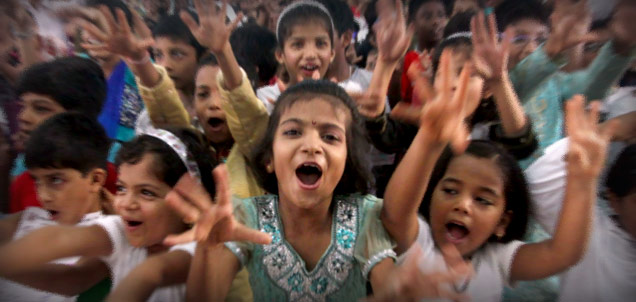
    Representational photograph (Kids participating in laughter therapy session in in Mumbai… Photograph by Fotocorp)


    By Ananya Saha


    There was a time, not so long ago in the 1990’s, when the Sunday slot of Mahabharata and animated series meant family viewing or kids genre. Kids were allowed to watch TV with parental permission. And today, kids genre in television media is the third largest after Hindi GECs at 27.6 per cent and Hindi movies at 11.9 per cent according to the FICCI-KPMG 2012 report.


    Anita Nayyar

    Acoording to Anita Nayyar, CEO, Havas Media, India & South Asia, the advent of Discovery Channel in 1999 saw a segment of kids watch it for education or interest. “Star World in 2004 had programmes like ‘Full House’ starring kids, but it was really post-2006 when kids became dominant. Their growing viewing needs and dedicated channels for them were addressed by various slots on various channels and some dedicated channels like Cartoon Network, Pogo, Disney Channel, Nickelodeon, Hungama, etc,” she points out. However, there is no denying the fact that there is not enough programming and print magazines for the young adult making them an underserved audience.


    Nina Elavia Jaipuria, EVP and Business Head, Sonic and Nickelodeon India concurs, adding, “In terms of getting their daily dose of entertainment, this TG needs to flirt with options available across multiple platforms – be it TV, online or print.”


    Sashwati Banerjee

    Apart from television content, on the print content, Sashwati Banerjee, Managing Director, Sesame Workshop Initiatives India PLC added, “Books / print is another matter. This is not a generation that is growing up with print awareness and it is reflected by the recent ASeR report which showcases that children in Grade 5 are reading at Grade 2 level. There is a serious crisis in education, and reading, comprehending and fluency are critical indicators to children’s lifelong learning. There is a large number of publishers in India, but very few publish children’s books and a still smaller number specialize in publishing children’s books. Recent reports have indicated that ebooks have a higher growth potential. However, wider access is still an issue as these books require high end mobile devices (cell phones and tablets) to access and use.”


    Nina Elavia Jaipuria

    Catering to infants to kids upto eight-years, Galli Galli Sim Sim has evolved in multiple ways since it’s inception in 2006. It evolved the format from the classicSesame Streetmagazine style to a more narrative ‘block style’ based on research that children in India are more used to stories or narration. Considering that access to television is limited, Galli Galli Sim Sim produced a radio programme, that is being aired by 10 community radio stations to reach populations with critical messages around health, hygiene, literacy and girl child education.


    Talking about Nicklodean and Sonic, Ms Jaipuria, said that Nickelodeon reaches out to 11 million kids pan India. “With media spends on kids channels approximately in the range of Rs 270cr, It is slated to grow further due to a slew of new channel launches in FY 13, she asserted. She also said that with the launch of Sonic in 2011, the investments in the kids genre has grown.


    According to a recent E&Y study the children’s genre has emerged as the largest viewership segment after India’s general entertainment channel (GEC) sector. The segment comprised 18.3 per cent of the viewership among 4-14 year olds in 2011, as compared to 16.9 per cent in 2010. The study also states that advertising revenue generated by the children’s genre totalled Rs 2.4 billion in 2011, up from Rs 2 billion in 2010. This is attributed to the growth in the viewership in the children’s genre from 43 million in 2010 to 48 million in 2011. This segment focuses on its target audience through a total of 14 channels in the age groups of 2-4 years and 4-14 years, comprising the majority of the market, as well as 14-18 years.


    The market for kids programming is huge, and the audience in this segment is growing. No wonder then that this November Zee launched ZeeQ, a 24×7 edutainment channel for kids aged 4-to-14-years. There are talks and suggestions of a DD Kids given Doordarshan’s reach. Kids seem to be pampered in the true sense and it is positive pampering.


    Even as the category sees more entrants trying to woo the young audience, in terms of advertising pie, this genre ranks after general entertainment and sports. “We’ve seen a range of products and services making the kid the hero – from financial like insurance say an ICICI Smart Kids with the kid at the dinosaur museum or Bank of India with the kid putting his piggy bank in the locker to a flipkart.com with kid avatars of the elders contemplating a buy; simply because they are either targets or influencers and their starring role has the potential for breaking clutter. We’d estimate the kids ad-market between Rs.200crores to Rs.260crores. The pioneer in using kids to demonstrate pester power was Maruti Suzuki’s Esteem report card commercial,” elaborated Ms Nayyar.


    With evolving societal structure as well as keenness on kid’s development for the future, Ms Nayyar predicts that “edutainment” will be the biggest driver in the category growth. Kids today are also more exposed .They are more amenable to instruction through entertainment. According to her, the vehicles that will drive the growth will be television, print and online, with online gaining lead.


    “Word-of-mouth in this category has really been underestimated but here is a core audience for this marketing phenomenon,” said Ms Nayyar.


    Challenges

    Content creators and television channels for kids are increasingly experimenting with applications for cellphones and low-cost tablets and migrating content from a traditional linear medium such as TV to non-linear mediums to expand access to populations that need it the most as well as to enhance and enrich learning experiences for children. Notwithstanding the fact that the advent of digitization in India will be a key driver to the growth of the genre in the near future, mobile devices rather than the television set will be the primary driver to engage children in the future. “We’re seeing this change in theUSas well,” said Banerjee.


    But the genre is facing very many challenges even as it looks at growth. As Ms Jaipuria points out:

    – The kid’s category is still hugely under-indexed despite the category contributing 8% to viewership on an All India Level at 4+ age group. TV adsales are under 2% for this genre. Hence investments in the business are under pressure.

    – The fragmentation in the kid’s category is increasing by the day with over a dozen players existing currently. This makes it possible for the broadcasters to offer differentiated content across genres and platforms.

    – Kids as an audience are a tough bunch to target. They do not consume print and outdoor as primary consumers. A large chunk of the marketing investment is on BTL activities such as School Contact Programmes, Retail activation, direct consumer contact using multiple on-round vehicles which have an extremely high cost per contact.

    – Distribution and carriage remains a challenge for this category.


    Also, as Ms Banerjee explains, children today are “exposed to all kinds of programming especially in single TV homes. There is also extremely low awareness amongst parents on what children should view and what they should not. There is an imperative need to provide rating guidelines as well as awareness on how media affects children.”


    While the experts believe that the greatest challenge is the creation of original content, or even good adaptation, quality is a major issue. There needs to be a very clear understanding  of the sub-slice segment categories to contain the spill to international programmes, CDs and the online world as also increase the share of viewership of the media vehicle.


    Says Ms Nayyar: “A lot of content and marketing is done and created for the Sec A and B but we miss a whole other India which invests heavily to educate its kids to give them another destiny. Here, affordable print with in-school promotions with reach beyond the creamy layer would create a whole new bottomline. Also, regional is a huge emerging market; again content with localization and language are opportunities and challenges. Content as always will be both the game player and game changer!”


    The growth might also come from other content and entertainment avenues such as gaming. The only challenge is to tap into the potential with the right content.


  • Enough backers for payback series?


    By Johnson Napier


    The India-England cricket series that kicks off from November 15, 2012 is being billed as a revenge or payback series by most scribes who follow the sport closely. Be it the media, analysts, critics or even players/commentators, virtually all are going gaga about how the current series would be the one to watch out for as India will be fighting to prove its mettle as being the best in the business. The fact that the men in blue were thrashed badly by the Englishmen the last time they played each other makes the cause even more compelling. But is the prevailing sentiment as positive as is being made out to be, or will it be a tough ask for the channel as it begins its quest to draw in more audiences? And, more importantly, what is the response that can be solicited from the advertisers who of late are opting to stay aloof from their association with the sport?


    To begin with, the good news is that the tournament begins at a time when most of India is in the mood for celebration what with the festival season already underway. So while partying, visiting relatives and relaxing would be top of mind for most it would also mean being able to sit at home and watch Sachin Tendulkar or Virendra Sehwag get India off to a roaring start. And that’s what is leading everybody to believe that the Series will at least kick off on a high note.


    Ayaz Memon

    Anticipating a huge response, senior journalist, sportswriter and now commentator Ayaz Memon is hopeful that the current series will be a success. As Hindi commentator for the current series, Mr Memon sounded positive: “I feel the pressure is more on India as they have to prove a point on the home turf. The fact is that India hasn’t lost a home series since 2004, and also the record since the last 12 months hasn’t been good so the pressure is squarely on the Indian team. Also the team is not in peak form as can be inferred from their recent performances across other tournaments. So one can expect the Indian team to put up a compelling fight, to say the least.”


    Backing up his claim, Mr Memon said that the channel has been doing a good job promoting the series. “I will be doing commentary for Star in Hindi and I can tell you that they have done a good job in building up the tournament and promotion-led activities. Even on the print platform the exposure has been pretty good. But we will have to wait and see how it pans out over the next few weeks. But I am sure that the viewership will be higher than the previous Test matches. The fact that you have Sachin Tendulkar playing in the series along with Yuvraj, Harbhajan and also Kevin Pietersen from England etc, I think it will be a marquee series.”


    Balakrishna

    Backing Mr Memon’s optimism is PM Balakrishna, COO, Allied Media, who said, “From a cricket and sentiment point of view, I feel people are looking forward to the series. It is being touted as the Grudge Series going by the promotional activities that are being carried out by the broadcaster. The audience really wants to see India thrash the English. So based on the hype, I expect to see more crowds at the stadium and also more ratings for the broadcaster.”


    But while the initial sentiment seems bright it is definitely not easy predicting results before the start of the tournament. The prediction becomes even more difficult when the series begins with a Test match and not ODIs or T20 that can guarantee some decent TVRs. When asked about the possible ratings that can be expected, Mr Balakrishna said, “Test matches have never been about ratings like ODIs or T20. But maybe because of the fact that this is a long holiday week, one can expect high ratings at least from the initial match itself. While it would be difficult to hazard a guess, I would be happy to go with an average TVR of 2-3.”


    Kartik Sharma

    Kartik Sharma, Managing Partner, Maxus India was more forthright, saying, “Any cricket tournament involving India is always unpredictable but exciting. As Indians, we obviously want our country to win but a sport like cricket is always difficult to predict. If you ask me, the sentiments are purely driven by the results of the first few matches. And going by our ability to digest defeat, we Indians don’t really fare well in that department. By that I mean that if we lose a match or two, we tend to divert our attention to other sports or television properties. But then again, this being a festival/holiday season I expect at least the first few matches to have a decent viewership as people will be at home and thus would be able to watch the matches. By nature, Test matches anyway do not draw in more audiences compared to what the T20 or ODI matches do. So I am expecting an average TVR of 2+ for Test matches and an average TVR of 4+ for ODIs.”


    Mahesh Ranka

    Presenting another factor that could guarantee ratings or dismiss them, Mahesh Ranka, CEO, Indus Sports asserted that it may even depend on the opponent playing against India: “If it is Australia or even England, there could be some decent ratings expected, as these teams are ranked higher compared to what a Bangladesh or Zimbabwe series would draw. The thing about England is that we lost to them badly when we went there so hopefully, we can look forward to avenging that result through the current series. And if India happens to win the first match, you could expect more audiences (in the range of 20-30 percent more on the base figure) who will come in for the second match, and so on.”


    But in the overall analysis, Mr Ranka is of the opinion that the current series will not have anything great to offer in terms of viewership, at least as far as the Test matches go. “The ratings that Test matches have thrown up in the recent past kind of puts everything under the scanner. Though people (particularly media) tend to hype any tournament, Test matches have never really managed to draw in the audience (viewership). That’s because people have their own mindset behind watching any match and advertisers will always have to move along taking into account the risk of losing out on viewership.”


    On the interest shown by advertisers, Mr Ranka said, “From an advertiser’s perspective, one has to always look at why cricket is typically watched: it is brought for reach. There are two things to that. Firstly it is the festival season where advertisers have monies to spend and whether it is cricket or no, they will eventually spend at this time of the year. The rates that could be expected for Test matches in the current series would be in the range of Rs 50,000 to 1 lakh for ten seconds.”


    Taking a diplomatic stand Mr Sharma said, “The advertiser sentiment depends on the packages that are being offered by the broadcaster and there are various deals in store. But I wouldn’t be able to comment if the rates are more or less compared to the previous tournaments.”


    Presenting a bullish outlook, Mr Balakrishna said that from the advertiser’s standpoint, the sentiment seems pretty positive. “Against the backdrop of digitization, one genre that is the least affected always is cricket, as the sport is not always about being CPRP-led but also about hype and other such factors. So I do see a positive resonance to the whole series from an advertiser standpoint. Also, I am sure that the channel would have factored in the tough economic scenario and therefore would have come up with a competitive package for the advertisers, making it a win-win for both of them.”


    So whether it will be a winner or a dampener, what the India-England Series is managing to do is turn the spotlight back to cricket. Which is a good move considering that the recently held Champions League tourney didn’t go down too well with audiences. The icing on the cake would be if India manages to whitewash the team from England. TVCs have been saying that India “Angrezon ki band bajaayega” – that is, will thrash the English. Music to our ears or hitting the wrong notes? The game will tell.


  • Jaldi 5 with M R Srinivasan: Chennai could need 3-6 months for digitization switch-over

    01. The court has extended the sunset date. How is the situation in Chennai post the extension?

    In Chennai currently, there is a big confusion. One day we went to the court and got interim order stay and now the case has gone to the Bench, which will have the hearing on 19th. Secondly, despite our letters to MSOs and MIB from our end, none of them are importing the set-top boxes. SAB said that they will be able to import boxes in 21 days provided the LCOs deposit advance money. But some of our members have already deposited two lakh rupees as advance last month. They are yet to receive to boxes. We will be submitting the dealing to the Court on 19th.


    There is uncertainty also because Arasu cable has not been given license yet to provide STB, and once it is given the license it will conquer the market. So, the existing MSO and licensed players are not sure of importing the boxes yet. As they may get wiped out once Arasu gets license.


    Four out of eight players who have got license, only three have installed head-ends.


    02. What are your expectations from the Bench on 19th?

    Well, they should extend the deadline. And if the extension is given, I&B Ministry should take views from all stakeholders. And all the information should be furnished clearly for and by stakeholders in front of MIB. Verification should be done if the said number of STB have been installed and activated. It should be made known as to how many boxes have been imported and how many of it installed by every player, since the imported boxes are usually smuggled in Middle East or Sri Lanka.


    03. How much of Chennai has been digitised, according to you?


    Right now, as per active status given to broadcasters by SAB it is 1.25 lakhs. As per our calculation, the active status is 1.3-1.5 lakhs only. DTH players are claiming that they have sold seven lakh connections. Most of these boxes, almost about 300-400 per month, are smuggled out of Chennai. In Chennai, about three-four lakh of these claimed DTH connections are active. We require about four million boxes in Chennai metropolitan area, which also covers the outskirts of Chennai.


    04. Even if the extension is given, how much time would Chennai require to reach 100% digitisation?

    Chennai would need 3-6 months to switch completely to digital signals. It is well-known that analogue signals are still on in Delhi and Mumbai where 100% digitization has been claimed. In Delhi and Mumbai, boxes are available aplenty and still they have analogue signals. Here in Chennai, we do not have STBs. It is important that analogue signals are not switched off.


    05. How does analogue benefit the stakeholder?

    We have 4G spectrum, but TRAI has not wiped out 2G. With digital, 10-15 analogue channels should be available. Not everyone can afford a STB. One should also think of low-income households.


    As told to Ananya Saha


  • Peter Mukerjea: Never let a crisis go to waste…

    By Peter Mukerjea


    The UK media the last week has been dominated by the events at the BBC. Yes – the BBC. First, with allegations, made by over 450 people, who have now come forward after three or four decades, on a TV celeb – the late Jimmy Saville, a one-time Radio Jockey and TV show presenter at the BBC. They have accused him of sexually abusing them as children when they had come across him during their visits to the BBC.


    Several other TV celebrities have been arrested and bailed in this connection and a public enquiry has been commissioned by the Government. The enquiry is headed by a respected news man called Nick Pollard – former Head of Sky News who was also later appointed by me as a consultant / advisor to NewsX in its early days, for over a year. Nick’s report and findings are now awaited.


    Meanwhile, last week, the very recently (barely two months ago) appointed Director-General of the BBC resigned as a result of a poorly and inaccurately produced daily News programme, Newsnight, where there were accusations saying that a Lord McAlpine had, many years ago, sexually abused children who were under the care of the state at the time. The news programme producers had not bothered to check their facts and simply went ahead and named him, and of course he denied it. As a consequence of this level of inaccuracy and irresponsibility, the Director General resigned and a few others have been suspended pending further internal enquiries.


    Now, we’re talking of the BBC. One of the most respected, most watched news organizations in the world and they got it wrong and did not have enough measures in place to ensure that the story they ran with was checked for accuracy. And the man at the top took immediate responsibility and stepped down. That certainly wasn’t the case for the head of another news organisation where phone-hacking was conducted on an industrial scale.


    Barack Obama’s former chief of staff Rahm Emanuel once said, “Never allow a crisis to go to waste.” These words have been heeded by all those people who are detractors of the BBC and find its existence to be completely against their free-market, anti-regulation ideals. They are certainly not allowing this situation at the BBC to go to waste. So they exaggerate the sins at the BBC and simultaneously minimize the crimes of their friends at another news organization currently under investigation, even though the police have now identified more than 4,000 people as possible victims of phone hacking, including the families of dead soldiers, relatives of people killed in terror attacks and a murdered schoolgirl.


    The media seem to be getting polarized – those for the BBC and those against.


    The Newsnight programme screwup has provided the perfect veil for an attack on the BBC and what we are witnessing is a coordinated assault on its reputation and output. The BBC is by far the biggest and best broadcaster in the world and to try and delegitimize or dismantle the BBC based on two screwups by the same news programme is grossly unfair given that over the years there have been a series of award-winning programmes watched by millions around the world – and consistently, year after year. Figures released by the BBC confirm that over 96 percent of the people in the UK consume BBC programmes each week.


    An Ofcom (the office of the communications regulator in the UK) survey in Nov 2011 stated that 59 percent of the people said the Beeb was the news source they most trusted. The next was ITV News at 7 percent! “No newspaper reached 2 percent,” the reporters added.


    I believe that the BBC, despite its many faults, should be protected from its right-wing enemies so as to preserve high-quality, non-partisan public service broadcasting. Earlier in the week gone by the Director-General was publicly taken to task by no other than one of his own employees in a one-on-one radio interview. Which other news media company would entertain that? Not many, I would think. The BBC have accepted their mistake, lost their DG and paid an out-of-court settlement of 185,000 Pounds (almost Rs 1.5 crore) to the falsely accused Lord. All of this goes some way to preserve its reputation and dedication to honest, fair, unbiased, incisive reporting. Maybe this crisis will enable the BBC to emerge, as a better, bolder and more robust news organization that what there is presently.


    I also wonder how many news organizations in India would take this approach – pay a fine, take the rap and follow up diligently with an internal enquiry if they report on a story where the reported facts are wrong and have been aired unchecked. Not many, I don’t think – at least not in a hurry. But let’s live in hope that maybe, just maybe, one day in India we will get DD to a similar state of play and be seen by the world as having a world-class broadcaster which reaches out to the free people of the largest democracy in the world.


    Either way, it’s a good reality check and a lesson in not letting a crisis go to waste.


    Peter Mukerjea, celebrated media professional and former CEO of Star India, mulls frequently for MxMIndia.com


  • Monica Tata quits Turner. No replacement for now

    By A Correspondent


    Monica Tata, GM – Entertainment Networks, South Asia at Turner International India, has put in her papers. A Turner official confirmed the development and informed that she will be with the company till the end of the year. Ms Tata’s next destination is not known, and it is learnt that her position may not be filled in for the moment.


    With over 23 years of experience, Ms Tata has had an excellent record of increasing sales, effective negotiations, P&L analysis and strategic implementation of business operations. She joined Turner in 2004 after a 12-year stint at Star India and earlier at the now-shut Sunday Mail. She is Honorary Secretary of the International Advertising Association, India Chapter and is part of the Indian Broadcasting Federation’s proposed Indian Television Festival core organizing committee.


    Ms Tata was recognised as ‘Next 30’ most powerful women to look out in 2010 and was also adjudged as one of India’s hottest young executives of the media industry in 2009 by Business Today magazine and adjudged amongst the Top 50 influential women in media, marketing and advertising by Impact magazine earlier this year.


  • NDTV expands global reach; launches in Malaysia

    By A Correspondent


    Expanding its reach in the international markets, New Delhi Television Limited has also launched NDTV 24×7, NDTV Good Times and NDTV India in Malaysia. The channels are part of Asia Broadcast Network’s (ABN) new platform in Malaysia and available in a combination of basic as well as especially dedicated NDTV branded packages.


    NDTV channels have long been available in more than 18million homes in 75 countries internationally and this agreement marks the first time that three of NDTV channels will be available in Malaysia. Each channel is the category leader in Asia’s largest pay TV market – India and this partnership with ABN will now see them become accessible in South East Asia’s largest pay TV market – Malaysia. Under its slogan ‘Access for All’, ABN aims to offer over 200 channels of news, education, entertainment, movies, sports and local programming, and has signaled plans to offer full triple play services such as video-on-demand, social TV and interactive gaming, alongside high-speed Internet and voice services over a hybrid fibre-coaxial (HFC) network.


    The Head of NDTV Network Distribution & Affiliate Sales, Rahul Sood, said, “We are delighted to be part of the ABN platform and reaching new viewers in Malaysia. NDTV has been serving the Indian Diaspora across 75 other countries worldwide and we are glad that the 2million plus Indian community in Malaysia will now also get the chance to see some of the most iconic programs produced out of India. We hope the viewers of Malaysia will be pleased to be informed and entertained like our viewers in the rest of the world.”


  • Star Jalsha to launch in UK

    By A Correspondent


    Star Network’s Bengali General Entertainment channel Star Jalsha, will be launching in the UK on Sky channel 808 on November 22nd.


    ‘Jalsha’ is synonymous to entertainment and celebration in Bengali and it is indeed a matter of great celebration for the Star Network to launch Star Jalsha in the UK- making it the first South Asian regional channel to be retailed in the Sky Entertainment Pack, said KevinVaz, President and General Manager, Star Jalsha, speaking from his Mumbai office.


    Launched in Sept 2008 and rebranded in June 2012, Star Jalsha dominates the Bengali television ratings in India as the No.1 Bengali General Entertainment channel. With the launch of Star Jalsha in the UK – the Star Network expands its regional offering to the UK’s Bengali community from both India and Bangladesh.


    Yeshpal Sharma, Sr. Vice President UK & Europe said, “I share Kevin’s enthusiasm and am pleased to be part of history making Star Jalsha the first regional South Asian channel to be available on the Sky Entertainment Pack. We are very excited to bring Star Jalsha to our UK viewers and as always, our commitment to quality broadcasting will be our utmost priority.”


  • Video wars from Bindass

    By A Correspondent


    Bindass is all set to introduce its brand new daily show – Video Wars powered by Airtel. For the first time on television Bindass is introducing an entirely new format that provides the contestants a big ticket to fame! With Video Wars, each of the contestants will be able to maintain a video dairy of their best candid moments… So it’s time to blog more and rest less with Video Wars, tapping the young and restless the show offers a sneak peek into the lives of five Young, Restless and bindass individuals!


    Expressing their thoughts on television, these funny, crazy youngsters will video blog their way into your television screens. The show will center around the lives of these individuals with a day-to-day video blog shot by themselves of the ‘happenings’ in their lives! These 5 contestants that will compete with each other to entertain you, and only if they succeed in holding your attention will they get to stay on show. The cards are in your hands as viewers! Jo tikega, wo jeetega!


    Every week, the least popular contestant will be voted off. The voting will happen across social media platforms like Facebook, YouTube and Twitter. Viewers will get an opportunity to eliminate these individuals if their entertainment quotient lowers. The popularity of the contestant on the social media space and through the missed calls mechanism will determine the fate of each contestant on a weekly basis. The more number of ‘likes’, chances are that the contestant gets to stay longer. Whoever manages to stay the longest will win the ultimate battle of fame!


    Commenting on the new show, Nikhil Gandhi, Executive Director, Youth Channels, Media Networks Disney UTV, said “We are bringing User Generated Content to life on television for the first time in India. The show empowers the youth to showcase their talent and an opportunity to become famous as the most popular Video Star. This is a daily show format which will be extended online for viewers to interact with their favourite characters as they battle through their daily lives. This is the first daily reality show in the youth space.”