Reliance Broadcast Network (RBNL) and RTL Group, the leading European entertainment network, have announced the launch of their joint venture channel BIG RTL Thrill. To be positioned as an action entertainment channel targeted at male audiences, with the tagline Action ka Baap (Ultimate Action Destination), the channel will launch on November 5 in India.
Initially, the channel will go on air in Uttar Pradesh, featuring international content dubbed in Hindi. Phased expansion to other Hindi-speaking markets and the SAARC region (South Asian Association for Regional Cooperation which include the countries of Sri Lanka, Bhutan, India, Maldives, Nepal, Pakistan, Bangladesh and Afghanistan) will follow. The channel will cater to a largely untapped market segment, with an entertainment mix developed by detailed sampling of content, focus group research and comprehensive market analysis.
Thrill will target at male viewers aged 15 to 44 and promises to offer adrenaline rush, ‘edge of the seat’ entertainment with hand-picked content from across the globe including reality shows, action series, wrestling, extreme sports, game shows and movies. Content has been acquired from some of the world’s best production companies such as FremantleMedia, Endemol and Red Bull with key shows including Fear Factor, Cobra 11, Criss Angel, WipeOut and BayWatch. The line-up will also feature a strong library of international action films.
The channel will complement and provide synergies with RBNL’s 92.7 BIG FM which has six stations in the state, along with its variety entertainment channel BIG Magic. This consolidates Reliance Broadcast Network’s position as a leading media platform in Uttar Pradesh, offering maximum focussed reach to marketers. The channel will be marketed through a holistic multi-media campaign across television, radio, out of home, on ground, print and digital.
Speaking on the occasion, Tarun Katial, CEO, Reliance Broadcast Network Ltd. said, “BIG RTL Thrill comes as an answer to the Indian males’ quest for action entertainment. The product is world class, served in Hindi, and has been designed to fill a clear void that exists in the market, ensuring high audience engagement. With the launch of this channel, RBNL fortifies its standing in Uttar Pradesh, offering advertisers a robust and unmatched offering in the region, delivering exceptional value for their brands.â€
Andreas Rudas, Executive Vice President Regional Operations & Business Development CEE and Asia of RTL Group, said: “This is an exciting moment for us at RTL Group; it’s our first step into the Indian broadcasting market, which offers very promising growth opportunities. We will contribute our long-term broadcasting and programming expertise to BIG RTL Thrill – with high-quality content targeting a clearly defined audience. The powerful combination with Reliance Broadcast Network will help ensure that BIG RTL Thrill becomes a strong new brand on the Indian market.â€
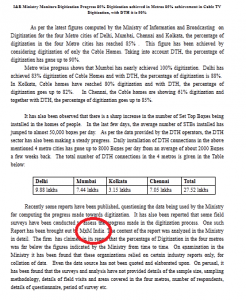
On Friday evening, the Ministry of Information and Broadcasting of the Government of India issued a statement defending the digitization numbers it has put out. The MIB contests the study published by Television Street Maps (TSM) and MxMIndia.com.
While we are happy to note that the ministry has carefully studied our data, we – TSM and MxMIndia – stand by the data published.
We will happy to cooperate with the Government and/or the TRAI if it wishes to see any clarifications. These can be addressed to editor@mxmindia.com and we will revert soonest.
We wish to reiterate that we are eager to see digitization happen. MxMIndia commissioned TSM to conduct the study only because it was felt that the data being put out by the MIB was not reflecting the true on-ground situation.
We understand the ministry too has undertaken its own study of the market. Records at the MSO headends, sms activations etc have been looked into.
We now have a new I&B minister in Manish Tewari. It’s a big day for him today – October 29. His first working day as the minister. There is a taskforce meeting scheduled for today. And there’s a Mumbai High Court hearing coming up on the delay in digitization.
Loads happening. We’ll bring you all the news and analyses.
UTV Spotboy and AKFPL (Anurag Kashyap Films Pvt Ltd), producers of Luv Shuv Tey Chicken Khurana, have joined hands with India Food Network’s (IFN) home chefs to create an exclusive rendering of the popular Chicken Khurana recipe.
IFN’s chefs Joel D Souza, Kalyan Karmakar, Veena Gidwani and Archana Arte took up the challenge by coming up with their best interpretations of the Chicken Khurana recipe. While some chefs prepared an authentic Punjabi dhaba dish, some added a twist to popular dishes like Chicken Tikka and Tandoori Chicken. The chefs used Punjabi ingredients and interesting improvisations to get the perfect flavours.
“The entire cooking session saw tremendous ingenuity on the part of our chefs. We could never imagine that you could replicate a dhaba style of cooking in your kitchen. One of our chefs, Archana, actually used charcoal to create that asli Chicken Khurana feel,” said Anagha Rajadhyaksha, Director, Acquisitions, Ping Digital Network.
Luv Shuv Tey Chicken Khurana is the story of a quirky Punjabi family in pursuit of a secret recipe that will enable them to reclaim their pride and wealth. The film, directed by Sameer Sharma, releases on November 2.
Bharti Airtel has announced the comeback of Worldspace Radio as iMusicSpace on Airtel digital TV, the DTH service from the company. DTH customers can now listen to an extensive collection of latest and retro Hindi songs, popular ghazals and their favorite regional music channels on the new avatar radio. Customers can now enjoy 24X7 radio on their TV in their native dialect be it Hindi, Bengali, Gujarati, Marathi, Punjabi, Tamil, Malayalam, Kannada or Telugu. Comprising of 12 channels including devotional and kids channels, iMusicSpace is now available to customers at an affordable cost of Rs 35 per month.
Speaking on the launch, Shashi Arora, CEO- DTH/ Media, Bharti Airtel, said, “At Airtel, it’s been our constant endeavor to offer innovative, versatile, and interactive life enriching services to our customers that enhances their overall TV viewing experience. The launch of Worldspace Radio on Airtel was an industry first and we are ecstatic to re-launch the new and evolved iMusicSpace application today on Airtel Digital TV. This service is yet another step by Airtel towards making TV a wholesome entertainment package for customers and we look forward to our partnership with Timbre Media for the WorldSpace Radio service”.
The service has been launched on the DTH platform in association with Saregama and Timbre Media whhich will jointly provide the content for the application.
Mathewkutty Sebastian, CEO, Timbre Media, a company formed in 2010 by the erstwhile employees of WorldSpace India, said, “Timbre Media is happy to be able to offer Airtel DTH subscribers the music experience they enjoyed in the past on this platform, brought to them by the very same dedicated team of radio professionals who pioneered genre based programming in India for WorldSpace.”
Airtel digital TV customers can easily access the application by just clicking the iTV button on their remote. The new channels include Magikbox – Kids, Shraddha – Devotional, Farishta – Retro Hindi, Falak – Ghazals, Sonar – Bengali, Umang – Gujarati, Surabhi – Marathi, Tunak – Punjabi, Thenisai – Tamil, Madhuri – Malayalam, Sparsha – Kannada and Spandana – Telugu.
Saregama, formerly known as The Gramophone Company of India Ltd, owns the largest music archives in India. The ownership of nearly 50 per cent of all the music ever recorded in India makes Saregama the most authoritative repository of the country’s musical heritage. Saregama has now expanded into other branches of entertainment, and also runs studio facilities in Dum Dum, Kolkata.
Timbre Media Pvt Ltd, set up in 2010 by a group of erstwhile employees of WorldSpace India Pvt Ltd, offers radio/music programming, sound packaging and studio services to platform owners in the DTH, Telecom, Internet and FM industry, and to corporate and retail clients. Headquartered in Bengaluru, Timbre Media specializes in genre-based radio programming in different languages and is the official licensee of the WorldSpace brand.
ESPN Star Sports (ESS), Asia’s biggest sports content provider, has delighted football fans once again by securing exclusive broadcast rights for all Football Association (FA) Cup matches, The FA Community Shield and all Senior and Under-21 England Team home matches for the next six years until 2018 for the South Asia Region including India, Sri Lanka, Bangladesh, Pakistan, Maldives, Bhutan and Nepal.
The multimedia platform deal, which allows the content to be made available across television, internet and mobile, was made with international media rights company MP & Silva.
Starting from November 3, ESS will begin broadcast of the first round of matches all the way up to the Final in May next year. Chelsea are currently the holders of the FA Cup but are likely to be challenged for the prestigious title by the other Premier League teams including Arsenal, Liverpool, Manchester United and Manchester City, among others.
This latest agreement further strengthens ESS’ network as truly being the ‘Home of Football’ for the South Asia region, with an unbeatable list of the biggest football properties including the Barclays Premier League, the Spanish Liga BBVA as well as the Italian Serie A, whose exclusive broadcast rights were recently secured from MP & Silva.
The FA Cup is recognised as the oldest and most famous domestic knockout competition, which traditionally begins in November and culminates with the final in May. It is also one of the most viewed football matches in terms of global television reach and the pinnacle of the English football calendar. The FA Community Shield is the English football season’s high-profile curtain raiser, held a week prior to the kick-off of the Barclays Premier League season in August and is played between the winners of The FA Cup and the Barclays Premier League from the previous season. The England national team will play approximately five games per season, including England’s home qualifiers for the FIFA 2014 World Cup in 2014, and England’s home friendly games until 2018.
Nickelodeon’s recently launched new show Motu Patlu in its bid to get kids hooked onto its second home-grown animated show has started its on-ground initiatives and promotional campaign.
Apart from Motu Patlu being the top priority for promotions on the network, the campaign will ensure optimal reach though an extensive media bouquet that includes various on-ground activities and strategic promotional partnerships.
The retail sector sees a huge increase in consumers in the festive season of Dussehra and Diwali. The campaign will make most of this though its partner Pantaloons and be actively present across 18 Pantaloons outlets in Mumbai and Delhi to ensure maximum brand visibility.
In an attempt to be present everywhere kids are, Nickelodeon has also tied-up with exclusive gaming outlet – Timezone. Here kids can participate in the Motu Patlu contest through the Kiosk’s at Timezone and also sample the show, while they win cool Motu Patlu merchandise.
Making the consumer ‘Eat, Drink, Sleep’ the brand has been taken literally, as Motu Patlu’s Signature dish Chole Bhature will be available and promoted across Bombay Blue outlets in Mumbai. Kids can also engage with the interactive Motu Patlu tray mats at all the outlets. Promotions will also be a part of the on-going Nickelodeon workshops at Hobby Ideas where kids will be exposed to the unique flavour of the show while they participate in ‘Art Jam’ workshops and bring out their creative side by making Motu Patlu chocolate boxes and more. The activity spans across 5 cities and over 7 centres.
Commenting on the innovative marketing strategy, Nina Elavia Jaipuria, Executive Vice President & Business Head, Sonic and Nickelodeon India says, “This experiential marketing campaign brings alive Motu Patlu, engaging kids through innovative initiatives at multiple touch-points. Our unconventional campaign connects with kids and reaches out to them wherever they are. Thus, tangibilizing and creating awareness for Motu Patlu.â€
It was essential that the campaign focused on the width as well as depth through its media. Hence, while a lot of efforts have been made to target the urban kids, the smaller towns are not too far behind. Nickelodeon has planned engagements through Van Activations in over 30 towns like Lucknow, Kanpur, Allahabad, Varanasi, Agra, Mathura, etc. in Uttar Pradesh and Gwalior, Khandwa, Indore, Ratlam, Bhopal, Jabalpur, etc. in Madhya Pradesh. Kids can enjoy Motu Patlu games and watch the episodes while wining Nickelodeon merchandise. The Van Activation has been designed to give kids the right flavour of the show and make show and its characters familiar with the kids.
To ensure the right connect with the tech-savvy generation Nickelodeon has also launched Motu Patlu’s official website – Motupatlu.in. The site will host a strong content mix that includes numerous Motu Patlu games, contests, download-ables and a lot more. In addition, motupatlu.in will also be promoted through a comprehensive digital campaign that entails banners on kid gaming websites, video banners and innovative rich media banners that allows the users to interact on the banner itself. The show will also be promoted on Nick India’s official page on Facebook (www.facebook.com/nickindia) and on twitter @nicktvindia.
As a part of the ATL promotions, Motu Patlu will also be promoted across various General Entertainment Channels and print advertisements in leading comics. Adding yet another innovation to this home-grown animated show, Nickelodeon has roped in legendary lyricist Gulzar to create a title track composed by acclaimed musician Sandesh Shandiliya and sung by renowned singer Sukhwinder Singh. The title track of the awesome twosome’s jodi will be played on all radio stations across Mumbai and Delhi and several other cities in Madhya Pradesh and Uttar Pradesh.
The Indian M&E industry, with revenues of about 805 billion INR (17.2 billion USD) in 2011, is set to grow robustly over the next few years on the back of steady macro-economic growth, rising spending power and positive demographic indicators. The industry revenues are expected to reach 1,764 billion INR (37.6 billion USD) by 2016, with a CAGR of about 17% from 2012 to 2016, according to India Entertainment and Media Outlook 2012.
According to the study, which was released by CII and PwC during the Media and Entertainment Summit 2012, the television and print segments continue to be the largest contributors to the industry, accounting for 66% of the total revenue. Internet access contributed 14%, up from 11% in 2010. However, the contribution from the print and film segments have reduced marginally, as year-on-year growth rates have been lower than the industry average. The internet access and gaming segments have been the fastest growing, with annual growth rates of 57% and 33%, respectively
The report further lists that the Indian E&M industry has been one of the fastest growing, followed by countries such as China, Russia and Brazil. Going forward, the industry is expected to grow at a CAGR of 17% between 2012 and 2016, to reach a size of 1,764 billion INR. Internet access, advertising and gaming are projected to be the fastest growing avenues, each growing at a CAGR higher than 20%. The revenue from advertising is expected to grow at a CAGR of 13.4% to reach INR 525 billion in 2016, significantly up from INR 279 billion in 2011.
The television segment is expected to retain its position as the largest E&M segment in the country, with an estimated CAGR of 15% till 2016. Given the high penetration of mobile internet in the country, robust growth has been projected in internet access till 2016 (given the current under-penetration), which will overtake the print sector by 2013, in terms of industry revenues, and become the second-largest segment in the Indian E&M industry. The print segment is expected to grow at 9% for the next five years, and claim 17% of market share by 2017.
The report recommends that given the high potential growth, the industry should focus on collaboration and innovation to achieve the target numbers.
Text of Star India CEO Uday Shankar’s keynote address at the CII Big Picture Summit in New Delhi on October 29
Good morning. Mr. Amit Khanna, Mr Andy Kaplan, Ms Shabana, my dear friends Andy Bird, Ronnie, the remarkable team of CII that has organized this fabulous event, friends from media, ladies and gentlemen.
I am truly privileged to have this opportunity to speak to this august gathering.
What makes it even more of an honour is the theme of this summit. Because, over the years we have come together on multiple forums to engage on critical and interesting issues facing the industry – taking a specific aspect of it: be it content creation, content regulation or more recently digitalization.
But what is special about this summit is that – first and foremost it is one of those rare occasions where the whole industry has come together to look at the big picture. What is even more important is not only that we trying to paint a big picture, but we are also trying to paint a bold picture because of the tangible goal that the industry has set for itself: “A 100 billion dollar media and entertainment industryâ€
Let’s see where we are and how difficult it is to get there.
We are a 15 billion dollar industry today, which includes television, print, radio, digital media – growing at around 14% a year. This, by some accounts has been impressive – benefiting immensely from the tailwinds of GDP growth of the last decade.
At this rate, we will still take 15 years to get to 100 billion dollars. Obviously we want to get there much faster.The question is: Why and how do we do that?
I do not pretend to have a ready reckoner with all the answers – I hope that over the next two days some of the best minds from Indian and global media will exchange notes on this.
Â
The benefits of pursuing this dream are obvious to the industry– larger size should lead to bigger profits, bigger share holding value and more wealth. It is easy for the industry to get motivated about the goal.
Today, at $15 bn as an industry, we are about half the size of Google – a 10-year-old company ($26 billion revenues)
Let’s not even go that far: if the entire Indian media industry was a company, it would rank 7th or 8thin India!
Media and industry is a globally growing industry – but our participation in that eco-system is zero and India is hardly factored into the global thought process of technology or content.
In the late 90s – when I first went to IBC in Amsterdam I remember that the first thought that struck me as a young television professional was the complete lack of attention for Indian visitors. No matter how early you made the appointment – the people one got to meet were hardly ever the most senior people. They showed little patience or enthusiasm. I notice how – 15 years later, because India is now a fast growing market, there is a clear shift in their focus. I do not frequent the IBC – however, with striking regularity I get invitations from technology and product vendors.
However, it still has not changed as much as it should Technology is still not developed keeping India in mind. They are still not keen on developing products for the country, which is not the deal with China or the United States for example.
Similarly, even in programming – Hollywood studios ARE keen to sell to India. However, because it is not meaningful in size – there is no customization in any aspect: sales, product contracts or content – to suit the needs of the Indian buyer. Not being able to sell to India has no material impact on their top lines. As a result, we are not able to fully exploit the potential of that content. Taking this argument a bit further – Hollywood content is sold in two categories as premium and classic. That classification in India does not work. But explaining it to them continues to be a struggle and there is no third bucket for the Indian consumer. Not having the scale does not give us a top seat at the table – our ability to maneuver business discussions the way we would like tois severely constrained.
The question naturally follows: How do we achieve this scale?
To start with – we are drunk on our own volumes: largest number of newspapers in circulation, largest number of television viewers at 400 million, 100 million digital consumers. Digital in particular – is an indictment of our creative and strategic limitations – we have 600 million mobile screens and yet we do not have a unique content proposition for the medium.
So, our ability to convert that into corresponding value is disappointing – of course some of that value will come through economic growth but there is nothing that stops us from creating more value out of our volume today.
And do remember, even at these volumes our reach as a % of population is not spectacular: we still have 100 million households with no television, their time spent on it is abysmally low when compared to global standards, 350 million people read the newspaper – but that tells how many do not read!
Scale brings with it not only value but also greater reach. One place to look for scale is to gaze outside India. Our friends in the pharma sector have shown how this possible: 50% of the pharma sector revenues come from outside of India. These are from developed markets like US, developing ones like Brazil and newer markets like Africa.
Our media and entertainment industry serves – what is arguably the world’s toughest media market: catering to a diverse culture, language, value systems and sophistication of tastes. If a pan-Indian broadcaster acquires the expertise to speak to an audience in over 5 or 6 languages, why should it not allow us to go beyond the Indian diaspora?
However, whether it catering to an audience beyond Indians or just scaling for the domestic market – we all know that it is not that simple.
In television for example we will need lots more content and will come not only by scaling production but a fundamental transformation of the eco-system – resources, talent etc: all have to evolve dramatically. For example – the production infrastructure in Mumbai studio space, access to talent is creaking and is unable to keep pace with the demand. However, it is not a problem that the industry can solve in isolation – it requires intervention from municipal corporations, state government, central government and perhaps even the initiative and support from other states. Similarly, look at distribution – for years this industry has reeled under the impact of analog. Finally the needle has moved when the UPA Government understood the needs for digitalization and passed an act to enforce this. Again – we are seeing how important it is for all state Governments to actively participate in this endeavor. The nature of the business is such that it is wide-spread and far-reaching in its relevance and impact.
For all of this to happen, the entire society – whose interest the Government is supposed to represent must help us in this.
Usually, it is easy to make the case to the Government and the Politicians when the benefits to society are clear and immediate. However, if the benefits accrue over the long-term and inflict short-term pain – I am one of those who believe that this is a struggle to get them behind us. So it is even more critical for us to establish a clear case for a 100 billion dollar M&E industry.
Â
Two of the goals that all establishments are worried about are financial resources and jobs.
The sheer scale of a $100 billion dollars can generate over 5 billion dollars in taxes (assumption: 15% EBIT; 30% tax rate). Let us look at what that means: it is more than half the current allocation for NREGA (8 billion). The Government has passed the Right to Education act and as part of that efforts on Sarva Siksha Abhayan have been scaled up.
At a 100 billion dollars our tax revenues would have been able to fund the entire budget of Sarva Siksha Abhayan (5 billion) or the National Rural Health Mission (6 billion).Perhaps, outside the I&B ministry, the media and entertainment sector is not taken seriously in the economic agenda of the nation. In the best of times it is seen a vehicle of glitz and glamour and most of the times as a source of irritation. At 100 billion dollars the significance of the industry will be difficult to ignore or undermine.
The other big benefit will be in driving employment. For example, today we directly employ atleast 80 people when we do a drama on Star Plus and obviously this can be much higher depending on the scale of the show. This is just direct employment – you can imagine the number of people directly and indirectly that can be employed by the M&E industry.
The beauty of the Media and Entertainment is that it does not place massive demands on technical and educational infrastructure. Most of us are born with the creative skills and this can be honed with marginal investment. This is quite unlike creating a pool of doctors, engineers and software programmers.
We all know about the college drop-outs who have gone on to create enduring businesses – be it Microsoft or Facebook. While maybe not at that scale, the number of drop-outs who get embraced by the M&E industry and go on to be successful is a story waiting to be told.
So, whether it is the industry or society this is a goal worth pursuing.
Before we embark on this journey – we need to achieve clarity of vision and consensus on that clarity.
Until that clarity comes in we will not have the commitment to pursue it.
I look forward to the next two days to discuss such ideas and many more, which this august gathering will bring – to challenge status quo and put us on a trajectory to a 100 billion dollars.
100 billion dollars is a dream, but it is certainly one worth dying for.
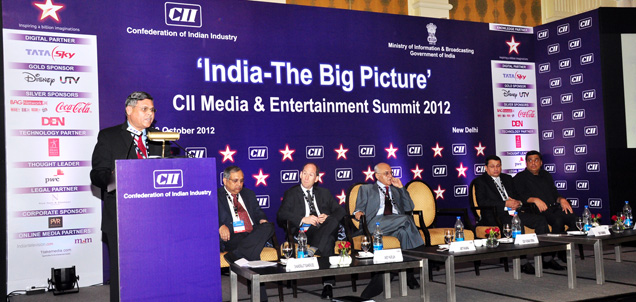
L to R: Uday Kumar Varma, I&B Secretary, Chandrajit Banerjee, DG, CII; Andy Kaplan, President, Worldwide Network, Sony Picture Television; Amit Khanna, Chairman, CII National Committee on M & E and Chairman, Reliance Entertainment; Uday Shankar, CEO, Star India and Ronnie Screwvala, MD, The Walt Disney Co
By Ananya Saha
CII Media and Entertainment Summit 2012, India – The Big Picture discussed critical issues such as cause and effect of market-driven approach in the media and entertainment (M&E) sector, censorship hurdles, and the roadmap for $100 billion Indian M&E industry. The two-day conference saw the who’s who of the sector take a close look at the critical role that M&E plays in India.
“We are drunk on our own volumes: largest number of newspapers in circulation, largest number of television viewers at 400 million, 100 million digital consumers. Digital, in particular, is an indictment of our creative and strategic limitations – we have 600 million mobile screens and yet we do not have a unique content proposition for the medium,” Uday Shankar, CEO, Star India, said in his keynote address, adding, “Our ability to convert that into corresponding value is disappointing.â€
“Media and industry is a globally growing industry – but our participation in that eco-system is zero and India is hardly factored into the global thought process of technology or content,” he added. Similarly, on the domestic front, the industry is yet to fully unlock the potential of the vast Indian market.” The size of India’s Media and Entertainment industry, which includes television, print, radio, digital media, was pegged at $15 billion at the end of 2011. The industry is growing at around 14 percent a year. “At this rate, we will still take 15 years to get to $100 billion. Obviously, we want to get there much faster. The question is: Why and how do we do that?” Mr Shankar quipped.
Ministry of Information and Broadcasting Secretary Uday Kumar Varma, Leader of the opposition in Rajya Sabha Arun Jaitley, The Walt Disney Co MD Ronnie Screwvala, Viacom 18 Media Pvt Ltd CEO Sudhanshu Vats, Sony Picture Television President for the worldwide network Andy Kaplan, News Corp Sr Executive VP David Hill, NDTV Group CEO and Executive Director Vikram Chandra, Times Television Network MD and CEO Sunil Lulla, Sony Entertainment Television CEO Man Jit Singh, Times Group CEO Ravi Dhariwal, Prasar Bharti CEO Jawahar Sircar, eminent journalists such as Nik Gowing, Vir Sanghvi, Vinod Mehta and Aroon Purie shared their views at the summit.
Uday Kumar Varma, Secretary, MIB, recent decision of the government to allow 74 per cent FDI in DTH, IPTV, mobile TV etc. are some of the steps that have been taken in this direction and underscored that those steps would be game changers. He said that many positive steps would be taken in revamping the FM Radio to enhance its reach and content. The empowered Group of Ministers are looking into some of the grey areas in the auction of 839 new FM radio stations across over 290 towns and cities in the country. “We hope to complete the auction of the first tranche of the stations by the end of the financial year,” he added.
Day 1 of the summit saw Arun Jaitley, Leader of the Opposition, Rajya Sabha make a scathing attack on trial by media and said that most often such debates are based on half- truths and imaginations. Nik Gowing, Presenter, BBC World News said, “Media is greatly influenced by technology and speed in which the information travels. Political leaders and corporations have to realize that to become a leader in the technology driven environs, where they would be put to scrutiny not necessarily by the media but also by public at large, through twitters and other social media, was an onerous task.” Vinod Mehta said, “What we require is blending good business practices with news collection and dissemination, which is a formidable task of media industry.” Ravi Dhariwal, CEO, Times Group, said that media is judged by its contemporary relevance and trust it builds with the general public.
Broadband penetration to reach 600 mn by 2020
Speaking on the panel for ‘The Game Changers: Taking M&E industry to $100 bn’, R Chandrasekhar, Secretary, Information Technology and Chairman Telecom Commission said the government is taking proactive steps for enhancing the broadband penetration in the country from the present level of 20 million to 600 million by 2020 so as to cover the entire breadth and length of the country.
“The government is investing Rs 20,000 crore over the next few years for strengthening the broadband network in the country. In its wake, such massive investment will give a boost to the digitization, cloud-based services and convergence to reach out to the common man in the far flung areas,” he said. The government’s role, he stressed, would be that of a facilitator and the last mile movers would be cable and telecom service providers.
Manjit Singh, CEO, Sony Entertainment Television maintained that advertisement and subscription income from media business should be at a 50:50 basis and a business model based on these parameters would help penetration of broadband, inflow of more FDI and the government would stand to gain from realization of more taxes. The ratio of TV advertisement to GDP in India is abysmally poor as compared to developed countries and hoped that the stress on subscription would give a sustainable and healthy revenue stream to the media business. Narayan Rao, Executive Vice-Chairperson, NDTV said, “For the ambitious target to reach 100 bn, the industry needs to recognise three things: advertisers need to recognise that as audiences have grown, and thus, rates also need to grow; the broadcasters need to get rid of carriage fees; and the broadcasters need to look at alternate sources o revenue, which can currently come only from subscription revenues.â€
TGBCL’s MD and CEO Sunil Lulla said the industry needs to dream a collective dream to reach the $100 bn mark. “The industry needs to collaborate, partner and compete for a healthier industry status,” he said. Smitha Jha, Leader, Entertainment & Media practice, PWC India, observed that the game changers in the media industry would be advertisement, subscription and infrastructure and policy framework. In India, she said that the consumer spends only $7 per month as subscription as against US$ 500 in the US. Also, to help industry to achieve the potential, infrastructure has to be toned up, such as rolling out of 3G and 4G coupled with strengthening broadband network.
Policy Conundrum
Rahul Khullar, Chairman, Telecom Regulatory Authority of India (TRAI) stressed on the need for a separate regulator for content and carriage. He also said that the Indian market should not be compared to Western markets and stressed on the fact that India is a price-sensitive market. Harit Nagpal, MD and CEO, Tata Sky pointed out, “We are most heavily taxed business in the industry. We pay close to 30-35 percent as taxes, exclusive of the import duty on set-top boxes.” Agreeing with Mr Nagpal, SN Sharma, CEO of Den Networks said, “Taxation is going through the roof, and ultimately consumers will have to bear the costs.”
Anuj Gandhi, Group CEO, IndiaCast, opined, “As we progress with digitisation, it is important that the issue of carriage fees is sorted out. We need to get the ARPUs right to be on the path to reach $100 bn-industry.” The panel also pointed out how the policies in India have not found the regulation support. Vanita Kohli-Khandekar, Contributing Editor, Business Standard said that tax holidays can do wonders for stabilising the industry. She also pointed out how regulation is required in the areas of cross-media monopoly; how 50-60 percent of media buying is concentrated in the hands of one agency and the ownership of news media.
In response to the worries voiced by the panel, Mr Khullar said that the regulator is aiming at bringing out a white paper on cross-media ownership, which will be done with prior consultation. He also said that as digitisation progresses, the industry should foresee and prepare on changing business models.
Managing M&E in digital era
As digitization takes last steps towards sunset date, issues related to convergence have been taking centre stage at various discussions and forums. The panel on convergence issues chaired Neeraj Roy, MD and CEO, Hungama Digital Media was of the view that consumption and monetising of content, global IT systems, infrastructure and policies that deal with convergence need to be developed to provide clarity to industry players as well as consumers.
Vikram Chandra, Group CEO and ED, NDTV, said, “With convergence and real-time interactivity taking shape, the only question that remains to be answered is how do we monetise the properties.†Vijay Lazarus, President, IMI pointed out how in absence of policy regulations, music became the first victim of technology in the form of piracy. “But then knowing there was no turning back, the music industry also embraced technology,†Mr Lazarus pointed out.
The panel agreed that innovation in convergence will result in monetisation.
The last panel on Sports and Entertainment focused on whether sports broadcasting in India is only about cricket or is there an opportunity much beyond which lies untested and unexplored. “The government, corporations, media and civil society should come forward to support sports beyond cricket with a long term roadmap,” maintained Atul Singh, CEO, Coca Cola India. He also hinted that dependence on one form of sports is not the ideal approach since that would lead to unbalanced growth of sports in the country.
Mr Singh cautioned the corporations not to look for immediate results and dividends from sponsored games other than cricket. David Hill, Senior Executive Vice President, New Corp said, “Sports is predominantly a middle-class indulgence and with India’s middle class touching one billion by 2025, sports will receive a lot of attention in the future.” Referring to the lack of corporate support in India, Harish Thawani, Executive Chairman, Nimbus Communications said that corporates allot adequate budgets for CSR and massive commitment for advertisements but hardly any when it comes to sports.
While there is no doubt that the Indian M&E industry is seeing unprecedented growth, the question is whether the industry will be able to shed policy inhibitions and grow to the $100-billion-stage by 2016.
So you thought the fancy 165-cm Sony Bravia would look fantastic on the bare wall of your living room. Now, where you are going to keep the set-top box? Pain, huh?
#2 Other paraphernalia for the box:
Like a sexy little cover for the box so that dust doesn’t settle on it when not in use. Buy an all-in-one remote and if necessary get an additional remote laminated. Build an electricity point for the set-top box.
#3 Keep tabs on packages:
Until now it was the cable operator who decided what you saw. Well, kinda. But now with several packages, and a variety of new channels coming on board, get ready to be picking and changing channels and/or packages.
#4 One more monthly payment to be made
If your existing arrangement with the cablewallah allowed you to pay just once a year, now you may want to make it a monthly cycle, until you’ve decided what package to take.
#5 More money
Set-top boxes for all the help/assistants at home, office, the driver… and the building sweeper and watchman. Guess one of the suggestions that someone should’ve made to the government that is that investments in buying set-top boxes will get you tax exemption. This could be sizeable given the number of boxes you’ll be buying in the immediate future.
A strong push towards investment in relevant local content and newly emerging markets took centre stage on the first day of the CASBAA Convention 2012 in Hong Kong. Featuring global and Asian industry leaders, regulators, media personalities and technologists the conference line-up pinpointed key trends facing the industry today.
“Creating relevant content is a huge focus,” said Gerhard Zeiler, President of Turner Broadcasting System International at the Talking TV session. Emmy and Golden Globe winner and Founder & Chairman of Electus Ben Silverman highlighted key innovations around local content production that are already occurring, while Ross Martin, EVP, Scratch/Viacom Media Networks noted that social media is being used to continue and further improve engagement. However, the first day speakers all agreed that content providers should not lose sight of the audience as “they are the bosses”.
A concentration on local content for millennials is also creating opportunities in emerging South East Asian markets such as Myanmar, where the median age of the population is under 30-years-old, said Ye Htut, Myanmar’s Deputy Minister of Information. He said the Myanmar broadcast industry is opening up and would welcome foreign investment in pay-TV when a new regulatory framework is completed. He added that with over 100 ethnic minorities, his government is looking to the interests of diverse groups represented through local content.
Diego Reck of Fox International Channels in Latin America highlighted the integration of a newly engaged audience commentary during live sports events, while Gautam Anand, Director, Content Partnerships, Asia-Pacific at Google pointed to massive increases in the use of social media. Meanwhile, Kenneth Lee, Director of Media Networks Technology, The Walt Disney Company, highlighted his company’s explorative efforts to insert advertising into the Watch Disney app.
Monetising social media efforts spurred debate. Jonathan Ellis, CEO of TMS in Hong Kong, argued, “You should not drive people from a broadcast media into a social platform without understanding why. You need to own the social data that is being created and use it. That’s where the value lies.”
Participants also explored the opportunities surrounding OTT. Sam Blackman, CEO, Elemental observed that OTT is now being used to enter markets where there is no other presence. However, Dennis Rose, VP, Asia-Pacific, Brightcove cautioned that complexity is not going to go away. Even so, all panelists agreed that OTT is a tool that can unleash enormous market potential, and if it not seized, will be left to enterprising pirates.
Whether it is traditional media or social media, piracy was a key concern for all attendees. Andrew Wajs, CTO, Irdeto pointed out that tracking and monitoring is vital for combating hackers, who are becoming ever more creative. He added that for content in mobile devices, securing the device with secure software is crucial. “The idea is to make it as uncomfortable and inconvenient to view pirated content and drive viewers to legitimate sources.”
At the opening ceremony for CASBAA 2012, Eliza Lee, the Director-General of Communications of the Office of the Communications Authority, noted, “The global communications industry is fast evolving, pushed by innovative technologies and the changing demands of consumers.” She added, “To cope with the challenges of convergence of telecommunications and broadcasting, the Communications Authority was formed early this year as a single unified regulatory body for the entire electronic communications sector.”
The CASBAA Convention 2012 is supported by FOX International Channels, Turner, Eurosport, Dolby, A+E Networks, AMC/Sundance Channel Global, APT Satellite, ABS, AsiaSat, Bloomberg Television, Brightcove, Conax, Discovery Networks APAC, Disney Media Distribution, Elemental Technologies, Ericsson, euronews, Food Network Asia, France 24, HBO Asia, Intelsat, Invest Hong Kong, Irdeto, ITV, MEASAT, Movideo, NBA, NBCUniversal, now TV, Paul Weiss, Playboy Plus Entertainment, PwC, SES, Sony Pictures Television Networks, TBN Asia, ThinkAnalytics, Time Warner, True Visions, TV5MONDE, Verimatrix, Viacom International Media Networks, WarnerTV and YouTube.
For a third year leading sponsor Create Hong Kong (CreateHK) has also shown its support for the CASBAA Convention by sponsoring a Community Outreach Programme. Complimentary passes have been offered to local SMEs in the TV sector and tertiary students of relevant courses to attend the event for networking and knowledge exchange. CreateHK is the dedicated office set up by the Hong Kong SAR Government to promote local creative industries.
Okay, there are the hiccups. The plea to push digitization in Chennai was successful with the Court extending the date to November 5. In Mumbai, the plea was rejected even as local cable operators are gathering in the afternoon to decide on the next course of action. They may even go in for an appeal to the Supreme Court.
What the stakeholder body bosses say:
Man Jit singh
Man Jit Singh, President IBF and CEO, Multi Screen Media
This has been the biggest step in the broadcast industry. Not only is digitization good for broadcasters as it will bring subscription revenues in line but will also enable us to launch new channels, the carriage fees will be lower; but it is also good for consumers. This is the chance for consumers to get different content, it is also a chance for them to get broadband connectivity, which will bring a great information revolution. It is great for MSOs as they will get fair revenues from customers after having invested in the boxes. FDI is allowed too, so the MSOs can look for investments. For LCOs, ARPUs will go up when they offer services like cable modems and broadband connectivity. Government will get more taxes. It is going to be a fantastic phase.
Arvind Sharma
Arvind Sharma, President AAAI and ASCI and chairman and CEO of India subcontinent, Leo Burnett
Digitiation will be a big leap for everybody involved, either as an advertiser, as a businessman, as an agency. So all of the stakeholders are looking at the day with the hope that all will go well.
Roop Sharma
Roop Sharma, President, Cable Operators Federation of India
We all were waiting for digitization. But i have mixed feelings for the day. We have not been able to deliver what we had promised the consumer. There is no transparency, the electronic bill system is not in place, and moreover, the required number of boxes have not been seeded. What can one say? Chennai has extended the deadline. Mumbai will now be moving to Supreme Court for the extension of deadline.
In Kolkata, the opposition is kind-of state-sponsored with Chief Minister Mamata Banerjee objecting to the mandatory digitization and the impact it has on the poorest of poor.
In Delhi, there were some objections raised, but they appeared to have fallen on deaf ears.
The result: mandatory digitization in three metros is here. And at long last there is going to be some order in the broadcast business. One is not very sure whether those who are very elated about the move will be so in future. Because transparency comes with its own set of problems. Especially for those who have been used to the inefficiencies for far too long.
See also: Shailesh Kapoor/TV Trail: Channel Brand: The Digitization RealityThe Anchor: 5 problems and that you and I will face thanks to digitization
So, who gains and who loses by the digitization:
Consumers: Will they gain? Yes and No. It’s great for those who can afford it, but for the lowest common denominator already burdened with rising salaries and falling incomes, it’s going to pinch.
Broadcasters: Content-makers will now get the money they ought to get as they will know how many people are subscribed to their channel, but no longer will they be able to give the spiel of millions of viewers watching their channel without the relevant proof. Â They will save some of the carriage fees paid to Multiple System Operators (MSOs)
MSOs: Monies coming from carriage fees will take a beating, though it won’t vanish entirely as some revenues from placement etc can be made. Their incomes could rise with better reporting from the local cable operators.
LCOs: While quality of content will mean greater number subscriptions to niche channels and hence more commissions, the overall revenues will reduce as the set-top boxes will mean zero unaccounted connections (unless of course there’s pilferage)
Distribution Bouquets: MediaPro with Star and Zee channels in its fold will be the biggest gainer as will be IndiaCast with the Network18 and allied group channels. However, others smaller group but with key channels like, say, Times Now could also flex their muscles.
Advertisers and Media Agencies: They will now have a better idea of the reach and may be able to negotiate harder, but there may be a few hiccups
Hiccups there will be for all. The next few months – possibly till end-December – will see a state of uncertainty for stakeholders. The fight for mandatory digitization may have been won, but the battle has just begun.
 Reliance Broadcast Network (RBNL) and RTL Group, the leading European entertainment network, have announced the launch of their joint venture channel BIG RTL Thrill. To be positioned as an action entertainment channel targeted at male audiences, with the tagline Action ka Baap (Ultimate Action Destination), the channel will launch on November 5 in India.
 On Friday evening, the Ministry of Information and Broadcasting of the Government of India issued a statement defending the digitization numbers it has put out. The MIB contests the study published by Television Street Maps (TSM) and MxMIndia.com.
 Good morning. Mr. Amit Khanna, Mr Andy Kaplan, Ms Shabana, my dear friends Andy Bird, Ronnie, the remarkable team of CII that has organized this fabulous event, friends from media, ladies and gentlemen.