Category: TV

  • In Week 49, Zee is at #2

    By our Research Associate


    While Star Plus continues to be numero uno, Zee gets ahead of Colors for the #2 slot in Week 49 amongst Hindi GECs.


    The following are the numbers:

    Star Plus            561197 (548331)

    Zee TV               479878 (448553)

    Colors                456302 (478534)

    Life OK               325066 (334327)

    SAB                     260862 (269269)

    Sony                   241395 (238987)


    Figures in brackets indicate viewership numbers for the previous week. Note these numbers have not been sourced from TAM but they are sourced from a TAM subscriber which is very reliable.


  • India TV gets sent for polls, refreshes new top deck for newsroom

    By A Correspondent


    This is what news channels would call a ‘Diwali’. The big day is coming up and before the festivities begin in right earnest, it’s get to clean up the house and make it sparkling and bright.


    QW Naqvi

    After bringing in QW Naqvi, India TV has announced a round of senior-level announcements. First off is Amitabh, who after spending 18 years with Aaj Tak, joins as Senior Executive Editor. Then there’s Pranay Yadav coming in as Executive Editor. He returns to India TV after a stint at TV 9 and Shivendra Kumar, who was earlier with ABP News, joins as Deputy Executive Editor.


    The newsgathering team of India TV is now led by Executive Editor Rahul Choudhry who also comes from Aaj Tak. The team is supported by Political Editor Sukesh Ranjan who was with IBN 7. Choudhry is also joined by his Aaj Tak colleagues Shamsher Singh as Editor – Current Affairs, Prateek Trivedi as Associate Editor and Sundeep Sonwalker as Deputy Editor.


    The content style of the leading channel has changed to in-depth coverage and deep-delving analysis, informs a communiqué.


    Rajat Sharma

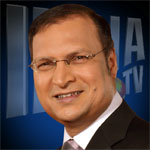
    Editor-in-chief Rajat Sharma will now be on primetime with ‘Aaj Ki Baat – Rajat Sharma Ke Saath’. Mr Sharma, who resumes a daily news show after a gap of over four years, said: “The India TV newsroom is fully charged to capture the excitement of upcoming general elections. Extensive plans have been made to report, analyse and present the battle for the next Lok Sabha to our viewers.”


    “Our viewers can rest assured of most accurate and responsible news reporting, which will further cement our leadership position in Hindi News genre,” said Editorial Director QW Naqvi.


    Ritu Dhawan

    Commenting on the new appointments, Ritu Dhawan, MD & CEO, India TV said: “When the channel announced the appointment of QW Naqvi as the Editorial Director in October, it was always on cards that the content team will be further strengthened to gear up for the biggest event in news genre, the general elections slated for 2014, to begin with.”


    “All such efforts are a testimony to our commitment to broadcast a perfect mix of news, views and analysis to our ever-evolving audiences and we are sure that we will be able to create and maintain a perfect content mix,” she added hinting at more defining announcements, beyond appointments, to follow soon.


  • Vital Stats: Status of Permitted Private Satellite TV Channels in India as on Dec 2

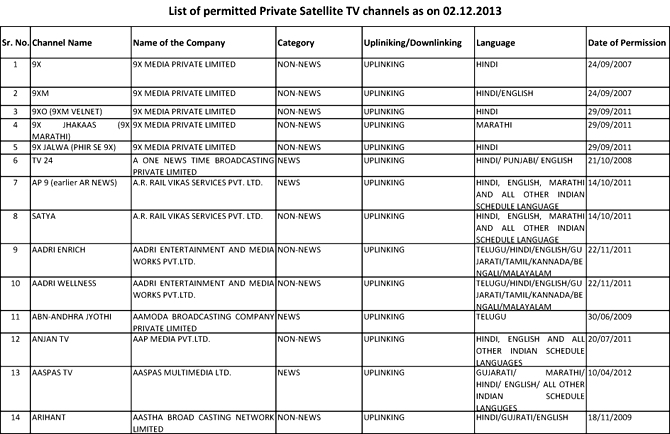
    This is the status of permitted private satellite TV channels in India as on December 2, 2013 as per the Ministry of Information and Broadcasting, Government of India


    Permitted Satellite TV Channels in India: 784

    News and Current Affairs Channels: 389

    Non-news and Current Affairs Channels: 395

    TV Channels permitted for uplink from India and also to downlink into India: 693 (News: 373, Non-news: 320)

    TV Channels permitted for uplink from India and not permitted to downlink in India: 31 (News: 4, Non-news: 27)

    TV Channels permitted to only downlink into India (uplinked from abroad): 91 (News: 16, Non-news: 75)


  • India TV refreshes look. New studio, mike ids greet viewers

    By A Correspondent


    Leading Hindi news channel India TV has given itself a full scrub. The channel greeted viewers this morning (Monday, December 16) with an all-new look. The logo which was unveiled last Friday is now housed in a refreshed channel.


    The new look has been designed by Renderon Broadcast Design, a US-based packaging firm has Fox News and NBC amongst its clients. India TV’s new logo has been designed by brand strategy firm DY Works.


    The India TV news presentation moves to a highly sophisticated double storey set, designed and executed by Broadcast Design International (BDI). Mike Baker, former Lighting Director, BBC was flown in for lighting the new set. The new look for India TV mikes has been designed by Germany’s Schulze-Brakel that specialises in collateral design for microphone IDs.


    Ritu Dhawan

    Talking of the revamp, India TV Managing Director and CEO Ritu Dhawan said: “It is the result of months of seamless planning and execution. The channel will soon launch a 360-degree marketing campaign to promote and reinforce the rejuvenated programming and packaging. The campaign will elaborate and capture the thought and philosophy behind the revamp across mediums,” she added. It may be recalled Eleven Brandworks was retained as the channel’s creative agency a few months back.


    Rajat Sharma

    As is known, Editor-in-chief Rajat Sharma has revived his popular show Aaj Ki Baat- Rajat Sharma ke Saath.  Mr Sharma’s nightly programme will lead the refreshed look. Meanwhile, Editorial Director QW Naqvi, widely credited with the success of Aaj Tak and a team of experienced editors, producers, presenters and creative writers have recently joined the channel to execute changes in the content.


  • Nitin Kukreja: Role of broadcast in growing sports in India

    Nitin Kukreja

    Nitin Kukreja, President – Sports, STAR India spoke at the India Pro Leagues Forum 2013 last Friday elaborating on the ever-growing interest in sports in the country and this interest is directed towards sports other than cricket. Extracts from the keynote:


    I’ll start with a few questions: Does ‘sport’ in India really begin and end with ‘Big Boys’ Cricket’? Or do we just see it that way? Across the length and breadth of India, there are strong communities and pockets of interest where people are passionately engaged with local sports and local players – football in Bengal, hockey in Punjab and Orissa, badminton in Hyderabad, basketball played in schools and table tennis played in clubs, colleges & offices across the country.


    But if a tourist landed in India and turned on the television or turned to the sports page of a newspaper, we could forgive him for thinking that India cares only about international cricket when Team India is playing.


    Why then, has this rich diversity of interest and talent not been harnessed? Why is it that in the media, on television and in the public mind-space, sport equals international cricket? How is it that the English Premier League enjoys such a phenomenal following within the UK when the English national football team has not won an international competition since 1966! Why is it that an average 18-year-old in South Delhi or Bandra is more emotionally connected to the fortunes of Manchester United or Chelsea than say the Mumbai Ranji side (40-time winner of Ranji trophy) or the Indian National Kabaddi team (winner of all 4 World Cups played so far)? You may argue that not many nations play Kabaddi other than India and Pakistan; well – you could say the same about Baseball! The US is the best example of a country that thrives on local sports and leagues – some of their sports are played in no other country – yet they call it “World Series Baseball” and Babe Ruth is an American hero and legend.


    Americans follow their city and college teams with a passion – across baseball, American football, basketball and ice hockey; Italy, Spain, Turkey – all follow their local soccer teams with a fanaticism; tourists visiting Galatasaray are advised not to wear rival team colours while visiting! And note that all these nations consume their sport in their own respective languages.


    In the last 15 years in India, entertainment and movie channels have gone local with a vengeance; the number of regional channels has gone up from just a handful pre-2000 to over 300 today; while Hindi accounts for ~55% of TV viewership; regional language content accounts for ~30% of viewership share; and it’s not just about language; a Bengali, Marathi or Tamil show is rooted in the local culture and ethos with participation from the local creative fraternity


    It is only the sports genre in India that has remained aloof from localization – until 2008 there was no IPL, and until 2012, telecast of cricket was limited to English, a language spoken by less than 10% of India.


    In India then, how can we take local sports and leagues to the next level? Broadcasters have a big role to play in this but more importantly the entire ecosystem – the sports federations, the government and the news media and advertisers need to come together to ensure that our home grown leagues get the money, resources, infrastructure and coverage that they deserve;


    Look at the quality of television coverage for International cricket over the years – the evolution has been amazing – the production quality, the camera work, the graphics, the slow-motion replays and the immensely talented people who narrate the action – all these elements really take the television viewer closer to the game; it is immersive, engaging and a pleasurable experience even for casual viewers who are not dyed-in-the-wool fans; television coverage has played a huge role in growing the fan base and support for cricket; this is despite the fact that for all these years, all coverage was in English.


    But even in cricket – the more local forms of the game – be it Ranji trophy, Irani Cup or university cricket have so far been treated as the poorer cousin – the benchmark for coverage that has been set for international cricket needs to be duplicated in the local forms of the game. The fact remains all the international heavy weights – from Tendulkar to Yuvraj Singh to Kohli – have cut their teeth on and emerged from these local level tournaments;


    The task is even greater for other sports – where even the national level game has not got the coverage it deserves. Consider the coverage that an average hockey or football match gets – you see some indifferently placed cameras and a disinterested narrative; there has been no attempt to make the viewer experience the thrills, the speed or the skill involved; when you watch a badminton match live – it is astounding to see the speed of the game and the agility of the players. The current standard of television coverage does not even begin to capture that excitement and skill;


    In a pre-digitized world with limited bandwidth, TV broadcasters were forced to follow a one-size-fits-all approach and therefore focused on only saleable national-level content at the expense of local content and language; but in a digital world the consumer has ability to access a variety of content in multiple languages and on multiple platforms; broadcasters would be doing a great disservice if they continued to use a cookie-cutter approach and did not use this opportunity to go deeper and serve the interest of all pockets of interests whether by sport, region or language.


    Great production values are not enough, the on-ground event also needs to be organized and mounted like a spectacle – this is where the sports federations have a key role to play. They must enable and nurture talent, and promote and market the game at least in the locales of affinity if not in the whole country. They must do their part to ensure that the sports page carries interesting stories and coverage of the game and the players- and not only controversies! But most important, they need to partner with the other stakeholders in the ecosystem with the long term vision of growing the sport – without the spirit of partnership and the vision; the league or the sport will not grow.


    The government has a huge role to play – by allocating adequate monies, developing stadiums and infrastructure and putting in enabling policies in place. The government allocates around Rs. 1000 Cr. to Sports (and Youth Affairs) which is the budget for the current year. That number is less than what we will be paying only for one tournament -the ICC T20 world cup – that number is less than the number that STAR invests in sports each year. It means that Star is a bigger investor in sports in India than the government of India itself!


    The scale of magnitude of the government’s investment should be at least 10x of that number! Why do you ask? More than half of India’s population is below the age of 25 and 65% below 35; Sports has a crucial role to play in youth development and can even be a huge generator of employment. IPL has opened up career options for 120 players; not just 15. Hockey players can now make up to 60 lacs for one month of play in the HIL; badminton players can make 50 lacs for 3 weeks of work; not to mention the production, support and service staff that works on these leagues. When the hockey union went on strike in Canada a while ago, the prime minister of the country got involved because his fear was that a prolonged strike would have an adverse impact on the GDP of Canada! More than anything, it showed the power of sports and its ability to be a huge economic growth engine.


    Forget about investment, even simple hygiene factors such as easing procedures can go a long way – it cannot take 38 different permissions just to host a hockey match in a certain venue; increase venues and the number of permissions multiplies!


    It’s a vicious circle, since there is no investment, there is no growth and no popularity for local leagues and sports – therefore they attract no money! The common man (or woman) in India does not view “sport” as a viable career option or life choice; it remains a “hobby” to be pursued in free time;


    Star has thrown its weight behind building an enduring viewer proposition around local leagues and sports- and in the language of the people. Our tryst with these local sporting leagues has thrown up some interesting results:

    • We partnered with Calcutta Football League, one of the oldest leagues in Asia and in the world with 157 kolkata based clubs and units to air their league matches on our Bengali movie channel. In the core national male audience, the TV viewership is 4-5x higher than your average EPL match! Even with the current quality of football and coverage, an East Bengal-Mohan Bagan match attracts crowds up to 70000 in the stadium!
    • We also partnered with Hockey India League the first edition of which was held in January 2013. The excitement on grounds was to be seen to be believed. For e.g. grounds in Ranchi were completely packed to support their Ranchi Rhinos team which went on to win the league; there was a lathi-charge 2 days before the match when demand for tickets got out of hand and in fact when the match was on – even the neighbouring stadium that simply had a big screen projecting the match – was full! The excitement rivalled that seen in Wankhede stadium or Eden gardens during high-octane international cricket;
    • University cricket is another great example – during the Jamia vs Bangalore’s Jain university match, stadium was so packed that it took 40 mins to enter; and the crowd was chanting – not “Sachin Sachin”, not “India India” but “Jamia Jamia”!


    The pockets of passion exist; it is on us collectively to harness and magnify them


    The IPL has shown the way in how to mount a successful local league; granted that it was built on an already popular sport – but all the stakeholders have done a great job in coming together to mount it like a spectacle – it is no longer a game but entertainment and a serious alternate to any other movie or television show. Clearly, a “manoranjan ka baap”


    There is a lot more to be done and many challenges to overcome. It will take a spirit of partnership with federations and people with vision to get there – for the benefit of sports, for the benefit of the country and for a healthier and fitter society!


  • Doordarshan-UNICEF celebrate 10 years of Navjyoti Awards

    By A Correspondent


    Had it been a private broadcaster, it would’ve gone to town about it. But this is pubcaster Doordarshan and not many of us in the trade media watch it. But having read the release which came in, we thought this deserves pride of place.


    A joint venture of UNICEF and Doordashan Mumbai Kendra, the Navjyoti programme aims to recognize initiatives taken by girls despite adverse circumstances. Started in 2003, Navjyoti celebrated its tenth year in a colorfully decked studio in Mumbai’s Doordarshan centre last weekend.


    Stories of ‘girl power’ unfolded and stunned the audience as nine girls from remote Maharashtra were felicitated for resisting child marriages and also helping other girls fight the scourge. They had one common message to share – “Girls are not any less.”


    They received honours from nine eminent and inspiring personalities like Nirmala Sawant Prabhawalkar, Dr. Jamuna Pai, Neela Satyanarayan, Manisha Goel, Priyanka Sinha Jha, Rajeshwari Chandrasekhar, Kiran Juneja, Sucherita Hegde and Grace Pinto. Other dignified personalities present were Dr Jagannath Hegde, Udai Gupta, Ulhas Wagh, Abuzar Zakir and DD Mumbai’s very own Mukesh Sharma.


    DD Sahyadri will get telecast a programme based on this on December 28 and 29 from 10am onwards.


  • Life OK will be #1 Hindi GEC in 18 months: Ajit Thakur


    When the media heard Ajit Thakur was returning to the country to join Star India and relaunch its second Hindi GEC, it didn’t require Star bosses to tell us that it wasn’t just a flanking strategy. As General Manager and Business Head of the channel, he was sure to make it formidable force. Although the start may have been slow for Life OK, there appears to have been a method to the growth, says Mr Thakur in this extended interview with MxMIndia. As it happens, today (December 18) is when Life OK completes two years of existence. And on the eve of this milestone, Mr Thakur told us he wants Life OK to be the No 1 Hindi general entertainment channels in a year-and-a-half. May sound ambitious, but look what’s happened at Multi Screen Media with Sab TV consistently ahead of Sony! There are of course many content plans up his sleeve, and a refresh and brand-push is also on the anvil. Excerpts from the interview:


    Two years on, how has the Life OK journey been?

    I think it’s been a rollercoaster in the truest sense of the word. Because we’ve had as many downs as ups. For me, that’s been the joy of it. We said we’ll aim to make a place for ourselves without following the code of conduct of GECs – target the woman, do soaps and pitch these women protagonists – as the only way to grow a GEC channel. We didn’t do any of the three. So the good thing is 14% market share, 2 years later without following the three GEC codes. I’m very satisfied. And the bonus has been we’ve broken even.


    At the time of Life OK’s launch, we spoke with Sanjay Gupta and some others on the one reason why your predecessor Star One didn’t work was the attention given to it, or rather the lack of it. It was always Star Plus that was getting primary attention. Obviously your personal existence here has, kind of, changed that. Would you say the primary channel’s got more prominence even now?

    I think the big difference that has happened from Star One to Life OK is that the flanker strategy has changed to a full-blown challenger strategy. And that’s important in many ways than one, but to answer your question directly, the way it works right now is that Life OK is seen as sometimes the best, sometimes a star, sometimes as the younger sibling who wants a lot more attention in all forms.


    So everything – from internally emotionally blackmailing to whatever it takes for us to get attention, we do that. And the great thing is that the attention has been coming both in terms of softer aspects as well in terms of harder ones. Which was in terms of investment that we needed. And we’ve got it. And to the extent that now, every time I’ve met Uday in the last six months, after we’ve kind of, managed to establish: there’s only one thing he says. So when are you beating Star Plus? And that is unheard in the corridors of the Star network in the last few years. That’s the only question he asks me. And I think for that we had to make sure we put our feet firmly on the ground… which we have done in the last six months.


    Did this change happen mid-course in these two years or was it there from the very beginning?

    I think in terms of the intention and investment, it was there right from when I joined in August of 2011. That’s the reason why they wanted pretty much a separate management to the extent that we were told to run out of an independent office.


    I’ll tell you what the last 12 months has seen. And it is linked to a couple of things that happened in the universe. As we were going into digitization and LC1, there was a lot of uncertainty of what’s going to happen. By then we already had 10% marketshare. We were doing fine and all that stuff. But what it gave us in that entire churn of both LC1 and digitization and metros first and the next tier towns was that suddenly the share of the Top 3 channels in terms of absolute numbers was declining and from the lower three, two channels, one of which was Life OK was clearly growing and then six months back, we broke away from the pack. And as that has happened, it’s given us the third reason which is a tangible proof of saying that yes, it can be a good long-running GEC to saying oh, we have a serious chance at becoming No 1.


    For a long period after launch, you were not among the Top 5

    Yes, we were No 6.


    So, it took it’s time?

    Yes.


    And in the past, we’ve had GECs which turned No 1 in a year!?

    Yes.


    As mediawatchers, one wasn’t very sure whether Star India was walking the talk on making Life OK strong enough to be the No. 1?

    I’ll give you very clear answers on this. I could substantiate the numbers but because of reasons of confidentiality, I won’t. But I’ll give you a very clear answer on this. Because nobody has asked me this question so directly. There are three things.


    First and foremost, among the many channels that have launched in broadly the GEC or Hindi category, there’s been only one before us that has sustained for a good run. And all credit to that launch.


    But when we started, we said we’ll fund ourselves. So we’re not going to lose a lot of the company’s money in the first 3 years to see where we land to get that marketshare. And I’m very, very proud of that fact that we broke even at the end of our first full year of operations. At the end of June last year, we were breaking even. This year, we will turn profitable. And that nobody can claim including the one channel we’re talking about.


    There are many who’ve come, not wanting to be called GEC. And some have come and said they’ll be GECs. One has succeeded long-term, yes, full credit to them and become No 1 overnight, like you said. But nobody’s broken even or turned profitable within the first two years of operations which is important because in today’s market, as we’re getting into digitization and more and more fragmentation, the quick win doesn’t equal to sustainable, profitable growth. Today somebody can create a No 1 GEC at three times programming investments and not make money and somebody can be a No 3 GEC at 1.5x programming investments and make money. Which one would you choose? I would go for the latter.


    Hmmm.

    These are two different channels among the current Top 5 where the 3x and 1.5x is very relevant and say we’re at 1x of investment. But the 1.5x may not be a No 1 but significantly more profitable than the 3x. So that is important. Right? And then comes the third factor, which is where I think may be we are wrong, but we won’t change it. Which is that the kind of genres and programming strategy we’ve taken on, there are two things that are happening. One, there’s a faster burn in our stories. So when you pick up a show which is a family drama but rooted in domestic violence and you want to treat it like a thriller. Today, what did we come and do?


    Our first hit which was ‘Saubhaagyavati Bhava’ was treated like a thriller, not a regular kitchen soap. We exhaust our stories much faster. Second is that there’s a certain kind of viewership that is happening in middle India where there’s familiarity with the ‘Saas-Bahu’ type of shows. I have nothing against dramas, I have a predominance of dramas set in the kitchen. Right? The familiarity of that means that anything new that you want to push, either you manage to get it right but you exhaust the story fast, you don’t get noticed at all. It has happened to every two of our three launches. Because the DNA of the show is so different that you just don’t land it there. This is not for me. And for whatever it’s worth, the dominant viewer in the household on weekdays is still the housewife. The dominant viewer, I’m not saying the exclusive viewer. And that changes on the weekend. Which is why our programming changes so much.


    So every time we leave a show which you know is a sure takeoff point because it’s set in the kitchen, we have a little moment of ‘we should’ve done it’. But we haven’t done it. And we’re happy for that because now when we go back and talk about it, they’re very clear that amongst the Top 3 there’s nobody who offers them variety. There are other people who offer them variety but not the Top 3. And Life OK is definitely one of those channels that offers them the variety where there’s something for everybody in the family to watch, including kids. We have a very conscious kids strategy. At 8 pm, our next launch, ‘Hatim’ is purely designed for kids. But enough of a narrative like any of the good animations from Hollywood. Adults can watch it.


    Was the intent of Life OK being a Star Plus killer in existence from the very beginning or did it change as you moved on?

    I won’t use the word killer but I would say a serious challenger to the No 1 position. It was there right from the beginning. Both in terms of investment and intent. What the last 12 months or 6 months in particular have done is that it has given a tangible proof of that we can achieve it.


    I was telling you the three things that make us stand out is One, turning profitable, having sustained a two-year run and looking to continue consolidate, which has been the case with one more channel, but, I think no one has turned profitable so quickly. Second is that, in two years now, it seems like the journey is only 25% done. So we know the plan ahead. So we know where we want to go. And, third, and most important is that we’ve still not given into the temptation of doing the same.


    Given that there’s a Star Plus already wouldn’t it have been better for Star India to offer a channel with a similar content strategy so that advertisers can be given a better packaged deal?

    If the corporate strategy was to bring in Life OK to fill in the gaps or get whatever is left after Star Plus, we would’ve continued to be a flanker channel and we wouldn’t have been where we are today. What we’ve been told is chart your own destiny, find a space for yourself that’s distinct from Star Plus but still big enough to challenge it and cross it. So we’ve never had a brief of saying what is the best way to monetize the two channels together? If that was the brief, we would’ve remained an 80 GRP channel and at 8% share and it would still have made a lot of sense for the corporate.


    Has LC1 helped you or been a shot in the arm for you?

    What has helped us a network is that we have been aware of the power of the smaller markets much before the others and without giving details we’ve gone and activated that for all three channels… for Star Plus, Star World and Life OK. And that we did before the measurement came in. I think too often in the industry we’ve been guilty of chasing the measurement matrix to market and plan content. And I think every time somebody does that you’re always behind the trend. So we’ve taken the leap of faith and I can tell you that we’ve just gone town by town, village by village and taken the message of the network with a very unique programme that we’ve created. So much so that now there are some clients who now want to come on board on that programme. Saying hey listen, we went there and we saw a poster of Nayi Soch and Life OK Mahotsav… what have you guys done?


    So, being aware to the smaller market did help. Did digitization help? I don’t think it helped Life OK. All it did was it made an even playing field for everybody for content to finally win.


    When you started out, you had this huge digital thing. Your name was Life Ok. The fonts used in your identity were cool. You had a Madhuri Dixit as the ‘sutradhaar’ So it had a fairly urban as against a middle India feel. Did you at that point of time feel there was a bit of a disconnect?

    When I say middle India, I mean middle class India. For me that exists as much in Mumbai as in Moradabad. So for me that was never a disconnect. Over time, as the content has been consumed differently, without any intentional push, some markets have become stronger than others. So our first market that became strong was completely intentional, which was UP and Delhi. But after that an MP nad Punjab came to us much faster than Mumbai and people started saying you’re more small town India than big town India! But digitization happened and now in Mumbai we’re growing as fast as any other market.


    What about the all-important Gujarat market.

    There are so many people are competing for it, I’d rather leave it for now. The only way to cater to Gujarat is to create content for them. Unfortunately in two years I haven’t found a single show which is set in Gujarat which I’ve liked.


    In a city like Mumbai you don’t find Gujarati content?

    I found a lot of Gujarati content which is set in the kitchen. But by definition we won’t do it. So, in April we’ll do our first content targeting them and which is a musical. I can’t tell you anymore.


    We’ve had a situation where you’ve had a flanking channel which is become the No 1 in the network. You’ve been yoyo-ing with that channel – Sab TV – for a while in terms of the ratings. When can we expect a Life OK displacing Star Plus to be the No 1?

    You know I wish I knew the answer. But jokes aside, I’d give ourselves 18 months to make it happen.


    To be the No 1 Hindi GEC in the country?

    Yes. I mean, you can’t have a longer timeline then that! So I’d give ourselves 18 months.


    You have a background of having achieved a fair bit of success at Sony

    Yes, but the glass was half full. I would’ve loved to finish that. Not a fair comment to say on a LifeOK interview but family came first and I wanted to move to Singapore so all that happened. But I must tell you, I’m a big fan of what Sab TV does and that I can say officially.


    It’s a channel which stands out for me. I’m very happy for them. My personal attachment is to Sony because I’ve worked there. But for us, our destiny is not there, because nobody is trying to target the whole family. And we’re trying to make this big statement that we must in the Indian context allow the family to come together and watch TV. And not divide them and make them watch their programs.


    And by doing that if we can come to 14% and No 4, we’ll have to work much harder, but we can become 24% and No 1. And that’s what we want to do. But we’ll do it by keeping the family together.


    In terms of programming hours, is it going to change? You’ve done your share of reality shows. Not a good share but some reality shows. You’ve not had too much success with them.

    Yes, I’ll tell you on reality shows and then I’ll come back and answer in terms of programming hours. That’s why I told you that every two of the three new ideas we do, fail. And I enjoy our failures because there’s so much to learn from each one of them. On reality shows my brief to the team is don’t bring me a singing-and-dancing idea. We’ve tried a show about making people find love, which is ‘Bachelorette’ or a show about finding talent beyond just adults which was ‘Kids: Hindustan ke Hunarbaaz’ or ‘Saavdhaan’ it’s fiction, non-fiction, it’s about crime or we did ‘Come Dine with Me’..


    Did you think ‘Mahadev’ would be such a success?

    No, not at all. No clue. We had no clue.


    But you kind of put many eggs in a basket.

    On three shows.


    You also had a whole concert around Mahadev?

    Because he was a unifying hero. I have this big thing that all content must unify. So we’d think who’s the one hero who unifies? But our highest investment was on ‘Saubhaagyavati Bhava’. The second was ‘Meri Maa’ which failed. Sach ka Saamna Bhrashtachar ke khilaf: failed! Because nobody wants to see a show on voyeurism around corruption.


    Are you looking at Sach ka Saamna again?

    Yes, we’re trying to find the right take on it. Then the last one was Mahadev. Mahadev was a No 4 at that time. And by the way Mahadev didn’t take off till four months of launch. It was kind of hovering. Saubhaagyavati Bhava became a big hit. A show we didn’t promote at all called ‘Main Lakshmi tere aangan ki’ became our second big hit. A simple thing about a girl’s choices between money and love.


    So tell me, now that you’ve mentioned about the 18-month window …

    I just made it up.. but, yes, that’s it.


    … which is just a year-and-a-half away. What are the specifics you’ve thought of for what you’ve to achieve over the next one year?

    Obviously I can’t talk about specific plans but I’ll tell you things that are a part of the DNA of the team. So the first specific and it’s an important one is that we’ll continue to be modest. The problem with some of our predecessors who’ve had a good start and failed is that at some stage you start thinking that you know it all. This audience is evolving fast. The market is fast-changing. With digitization we don’t know how many more dynamics will come into it.


    An integral part of that modesty is knowing that we’ll still continue to fail more often than we’l; succeed. If we don’t keep failing, we won’t do the next thing better. This thing that we’ll have zero failure rate doesn’t exist in my dictionary.


    The second thing is that I think we’ve to take our content play to the next level. For a number of reasons. So, with advertisers now, we’re full. Our inventory is full even in the leanest months now. Because they can see the efficiency with which Life OK delivers for them. We are going to do a big award show for which we’re going to make a formal announcement around Christmas.


    Is it the Screen Awards?

    I wouldn’t confirm it right now, but the reason I’m telling you this is so that you understand there’s a method to the madness. One is about humility and continue to learn from failures. Second is about creating impact. In fact on reach in some weeks, we’re No 2 if you’ve been tracking it in the last few months. That message to advertisers has completely gone through. That Life OK has some impact properties which are not regular ‘Saas-Bahu’ shows, they also know that. But now we want to give them the impact properties as big as any channel. The only difference is that for us impact doesn’t equal to the next big dance or singing show. After the award show, we’re going to open up from March to June with impact in fiction. And there you’ll see the method to madness.


    Hmmm….

    If you realize after launch, we’ve been lying low on the brand. There’s no point going and saying this is the brand that’s gonna change your life! Until enough people are watching it. So come Quarter 1 next year, by the end of it, on the impact of the changes and stuff we’re doing in ficiton and the award show, we’re going to refresh the brand and this time we’re going to say what we want to say. A brand that wants to go more with entertainment, a brand that wants to keep the foundation.


    Have you started working on that already?

    Yes, we’re ready with it but we won’t launch it yet. Because we want to launch it along with our content.


    With the award show or later?

    First quarter, we don’t know the timing yet, but between January and March.
     

  • In Week 50, Colors is No 2 Hindi GEC

    By our Research Associate


    It’s a game of yo-yo at the top.


    So, last week, Zee was No 2 and Colors has marched ahead in Week 50 of the calendar year.


    Star Plus is still the numero uno Hindi GEC. All of this is as per TAM ratings revealed to us, not directly by TAM which has been restrained by the powers that be to give the media get a first-hand update on weekly ratings. Instead we have to get it from our friends who share the info. It’s reliable but, then, we haven’t got it from TAM.


    The following are the numbers:

    Star Plus              579 {561} (548)

    Colors                   449 {456} (479)

    Zee TV                  439 {480} (449)

    Life OK                 313 {325} (334)

    SAB                        291 {260} (269)

    Sony                       267 {241} (239)


    Figures in brace brackets indicate viewership numbers for last week {Week 49} and in regular brackets for the previous week (Week 48).


  • Shailesh Kapoor | Bigg Boss 7: The Coming-Of-Age Season

    By Shailesh Kapoor


    Since its start in 2006, Bigg Boss has acquired cult status in certain sections of the Indian audience, driven by youth and the urban elite. In today’s age of paid news, the programme gets sizeable free publicity in mainstream media, and has been a runaway hit with the social media in the last 3-4 years.


    Historically, Bigg Boss has not been a high-rating show, with the 3-TVR mark being considered a very good result. But there are many other factors that compensate for this, none less than the huge opportunity the programme offers for in-programme product placements and integrations. Colors has also invested well in the property over the last six seasons, upping the scale every time. The big leap, of course, was in Season 4, when they brought in Salman Khan as the host.


    If Season 5, which started with Shakti Kapoor in the house with a dozen women, was the worst Bigg Boss season till date, the current season (7) is what I’d call the coming-of-age season for the Bigg Boss franchise. It may lack a pivot like Dolly Bindra or Imam Siddiqui, who can single-handedly deliver content, but it breaks new grounds, which may impact Indian television itself, not just Bigg Boss.


    The biggest coming-of-age aspect in Bigg Boss 7 comes in the form of two very real love stories that have unfolded this season – Gauhar-Kushal and Tanisha-Armaan. In the past, Bigg Boss seasons have only hinted at romance, without much meat to chew. An episode in Season 1 ended with Aryan Vaid kissing Anupama Verma on her forehead. That, and a few massages apart, there hasn’t been much else in the name of love (or lust, for that matter) that registered.


    But the public display of affection this season has been heart-warming. Some may argue that it’s done on purpose to garner mileage and propel careers, but as an avid viewer, I’d pass that off as baseless cynicism. When Kushal proposed to Gauhar on screen, rather spontaneously, and she accepted, it was for real. They lived like a couple thereafter, till Kushal’s eviction this week.


    Armaan and Tanisha may not have formally announced their status, but it’s there for all to see. And the element of lust is apparent too, with rumours of their lovemaking in the house doing the rounds on social media. Both couples have also used the camera-free washroom rather brazenly at times. Full credit to the channel for telecasting at least some such portions.


    For me, this is a far cry from the kid-glove handling of romance and man-woman relationships that we are used to seeing on our television. Bigg Boss 7 pushes the envelope, and in a smart way that doesn’t allow for any silly protests or moral policing. After all, who can object to consensual love? (Oh wait!)


    In many of our serials, the hero and the heroine may well have been brother and sister, the way they maintain safe distance from each other, even in private moments. Perhaps Bigg Boss 7 will embolden the channels and producers to relook at what comes across, at least at times, as a playing-it-safe strategy.


    Only time will tell if this season was a real trendsetter, or just a flash in the pan when the channel got lucky because real people fell in real ishq wala love on the show. But for those who complained that Bigg Boss was way too sanitized compared to Big Brother, we have now officially moved on.


    Signs of a changing India?


    Shailesh Kapoor is founder and CEO of media insights firm Ormax Media. He spent nine years in the television industry before turning entrepreneur. The views expressed here are his own. He can be reached at his Twitter handle @shaileshkapoor


  • Digital cable subscribers to get monthly bills

    By A Correspondent


    Digital Cable TV subscribers will now get monthly bills from their cable operators. The new facility, which has been introduced as per the Telecom Regulatory Authority of India (TRAI) regulations, will usher in greater transparency in billing, notes a communiqué from the MSO Alliance


    Beginning December 2013, subscribers will get a bill for their cable TV every month starting with that of November 2013.  Commenting on the introduction of monthly billing, S N Sharma, Secretary, MSO Alliance and CEO, DEN Networks said: “This move is important as it will ensure that there are no additional or random charges levied on the subscribers. Our viewers will thus pay only for what they watch and they must insist on a bill from their local cable operator or multiple system operator at the time of monthly payment.”


    The MSO Alliance has also launched an advertisement campaign through print media and cable television channels to spread awareness about the monthly billing system.


    As per the TRAI regulations, subscribers will get a time period of 15 days from the date of the bill to make their payment. In case the subscriber fails to make the payment after the expiry of the due date of payment, the MSO or the affiliate LCO (local cable operator) has the right to charge interest on the outstanding amount.


    The MSO Alliance comprises the major digital TV platforms of the country including DEN Networks, Hathway, SITI Digital Cable Television and Incablenet. Digital cable currently has over 19 million subscribers in the 41 cities covered under Phases 1 and 2 of digitization.


  • History will remember ’24’ as a gamechanger in Indian television: Raj Nayak

    As the clock ticked to the closure of Season 1 of ’24’, the social media was buzzing with chatter on how the Colors mega-series saw Anil Kapoor giving one of his best ever performances. There were others who spoke about the international teleseries’ superior production qualities and how the entire cast put up an excellent act. For Colors and its CEO Raj Nayak, the acquisition and airing of 24 was a huge gamble. In a business where just hiring the best talent doesn’t guarantee success, 24 is sure to raise the bar much on fictions on Indian entertainment television. MxMIndia spoke to Mr Nayak on the how Season 1, which concluded on Saturday (December 21) did for his channel. Excerts from an interview:


    So how was the ’24’ experience?

    For me, it’s been the best experience in my career. And I would say that because my Board gave me the consent and support to go ahead and do a show of such a magnitude that too a fiction show and experiment with something when everybody was sceptical about it. I think people were sceptical because of two things – one, the cost and, two, the quality would be compared to the international format.


    Was it ‘Paisa Vasool’ for the channel?

    Yes, it was Paisa Vasool. I think it was Paisa Vasool because from a strategic point of view, we went with our eyes open. We knew we wouldn’t make money on Season 1, even though we have recovered most of the cost because of the way we monetized it.


    From a channel and brand perspective, 24 has done several things for us. First, the buzz it has created for me in two months time is possibly the entire PR, we got for our other shows not just in India but globally. Second, it has brought to a Hindi general entertainment channel viewers who probably never watch us – the South Mumbai crowd, for instance now discuss our ’24’. Third, it has also demonstrated how cleverly you can integrate a product within a show if you think it through and do it well. I think that’s what happened with Tata Motors which went on record that its sales has gone up by 30 percent because of 24. You may or agree or disagree with the ratings, but for me, this is the proof of the pudding. Clearly, what 24 has done is create an impact. And it’s not that it ends here. I will re-run 24 on a daily format. When and where I do it is a different issue…


    As a daily?

    Yes, I will strip it to make it a daily. There were many people who missed it on weekends. People would call me often to ask me when the repeat airing was on for a DVD. There is an audience that wants to watch a show like this again and again and again. So if I give it a break and I strip it to a daily format, we will see what it can do again.


    Hmmmm.

    Purely from the RoI point of view, I think 24 was a super success.


    What about Season 2? Is that on?

    We haven’t finalized anything yet but there is intent. Seeing the success of Season 1, I believe Season 2 will do better…


    No dates firmed up?

    No, we haven’t finalized anything yet


    Internationally, it’s an annual

    Yeah! That would be idea here as well. As you know, internationally Season 1 didn’t go well, Season 2 picked up big time and I think that’s a trend that will happen here as well.


    Are your sponsors going to continue with you for Season 2 as well?

    Well, first of all, I would want them to pay double the money because we didn’t know how successful 24 would be (laughs). But, honestly, we also didn’t realize the magnitude of how much value the content would generate and we were very keen on closing the deal because we were going to production then. We have an excellent relationship with Tata motors and from my engagement, they are very happy and I am sure they would want to come in be part of Season 2.


    Looking back, would you have done things different to get rated better?

    Yes, we would have done a few things differently. We have realized   and we have analysed what went wrong and what went right and that is something we will ensure that we will fix in next season.


    Any one thing that you could tell us?

    Well, while keeping it intellectual and slick and everything, there could be a five percent deviation in terms of dumbing it down without taking away the original content and the storytelling, but just making the television grammar a little more Indian.


    Do you think India is ready for slick or as they in Mumbai lingo a chikna show?

    I think India is ready, We know one can’t achieve things overnight. History is often written in retrospective, later in life. This will be one show that will definitely be written about as a gamechanger for Indian television content


    Any more international show that you are looking at?

    I am very and I have also heard that all broadcasters are equally keen and in discussions.


    We’ve heard Grey’s Anatomy is being done by another GEC…

    From what I learn, they are not doing the original version. They haven’t got the rights for it and are possibly recreating something similar. Shows like Grey’s Anatomy, Boston Legal etc are easily adaptable


    So does Comedy Nights come back to being twice a week?

    Yes, Comedy Nights with Kapil will go twice a week again from the first week of January.


  • Aidem to rep Janta TV sales

    By A Correspondent


    Janta TV has handed over its ad sales mandate to Aidem Ventures.


    Launched in 2011, by Gurbinder Singh, Janta TV is known to provide more local news than any other news channel in the PHCHP region. According to a communique, it is also the only regional news channel to dedicate 20 % of content towards public opinion shows (Bol Janta Bol & Bol Free) and has four fresh interactive bulletins that receive thousands of call-ins daily. The channel enjoys a strong presence and viewership in the PHCHP market and is also distributed in the states of Jammu & Kashmir, Uttarakhand, Madhya Pradesh, Jharkhand, Uttar Pradesh, Bihar and New Delhi.


    “The Aidem team possesses a great amount of business appetite as also a thorough understanding of the broadcast media and of the Indian advertising market. We are looking forward to the team’s industry knowledge and their national coverage to cover advertising opportunities across the country,” said Gurbinder Singh, Vice President, Janta TV.


    “It isn’t very often in this economic climate and media landscape that an independent news channel such as Janta TV gets off the ground and marks its spot in the Top 5 in its genre. It truly is exciting to be part of the channel’s expansion quest. The team is geared to get their feet on the street to help Janta TV maximize their revenue potential.” added Alok Rakshit, Senior Vice President – Regional Bouquet, Aidem Ventures.


    “We, at Aidem, aim at making life simpler for media owners, media agencies, advertisers and our sales staff. Bagging Janta TV is a big step towards our goal to build a more robust News media cluster thus easing the media buying process,” added Shailendra Shetty, Senior Vice President at Aidem.