Category: TV

  • Sachin’s farewell Test is highest rated in 8 years

    By A Correspondent


    Master Blaster Sachin Tendulkar’s farewell Test match has emerged as the highest rated Test on television in India in the past eight years. The match garnered 1739 average TVTs which remains unmatched since 2005.  According to a communiqué, the Star Sports network channels together had the maximum channel share across all genres during the six playing days of the series. (Overall TVTs generated during the day). Also, starsports.com attracted 3.5 million unique visitors during the two matches of the India-West Indies Test series.


    Star India put out all stops for the series. It had secured the title sponsorship rights for the Test series and launched its seven-vehicle network on Day 1 of the first Test. There was a 360-degree initiative involving programming, production, marketing to add buzz around Sachin Tendulkar’s farewell series. The broadcaster also launched three shows programs to engage with the sports fan. Then there was a  ‘Cheer for Sachin’ campaign along with a slew of on-ground activities. Star India CEO Uday Shankar presented Sachin Tendulkar with the first STAR Sports ‘Believe’ Trophy during the post-presentation ceremony in Mumbai.


    Speaking on the occasion, Nitin Kukreja, Head of Sports Business, Star India, said, “We are delighted with the ratings. Our strategic investment in the Hindi language feed over the past year or so is now paying us huge dividends. We will continue in our endeavor to promote sports culture in the country,” added Nitin.


    Important: The TAM numbers quoted above (Average TVTs; TG: C&S 15+, M, SEC ABC ) are sourced from a communiqué sent by Star Sports. These have not been verified with TAM.


  • CNN to profile Ted Turner on Sunday, Nov 24

    By A Correspondent


    Want to know about innovator, visionary, trailblazer and the founder of CNN Ted Turner? Well, just watch – what else – CNN itself. Mr Turner is the subject of a 60-minute profile encompassing his remarkable life and achievements. Reported by CNN anchor Wolf Blitzer, Ted Turner: The Maverick Man explores Mr Turner’s difficult early years, his extraordinary career, his legendary America’s Cup win, Turner’s historic humanitarian and cable television legacies – and everything in between. The documentary will air on Sunday, November 24 at 4.30pm IST.


    The film features first-hand accounts from Turner on founding his first “Super Station” and rapidly transforming that venture into a global media company. Of CNN’s ground-breaking, enterprising broadcast coverage of the 1991 Iraq War, Turner reflected it as still the “greatest scoop in the history of journalism.”


  • News channels maxed with Mumbai terror attack coverage: TAM data

    By Our Research Associate


    It’s not a distinction that we are all too happy about, it’s data that cannot be ignored.


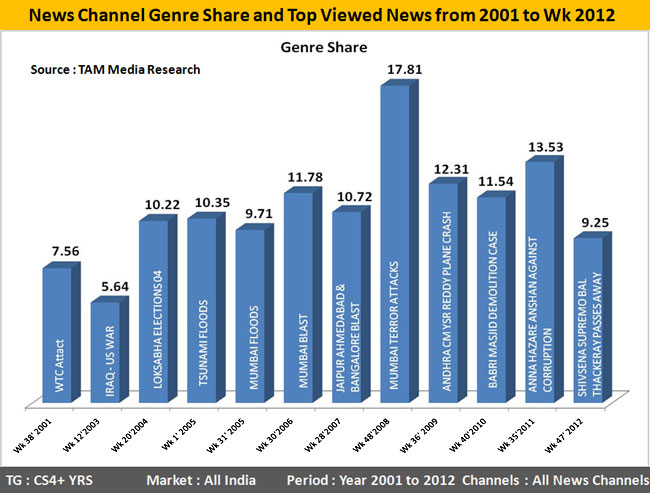
    In the period 2001-12, the Mumbai terror attacks story gained maximum viewership as per TAM data made available to MxMIndia.


    These are All-India figures and include regional news and it is for the target audience being CS 4+ years (Cable-Satellite, above 4 years).


    While Mumbai terror attack saw news channels score a genre share of 17.81 percent, the Anna Hazare fast agitation was second with 13.53 percent. The plane crash which led to the death of Andhra Pradesh Chief Minister YSR Reddy is third with 12.31.


    What has emerged from these numbers is that all news events that spread over a period of time generated more eyeballs. For instance, in the case of the news around the passing of Shiv Sena head Bal Thackeray last year, the news channel coverage lasted a day and a half. The coverage on the Mumbai terror attacks was spread over four days and it went on for much after that. Ditto with the YSR Reddy plane crash.


    Interestingly, the Gujarat riots of 2002 does not figure in this table, whereas the World Trade Centre attack in September 2001 does have fair viewership.


  • Arup Ghosh & Co’s news syndicate gets set for elections

    By A Correspondent


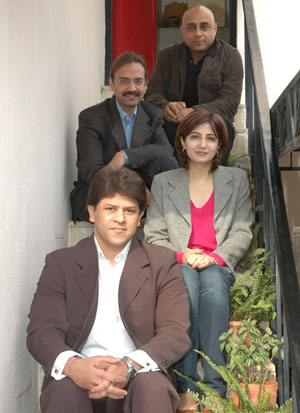
    (clockwise from top left) Network1 Media co-founders Kamal Dixit, Sundeep Misra, Shireen Sethi and Arup Ghosh

    Network1 News and Information Syndicate (NNIS) has announced that its news and feature service subscribers will now have access to live coverage from its network across metros locations. Simultaneously, NNIS has enhanced its focus to news breaking from Congress and BJP headquarters in Delhi to capture real-time developments during the ongoing assembly elections as also the general elections next year.


    Led by Arup Ghosh, N1Media has its co-founders Shireen Sethi, Kamal Dixit and Sundeep Misra. “While NNIS has succeeded in getting great recognition for the quality of its content plus the choice it makes in selection and production, our clients can now get top quality live coverage during the elections and beyond,” said Arup Ghosh, CEO, NNIS, whose experience spans Bennett Coleman group, NDTV and start-up operations he led at Sahara, Channel7 and NewsX.


    In addition to television, NNIS has also built a strong presence among Online Portals and Mobile Value Added Service providers since it was set up in April 2010.


    “In the past, our association with media houses helped them create great branding. Now, it is our turn to create our own brand in NNIS which shall make maximum impact in times to come,” said Shireen Sethi who brings extensive on-air experience coupled with programming skills. “Acquiring the best that there is in technology-from news capturing, processing to transmission-allowed us to leap frog a complete generation. The new generation equipment offers twin advantages to media houses as they get quality, speed and reliability,” says Kamal Dixit, who as Chief Technology Officer and co-founder leads NNIS’ technology operations and brings in wide-ranging broadcast systems expertise.


    As NNIS does not work on legacy systems, it is in a position to offer news and feature content at prices that can help channels to reduce their operational expenses thus becoming profitable, a communiqué adds.


    In September 2013, NNIS raised growth equity from Rajasthan Venture Capital Fund (RVCF). Earlier, prominent angels– Saurabh Srivastava (Rajasthan Projects Private Limited), Raj Bhatt (Shell Investments Limited) and Navjot Sobti (Almondz Global Securities Limited)– invested in the venture.


  • Martin Sorrell to a do a monthly show for CNBC-TV18

    By A Correspondent


    So what’s Sir Martin Sorrell doing these days? Betting big on China of course as he did in a signed article in London’s Daily Telegraph last Saturday. It’s interesting hence to note that the world’s most powerful name in advertising and marketing services is going to doing a show titled ’30 Minutes with Martin Sorrell’ for our own CNBC-TV18.


    This new monthly half-hour programme (subject, of course to his hectic schedule, a communiqué from the channel adds) will kick off from tomorrow, that’s Friday, November 29 at 7pm.


    The show will be hosted by Anant Rangaswami, Editor of Storyboard and Senior Editor of Firstpost. Each month, Mr Rangaswami will speak to the WPP CEO on recent and imminent developments from the world of media, advertising and marketing.


    Although CNBC-TV18 via its PR agency Good Relations India did not part with the transcript of what Sir Sorrell said, a communiqué says that among the key issues the show will cover on Friday will be Twitter’s revenue model and valuation, the rumour that WPP will buy IPG, why big retail should be bothered about Chinese ambitions and finally the WPP captain’s prognosis for calendar year 2014.


    Interestingly, this is what Sir Sorrell wrote about India in the Telegraph article: “India may remain in stasis after the election, as no party will have a clear majority and a coalition will continue to compromise.” And on China? “I’m very bullish on a China with strong new leadership following the Twelfth Five Year Plan and the Third Plenum of the Eighteenth Party Congress – when did a Western government set out such a detailed and comprehensive plan?”


    The 68-year-old media baron believes “next really big thing, or things, will be coming from China”. Perhaps it/they will. Meanwhile, let’s wait for what he says on his own show this week and then, month after month.


  • Bloomberg TV-Autocar Awards on Dec 20

    By A Correspondent [updated]


    Bloomberg TV India and Autocar India will present the annual Bloomberg TV India Autocar India Awards on December 20. Speaking on the Awards, Amrit Rai, Business Head – Bloomberg TV India said, “The Bloomberg TV India Autocar India Awards have become the benchmark of performance for the industry and with each passing year, the bar has been raised by the players. We expect the 2013-14 Awards to be a keenly fought battle across all categories and wish all nominees the very best.”


    Added Hormazd Sorabjee, Editor – Autocar India magazine, on the Awards: “These awards have unmatched credibility thanks to an exhaustive evaluation process and a jury that is the best in the business. Consumers can rely on these awards to make an informed car buying decision.”


    The Bloomberg TV India Autocar India Awards 2013-14 will be given across 20 categories.


    The awards night onDecember 20will take place at the Seaside Lawns of the Taj Lands End in Mumbai and will be presented by Reliance General Insurance and powered by Mobil 1.


  • Sony still at #6 among Hindi GECs. Star Plus #1, Colors #2, Zee #3

    The table below. tells you the story. As per TAM, Week 47 of the calendar year saw Star Plus as the #1, Colors #2 and Zee #3. Life OK is #4, Sab at #5 and Sony at #6.


    Please note that these numbers haven’t come in from TAM, but from a source we trust and is reliable. Readers are requested to verify the data before making any decisions.


    Channel

    Gross Viewership in Millions

    Star Plus

    560

    Colors

    513

    Zee TV

    433

    Life OK

    335

    SAB

    308

    Sony

    269

    Star Utsav

    98

    Sahara One

    30


  • Are we a Noise-loving TV Nation?


    By Shailesh Kapoor


    You would normally not associate positive emotions with the word ‘noise’. It’s generally assumed and accepted that noise is bad. In context of television too, the media has propagated this notion for a while now. But there is very little real evidence to accept this belief. In fact, there is telling evidence to the contrary.


    For many of us, the first association with noise on Indian television would be Arnab Goswami. His rival channels even start their bulletins (the 10pm news on NDTV, for example) with the line ‘where you get news, not noise’. Yet, the high viewership of Arnab’s show speaks for itself. In the noise and the cacophony lies a sense of power the viewer feels. When you see the privileged political class being put in the docks and spoken to like they are criminals (words like hypocrite and hooligan are routinely used by Arnab to describe his guests), you feel empowered by proxy. And that would be impossible without the noise.


    Gauhar Khan is by far the most popular contestant on Bigg Boss 7 (Source: Ormax Characters India Loves). But she’s not someone who will die wondering. She’s out there, raising her voice, which gets rather shrill at times, at the slightest excuse. But like Arnab, her ‘noise’ comes from her conviction. And conviction is an unequivocal sign of strength.


    One of the top-rated shows on television for the last five years is what you would classically label ‘a loud comedy’. Yet, Taarak Mehta Ka Ooltah Chashmah, with all its executional hyperbole, continues to enthrall audiences, especially in Western India. I haven’t seen anyone who even remotely resembles the serial’s female lead Daya in mannerisms and talking style. A relatively moderate husband (Jethalal) provides a good contrast and the couple has been the most popular ‘jodi’ Indian television for a while now.


    There are many other examples across genres where one can sense that the mellow and the soothing is finding it hard to seek attention, while the noisy and the high-pitch manages to get viewership and media talk. One of the biggest successes of this year, Comedy Nights With Kapil, is a fairly loud show itself, even though it incredibly manages to keep its aesthetics consistently in place despite the noise. And the consistent performance of slapstick comedies and dubbed South action films on Hindi movie channels further propels the noise-works theory.


    Sometime earlier this year, I made the mental shift to accept that on Indian television, ‘noise’ and ‘loud’ are not undesirable, negative terms. Here, the viewer equivalent of what the US audiences will call ‘noise’ is ‘over’ (as in, “bahut over dikhaya hai”). ‘Over’ stands for over-acting or screenplay exaggeration. But ‘noise’, when not ‘over’, is perfectly desirable.


    In several discussions within the industry on this topic in recent years, the most interesting reason on why this should be the case goes as follows. There are more than 100 channels on an average consumer’s TV today. Even though she may watch only 8-10 of them regularly, the idea of multiple channels is still intimidating to the Indian audiences. So, the ‘surfing experience’ is still a stressful one, whereby the viewer is trying to come to terms with the plethora of choice available to her, often not knowing where to stop. With the number of channels on a perpetual increase, this intimidation is not going away anytime soon.


    In this context, in a ‘surfing’ scenario, a channel gets only about 5-10 seconds window to ‘attract’ the undecided viewer. This is where ‘noise’ comes in. It’s like a sales pitch or the good old Aussie art of ‘spruiking’, whereby you sell through showmanship of speech.


    There may be other reasons too, but ‘noise’ is in for sure. Let the drum rolls begin!


    Shailesh Kapoor is founder and CEO of media insights firm Ormax Media. He spent nine years in the television industry before turning entrepreneur. The views expressed here are his own. He can be reached at his Twitter handle @shaileshkapoor


  • Mediametrie… who, why, how?


    By A Correspondent


    If the question in our headline is what a lot of broadcast industry stakeholders have been asking this weekend, there’s reason. The US- and UK-exposed Indian media fraternity do not know much about Mediametrie, the French joint industry body for TV measurement that’s been chosen as the primary technology vendor by the Broadcast Audience Research Council (BARC).


    The BARC Board met on Saturday, November 30 and is reported to have given an in-principle clearance for awarding the measurement contract to the French measurement body. However, that’s as per the information leaked. Officially, the BARC communiqué issued doesn’t name any vendor.


    On Saturday, the BARC Board met to decide on the technology and the path ahead. “There was unanimity in deciding on a leap in technology to be used in television measurement. The Board approved the management and the technical and commercial committees to go ahead and finalize with a couple of international companies for this. The team will be completing the pilots and will start deployments soon. The Board also decided on the funding mechanism and is encouraged by the response received from banks for funding the project,” the release noted.


    As per reports earlier this year that were later denied by a BARC official, there were five vendors shortlisted for the key function of installation of set-top boxes and generate measurement viewership numbers. These included Kantar and Nielsen. Sources say Nielsen was in the final shortlist of three and was close to being selected, but the solution it offered was far more expensive than that of Mediametrie. TAM, a joint venture of Nielsen and WPP-owned Kantar, was not involved with the bid process at this stage.


    The vendor selected will not be involved with the analyzing of data, and that contract will be awarded separately by BARC. TAM is a likely contender for this, subject to the cross-ownership not being a stumbling block in its participation in the bidding process.


    So what is it that got Mediametrie to win the race? And who and what is Mediametrie?

    The reasons, in brief:

    First, the technology.

    Second, the low cost.

    Third: Mediametrie is not married to any set-top box provider

    And fourth, Mediametrie is structured like BARC and is not a solely-for-profit body


    The technology Mediametrie is likely to deploy is called ‘watermarking’ which entails inserting into programmes a ‘mark’ that is inaudible to the human ear. This ‘mark’ contains the identification of the channel which airs the content and the regular broadcast time markers. The audimeters installed in panellists’ homes can then recognise this information. According to sources, BARC officials have discussed the viability of inserting these markers with private channels as well as with Doordarshan. The technology allows for measurement of TV content on mobile phones as well as sedentary computers.


    The watermarking technology is being licensed from a Netherlands-headquartered vendor Civolution.


    The cost is indeed low for the technology and the set-top boxes and that’s the reason why BARC is bullish about achieving a 50,000 panel base in a year-and-a-half (See: http://www.mxmindia.com/2013/10/barc-eyes-50k-panel-in-1-5-years/) .


    A key irritant in the increase of the panel base of TAM was the cost of set-top boxes deployed. While TAM was willing to buy more, the costs were high and the taxes made them even more pricey. With the Mediametrie deal, the measurement technology is the key and not the set-top boxes. In fact, the boxes will need to be procured by BARC separately through one or more vendors. As per a source, Nielsen almost won contract due to this clause, as it was a tried-and-tested offering. However, buoyed by the confidence reposed by various stakeholders, the BARC technical committee is understood to have taken the decision to get into a separate contract with one or two hardware providers who can bring in the mandatory 20,000 set-top boxes required within six months of the government guidelines for TV measurement coming into force. Cisco was also rumoured to be in the running for this contract, but sources say that it may not among the chosen ones.


    As per info on its website (hence not verified by this correspondent), Médiamétrie was founded in 1985 in response to the changing demands in the French audiovisual sector. The government encouraged the creation of an independent company to ensure that audiences of the principal audiovisual media could be measured scientifically. This independence for Mediametrie is guaranteed by the presence of all professional parties, in all its decision-making processes and in its stakeholding, including the media, advertisers and agencies without any of them having a majority holding to take a decision alone. The ownership and structure of Mediametrie is hence quite like BARC and it isn’t a solely-for-profit set-up.


    Médiamétrie is now developing its range of services and extending its scope by working on new media, telephony, new multimedia practices, crossmedia, etc. It offers original products designed for specific users and launches offers on the international market that have become essential due to changes in consumers’ listening and viewing habits. Mediametrie has also created Eurodata TV Worldwide for analyzing and distributing info on over 5500 channels across over 100 countries.


    Civolution was  formed in October 2008 as a spin-off of Royal Philips Electronics.  In August 2008, Philips Content Identification, a business unit of Philips Electronics, assumed full ownership of its joint venture Teletrax. The combined entity was spun out of Philips in October giving birth to Civolution. In July 2009, Civolution took over the Software and Technology Solution from Thomson (Thomson STS), formerly NextAmp. Mediatmetrie’s technology is aided by that of Thomson (and hence Civolution).


    So, a source close to the developments, told MxMIndia that while Mediametrie is the primary tech vendor, Civolution and the set-top box vendor(s) will also play a key role in the implementation.


    When will the new BARC measurement come into force?

    BARC as we know is a Joint Industry Body (JIB) set up in 2012 with the specific purpose of designing, commissioning, supervising and owning India’s Television Audience Measurement System. IT is a joint venture bringing together the three key stakeholders – broadcasters, advertisers and advertising and media agencies. Their respective apex bodies, the Indian Broadcasting Foundation (IBF), the Indian Society of Advertisers (ISA) and the Advertising Agencies Association of India (AAAI), represent the three sectors.


    Although the public position for BARC may be that the new measurement regime will be up and about by the end of Q2 of 2014 (that’s by June 30, 2014), MxMIndia estimates as per discussions with various stakeholders in the industry, given the criticality of the data, subscribers will switch off the tap only after they are a hundred thousand percent convinced about the data.


    “Remember Q3 and Q4 are the all-important adspend seasons and we can’t afford to risk any mess-up due to the non-availability of data that has a buy-in of all parties. So even though we want the new BARC system to be a success, we need to be realistic,” said one industryperson. A broadcast sales head was more pragmatic. “Although it appears that the market will improve and we will be done with the elections, over the last few years there have been too many extraneous factors impacting broadcast sales. We can’t have one more variable in the system,” he said, indicating that the transition to the new measurement regime from TAM could well be done in a phased manner. So the new BARC data will start coming in from August 2014, as per scheduled, but subscribers may dispense with the current system only later.


    In the meantime, BARC needs to also contend with the government and a zealous Minister of Information and Broadcasting who is keen on effecting the new measurement regime in his tenure. “Minister Tewari’s intent is well-placed,” said a key BARC stakeholder, adding: “In reality, the system just can’t be executed in the UPA-2 tenure. Also, we do not a half-baked system to get operational.”


    The minister (and the ministry) is keenly keeping tabs on the progress being made on this front and it is learnt that key BARC officials are likely to meet them in Delhi this week.
     

  • MTV concludes multi-city music talent hunt

    By A Correspondent


    Music channel MTV India concluded its nationwide contest - MTV Rayban Never Hide Sounds – with a gig last weekend in Mumbai. The hunt across Mumbai, Delhi, Bengaluru and Kolkata for the give best bands across genres like rock, sufi, folk and pop gave winners a chance to be mentored by renowned musicians like Raghu Dixit, Benny Dayal, Uday Benegal,Harshdeep Kaur and Shilpa Rao.


    The shortlisted bands – Parvaaz, Rang, Frisky Pints, Life and Nasya jammed with one maestro from their specific genre and then went on to collaborate on some of the most iconic tracks by the mentors.


    Aditya Swamy

    Speaking about this, Aditya Swamy, EVP and Business Head, MTV India said, “Every young musician needs a mentor to go to the next level and this initiative does just that… Bringing together talent from two different generations has been an incredible experience and I look forward to this becoming a calendar event on the Indian music scene. It’s been an absolute pleasure working hand in hand with Ray Ban in building new talent and giving them a platform to take their music to the people.”


    Shirley Gong, Ray-Ban Business Manager, Emerging Markets said, “Ray-Ban Never Hide Sounds is an initiative to put forth upcoming talent.  This year we were set out to search the most unique and talented voices across various genres of Music.  I am delighted to see that this approach has brought a brand new dimension to the latest edition and we have successfully completed this musical journey.”


  • MK Anand quits Disney UTV, replacement to be announced soon

    M K Anand

    By A Corrrespondent


    M K Anand, Managing Director, Media Networks at Disney UTV is moving on.


    He has put in his papers, and his last date at Disney UTV is December 31, 2013. Although the entertainment-to-broadcast-to-gaming conglomerate has not confirmed the departure officially, a senior executive confirmed the development indicating that a new structure for the broadcast business is being worked out and then the name of the team leader will be announced.


    Mr Anand has worked with The Times of India group for 19 years, first with print for 14 years and later with the television business as VP for Zoom from 2004-09. The leapfrog to CEO of UTV Software saw him lead the broadcast business through the transition to Disney UTV.


    M K Anand’s destination is not known and he wasn’t reachable for comment.


  • Pharma giant GSK’s sign-on bonus demand leaves adland divided

    By Pritha Mitra Dasgupta


    UK pharma major GlaxoSmith-Kline’s demand for sign-on bonus from advertising firms to do business with it seems to have divided the Indian advertising and marketing fraternity into two camps on the social media.


    While GSK’s move is being condemned by international advertising agencies that have termed it ‘scandalous’, ‘lazy’ and ‘bullying’, some industry veterans in India support the rebate, saying it will put a leash on media agencies that, they allege, discreetly charge over 10% commission and show 2-3% on record.


    Following an Economic Times story on the matter on Monday, advertising veteran Preet Bedi, who has worked with Rediffusion Y&R and Lintas, wrote on his Facebook wall, “The concept of a sign-on bonus payable by agencies to clients is a masterstroke. As an agency man, I would obviously have opposed it but from the outside, I know it’s a great idea.”


    His reasons – “one, it forces agencies to pitch only for brands they really wish to be associated with and vice versa. Secondly, it forces agencies to make upfront investment in the new business; currently agencies spend peanuts on new client acquisition. Thirdly, it will force transparency in agency remuneration.”


    He also says that the move will lay bare a fraud, media agencies often perpetrate. “U (sic) will find media agencies agreeing to pay more than one or two year’s declared revenue as sign-on bonus. How? Because the actual margins are often double or even triple the declared margins. Quite brilliant; Martin has met his match,” Mr Bedi posted on Facebook.


    This sparked a virtual debate on Mr Bedi’s Facebook wall. Harit Nagpal, managing director and CEO, Tata Sky, supported GSK’s move saying, “Why are agencies complaining? If none of them is willing to pay, it won’t happen. And if even one of them is willing, and the client goes for it, disregarding the agency’s merit, he deserves it.”


    Kedar Anil Gadgil, principal consultant at Druid System, however, called the concept “an oligopoly of rich, established agencies creating a moat around their castle to protect it from the outsiders” and added that agencies should knock the door of competition lawyers to safeguard their interest.


    Mr Bedi, however, opined that nothing can stop sign-on bonus from getting implemented. “…don’t waste your money trying to fight it. If clients want it. (sic) It will happen,” he commented.


    He also wrote that while a client contributes an average of Rs 10 crore to an agency’s revenues, “the input on winning a brand is miniscule.”


    Vikas Mehta, head of Euro RSCG, Oman, countered it, “The average client does not give an average revenue of (Rs ) 10 crores. Even in the top 5 Delhi agencies, average client revenue will be less than (Rs ) 5 crores and average brand revenue still less. Not workable.”


    The fear of many advertising agencies is that if GSK is successful in implementing this, then other marketers may follow suit. In the UK, before GSK made its demand for sign-on bonus, Premier Foods that owns brands like Bisto and Hovis had parted ways with its media agency Starcom MediaVest over “investment payment”, head of an advertising agency said. “So it seems more and more marketers are warming up to it,” the person added, requesting not to be named.


    Industry bodies have come out against the sign-on bonus concept. While the Advertising Agencies Association of India has already said it should be “discouraged strongly”, International Advertising Association’s India chapter president Srinivasan K Swamy, said it is an “impractical concept.”


    “No marketer or a right thinking person would ask an agency to pay a sign-on bonus. A buyer has to pay for the goods and services he buys and it could not be the other way round,” said Mr Swamy who is also the chairman of RK Swamy BBDO. “If I have signed a contract with my client that says that if sales drop then I will have to pay a penalty then that could be worked out. Otherwise, why should an agency pay a penalty?” A mail sent to Indian Society of Advertisers chairman Hemant Bakshi, who is also the executive director, home & personal care at Hindustan Unilever, remained unanswered till late on Tuesday.


    R Ramesh Chandran, co-founder at Xtravision Media Associates, wrote on Mr Bedi’s Facebook wall that Reckitt Benckiser had tried something similar three years ago, with some tough demands such as fee to pitch for the business and penalty for not meeting CPRP targets.


    “…nobody pitched…it fell into ZOD’s lap due to international alignment… the situation at ZOD is quite a common knowledge now…Reckitt account is up for grabs again,” Mr Chandran wrote.


    Source:The Economic Times

    Copyright © 2013, Bennett, Coleman & Co. Ltd. All Rights Reserved

    Licensed to republish