Category: PRINT MEDIA

  • The Press has lost its sheen: Kuldip Nayar


    Text and Video by Shruti Pushkarna


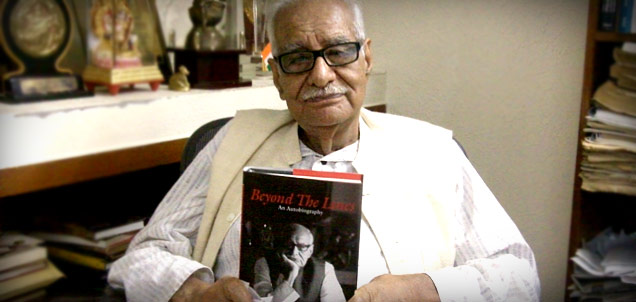
    Veteran journalist Kuldip Nayar memoirs, ‘Beyond the Lines’, are set to be released in the Capital today (July 11). He calls it a ‘political autobiography’ which recounts the political history of not just India, but Pakistan and Bangladesh as well.


    Now 89, Mr Nayar has been a close witness to a series of political events that unfolded in his journalistic career. An author and a human rights activist, Mr Nayar has also been a diplomat and Parliamentarian. He was appointed High Commissioner to Great Britain in 1990 and nominated to the Rajya Sabha in August 1997. He was media advisor to the late Prime Minister Lal Bahadur Shastri.


    He was also the former editor of the Statesman in Delhi, former Managing Editor of news agency UNI and former correspondent of the London Times. He still writes columns and op-eds for newspapers including The Daily Star, The Sunday Guardian, The News (Pakistan), Express Tribune (Pakistan), Dawn (Pakistan).


    A great believer in the power of press, Mr Nayar seems aware, and somewhere disappointed, at the emergence of the new ‘sensational’ journalism in the country. He feels that journalists today editorialize more than they report. As opposed to the ‘profession’ it used to be, Mr Nayar feels journalism today has become an ‘industry’, a ‘product’.


    In this candid one-on-one with MxMIndia, Mr Nayar shares his memories of journalism in the days gone by and the change he is witnessing today. Although he advocates self-regulation of the media, he believes that all journalists should prescribe to a strict code of ethics.


    Excerpts:


    This book is not based on columns. This is a book from my memory, 95 per cent of it is from memory, and only for about 5 per cent, I might have consulted my columns. It’s my political biography and it’s a current history of India, Pakistan and Bangladesh.You were among the first journalists to take your columns to the book form. Do you think that the book works better for a journalist?


    Have you given up on Indian media or Indian publications altogether?

    No, I have not given up entirely, because I still appear as a columnist in so many papers. Only the leading papers don’t publish my columns. I have full confidence in the press but I am disappointed that it has lost the sheen that used to be there in our times.


    Has it changed dramatically from the time when you were an active practitioner?

    Yes it has. Now it has become a product, then we were a profession, now it’s an industry. That way, independence is much less now. The influence of the owners and the corporate sector is much more than there was.


    Any other specific area where you see the change?

    Yes, the way of presenting news and the way of writing has changed. I find very few items of hard news now. In our times, we used to see what was happening in the cabinet and we even used to publish the cabinet agenda. Now it’s less inquisitive than before.


    In the Samir Jain incident you mentioned in the book, do you think the turning point in the treatment of editors by proprietors was when Girilal Jain has said to have slighted Samir Jain?

    That probably is one incident. The real watershed for journalism is the Emergency. That’s when the owners really saw that their pressmen caved in. So the owner thought that if they could cave in under pressure from government, they can also cave under my (owner’s) pressure. So the emergence of the owner started then, earlier the owner was nameless. But now we even see edits by owners and they decide who will write what.


    But there are still newspapers which are editorially driven…

    Very few.


    What’s your view of proprietors as super-editors especially in the regional, non-English media?

    That is a problem. Leading regional papers which have circulation in lakhs are owned by the same family, edited also by the same family and it’s being inherited down the generations, therefore it has become personal property. So this is a very serious issue.


    You’ve been an active votary of Indo-Pak ties, you are known to conduct candlelight marches to the Wagah border…do you think it’s correct for journalists to get ‘activist-y’?

    While I was in active journalism, I had certain views which I expressed, but did not participate in any activity. Now since I am only a columnist, I do take part in human rights violation, Indo-Pak relations and so on, because this is part of my ideology.


    You have also been quoted in the past to say that media plays a spoiler in Indo-Pak ties, that it only sensationalizes and most journalists have no sense of history…

    I think they (current media) don’t seem to have that sensitivity. I think media on both sides are still in the old age of mistrust, hatred and chauvinism. Things have changed in the region, so now we should be talking of conciliation. People on both the sides are willing to meet but media is a spoiler.


    Do you find newspapers having lost out in breaking news journalism vis-a-vis TV and the internet?

    Yes, newspapers are now breaking fewer stories, if at all they do, as compared to earlier. Television does much more. In our time, TV did not exist but now I can say that stories are broken by television network, and take the example of 2G scam, all these came from TV.  Newspapers followed up the story later.


    What’s your view on self-regulation versus government-controlled regulation of the media? You recently opposed the SC’s move to lay reporting guidelines stating that it will muzzle media. Is self-regulation the way forward?

    Yes, and why I say that is because however small regulation there may be, it will be controlled by somebody on the executive council. This question came up during Nehru’s time also, and Nehru said that he would rather have yellow press – sensational press – than controlled press. But I do want journalists to adopt a code of ethics. Editors’ Guild has formulated a code of ethics, Press Council has one, Press Commission had enunciated one. So I think we should have one code of ethics because the new type of journalism which is emerging is, at times, sensational, at times irresponsible and too much of editorializing. News is sacred, it should be conveyed as it is.


    What are your views on Paid news?

    Paid news is a recent phenomenon. This is the newspaper’s innovation and I think one of the biggest newspapers today initiated it. They are now selling space, not for advertisements, but space where the advertiser’s views will be presented as views from their correspondent. So it is really unfair to the reader who believes that news columns are sacred. You are selling the reader something motivated, some propaganda, through the credibility of your paper.


    Coming back to your book, any incident that you forgot to mention in the autobiography that you would like to share?

    Yes, there are quite a few…they were certain incidents about Mrs Gandhi’s regime which I should have included in the book. Also when I was in the Rajya Sabha, I had some exchanges with the Vajpayee government, I could have included those as well. Maybe I will do a sequel.


    Your message to a young entrant in the media…

    He or she should have commitment to certain values, commitment to the Constitution and commitment to the ethos of this country. Democracy, secularism and egalitarianism should be part of him or her while entering the profession.


    MxMIndia has partnered with Roli Books on the promotion of the book


  • Vikram Sakhuja re-elected President of Ad Club

    By A Correspondent


    Vikram Sakhuja

    The Advertising Club announced the list of its Managing Committee members for the year 201819. Vikram Sakhuja, Group Chief Executive Officer, Media and OOH, Madison Communications was re-elected as President of the Ad Club. The other leadership positions remained unchanged from the previous year with Ajay Kakar, CMO-Financial Services, Aditya Birla Group as Vice President; Shashi Sinha, CEO, IPG Media Brands as Secretary; Mitrajit Bhattacharya, Founder & President, The Horologists, Former President & Publisher, Chitralekha Group as Jt. Secretary and Dr. Bhaskar Das, Executive President, Dainik Bhaskar Group as Treasurer.


    Speaking on his re-election as the President of The Advertising Club, Sakhuja said: “Leading an industry body with such rich legacy as that of the Ad Club has been an enriching experience. Over the past one year, we have focused all our initiatives towards recognizing excellence, driving thought leadership, being a repository for marketing & advertising and attracting young talent into the industry.”


  • HT revamps school edition

    By  A Correspondent


    Hindustan Times launched its revamped school edition under the HT-PACE programme across the Delhi-NCR region. Over four lakh students from across a thousand-plus schools received the new-look paper


    Talking about the HT-PACE programme, Anapoorna Sehgal, Head – Education, HT Media said: “The Hindustan Times School Contact Programme is today a trusted partner of schools, well-established as a front-runner of all similar initiatives in the country. Our mission to bring the world into the classroom has received tremendous impetus from an eager school community with principals, educationalists and students partnering with us to make learning a fun filled, life-long engagement via the powerful medium of the newspaper, supported by a gamut of activities, events, workshops and curriculum modules.”

    On the new edition, Kunal Pradhan, Executive Editor, Hindustan Times, said:
    “There is an information overload these days, and it is important how news is curated, particularly for young minds. They need content that is enlightening, entertaining and informative. We have taken feedback from students and teachers and put together something especially for them. This is a revamped paper that will constantly evolve as we get more inputs because we believe that the readers of today are the leaders of tomorrow.”

    To start with, The school edition has been revamped for Delhi-NCR and this will be followed by a revamp of the Mumbai and Chandigarh school editions from next month.. The school edition can be viewed at http://paper.hindustantimes.com/epaper/viewer.aspx

  • Mathrubhumi launches integrated ad campaign celebrating Onam

    By A Correspondent


    Kerala’s leading media group, Mathrubhumi has launched a pan-India ad campaign around Onam that demonstrates the various combination of media that can effectively drive response across target groups.


    Said M V Shreyams Kumar, Joint Managing Director, Mathrubhumi Group: “Come Onam, media groups and advertisers keep talking about brands to people across Kerala, The campaign aims to demonstrate various combinations of media that can effectively drive response across target groups, through the integrated model and help our clients achieve their festive goals in Kerala. The campaign message is that it will be difficult for the Malayali and advertisers to ignore Mathrubhumi this Onam.”


    Added Francis Thomas, Creative Director, Maitri Advertising Works:  “We wanted this year’s Onam campaign to be very direct in its messaging – we wanted planners across the country to be aware of the reach that Mathrubhumi has across Kerala and even in the UAE. Using print as an effective medium for interactivity and demonstration was a cool challenge and we think the team did justice to it. Adding in the contest gave an added layer to the campaign and hopefully, planners will take notice”.


  • The Hindu’s Coimbatore edition turns 50

    By A Correspondent


    The Hindu’s Coimbatore edition has completed half a century. From having its copies air lifted from Chennai to Coimbatore to facsimile printing to its current state-of-the-art printing, the edition is a leader in the city of Coimbatore, notes a communique.


    Said Suresh Nambath, Editor, The Hindu, reminiscing the 50-year history of the Coimbatore edition: “For The Hindu, the year 1969, fifty years ago, was a special one. The daily, in its 91st year, was until then printed from its home base in Madras and delivered across the country, transported by road, railway and aircraft (special flights first, then its own planes starting 1963). For the first time, on July 27, 1969, page images were transmitted by means of a facsimile transmission system across some 500 kilometres and printed in Coimbatore to effect early morning deliveries over wide swathes of the States of Madras and Kerala. For a newspaper that had already heralded many a technological advance over the decades, this helped it meet its commitment to fulfil the needs of its growing readership for quicker access to the paper. It was for the first time that an Indian newspaper had used such an advanced electronic page transmission process for printing. This also marked an inflection point that saw a significant rise in the circulation and reach of The Hindu. More facsimile editions were launched in subsequent years: 1970 in Bangalore, 1976 in Hyderabad, 1978 in Madurai, and so on. Until the 1990s, when The Hindu switched to digital technology to widen its footprint, the facsimile transmission system remained its mainstay. Today, The Hindu is printed in as many as 21 centres. But Coimbatore remains something special.”


    Added Navaneeth L V, CEO, The Hindu: “The Hindu turned 140 last year and its Coimbatore edition turns 50 today, creating another milestone to cherish. We see this as a collective achievement, one that was paved by our readers’ trust and loyalty in journalism of integrity. And we are thankful to them for their continued patronage and relentless support.”


    Said Palaniappan V S, Chief of Bureau – Coimbatore, The Hindu: “We have left no stone unturned to ensure a qualitative and quantitative reading experience for our readers. It is not an exaggeration to say that it has become a part of the life of many English newspaper readers over the years as the numbers speak for itself.  The Hindu has always gone the extra mile to give the best coverage to its readers and it regularly has an unparalled local coverage despite being a national newspaper. Readers in Coimbatore have always reciprocated and travel with The Hindu by choice. As we step into our 51st year, we re-affirm ourselves to go the extra mile to provide the best coverage in our mission to keep our readers well informed and we seek your support by staying with us in our journey ahead to cross many more milestones.”


  • ABP Ananda organises flagship event ‘Sera Bengali 2019

    By A Correspondent


    ABP News Network’s subsidiary ABP Ananda awrded nine eminent personalities of Bengal during the 15th edition of its flagship event ‘Sera Bengali 2019’ at the Oberoi Grand Hotel, Kolkata.


    ‘Sera Bengali’ is a platform to honour progressive Bengali personalities whose achievements in their respective fields have brought laurels to the state. The recipients of the 2019 Sera Bengali Award are as follows: Ustad Rashid Khan (Music),  Bratya Basu (Theatre), Smaranjit Chakraborty (Literature), Dipa (Sports), Bimal Kundu (Arts), Ronojoy Dutta (Business), Abir Chattopadhyay (Films), Sandhya Mukhopadhyay (Lifetime Achievement) and Shirshendu Mukhopadhyay (Sera Sera)


    Said Avinash Pandey, CEO, ABP News Network: “I extend my heartfelt congratulations to the winners whose outstanding contribution to Bengal and its cultural life is immense. We are proud of the awardees and their work. ANN is known for identifying and honouring eminent personalities from various fields in various regions and through this platform, we want to encourage more citizens of India to take a step forward and do their bit in shaping the future of the country.”


  • Manoj K Das appointed editor of Mathrubhumi

    By A Correspondent


    Manoj K Das

    Manoj K Das has joined the Mathrubhumi Group of publications as Mathrubhumi Editor. In his previous stint, he was working, as the Resident editor of Times of India, Kerala.


    Das hails from Kanganzha in Kottayam. In 1994, he joined the New Indian Express and was later appointed as Kochi Bureau Chief, Deputy Resident Editor and as Resident Editor. He has also worked as Resident Editor in Asianet News, Deccan Chronicle and Times of India.


  • Rajasthan Patrika invites entries for KC Kulish International Award

    By A Correspondent


    The Rajasthan Patrika Group has announced entries for the KC Kulish International Award for Excellence in Journalism, instituted in memory of the Founder of the group, late Karpoor Chandra Kulish. Entries for the award will be accepted from today, March 20, the birth anniversary of the late KC Kulish, short for Karpoor Chandra Kulish, the founder of Rajasthan Patrika.


    Entries are invited for both the years 2018 (12th) and 2019 (13th) respectively. The last date for the entries is May 15, 2020.


    Any article or campaign published in any newspaper or national/international magazine across the world between January 1-December 31, 2018 and January 1-December 31, 2019 are eligible for the award. Separate entries for both the years would be accepted.


    The annual international award carries prize money of US$11,000 and a certificate, making it the biggest prize money to date for an awards for journalism. Merit awards will be given for 10 other noteworthy entries. Information related to the award and entry is available on the website: http://kckawards.patrika.com/. Award will be decided by an independent panel of jury from various fields, including journalism.


  • Manorama Weekly seeds a lockdown idea for citizens

    By A Correspondent


    Manorama Weekly has seen a record increase in copy sales during lockdown by providing free vegetable seeds along with its copies. The publication has seen a 30 per cent increase in circulation.


    Notes a communique: “The Manorama weekly joined hands with the Government of Kerala to arrange seeds for thousands of people who are locked in their homes. Manorama employees themselves attached the seed packets with glue to each of these copies and brought them home safely.”


    More than two lakh Manorama weekly readers are actively engaged in farming at their homes. With this initiative being a success among its audience, the weekly is planning to collaborate with the state government to come up with more sustainable ideas.


  • TimesJobs & Radio Mirchi launch ‘Baat Baat Pe Jobs’

    By A Correspondent


    E-recruitment website TimesJobs and Radio Mirchi have re-ignited their CSR initiative ‘Ready Steady Jobs’ for Season 2 with the title- ‘Mirchi Par Baat Baat Pe Jobs with TimesJobs’. In its maiden season last year, the campaign had shortlisted over 3892 candidates were in just 21 days and finally helped 1,065+ professionals get jobs.

     

    Explaining the details about the campaign, Sanjay Goyal, Business Head, TimesJobs & TechGig said: “At TimesJobs, our endeavour has always been to help people find the jobs of their choice. In the Covid-19 crisis, we wanted to rise above our business scope and help professionals cope up with career crisis triggered by Covid -19. We are joined by an equally enthusiastic team at Radio Mirchi Delhi for the campaign. I hope ‘Mirchi Par Baat Baat Pe Jobs with TimesJobs!’ is as successful as its earlier edition – named, ‘ReadySteadyJobs’ – where more than 1100 professionals were hired and more than 3800 applicants were shortlisted in just 21 days. All candidates have to do is sign-up at the campaign page free of cost and update their resumes and relevant companies/recruiters will contact them.”


    Added Shivangini Jajoria, Regional Director-North & East, Radio Mirchi, said: “Mirchi as a brand is always known for spreading happiness. In these tough times, too, we intend to follow through on this principle by putting forward ideas and campaigns that directly address concerns facing people today. One important crisis being faced by people during this pandemic is a career crisis. Through this campaign we will not only handhold our listeners through various aspects of the pre-recruitment process but also provide them with access to some of the top recruiters. We at Mirchi are excited to drive this with the TimesJobs team and are looking forward to making this a success!


  • Forest Essentials awards digital mandate to ET Medialabs

    By A Correspondent


    Forest Essentials, the Ayurveda skincare brand, has awarded its digital mandate to ET Medialabs. ET Medialabs has nothing to do with Economic Times.


    In addition to performance marketing, ET Medialabs will pursue off-page and on-page SEO for its new client.


    Said Amitek Sinha, COO, ET Medialabs:“We expect to meet and exceed the mandate entrusted to us by Forest Essentials. ET Medialabs is one of the leading digital marketing agencies because we have deep insights about how to create brand awareness online. We also understand how to optimise spends on online marketing channels. Insights gleaned by us help create larger funnels at all levels. One of our biggest strengths is making luxury brands more robust.  In the past, we have consistently added value to luxury brands and will undoubtedly do so for our newest client”.


    Added Tara Antony, Senior Manager, Digital Marketing of Forest Essentials: “We are looking forward to our strategic tie-up with ET Medialabs for our Digital mandate. As luxurious Ayurvedic brand we are particular about how the brand is represented and we believe that with their experience and expertise in digital marketing, ET Medialabs will be a suitable  partner. We hope for a fruitful collaboration ahead.


  • The Times of India has bumper issues across key markets on I-Day

    By A Correspondent


    The Times of India had bumper issues on Saturday, August 15 with a total of 60 pages in Mumbai, 72 pages in Gurugram, 58 pages in Delhi, 78 pages in Hyderabad, 52 pages in Bengaluru and 46 pages in Chennai including supplements, as per a press release. The paper drew advertisers across Retail, Real Estate, Auto, FMCG, Consumer Durables, E-commerce and many more categories inviting consumers with amazing deals and messages, the communique added.


    Said Partha P Sinha, President – Response, The Times Group: “We believe these are the initial signs of good things to come. Companies are confident that this festival will see a big resurgence in spending and the economy will get back on its feet. It also establishes print as a credible and dominant medium for reaching out to premium audiences. There’s no better way to make an impact.”


    Added the communique: “The Times of India Group publications have recovered almost 90% of circulation in some markets and over 70% in most markets. This is another reason advertisers are coming back to print to re-build their market shares, as the distribution is fast reaching pre-lockdown numbers. Every Saturday for the last 3 weeks has seen The Times of India come out with 50+ pages across their key markets. Today, has been the highest since lockdown. A great way to unlock a new sense of freedom – that of positivity and confidence.”