
Category: MEDIA

  • TAM releases mid-week TVRs for SMJ

    By A Correspondent


    Since Sunday last, when Aamir Khan made his debut on the small screen with Satyamev Jayate, there has been much discussion on the show and how it has established a new dimension to  entertainment television. Albeit only on Sunday mornings.


    While the all-India ratings will be out only next Wednesday, those for six metros was released this morning. According to TAM Media, in the All4+ category, the show’s prime telecast got a rating on 4.27 in the six metros for all nine channels. In the C&S4+, overall viewership TVR of the prime telecast was 4.08. In the three Hindi-speaking metros (Mumbai, Delhi and Kolkata), the show got a TVR of 3.79 on Star Plus itself. In the 6 metros (all4+), DD National scored a TVR of 0.43.


    Pratap Bose, COO, DDB Mudra was disappointed by the ratings. “To be frank, I was expecting a higher rating, so I’m surprised at a 3.79 TVR in the three metros. According to me, the show should have gotten at least a rating of 6 across sections. However, I’m optimistic and hope that as the show progresses, it will be able to do well.”


    On the other hand, Ashwini Kamat, GM, MediaCom feels that the ratings are okay since it’s mid-week rating only. “I’m sure the ratings which will come out on the coming Wednesday would be much higher. It would be closer to 4.5 TVR for the three metros.”


    Echoing the view that one must wait for the All-India ratings is Sundeep Nagpal, Director, Stratagem Media. “Given the canvas of the issues raised and the multi-channel simulcast across the country, the six-city numbers are probably not the best way to judge the popularity of the programme,” he said.


  • So will Digitization mean more Revenues?


    By Ashish Pherwani & Devendra Parulekar


    It is estimated that India has 127 million C&S television homes, out of which around 32 million are DTH, 7 million digital cable and the balance 88 million analogue cable homes.  The first phase of digitization of analog TV broadcast, which covers the four metro cities – Delhi, Mumbai, Kolkata and Chennai – is mandated to be completed by June 2012, while the entire country is to be digitized by December 31, 2014 when analogue signals will be finally switched off completely.


    It is expected that the industry will need to invest around Rs75 billion in the process, and Phase I alone will need around Rs11 billion. This is based on the assumption that the cost of digitization per subscriber will be Rs1,500, out of which around Rs600 will be borne by the customer.


    The following present some of the key aspects of digitization:


    How does digital cable compare with DTH, the current digital distribution leader?

    Digital cable has the capacity to carry 1,000 Standard Definition (SD) channels and surpasses DTH, which can only carry 250-300 SD channels at present due to limited transponder availability. In terms of technology, digital cable is capable of having a “return path”, which is not possible in the case of DTH. This limits the latter’s scope to provide value-added services and dual play. Digital cable is able to provide a larger number of regional channels, and given the growth of the Indian media sector – fueled largely by regional content – this could be a significant advantage for it.


    However, in terms of customer connect, management capabilities and readiness, DTH players have a definite advantage, since while they have had B2C from the beginning, most Indian MSOs still have B2B. DTH players already have in place customer-centric systems and processes, including multi-lingual call centres and field engineer forces.  They understand the implications of running a B2C business, having already implemented subscriber management systems, customer relationship management systems, and so on.  Moreover, DTH players have already invested heavily on building their brands, using ambassadors such as Saif Ali Khan, Aamir Khan, Shah Rukh Khan and Abhishek Bacchan, thereby making DTH an aspirationally more desirable product.


    Due to the factors mentioned above, it is expected that there will be a churn of subscribers from cable operators to DTH, particularly in Phase I. While certain MSOs peg this churn at 15 per cent in favour of DTH, DTH players are more optimistic and expect to gain up to 40 per cent of MSOs’ customers. This churn will, however, largely depend up the readiness of MSOs to meet digitization deadlines and also take advantage of the marketing and sales efforts of MSO and DTH players.


    Another factor that needs to be considered is Headend in the Sky (HITS).  HITS operators may find it advantageous to assimilate smaller LCOs by becoming their technology service providers and providing them with content as well as SMS, CRM and billing services.  However, this could pose issues for MSOs, who are counting on aligning themselves with such LCOs.


    Evolution of the distribution system

    The distribution system comprises four key segments:

    • DTH companies
    • Large national multi-service operators (MSOs) – 5-6 players
    • Small MSOs with a regional presence – around 25 players
    • Small LCOs (local cable operators) – around 40,000 players


    Currently, national MSOs have interests in several smaller MSOs and LCOs. This is either in the form of investments or JV agreements.


    Going forward, the distribution system is expected to evolve, based on the ability of small players to scale up their operations. Today, the main role of an MSO is to buy content from broadcasters, decrypt it and distribute it to LCOs for last-mile distribution to customers. All customer-facing operations are performed by LCOs, which include billing, collection, repairs and maintenance.


    Once digital addressable systems are set up, some of the smaller MSOs or more competent LCOs may decide to provide all services to customers themselves. In this event, they may break away from their parent MSOs, and assisted by funding and systems setups, be in a position to manage their customer bases on their own, and thereby gain a large share of the total subscription revenue generated.


    Therefore, we expect that broadcasters may not only be dealing with the big 5 MSOs, but the big 50 MSOs as well in a short time, which would be a definite advantage for them.

    The depth of relationships of MSOs with their JV partners and the LCO community will be critical for a successful national roll-out.  It will determine which and how many LCOs team up with each MSO, as well as the share of revenue an MSO can expect to receive from LCOs.


    The entry of pure-play global cable operators such as Liberty and Comcast could result in consolidation of the industry.  The proposed change in FDI limits for all cable distribution to 74 per cent, and the sheer size of the Indian TV market, is sure to interest such global players. PE players have shown a significant interest as well, but appear to have taken a watch-and-wait approach to determine how phase I of the digitization process plays out before deciding on whom and how much they will fund.


    How will ARPUs move?

    Given the past as a benchmark, one likely scenario is that the base pack of free to air (FTA) channels is priced at around Rs100 plus taxes.  Earlier indications from TRAI indicated a rate of around Rs83 plus taxes, but given that several channels are expected to opt for FTA in the digital arena, this will probably increase.  The cost of this base pack is, therefore, expected to increase at an inflationary rate of around 8per cent every year.


    High growth rates of 10-15per cent are likely to be seen in tier 1 and tier 2 packages, which will comprise most of the popular pay channels, e.g., the GEC and sports channels, and be priced between Rs150 and Rs250 plus taxes.  Premium packages, priced at Rs300-500, and including packages that have a large number of niche and HD channels, will probably grow at 15-20per cent per annum.


    Compared to the current ARPU of Rs140 per subscriber, we expect that within two years, the average family cost per TV set will increase to Rs250, inclusive of taxes.  The important factor to note is that households with two or more TV sets (according to estimates as high as 20per cent or more in the four metros) are likely to opt for addressable digital systems, and thereby, increase the size of the industry significantly.


    Application of a price cap, either at per channel level or a package level, could prove detrimental to the roll-out of digitization.  The equilibrium brought about by market forces would ensure optimal price points from a customer perspective.


    The tax impact could be significant as well.  The so far largely untaxed 88 million analog subscribers will now be subject to taxation, and this is likely to result in an increased cost of Rs25-45 per subscriber per month.  In all probability, this cost (around Rs4,000 crore a year) will be transferred to customers by the industry, and therefore, ability to increase ARPUs may be impacted in the short term.  Therefore, the efficiency of the value chain will be critical in determining the actual incidence of taxes levied on LCOs, MSOs and broadcasters.  The cost incurred to digitize networks also needs to be considered in terms of a one-time write-off or by spreading its impact over several years.


    How will ARPUs be shared?

    Honestly, we don’t know.  Today, many LCOs retain up to 85per cent of the revenues they collect from their end customers due to under-declarations made by subscribers, and the balance is split between MSOs and broadcasters in a ratio of 1:2.


    Different MSOs are proposing different splits.  Some envisage an equal split between the broadcaster, MSO and LCOs.  Some expect LCOs to retain 50 per cent of the collection, even two or three years down the line (given that it would be difficult for them to give up their revenue share).  According to a recent news article, TRAI is considering a regulation whereby LCOs will retain 70 per cent of the collections.  Some sources indicated that MSOs may guarantee revenues for certain LCOs at their current take-home levels for a year or two.


    Eventually, once addressability sets in, the share of revenues is expected to be driven by services provided to the customer.  Broadcasters will get a share for the content they provide; MSOs for their buying efficiency and the technology support they provide;  LCOs a share that is proportionate to the last- mile and customer-facing activities they provide.  If we compare this to the telecom sector, 60-70 per cent of the revenues are retained by telcom, as compared to 90 per cent by MSOs and LCOs.  This percentage needs to come down to global levels, where less than 50 per cent is the share of the distributors.  But this will take time.


    How carriage fees are likely to move

    Every business has a cost of distribution, and media is no different.  The cost of carriage will remain, one way or the other, whether as a per subscriber technology, a provisioning cost, a fee to place a channel in a package or as one to position a channel within a genre.


    There is likely to be some reduction in carriage fees, since digitization will result in eradication of the artificial scarcity caused by the analogue infrastructure.  However, in the long term, carriage fees are expected to continue in one form or the other .


    In all probability, strong channels (and those that are included in much-demanded broadcaster bouquets) will end up paying a reduced carriage fee, and weaker ones will pay a higher amount.


    The role of TAM

    TAM is expected to continue being the leading provider of viewership measurement services inIndia, since no method or technology is currently planned in any large-scale STB implementation program or any other system to find out which person in a household is watching which part of which program.  It may be possible to determine how many subscribers have subscribed to a channel by aggregating data from leading MSOs, but that is not a measure of actual viewership.


    Alternative business models

    Broadcasters and distributors can now think about implementing channels by using innovative methods to share risks and rewards.  Some such methods could be:

    • Broadcasters selling channels to distributors to exploit these in the form of ad sales and subscription revenues
    • Re-packaging existing channels for local audiences of MSOs and larger LCOs
    • Creating channels based on dubbed content from popular channels, to be rolled out as regional language channels across larger MSOs
    • Broadcasters, etc., distributing specially packaged film or music channels on a revenue-sharing basis


    The recent recommendation made by TRAI to limit the total advertising time on pay channels to 6 minutes per hour and FTA channels to 12 minutes per hour could also have a significant impact on the number of channels that continue to “go pay,” should such recommendations become the law.  Such a rule would boost transparency in TV distribution, and given that advertisers would not be willing to pay twice for the same audience reach, would also push up per-channel prices significantly.


    Moreover, in addition to regular revenue streams, new ones would emerge for MSOs.  For example, Hathway has demonstrated that it can generate 10-15 per cent of its revenues through broadband, and this could become a service other operators can also begin providing. Video on demand, gaming and niche content could also be provided at local levels.


    In summary, although the timeline for digitization is aggressive, the ordinance is a concrete step toward enabling systematic growth in the industry and more equitable distribution of revenue across the distribution value chain. All stakeholders are expected to benefit from the digitization process – transparency generally ensures this. It is, therefore, in the best interest of the industry that all stakeholders ensure that this initiative is implemented in as speedy a manner as possible, and make sure that no political, regulatory or any other road-blocks interfere in the process.


    Ashish Pherwani is Associate Director, Ernst & Young & Devendra Parulekar is Partner, Ernst & Young

     

  • AV Birla group buys 27.5% in India Today group

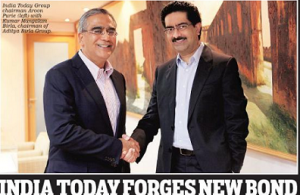
    A Mail Today news article with Aroon Purie with Kumar Mangalam Birla in the photograph

    By A Correspondent

    The Aditya Birla group has announced a financial investment of 27.5% in Living Media India (better known as the India Today group).

    The move has been confirmed by a way of a communique to the stock exchanges. Says Kumar Managalam Birla, chairman, Aditya Birla group, “The media sector is a sunrise sector from an investment point of view. I believe that Living Media India offers one of the best opportunities for growth and value creation.”

    Comments Mr Aroon Purie, chairman of the India Today group, “I am delighted to partner with the Aditya Birla group to aggressively address the current and futre potential of the Indian media business which is at a tipping point. The Aditya Birla group with its strong leadership global footprint, diversified business interests and its shared values of integrity, commitment and social responsibility make it a perfect fit with the India Today group.”

    The transaction is of course subject to the statutory approvals.

  • DNA drives 10,000 visitors to Wheelocity Auto Expo 2012

    By A Correspondent


    Over 10,000 visitors visited DNA Wheelocity Auto Expo on May 12 and 13 at theBombayExhibitionCenterto enquire about sedans, hatchbacks, SUVs and bikes, which were being exhibited. From Maruti to the brands like Toyota, Mahindra, Honda, Renault, Hyundai, Ford, Nissan, GM, BMW, Land Rover, Volkswagen were amongst others on display. The expo also saw some vintages on display – a Ford Mustang 1969 model, a Dodge 1954 and Avon SS 1933.


    This edition of DNA Wheelocity Auto Expo which showcased cars from the every price level turned out to be a winner as there were interested buyers gathering information on their choice. Gautam Dalal, Vice President Marketing, DNA said: “The ability of a newspaper to deliver over 10,000 footfalls is an absolute testament to the response generating power of DNA. The clients present have ensured that working with DNA was indeed a fruitful relationship. They now want us to commission the next one at the earliest.”


    DNA had begun their campaign just 15 days prior grabbing the attention of their 6 lakh readers.


    In 6 years, DNA has become India’s 6th largest and the fastest growing English daily. Targeted at a young readership, DNA is the voice and soul of its readers intertwined with honesty. Through news, views, analyses and interactivity, DNA provides readers with a composite unbiased picture of their city and the world. Its interactive platforms seek to bring the reader and surfer at the centre of its news activity.


  • Nothing can kill brand IPL: Experts

    Indian Premiere League (IPL) was the most-talked about sporting tournament inIndiawhen it started in 2008. From players’ auctions to cheerleaders, the Twenty20 championship caught everyone’s fantasy.


    From its inaugural year till today, the tournament has been more than just cricket. It seems that IPL and controversies go hand-in-hand. Slapgate, cheerleaders’ uniforms and Lalit Modi’s case made us wonder if one had seen it all. However, the hand-in-glove relationship the cricket tournament has had with controversies has never stopped. The latest ones – match fixing, SRK-MCA brawl and molestation case – have started everyone talking again, not all of it good. Some even want the IPL to shut down as well.


    MxMIndia’s Meghna Sharma spoke to a few media professionals to know if they think brand IPL is losing its value.


    Dilip Cherian
    Vikram Sakhuja
    Josy Paul

    Dilip Cherian, image consultant and co-founder Perfect Relations

    It’s true that brand IPL has taken a knocking due to current controversies. However, I don’t think it will harm the brand. The recent events just show that the various rules and regulations need to be stricter and implemented well.


    As long as crowds go to the stadiums and viewers switch on their television sets to watch the matches, the show will go on. It also brings other brands into people’s mind. Hence, marketers will continue to invest in the tournament.  So, why will the brand die?


    Vikram Sakhuja, CEO – South Asia, GroupM

    With so many channels and shows, the eye-ball distribution is obvious. But the tournament, so far, has got more TRPs than last four years. This only proves that the tournament is doing well. IPL is alive and kicking and will continue to do so.


    Josy Paul, Chief Creative Officer and Chairman BBDO India

    IPL is a bhelpuri of entertainment, and not cricket. The more controversies, the merrier it will be for the tournament. Nothing can shake it; controversies and achievements will only increase its sheen. The brand IPL is about entertainment and it is providing the same to its fans.


    Kushal Sanghvi, MD, Spiider Digital Hub

    The TRPs of this season is around 3, so it is not doing as well. However, the show is big and helps any brand to position itself well across sections. The marketers get visibility so will continue to get associated with it. No controversy can shake it; it will continue to remain huge.


    Kamal Nandi, vice-president (sales and marketing), Godrej & Boyce

    The stats have gone down, so it is becoming less lucrative to invest in the IPL. There is no doubt that it is a strong brand and will be so – controversies or no controversies. However, marketers will be a little cautious in investing in the tournament is the returns are lower than the investment.


  • Apalya TV crosses 11 million viewers on IPL 2012

    By A Correspondent


    The IPL’s fifth season is proving to be good news for mobile TV operators. Apalya Technologies, leader in mobile video, has registered 11 million viewers till now for the IPL 2012. This rise in mobile viewership is close to the numbers garnered by YouTube, which is also registering the same number of viewers on its website.


    Speaking on the increasing viewers for mobile TV, Vamshi Krishna Reddy, Co-founder & CEO, Apalya Technologies said: “We started the tournament with an aim to catch at least 10 million subscribers before IPL 2012 ended and today after 65 matches, we are proud that Apalya Technologies has already crossed its target and registered 11 million viewers who are watching the matches Live on their mobiles. With another 10 odd matches to go, we are sure that we will be able to write many success stories this IPL.”


    He added: “Apalya Technologies is exceeding not only TV, but also online viewership numbers, as compared to mobile viewership with the average minutes of usage per customer being between 17 to 20 minutes per day. Out of these viewers that we have registered till now, at least 70 per cent is coming from the Nokia users. The fact that mobile TV viewership is increasing is a proof in itself that the trends are changing and we are adapting to newer ways of watching TV.”


    With emerging technologies and growing mobile video viewing habits, India records over 200 million video views a month on mobile devices and Apalya is all set to capitalize the opportunity to tap the interest of the youth, allowing them mobile video viewing for various popular events. During the World Cup season in April 2011, Apalya generated 17 TB of streaming and with close to 50 minutes of usage per user for the 6 matches India played. Currently, Apalya powers mobile TV for all the major telecom service providers in India and has also launched its services with leading operators in Sri Lanka & Indonesia.


  • Congress-led UPA loses sheen as BJP inches ahead: ABP News-Nielsen Survey

    By A Correspondent


    The ABP News-Nielsen survey conducted on the eve of the UPA-II third anniversary has revealed that after eight years in power, the Congress-led coalition’s pull seems to be diminishing.


    The survey, conducted across 28 cities across the country in April-May 2012, revealed that the BJP would garner 28 per cent of the votes if Lok Sabha elections are held now, while the Congress would manage only 20 per cent.


    In fact, the BJP has turned out to be the most favoured party. In an interesting revelation, only 69 per cent of those who voted for Congress during 2009 Lok Sabha elections are still intending to vote for it, if Lok Sabha elections are held now. 31 per cent are moving away from it and 12 per cent now intend to vote for the BJP. Whereas for BJP, 84 per cent will stick with the party and only 2 per cent are switching away from it to Congress.


    In 2009 elections, 28 per cent of these respondents voted for Congress, while 27 per cent voted for the BJP. But for the BJP, the dip of 8 per cent in the Congress vote share is not a complete gain. The BJP is gaining only a marginal 1 per cent. The remaining 7 per cent dip in Congress vote share among these respondents is gain for regional parties.


    In the 2009 Lok Sabha elections, Congress had won 207 seats while BJP had got 116 seats.


    While 32 per cent believed the government’s performance was good or very good, a sizable 35 per cent rated the performance as average.


    Significant 21 per cent respondents said it was poor while 11 per cent rated the performance as very poor. The performance of UPA government has been rated slightly below average with a mean score 2.95, which is lower than the mean score of 3.22 last year.


    However, Manmohan Singh’s ratings are good with 37 per cent respondents saying his performance was good or very good. Another 33 per cent ranked him average, while 28 per cent believed his performance was poor or very poor.


    Around 32 per cent of the respondents felt that performance of UPA government is better or much better than its last term. A dip of 8 per cent is observed in the perception of people from last year survey, where 40 per cent of the respondents felt that the performance of UPA government is better than previous term. 39 per cent rated UPA performance as “about the same” this year, similar score in comparison to last year.


    Only 36 per cent of the respondents felt that performance of the PM is better than its last term. A dip of 8 per cent is noted in the perception of people from the last year survey, where 44 per cent of respondents said that the PM performed better than his previous term.


    When it comes to best leader in the country, Narendra Modi 17 per cent said he is the best leader over Manmohan Singh at 16 per cent. Modi was preferred at number four during last year’s survey (12 per cent).Manmohan was ranked at number 1 last year (21 per cent).  Rahul Gandhi’s scores have dipped from 19 per cent to 13 per cent this year.  Sonia Gandhi’s scores are down from 14 per cent to 9 per cent.


  • Birla may use personal money for buy, Mail Today may now launch editions in Mumbai, other metros

    The Aditya Birla group investments may help India Today invest in launching editions of its newspaper Mail Today in Mumbai and other metros.


    By A Corresdpondent


    Kumar Mangalam Birla, chairman of Aditya Birla Group, has bought a 27.5% stake in Aroon Purie-controlled Living Media India, the publisher and owner of India Today magazine and Aaj Tak television channel. Mr Birla will use his personal money to invest in the New Delhi-based group, which straddles the entire media chain, from television to magazines to tabloids.


    A statement from the metals-to-retail group said Birla has agreed to join the Living Media group as a financial investor. It did not specify the price for the deal or the valuation.


    However, investment bankers close to the transaction said the deal has been finalised for Rs 600-700 crore, valuing the media group at Rs 2,400-2,800 crore. Mumbai-based investment bank Ambit Corp was the advisor to the deal.


    This is the second big investment by an industrialist in the media space. In January, affiliates of Reliance Industries agreed to buy a large stake in the companies of Raghav Bahl, the promoter of Network18 and owner of channels such as CNBC-TV18 and CNN-IBN. The investment was worth over Rs 1,500 crore.


    TV Today is listed on the stock exchanges, but it is not clear whether Birla’s personal investment companies will now have to make an open offer to buy 26% from public shareholders.


    The financial investment also marks the realisation of Kumar Mangalam Birla’s cherished dream of owning a media company. “The media sector is a sunrise sector from an investment point of view. I believe that Living Media India offers one of the best opportunities for growth and value creation,” Birla said in a release.


    Birla made an unsuccessful entry into the entertainment space by launching a movie and TV production company, Applause Entertainment, in 2003. The company, which produced the acclaimed movie Black , was closed down in 2009 after the downturn in the entertainment industry sparked off by the global recession.


    Living Media will use the cash from the deal to expand its presence in media. It may now look at launching its New Delhi-based tabloid, Mail Today, in other metros, including Mumbai, according to persons close to the company.


    Source:The Economic Times

    Copyright © 2012, Bennett, Coleman & Co. Ltd. All Rights Reserved

  • Why media purists needn’t worry about Kumar Mangalam Birla’s 27.5 % in Living Media

    By Pradyuman Maheshwari


    On April 10, the TV Today network clarified to the Bombay Stock Exchange on rumours that the Aditya Birla group was acquiring a stake in the India Today group. The clarification said the Company (TV Today) was not aware of any such transaction and was not in a position to confirm the contents of the media reports.


    A little over a month later, the same organization sent the BSE a copy of the press release stating that 27.5 per cent of Living Media India, better known as the India Today group, was sold to the Aditya Birla group.


    A senior member of the AV Birla group told this correspondent that the investment was made by chairman Kumar Mangalam Birla on a personal level and not by any of the group companies.  After the customary approvals in a few months, we would get to know the real numbers. Late on Friday, Ashish Bagga, recently appointed CEO of the entire group (including TV Today), informed staff of the development by way of an email.


    The question which everyone wants to know is the price that Mr Birla paid for the 27.5%. There have been various figures floating around… that the money paid is in the region of Rs 350-500 crore. In the communique issued, Mr Birla is quoted saying: “The media sector is a sunrise sector from an investment point of view. I believe that Living Media India offers one of the best opportunities for growth and value creation.”


    Also read:

    AV Birla group buys 27.5% in India Today group


    Birla may use personal money for buy, Mail Today may now launch editions in Mumbai, other metros


    Loss of plurality is worrying: Paranjoy Guha Thakurta

    And here’s what Aroon Purie, chairman of the India Today group said: “I am delighted to partner with the Aditya Birla group to aggressively address the current and future potential of the Indian media business which is at a tipping point. The Aditya Birla group with its strong leadership global footprint, diversified business interests and its shared values of integrity, commitment and social responsibility make it a perfect fit with the India Today group.”


    So where’s the money going to be used? For one, it would mean expanding its current businesses. Specifically, Mail Today to move to markets like Mumbai and other cities and for TV Today to get into the regional space, and possibly a business channel. With a question mark on overall growth of newsmagazines, Living Media needs to invest its resources on segments with a growth potential.


    It has already done so by investing in smaller, niche magazines which have a smaller print run and attract fair amount of advertising as also bringing in international content.


    The TV Today network has also been in pressure in recent months with competition gaining ground. The radio station -Oye 104.8 – also needs to grow on the ratings roster.


    And what does it mean for the industry? Although a 27.5% equity will give Mr Kumar Mangalam Birla a toehold in media, it’s not significant enough for him to wrest editorial control. However, while there is fear of how big business money may impact the media, the fact is that it is already doing so. Even today, there exist managements and editors which buckle under pressure from large advertisers and influential individuals. There are enough stories of vested interests at play in Indian journalism, and for the media as a whole, the infusion of money from big business houses and foreign players could possibly ensure better salaries and hence lesser corruption. Standards of journalism are bound to improve.


    Also, it’s not that business empires haven’t been in the media already. The KK Birla group runs Hindustan Times, the Tatas would own the Indian title of Reader’s Digest until it sold to Living Media and there are other smaller players too who are known to back media players. Zee TV’s Subhash Chandra has a successful enterprise running under the Essel brand and even The Times of India group’s Jains have had long-standing interests in other fields.


    Since the media needs to increase scale, it needs the money for expansion. A route followed by some groups like Dainik Jagran, Dainik Bhaskar and Deccan Chronicle has been to go public. Still others – like Network 18 and Television 18 – have been public and also secured investment. Last year, the Abhey Oswal group bought 14.17% in NDTV.


    The Reliance Anil Ambani group has significant presence in the media with radio and television. It has also acquired a majority stake in business channel Bloomberg UTV. Just yesterday (Sunday, May 22), one saw a programme airing consumer complaints with a subscribers’s peeve against Reliance Communications. So it’s not that Bloomberg UTV blanks out all criticism of Reliance ADAG activities.


    According to me, more than the possibility of business empires exerting pressure after investing in the media, the worry is when the situation reaches oligopolistic proportions. This has in fact been seen with media groups having a stake in allied business like radio, television and events.


    Buzz me if you have a story to tell. Confidentiality assured. There are various ways you can reach me:

    pradyumanm[at]mxmindia.com, BBM 23050B5D, Gtalk pradyumanm@gmail.com, Twitter @pmahesh and of course the mobile: 98338 76278.


    Disclaimer: Although he is CEO and Editor-in-Chief of this site, Pradyuman Maheshwari’s views in Mediaah! are not necessarily those of the rest of the team and MxMIndia.com.


  • Loss of plurality is worrying: Paranjoy Guha Thakurta

    Paranjoy Guha Thakurta

    By Paranjoy Guha Thakurta


    This sort of an acquisition is part of a growing trend of ‘corporatization’ of the media where big business houses such as the Aditya Birla Group and the Reliance Industries group are investing into existing media groups. Through this process of consolidation, they are also bailing out these groups.


    The Raghav Behl-led Network 18 and Ramoji Rao-led Eenadu are now part of one big conglomerate because Reliance Industries Ltd (RIL) has bailed out both by pumping in a huge amount of money. On paper, it appears as if they are still separate corporate entities, which they are, as per the laws of the land. But the kind of associations they have struck gives an impression that they are now going to work like a conglomerate. Now this is exactly what has happened in the case of Mr Aroon Pourie who heads the India Today group which is also going to be one major conglomerate. So what we are seeing, in that sense, is the ‘cartelization’ of the media. There are cartels being formed, there are oligopolies being formed.


    The recession in the west has led to shrinking of advertising expenditures for the media in India and across the world especially after 2008, and this has had a direct impact on the fortunes of media organizations. So this process of consolidation has got expedited. What this means is that the media in India is going to become less plural, it’s going to be dominated by relatively fewer groups. What you are really seeing is, large corporate groups exercising greater dominance on the media. Now there are two implications.


    Also read:

    AV Birla group buys 27.5% in India Today group


    Birla may use personal money for buy, Mail Today may now launch editions in Mumbai, other metros


    Why media purists needn’t worry about Kumar Mangalam Birla’s 27.5 % in Living Media

    One is, of course, you are finding telecom companies (Mr Aditya Birla also happens to be the head of Idea and Mr Mukesh Ambani’s RIL is a major player in the broadband wireless access space), which are providing you communications, are also now playing an important role in companies that produce content. So the content providers and content distributors are coming together. This, in my opinion, is going to result in a loss of heterogeneity, resulting in a loss of plurality. In a sense, the oligopolies that are going to be formed will also impact the listeners of content, the viewers of content, or the readers of content. The content they get will be less heterogeneous.


    The other part of the story is that these companies are also big advertisers. Therefore, the clout of the advertiser will go up. As I said, the telecom service providers are now becoming important stakeholders in companies that are producing content. So the distributors of content are becoming stakeholders in the producers of content. Similarly what you also see at another level, the companies which are big advertisers are also now becoming the owners of the media. So in my opinion, these trends towards ‘cartelization’, or the formation of these giant corporate conglomerates is not going to lead to greater plurality as far as the consumers of content are concerned.


    The numbers of TV channels and newspapers and websites often give you a very deceptive kind of a picture and the capital is a classic example of that.Delhiis the only city in the world with 16 English language daily newspapers. This gives you a misleading picture, that readers of English dailies inDelhihave a huge choice. But the fact of the matter is that two newspapers, The Times of India and Hindustan Times would account for well over three-fourths of the total market of all English daily newspapers. And if you add to that Economic Times, then these three publications put together would account for more than 80 per cent of the total circulation of all English newspapers in India. So, in terms of numbers it looks good, but if you look at the structure of the market, you see few dominant players.


    In India, unlike in other countries of the world, like US, UK or Australia, there are no cross-media restrictions. In other countries, there are both vertical as well as horizontal restrictions. Vertical restrictions mean that the content producer and the content distributor are different companies/groups. In India, the same guys who are producing content are also distributing the content. You have the DMK controlling the distribution channel and also producing the television channel; you have Zee News producing news and also controlling Dish TV. There are clear conflicts of interest that arise if your distributor and the provider are the same. That’s only one part of the story.


    The other is what is called horizontal cross media restrictions. That means, the same company dominates all forms of the media, like print, radio, TV, in the same geographical area. In our country we don’t have any legal restrictions on cross media holdings. As far as the media is concerned, the group concept or the conglomerate concept does not operate in our country. So you have Bennett Coleman Ltd which brings out various print publications, and then you have Times Global Broadcasting which brings out the television content. These two companies happen to be controlled by the same set of people. But because the legal restrictions that exist in India apply to individual entities and not to conglomerates, effectively you have no cross-media restriction.


    Speaking of editorial content, editors will not publish or broadcast anything that would go against the interest of the corporate that controls; these would become subtle forms of censorship and control. For instance, Living Media which includes, Aaj Tak, India Today, Headlines Today and Mail Today, these publications or these broadcasters are unlikely to publish anything negative that could affect the business interests of the Aditya Birla Group. So that could be an eminent danger, that degrees of freedom that editors and content providers would enjoy, would get curtailed not just because of the pattern of ownership but also because the owners of major conglomerates are also major advertisers.


    Even if on paper, the editors have the autonomy and independence to publish what they like, there could be subtle forms of censorship wherein editors would feel constrained or would think twice before publishing any story that could in any way go against the interest of the promoters of the company that control these media conglomerates.


    I am optimistic about the future of media in India but I am also concerned about the fact there is loss of heterogeneity, loss of choices to the consumer.


    (As told to Shruti Pushkarna)


    Paranjoy Guha Thakurta is a senior journalist, editor and broadcaster based in New Delhi.


  • NDTV celebrated May 20 as ‘India’s Recycling Day’

    By A Correspondent


    NDTV, the country’s most reputed news network, brought together concerned citizens for the fourth edition of the NDTV-Toyota Greenathon on May 20, in a 12 hour long gala finale at the Yash Raj Studio in Mumbai.  This year, the focus has been recycling waste, especially plastic, along with encouraging everyone to keep their immediate environment clean. Joining the grand celebrations of Greenathon 4 were a galaxy of film personalities, celebrity chefs, composers and singers, chief ministers, Members of Parliament, school children and citizens from around the country.


    In keeping with the green theme, the NDTV-Toyota Greenathon 4 set was made of recyclable products. The unique Green Set, created by well known designer Omang Kumar, also had a Green Kitchen area where celebrity chefs including Aditya Bal, Ritu Dalmia, Bikramjit Singh and Vicky Ratnani cooked some eco-friendly, delicious recipes for guests and hosts.


    Supporting this Green Initiative and raising awareness about the environment, actor Milind Soman started his 1,500 km Green Run on April 20, running from the Qutub Minar in New Delhi, across 5 states and ending his Green Run at Yash Raj Studios in Mumbai. His 1,500km run in 30 days had been recognised as a World Record by the Limca Book of Records.


    In an attempt to mobilise a mass movement, plastic/recyclable waste collection centres were set up across New Delhi, Mumbai, Kolkata, Chennai, Bangalore, Phagwara (Punjab), Dharamshala and Nainital. People were invited to come out and participate in the recycling drive by depositing their recyclable waste, from plastic (bags and bottles), metal, paper, Tetrapak cartons and e-waste.


    Some of the generous supporters of the campaign were brand ambassador Priyanka Chopra, Cyrus Broacha, Shah Rukh Khan, Aamir Khan, Shahid Kapoor, Sridevi, Farhan Akhtar, Imran Khan, Deepika Padukone, Rahul Bose, Kunal Kohli, Parineeti Chopra, Arjun Kapoor, Bappi Lahiri and Vasundhara Das.


    Speaking on the occasion, Dr Prannoy Roy, Chairman NDTV Group, said: “NDTV-Toyota Greenathon 4 has been the best we have seen so far. I would like to thank TERI for being there and making this whole experience a success. Not having light is like losing your eyesight.”


    NDTV-Toyota Greenathon 4 saw Rs8.89 crore being raised to benefit 508 villages. IndusTower came forward to donate Rs5 crore and the Power Finance Corporation donated Rs3 crore. Other key donors included Shah Rukh Khan who adopted 12 villages and Aamir Khan who adopted 5 villages. Shahid Kapoor adopted 3 villages, Priyanka Chopra adopted 2 villages.


    Since its launch in 2008 The Greenathon Campaign has already funded solar lanterns for over 600 villages benefitting thousands of households. The NDTV-Toyota Green Campaign was the first ever-nationwide campaign to save the environment. The Campaign is aimed at creating awareness about the environment, by involving the people of our country to make a difference, and is supported by Dr RK Pachauri and TERI.


  • Disney wows kids with contest, launches new shows for summer

    By Meghna Sharma


    This is the time when it’s not just the weather, but even the competition between various channels targeting children that hots up. This year, Disney Channel has raised the bar with a unique offer in association with Jet Airways: 30 kids and their families fly to the Hong Kong Disneyland.


    Talking about the campaign called ‘Jet Set Go’, Vijay Subramaniam, Business Head, Walt Disney Television International India said: “This is the first time ever that a plane full of families is flying to Disneyland! And to add to the unique experience, we are also wrapping an entire Jet Airways aircraft with Disney favourite characters Mickey Mouse, Donald Duck, Pluto and Goofy, a one-of-a-kind virtual ‘billboard in the sky’.”


    Families will fly to Hong Kong on July 9 for two days where they will stay at the Disney’s Hollywood Hotel. The contest, wherein the kids have to watch Disney Channel closely from April 29 until May 28 and spot a magical plane with their favourite characters- Mickey & Friends on their television screen to win, saw an overwhelming response.


    “The campaign stands out because of the record-breaking response that we have seen in just three weeks! We had three lakhs calls on day one, crossed the two million mark in a week and now, we have registered 3.5 million calls from across the country with another 14 days to go. These are at least 50 times the responses the genre has been receiving through other campaigns, so this is clearly unprecedented levels of participation and excitement,” added Mr Subramaniam.


    The channel feels the response is the testimony of the strength of the channel’s reach. Almost 50 per cent of the entries came from 5 key circles – Andhra Pradesh, Delhi, Maharashtra, Mumbai & MP + Chhattisgarh. And the entries coming from across the country and the winners selected till date come from  both metros and Tier 2 cities – Dehradun, Chandrapur, Kolkata, Vishakapatnam, Pune, Baerelli to name a few.


    The channel has been working on various campaigns in its objective of reaching out to its TG. Last year, it had ‘Disney Channel Shooting Stars’, billed as one of the biggest talent hunt platform by a kid’s channel. “Disney Channel is the only kids channel to cross the 200 GRP mark this summer as well as the last and such megashowcases reinforce our position as the leading entertainment brand for kids and families with viewers and advertisers alike,” said Mr Subramaniam.


    He added about how and why a kids’ channel should take advantage of summer vacations. “Summer is a time when kids have greater control over the remote and kid’s channels see a 25 per cent increase in viewership. Last year, Disney which houses Disney Channel, Disney XD and Hungama TV, saw an increase of over 30 per cent in viewership.”


    This year, along with the ‘Jet Set Go’ initiative, the  channel has also planned a strong content push with over 500 hours of fresh programming across the three channels, which will see premieres of 24 series across genres. “Through tent-pole programming and campaigns such as Jet Set Go, our idea is to use summer as a springboard to engage more kids and families throughout the year,” said Mr Subramaniam.