Category: MEDIA

  • What politicians think of big biz in news media


    By Karuna Madan


    Even as Information and Broadcasting Minister Ambika Soni recently said that the Reliance Industries Limited (RIL) did not hold any direct stake in any news media company in the country, politicians across the party lines feel that the statement does not hold water. Rather, they lament the sorry state of affairs caused due to the unholy and unnatural nexus of business and news in India .


    Vice president of the main opposition, Bharatiya Janata Party (BJP), Karuna Shukla regrets the fact that the mighty corporate and business houses are investing in news media only for the purpose of “twisting” public opinion or government policies in their favour.


    She feels that the news media must, essentially, be free and neutral at all times and circumstances: “You see, the news media is supposed to be free, neutral and free from biases. So much so that even the advertisements shown or published by the media groups defeat the very concept of neutrality. The case of 2G spectrum can be taken as a valid example. These business groups are now moving to all possible avenues of money-making. But news is sacred, it should not be touched. It cannot be sacrificed at the altar of big bucks.”


    “The people we are talking about are smart. They are not only buying stakes in media but have now started their own newspapers. Today it is ‘their money’ which is controlling news media in India . Their money decides how much truth must be revealed and how much be kept hidden. What are they trying to prove by buying stakes in existing media houses or starting their own news businesses? Investment by industrialists in media is no social service. They have no social responsibility. They invest only with the intention to influence public opinion; creating favorable opinion for them and disapproving opinion for their competitors,” Ms Shukla emphasised.


    Ambeth Rajan, Member of Parliament (Rajya Sabha), from Bahujan Samaj Party (BSP) said that the news organisations these days are not only taking money from big business houses of the country, they are also shamelessly taking directions from them and blindly following the diktats.


    “These corporates decide what news must be flashed and what not, and which news item can be used for blackmailing a certain politician or a rival business group. You see a certain kind of news flashing on a particular channel only because it has the potential to harm the interests of the rivals or support the interests of a particular segment of society or a particular political party. All this is orchestrated and staged. Is this what we know and understand as ‘sacred business of news’,” Mr Rajan averred.


    A powerful Congress leader at the Centre, who does not want to be named, told MxM India that “nobody is a saint here. Yahan doodh ka dhula koi nahin hai.”


    Meanwhile, Nilotpal Basu, Member of the Central Secretariat of the Communist Party of India (Marxist), describes it as “very disturbing trend.” “Corporate investment in news media is nothing but marketing, rather aggressive, shameless marketing. The big business houses do not really bother about what repercussions it will have on the state of affairs in the next ten years or so. These big business houses are aware of the power of media and are abusing that. The industrialists in the country exploit the news business, particularly during elections at the state and national level,” said Mr Basu.


    “The corporates are investing and owning media to influence media space and policy directions. We are opposed to unregulated investment of corporate in media. These investments undermine the concept of free media, and media as an avenue for information. This is extremely sad that this trend is going completely unchecked and the government seems just not bothered to rectify the malady,” he added.


    Likewise, Prabhodh Panda, Member of Parliament (Lok Sabha), Communist Party of India (Marxist), feels that the news media was controlled by the corporate sector even earlier by way of paid news, which came to be openly discussed only recently: “We know that the corporate sector is trying to influence public opinion by investing in news media. Even otherwise, the media is mostly publishing or telecasting paid news. It is an unethical practice by media groups, which must be curbed. It can be curbed only if the governments at the state and national level display the political will to do so. Media must maintain high stands of morality and ethics. The government, particularly at the Centre, must initiate steps to ensure that the media is not abused by the industrialists for their petty benefits, sometimes even at the cost of national security. Also the Press Council of India should come out with guidelines on the entry of corporates in the news media business and adopt a firm stand in this regard. What else the Press Council of India , or for that matter Prasar Bharti, are for,” said Mr Panda.


    Interestingly, Debabrata Biswas, General Secretary, All India Forward Bloc, stated that the motive behind corporate investments in news media is an open secret: “It is a well known fact that the multinational companies are completely controlling print and electronic media in India and even outside the country, thus trying to influence international government policies and the state of world economy. Earlier, the character of news media was altogether different. It was more of a catalyst to bring about positive change in the society. It played a major part during the freedom struggle of the country. News essentially meant positive and developmental reportage, free of all kinds of biases and prejudices. It was aptly described as the powerful fourth pillar of democracy. When one talked of media, one talked of an independent and neutral news providing machinery, not of the handmaid of industrialists. These industrialists have now completely taken over the business of news, directly and indirectly. Everyone knows that Birlas, Tatas and Ambanis are now controlling the newspapers and news channels in the country,” said Mr Biswas.


    Amarjit Kaur, National Secretary, Communist Party of India (CPI), feels that the investments by big business houses into the news media is most certainly “not innocent investment.” “The purpose of investments made by the big business barons of India into our news media is only profit, profit and more profit. Industrialists know that they can get their projects cleared within no time if they have a direct or indirect influence or say in any popular newspaper or new channel having a good subscriber base. These news outfits then act as agents of the corporates. But unfortunately, nothing much can be done about this new trend of corporate interest in media, the reason being that the government is pro-corporates and it shows. If the Information and Broadcasting Ministry is turning a blind eye to this malaise, do you think, the common man has any choice. We can only lament the situation which is turning worse by the day due to utter failure and inaction on the part of the government in this regard,” said Ms Kaur.

     

  • Prateek Chandra appointed CFO @ Fever FM

    By A Correspondent


    Prateek Chandra has been appointed as CFO, Fever 104 FM. Mr Chandra has spent more than 4 years with HT Media and in his last role as Senior Financial Strategist, he has been instrumental in adding value on various strategic initiatives and successfully driving several projects including IPO of HMVL. Mr Chandra will be replacing Ritesh Handa who, after 18 months of tenure as CFO, Fever, has decided to move on to pursue other opportunities.


    Prior to joining HT, Mr Chandra had spent almost 6 years with KPMG and EXL handling different aspects of Finance function. In his new role, Mr Chandra will report to Harshad Jain, Business Head, Radio with a functional reporting to Piyush Gupta, Group CFO. He will be a part of the Leadership Team of Radio Business, and have end-to-end responsibility of finance and related operational aspects of Radio business.


  • BIG Bangla Music Awards 2012 unveils jury and awards list

    From the MxMInfodesk


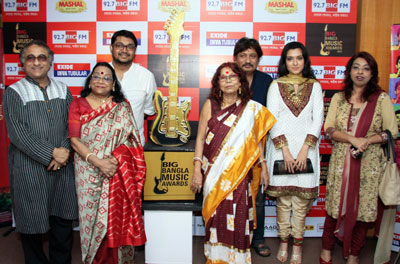
    Reliance Broadcast Network Limited’s BIG Live and its radio arm 92.7 BIG FM announced the jury for the BIG Bangla Music Awards 2012 which include veteran singers Nirmala Misra and Banasree Sengupta, music director Kalyan Sen Barat, music arranger Rocket Mondol, Programming Head of Dhoom Music Channel, Srijit Halder and acclaimed Actor Arpita Chatterjee.


    The lineup this year will have 16 Trophies and a Lifetime Achievement Award. 14 popular categories will be nominated by the jury and decided by listeners through a multi media voting campaign. The balance awards will be conferred by the jury directly.


    Apart from celebrating the resurgence of Bangla music and recognizing the best work of 2011, a key initiative will be to highlight the message of anti-piracy to music lovers and build awareness to stop the menace. This effort is being supported by the government of India recognized- Indian Performing Rights Society (IPRS) as well as leading production houses.


    A special anti piracy theme song is being composed by leading rocker and Cactus frontman Siddhartha Shankar Ray which will be sung for the live on the stage during BIG Bangla Music Awards. The resurgence of popular Bangla music and its huge impact on Tollywood is best exemplified by the works and rise of the phenomena called Jeet Gannguli. It is with this in mind that 92.7 BIG FM has chosen him to be the Face of the Award 2012. The Award is being supported by Exide Invatubular  and Mashal Mustard Oil.


    The news and content published in reports crediting MxMInfodesk are mostly unverified and based on press releases and communiques sent by organizations and/or individuals either directly or through their PR agents.

    However, not all press releases and requests are carried, and we take care to ensure that at least the source of the information recent is authentic.

    Requests for carrying communiques and intimations must be addressed to editor@mxmindia.com.


  • A whole new world to discover: Rahul Johri

    The footprint of his responsibility is huge and very challenging. Mr Rahul Johri, Senior Vice President and General Manager, South Asia at Discovery Networks Asia-Pacific, leads his network’s South Asia operations and is responsible for driving the company’s growth in the region which includes India, Pakistan, Sri Lanka, Bangladesh, Maldives, Bhutan and Nepal.


    He is responsible for revenue generation, portfolio expansion, affiliate partnerships, networks’ viewership, content creation and talent management. In 2010, he led Discovery Channel to become India’s No.1 channel in non-fiction entertainment. He cemented TLC as India’s favourite lifestyle channel and energized Animal Planet within the advertising community.


    Mr Johri has over 18 years of media industry experience across various verticals including news channels, magazines and print dailies. He has been actively involved in the launch of many of India’s leading media brands including Aaj Tak, Outlook and HT City. Prior to joining Discovery, he was the General Manager – Sales of IMG India.


    In this interaction with Tuhina Anand, Mr Johri talks about the channel and its impact and further plans.


    It looks like the way to go ahead is regional; how has Discovery in regional languages and feeds helped in garnering greater viewership share?

    Dubbing in Indian languages has been one of our important growth strategies in India. Dubbed content attracts strong viewership from across age groups, genders and geographies and is accepted very well by the viewers. Thus introduction of regional language feeds is our attempt to localize the content for viewers across India, reaching the specific markets in their own language.


    Discovery Channel which is currently available in four languages – English, Hindi, Telugu and Bangla – has shown upward trend in viewership post introduction of 24-hour parallel language feeds. It has helped the channel grow and connect with a larger audience.


    In 1998, Discovery Channel launched its 24-hour parallel Hindi feed, which boosted the channel’s nationwide viewership. Continuing with its promise to delight its viewers across India, the channel launched the Telugu feed from January 01, 2011 and Bangla from 15th April 2011. Post the Telugu launch, Discovery Channel’s viewership in Andhra Pradesh jumped by 180 percent (source: TAM, Market – Andhra Pradesh, Wk 1-40 2010 vs 1-28 2011, 0700-2359 Hrs, Viewership comparison, TVR000s), and witnessed rise of 20 percent post the launch of the Bangla feed. (Source: TAM, West Bengal, Wk 1-15, 2011 vs Wk16-28 2011, TVR%)


    From August 15, Discovery Networks Asia-Pacific has launched its first regional channel – Discovery Channel Tamil for the viewers of Tamil Nadu. Our constant research and feedback from the viewers encouraged us to launch a dedicated 24-hour channel for Tamil viewers in their native language.


    Our 24-hour wildlife channel Animal Planet which presents engaging stories from the depths of oceans to the interiors of jungles in the comfort of your homes, is also available in English and Hindi.


    What other regional languages do you have on your radar and by when would they fructify?

    We constantly keep evaluating new languages.


    How have the channels such as Discovery Science and Discovery Turbo fared for the network?

    Discovery Science and Discovery Turbo are unique content channels dedicated to science and automobiles respectively. These channels were launched last year to cater to the demands of quality content by the aspirational Indian viewers. The channels are available across analogue and on all leading DTH platforms – Dish TV, Tata Sky, Airtel Digital TV and Videocon D2H, the channels are currently reaching over 17 million subscribers each.


    India is a young country and there is immense curiosity amongst the viewers for information. Knowledge is cool. The viewers want to be informed and entertained about the various advancements and technologies from around the world. As expected both Discovery Science and Discovery Turbo have received encouraging response from the viewers across the country.


    The most visible proof of the growth and success of these unique content channels is the increasing interest and spends by advertisers and affiliates on our networks.


    From your own experience, how much does re-branding help a channel, a case in point being TLC?

    TLC, formerly known as Discovery Travel & Living, has remained India’s leading lifestyle channel. It was the first channel to introduce lifestyle programming on diverse manifestations in travel, food, fashion, music way back in 2004.


    Today’s consumer has evolved. The aspirational, well-travelled and informed Indian viewer demands unique and compelling content. This evolution is accelerated by increasing integration with globalised lifestyle and consumption patterns leading to the overhaul of the Indian consumer.


    Keeping pace with this metamorphosis, television channels have to innovate and remain relevant. Re-branding helps refresh the brand proposition, offering and strengthen consumer connect. TLC was rebranded in 2010 to make it bigger, better and bolder, featuring new faces, new genres and new places.


    Travel as a genre has become a competitive space, with some channels like Fox History & Entertainment re-branding to include the travel genre in their name. Does it impact TLC in anyway?

    TLC offers unmatched brand proposition and remains India’s ultimate lifestyle destination with a distinct identity. The channel offers a unique blend of international lifestyle programmes and India productions which sets it apart from the other channels in Indian television space.


    Having innovation at its core, TLC pioneered in travel programming under a variety of themes such as exotic locales, cultural destinations, luxurious hotels, world’s best beaches, culinary journeys and this year introduced a dedicated time band for travel, at 9pm. Some of the popular travel series on the channel presented by renowned travel experts are  Samantha Brown’s Great Weekends, Beach Watch, Anthony Bourdain: No Reservations, Get Out, Xtreme Tourist, Sea Nation and Fun Asia.


    Redefining the food genre on Indian television, TLC introduced the most sought after chefs and food experts who bring in variety of cuisines from different parts of the world. The channel explores the finer nuances of culinary skills through its enticing food series presented by celebrated chefs like Kylie Kwong, Nigella Lawson, baking expert Rachel Allen and bizarre foods with Andrew Zimmern.


    TLC offers its viewers an experience of the fascinating world – ranging from ice diving in the high Arctic to watching the sun come up over the pyramids, from stripping in Las Vegas to diving with sharks, from driving a Ferrari to swimming the English Channel and from spending a night in a haunted castle to exploring the volcanoes in Indonesia. No experience is left unturned.


    For further growth, you need to go beyond tier 1 cities, do you think in tier 11 and 111 cities are ready to go beyond fiction, news and sports? What does your research say?

    Discovery’s mission is to satisfy the curiosity of millions of Indian viewers through high-quality, entertaining programmes. The power of the Discovery brand stems from our ability to provide unparalleled content and create meaningful connections with audiences. Introduction of local language feeds gives us just the opportunity to reach millions of viewers across India.


    Our flagship channel Discovery Channel last year became India’s 9th largest channel amongst all 600+ channels, in cumulative reach. Discovery Channel is currently amongst the top ten distributed channels, available in over 2 lakh villages and reaching over 160 million subscribers through the country.


    Also, the various programmes on Discovery’s various channels are mostly documentary-dramas, which further makes dubbing more relevant without losing the basic essence of the series.


    Animal Planet is also available in English and Hindi. This year Discovery Networks has launched Discovery Channel Tamil dedicated to the viewers of Tamil Nadu. This dubbed content is much appreciated by the viewers beyond metros.


    In terms of big properties, what should we expect from the channel by the end of this year?

    We continue to refresh our programming on a quarterly basis across our seven networks, bringing new programmes, refreshing formats, enthralling hosts and newer seasons of the existing series.


    Some of the new programmes across our channels are:

    Rising: Rebuilding Ground Zero (to air from September12-17, 9 pm) which is nearly a decade after the September 11th World Trade Center attacks, Discovery Channel and acclaimed producer Steven Spielberg bring special series chronicling the historic reconstruction of Ground Zero. Documenting this gigantic project in a six-part series, Rising: Rebuilding Ground Zero, Discovery Channel takes a comprehensive look at Ground Zero’s rise from the ashes, as seen through the eyes of those who are making it happen.


    Discovery Channel – Norway Massacre (to air on September 21, 9 pm): July 2, 2011, a day now indelibly ingrained in Norway’s history, is the date Anders Behring Breivik killed eight people in a bomb set off outside government headquarters in Oslo and embarked on a 90-minute shooting spree, resulting in the death of 69 young people on Utoya Island. Discovery Channel chronicles the events of that horrid day – and the impact it has on this nation and its people – in Norway Massacre.


    On TLC we will have Chuck’s Day Off, where the owner and head chef of one of Canada’s hottest restaurants spends his only day off by… cooking!


    Discovery Science- Innovation Nation: What will the future look like? Will people fly to work? Will one live a disease-free life? Will one never age? Brilliant thinkers, cutting edge research, backyard inventors are on the way to breakthrough science that will change lives forever. Innovation Nation features budding inventors, innovators and designers who have been laboring away in sheds to dig out things that we would have only thought of. Travelling across the globe from cutting-edge research to ingenious inventors, it offers intimate access to the people who make high science a reality. Real world demonstrations, lab experiments, and in-depth interviews are complemented by stunning visuals, all of which bring the planet’s bravest new ideas to life.


    One last question: it’s been 15 years since Discovery’s debut in India; in these years what has been your biggest challenge?

    Discovery refreshes the content of all its seven channels in India every three months. This decision to offer new content every three months is a big challenge but we have been successful in converting into an opportunity. Variety is our unique strength. No one can replicate it.


  • Inext seals the big show at WAN-IFRA awards

    By A Correspondent


    Taking yet another big leap, Inext has bagged the top honours in WAN-IFRA (World Association of Newspapers and News Publishers) awards for 2012.  With an unrelenting focus on espousing youth’s philosophy, Inext, won both the top award in the Public Service category for this year’s World Young Reader Prize and has also been named World Young Reader Newspaper of the Year for 2012. The prizes will be awarded on July 10 inBangkokat the 1st Asia-Pacific Young Reader Summit.


    WAN-IFRA, a global organisation of the world’s press, representing more than 18,000 publications, 15,000 online sites and over 3,000 companies in more than 120 countries, gives away awards for excellence in the defence and promotion of press freedom, quality journalism, editorial integrity and the development of prosperous businesses and technology.


    Welcoming the announcement, Shailesh Gupta, Director, Jagran Prakashan Limited, congratulated the team and lauded the efforts that went into the winning campaigns and the stories. “It is due to the substantial focus and tangential wisdom of the team Inext that such smart campaigns which incorporated both the news value and more importantly, the societal concerns, were run. It has been yet another token of excellence for the Jagran group and I believe the good work would be kept up with in the future too.”


    This year, Inext’s success at WAN-IFRA hinged on three major stories: The Power of youth; wherein survey was done to tap the thinking and preferences of youth in run-up to the assembly elections in UP and Uttarakhand. Tol Mol Ke Poll was an election page carried daily till elections which focused on an issue related to elections almost daily and succeeded in connecting with youth through a column ‘Sadda Haq’.


    Second campaign was Bhari Basta; an educative and investigative campaign that activated the government machinery – school authorities, parents and teachers – to reduce the weight of schools bags of kids. It was run across 12 cities in 4 states and proved to be a catalyst in children empowerment. The Jury also found Inext’s iktara campaign, a unique folk singing competition, integrated online to bring out the talent in folk singing, a new approach to entertainment. It created a strong buzz across the country in favour of the old, relegated art.


    The jury observed that these campaigns provided a refreshing perspective on the 3Cs-corruption, compassion and creativity. “Inext did an excellent job in galvanizing youth to get out and vote. We found it especially interesting that youth considered corruption the number one topic of concern. The other two projects entered also showed creativity and relevance. The investigative report and campaign about heavy back-packs truly made a difference, and the folk singing contest was a fresh approach to youth entertainment,” mentioned the official communication.


    Last year, the World Young Reader Newspaper of the Year award was won by Indonesian newspaper JAWA POS, while for 2010 the winner was French newspaper Le Monde. This year, Inext has joined the distinguished league of such illustrious antecedents for the top honour.


    Expressing pleasure at the development, Inext’s Project Head and COO, Alok Sanwal revealed that it is Inext’s youthful vision that provided the cutting edge to the tabloid. “We have always tried to capture the social concerns with a young eye. All our major campaigns are directed at influencing young minds and developing in them a taste of societal awareness and understanding. We would continue to undertake such path breaking campaigns that underline our responsibility to change the world around us.”


  • Airtel forays into m-advtg, expects 40% growth

    By A Correspondent


    Bharti Airtel recently announced its strategic foray into the mobile advertising (m-advertising) segment in India. With this, Airtel will equip advertisers to connect with their potential customers in a targeted and personalized fashion via their mobile phones. The platform is designed to meet all the essential demands of advertisers such as inventory management, campaign management, reporting and analytics. As has been reported by MxMIndia in the past, Airtel has mandated Mogae Digital, a company owned co-owned by Sandeep & Tanya Goyal, former JV partners of Dentsu in India & the Middle East, to be its sole and exclusive monetization partner.


    Commenting on the development, K Srinivas, President – Consumer Business, Bharti Airtel, said: “We are excited to launch our mobile advertising platform. Personalization, sharp segmentation and contextualization are increasingly making this platform an exciting proposition for brands. With the mobile advertising market poised to grow by more than 40 per cent over the next few years, Airtel with its technology, scale and customer intelligence is placed uniquely to leverage this growing medium. Airtel’s m-advertising platform will enable advertisers to land their message in a simple, effective manner in an increasingly complex media environment.”


    Through Airtel’s m-Advertising platform, advertisers will be able to leverage multiple communications outlets and tools such as mobile internet (WAP), Messaging services and Airtel digital TV to engage their audiences. With this platform, companies can also extend their access to the rural audience with voice solutions.


  • Tata Sky gears up for digitization with new ads

    By A Correspondent


    “Drop cable, upgrade to Tata Sky,” reads the latest ad of the direct-to-home (DTH) service provider, as the cut-throat rivalry between DTH players and cable operators intensifies in the countdown to the first phase of compulsory digitisation in the top four metros by June 30.


    “Your TV will continue to run on your inverter even during a power cut…isn’t this a reason enough to choose Tata Sky over cable,” said another advertisement, as the DTH major unleashes its third phase of print and out-of-home (OOH) ad blitzkrieg to lure millions of cable users in the top four cities to its services.


    Vikram Mehra, Chief Marketing Officer of Tata Sky, said the campaign is directed at educating consumers so that they can make an informed choice. “Our latest print campaign tells subscribers to do their homework before they buy a set-top box (STB) so that they chose Tata Sky and not just some dabba (box),” said Mehra. It’s not targeting any cable operator, he added.


    With over 9 million subscribers, Tata Sky is the second-largest DTH service provider in the country, after Dish TV.


    Last December, Lok Sabha passed the Cable Television Networks (Regulation)

    Amendment Bill, 2011, which makes it compulsory for cable companies to convert their analogue system to digital in a phased manner from June 2012.


    Consequently, in the first phase of digitisation, India’s top four metros – Delhi, Mumbai, Chennai and Kolkata – will have to replace all analog television networks with digital transmission from July 1, 2012.


    This means that all cable subscribers would need to get digital STBs in order to ensure that their TVs don’t go blank. By March next year, as many as 38 cities across the country would be brought into the digital fold.


    While phase 1 has around 10 million TV homes in the four metros, over 90 million analogue cable TV homes are estimated to convert to digital by the end of fourth phase in December 2014.


    Stakes are indeed high for DTH players who have a ready, captive base of millions of analogue cable TV customers, who just need to install a digital set top box in their homes.


    “DTH is expected to grow at a healthy CAGR of 20 per cent for the next 5-7 years,” said Abhishek Chauhan, Senior Consultant, ICT Practice, Frost & Sullivan, South Asia & Middle East. DTH contribution would increase to more than 30 per cent to overall the pay TV market, reducing the cable providers’ contribution to less than 65 per cent, he says. While the number of DTH households in the country is set to go up from 37 million in 2011 to 86 million by 2016, digital cable would see its subscriber base jump from a mere 6 million to 75 million, according to a recent FICCI-KPMG report.


    The number of cable and satellite (C&S) households is estimated to reach approximately 176 million by 2016, of which paid C&S households is estimated at 168 million, representing 89 per cent of total TV households. In 2011,146 million households in India had television sets; 119 million of which used cable or satellite services, says the report.


    While Tata Sky has been relentless in its campaign against cable, Dish TV has a different strategy. “Direct attack on cable operators is a short-lived approach,” said Salil Kapoor, Chief Operating Officer, Dish TV. Differentiated offerings and emotional connect with users is a sustainable strategy, he added. Dish TV has, in fact, tied up with neighbourhood operators to push its own set-top boxes and install connections.


    Meanwhile, Tata Sky has been running a campaign to shed its premium image and spread awareness about the impending digitisation and the value-added services that it offers.


    Perceptions on pricing in multiple television households, vacation time charges, relocation charges and prices about offerings are some of the issues that ‘Poochne mein kya jaata hain’ campaign started to address since last September. Created by O&M, the commercials urge consumers to ask while underlining the range of offerings.


    “Poochne mein kya jaata hai campaign was our way of telling customers that it’s possible to get a world-class service at an affordable price,” said Mr Mehra of Tata Sky. The latest campaign in this series informs one about the affordability of DTH services.


    Sonu & Cookie (characters from the last campaign), try to find items which are cheaper than Tata Sky. But every time they bring one to the shop, the shopkeeper surprises them by informing them that Tata Sky’s package is even cheaper.


    ‘Get the quality of DTH at the price of cable,’ says a print commercial of Den Networks, one of the largest multi-system operators having presence in a number of states, just a few months back. And a subsequent radio ad raised the pitch by mocking at DTH players – ‘DTH stands for Don’t Try at Home.’


    Tata Sky was quick to come up with a tit-for-tat print advertisement – “World-class digital box or any other dabba. What will you choose?”


    “Den has been the first cable TV MSO in India to launch a nationwide brand campaign, created by Bates,” said a Den Networks spokesperson, adding that different players will experiment with different types of messages and campaigns to attract subscribers.


    Digital cable has some inherent advantages such as weather-proof services that are not interrupted by rain, service through the local cable operator who is known to the household for years and is just a phone call away, to address any technical or service queries, the spokesperson says.


    While such kinds of advertisements may be attention-grabbing tactics, they also help consumers in making a better choice, say advertising and brand experts.


    “These are attention-grabbing tactics as consumers are in the process of making up their minds,” said Jehil Thakkar, Head, Media and Entertainment, KPMG. While now there is an opportunity for DTH players to acquire analogue subscribers from cable, the latter would obviously try its best to keep users under its fold, he added.


    Most advertising that we see around are intra-category fights, driven on the shoulders of brands such as Pepsi vs Coke, Rin vs Surf, Bajaj vs Hero. However, it’s the category versus category fight, for example GSM Vs CDMA, which is the game changer, say brand experts.


    In a fight like this, end consumers stand to gain, said Prathap Suthan, Chief Creative Officer of Bang in the Middle, an independent ad agency. “And this is exactly what is expected when it gets into a category versus category fight.”


    Tata Sky is clearly and visibly a better constructed and sustained brand among DTH players, feels Suthan. “When you stand for a category, and you represent a category (just as Tata Sky has done), other brands will look small or will be made to look small.”


    The other DTH brands, it seems, have sort of abdicated the position of category leadership to Tata Sky, he added.


    Source: The Economic Times
    Copyright © 2012, Bennett, Coleman & Co. Ltd. All Rights Reserved


  • Post-IPL, Sony goes HD

    By A Correspondent


    Viewers will now be able to watch their favourite shows on Sony Entertainment Television in pristine High Definition from May 28. The HD feed will be available for analog and digital distributors. It will be available on Tata Sky, Airtel, Dish TV and Videocon, covering almost all the current HD universe. Apart from this, it will also be available on Hathway, Seven Star & other key cable networks.


    NP Singh, COO, Multi Screen Media Pvt Ltd said: “I am pleased to announce that our flagship channel Sony is all set to be broadcast in HD. Traditionally, SET Network has always embraced technological excellence and going HD is another step in that direction. Improving viewer delight is our aim and I am sure that our consumers will enjoy the enhanced viewer experience immensely.”


    Sneha Rajani, Senior Executive Vice President and Business Head, Sony Entertainment Television said: “As a channel that has always been a pioneer in its content offering for the TV audience at large, Sony will continue to keep its viewers in the forefront and be a leader in the marketplace. Going HD is a continuation of that focus and a very proud moment for us all.”


    The other channel already on HD in the MSM bouquet is SIX. The IPL is also broadcast in HD on Max.


    Sony Pictures Television (SPT) comprises Sony Entertainment Television (SET), one of India’s leading Hindi general entertainment television channels; MAX, India’s premium Hindi movies and special events channel, SAB; a family comedy entertainment channel; SIX,,a premier sports entertainment channel, PIX, the English movie channel and MIX a refreshing hindi music channel.


  • Competition Commission approves RIL Trust’s stake buy in Network 18, TV18

    By A Correspondent


    India’s competition watchdog has approved Reliance Industries’ acquisition of stake in Raghav Bahl’s media companies Network 18 and TV18 Broadcast.


    The Independent Media Trust, a trust set up for the benefit of Reliance Industries Limited, acquired the stake by subscribing to the optionally convertible debentures of companies controlled by Mr Bahl.


    The deal, expected to be around Rs2,700 crore, is touted to be one of the biggest in the media industry.


    The Competition Commission of India states in its order that the assessment of competitive impact of the proposal was carried out to ascertain whether both groups are engaged in production, supply, distribution, storage, sale or trade of similar or identical or substitutable goods or services.


    However, CCI noted that new channels can be started with ease in the country given the scope of innovation and technology. “The commission is of the opinion that the proposed combination is not likely to have any appreciable adverse effect on competition in the business of supply of television channels in India… specific determination of relevant product and geographic market in respect of supply of television channels in India is not necessary,” the CCI said in an order put up on the commission’s website.


    The TV18 group operates CNN-IBN and CNBC TV18 channels, among others.


    Source: The Economic Times
    Copyright © 2012, Bennett, Coleman & Co. Ltd. All Rights Reserved


  • Ormax launches brand track tool for TV & radio

    By A Correspondent


    The India n television and radio industries now have their own brand health & equity tool, called Ormax Brand Matrix (OBM).


    Launched by Ormax Media, OBM is the first brand-tracking tool customized to address the needs of broadcasters (both television and radio) in India. The product design is based on a mix of qualitative and quantitative consumer research.


    Speaking about OBM, Shailesh Kapoor, CEO, Ormax Media said: “There are various conventional models for brand health and equity measurement available in the research industry. However, none of these catered well to broadcaster requirements. Unlike FMCGs, television and radio consumption is very different. There is no monetary consideration, but there is time cost instead. Also, the viewer or listener consumes multiple brands everyday. The broadcasting industry deserves its own brand-tracking model. We are finally ready with OBM, after extensive research and testing over the last two years.” OBM is not only customized to television and radio, it also has custom-made variants for various television genres, such as GECs, movie channels, youth channels, kids, niche channels, and others.


    Mr Kapoor added: “More than a research product, we have conceptualized OBM as a strategic framework. If used well, it can enable brands to take sound business decisions based on statistically robust and qualitatively layered consumer evidence.”


  • Aidem Ventures ties up with Radiowalla Network

    By A Correspondent


    Aidem Ventures has announced a tie-up with Radiowalla Network to take charge of its service  and ad sales for Radiowalla Network’s SpotRadio. It will also look at ad sales for the Radiowalla internet radio platform.


    Commenting on the collaboration, Kaushal Dalal, Executive Vice President, Aidem Ventures, said: “We believe that SpotRadio and Radiowalla offer a valuable service and are excited to be associated with these. Besides, Aidem commands ample domain expertise, including in the media services and ad sales spaces.  This will also be a great opportunity for establishments as well as for advertisers that are looking to tap a captive audience and build brand character. As for Radiowalla, internet radio offers many advantages over personal saved music and is in line with building our online sales strategy.”


    Said Anil Srivatsa, CEO & Co-founder, Radiowalla Network: “SpotRadio is rapidly picking up pace and is already present across 40+ retail chains and over 3000 locations in India. Gloria Jeans, Costa Coffee, Lifestyle, Fastrack and Puma are some of the major brands that are already on board. Commercial establishments have been very receptive to the idea of SpotRadio. With Aidem’s strong foothold in the media sales and service space, we are positive that this partnership will establish SpotRadio and Radiowalla as the category leader.”


  • Ensure digitised feed from July 1: Broadcasters

    By A Correspondent


    Television broadcasters have urged the government to stick to the deadline of June 30 for mandatory cable digitisation in the four metros and slammed vested interests who were trying to create roadblocks.


    Cable digitisation in India has been hailed as the break of a new dawn for the entire broadcasting industry and all stakeholders – viewers, cable operators, multi system operators and broadcasters will benefit from it.


    “By and large, the industry has welcomed this transformation, but it is unfortunate that there are certain pockets of vested interests that are trying to create roadblocks,” said Uday Shankar, president of the Indian Broadcasting Foundation and the chief executive officer of Star India. “We remain confident that the government, TRAI, the parliamentary committee and for that matter even the courts will not allow these isolated voices to jettison what now is a national mandate.”


    Cable digitisation will to allow viewers to get more channels and will give them the option of refusing channels that they do not want. Being digital, it will also provide better quality of sound and picture. For MSOs, this would mean better transparency and ability to get a clearer idea of the number of subscribers. MSOs will therefore be able to declare revenues more precisely. With high bandwidth at their disposal, they will now be able to offer value added services and improve revenues.


    But some cable operators have cited unavailability of digital set top boxes and urged the government to extend the deadline.


    “The deadline must and has to be met. If it doesn’t happen on time, the confidence in this transition will completely evaporate and investments will not come in,” said Sunil Lulla, managing director and chief executive officer of Times Television Network, which runs Times Now, ET Now and Movies Now channels.


    In the current cable regime, broadcasters have been finding it difficult to generate revenues and scale up. “Broadcasters, particularly news broadcasters, have been crippled with huge carriage costs and poor subscription revenues. Digitisation changes all that. We will have far more resources to put into content, which will again benefit the consumer a great deal,” said KVL Narayan Rao, president of the News Broadcasters’ Association and executive vice-chairperson of the NDTV Group.


    Digitisation will benefit broadcasters as they will no longer have to pay large carriage fees and will now be able to get better subscription revenues. In the run up to the deadline, over the last two months, many television broadcasters have been communicating the shift towards digitalization at least five times a day.


    “Yes, there will be some disruption during this process but this is a game changing transition for the industry in India,” said Mr Lulla.


    Source: The Economic Times
    Copyright © 2012, Bennett, Coleman & Co. Ltd. All Rights Reserved