Category: MEDIA

  • [95 Days to D-Day] No negotiation on deadline: MIB

    By Shruti Pushkarna


    Once again the government of India maintained its hard stand on the issue of digitization. Speaking at a FICCI organized seminar, ‘India going Digital: An Industry Interaction with Stakeholders’, Additional Secretary, Ministry of Information & Broadcasting, Rajiv Takru, made it very clear that the June 30th deadline is not subject to any negotiation. Addressing all stakeholders, the LCOs, MSOs and the broadcasters, Mr Takru said, “All analog will be switched off from July 1. The June 30th deadline is not negotiable at all. So all stakeholders should pace up and brace the change.”


    The seminar on digitization was organized by FICCI in New Delhi in partnership with the government of India. Participating in the event were all stakeholders, from local cable operators (LCOs), to multi-system operators (MSOs) as well as broadcasters. The seminar was organized to address issues faced by various stakeholders in the run up to the switch over from analog to digital.


    Mr Takru started off by saying that there are several rumours in the market that he would like to belie. The first being the unavailability of set top boxes (STBs). He said, “In Delhi there is a requirement of around 33 lakh STBs out of which 7 to 8 lakh STBs are already installed. And around 28 lakh STBs have already been ordered for and they are at various points in delivery. So whoever tells you that there are not enough STBs, is all false.” Secondly, he said there is a lot of talk about the sunset date being extended, he said that the deadline was absolutely sacrosanct and all industry stakeholders will have to follow it as an order. However, he admitted that the task that lay ahead is not easy but knowing the weaknesses of analog, this seems to be the best way forward for all. Mr Takru said that digitization is good for everyone and especially for the consumer. He said, “Digitization is in the larger interest of the consumer and if it hurts a few then so be it. This initiative is not being undertaken to promote any particular business interest, it is a larger step in the move towards digital.”


    Also addressing the gathering was Ms Supriya Sahu, Joint Secretary (Broadvast & Policy), Ministry of Information & Broadcasting. Sharing some numbers with the audience Ms Sahu said, “There are 33 lakh cable TV homes and around 5000 cable operators. There are 5 national MSOs and several independent MSOs. The task ahead is difficult and we need to especially reach out to the migrant workers and slum dwellers.” She also said that the government was doing its bit by running ads on radio and TV for consumer awareness. A toll free number has been set up for all kinds of queries on the matter, and the ministry also has a Facebook page where issues can be addressed. However, she urged the LCOs to get into the act now. She said, “You need to start contacting all your consumers to pass on the message because time is very limited.” She assured all stakeholders that although the rules are still being framed by the ministry, once out, they will only ease the process of transition for everyone involved. She said that there were no substantial changes that the ministry is going to make to the existing framework for the benefit of all stakeholders.


    Despite all assurances of support from the government representatives, the industry stakeholders seemed unconvinced. Ministry representatives invited questions for discussion from the audience and it was evident from the several points raised at the forum that there were varied levels of discomfort among the stakeholders. While some were hoping that there will be an extension to the sunset date, some hoped that there will be subsidies in sight. But putting all doubts to rest, Mr Takru said, “There will be no free STBs provided for by the government, just like there is no such thing as free lunch. There are no subsidies being contemplated by the government at this point.” He said however, the service providers are putting their services out in the market with heavy amount of subsidy built in, like the cost of a set top box is already subsidized.”


    A concern was voiced by a local cable operator with regards to the quality of STBs. He said, “Often there are issues with the set top box provided by the MSO and once the customer buys the STB, he/she is stuck with it. Since the LCO is the link between the end user and the MSO, what does the LCO do if the consumer wants to return the STB and get another one?” Addressing his query Mr Takru said, “The government is devising a scheme where a customer can return a STB he/she has purchased. The refund guidelines etc. are being worked upon by the ministry. The LCO can also return the STB to the MSO and get a refund in return.”


    Addressing a concern over the tariff for channels, Mr Takru said that TRAI will soon notify the tariffs which will apply to all, including the LCO, MSO, broadcaster as well as the customer. On repeated complaints over lack of availability of STBs from the MSOs’ end, Mr Takru told several LCOs present that they were free to change their MSO if the MSO refused to provide them with required STBs. But he also urged the cable operators to cooperate with the MSOs in the switch over process.


    The seminar was followed by a press conference by the ministry officials. Addressing the media, Mr Takru said, “The discussion with the stakeholders was very interesting and we managed to address several concerns of all the stakeholders.” The Additional Secretary reiterated for the media that there were more than required STBs available in the market and the deadline was non-negotiable. Speaking of the tariff for channels, Mr Takru said, “We don’t expect the tariff structure to rise or to go beyond what it is today.” He also said that consumer awareness initiatives are being undertaken by the ministry, which has already put up radio jingles on AIR FM Gold and Rainbow. Two TV spots will be on air soon on all national and private channels. The IBF and NBA are also carrying tickers as an initiative to raise consumer awareness on the subject.


    Mr Takru concluded by saying that this process might leave a few unhappy but because it is being done in the larger public interest, the government is forced to ignore certain concerns being voiced by a smaller group. He said that digitization will empower the customer who will now have the ‘choice’ to watch what he/she desires to watch unlike the present day scenario when the customer is dependent on what is offered by the cable operator.

     

  • Digital is the way forward for Zee

    By Rishi Vora


    The future is definitely Digital, and Zee Group has its sights set firmly on it. In addition to its recent launch of Ditto TV, the broadcast major has been fairly active in the digital space to promote properties such as Dance India Dance 3 (DID) and Punar Vivah.


    The channel has also taken a new and different step to enhance consumer interaction. It has introduced ‘free voting’ for contestants (where the viewer is asked to give a ‘missed call’ to his favourite contestant) as against the industry norm of pay-per-message.


    To further intensify its focus on Digital, Zee has now unveiled a WAP site and a mobile application that connect with DID fans on the go.


    The WAP site has interactive features which enable fans to interact with the contestants and judges and allows them to vote by a click of a button apart from a few other interactive features.


    MxM India spoke to Marketing Head Akash Chawla about these and other digital initiatives.


    Q: This whole focus on Digital… is this something that will take Zee a step ahead of competition?

    That is what we expect to do. We hope to be ahead of the competition with regard to this particular thing. From our perspective we’re not looking at how competition is doing on this front, because our entire objective is to be very close to the consumer. There are times when we do it by being on the ground and there are times when we do it by actually going to their homes. In the age of interactivity it is apt that we use digital media to the best. And that is exactly what we’re looking to do.


    Q: Does this take away anything from the way you use traditional media?

    The one mantra which we’re going after is driving conversations with the customers. So, even when we’re using the traditional media – a print ad for example – the attempt is to make it more interactive. Any my belief is that you can also use traditional media to drive a lot of audience on your social network.

    I’m not saying that traditional media is something we won’t do, but our attempt will be to drive more conversations through our communication.


    Q: You’ve been fairly active on social media and that seems to be a big thrust going forward as well. But there is a saying that social media is a double-edge sword and that it could well turn out to be harmful to a brand like yours.

    It is too soon to say that. In the case of iconic brands or sectors such as automobiles you can see a sizeable community. In the GEC space we’re just beginning to do that. So our first objective is to build a sizeable community. Once you get a sizeable community then how to use that is the second objective. Traditional media will irrespectively be required as social media in India is growing.


    Q: This missed-call concept which you’ve introduced for DID is something very different altogether. How did you come up with a concept like that?

    At Zee, we’ve been doing talent hunts such as Sa Re Ga Ma and DID. When we started this interactivity thing in 2005 with Sa Re Ga Ma Pa Challenge, we used to get a lot of votes. If we sit down and draw a trend, votes have actually gone down over a period of five to seven years. Most of the formats today are interactive in terms of asking for votes. Second, the credibility aspect. Consumers have come up to us and said that it is just a revenue making mechanism because the SMSes are charged higher than the normal SMSes. Frankly, as a broadcaster, for us, at this particular time, it is more about building the brand salience than the small amount of revenue that’ gets generated through votes.


    Q: That revenue – is it that small enough to be left out?

    It’s a tradeoff. Tomorrow we may not be able to do it for all our reality shows, but at the end of the day if it is about a brand like DID – from the consumer’s perspective, credibility is of primary essence. And whatever brings us that credibility is something we would want to go in for.


    Q: Is this a beginning of a new trend in broadcast?

    You cannot do this for everything. It is not a model that can be followed by all brands. There are certain attributes of DID in terms of how many people were connecting with it, in terms of it being a brand which is already known and the kind of credibility it has at this juncture…


    So I don’t think it’s a concept that’ll fit all brands. How many more people will start following us on that? We don’t know. But we did try this again for another show, Punar Vivah. We decided to apply that to the show because as a concept it applies to a segment where we could afford to be more interactive and it gave us phenomenal results.


    Q: Does a show like Punar Vivah attract a lot of traction on social media?

    Actually if you go to our Facebook fanpage, Punar Vivah is one of the topics that is heavily discussed. You’re right that you cannot do things on social media blindly. And I’m worried about that. If something is successful people will start using it as a formula. The aspect we’re following for Punar Vivah is very different. We’re doing Punar Vivah symposiums across 18 cities of India, where every week we have a couple of symposiums which includes a psychotherapist, a marriage counsellor and one reputed NGO of that particular city or state. We also have people on the panel who have gone through the remarriage process, our viewers and media.


    Our attempt is to bring this so-called taboo topic out of the closet. You may do with social media with a particular level. But, we feel for Punar Vivah that is the one that is actually more relevant than just social media. So yes, you’re right. Social media has to be used keeping the segment that you’re chasing in mind.


    Q: You’re at No 3. Neck-and-neck with your nearest competitor. Where next?

    No 1 next. It was a matter of 1 GRP with Sony last week.


    How long for No 1?

    (Smiles) I told you three months ago that we will be No 2 in three months. We’ve become No 2 in three months.


  • RAMcheck: More surprises for FM players

    By A Correspondent


    TAM Media’s Radio Audience Measurement (RAM) – which covers four key metros, Mumbai,Delhi, Kolkata and Bengaluru – released its latest radio listenership figures for Wk 4 to Wk7 (Last two weeks of January 2012 and first two weeks of February 2012).


    According to the latest RAM data, for listeners of 12 years of age and above, all places of listening, and according to radio channel shares,RadioCity, Radio Mirchi, Fever FM, Big FM, Red FM, Radio One, Oye! FM were some of the top FM stations in the big four metros.


    Mumbai:

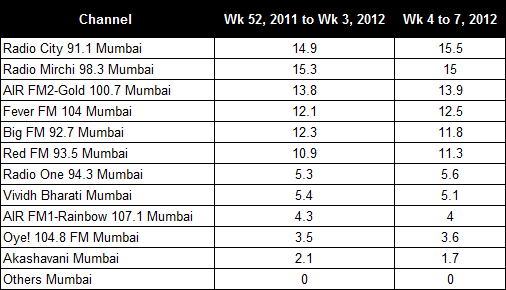
    Radio City surged ahead of Radio Mirchi as the most popular FM station in the city with 15.5 per cent channel share from Wk 4 to Wk7, 2012 whereas Radio Mirchi’s channel share stood at 15 per cent. Ranked three is AIR FM2 Gold which more or less remained unchanged in listenership share from wk 4 to 7, 2012 as against Wk 52, 2011 to Wk 3, 2012. As compared to Wk 52, 2011 to Wk 3, 2012, six FM stations witnessed growth in their listenership share in Wk 4 to Wk 7, 2012 namely, Radio City, Fever FM, Red FM, Radio One, Oye! FM and AIR FM2 Gold.


    Source : RAM

    Market: MUMBAI

    Demographic: All People 12+ Filter Demographic: None

    Statistic: Share %

    Daypart: Sun – Sat 12:00 AM – 12:00 AM

    Place of Listening: All


    Delhi:

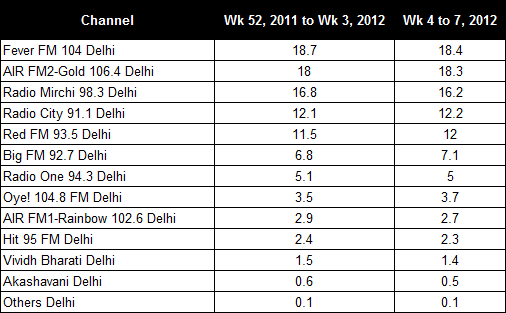
    Fever FM once again manages to retain its leadership position inDelhi, its nearest rival in Delhi is Radio Mirchi, if the government owned AIR FM2 Gold is excluded. According to figures for Wk4 to Wk 7, 2012, AIR FM2 Gold is close behind Fever FM for the top spot. What remains to be seen is whether or not Fever FM is able to retain its leadership position inDelhi.


    The Wk4 to Wk 7, 2012 RAM numbers reveals that in comparison to Wk 52, 2011 to Wk 3, 2012 only five FM stations witnessed any growth in the Delhi market. The FM stations to have seen growth in their listenership shares are Radio City, Big FM, Red FM, Oye! FM and AIR FM2 Gold.

    The other FM stations in the Delhi market are Radio One, Hit FM, AIR FM1 Rainbow, Vividh Bharathi and Akashavani Delhi.


    Market: DELHI

    Demographic: All People 12+ Filter Demographic: None

    Statistic: Share %

    Daypart: Sun – Sat 12:00 AM – 12:00 AM

    Place of Listening: All


    Bengaluru:

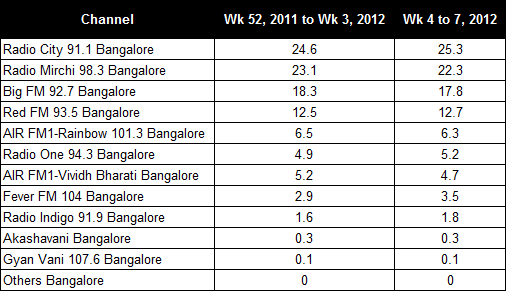
    In Bengaluru too, Radio City continues maintain its numero uno position, the FM station has managed further grow its listenership share in Wk 4 to Wk 7, 2012 as against Wk 52, 2011 to Wk 3, 2012. The second most popular FM station in Bengaluru is Radio Mirchi followed by Big FM and Red FM, ranked third and fourth respectively. Ranked fifth is AIR FM1 Rainbow and Radio One is ranked sixth. The five of the eleven FM stations in the Bengaluru market which witnessed growth in listenership share areRadioCity, Red FM, Radio One, Fever FM and Radio Indigo.


    Market: BENGALURU

    Demographic: All People 12+ Filter Demographic: None

    Statistic: Share %

    Daypart: Sun – Sat 12:00 AM – 12:00 AM

    Place of Listening: All


    Kolkata:

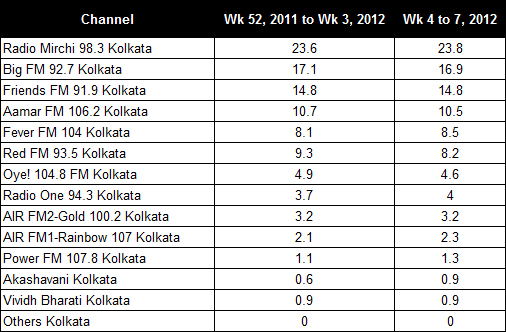
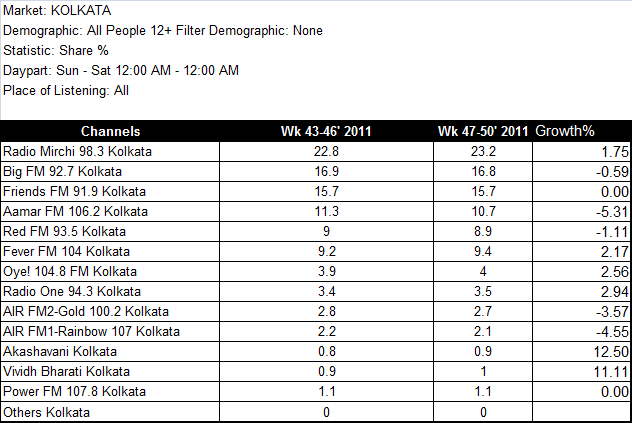
    Radio Mirchi has not only maintained its leadership position in the city, but has also witnessed some growth according to the Wk4 to Wk 7, 2012 RAM data as against Wk 52, 2011 to Wk3, 2012. Kolkata is the only RAM market to have seen no change in atleast the top three rankings. Radio Mirchi, Big FM and Friends FM continue to be the top three FM stations in the city. Ranked four is Aamar FM, followed by Fever FM, Red FM and Oye! FM. Of the thirteen FM stations in Kolkata, six FM stations in the city have witnessed growth in their listenership shares: Radio Mirchi, Fever FM, Radio One, Power FM and AIR FM1 Rainbow. Although Friends FM remained stagnant in its listenership share, nevertheless it is comfortably placed at number three. The other FM stations in the Kolkata market include Radio One, Power FM, AIR FM1 Rainbow, AIR FM2 Gold, Akashavani Kolkata and Vividh Bharati.


    Market: KOLKATA

    Demographic: All People 12+ Filter Demographic: None

    Statistic: Share %

    Daypart: Sun – Sat 12:00 AM – 12:00 AM

    Place of Listening: All


  • RAMcheck: What women listen to…

    By A Correspondent


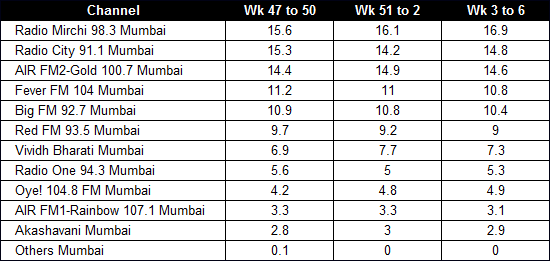
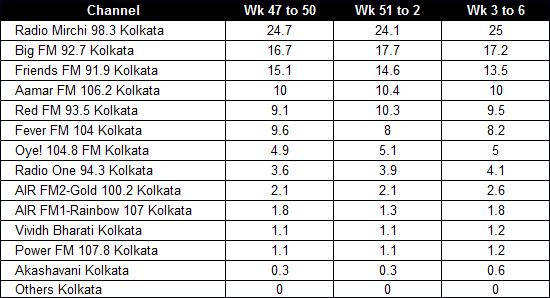
    Which are the most popular FM stations among women? MxMIndia shifts focus on women listenership trends in the four RAM (Radio Audience Measurement) – Mumbai, Delhi, Bengaluru and Kolkata. The data consists of women who are 12 years of age and above, all places of listening from WK 47, 2011 to WK 6, 2012. The most popular FM stations among women in the four metros are Radio Mirchi, Radio City, Big FM, Red FM and Fever FM.


    Delhi:

    Fever FM is the most popular FM station among Delhi women listeners, followed by Radio Mirchi, AIR FM2 Gold, Red FM and Radio City – the top five FM stations for women in Delhi. The listenership share of Fever FM has in fact moved slightly higher on Wk 3 to Wk 6 as compared to Wk 47 to Wk 50. The top five FM stations in the city have managed to sustain their listenership rankings from wk 47 to 50, 2011 to Wk 3 to 6, 2012. The other FM stations in the city are Big FM, Radio One, Oye! FM, Hit FM, AIR FM1 Rainbow, Vividh Bharati and Akashvani.


    Mumbai:

    For the women listeners in the commercial capital, Radio Mirchi is the numero uno FM station, at least in terms of station share. Radio City is the second most popular FM station among the women listeners of Mumbai followed by AIR FM2 Gold which is ranked three. The other two FM stations in the top five category are Fever FM and Big FM, which are ranked four and five respectively. While these top five radio stations have received a double digit listenership share, the other FM stations in the city are Red FM, Radio One, Oye! FM, Vividh Bharati, AIR FM1 Rainbow and Akashvani.


    Bengaluru:

    The Bengaluru women listen to Radio City the most. Radio City has maintained its leadership position among women listeners from Wk 47 to Wk 50, 2011 to Wk 3 to Wk 6, 2012. Ranked second is Radio Mirchi followed by Big FM, the third most popular FM station of the city. Ranked four and five are Red FM and AIR FM1 Rainbow. The top four FM stations have infact witnessed their share per cent in double digits. The other FM stations in the Bengaluru market are Radio One, Fever FM, Radio Indigo, AIR FM1 Vividh Bharati, Akashvani and Gyan Vani.


    Kolkata:

    Radio Mirchi is clearly the most popular FM station for Kolkata women. The FM station has maintained a significant lead in the city with 25 per cent of the market share as on Wk 3 to Wk6, 2012. Its nearest rival in Kolkata is Big FM with a share of 17.2 per cent followed by Friends FM with 13.5 per cent of the share. Aamar FM and Red FM are ranked four and five with a share of 10 per cent and 9.5 per cent respectively. The other FM stations in the city are Fever FM, Oye! FM, Radio One, Power FM, AIR FM2 Gold, AIR FM1 Rainbow, Vividh Bharati, and Akashvani.


  • RAMcheck: No changes in top rankings in four metros

    By A Correspondent


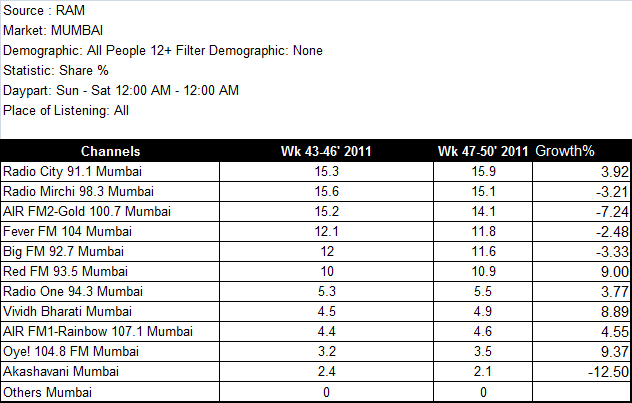
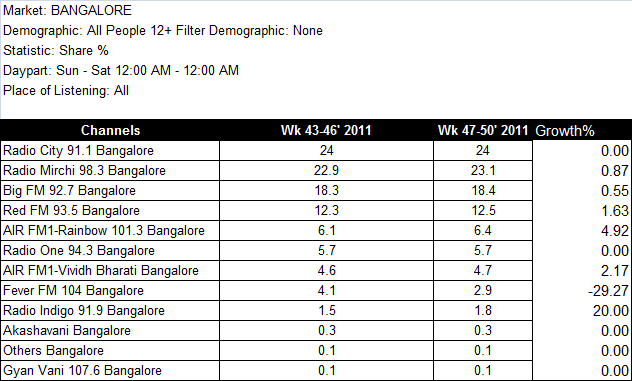
    On Friday, January 6, 2012, Radio Audience Measurement (RAM) – which covers four key metros, Mumbai, Delhi, Kolkata and Bengaluru – released its latest radio listenership figures for Wk 43-46 (last two weeks of October and 1st two weeks of November 2011) Vs Wk 47-50 (Last two weeks of November and 1st week of December 2011).


    According to the latest RAM data, for listeners of 12 years and above, and according to radio channel shares, Radio City, Radio Mirchi, Big FM, Red FM, Fever FM, Radio One, Oye! FM were some of the top FM stations in the big four metros.


    Mumbai:

    In Mumbai,Radio City further strengthened its leadership position in Wk 47-50 as against Wk 43-46 with a growth of 3.92 per cent in its channel shares. Radio Mirchi was rated the second most popular FM station in terms of channel shares followed by AIR FM2 Gold, Fever FM, Big FM, Red FM and Radio One. The other clusters of FM stations in the city are Oye! FM, Vividh Bharati, AIR FM1 Rainbow and Akashavani Mumbai.


    Besides Radio City, Red FM, Radio One, Oye! FM, AIR FM1 Rainbow, Vividh Bharati and Akashavani Mumbai are the only radio stations to have shown growth.


    Delhi:

    Most radio stations inDelhiwitnessed growth in the channel shares in Wk 47-50 as against Wk 43-46. AIR FM2 Gold emerged as the number one FM station inDelhi, its channel share however remained stagnant. Fever FM slipped to the number two position in Wk 47-50 after its channel share saw a decline as compared to Wk 43-46. Fever FM and AIR FM1 Rainbow were the only two FM stations inDelhito have seen a decline in channel shares on Wk 47-50 as against Wk 43-46.


    Radio Mirchi was the third most popular FM station followed by Red FM, Radio City, Big FM, Radio One, and Oye! FM. The other clusters of radio stations inDelhiinclude AIR FM1 Rainbow, Hit FM, Vividh Bharati and Akashavani Delhi.


    Bengaluru:

    There was no change in the station rankings in Bengaluru.Radio City continued to lead Bengaluru followed by Radio Mirchi and Big FM. While Radio City showed neither growth nor decline in its channel share, Radio Mirchi and Big FM saw marginal growth. Fever FM, however, was the only FM station that showed decline in its channel shares.


    Kolkata:

    Kolkata too saw no change in its station rankings. Radio Mirchi, Big FM, Friends FM, Aamar FM and Red FM were the top five FM stations in Kolkata in terms of their channel shares. Radio Mirchi, the most popular FM station in Kolkata has further strengthened its leadership position with a growth of 1.75 per cent in channel shares in Wk 47-50 as compared to Wk 43-46.


    While Radio Mirchi’s nearest rival in Kolkata, Big FM came a distant second with a slight decline of 0.59 per cent in terms of its channel share, the third most popular FM station in Kolkata, Friends FM remained stagnant. Besides Radio Mirchi, Fever FM, Oye! FM and Radio One were the only private FM stations in Kolkata to have witnessed growth in channel shares.


  • RAMcheck: Most popular FM stations heard out of home

    By A Correspondent


    Unlike our regular RAMcheck reports which didn’t differentiate between any places of listening, this time MxMIndia decided to concentrate exclusively on radio channels’ out of home (OOH) listenership. According to RAM (Radio Audience Measurement), the OOH listeners include listenership in cars, at work and other out of home places. TAM Media’s Radio Audience Measurement from week 40-43, 2011 to week 52- 3, 2012 reveals the most popular FM radio station out of home. RAM is currently present in four metros – Mumbai, Delhi, Bengaluru and Kolkata.


    Mumbai:

    According to the RAM data for OOH listenership, the top five FM stations for Mumbaikars are Radio Mirchi, Big FM, Radio City, Fever FM and Red FM, excluding the government-owned AIR FM2 Gold. The radio stations, from week 40- 43, 2011 to week 52 to 3, 2012, have not seen much variation in their channel shares.


    Delhi:

    In Delhi AIR FM2 Gold is the most popular FM station followed by Fever FM, a strong number two in OOH listenership share. While the number one and two slots have a clear position in OOH listenership, there is no clear winner for the number three position. There is a close fight for number three position between Radio Mirchi, Radio City and Red FM. However in Wk 52′ 2011 to Wk 3′ 2012, both Radio Mirchi and Red FM received 12.4 per cent station share whereas Radio City received a station share of 11.1 per cent. The other FM stations in the Delhi market include Big FM, Radio One, Oye!FM, Hit FM, AIR FM1 Rainbow, Vividh Bharati and Akashavani Delhi.


    Bengaluru:

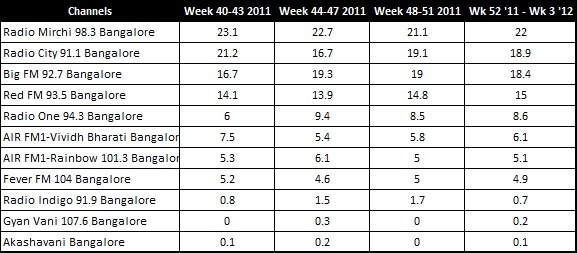
    Radio Mirchi is the number one FM station in Bengaluru followed by Radio City, Big FM, Red FM and Radio One. Between Wk 40- 43, 2011 to Wk 52, 2011-Wk 3, 2012 the radio channel share for Radio Mirchi was at its peak in Wk 40 -43, 2011 with a share of 23.1 per cent. Radio City, the second most popular FM station in OOH listenership, was also at its peak in wk 40 – 43, 2011 with 21.2 per cent share. However in week 52, 2011 – Week 3, 2012 the station share for Radio Mirchi dropped to 22 per cent whereas Radio City’s share was 18.9 per cent. The other clusters of FM stations in Bengaluru are Fever FM, Radio Indigo, AIR FM1, Vividh Bharati, AIR FM1 Rainbow, Gyan Vani and Akashavani Bengaluru.


    Kolkata:

    Kolkata has a clear number one and number two FM stations in Friends FM and Radio Mirchi. Ranked third is Red FM. The gap between the top three FM stations is significant. While Friends FM received a market share of 23.4 per cent in Wk 52, 2011 – Wk 3, 2012, the same week saw Radio Mirchi receive just 18.3 per cent market share and Red FM receive 12.4 per cent share. The other clusters of FM stations in Kolkata are Fever FM, Aamar FM, Air FM2 Gold, Oye! FM, AIR FM1, Rainbow, Radio One, Power FM, Akashavani and Vividh Bharati Kolkata.


  • RAMcheck: Media agencies on new FM listenership numbers

    By Robin Thomas


    The latest RAM data on radio listenership for the month of September to mid-October has thrown up a few surprises in radio listenership. New leaders have emerged in cities that were once strongholds of their rivals. Barring Kolkata where Radio Mirchi continues its leadership position, the remaining three markets – Mumbai, Delhi and Bengaluru have new No. 1s.


    Take Mumbai for instance, once a Radio Mirchi bastion, the latest RAM figures (category: all people 12+, all places of listening, shares) show Radio City as the number one private FM station in the city, slightly ahead of Radio Mirchi. However this time (i.e. week 38-42, 2011) Radio City had to share the No. 1 slot with the government owned FM radio – AIR FM2-Gold. Bengaluru where Big FM held its number one status for a very long time is now overthrown by Radio City. In Delhi Fever FM has become number one taking over from AIR FM2- Gold, Radio Mirchi which was number one in the city for very long time has slipped to number three position. These figures are according to RAM, All People 12+, all places of listening and all daypart (i.e. Sunday to Saturday 12 am to 12 am).


    In addition to these developments we find that when we compare week 35- week 38, 2011 (last week of August to 1st three weeks of September, 2011) and week 39- week 42, 2011 (Last 2 weeks of September and 1st two weeks of October, 2011) not all FM stations have witnessed growth in their listenership. When asked whether FM stations have reached a stagnation point in listenership, Mr Janardhan Pandey, Associate VP, Mudra Max explained, “It has not reached a stagnation point, but a period of stabilization. To further increase listenership, FM stations will have to take the quality of content and programming to the next level along with higher-level product promotions.”


    Mr Ajay Rao, Vice President, Dentsu observed, “FM stations do not have novelty working for them any more. It is today a force of habit for people who find themselves without a smartphone to keep them going. For the young people FM is losing out to other more engaging past times. Can one differentiate basis the content? Listeners tune in for music and switch channels during breaks.”


    AIR FM2- Gold which has been growing strong in listenership particularly in Mumbai and Delhi where it has emerged as a strong number two contender. What remains to be seen is whether this trend continues or will it see a decline or stagnation in listenership. Media planners are however of the view that since AIR FM2- Gold offer only specific contents it is not considered as often as the private stations. Mr Narendra Kumar Alambara, Vice President, Starcom Chennai was of the view that, “Since the entertainment content is limited in AIR, the advertisers do not consider AIR as often as compared to the private stations.”


    “AIR FM- Gold has been consistently delivering impressive numbers, this suggest that the music is most important content of a radio station and RJ/ innovations and promotions alone cannot keep you on top,” said Mr Janardhan Pandey.

  • RAMcheck: Some surprises in 4-metro stats for Aug to mid-Oct

    By Robin Thomas


    On Friday, December 2, Radio Audience Measurement (RAM) released its latest radio listenership figures for Week 35 to Week 38, 2011 (last week of August to 1st three weeks of September, 2011) and Week 39 to Week 42, 2011 (Last 2 weeks of September and 1st two weeks of October, 2011). RAM covers four key metros – Mumbai, Delhi, Kolkata and Bengaluru.


    According to the latest RAM data, for listeners 12 years and above, from all places of listening and according to share value, Radio City, Radio Mirchi, Big FM, Red FM, Fever FM, Radio One, Oye! FM are some of the top FM stations in the big four metros.


    Mumbai:

    In Mumbai Radio City emerged as the number one FM station in Mumbai, followed by AIR FM2- Gold, Radio Mirchi, Big FM, Fever FM, Red FM, are the top six FM stations in Mumbai. The other FM stations in Mumbai include Radio One, Vividh Bharati, AIR FM1 Rainbow and Oye! FM.


    If we compare growth of FM listenership in terms of shares from Week 35 to week 38, 2011 and Week 39 to Week 42, 2011 we find that Radio City, AIR FM2- Gold, Big FM, Fever FM, Radio One and Vividh Bharati are the only FM stations to have witnessed growth. Interestingly, AIR FM2- Gold emerged as the fastest growing FM station, with a share of 12.59 per cent. Radio City, number one FM radio station grew 0.63 per cent in shares. Big FM, the fourth most popular FM station as per the latest RAM figures remained stagnant whereas Fever FM saw a marginal growth of 0.88 per cent. Radio One also saw good growth of 6.25 per cent.


    The FM stations which saw a decline in their listenership share are Radio Mirchi, Red FM, AIR FM1- Rainbow and Oye! FM. While Radio Mirchi is the third most popular FM station in Mumbai after AIR FM2- Gold then Radio Mirchi saw a decline of 7.19 per cent. Oye! FM on the other hand saw a decline of 11.43 per cent in their listenership share.


    Delhi:

    The RAM figures for Delhi too have thrown some interesting figures. Fever FM emerged as the number one FM station from week 39 to week 42 (i.e. Last 2 week of September and 1st two week of October, 2011). Fever FM took the leadership position from AIR FM2- Gold which was number one in Delhi from week 35 to week 38, 2011 (i.e. (last 1 week of August to 1st three week of September, 2011).


    Ranked one is Fever FM with a share of 20.7 per cent as on week 39 to week 42, 2011. Fever FM is closely followed by AIR FM2- Gold with a share of 20 per cent. Ranked three is Radio Mirchi with a share of 16.7 per cent and Red FM with a share of 11 per cent as on week 39 to week 42, 2011. While Big FM and Radio One received a share of 5.6 per cent and 5 per cent respectively, Oye! FM and Hit FM received 3.6 per cent and 2.1 per cent share respectively.


    The FM stations that witnessed growth in their listenership share (i.e. comparing ‘Week 35 to 38, 2011’ and ‘Week 39 to 42 2011’) we find Fever FM, AIR FM2- Gold, Big FM, Radio One, AIR FM1- Rainbow, Hit FM and Vividh Bharati are the FM stations to have witnessed growth. Fever FM which leads Delhi in terms of listenership share grew 5.61 per cent, Big FM grew 5.66 per cent, Hit FM grew 5 per cent, AIR FM1- Rainbow grew 4 per cent. Radio One emerged as the fastest growing FM station in Delhi with a listenership share of 5 per cent as on week 39 to 42, 2011 which is a growth of 8.70 per cent as against 4.6 per cent share on week 35- week 38, 2011.


    Radio Mirchi, Radio City, Red FM and Oye! FM on the other hand saw a decline in their listenership share (i.e. when we compare Week 39-42 as against week 35 to 38, 2011). Fever FM, AIR FM2- Gold, Radio Mirchi, Radio City, Red FM, Big FM, Radio One and Oye! FM are the top 8 FM stations in terms of listenership share.


    Bengaluru:

    Radio City continues its leadership position in Bengaluru, it is closely followed by Radio Mirchi, Big FM, Red FM and AIR FM1- Rainbow are the top five FM stations in Bengaluru.


    Big FM which held the number one position for a long time in Bangalore is now ranked three after Radio City and Radio Mirchi. However with a listenership share of 18.3 per cent (on week 39 to week 42, 2011), Big FM witnessed a marginal growth of 0.55 per cent as against its listenership share of 18.2 per cent (from week 35 to 38, 2011). The other FM stations to have witnessed growth are Radio City, Radio Mirchi, AIR FM1- Rainbow and Radio Indigo. Radio City received a share of 24 per cent on week 39 to week 42, 2011 as against 23.6 per cent from week 35 to 38, 2011, a growth of 1.69 per cent. Radio Mirchi on the other hand grew 3.65 per cent after receiving a share of 22.7 per cent on week 39 to 42, 2011 as against a share of 21.9 per cent from week 35 to 38, 2011.


    The other private FM stations in Bengaluru are Red FM, Radio One and Fever FM which received a share of 11.6 per cent, 5.5 per cent and 5.4 per cent respectively. Red FM for instance in Bengaluru received a share of 11.6 per cent (from week 39 to 42, 2011), week 35-38, 2011, the FM station received a share of 12.3 per cent, a decline of 5.69 per cent. Radio One declined 5.17 per cent after receiving a share of 5.5 per cent on week 39 to 42, 2011 as against 5.8 per cent share on week 35 to 38, 2011. Fever FM on the other hand received a share of 5.4 per cent (on Week 39 to 42′ 2011) as compared to its share of 5.8 per cent on week 35 to 38, 2011, a decline of 6.90 per cent.


    Kolkata:

    The top five FM stations in Kolkata are Radio Mirchi, Big FM, Friends FM, Aamar FM and Red FM. While Radio Mirchi continues to lead the Kolkata market with a share of 23.1 per cent (for week 39 to 42, 2011), the second most popular FM station as per week 39 to week 42 data, Big FM is a distant second with a share of 17.4 per cent. Friends FM maintains its third rank in Kolkata with a listenership share of 15.5 per cent, Aamar FM came next with a share of 10.5 per cent and rank five is Red FM with a listenership share of 9.3 per cent.


    The other private FM stations in Kolkata are Fever FM, with a share of 8.5 per cent, Oye! FM with a share of 3.9 per cent, Radio One with a share of3.8 per cent, Oye! FM received a share of 3.9 per cent and Power FM received 1 per cent.


    Radio Mirchi, Big FM, Friends FM, Red FM, Oye! FM, AIR FM1- Rainbow, Akashvani and Vividh Bharati are the only radio stations to have witnessed growth in the week 39 to week 42 data as against their numbers in week 35 to week 38.

  • KAAA asks govt to end Kerala newspaper distribution impasse

    By A Correspondent


    Continuing with the situation that has been created by the newspapers vendors in Kerala, T Vinay Kumar, President, Kerala Advertising Agencies Association (KAAA) has addressed the issue. In a letter to its members he has mentioned how the strike has affected the advertising agencies and the loss of considerable amount of business in the last one week.


    As both the parties including the vendors and the publisher cartel being adamant with no signs of issue being resolved, KAAA has been left with no option but to interfere to safeguard its interests, and has made a statement in mainline dailies requesting the CM and the involved parties to take a stand to end this impasse.


    They have also planned a symbolic distribution of newspapers near Ernakulam Public Library today (March 29), followed by a meeting in front of the residence of Justice VR Krishna Iyer who will share his views on solving the issue.


    It has been more than a week since newspaper distribution in Kerala has come to a stop with Newspaper Agents & Distributors Association demanding 50 percent commission of the cover price of the newspaper, pension, medical insurance, extra payment for advertising supplements, and stoppage of inserts, among other things. The Hindu, Mathrubhumi and Malayala Manorama have vehemently opposed these demands while Indian Express has agreed to 40 percent commission.


  • DDB Mudra Max OOH takes Tata Sumo Gold pan India

    By A Correspondent


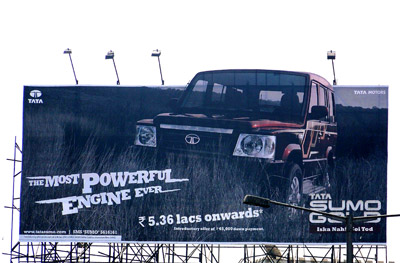
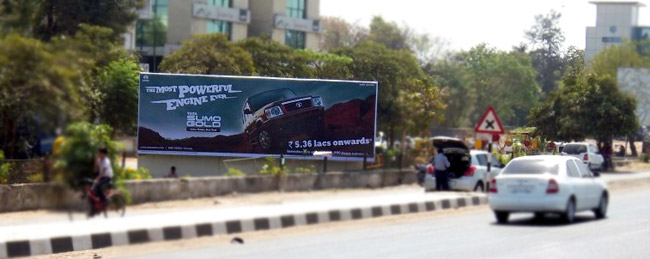
    DDB Mudra Max OOH carried a pan-India Out of Home (OOH) campaign for Tata Motors latest car- Tata Sumo Gold. The out of home campaign had commenced on February 28, 2012 and will conclude by the end of March, 2012. While the creative message of the campaign was ‘The Most Powerful Engine Ever’, its target audience are SEC A, B, those in the early 30s and living in the semi-urban and rural areas. The OOH campaign for Tata Sumo Gold is a pan India campaign spread over 200 plus markets. The OOH media vehicles used in each city were – Bill Boards, Unipoles, WallWraps, Walls for Paintings and BQSs.


    According to the brief from Tata Motors, the main aim behind launching this campaign is to make both personal and commercial segment consumers aware that there is an-all new Sumo variant (Sumo Gold) with a new, powerful CR4 engine. It allows Sumo Gold to take on different (rough and tough) terrain with ease.


    Since most of Tata Sumo’s TG is said to live in the semi-urban centres and that they mainly travel to outside the city to work, one of the strategies was to project Tata Sumo Gold as the vehicle that is adaptable to all kinds of roads and any circumstances. Hence whether it is travelling through difficult and bad roads, small lanes, traffic jams bad patches and other extreme situations, Tata Sumo Gold helps one travel with ease.


    Locations such as major entry and exit points, national highways, railway stations, religious destinations, bus stands, taxi stands etc were incorporated so as to reach the potential customers at all possible touch-points. For markets where OOH options were not available, Wall-Wraps and Wall painting were done to increase the reach. Cut-outs and LEDs were also installed in various markets to further enhance the appeal of the campaign.


    Ashesh Dhar, Head-Utility Product Group, Tata Motors said, “The new Tata Sumo Gold is a result of extensive consumer studies and field tests. The product has been designed to fulfill various requirements, long-awaited by the new generation customer. At the heart of every Tata Sumo Gold, lies a growling engine that thumps out vicious power. The Tata Sumo Gold goes a step ahead in putting the reins of power in the customer’s hands that suits his driving experience, delivering the best-in-class acceleration, power and an excellent torque aided pick-up and pull power. To communicate this message, DDB MudraMax OOH really helped in reaching out to the nooks and corners of the country with the traditional and unconventional outdoor spread.”


    Arun Rogha

    Arun Rogha, Group Account Director, DDB MudraMax OOH said, “It was a daunting task to execute a campaign of such a magnitude. While ensuring the optimum geographic spread we all had to take care of the intensity in each market. Strict Roll out schedule along with streamlined logistics helped us keep a check on the timelines. We had to live upto the benchmarks set by the previous launches of Tata Aria and Tata Sumo Grande. Tata Sumo Gold launch was more important considering the TG we had to reach to, throughout the country.”


    Adille J Sumariwalla, Head, DDB MudraMax OOH said, “Tata Motors have been the pioneers in the UV market in India. With the launch of the new Sumo Gold, we had to effectively communicate the new features and powerful engine, the car comes with. To effectively reinforce the message we had planned the media at important consumer touch points. Creative and Medium led innovations were also executed in important markets to break away from the clutter.”


  • Mediaah! Network 18 bags 39 news TV awards, MCCS 24

    By Pradyuman Maheshwari


    Under normal circumstances, we wouldn’t write about an event until we were physically present at an event. But, in India, sadly media entities in the same space are normally not invited by peers (rivals), and so MxMIndia wasn’t present at the annual News Television awards of Anil Wanvari’s IndianTelevision.com. Sad, because we would’ve loved to report on the event. Okay, we would’ve have networked with people, exchanged cards and consumed some alcohol and food, but, heck, by not getting due coverage, the very industry you are trying to promote loses out.


    Regardless of this and since I was associated with one edition of the awards, here’s a quick, politicially incorrect report – Mediaah-ishtyle:

    Network 18 channels (and website ibnlive.com) bagged maximum honours at the annual News Television (NT) awards presented by IndianTelevision.com in New Delhi on Wednesday.


    MCCS channels bagged 24, TV 9 with 15 and NDTV and TV Today with 12 metals awards each. CNN-IBN (and its website ibnlive.com) bagged 17 awards followed by IBN Lokmat in Marathi and TV 9 in Telugu with 14 awards each. MCCS channels Star News and Star Majha (Marathi) bagged 12 awards each.


    Some trivia: in general English channels, Headlines Today bagged 7 awards while NDTV 24×7 had 5. Also, ET Now with 5 and Bloomberg UTV with 3 was ahead of CNBC TV18 with 2 in the final tally. CNBC Awaaz was the only Hindi business channel in the awards list with 4 awards. Times Now does not figure in the list of awardees, though ET Now from the stable does.


    Note: Since MxMIndia was not invited to the event, this is based on the Indian Television report at link


    Full list of winners can be accessed at link.


    Important: while reading the tally and list of winners, it is vital to note the number of entries sent by each channel as well as who participated and who didn’t.  Reason: the more you participate, the more you are likely to win. And, an obvious observation, but must be underscored, if you don’t participate, you don’t win.


    It’s good to see Star News bag a good number of awards… they’ve been consistent at their work and also playing second-fiddle to Aaj Tak in mass and NDTV India in class. Though I don’t find anyone more mass than Deepak Chaurasia and class as some of the other anchors whose names I forget.


    Anant Rangaswami on afaqs

    It was nice to read Anant Rangaswami on afaqs.com. He’s a great writer, and having been in the business for a few decades, is on backslapping terms with a host of folks. More importantly, he has a good understanding of advertising and media issues.


    The footnote in the afaqs article says he’s a consultant at firstpost.com, but the site notes he’s senior editor, but those aren’t significant issues. I think firstpost.com is picking up well, and I’m beginning to enjoy some of its commentary, even though I don’t agree with some of it.


    I had stopped reading Campaign India after Anant quit, but his successor (seasoned theatreperson and Printweek editor) Ramu Ramnathan is a great guy and has managed to set it back on sail. It’s credible, looks good and is still popular… guess that’s what matters.


    But lemme not digress any further and get back to Monsieur Rangaswami’s afaqs piece. I was quite surprised to see him believe that regulating ad duration on television is good. Agreed what we have on some of the channels is obnoxious, but that’s because all of them are doing the same. The moment a few channels change their standards, I am sure the rest will follow.


    In fact Anant’s very argument that digitization should reduce the pressure on revenues from advertising is what should make things exciting. If the government really want to reap the benefits of a free-for-all, it must watch the fun post digitization. I understand TAM is also getting digitization-ready and the master strategists amongst all broadcasters will be put to test to figure what their revenue policies must be in the wake of viewership data coming in from addressable set-top boxes.


    Let the free market prevail, my friend!


    The views expressed here are my own and not necessarily those of MxMIndia.com and the team working with it.


  • Ten Sports and NBA launch ‘Biggest Fan Contest’

    By A Correspondent


    The National Basketball Association (NBA) and Ten Sports will kick off the first-ever NBA Biggest Fan contest on March 31. NBA fans who tune in to NBA games on Ten Sports will be able to answer trivia questions for a chance to win the title of NBA Biggest Fan and a trip to the United States for a 2012 NBA Finals game.


    From March 31 till April 26, a trivia question will be asked during each NBA game broadcast on Ten Sports. Fans will have 24 hours to respond to each question via SMS, and will become eligible to win after registering on Tensports.com. The two fans who answer the most questions correctly will be named NBA Biggest Fan and win a trip to the U.S. to experience the NBA Finals.


    The NBA will promote the contest across its digital and social media assets in India to engage more fans. Ten and the NBA will produce a series of vignettes highlighting the winners’ experience at the NBA Finals which will air on Ten Sports and NBA.com/India during The Finals.


    “We are happy to be part of the NBA Biggest Fan contest to find the most dedicated fans of the NBA in India,” said Atul Pande, CEO of Ten Sports. “This contest reaffirms our commitment to grow NBA viewing in India through various marketing initiatives.”


    “We are excited to launch the first-ever NBA Biggest Fan contest with Ten Sports to provide our fans with the chance to win a trip to witness live NBA action,” said Matt Brabants, NBA Senior Vice President, International Media Distribution. “Thanks to our partner Ten Sports, we were able to create an exciting way to actively engage fans and reach out to new audiences while driving viewership for NBA broadcasts on Ten.”


    The NBA has comprehensive television coverage in India this season. Taj Television, which operates the Ten-branded sports channels, televises up to three live games per week on Ten Sports. Live games air each Tuesday, Thursday and Saturday throughout the season with replays of each game in prime time. Ten Sports also televises the NBA’s marquee events live, including NBA All-Star, the NBA Playoffs, the Eastern Conference Finals and the NBA Finals.


    The NBA has been actively developing basketball in India since first visiting in 2008 with the Basketball without Borders program. Since then, the league has staged a number of grassroots basketball development programs in the country including Jr. NBA/Jr. WNBA and the Mahindra NBA Challenge, the largest, multi-city, community-based basketball league in India. Approximately15 players and legends from the NBA and WNBA have visited India to conduct basketball clinics and engage fans including NBA All-Stars Dwight Howard, Pau Gasol and Baron Davis.