Category: MEDIA

  • TRAI-ing time for TV with ad curbs


    By Rishi Vora


    The Indian television scene as we know it is set for a sea change, and not in a good way for everyone. While viewers may heave a sigh of relief, advertisers and agencies are already counting the declining shekels as the authorities’ latest move is likely to cause a major setback to the Rs 21,000 crore television industry.


    Keeping in mind consumer grievances about too many ads, too little content, the Telecom Regulatory Authority of India (TRAI) has proposed to limit ad duration on pay television channels and also a few other suggestions on sporting events and news coverage.


    The story of Indian TV’s growth is also the story of increased advertising – which is good for brands, broadcasters and media agencies. The consumer, however, tends to feel inundated with advertisements especially at prime time and during the most popular shows.


    Not that there are no existing norms, but with the recent proposal, TRAI has stepped up the pressure for a better viewer experience.


    The Proposal

    • No free-to-air channel shall carry advertisements that exceed 12 minutes. For pay channels, the limit shall be six minutes. Furthermore, the prescribed limits shall be enforced on a clock-hour basis as against being averaged for 24 hours.

    Also it is proposed that the 12-minutes of advertisement are not to be aired in more than four sessions in one hour which means continuous ad-free broadcast for at least 12 minutes.

    • No more than three ad breaks during a movie, with a minimum 30 minutes between ad breaks will be permitted.
    • During live sporting events, advertisements can only be carried during interruptions in the sporting action. TRAI has also put up a proposal to ban on part-screen & drop-down advertising, which means only full-screen ads are permitted.
    • TRAI has proposed that audio level of the advertisement should not be higher than the audio level of the programme.
    • News and current affairs channels shall not run more than two scrolls at the bottom of the screen carrying non-commercial content. These scrolls should not occupy over 10 per cent of the screen space.


    The general sense among key stakeholders of the industry is that it’s a drastic move to slice ad duration to such an extent – almost half of the current norm – for pay channels. It’s going to be tough for the pay channels as anyway they lose out on substantial monies on account of leakages in the subscription model. Added to this are other worries such as increase in ad rates, inventory issues which may crop up, impact on quality content etc.

    MxM India finds out what key stakeholders have to say.


    Mr Sunil Lulla, CEO, Times Global Broadcasting Co. Pvt Ltd said, “The industry standard today is 10 minutes plus 2. Most of us are around that on an average hour basis but given the pressure and high cost of this business, very often the industry has had to go beyond the earlier stipulation and I think this should be left to the forces of the industry to regulate, like we’ve done for content.”


    He further added, “Regulation must be industry-created and cannot be ministry or government-thrusted. We believe that self-regulation has worked for content; we believe that self-regulation will work for advertising and many other aspects, and that’s the best way to develop this industry.”


    According to Mr Ajay Kakar, Chief Marketing Officer – Financial Services, Aditya Birla Group, these guidelines, though framed keeping viewer experience in mind, are more likely to impact the industry negatively as they may lead to increase in ad rates. He explains that the lower ad revenue would put pressure on broadcasters to reduce costs, which will subsequently impact the quality of content. Mr Kakar feels that these guidelines if accepted by the industry could lead to a paradigm shift for broadcasters and advertisers.


    Mr Ashish Pherwani, Senior Manager, Media and Entertainment – Ernst & Young has a similar view. He says that 70-80 per cent of a pay TV channel’s revenue comes from advertising and if the current regime of 12 minutes per hour is to become six minutes per hour, rates are ‘unlikely’ to double to make up for the revenue dip, so cost of content will go down and therefore shows like Bigg Boss and KBC won’t be viable.


    “The TRAI note stresses that digitisation will get more subscription revenues for broadcasters but that’s not going to happen soon. It’s going to take some years! Given that most GECs and sports channels’ inventory is 100 per cent and sold out currently, ad rates will go through the roof if inventory is halved. Advertisers will reduce TV spends and go to other media or less expensive TV channels. Hence, overall a negative impact on the TV industry.”


    Mr Jehil Thakkar, Partner and head of Media and Entertainment, KPMG noted that the guidelines have been in existence, but it is the market that determines the volume. He further added that it is in the broadcasters’ interests that they keep a limit on advertising, noting that they are well aware of the perils of excessive advertising as consumers tend to move between channels to avoid long commercial breaks.


    Mr T Gangadhar, Managing Director – MEC India is all for a good viewer experience. “I’m not a big fan of regulations, but there needs to be a way to protect the consumer’s interest,” he maintains. “Pay channels are making money through subscription. But yes, that is not much, as a lot of that is lost in leakages that are so prevalent in the broadcast industry.”


    He further added, “Typically, in many countries, subscription and ad sales go hand in hand – so what they’re trying to achieve is that if you’re a pay channel, quite clearly you have a revenue model in subscription and therefore while you are entitled to advertising revenue as well, it can’t come at the expense of spoiling the viewer experience especially when the viewer is paying for that particular channel.”


    Mr Neelkamal Sharma, COO – Buying Madison Group advised, “I woul suggest that it should be done in two stages, maybe from 12 minutes to 10 and then to 8 minutes. The move to have a limit is good and is in the overall long-term interest of the TV industry, since it will reduce viewer irritation. But a decision like this should be taken in consultation with industry bodies like IBF, ISA and AAAI.”


    It will be interesting to see if these guidelines are passed as the industry clearly is not on the same page as the TRAI. Broadcasters and advertisers are expected to send their suggestions to the TRAI before March 27.


    Watch this space for updates, views and more analysis.


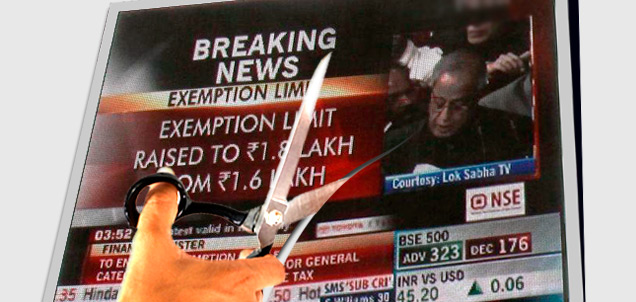
    Imaging: Rafiq, File photograph of Budget on a television set: Fotocorp

  • Water bottle for the front page of DNA

    By A Correspondent


    DNA initiates a path breaking front page innovation on the occasion of World Water Day DNA is known for its revolutionary approach towards almost everything it does and along with the daily news analysis; this English daily is impeccably marching ahead in making a change in the traditional newspaper industry.


    On the 22nd of March, when people grabbed their copy of DNA they experienced a refreshing change with a brand new colour on the front page. On the occasion of World Water Day, DNA and Tupperware had teamed up to showcase a new product by this well known high quality smart kitchen solutions company.


    Every newspaper, until today was getting printed in a four colour system through an offset printing machine, whose colours namely are CMYK (Cyan, Magenta, Yellow and Black) and occasionally various newspapers experimented with Gold or Silver. But the first time ever, in the history of Indian newsprint industry, a broadsheet has a shade of blue as a part of their printing colour palate and a live edit to make believe the trueness of the Tupperware bottle and making people comprehend a fresh and pure colour of blue on the well deserved occasion of the World Water Day.


    “Tupperware was launching their aqua fresh water bottles and we chose World Water day, March 22nd, as it was a perfect fit for the announcement. We wanted to do something exciting for Tupperware and this is when DNA came up with the concept of innovating it in a three-dimensional way. It’s the first campaign of the year for Tupperware and stands as a clear communication for all readers to drink fresh and healthy water”. – Surbhi C. Murthy, AVP, Allied Media This was done to launch the Tupperware bottle that is so pure and perpetual that it could be used for life. There could be no better gift for the readers than this, on the occasion, isn’t it!


    “Tupperware’s Aquasafe Bottles provide a quick, sustainable solution to safe, healthy water for consumers. Towards this, we have embarked upon an advertising campaign which is based on clutter-breaking innovation to generate buzz amongst the consumer. Committed to make the world a better place to live in, Tupperware endorses the idea and cause of effective water storage solutions and lends its whole-hearted support to the World Water Day.”  Anshu Bagai, Director- Marketing, Tupperware “Water bottles are a significant part of Tupperware’s range of products. The ‘Sip of Bliss’ campaign was created to celebrate water. What we wanted was to have an innovative kick-start for the campaign. And there could not have been a better way and a better day than the World Water Day, on March 22nd,   to launch it with a special innovation using a special colour to make it memorable and effective”  Jyotsna Chauhan, COO,  IBD India Pvt. Ltd.


    “Tupperware’s summer campaign is all about the romance and the sheer bliss of water.  The DNA innovation provided a refreshing twist in taking the idea further.” Jai Singh, Senior Creative Director, IBD Brands, Gurgaon. Explains Mr. Nirmal Kanthode, the DNA Production Head “The printing process had to be altered to create the depth of the Tupperware colour. After the normal 4 stage process, a 5th printing round with a special ink had to be done to create the magical effect. While this sounds easy, doing it for a full run of 6 lakh copies with high speed machines meant meticulous calculations & calibrations to ensure no delay & perfect output. Any shade change would be disastrous & we would have no way to stop it either.”


  • Sourav Ganguly to lead Pune Warriors in IPL5

    By A Correspondent


    Pune Warriors India, the IPL franchise of Sahara India Pariwar, has announced that all-rounder and former Indian captain Sourav Ganguly will lead the side of Pune Warriors India as Captain and Mentor in the fifth season of the IPL, to be played from 4th April, 2012 till 27th May, 2012.


    Pune Warriors India team in IPL 5 will don new turquoise blue and silver jerseys. Turquoise blue color stands for zeal, confidence and victory, the very attributes and motto of a Warrior.


    The Pune Warriors India’s bowling coach is Allan Donald while Praveen Amre is the batting coach. Paddy Upton is the mental conditioning and high performance coach of the team.


  • The Anchor: The 6 Cs of the TV business in South India

    By Anup Chandrasekharan


    Consumer: The consumers in South India are probably the most complex lot to understand. Each state in South has more than 20 districts and each district is a state on its own. Hence one can imagine the varied preferences of these consumers, and one has to find a path that will cater to and appease this varied audience.


    Connectivity: CNS penetration is more than 90 percent in all the four states put together in the South including TN, Karnataka, Andhra Pradesh and Kerala. In fact, in states like Tamil Nadu it is said that they have more TV homes than toilets!


    Content: Content is the key to success for anyone in the business. In the South, audiences like to watch content which is good for family viewing. In terms of difference in content, in Tamil Nadu and Andhra Pradesh the general rule is that audiences like to watch content that is loud whereas in Kerala and Karnataka content that is subtle is preferred.


    Cost and Earnings: It is possible to invest prudently in content while keeping the cost of operations on a tight leash, thereby ensuring that ROI is high. The mantra is to invest in smart content and keep running and operations cost minimum, which is possible among the Southern channels.


    Capability: It’s a sad truth but the talent pool is scarce as there are hardly any good institutes which can impart basic training for a foundation to enter the TV industry. Hence most of the learning comes while being on the job.


    Competition: There are 17 channels put together in Kerala and Karnataka and 35 in total in AP and TN. Therefore, there is no space for being smug and content if one enjoys a leadership position. The tables can turn any time and the heat is forever on, as competition intensifies among the existing players.


    Anup Chandrasekharan is the Business Head, Suvarna Channel.


  • FICCI-MIB discussion on digitization on March 27

    By A Correspondent


    Digitization in TV distribution system is going to be a reality soon. The Ministry of Information & Broadcasting, Government of India has come up with a detailed roadmap to digitize the TV distribution system by 31st December 2014. And the four metros, Delhi, Mumbai, Kolkata and Chennai are to be digitized by 30th June which is just 100 days away.


    For digitization to happen successfully by the notified date, several steps have to be taken and one of them is to make the consumer aware of the benefits of digitization. A step in this direction of creating public awareness on digitization is being undertaken by FICCI in partnership with the Ministry of Information and Broadcasting, Government of India. FICCI jointly with the Ministry of Information & Broadcasting is organizing a seminar on ‘India going Digital: An Industry Interaction with Stakeholders’ on the 27th of March, 2012 at 10:30am at FICCI Auditorium in New Delhi.


    The seminar will start with a presentation on Digitization by Supriya Sahu, Joint Secretary (Broadcast & Poilcy), Ministry of Information & Broadcasting. The presentation will be followed by a keynote address by Uday K Varma, Secretary, Ministry of Information & Broadcasting. Following the keynote by the Secretary of I&B, will be an interactive session and the seminar will finally end with a concluding address by Rajiv Takru, Additional Secretary, Ministry of Information & Broadcasting.


    The event is being supported by MxMIndia.


  • Ashutosh: Anna book is written in anger

    Video and Text by Shruti Pushkarna


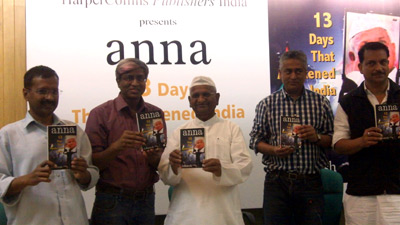
    Launching his book titled, ‘Anna: 13 Days That Awakened India’, in New Delhi, Ashutosh, well-known Hindi journalist and Managing Editor of IBN 7 noted that the book was not about Anna Hazare but about the larger people’s movement. Addressing a gathering of journalists, social activists, politics, family and friends at the book launch, he said, “People think that the book is about Anna Hazare, it is not about Anna Hazare. It traces the movement, from where it started, the principal actors of the movement, their confrontation with the government and the politics of the day. Basically it encapsulates the entire movement from beginning to end.”


    The 74-year-old activist, Anna Hazare released the book written by TV journalist Ashutosh on the agitation in Ramlila Maidan last August, at the India Habitat Centre in New Delhi.


    In the book, Ashutosh weaves together the story of the thirteen days of Anna’s hunger strike. He had a ringside view of the developments, stationed as he was at the Ramlila grounds in New Delhi, the venue of the fast, and had intimate access to the two warring parties, the Congress government and Team Anna. Lauding the book, Mr Hazare said that it would be a great source of inspiration for the youth for whom this book will serve as a historic account of those thirteen days.


    [youtube width=”400″ height=”200″]http://www.youtube.com/watch?v=1i96hzMWcMY[/youtube]

    Ashutosh told the audiences that he’d written this book in anger at the so-called ‘elitist’ section of society who, he feels, have failed to understand the anti-corruption movement led by Anna. He also said that despite being a Hindi journalist, he chose to write the book in English because he wanted this group of people to read the book. He said, “This book is written in anger. Anger because through the movement I realized there is a section of English intelligentsia which is refusing to understand the movement and they are unnecessarily trying to find faults and trying to project it as anti-democracy. These people I thought, had no understanding of reality, they had never been to the Ram Lila Maidan, so I thought if I wrote in Hindi these people won’t read it. I wanted them to read and realize that there is a section of society which is very angry with their stand. That’s why I decided to write this book. I wanted to take my battle to their turf to understand how wrong they are. I wanted to take the battle to those who claim to be the guardians of history but actually know nothing about it.”


    The book release was followed by a panel discussion moderated by Editor-in-Chief, IBN 18 Network, Rajdeep Sardesai. The panelists included social activist Arvind Kejriwal, BJP spokesperson Rajiv Pratap Rudy, and Anna Hazare. Talking about the Anna movement, Arvind Kejriwal, member of Team Anna said that three factors had led to the success of the movement. One was Hazare’s leadership, second anger of people against corruption and third was the fact that Team Anna provided an alternative to fight the menace.


    Responding to whether the movement had lost its steam, Anna Hazare said that we will come to know by 2014 whether the movement still has the steam. He said, “There are questions about the movement. Some people doubt that the movement has lost the steam. Whether the movement still has the steam, we will know in 2014 when the country goes to general elections.” He added that he will wait till mid-May to see whether Parliament passes a strong Lokpal law during the ongoing budget session and then embark on a nation-wide tour to awaken people about the issue.


    Mr Hazare also said that one law cannot end corruption and therefore what we need is a change in the system. BJP spokesperson Rajiv Pratap Rudy said, “What we need is a change in the system. Bureaucrats are supposed to construct roads and MLAs and MPs make laws. However, in India bureaucrats make laws and lawmakers construct roads.” Mr Rudy asked how one could call India a functional democracy when a former Chief Minister, who was jailed for a multi-crore scam, gets elected to the Lok Sabha. Mr Rudy extended full support to Mr Hazare’s movement and appealed to Mr Hazare to urge good people to join politics.


    Rajdeep Sardesai expressed his reservations about the movement but he accepted that somebody has to take the lead in the fight against corruption.


  • 100 Days to D-Day…but where are the Set-Top Boxes?

    By Shruti Pushkarna


    Only 100 days to go for Digitization Day and the ground reality does not look too promising at this point. There is a mammoth requirement of set top boxes, Digital Addressable System (DAS) licences have not yet been issued to operators and several other issues remain unresolved as of now.


    To get a clearer picture of the ground reality from the cable operators’ end, MxM India spoke to Roop Sharma, President, Cable Operators Federation of India. Speaking of the ground level scenario, Ms Sharma said, “No DAS licences have been issued to the operators still. Until and unless the operator has the license, he can’t get a bank loan and unless the operator has the license, he will not want to order equipment which is worth no less than 1 crore. And more importantly there is no consumer demand for digital. This is only government’s demand because they want to curry favour to the broadcaster. There isn’t any incentive from the government either. They are only forcing a technology on consumers by mandating it.”


    But more than anything, the biggest problem as pointed out by Ms Sharma is the sheer unavailability of Set Top Boxes (STBs) in the market. She told MxM India, “You need a Set Top Box to go digital and where are the STBs? First there was talk of importing them from China but that will also take atleast four to five months. Now there are some vendors in India but for that too, the chip has to be imported from outside. There is a requirement of 30 lakh STBs for Delhi alone and this is counting only one TV per household. Also, where is the manpower to deploy all these STBs?”


    Another industry source told MxM India, “As per the declared number, there is a requirement of 10 to 12 million STBs but my experience says that the actual total count will be no less than 20 to 22 million, because they have only counted 1 TV per household. The boxes are just not there.”


    Ms Sharma feels that the government is pressurizing the smallest guy in the entire value chain, which is the cable operator. Talking of other unresolved issues, she said, “Even if the cable operator gets the STBs and gets the license, the government has not assured that every operator who gets the license will get the content. How can the operator make such a huge investment when there is no assurance of content? The government is only pressurizing the smallest guy in the value chain, they can’t pressurize the broadcaster, not even the MSO.”


    MxM India also spoke to Mr Neeraj Sanan, EVP- Marketing and Distribution, MCCS to learn of the state of readiness of channels and industry as a whole. Mr Sanan said, “In principle, the entire fraternity of MSOs, LCOs and DTH friends are united in supporting the lead taken by TRAI. In my view, Delhi and Mumbai are slightly ahead of Kolkata in digitization. Being a country where examinations to appraisals to income tax, everything happens at the last minute I see two things:  a huge last minute rush (that too provided TRAI holds it grounds) which will put operational pressure in implementation. I still hope that, in the larger interest of the community, that we see the sunrise of Digitization. Already we have taken a lead in creating consumer pull through tickers which have been running on MCCS’ three channels for a month now and if all players in the value chain do the same I am sure we can see a successful June 30 sunrise.”


    But as per another industry source June 30th seems quite unachievable, “There is a lot of resistance from LCOs and cable operators’ end. Their business is fragmented, that’s how they make their revenues, and digitization will put a stop to that. And moreover, none of the MSOs are really prepared because this requires a capital investment of 30 to 35 crore and they don’t have that kind of funding. The sheer size and the volume of the business is so large that you cannot do it even by December 31st. One thing is certain, it will create unforeseen situation on ground.”


    Ms Sharma feels that the deadline might seem possible only if STBs are made available. Listing out all issues that need to be addressed before June 30th, she said, “First and foremost, tariff needs to be in place. DAS licenses have to be issued. Interconnection agreements have to be in place. Revenue share has to be specified. STBs have to be made available in the market. And there have to be fiscal incentives given to the operators. Also, we need to have many consumer awareness programmes. All these problems have to be addressed if the deadline has to be achieved by the notified date.”


    She also added that the TRAI had only done one open house recently in Delhi but since the June 30th deadline applies to all the four metros, TRAI should have done an open house in each of these cities.


    What’s your view on Digitization? Do you think the four metros can meet the deadline? Email us at shrutip@mxmindia.com and editor@mxmindia.com.


  • Comment: Is Facebook the new centre of the digi universe?

    By Hareesh Tibrewala


    Legend has it that the digital universe, as we know of it today, evolved from ARPANeT. And a lot of websites, portals, directory sites and search engines lay claim to the ownership of this digital universe in its early days, until Google came along and put a method to the madness. It became the de-facto gate-keeper of this world. If Google did not know of you, for all practical purposes, you were just some digital litter in some corner of this universe!


    For the past few years, Facebook is challenging Google’s role as the gate-keeper of this universe. Already the total number of minutes spent on Facebook by netizens equals the number of minutes spent on Google. And Facebook’s understanding of relationships, and of likes and dislikes in the cyberworld is by far deeper than what Google can ever achieve.


    And now, with the launch of “Timeline” feature for brand pages, Facebook is signalling perhaps its strongest intent to move to the centre of this digital universe. Here are some interesting features that implementation of timeline gives to brands:


    Brand pages on Facebook are now no longer pages, they actually become a brand website anchored in Facebook.


    The new timeline feature gives huge real estate on the brand Facebook page, for a brand to communicate its message. Once upon the time, the only real estate that the brand had was a very small display picture (DP) and a small left hand aligned banner. Pretty much all Facebook pages looked the same!


    But now there is a complete masthead that stands out and fills almost 1/3rd of the screen, all of it screaming ‘brand’. We will see very creative uses of this real estate, in time to come, which will enable brands to communicate their differentiation to the audience.


    Brands can pin a story of their choice to the top of the fan page, thereby ensuring that page visitors definitely view that story. Again some more opportunity for brand communication Fans always had the facility to communicate with the brand using the wall. But this was a one-to-all kind of communication. Now a fan can send a message to the page and do a one-on-one communication, almost like a “contact us” kind of communication.


    With the entire tab navigation now moving prominently to the masthead, and with a compressed drop-down list, a brand can create a complete website with these tabs (with individual tabs for about us, products, services, testimonials etc).


    So now a brand can have its complete digital presence as well as its community… both at one place. And as more and more of us depend on ‘referral’ based inputs for our decision making process, rather than ‘information’ driven inputs (that Google offers), we might see both consumers and brands finding the Facebook eco-system more conducive than the current Google dominated ecosystem.


    So is www.mybusiness.com now passe and www.facebook.com/mybusiness the new norm? And is Facebook now going to be the new centre of the digital universe? What is your opinion?


    Hareesh Tibrewala is Joint CeO, Social Wavelength.


  • E Raghavan, Editor, Vijaya Karnataka and Vijaya Next is no more

    By A Correspondent


    E Raghavan, the Editor of Vijaya Karnataka, the Kannada daily from TOI and the weekly Vijaya Next passed away on March 24 of cardiac arrest at the age of 61. He had also been the Editor of The Times of India Bangalore and The Editor of The Economic Times, Southern Editions.


    Mr Raghavan had been a TOI veteran and been with the company for long holding various positions both at TOI and The Economic Times. He had started his career with The Indian Express later to move to TOI. He had also been an Editorial Consultant to DNA Bangalore.


  • A Golden year for Femina Tamil

    By Archita Wagle


    The 1st anniversary special issue of Femina Tamil was unveiled by actress Amy Jackson, cover girl for the issue, and Tarun Rai, CEO, WWM, at a party held at Taj Coromandel, Chennai. Leading city jeweller GRT Jewellers partnered with Femina Tamil for this event, providing select pieces of jewellery from their newest collection for the anniversary issue.


    Femina Tamil was launched in April 2011, taking off from the parent brand with content customised to suit the modern, progressive Tamil reader.


    The anniversary issue is a special 200-page issue with the focus on Tamil Nadu. It includes a tete-a-tete with 10 most gorgeous women of South India, the fun side of Chennai explored in 24 hours, and scoops on the biggest scandals to hit Tamil Nadu in recent years.


    Additionally, there is a gold pendant that is the special cover mount for the issue. There is also a contest where readers can win jewellery vouchers, sarees, holidays and other gifts.


    The marketing campaign for the anniversary issue spans radio, print, Facebook and on-ground visibility through display, POS and inserts.


    Tarun Rai, CEO, Worldwide Media said, “We are very happy at the response that Femina Tamil has got, both from readers as well as advertisers. It has only been twelve months and Femina Tamil has already established itself as the magazine-of-choice of the discerning and progressive Tamil woman.”


    Commenting on the 1st Anniversary Issue, Tanya Chaitanya, Editor of Femina & Femina Tamil said, “It has been a year of remarkable grit, inspiring stories and women power. It has been a year of Femina Tamil. A huge thank-you to all our readers who have helped us gain an insight into their lives and who have given us a thumbs up. Here’s to a great first anniversary and many more to come.”


    ‘The perfect magazine for the modern, progressive woman’

    On the occasion of the first anniversary, MxMIndia talked to Tarun Rai, CEO, Worldwide Media, about Femina Tamil, the magazine industry, and whether there will be more Feminas in South India.


    Q: With 2011 witnessing a decline in the readership figures of dailies, monthlies and fortnightlies, how comfortable were you launching a new magazine in such a scenario?

    We launched Femina Tamil last April. For us, this was an entry into a new market where we tapped a whole new set of readers. The Tamil market is a large one, with multiple magazines being present in the Top 10 list of most popular magazines in the country.

    We have targeted the 20-29year old SEC A Tamil-speaking woman who is modern, progressive and forward thinking. Based on previous IRS figures, there was no Tamil magazine that was popular with this segment and it provided us with a perfect opportunity to enter the market.

    The increase in sales figures month-on-month has been promising and we are very happy to have been accepted by the readers.


    Q: What was the different approach you took… positioning and branding?

    Femina Tamil was positioned in line with the popular English magazines that are available in the market. The monthly magazine is a 140+ page glossy with production values and quality same as that of the parent brand Femina (English). The content is a mix of stories written specifically for the Tamil reader and popular features from the parent magazine.

    The magazine was targeted towards the progressive, modern, Tamil-speaking woman in the age group of 20-29 years from SEC A.

    All communication and branding was customised to speak to this woman – showcasing different aspects of her life and how Femina is the perfect magazine to suit her needs as she tackles different roles in her life. The campaign embodied the tagline of the magazine “for all the women you are”.


    Q:What was the revenue model you adopted? How has it helped?

    As in the case of all print media, this magazine also relies heavily on ad sales. The advertisers are a mix of local and national clients who have used this vehicle to reach out to their TG in this market. Additionally, we have relied on magazine sales through new channels like format bookstores like Landmark and Crossword. We have also worked aggressively to get subscriptions for the magazine. Tamil magazine market is primarily a sales driven market. We have rolled out several attractive schemes to bring in subscriptions both from ground activations as well as online channels through our subscription website www.timesmags.com and promotions on Facebook.

    Femina Tamil is also available on Magzter, the popular online magazine portal where it is receiving a good response from the readers in terms of downloads and online subscriptions.


    Q:There have been a lot of specials in the magazine. Was it a deliberate move? Has it helped?

    Femina Tamil has had a special theme in all its issues – this has ranged from Akshay Tritiya special in May to Ddiwali, Pongal and Valentine’s Day specials. We have also had ‘shopping’ and ‘bridal’ special issues. The aim has been to give readers something interesting to look forward to in every issue.

    Being a new entrant in the market competing against multiple old and established magazines, we have used our fresh and novel edit content to attract readers.

    The special articles, along with other edit initiatives have helped us gain a dedicated reader base in the market in a very short space.


    Some key changes we have introduced:

    The cover girl is always a woman who is a celebrity in Tamil Nadu. In the past, we have featured Trisha, Asin, Shriya Saran, Shruti Hassan and Kajal Aggarwal and Deepika Pallikal on our covers.

    The cover story is always an original story, covering topics that are relevant to t he reader.

    We have introduced a special column called ‘I want’, where our readers meet experts and learn a new skill like make up or baking – anything that they want!


    Q: Do you have the readership figures for Femina Tamil for the past year?

    We have not participated in IRS in the launch year. However, we have seen a steady growth in our numbers both from Trade sales as well as Subscriptions from the launch issue onwards. This is a positive indicator that the magazine has been well accepted by the readers. We plan to become even more visible and active in the market in the coming months to capitalise on the buzz created by our recent marketing activities and consolidate our position in the hearts and minds of readers.


    Our print run is 85,000 copies across South – 80 percent circulation is in TN, rest in main cities (Bangalore, Hyderabad and Cochin). While we have no IRS/NRS figs, however even if we take two readers per issue, we have 1,70,000 readers.


    Q: What plans for the future? Are you planning to launch in other South Indian markets too?

    South India is a vast market and is extremely exciting in terms of the scope it provides us to reach out to new readers. Yes, we are looking to launch in other South markets too.


  • [MJR] In which Justice Katju tells it like it is. Again

    By Ranjona Banerji


    Press Council of Indian chairman Markandey Katju has been one of the most vocal holders of this post, losing no opportunity to stand up for the media when required and to castigate it at other times. The trivialization of news remains a key issue with him and he has questioned once again whether our obsession with Sachin Tendulkar’s 100th century was justified. Interestingly, Tendulkar himself questioned it, pointing out that in the four matches when he got his 99th 100, no one mentioned it at all!


    Katju, speaking at the convocation ceremony of the Bharatiya Vidya Bhavan in New Delhi (“over the weekend” says The Hindu in Monday’s paper) however saved his best for last, taking on Anna Hazare and his methods. While making it clear that corruption is a mega issue and that is why Hazare’s movement gained so much support, he questioned Hazare’s methods. “What is the rationale of the thinking of Anna Hazare? With due respect, I could not find any scientific ideas. These shoutings will not do anything.”


    Katju is a man who calls a spade a spade. Much as he rubbed most of the media the wrong way, there is perhaps some merit in taking some of his criticisms seriously. Is Aishwarya Rai’s pregnancy really front page news? Did the world end with Rahul Dravid’s retirement from cricket? There’s no point getting defensive here and saying, “The media has every right to choose its own stories”. Quite right it does. But does that mean that the media never makes mistakes? Or indeed, can one deny the dumbing down of the media in terms of choice of stories and understanding of news?


    **


    Talking about getting defensive, the editor in chief of this site Pradyuman Maheshwari faced some defensive posturing on the media’s role in the Norway-Bhattacharya child custody case on NDTV “over the weekend”. The anchor Sunetra Chaudhury, journalist Rashmi Saxena and former diplomat MK Bhadhrakumar staunchly held that the media had done no wrong. It was only when Maheshwari pointed out that no fact-checking had been done by the media and that the other side of the story was not presented – “a basic trait in journalism” – that the bluster of the others died down a bit and it was accepted that the media could have done more.


    Arrogance is all very well, but stupidity is just that.


    **


    This lack of perspective in the television media, especially when it comes to the armed forces, is equally appalling. It has the narrow-focused ability to only see every problem from the side of the armed forces. Yet surely we have seen, more so in recent times, highly ranked officers involved in the most reprehensible acts of corruption. In the current allegations made by chief of army staff VK Singh that he was offered a bribe by a former Lt-general, surely it would be better to get a few more facts on the case before having hissy fits in favour of every soldier ever accused of anything at prime time? At the very least it would be interesting to see if TV can seriously question what seems to be an obsession with attention as far as VK Singh is concerned. Also, at the risk of facing a firing squad at dawn, I would suggest that the media would be better served if it stopped treating the armed forces like a collection of overly-principled martyrs eschewing payment for their cause and just treat them with customary scepticism.


    **


    In an aside, how about TV channels hire some people with better spelling skills for their written portions? All morning on Monday I read about a “defemation vase” filed by Arun Jaitley against somebody. Of course, there are no bigger teasers than those little ticker tape thingies that run across the screen which promise so much and deliver so little.


    Twitter: @ranjona


  • Kannadada Kotyadhipathi betters KBC in first week

    By Tuhina Anand


    If one were to go by the first week numbers of Kannadada Kotyadhipathi or KBC in Kannada which debut on Suvarna Channel then surely the show has made an impression. Launched on March 12, the show has opened with a TVR of 7.32 (Source – TAM, CS 4+ Years) in the Karnataka Market. The average TVR for the show in its first week is 7.66 (Wk 11) which is better than the latest version of Kaun Banega Crorepati which opened at 5.24 TVR in top 3 metros (Mumbai, Delhi and Kolkata) and 4.5 TVR (Source :TAM) in its first week in the HSM market. The show Kannadada Kotyadhipathi in its initial week also became the No.1 show in Karnataka.


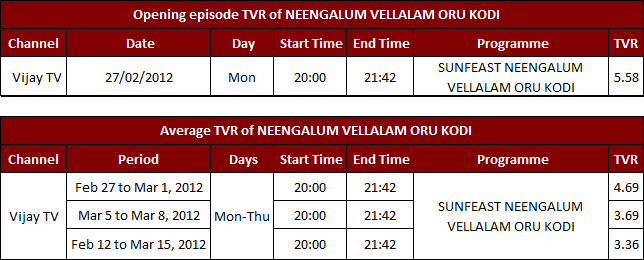
    In fact its counterpart, Neengalum Vellalam Oru Kodi which made its debut on Star Vijay managed a TVR of 5.58 on its opening day and since then has been on a decline with average TVR from Feb 27 to March 1 being 4.69, 3.69 (March 5-8) and 3.36 (Feb 12-March 15).


    Puneeth Rajkumar who comes from the first family of Kannada cinema is hosting Kannadada Kotyadhipathi whereas Suriya is hosting Neengalum Vellalam Oru Kodi.


    Anup Chandrasekharan, Business Head Suvarna Channel commented, “We are very happy with the initial response of Kannadada Kotyadhipathi, we have got a lot of positive feedback about the show from our viewers. This show is also made us the leader in week day prime time. We hope we are able to sustain the initial ratings.”


    On its comparison with Hindi KBC he added, “It is not correct to compare the two shows in terms of ratings as they belong to different markets, KBC is analyzed in the Hindi Speaking Markets (HSM) & Kotyadhipathi is analyzed in the Karnataka Market.”


    In the past, KBC was aired in Bhojpuri on Mahuaa TV as Ke Bani Crorepati with Shatrughan Sinha as its host and in Bengali as Ke Hobey Banglar Kotipoti hosted by Sourav Ganguly on Mahuaa Bangla. Both the shows did not garner much in terms of numbers. Bangla KBC averaged TVR of 2.29 (period June 6 to August 12, 2011), the Bhojpuri version saw an average TVR of just 0.45 (period June 6 to August 12, 2011). (Data source TAM).


    So it remains to be seen if KBC in Kannada will do the magic and retain its high ratings in the weeks to come.


    Source: TAM Peoplemeter System
    TG: CS 4+ yrs
    Market: Karnataka
    Period: Wk 11: Mar 11 to 17, 2012


    Source: TAM Peoplemeter System
    TG: CS 4+ yrs
    Market: Tamil Nadu
    Period: Wk 9 to 11: Feb 26 to Mar 17, 2012